



Three-Dimensional Collision Dynamics Model of High-Speed Train Considering Vehicle-End Contact and Coupler Instability
-
摘要:
为有效表征高速列车碰撞过程中车端接触与车钩失稳力学响应,建立一种适用于薄壁结构纵向冲击的接触力计算方法,该方法考虑车辆错位对接触力及接触力矩的影响,构建针对不同制式钩缓装置在压溃行程结束后的载荷特征表征方法;基于上述2种方法形成一种考虑车端接触与车钩失稳的列车三维碰撞动力学模型;对比2种工况下动力学模型与有限元模型的计算结果. 研究结果表明:所提车端接触力计算方法能较好反映不同薄壁结构在不同冲击速度下的接触力响应,与有限元结果最大相对误差为9.83%;钩缓装置载荷特征表征方法能有效区分不同制式车钩压溃后的载荷特性;所构建的列车三维碰撞动力学模型在车辆速度响应、碰撞界面力响应、车体垂向响应等关键指标上,与有限元计算结果吻合良好.
Abstract:In order to effectively characterize the mechanical response of vehicle-end contact and coupler instability during high-speed train collisions, a contact force calculation method for the longitudinal impact of a thin-walled structure was established, which considered the impact of vehicle misalignment on contact force and contact moment. Characterization methods for the load characteristics of different coupler-buffer devices after the crushing stroke were then established. Finally, based on these two methods, a three-dimensional (3d) train collision dynamics model was constructed considering the vehicle-end contact and coupler instability. The dynamics model results were compared with those from the finite element model (FEM) under two working conditions. The results show that the proposed method can better reflect the contact force responses of different thin-wall structures at different impact speeds, with a maximum relative error of 9.83% compared to the finite element results. The characterization method can effectively distinguish the post-crushing load characteristics of different types of coupler-buffer devices. The developed 3D collision dynamics model is in good agreement with the finite element calculation results in key indicators such as vehicle speed responses, collision interface force responses, and vertical responses of the carbody.
-
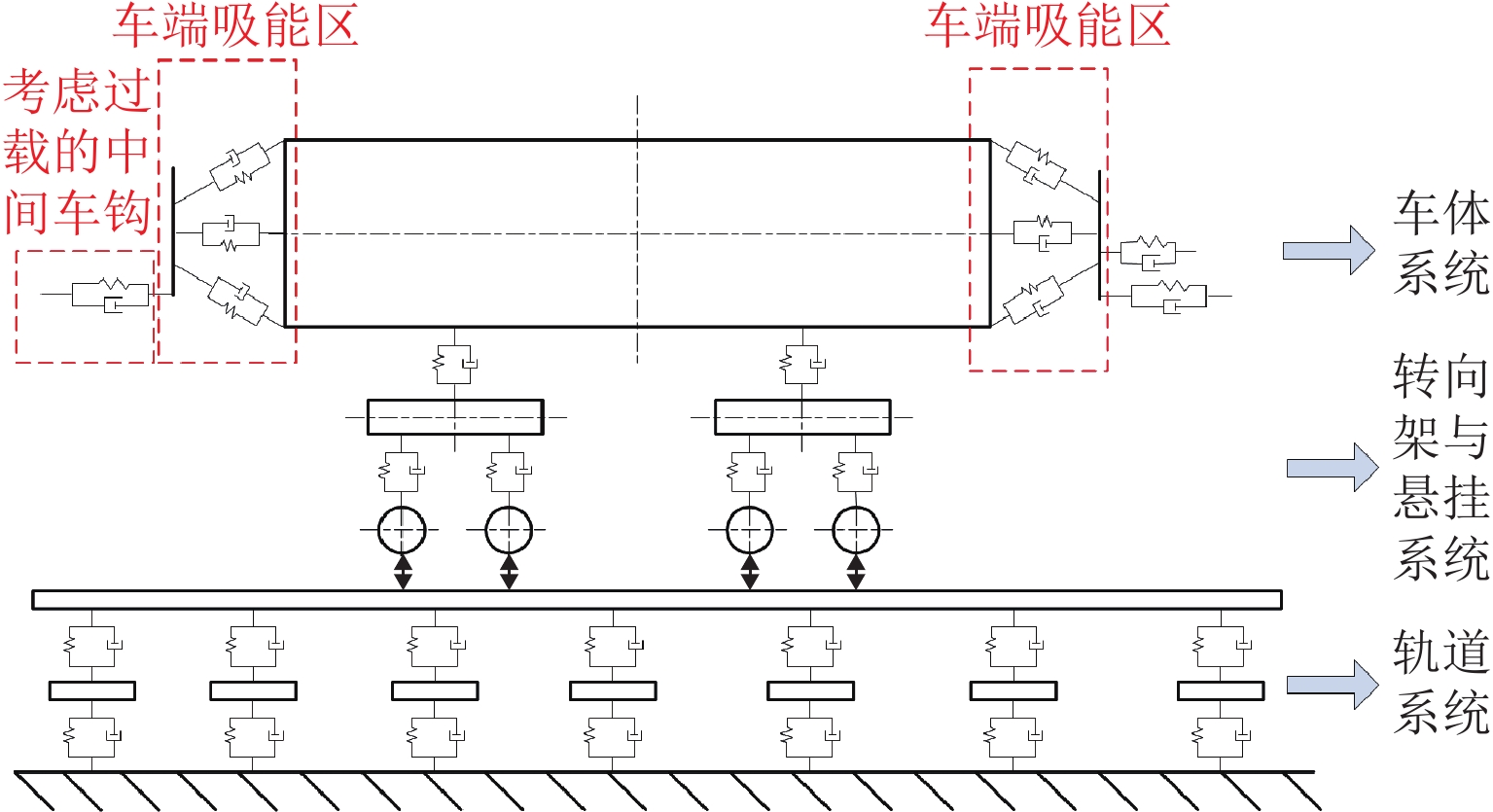
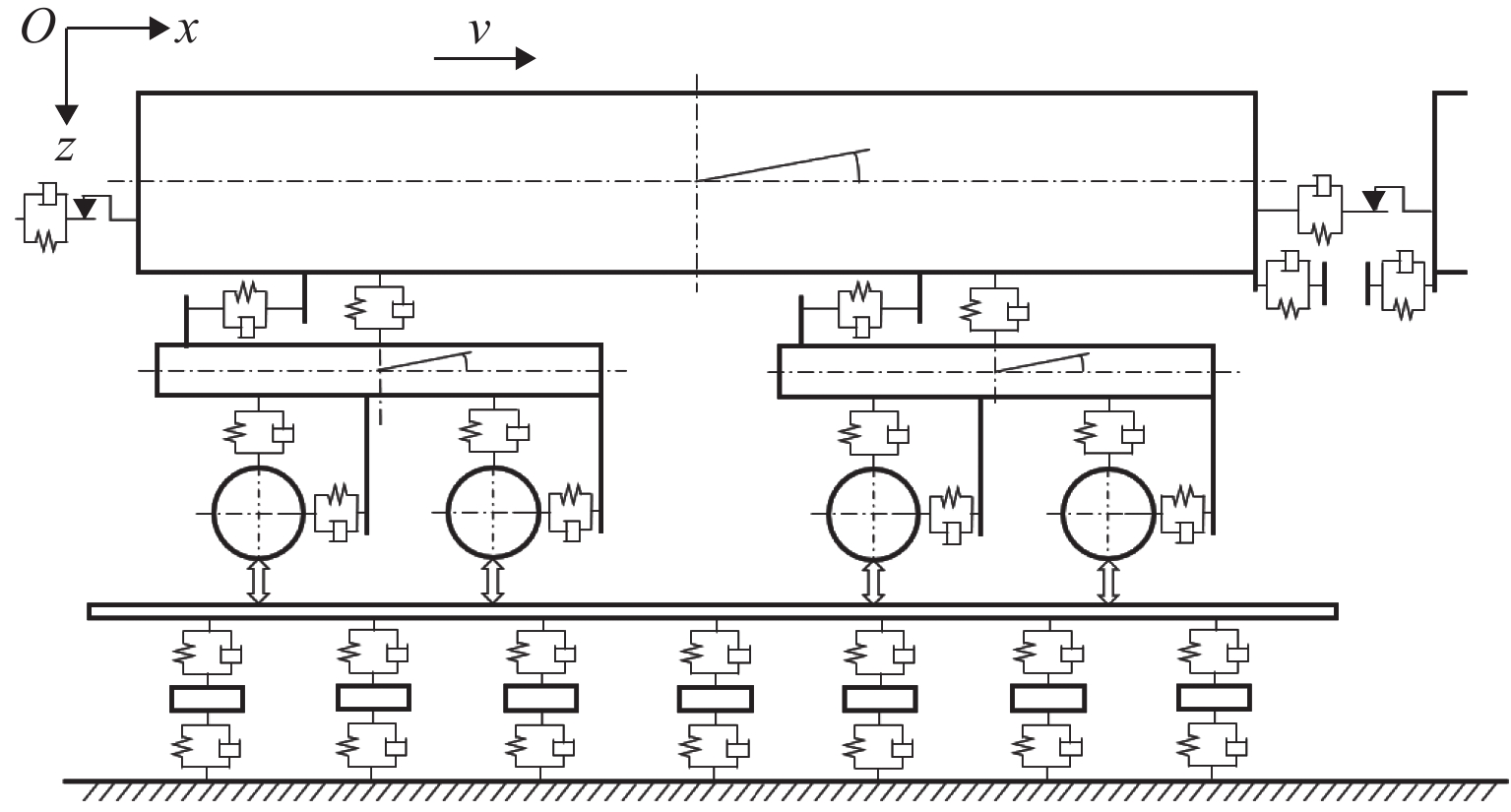
图 2 考虑车端接触力的列车碰撞动力学模型主视图
Figure 2. Front view of train collision dynamics model by considering vehicle-end contact force
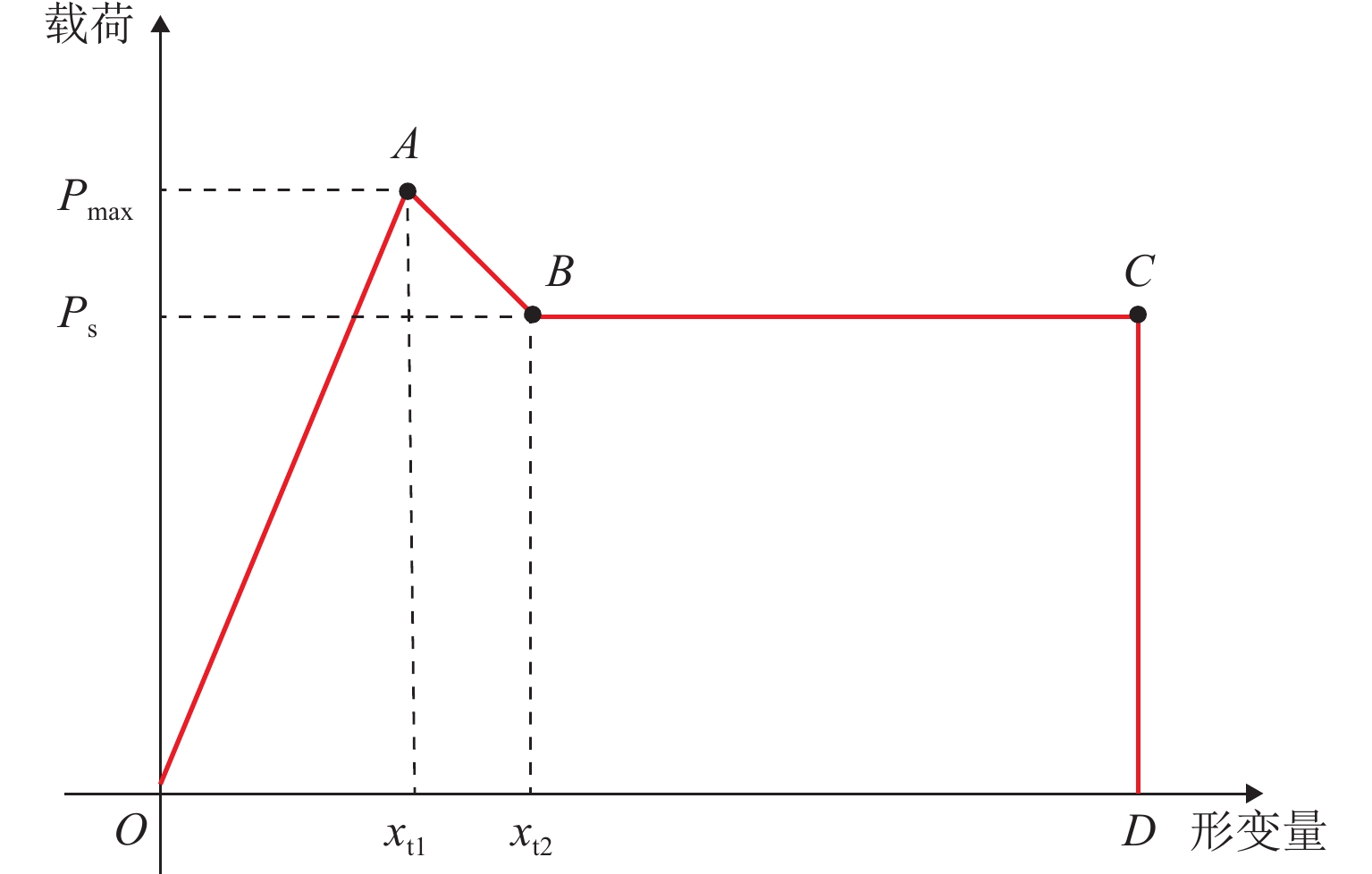
图 3 薄壁结构受纵向冲击响应特征
Figure 3. Longitudinal impact response characteristics of thin-walled structures
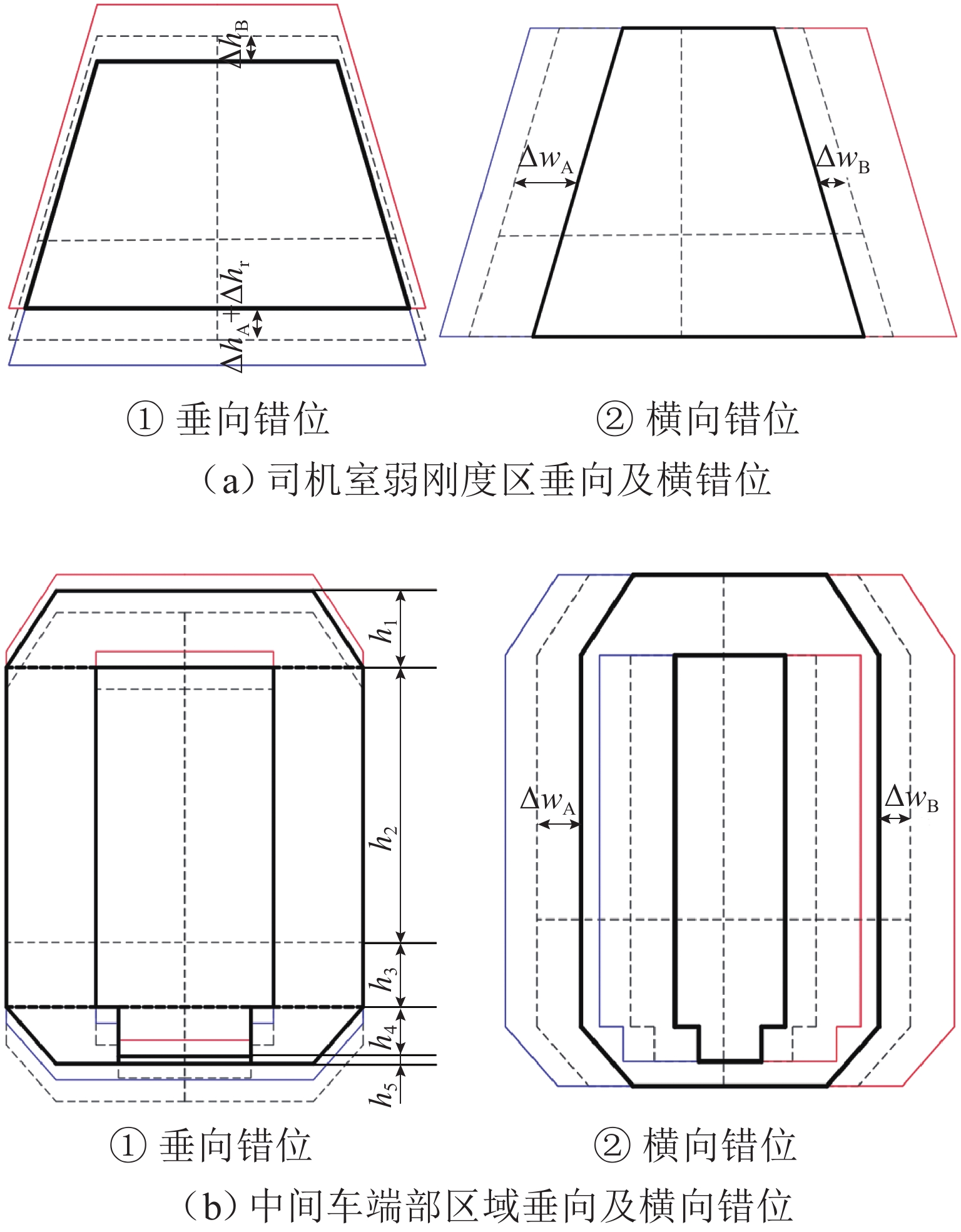
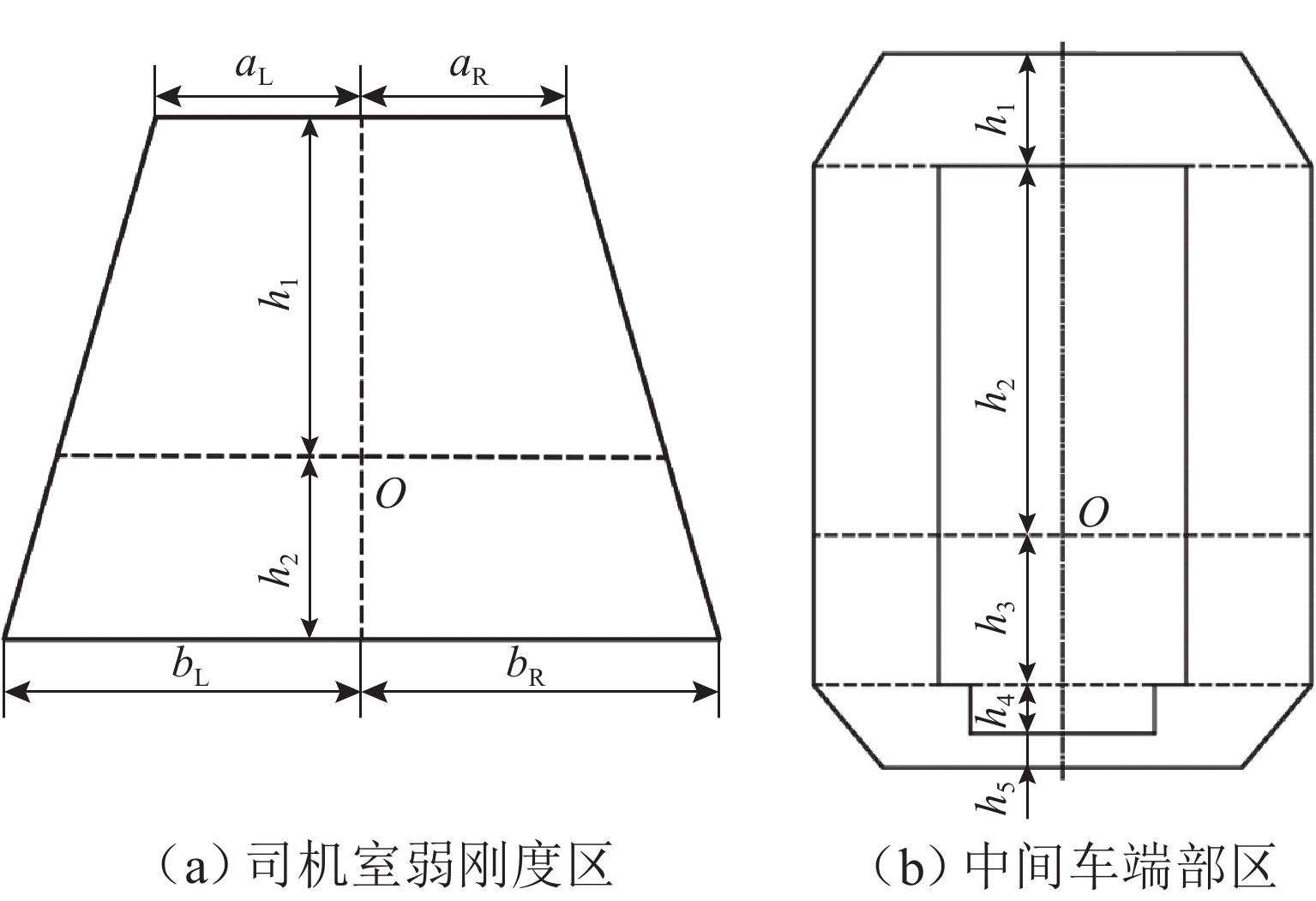
图 5 车辆端部区域错位几何特征示意
Figure 5. Geometric characteristics of misalignment at vehicle ends
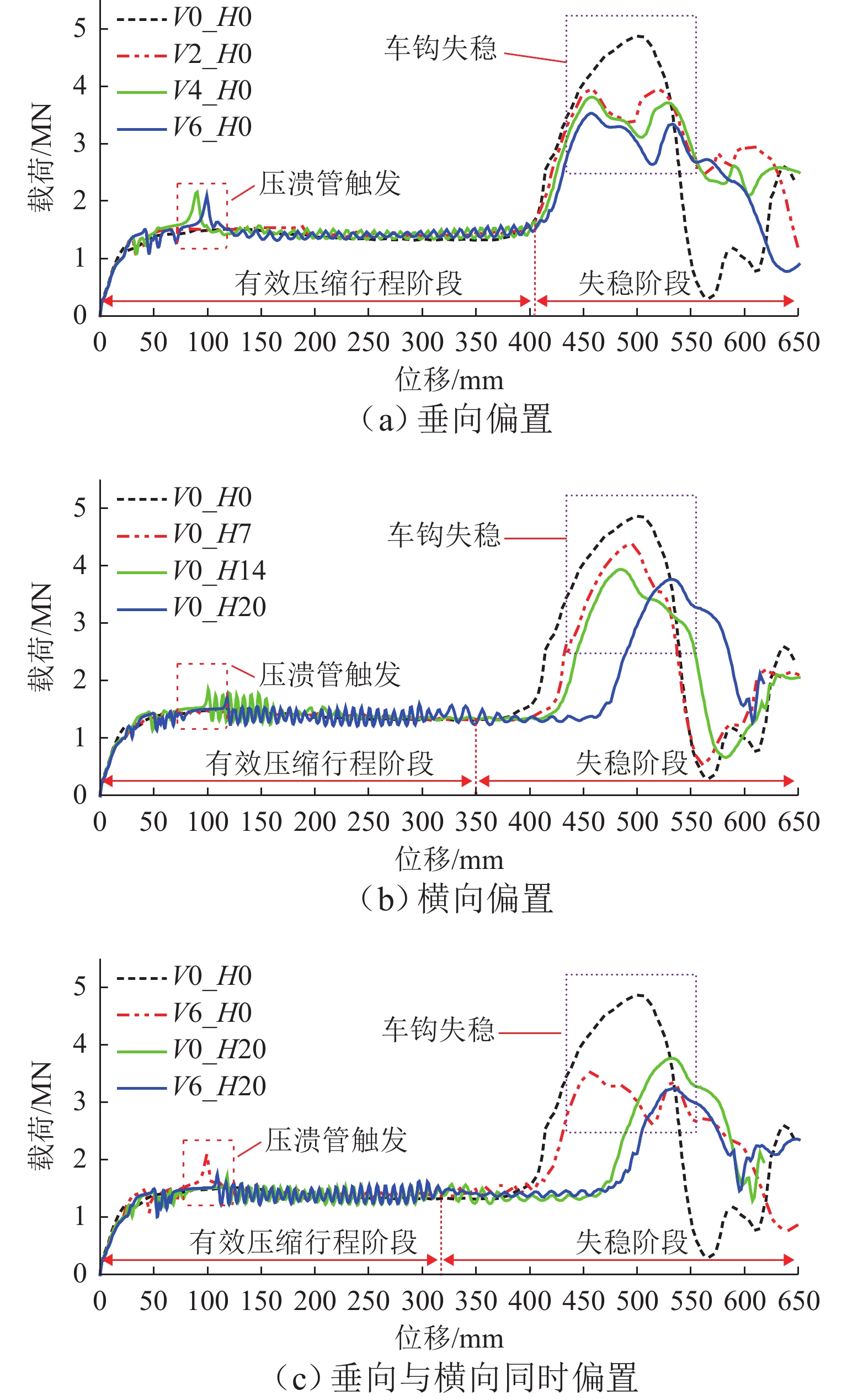
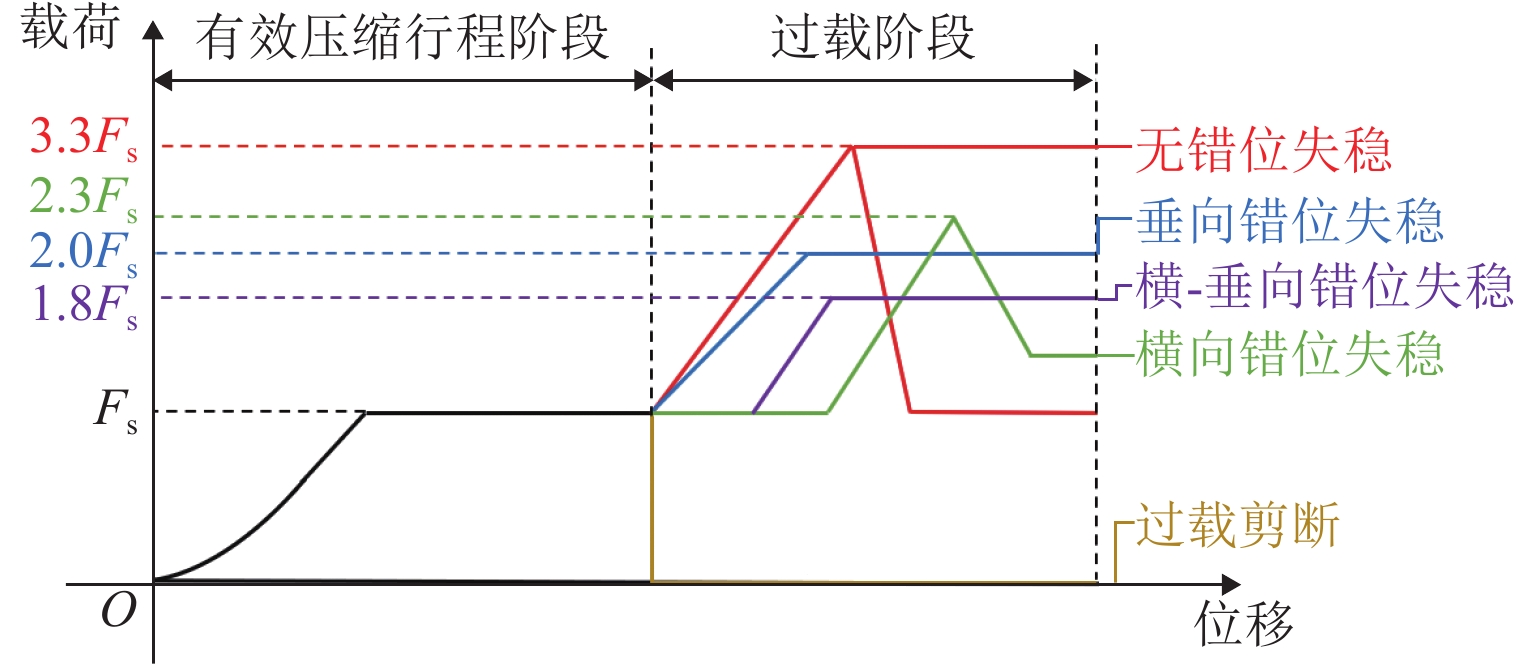
图 6 中间车钩在不同状态下的过载失稳特性
Figure 6. Overload-induced instability characteristics of intermediate coupler in different states[25]

图 10 有限元与动力学模型的速度响应对比
Figure 10. Comparison of velocity responses between the FEM and dynamics model

图 11 有限元与动力学模型的车端接触力响应对比
Figure 11. Comparison of vehicle-end contact force responses between the FEM and dynamics models

图 12 有限元与动力学模型的车体垂向响应对比
Figure 12. Comparison of carbody’s vertical responses between the FEM and dynamics models

图 13 有限元与动力学模型的速度响应对比
Figure 13. Comparison of velocity responses between the FEM and dynamics models

图 14 有限元与动力学模型的车钩力响应对比
Figure 14. Comparison of coupler force responses between the FEM and dynamics models

图 15 有限元与动力学模型的车端接触力响应对比
Figure 15. Comparison of vehicle-end contact force responses between the FEM and dynamics models
表 1 公式计算与数值计算结果对比
Table 1. Comparison of formula and numerical calculation results
结果 λ η 结构 1 结构 2 结构 1 结构 2 公式计算 0.166 0.333 0.673 0.979 数值计算 0.175 0.361 0.714 0.993 相对误差/% 5.14 7.76 5.74 1.41  下载: 导出CSV
-
[1] LIN C Y, RAPIK SAAT M, BARKAN C P. Quantitative causal analysis of mainline passenger train accidents in the United States[J]. Proceedings of the Institution of Mechanical Engineers, Part F: Journal of Rail and Rapid Transit, 2020, 234(8): 869-884. doi: 10.1177/0954409719876128 [2] ZHU T, XIAO S, LEI C, et al. Rail vehicle crashworthiness based on collision energy management: an overview[J]. International Journal of Rail Transportation, 2021, 9(2): 101-131. doi: 10.1080/23248378.2020.1777908 [3] YU Y, GAO G J, GUAN W Y, et al. Scale similitude rules with acceleration consistency for trains collision[J]. Proceedings of the Institution of Mechanical Engineers, Part F: Journal of Rail and Rapid Transit, 2018, 232(10): 2466-2480. doi: 10.1177/0954409718773562 [4] 许平, 瞿成举, 姚曙光, 等. 带方锥式吸能结构单节列车碰撞力学行为[J]. 中南大学学报(自然科学版), 2022, 53(5): 1889-1903. doi: 10.11817/j.issn.1672-7207.2022.05.033XU Ping, QU Chengju, YAO Shuguang, et al. Crash mechanics behavior of single-carriage train with square cone energy-absorbing structure[J]. Journal of Central South University (Science and Technology), 2022, 53(5): 1889-1903. doi: 10.11817/j.issn.1672-7207.2022.05.033 [5] 丁浩谞, 朱涛, 肖守讷, 等. SUS301L-MT不锈钢失效行为表征[J]. 机械工程学报, 2023, 59(8): 99-110. doi: 10.3901/JME.2023.08.099DING Haoxu, ZHU Tao, XIAO Shoune, et al. Characterization of failure behaviour of SUS301L-MT stainless steel[J]. Journal of Mechanical Engineering, 2023, 59(8): 99-110. doi: 10.3901/JME.2023.08.099 [6] 刘文, 张乐乐, 茹一帆. 基于损伤演化模型的高速列车侧墙碰撞失效分析[J]. 中南大学学报(自然科学版), 2022, 53(5): 1834-1842. doi: 10.11817/j.issn.1672-7207.2022.05.028LIU Wen, ZHANG Lele, RU Yifan. Failure analysis of high-speed train sidewall collision based on damage evolution model[J]. Journal of Central South University (Science and Technology), 2022, 53(5): 1834-1842. doi: 10.11817/j.issn.1672-7207.2022.05.028 [7] 许平, 郭维年, 于洋洋, 等. 地铁列车碰撞姿态辅助保护装置的设计与优化[J]. 中南大学学报(自然科学版), 2023, 54(10): 4171-4188. doi: 10.11817/j.issn.1672-7207.2023.10.034XU Ping, GUO Weinian, YU Yangyang, et al. Design and optimization of auxiliary protection device for subway train collision attitude[J]. Journal of Central South University (Science and Technology), 2023, 54(10): 4171-4188. doi: 10.11817/j.issn.1672-7207.2023.10.034 [8] 袁成标. 基于列车碰撞动力学的纵向碰撞建模及能量管理研究[D]. 成都: 西南交通大学, 2018: 17–34. [9] 张敬科, 朱涛, 王小瑞, 等. 列车一维碰撞能量管理的综合评价模型[J]. 西南交通大学学报, 2021, 56(6): 1329-1336.ZHANG Jingke, ZHU Tao, WANG Xiaorui, et al. Comprehensive evaluation model for one-dimensional crash energy management of trains[J]. Journal of Southwest Jiaotong University, 2021, 56(6): 1329-1336. [10] 吕天一, 肖守讷, 朱涛, 等. 列车端部吸能装置稳态阻抗力优化设计[J]. 铁道学报, 2023, 45(1): 28-34. doi: 10.3969/j.issn.1001-8360.2023.01.004LÜ Tianyi, XIAO Shoune, ZHU Tao, et al. Optimal design of steady-state impedance force of train end energy absorbing device[J]. Journal of the China Railway Society, 2023, 45(1): 28-34. doi: 10.3969/j.issn.1001-8360.2023.01.004 [11] DIAS J P, PEREIRA M S. Analysis and design for train crashworthiness using multibody models[J]. Vehicle System Dynamics, 2004, 40: 107-120. [12] LING L, GUAN Q H, DHANASEKAR M, et al. Dynamic simulation of train–truck collision at level crossings[J]. Vehicle System Dynamics, 2017, 55(1): 1-22. doi: 10.1080/00423114.2016.1240811 [13] 周和超, 詹军, 张超, 等. 有轨电车平交道口碰撞仿真[J]. 机械工程学报, 2018, 54(8): 35-40. doi: 10.3901/JME.2018.08.035ZHOU Hechao, ZHAN Jun, ZHANG Chao, et al. Simulation of the city tram collision at the level crossing[J]. Journal of Mechanical Engineering, 2018, 54(8): 35-40. doi: 10.3901/JME.2018.08.035 [14] ZHANG H H, PENG Y, HOU L, et al. Multistage impact energy distribution for whole vehicles in high-speed train collisions: modeling and solution methodology[J]. IEEE Transactions on Industrial Informatics, 2020, 16(4): 2486-2499. doi: 10.1109/TII.2019.2936048 [15] HOU L, PENG Y, SUN D. Dynamic analysis of railway vehicle derailment mechanism in train-to-train collision accidents[J]. Proceedings of the Institution of Mechanical Engineers, Part F: Journal of Rail and Rapid Transit, 2021, 235(8): 1022-1034. doi: 10.1177/0954409720959870 [16] 肖守讷, 张志新, 阳光武, 等. 列车碰撞仿真中钩缓装置模拟方法[J]. 西南交通大学学报, 2014, 49(5): 831-836. doi: 10.3969/j.issn.0258-2724.2014.05.014XIAO Shoune, ZHANG Zhixin, YANG Guangwu, et al. Simulation method for couplers and buffers in train collision calculations[J]. Journal of Southwest Jiaotong University, 2014, 49(5): 831-836. doi: 10.3969/j.issn.0258-2724.2014.05.014 [17] ZHU T, YANG B Z, YANG C, et al. The mechanism for the coupler and draft gear and its influence on safety during a train collision[J]. Vehicle System Dynamics, 2018, 56(9): 1375-1393. doi: 10.1080/00423114.2017.1413198 [18] DING H X, ZHU T, XIAO S, et al. Study on the collision characteristics of a subway coupler[J]. International Journal of Crashworthiness, 2023, 28(4): 537-551. doi: 10.1080/13588265.2022.2109817 [19] 吕天一. 基于碰撞动力学的列车碰撞脱轨行为研究[D]. 成都: 西南交通大学, 2022: 12-19. [20] 杨超. 列车碰撞动力学关键问题研究[D]. 成都: 西南交通大学, 2016: 57-72. [21] LUO L Z, NAHON M. Development and validation of geometry-based compliant contact models[J]. Journal of Computational and Nonlinear Dynamics, 2011, 6(1): 011004. doi: 10.1115/1.4002090 [22] DENG G X, PENG Y, HOU L, et al. A novel simplified FE rail vehicle model in longitudinal and lateral collisions[J]. Machines, 2022, 10(12): 1214. doi: 10.3390/machines10121214 [23] XU P, YANG C X, PENG Y, et al. Crash performance and multi-objective optimization of a gradual energy-absorbing structure for subway vehicles[J]. International Journal of Mechanical Sciences, 2016, 107: 1-12. doi: 10.1016/j.ijmecsci.2016.01.001 [24] LI Z Z, ZHU T, XIAO S. Study on the frontal collision safety of trains based on collision dynamics[J]. Applied Sciences, 2023, 13(19): 10805. doi: 10.3390/app131910805 [25] ZHANG J K, ZHU T, YANG B, et al. Collision characteristics of the intermediate coupler of a rail vehicle[J]. Vehicle System Dynamics, 2023, 61(12): 3089-3110. doi: 10.1080/00423114.2022.2157740 [26] ZHANG J K, ZHU T, YANG B, et al. A rigid–flexible coupling finite element model of coupler for analyzing train instability behavior during collision[J]. Railway Engineering Science, 2023, 31(4): 325-339. doi: 10.1007/s40534-023-00308-2 -

 下载:
下载:


 点击查看大图
计量
- 文章访问数: 333
- HTML全文浏览量: 233
- PDF下载量: 35
- 被引次数: 0