



Effect of Plateau Railway Special Meteorological Environment on Tunnel Aerodynamic Drag of Electric Multiple Unit Train
-
摘要:
为研究高原铁路温度与气压条件变化对动车组隧道气动阻力的影响,通过调研某高原铁路雅安至林芝段各站点气象数据,建立了高原铁路特殊高原气象条件下动车组列车隧道气动阻力的计算模型,分析了高原铁路沿线气压与温度变化对动车组隧道气动阻力的影响. 研究结果表明:动车组列车的隧道气动阻力与线路环境的气压、温度密切相关;环境气压越低,隧道气动阻力越小,环境温度越低,隧道气动阻力越大;与平原地区的气象环境相比,高原铁路沿线气压变化对动车组列车隧道运行阻力的影响能达到30%左右,温度变化对动车组隧道运行阻力的影响在10%左右.
Abstract:The effects of atmospheric pressure and temperature conditions along a plateau railway on the tunnel aerodynamic drag of electric multiple unit (EMU) trains were investigated by collecting and analyzing meteorological data of the Ya’an to Linzhi section of a plateau railway. A numerical model for the prediction of the tunnel aerodynamic drag of EMU trains was established, and the effects of the variations in air pressure and temperature along a plateau railway were analyzed in numerical simulations. The results show that the atmospheric pressure and temperature affect the tunnel aerodynamic drag of EMU trains. A lower atmospheric pressure leads to lower tunnel aerodynamic drag whereas a higher air temperature leads to higher tunnel aerodynamic drag of the EMU train. Compared with the normal meteorological environment of the plains, the variation in the atmospheric pressure along a plateau railway causes an approximately 30% change to the tunnel aerodynamic drag of EMU trains, whereas the effect of the variation in air temperature is around 10%.
-
Key words:
- Plateau railway /
- EMU train /
- tunnel /
- aerodynamic drag /
- meteorological environment
-
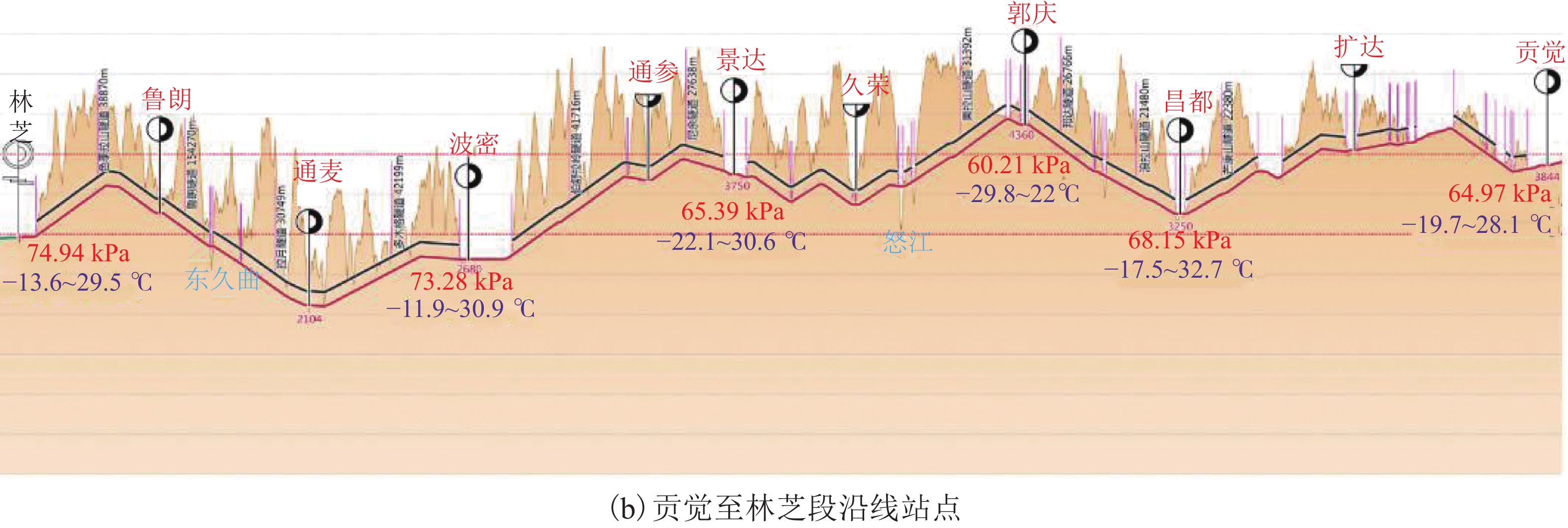
图 1 高原铁路沿线各站点温度与气压条件
Figure 1. Temperature and air pressure condition along the plateau railway
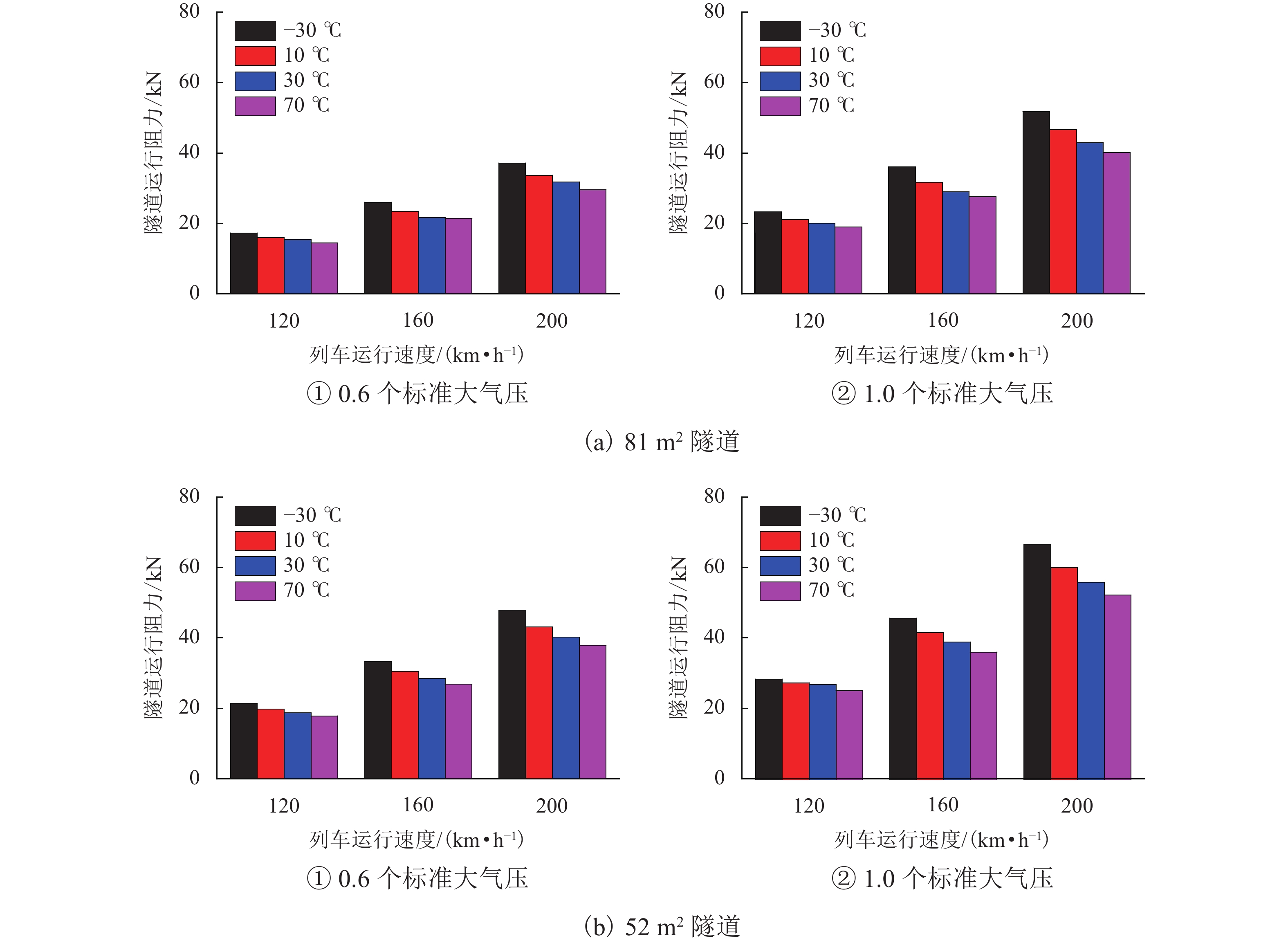
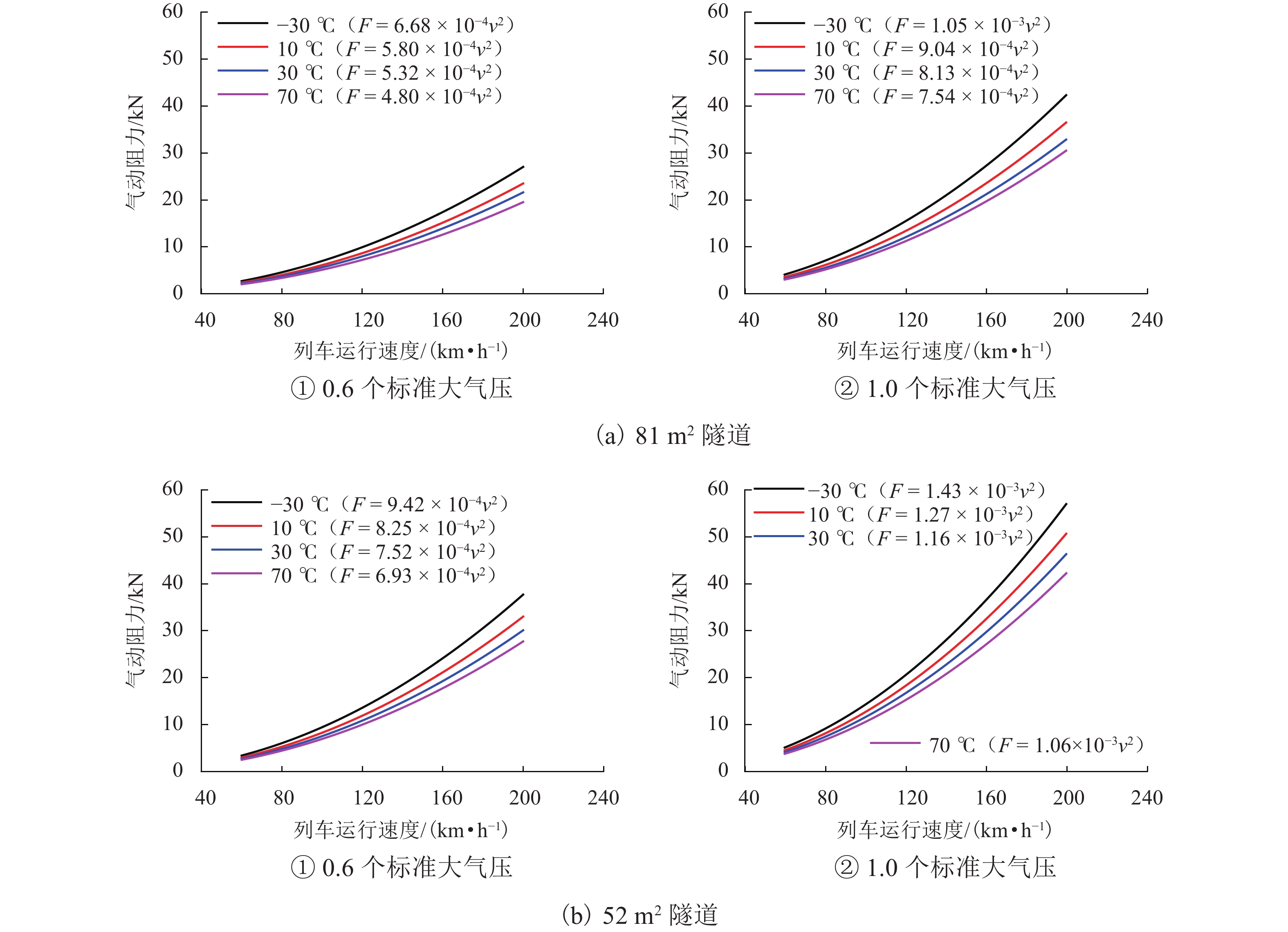
图 6 不同条件下列车隧道运行阻力
Figure 6. Running resistance of train in the tunnel under different conditions
表 1 不同列车速度下气动阻力所占比例
Table 1. The ratio of air resistance at different speeds
速度/(km•h−1) 20 50 100 160 ≥300 气动阻力占比/% 2 15 41 55 75 ~ 95  下载: 导出CSV
表 2 隧道运行阻力变化量
Table 2. The variation of tunnel running resistance
截面面积/m2 气压/Pa 温度/℃ 隧道运行阻力变化量/% 120 km/h 160 km/h 200 km/h 81 60 795 −30 −17.9 −17.7 −20.2 10 −23.9 −25.9 −27.6 30 −27.1 −31.4 −31.7 70 −31.4 −32.2 −36.6 101 325 −30 10.3 13.9 11.2 30 −5.0 −8.4 −7.9 70 −10.0 −12.7 −13.7 52 60 795 −30 −22.4 −20.4 −20.6 10 −28.4 −27.2 −28.6 30 −32.2 −31.8 −33.4 70 −35.2 −35.9 −37.2 101 325 −30 3.8 9.8 10.9 30 −2.0 −6.4 −7.0 70 −8.3 −13.3 −13.1
下载: 导出CSV
-
[1] RAGHUNATHAN R S, KIM H D, SETOGUCHI T. Aerodynamics of high-speed railway train[J]. Progress in Aerospace Sciences, 2002, 38(6/7): 469-514. [2] GUIHEU C. Resistance to forward movement of TGV-PSE trainsets,evaluation of studies and results of measurements[J]. French Railway Review, 1983, 1(1): 13-26. [3] 田红旗. 列车空气动力学[M]. 北京: 中国铁道出版社, 2007. [4] 徐世南,张继业,熊骏,等. 地铁列车通过隧道时的气动性能研究[J]. 城市轨道交通研究,2016,19(9): 99-104.XU Shinan, ZHANG Jiye, XIONG Jun, et al. Aerodynamic performance of metro vehicle passing through tunnels[J]. Urban Mass Transit, 2016, 19(9): 99-104. [5] 冯志鹏,张继业,张卫华. 高速列车在隧道内和明线上交会时气动性能对比分析[J]. 铁道车辆,2010,48(12): 1-5. doi: 10.3969/j.issn.1002-7602.2010.12.001FENG Zhipeng, ZHANG Jiye, ZHANG Weihua. Comparison and analysis of the aerodynamic performance of high speed trains passing by each other inside tunnel and on open track[J]. Railway Vehicle, 2010, 48(12): 1-5. doi: 10.3969/j.issn.1002-7602.2010.12.001 [6] 刘堂红,田红旗,金学松. 隧道空气动力学实车试验研究[J]. 空气动力学学报,2008,26(1): 42-46. doi: 10.3969/j.issn.0258-1825.2008.01.008LIU Tanghong, TIAN Hongqi, JIN Xuesong. Experimental study of full-scale train on aerodynamics in tunnel[J]. Acta Aerodynamica Sinica, 2008, 26(1): 42-46. doi: 10.3969/j.issn.0258-1825.2008.01.008 [7] 中铁第一勘察设计院有限公司. 铁路线路设计规范: TB 10098—2017[S]. 北京: 中国铁道出版社, 2017 [8] 铁道部科学研究院. 列车牵引计算规程: TB/T 1407—1998[S]. 北京: 技术标准出版社, 1998 [9] 黄尊地,梁习锋,常宁. 真空管道交通列车气动阻力数值分析[J]. 机械工程学报,2019,55(8): 165-172. doi: 10.3901/JME.2019.08.165HUANG Zundi, LIANG Xifeng, CHANG Ning. Numerical analysis of train aerodynamic drag of vacuum tube traffic[J]. Journal of Mechanical Engineering, 2019, 55(8): 165-172. doi: 10.3901/JME.2019.08.165 [10] 杨永刚,杜云超,梅元贵. 单列高速列车通过隧道空气阻力特性数值模拟研究[J]. 铁道科学与工程学报,2018,15(11): 2755-2763.YANG Yonggang, DU Yunchao, MEI Yuangui. Numerical simulation of aerodynamic drag of single high-speed train passing through a tunnel[J]. Journal of Railway Science and Engineering, 2018, 15(11): 2755-2763. [11] 王一伟,杨国伟,黄晨光. 高速列车通过隧道时气动阻力特性的CFD仿真分析[J]. 中国铁道科学,2012,33(增刊1): 33-38. doi: 10.3969/j.issn.1001-4632.2012.S1.06WANG Yiwei, YANG Guowei, HUANG Chenguang. CFD Simulation analysis on the aerodynamic drag characteristics of high-speed train running through tunnel[J]. China Railway Science, 2012, 33(S1): 33-38. doi: 10.3969/j.issn.1001-4632.2012.S1.06 [12] 赵士伟,王崇哲,杨健,等. 不同气体状态方程在高原环境下应用的差异分析[J]. 气象水文海洋仪器,2014,31(4): 17-20. doi: 10.3969/j.issn.1006-009X.2014.04.004ZHAO Shiwei, WANG Chongzhe, YANG Jian, et al. Analysis of different gas state equations applied in the altitude environment[J]. Meteorological Hydrological and Marine Instruments, 2014, 31(4): 17-20. doi: 10.3969/j.issn.1006-009X.2014.04.004 [13] 常翔,张献伟. 高速铁路隧道空气动力学效应控制[J]. 隧道建设,2007,27(增刊2): 117-120. doi: 10.3969/j.issn.1672-741X.2007.z2.023CHANG Xiang, ZHANG Xianwei. Study on control of aerodynamic effect in a tunnel of high-speed railway[J]. Tunnel Construction, 2007, 27(S2): 117-120. doi: 10.3969/j.issn.1672-741X.2007.z2.023 [14] SHIH T H, LIOU W W, SHABBIR A, et al. A new k-ε eddy viscosity model for high Reynolds number turbulent flows[J]. Computers & Fluids, 1995, 24(3): 227-238. [15] 康熊,曾宇清,张波. 高速列车空气阻力测量分析方法[J]. 中国铁道科学,2012,33(5): 54-59. doi: 10.3969/j.issn.1001-4632.2012.05.09KANG Xiong, ZENG Yuqing, ZHANG Bo. Measurement method for the air resistance of high speed train[J]. China Railway Science, 2012, 33(5): 54-59. doi: 10.3969/j.issn.1001-4632.2012.05.09 [16] 高翔,周毅,贾冰,等. 动车组隧道附加阻力试验研究[J]. 铁道机车车辆,2018,38(3): 44-46. doi: 10.3969/j.issn.1008-7842.2018.03.10GAO Xiang, ZHOU Yi, JIA Bing, et al. Experimental study of the EMU tunnel additional resistance[J]. Railway Locomotive & Car, 2018, 38(3): 44-46. doi: 10.3969/j.issn.1008-7842.2018.03.10 -

 下载:

 点击查看大图
计量
- 文章访问数: 288
- HTML全文浏览量: 208
- PDF下载量: 24
- 被引次数: 0