



Analysis of Wheel−Rail Frictional Temperature Rise Considering Temperature-Dependent Material Properties and Damage Discontinuities
-
摘要:
在轮轨摩擦温升计算中,材料温变特性和表面裂纹分别会引起材料不连续与几何不连续,而基于连续介质力学的传统解析方法和有限元方法难以处理此类问题. 为此,本文基于非局部近场动力学热传导理论,采用移动热源法表征轮轨接触区的摩擦生热边界,建立二维轮轨摩擦温升分析模型. 首先,在相同计算参数条件下,将所建模型的结果与经典解析方法进行对比分析;在此基础上,分析材料温变特性以及绝热裂纹倾角对钢轨摩擦温升的影响. 结果表明:所建模型与经典解析方法得到的轨面最高温度分别为364.9 ℃和358.7 ℃,相对误差仅为1.7%,验证了模型的合理性与准确性;不考虑材料温变特性时,摩擦温升随蠕滑率线性升高;考虑材料温变特性后,热量更易聚集于轨面附近,表现为表面温度升高、内部温度降低,且该效应在较高蠕滑率下更为明显;在15%蠕滑率工况下,考虑材料温变特性时的局部内部温度甚至低于10%蠕滑率不考虑材料温变特性时的结果;轨面裂纹会显著改变局部热流路径并诱发热量集中,当裂纹倾角为30°时,裂纹附近温度峰值达到
1014.6 ℃,约为无裂纹工况同位置温度的3倍. 研究结果可为复杂条件下轮轨摩擦温升分析提供一种新的数值方法.Abstract:In the calculation of wheel–rail frictional temperature rise, temperature-dependent material properties and surface cracks induce material discontinuities and geometric discontinuities, respectively, which are difficult to handle using traditional analytical and finite element methods based on continuum mechanics. Therefore, based on the nonlocal peridynamic heat conduction theory, a two-dimensional analysis model for wheel–rail frictional temperature rise was established by using a moving heat source method to represent the frictional heat generation boundary in the wheel–rail contact region. First, under identical calculation parameters, the results of the established model were compared with those of the classical analytical method; subsequently, the effects of temperature-dependent material properties and adiabatic crack inclination angle on the rail frictional temperature rise were analyzed. The results indicate that the maximum rail surface temperatures obtained by the established model and the classical analytical method are 364.9 ℃ and 358.7 ℃, respectively, with a relative error of only 1.7%, which verifies the rationality and accuracy of the model. Without considering temperature-dependent material properties, the frictional temperature rise increases linearly with creepage; when considering temperature-dependent material properties, heat more easily accumulates near the rail surface, manifesting as increased surface temperature and decreased internal temperature, and this effect is more pronounced at higher creepage. Under the 15% creepage condition, the local internal temperature when considering temperature-dependent material properties is even lower than that under the 10% creepage condition without considering temperature-dependent material properties. Rail surface cracks significantly alter the local heat flow path and induce heat concentration. When the crack inclination angle is 30°, the peak temperature near the crack reaches 1 014.6 ℃, which is about three times the temperature at the same location in the crack-free condition. The research results provide a new numerical method for analyzing wheel–rail frictional temperature rise under complex conditions.
-
Key words:
- contact temperature rise /
- crack /
- peridynamics /
- heat conduction /
- wheel–rail friction
-
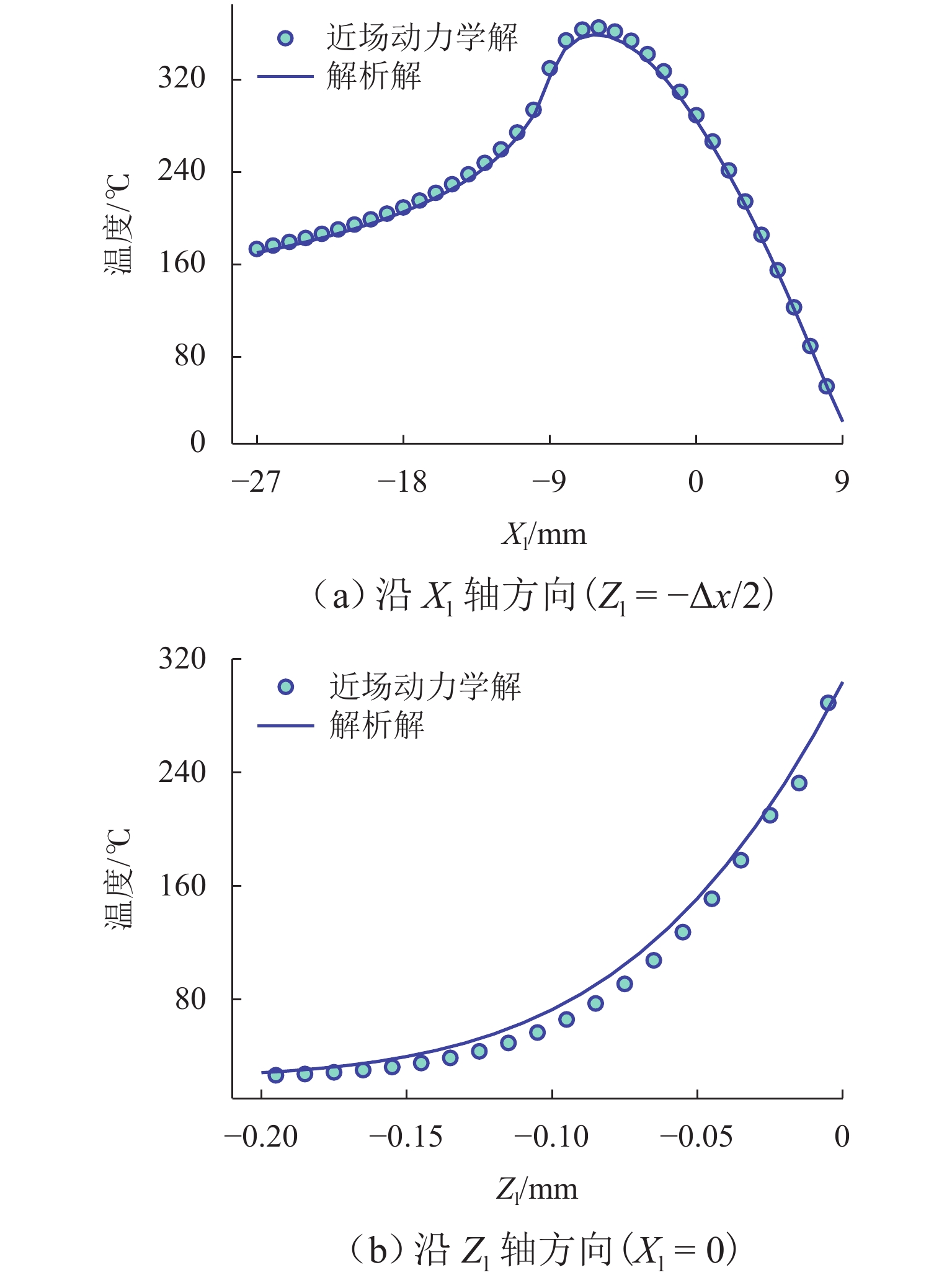
图 6 近场动力学与解析方法计算的钢轨温度对比
Figure 6. Comparison of rail temperatures calculated by peridynamics and analytical method
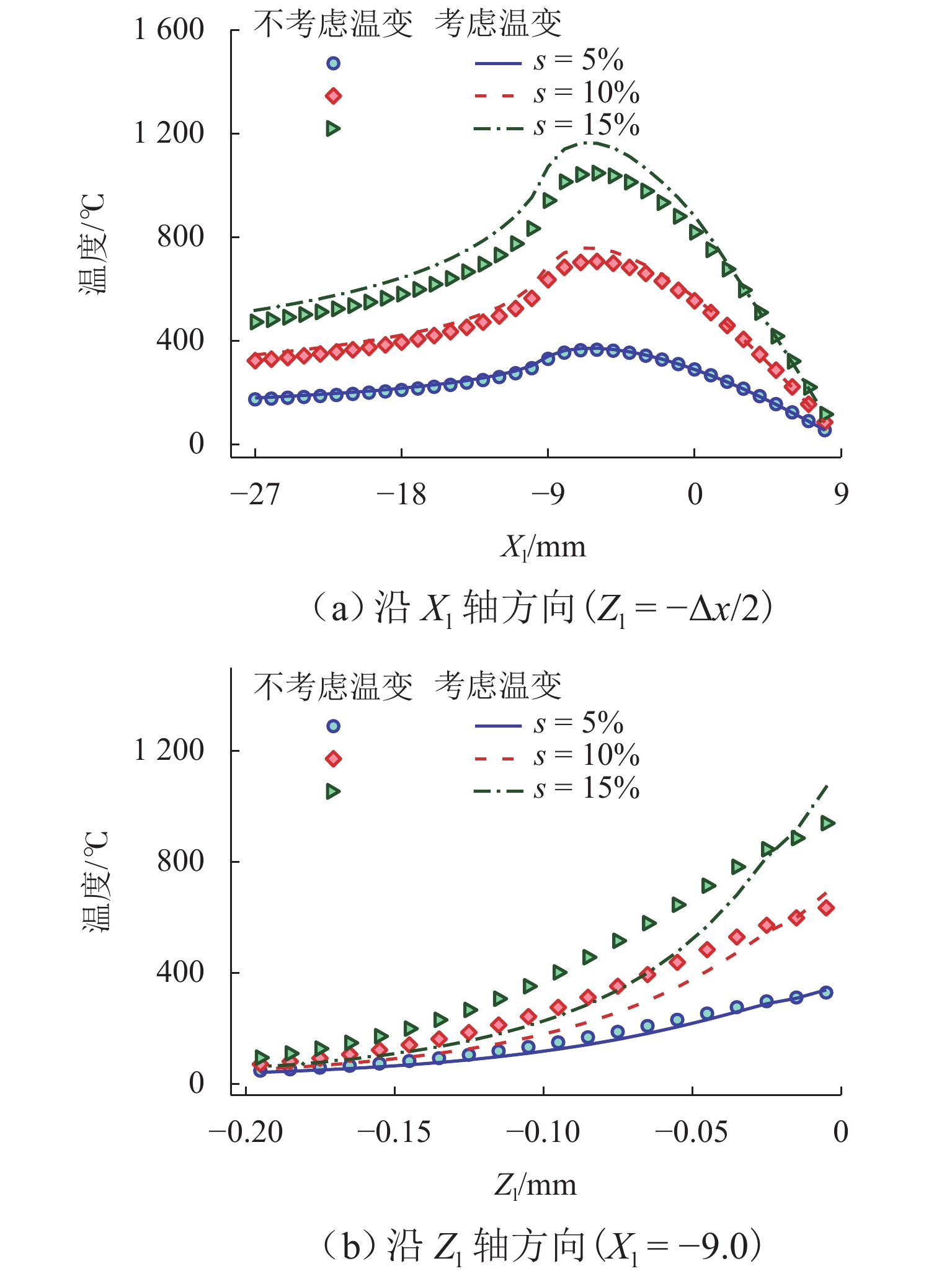
图 7 不同蠕滑率工况下材料温变特性对钢轨表面温度的影响
Figure 7. Effect of temperature-dependent material properties on rail surface temperature under different creepage conditions
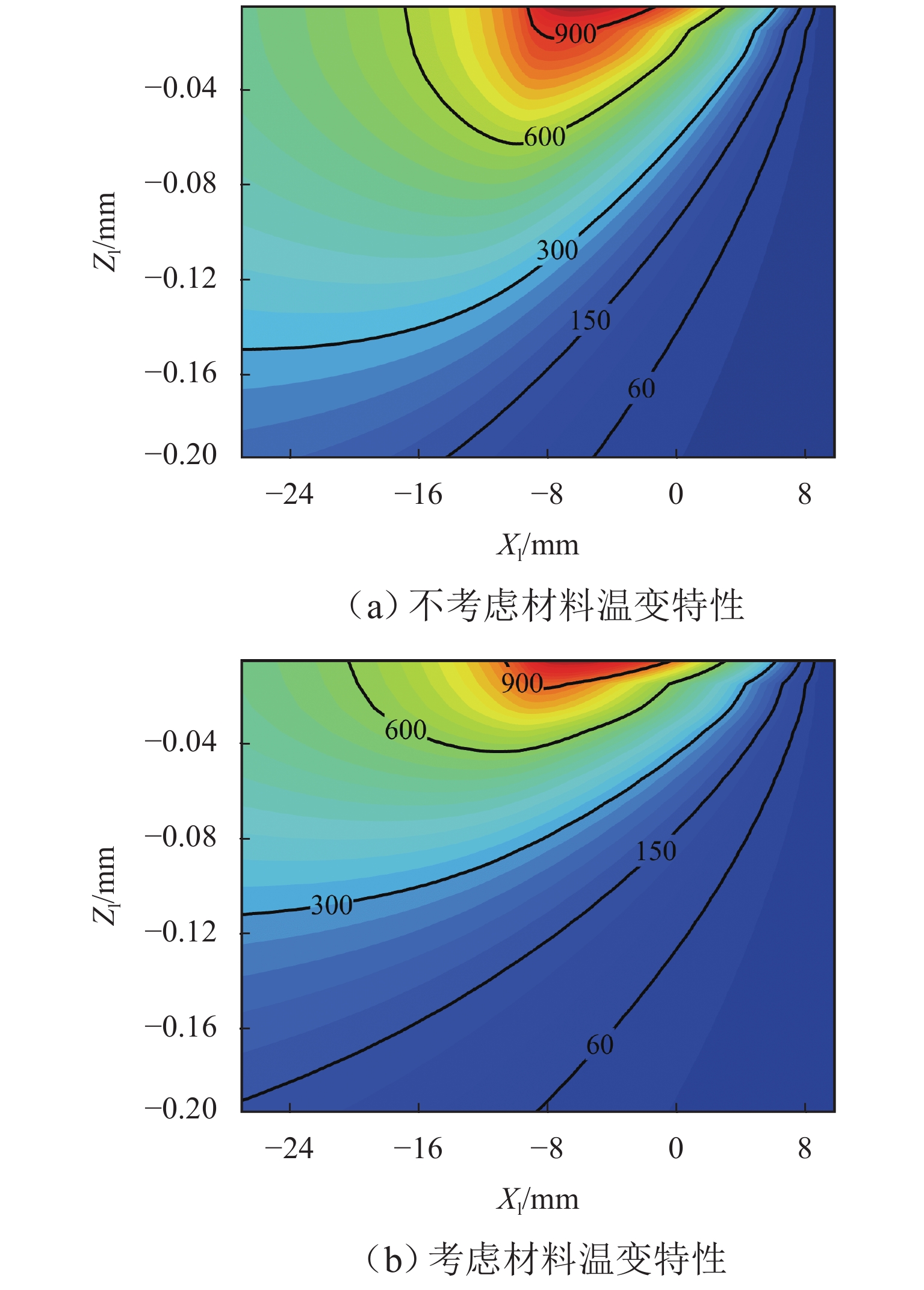
图 8 s = 15%时材料温变特性对钢轨温度分布的影响
Figure 8. Effect of temperature-dependent material properties on rail temperature distribution at s = 15%
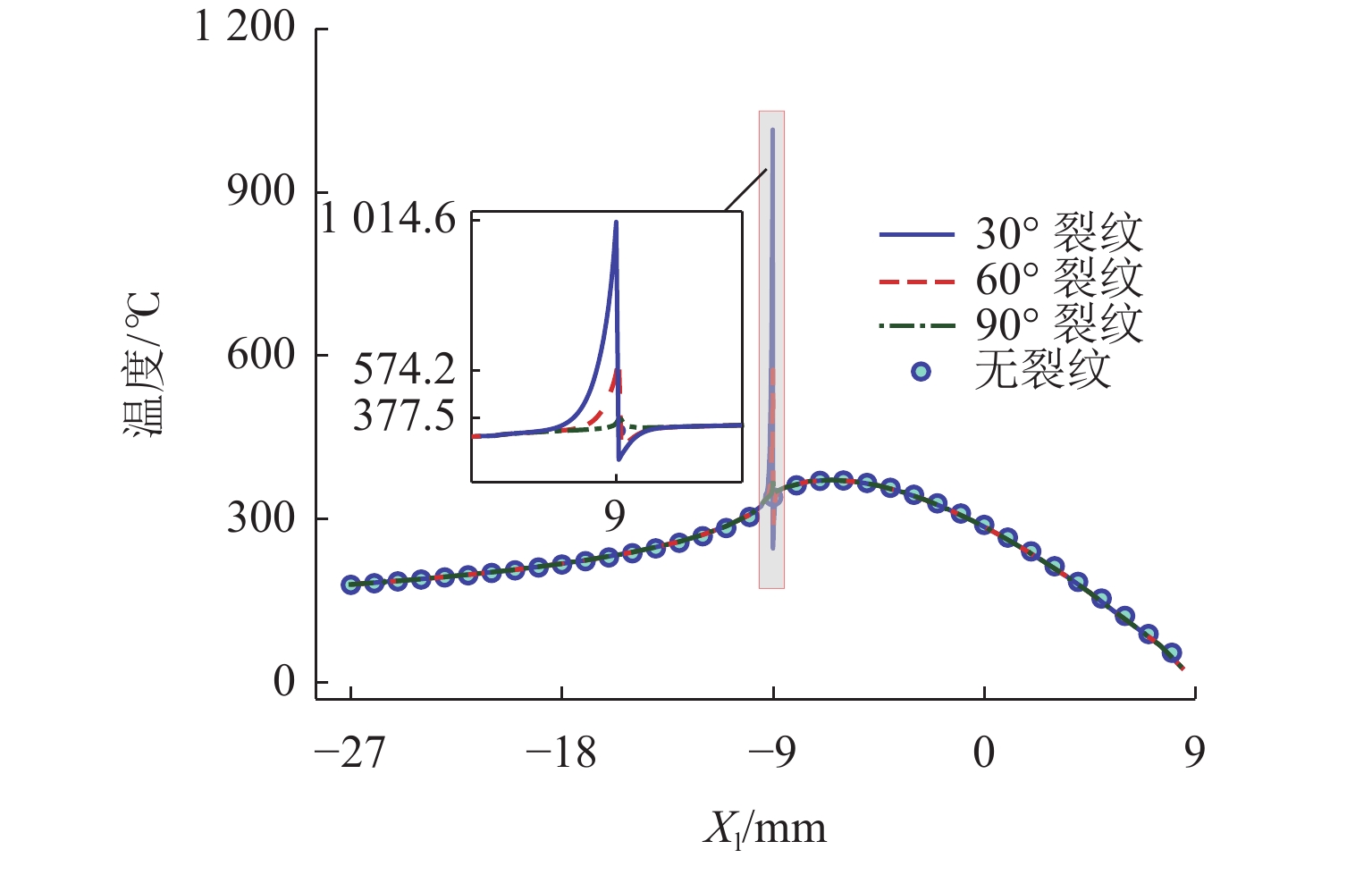
图 9 不同裂纹倾角下钢轨表面温度对比
Figure 9. Comparison of rail surface temperatures under different crack inclination angles

图 10 不同裂纹倾角下钢轨温度云图分布
Figure 10. Distribution of rail temperature contours under different crack inclination angles
表 1 模型计算参数
Table 1. Model calculation parameters
参数 数值 车轮载荷/kN 135 接触斑长半轴/mm 9.0 接触斑横向等效长度/mm 10.3 钢轨密度/(kg•m−3) 7850 钢轨弹性模量/GPa 210 钢轨泊松比 0.3 裂纹长度/mm 1 车速/(km•h−1) 140 摩擦系数 0.3  下载: 导出CSV
表 2 钢轨材料温度相关热传导参数
Table 2. Temperature-dependent heat conduction parameters of rail material
温度/℃ 热传导系数/(W•m−1•℃−1) 比热容/(J•kg−1•℃−1) 0 59.71 419.5 24 58.46 435.9 350 40.88 629.5 703 30.21 744.5 710 30.00 652.9 800 25.00 657.7 950 27.05 665.2 1200 30.46 677.3
下载: 导出CSV
-
[1] WANG X M, DONG W J, HE Q, et al. Nonlocal thermomechanical coupled analysis of wheel-rail contact using a peridynamic model[J]. Wear, 2023, 528: 204954. doi: 10.1016/j.wear.2023.204954 [2] 王平, 张洪吉, 孙耀亮, 等. 考虑材料温变特性的三维轮轨接触热分析[J]. 西南交通大学学报, 2024, 59(2): 239-246, 306. doi: 10.3969/j.issn.0258-2724.20220093WANG Ping, ZHANG Hongji, SUN Yaoliang, et al. Three-dimensional wheel-rail contact thermal analysis considering temperature-dependent material property[J]. Journal of Southwest Jiaotong University, 2024, 59(2): 239-246, 306. doi: 10.3969/j.issn.0258-2724.20220093 [3] ERTZ M, KNOTHE K. A comparison of analytical and numerical methods for the calculation of temperatures in wheel/rail contact[J]. Wear, 2002, 253(3/4): 498-508. doi: 10.1016/s0043-1648(02)00120-5 [4] 杨新文, 顾少杰, 周顺华, 等. 30 t轴重重载铁路轮轨滑动接触引起的钢轨热相变分析[J]. 铁道学报, 2016, 38(7): 84-90. doi: 10.3969/j.issn.1001-8360.2016.07.012YANG Xinwen, GU Shaojie, ZHOU Shunhua, et al. Analysis of rail thermal phase transformation due to wheel-rail sliding contact for heavy-haul railway with 30 t axle-load[J]. Journal of the China Railway Society, 2016, 38(7): 84-90. doi: 10.3969/j.issn.1001-8360.2016.07.012 [5] 伏培林, 丁立, 赵吉中, 等. 考虑材料温度相关性的二维轮轨弹塑性滑动接触温升分析[J]. 力学学报, 2020, 52(5): 1245-1254.FU Peilin, DING Li, ZHAO Jizhong, et al. Frictional temperature analysis of two-dimensional elasto-plastic wheel-rail sliding contact with temperature-dependent material properties[J]. Chinese Journal of Theoretical and Applied Mechanics, 2020, 52(5): 1245-1254. [6] 赵鑫, 金学松, 温泽峰, 等. 全滑动状态下轮轨接触热弹性应力[J]. 西南交通大学学报, 2008, 43(1): 51-56. doi: 10.3969/j.issn.0258-2724.2008.01.010ZHAO Xin, JIN Xuesong, WEN Zefeng, et al. Thermoelastic stresses due to wheel-rail contact in pure sliding state[J]. Journal of Southwest Jiaotong University, 2008, 43(1): 51-56. doi: 10.3969/j.issn.0258-2724.2008.01.010 [7] 赵鑫, 温泽峰, 金学松. 轮轨滚动摩擦温升分析[J]. 摩擦学学报, 2005, 25(4): 358-363.ZHAO Xin, WEN Zefeng, JIN Xuesong. Coupling analysis of wheel/rail frictional temperature[J]. Tribology, 2005, 25(4): 358-363. [8] 赵鑫, 温泽峰, 金学松. 表面不平顺对轮轨摩擦温度场的影响[J]. 交通运输工程学报, 2005, 5(2): 19-22. doi: 10.3321/j.issn:1671-1637.2005.02.005ZHAO Xin, WEN Zefeng, JIN Xuesong. Uneven surface effect on temperature distribution of wheel and rail contact[J]. Journal of Traffic and Transportation Engineering, 2005, 5(2): 19-22. doi: 10.3321/j.issn:1671-1637.2005.02.005 [9] 吴磊, 温泽峰, 金学松. 轮轨摩擦温升有限元分析[J]. 铁道学报, 2008, 30(3): 19-25. doi: 10.3321/j.issn:1001-8360.2008.03.004WU Lei, WEN Zefeng, JIN Xuesong. Finite element analysis of wheel-rail frictional temperature rise[J]. Journal of the China Railway Society, 2008, 30(3): 19-25. doi: 10.3321/j.issn:1001-8360.2008.03.004 [10] WU Y P, WEI Y P, LIU Y, et al. 3-D analysis of thermal-mechanical behavior of wheel/rail sliding contact considering temperature characteristics of materials[J]. Applied Thermal Engineering, 2017, 115: 455-462. doi: 10.1016/j.applthermaleng.2016.12.136 [11] NAEIMI M, LI S G, LI Z L, et al. Thermomechanical analysis of the wheel-rail contact using a coupled modelling procedure[J]. Tribology International, 2018, 117: 250-260. doi: 10.1016/j.triboint.2017.09.010 [12] LIAN Q L, DENG G Y, TIEU A K, et al. Thermo-mechanical coupled finite element analysis of rolling contact fatigue and wear properties of a rail steel under different slip ratios[J]. Tribology International, 2020, 141: 105943. doi: 10.1016/j.triboint.2019.105943 [13] SILLING S A. Reformulation of elasticity theory for discontinuities and long-range forces[J]. Journal of the Mechanics and Physics of Solids, 2000, 48(1): 175-209. doi: 10.1016/S0022-5096(99)00029-0 [14] SILLING S A, EPTON M, WECKNER O, et al. Peridynamic states and constitutive modeling[J]. Journal of Elasticity, 2007, 88(2): 151-184. doi: 10.1007/s10659-007-9125-1 [15] BOBARU F, DUANGPANYA M. The peridynamic formulation for transient heat conduction[J]. International Journal of Heat and Mass Transfer, 2010, 53(19/20): 4047-4059. doi: 10.1016/j.ijheatmasstransfer.2010.05.024 [16] OTERKUS S, MADENCI E, AGWAI A. Peridynamic thermal diffusion[J]. Journal of Computational Physics, 2014, 265: 71-96. doi: 10.1016/j.jcp.2014.01.027 [17] KILIC B, MADENCI E. Peridynamic theory for thermomechanical analysis[J]. IEEE Transactions on Advanced Packaging, 2010, 33(1): 97-105. doi: 10.1109/TADVP.2009.2029079 [18] OTERKUS S, MADENCI E, AGWAI A. Fully coupled peridynamic thermomechanics[J]. Journal of the Mechanics and Physics of Solids, 2014, 64: 1-23. [19] LI Z Y, HUANG D, XU Y P, et al. Nonlocal steady-state thermoelastic analysis of functionally graded materials by using peridynamic differential operator[J]. Applied Mathematical Modelling, 2021, 93: 294-313. doi: 10.1016/j.apm.2020.12.004 [20] WANG X M, LI S R, DONG W J, et al. Peridynamic study on thermomechanical damage of the rail during wheel idling[J]. Engineering Failure Analysis, 2024, 165: 108791. doi: 10.1016/j.engfailanal.2024.108791 [21] WANG X M, MA Y S, DONG W J, et al. Investigation of plastic deformation and damage at the wheel–rail interface under thermal contact conditions via peridynamics[J]. Results in Engineering, 2026, 29: 109375. doi: 10.1016/j.rineng.2026.109375 [22] SILLING S A, ASKARI E. A meshfree method based on the peridynamic model of solid mechanics[J]. Computers & Structures, 2005, 83(17/18): 1526-1535. doi: 10.1016/j.compstruc.2004.11.026 [23] CARTER F W. On the action of a locomotive driving wheel[J]. Proceedings of the Royal Society of London Series A, Containing Papers of a Mathematical and Physical Character, 1926, 112(760): 151-157. [24] WANG X M, WANG Q H, AN B Y, et al. A GPU parallel scheme for accelerating 2D and 3D peridynamics models[J]. Theoretical and Applied Fracture Mechanics, 2022, 121: 103458. doi: 10.1016/j.tafmec.2022.103458 [25] WANG X M, LI S R, DONG W J, et al. Multi-GPU parallel acceleration scheme for meshfree peridynamic simulations[J]. Theoretical and Applied Fracture Mechanics, 2024, 131: 104401. doi: 10.1016/j.tafmec.2024.104401 -

 下载:
下载:

 点击查看大图
计量
- 文章访问数: 251
- HTML全文浏览量: 141
- PDF下载量: 40
- 被引次数: 0