



Study on Magnetic Force Characteristics of Ground Coils and Side-Wall Beams in High-Speed Superconducting Maglev Transportation
-
摘要:
厘清机-电-磁多场耦合作用下零磁通线圈与侧壁梁承受的磁力特性,对超导电动悬浮系统线圈模组设计及轨道结构建造具有重要指导意义. 为此,参照日本山梨线电动悬浮系统参数,基于动态电路原理建立电动磁力数值计算模型,计算磁浮列车满载运行时单个零磁通线圈、线圈模组及侧壁梁的电动磁力响应,获取了系统磁力的基本特性;然后,探究超导磁体运动参数对电动磁力的影响,统计分析磁体在不同运动速度、下沉量与横移量下动荷载的变化规律. 结果表明:轨道承受的荷载呈增大—稳定—减小的走势,且至少需历经连续11个零磁通线圈才能稳定;电动磁力频域响应中主要特征波长为超导线圈极距1.35 m和2.5倍波长3.375 m;单个零磁通线圈磁力幅值随速度增大而减小,侧壁梁承受磁力均值逐渐增大,磁力中包含多个零磁通线圈时,其大小由感应电流与速度共同决定,主频逐渐由1.35 m波长向3.375 m波长对应频率转移;速度为200~600 km/h时,侧壁梁磁力响应的主频为17~49 Hz,结合磁浮列车常用运行速度为400~600 km/h,建议侧壁梁结构基阶频率不应超过33 Hz;轨道承受的横向力对超导磁体横移量敏感,为提升侧壁梁结构的动力稳定性,应尽量确保磁体不出现较大的横向偏移.
Abstract:Clarifying the magnetic force characteristics of null-flux coils and side-wall beams under mechanical, electrical, and magnetic multi-field coupling has significant guiding value for the design of coil modules and the construction of track structures in superconducting electrodynamic suspension systems. To this end, an electrodynamic force numerical calculation model was established based on the dynamic circuit principle, referencing the parameters of the Yamanashi line electrodynamic suspension system in Japan. The electrodynamic force responses of a single null-flux coil, coil module, and side-wall beam under the full-load operation of the maglev train were calculated, and the basic characteristics of the system magnetic force were obtained. Subsequently, the influence of motion parameters of superconducting magnets on the electrodynamic force was explored, and the variation rules of dynamic loads of magnets under different motion speeds, sinking amounts, and lateral displacements were statistically analyzed. The results indicate that the load on the track follows an increase, stabilization, and decrease trend, and it takes at least 11 consecutive null-flux coils to stabilize; the main characteristic wavelengths in the frequency-domain response of electrodynamic force are the superconducting coil pole pitch of 1.35 m and the 2.5-times wavelength of 3.375 m; the magnetic force amplitude of a single null-flux coil decreases with the increase of speed, and the average magnetic force acting on the side-wall beam gradually increases. When the magnetic force involves multiple null-flux coils, its magnitude is jointly determined by the induced current and speed, and the fundamental frequency gradually shifts from the frequency corresponding to the 1.35 m wavelength to that of the 3.375 m wavelength; at the speed of 200–600 km/h, the fundamental frequency of the side-wall beam’s magnetic force response ranges from 17 to 49 Hz. By considering that the commonly used operating speed of maglev trains is 400–600 km/h, it is recommended that the fundamental frequency of the side-wall beam structure should not exceed 33 Hz. The lateral force acting on the track is sensitive to the lateral displacement of superconducting magnets; to enhance the dynamic stability of the side-wall beam structure, significant lateral displacements of magnets should be avoided as much as possible.
-
Key words:
- electrodynamic suspension /
- null-flux coil /
- track /
- magnetic force /
- characteristic wavelength
-
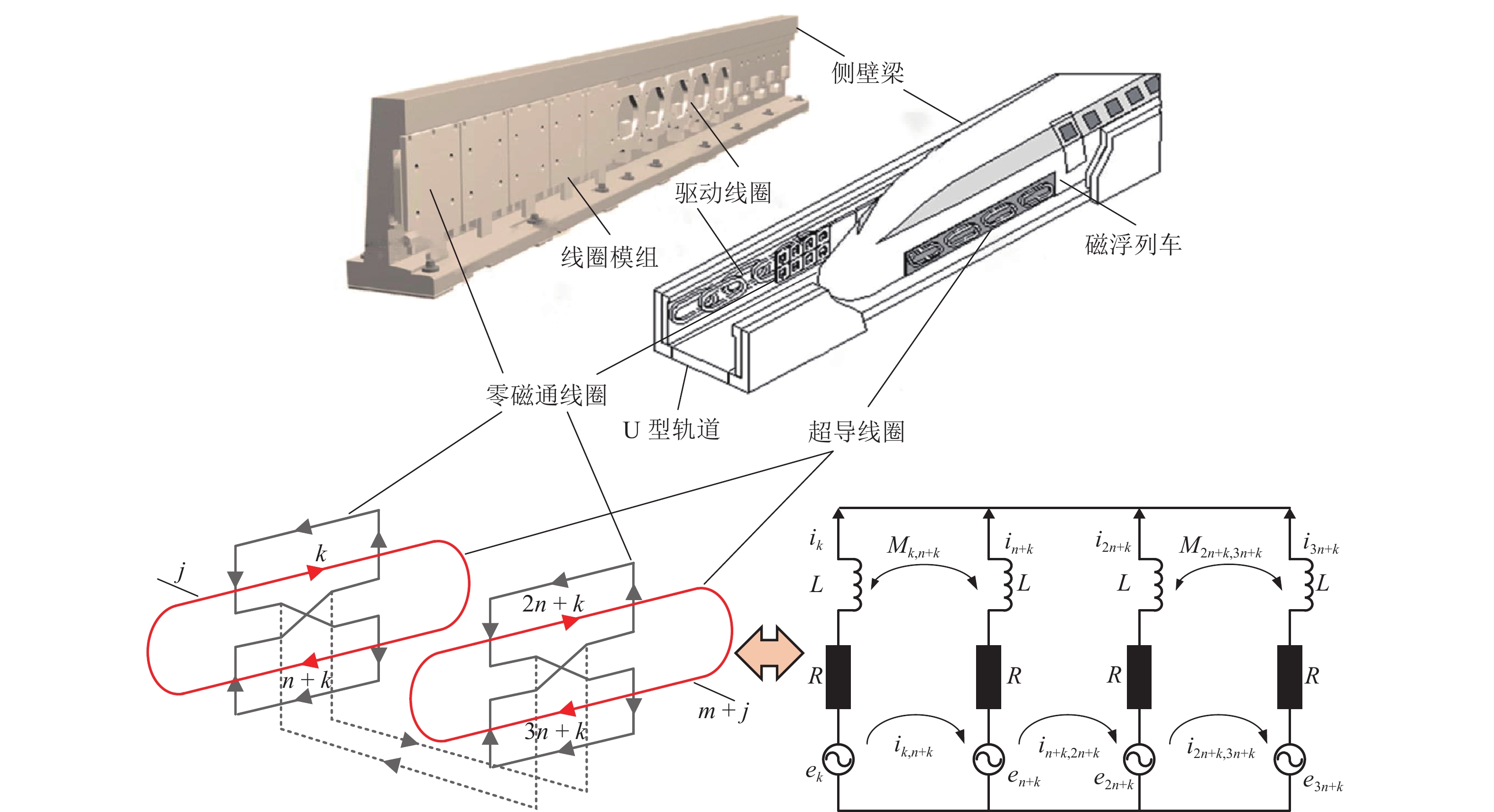
图 1 超导电动悬浮原理及最小拓扑结构的等效电路示意
Figure 1. Schematic diagram of superconducting electrodynamic suspension principle and equivalent circuit of minimum topological structure
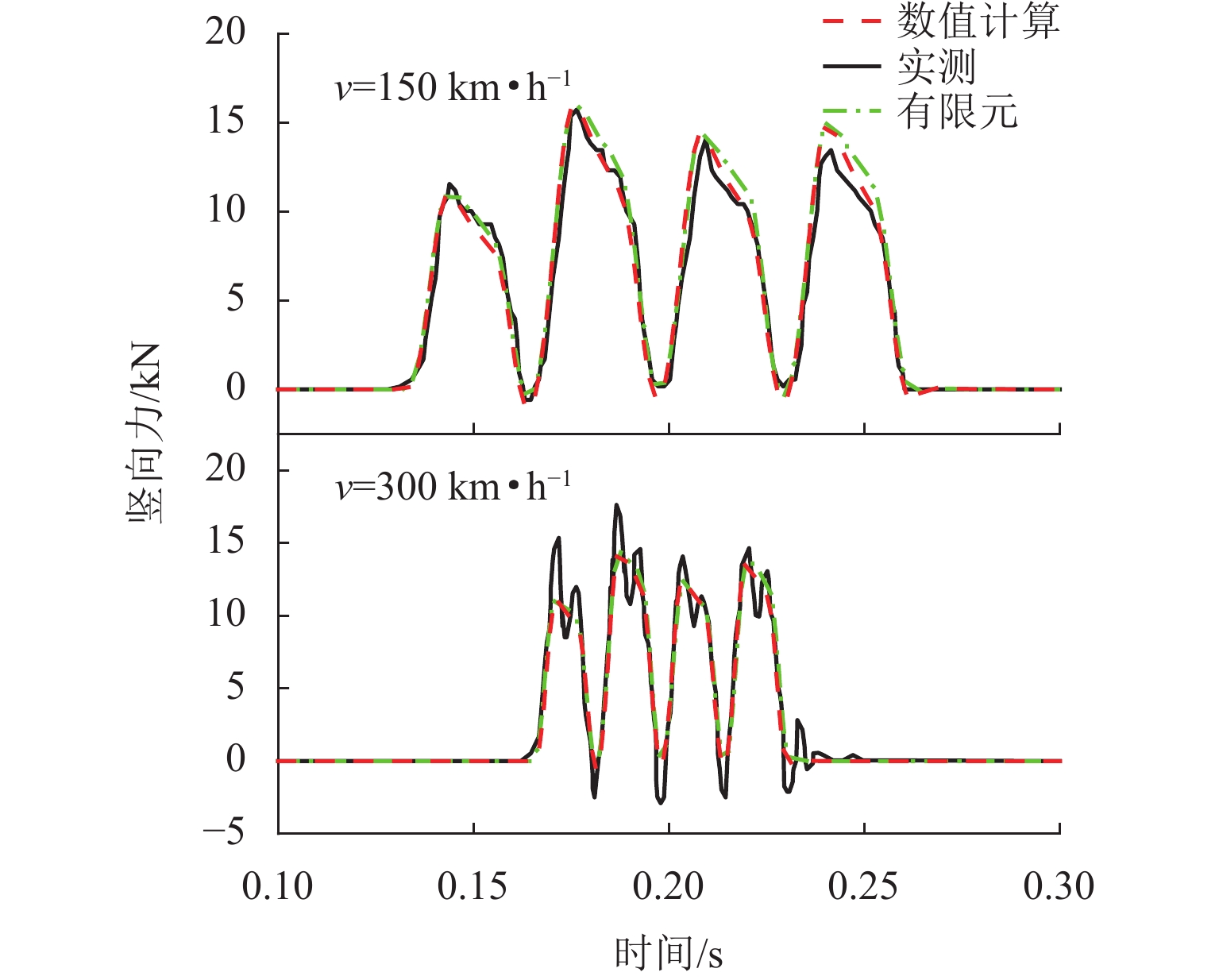
图 3 电动磁力数值计算模型验证
Figure 3. Validation of electrodynamic force numerical calculation model
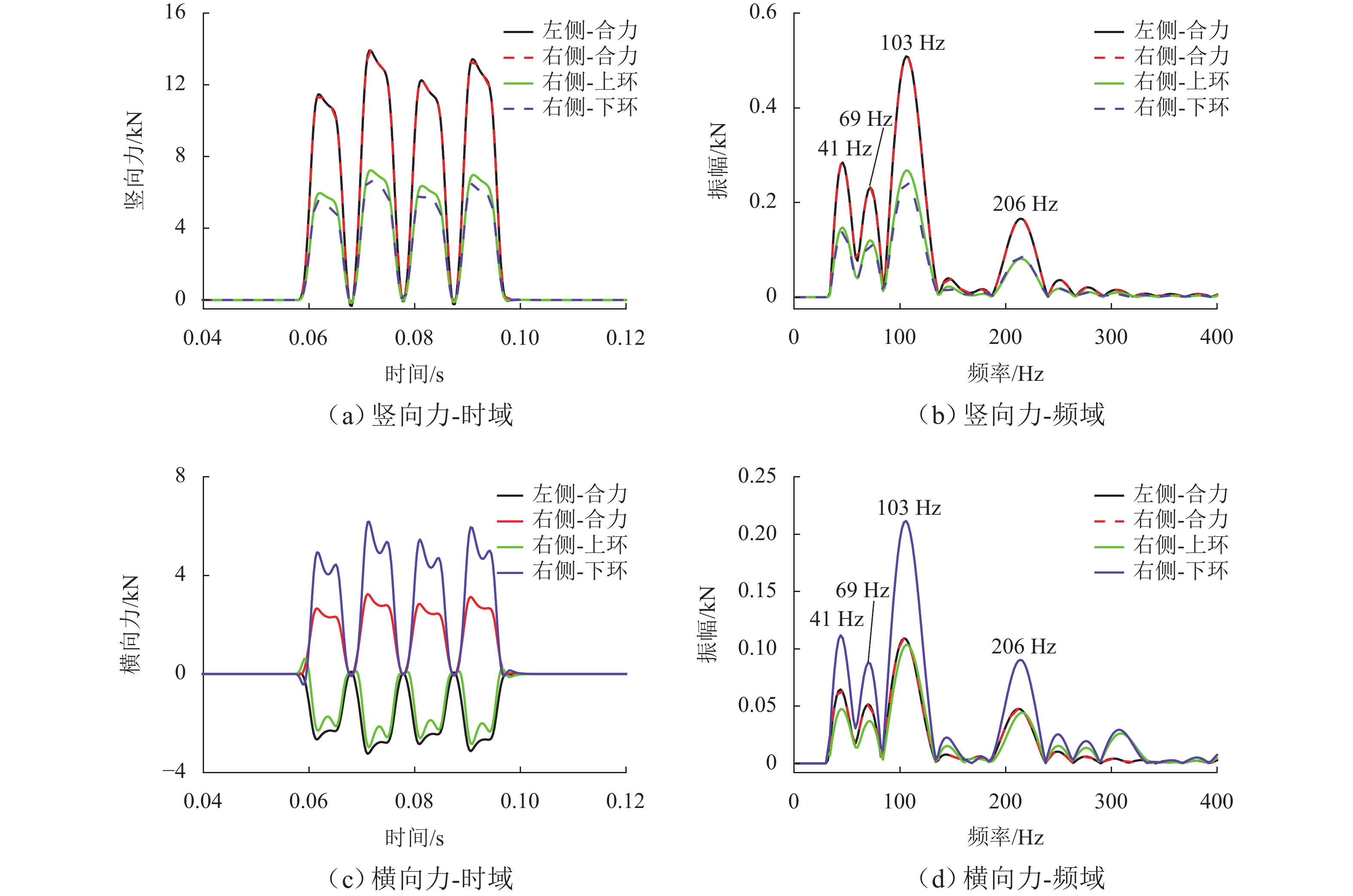
图 4 典型工况下单个零磁通线圈的磁力响应
Figure 4. Magnetic force response of single null-flux coil under typical operating condition
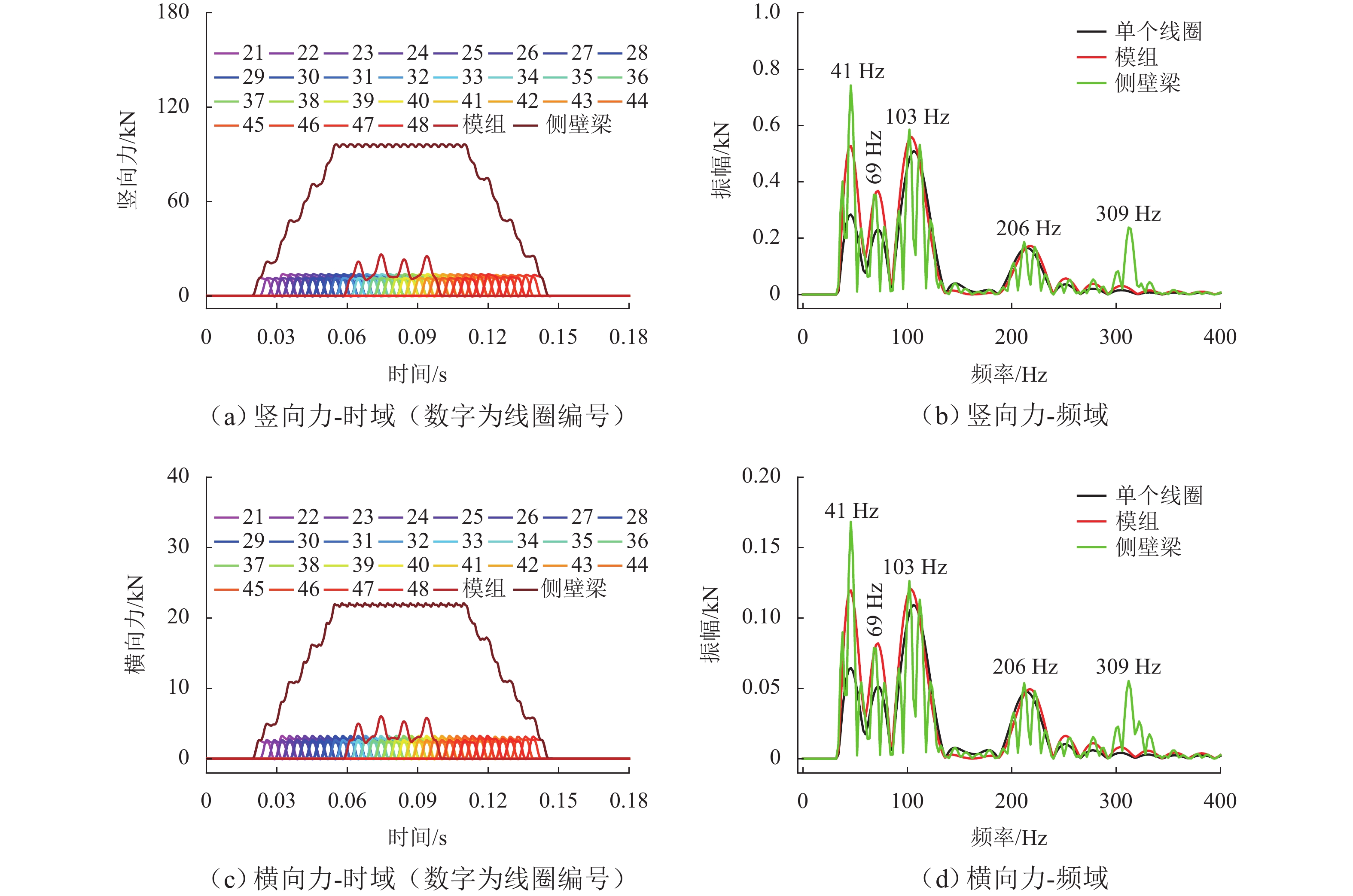
图 5 典型工况下模组与侧壁梁的磁力响应
Figure 5. Magnetic force responses of coil module and side-wall beam under typical operating condition
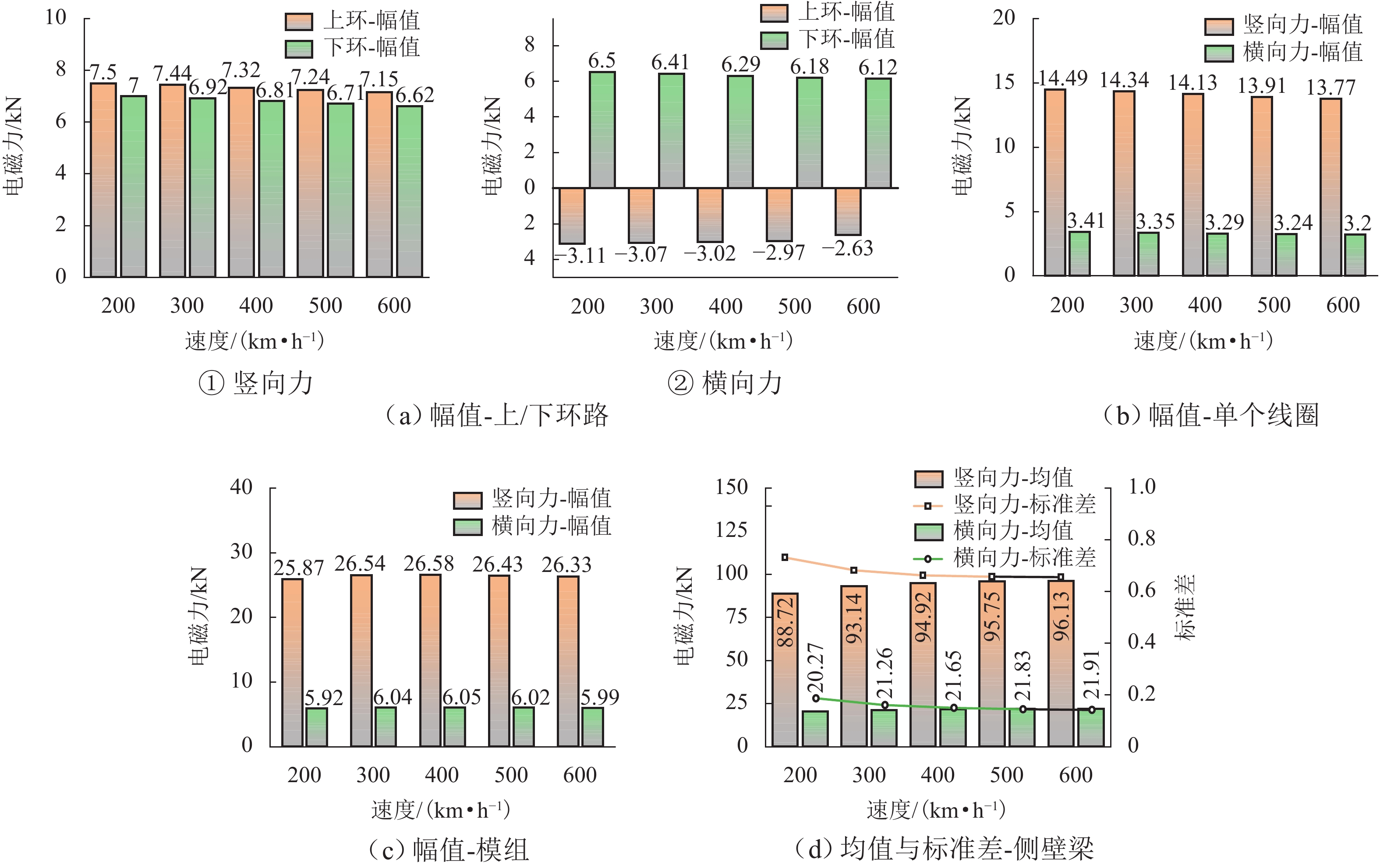
图 6 不同速度下系统磁力时域响应统计
Figure 6. Statistics of system magnetic force time-domain responses at different speeds
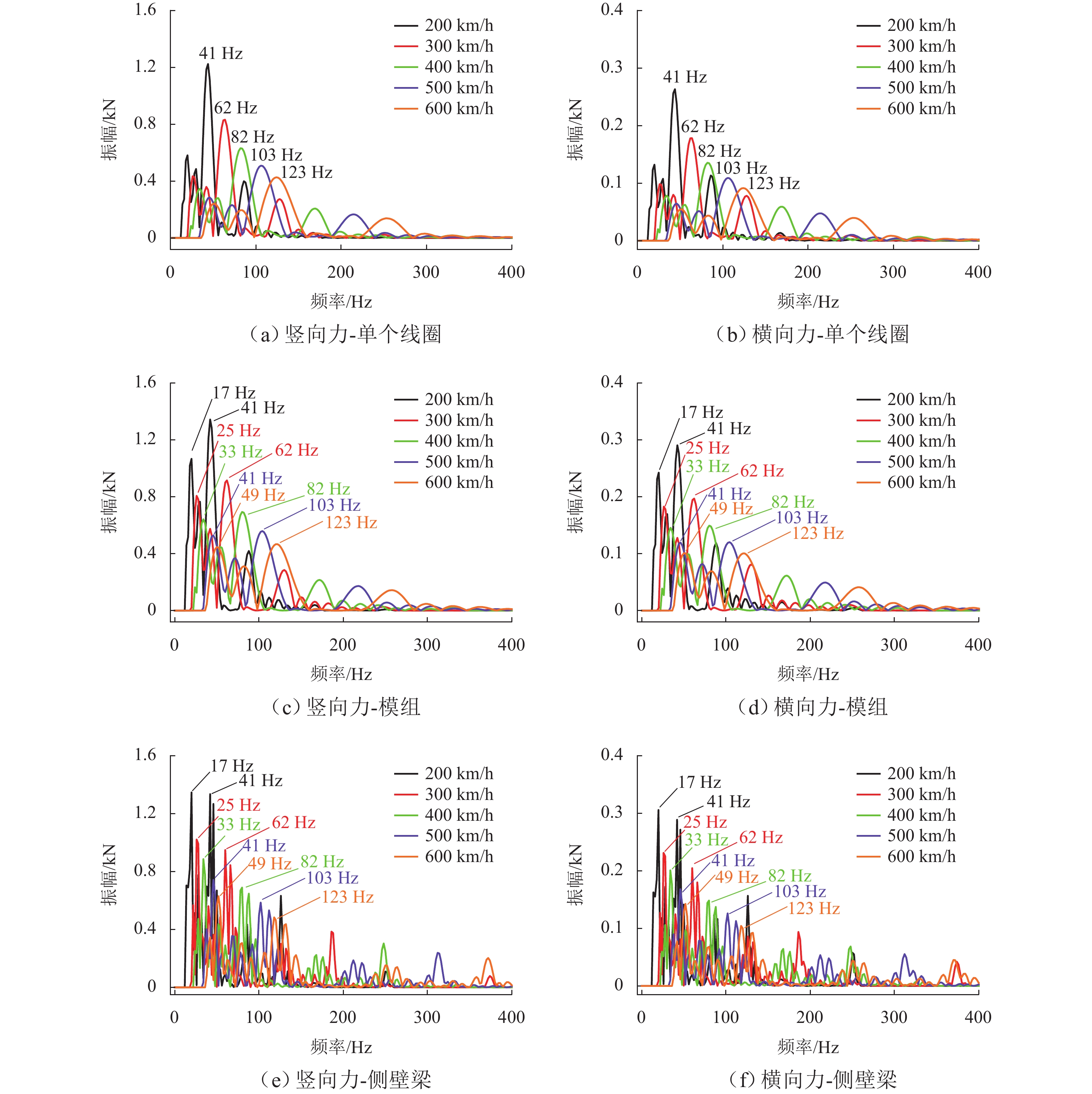
图 7 不同速度下系统磁力的频域响应
Figure 7. Frequency-domain responses of system magnetic force at different speeds
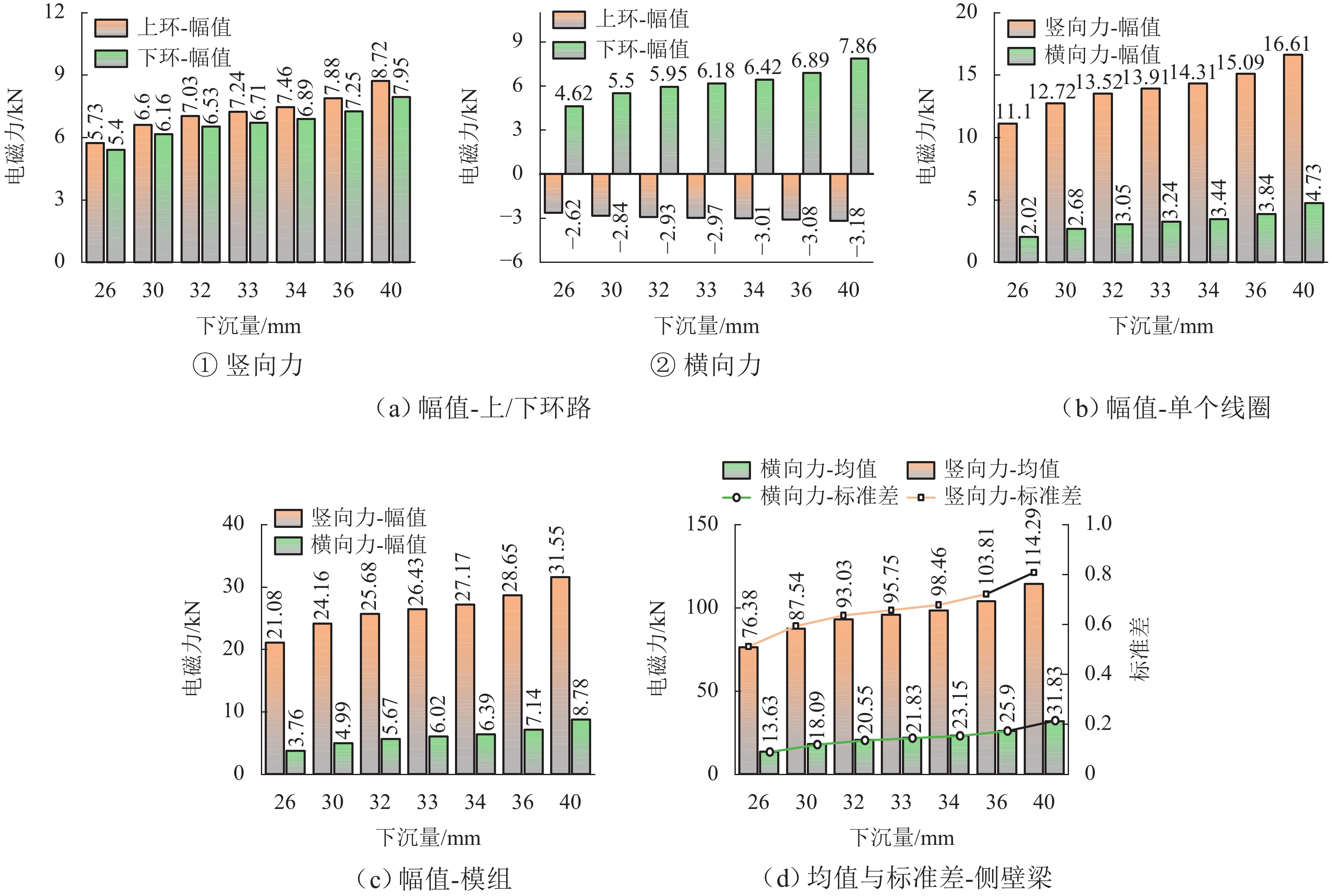
图 8 不同下沉量下系统磁力时域响应统计
Figure 8. Statistics of system magnetic force time-domain responses under different sinking amounts
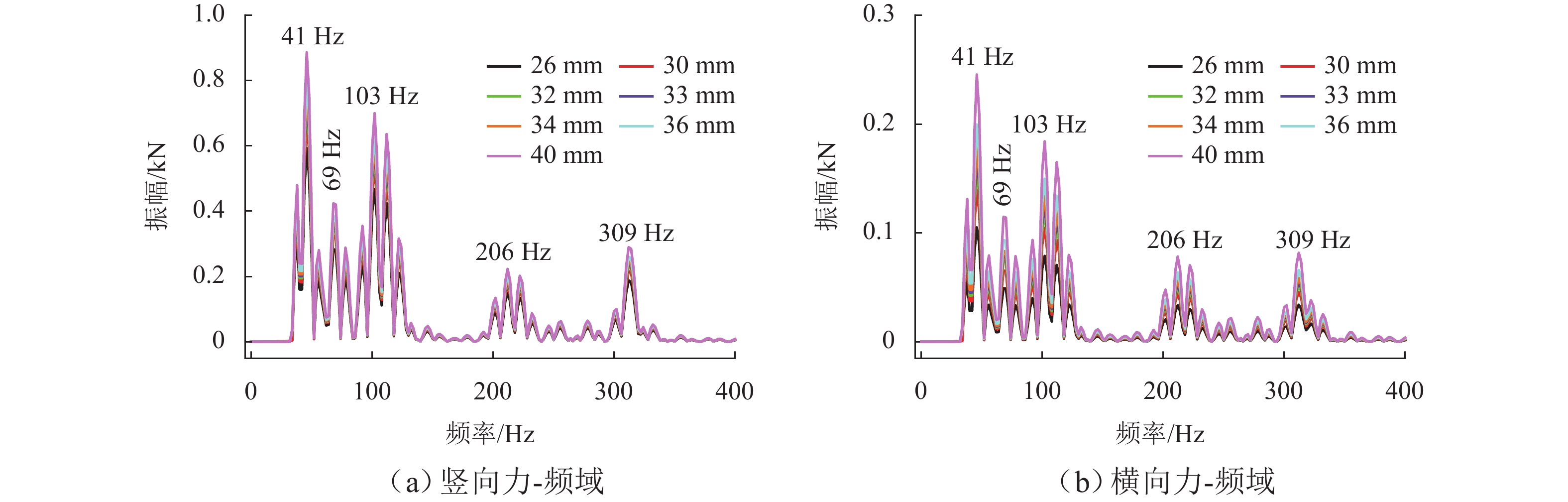
图 9 不同下沉量下侧壁梁磁力的频域响应
Figure 9. Frequency-domain responses of side-wall beam magnetic force under different sinking amounts
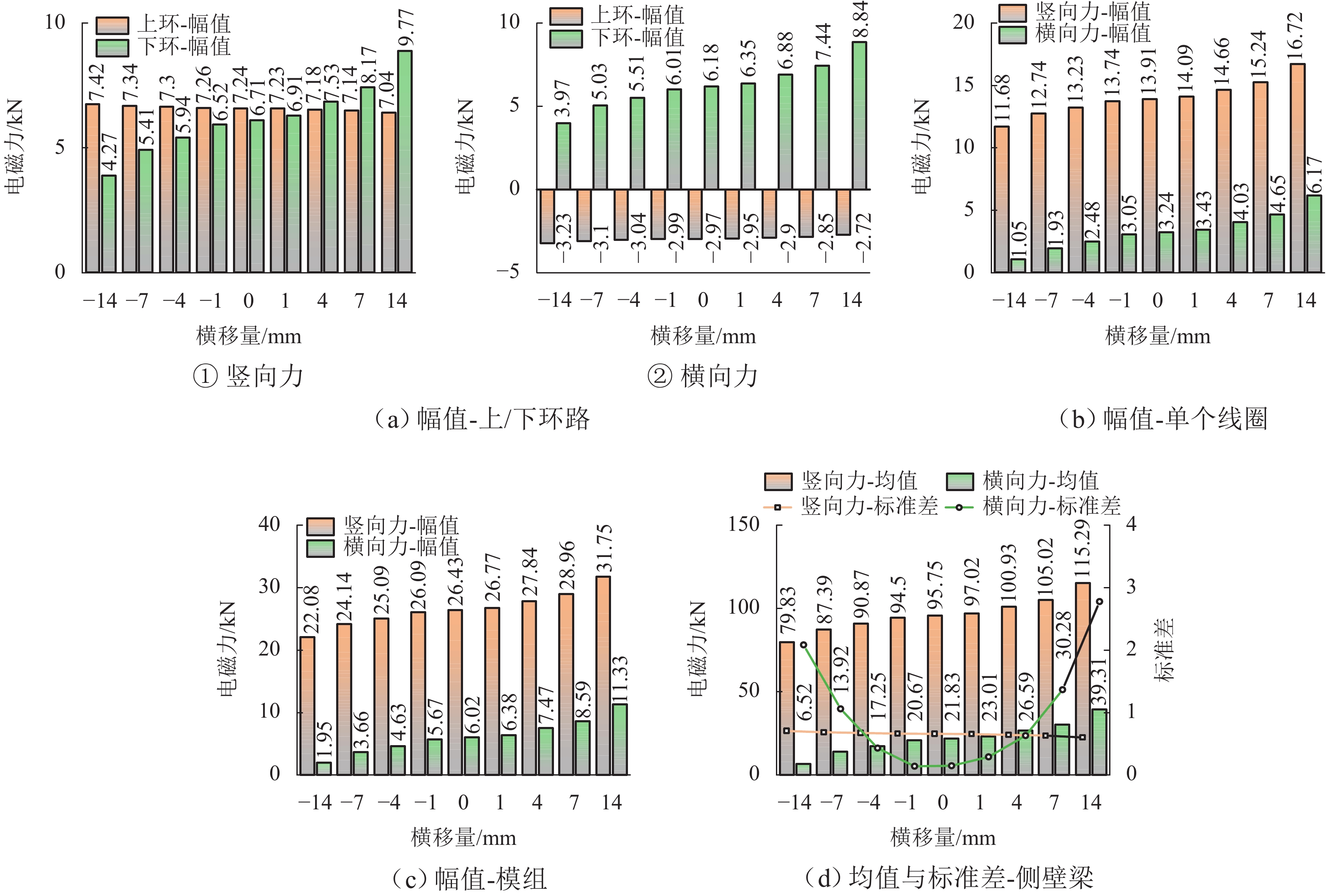
图 10 不同横移量下系统磁力时域响应统计
Figure 10. Statistics of system magnetic force time-domain responses under different lateral displacements
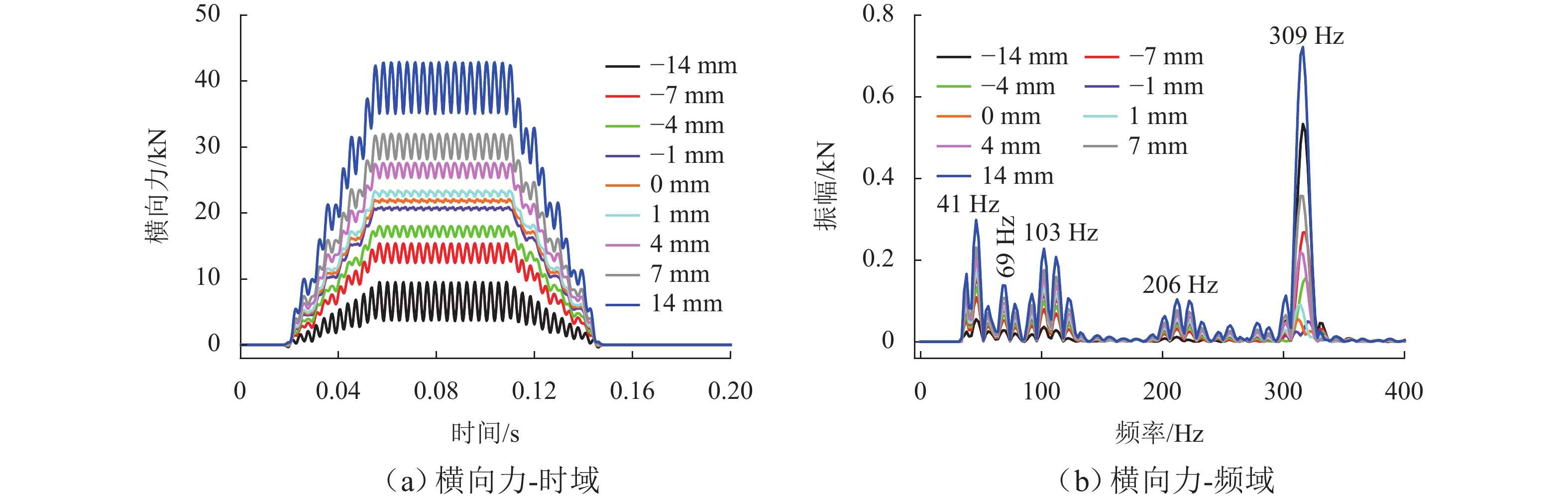
图 11 不同横移量下侧壁梁横向磁力响应
Figure 11. Lateral magnetic force responses of side-wall beam under different lateral displacements
表 1 超导电动悬浮系统参数
Table 1. Parameters of superconducting electrodynamic suspension system
线圈类型 参数 数值 零磁通线圈 高度/mm 340 长度/mm 350 极距/mm 450 电阻/mΩ 8.928 自感系数/mH 0.288 超导线圈 高度/mm 500 长度/mm 1070 极距/mm 1350 磁动势/kA 700  下载: 导出CSV
-
[1] 刘士苋, 王磊, 王路忠, 等. 电动悬浮列车及车载超导磁体研究综述[J]. 西南交通大学学报, 2023, 58(4): 734-753.LIU Shixian, WANG Lei, WANG Luzhong, et al. Review on electrodynamic suspension trains and on-board superconducting magnets[J]. Journal of Southwest Jiaotong University, 2023, 58(4): 734-753. [2] Sawada K. Outlook of the superconducting maglev[J]. Proceedings of the IEEE, 2009, 97(11): 1881-1885. doi: 10.1109/jproc.2009.2030246 [3] Nagashima K. Update on basic research into superconducting maglev and research on application of maglev technology to conventional railway systems[J]. Quarterly Report of RTRI, 2020, 61(1): 11-15. [4] 于青松, 李凯, 胡浩, 等. 超导电动悬浮应用研究与技术展望[J]. 机车电传动, 2023(4): 1-8. doi: 10.13890/j.issn.1000-128X.2023.04.001Yu Qingsong, Li Kai, Hu Hao, et al. Research and technological prospects of applications for superconducting electrodynamic suspension[J]. Electric Drive for Locomotives, 2023(4): 1-8. doi: 10.13890/j.issn.1000-128X.2023.04.001 [5] 张榕欣, 蔡小培, 汤雪扬, 等. 超导电动磁浮道岔线形设计与侧向过岔速度优化[J]. 西南交通大学学报, 2025, 60(4): 893-903. doi: 10.3969/j.issn.0258-2724.20240421Zhang Rongxin, Cai Xiaopei, Tang Xueyang, et al. Alignment design of superconducting electrodynamic suspension turnouts and optimization of lateral crossing speed[J]. Journal of Southwest Jiaotong University, 2025, 60(4): 893-903. doi: 10.3969/j.issn.0258-2724.20240421 [6] 于青松, 邵南, 冯耀锟, 等. 速度600 km/h高温超导磁悬浮交通系统悬浮力匹配技术研究[J]. 铁道学报, 2025, 47(7): 172-187. doi: 10.3969/j.issn.1001-8360.2025.07.016Yu Qingsong, Shao Nan, Feng Yaokun, et al. Research on suspension force matching technology for high temperature superconducting maglev transportation system with a speed of 600 km/h[J]. Journal of the China Railway Society, 2025, 47(7): 172-187. doi: 10.3969/j.issn.1001-8360.2025.07.016 [7] 王津, 葛琼璇, 赵鲁. 超导电动悬浮非对称系统多目标优化设计[J]. 西南交通大学学报, 2025, 60(4): 884-892. doi: 10.3969/j.issn.0258-2724.20240477Wang Jin, Ge Qiongxuan, Zhao Lu. Multi-objective asymmetric design for optimizing superconducting electrodynamic suspension system[J]. Journal of Southwest Jiaotong University, 2025, 60(4): 884-892. doi: 10.3969/j.issn.0258-2724.20240477 [8] 赵春发, 李煜寒, 彭也也, 等. 超导电动悬浮列车明线气动特性及其对悬浮状态的影响[J]. 西南交通大学学报, 2025, 60(4): 793-802. doi: 10.3969/j.issn.0258-2724.20240470Zhao Chunfa, Li Yuhan, Peng Yeye, et al. Aerodynamic characteristics of open wire of superconducting maglev train and its influence on levitation state[J]. Journal of Southwest Jiaotong University, 2025, 60(4): 793-802. doi: 10.3969/j.issn.0258-2724.20240470 [9] He J L, Rote D M, Coffey H T. Applications of the dynamic circuit theory to Maglev suspension systems[J]. IEEE Transactions on Magnetics, 1993, 29(6): 4153-4164. doi: 10.1109/20.280868 [10] 万尚军, 钱金根, 倪光正, 等. 电动悬浮型磁悬浮列车悬浮与导向技术剖析[J]. 中国电机工程学报, 2000, 20(9): 22-25, 31. doi: 10.13334/j.0258-8013.pcsee.2000.09.006Wan Shangjun, Qian Jingen, Ni Guangzheng, et al. Study of the levitation and guidance technology for electrodynamic suspension maglev vehicle[J]. Proceedings of the CSEE, 2000, 20(9): 22-25, 31. doi: 10.13334/j.0258-8013.pcsee.2000.09.006 [11] Gong T Y, Ma G T, Liu K, et al. An efficient 3-D FEM model for electromagnetic force and torque calculation in null-flux superconducting EDS trains[J]. IEEE Transactions on Transportation Electrification, 2025, 11(3): 7346-7356. doi: 10.1109/TTE.2025.3526652 [12] Ohashi S, Ohsaki H, Masada E. Equivalent model of the side wall electrodynamic suspension system[J]. IEEJ Transactions on Industry Applications, 1997, 117(6): 758-767. [13] Yonezu T, Watanabe K, Suzuki E, et al. Characteristics of magnetic springs for guidance of superconducting maglev vehicles[J]. Quarterly Report of RTRI, 2018, 59(4): 293-298. [14] 黄欢, 李海涛, 祝翰林, 等. 基于傅里叶级数方法的超导电动磁浮半解析电磁模型及刚度特性分析[J]. 机械工程学报, 2025, 61(14): 261-272.Huang Huan, Li Haitao, Zhu Hanlin, et al. Semi-analytical electromagnetic model and stiffness characteristics of superconducting electrodynamic suspension based on the Fourier series method[J]. Journal of Mechanical Engineering, 2025, 61(14): 261-272. [15] 胡道宇, 冯馨月, 张志华. 超导电动悬浮系统阻尼特性研究[J]. 中国电机工程学报, 2021, 41(13): 4679-4688. doi: 10.13334/j.0258-8013.pcsee.242029Hu Daoyu, Feng Xinyue, Zhang Zhihua. Study on the damping characteristics of superconducting electrodynamic suspension system[J]. Proceedings of the CSEE, 2021, 41(13): 4679-4688. doi: 10.13334/j.0258-8013.pcsee.242029 [16] Tan Y Q, Zhou D F, Qu M H, et al. A novel vertical active damping system for the superconducting electrodynamic suspension[J]. IEEE Transactions on Intelligent Transportation Systems, 2024, 25(11): 17702-17717. doi: 10.1109/TITS.2024.3432164 [17] 陈杰, 赵春发, 宁晓芳, 等. 磁浮列车超导电动悬浮系统的阻尼线圈主动减振研究[J]. 振动工程学报, 2026, 39(2): 497-506. doi: 10.16385/j.cnki.issn.1004-4523.202402009Chen Jie, Zhao Chunfa, Ning Xiaofang, et al. Active vibration reduction of the superconducting electrodynamic suspension system for maglev train using damper coils[J]. Journal of Vibration Engineering, 2026, 39(2): 497-506. doi: 10.16385/j.cnki.issn.1004-4523.202402009 [18] Hashimoto S. Research and technical development of maglev guideway[J]. Doboku Gakkai Ronbunshu, 1999, 1999(619): 1-12. [19] Suzuki M, Fujimoto T, Suwa H. Development of levitation coil by reaction injection molding method[J]. Quarterly Report of RTRI, 2000, 41(2): 57-62. doi: 10.2219/rtriqr.41.57 [20] He Z L, Zhao C F, Feng Y, et al. Changing laws and regulation strategies of dynamic factors of bridges with common spans for superconducting EDS maglev transportation[J]. IEEE Transactions on Applied Superconductivity, 2026, 36(1): 3600110. doi: 10.1109/tasc.2025.3633799 [21] Tanaka M, Aiba M, Suzuki M. Development of electromagnetic vibration test apparatus for ground coils applied to maglev system[J]. Quarterly Report of RTRI, 2007, 48(2): 110-114. doi: 10.2219/rtriqr.48.110 [22] Mizuno K, Tanaka M, Ogata M. Electromagnetic vibration test of a ground coil using a REBCO magnet[J]. RTRI Report, 2020, 34(11): 5-10. [23] Ikeda R, Mizuno K, Tanaka M. Evaluation of vibration resistance of levitation and guidance ground coils by electromagnetic excitation tests using a superconducting magnet[J]. Quarterly Report of RTRI, 2023, 64(1): 61-66. doi: 10.2219/rtriqr.64.1_61 [24] Cui L B, Ma G T, Su Z H, et al. Partial force calculation and structural strength analysis of null-flux coil for superconducting electrodynamic suspension train[J]. IEEE Transactions on Applied Superconductivity, 2024, 34(4): 3601110. doi: 10.1109/tasc.2024.3359758 [25] Yonezu T, Watanabe K, Suzuki E, et al. Study on electromagnetic force characteristics acting on levitation/guidance coils of a superconducting maglev vehicle system[J]. IEEE Transactions on Magnetics, 2017, 53(11): 8300605. [26] Takao S, Mizutani T, Shirakuni N, et al. Vehicle-running tests and development on the yamanashi maglev test line[J]. Quarterly Report of RTRI, 2004, 45(1): 3-6. doi: 10.2219/rtriqr.45.3 [27] Su Z H, Luo J, Ma G T, et al. Fast and precise calculation of mutual inductance for electrodynamic suspension: methodology and validation[J]. IEEE Transactions on Industrial Electronics, 2022, 69(6): 6046-6057. doi: 10.1109/TIE.2021.3088362 [28] Higashi K, Ohashi S, Ohsaki H, et al. Magnetic damping of the electrodynamic suspension type superconducting levitation system[J]. IEEJ Transactions on Industry Applications, 1997, 117(8): 1015-1023. [29] Fujimoto T, Aiba M, Suzuki H, et al. Characteristics of electromagnetic force of ground coil for levitation and guidance at the yamanashi maglev test line[J]. Quarterly Report of RTRI, 2000, 41(2): 63-67. doi: 10.2219/rtriqr.41.63 [30] 魏庆朝, 孔永健, 时瑾. 磁浮铁路系统与技术[M]. 2版. 北京: 中国科学技术出版社, 2010: 98-100. [31] Ohashi S, Ohsaki H, Masada E. Improvement of the damping characteristics for the superconducting magnetically levitated transportation system[J]. Transactions of the Institute of Systems, Control and Information Engineers, 1999, 12(9): 566-574. doi: 10.5687/iscie.12.566 -

 下载:
下载:

 点击查看大图
计量
- 文章访问数: 0
- HTML全文浏览量: 0
- PDF下载量: 0
- 被引次数: 0