



Research Progress on Disaster-Causing Mechanisms and Monitoring Assessment of Flood Impact and Scour on Bridges
-
摘要:
随着极端暴雨和洪水事件频发,桥梁因洪冲导致的水毁已成为威胁其安全运营的首要因素之一. 本文围绕桥梁洪冲致灾全过程,重点探讨和系统综述了冲刷发展机理、结构动力响应、智能监测预警及综合风险评估4个方面的研究进展. 从水文条件、结构参数与泥沙特性3个维度,分析桥梁基础局部冲刷的物理机制与演化规律的研究;阐述水动力荷载与基础冲刷耦合作用下,桥梁上部结构、墩台及基础体系的动力响应特征与典型失效模式;在监测预警方面,综述了基于声、光、电、力等原理的监测方法,并着重分析数据驱动与人工智能模型在冲刷深度预测中的应用潜力与当前局限;在风险评估层面,梳理从传统确定性分析向概率性易损性及系统韧性评估的范式演进;基于现有研究的不足,展望了未来的关键研究方向,包括复杂非恒定水文与波流耦合条件下的冲刷机理、多灾害链作用下的结构系统性能演化、多源信息融合的洪冲下桥梁智能感知与动态预警以及面向全生命周期的风险与韧性评估框架的构建. 可为桥梁抗洪冲韧性提升的理论研究与工程实践提供参考.
Abstract:With the frequent occurrence of extreme rainstorms and flood events, water damage of bridges induced by flood impact and scour has become one of the primary factors threatening safe operation. The entire disaster-causing process of bridges induced by flood impact and scour was studied, and the research progress in four aspects, namely scour development mechanisms, structural dynamic responses, intelligent monitoring and early warning, and comprehensive risk assessment, was emphatically discussed and systematically reviewed. From three dimensions of hydrological conditions, structural parameters, and sediment characteristics, the research on the physical mechanisms and evolution laws of local scour around bridge foundations was analyzed. Under the coupling action of hydrodynamic loads and foundation scour, the dynamic response characteristics and typical failure modes of the bridge superstructure, piers and abutments, and foundation system were elucidated. In terms of monitoring and early warning, the monitoring methods based on acoustic, optical, electrical, and mechanical principles were reviewed, and the application potential and current limitations of data-driven and artificial intelligence models in scour depth prediction were emphatically analyzed. At the level of risk assessment, the paradigm evolution from traditional deterministic analysis to probabilistic vulnerability and systemic resilience evaluation was systematically summarized. Based on the shortcomings of existing research, key future research directions were identified, including the scour mechanisms under complex unsteady hydrology and wave-current coupling conditions, the performance evolution of structural systems under the action of multiple disaster chains, the intelligent perception and dynamic early warning of bridges under flood impact and scour based on multi-source information fusion, and the construction of risk and resilience assessment frameworks toward the whole life cycle. Reference can be provided for theoretical research and engineering practice aimed at enhancing the flood impact and scour resilience of bridges.
-

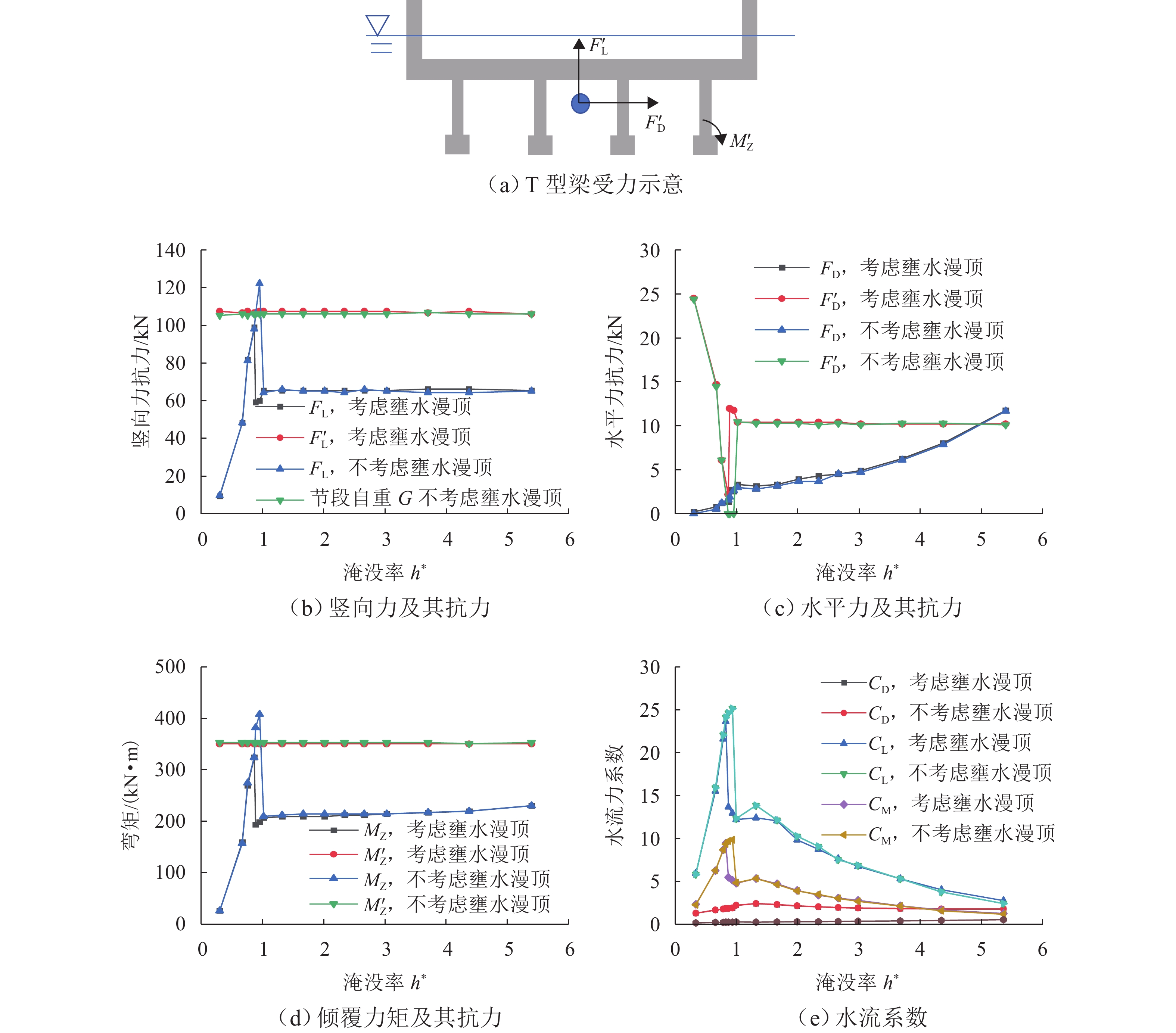
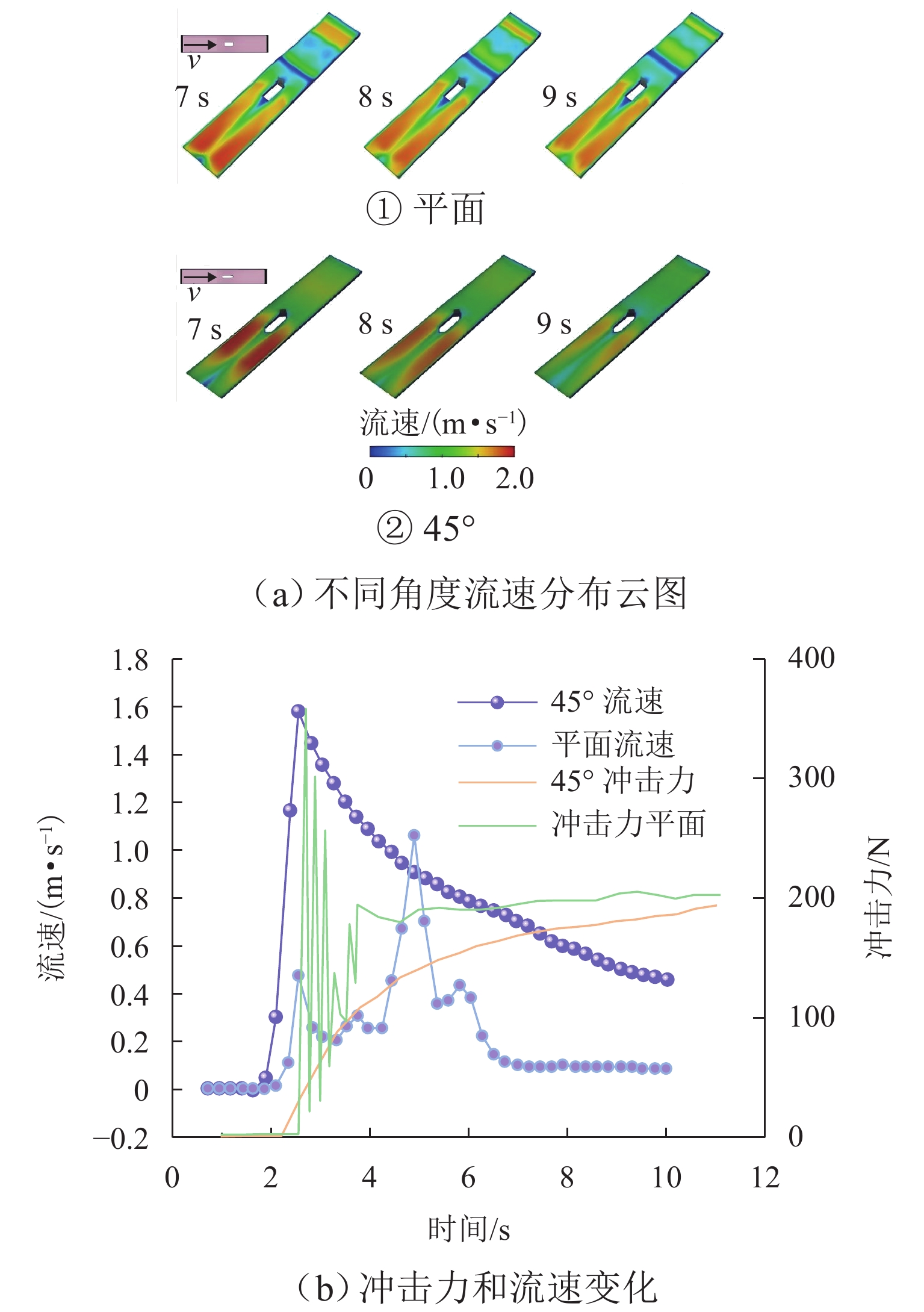
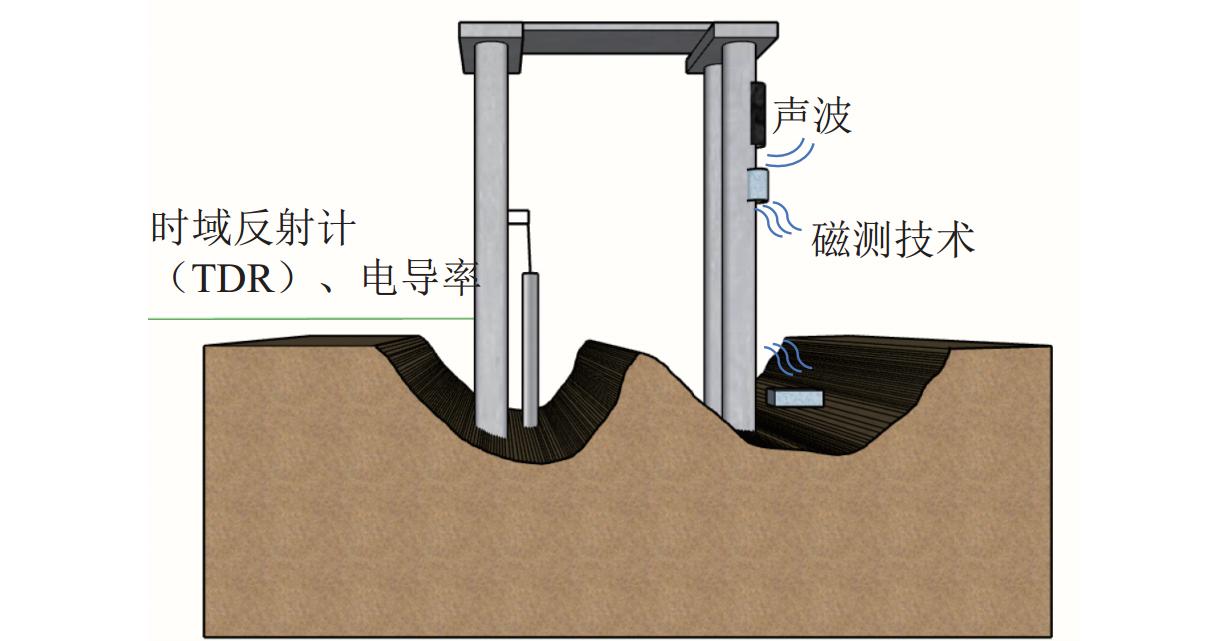
图 15 基于电磁、声波原理的监测方法
Figure 15. Monitoring method based on electromagnetic and acoustic principles
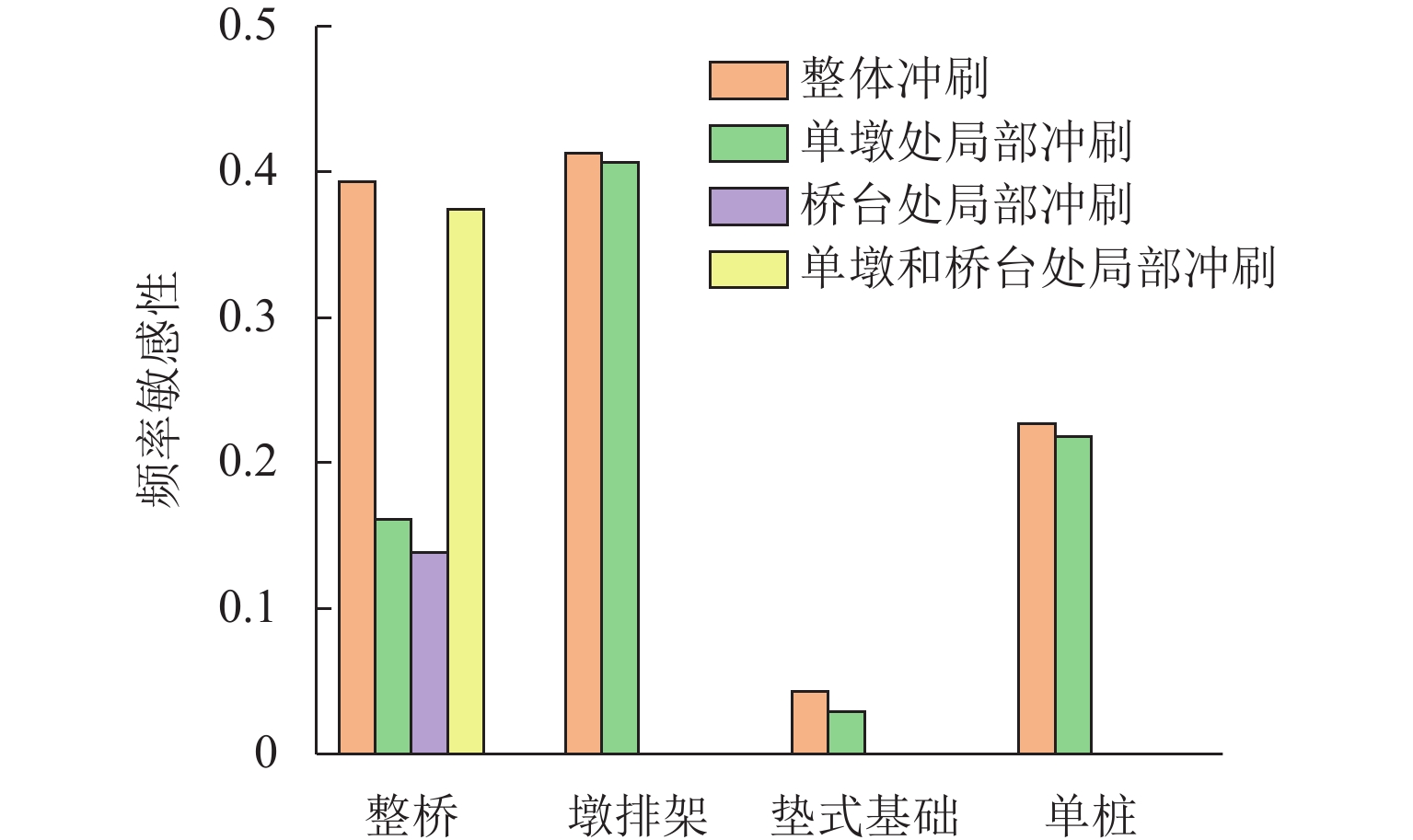
表 1 波流作用下平衡冲刷深度公式对比[16]
Table 1. Comparison of equilibrium scour depth formulas under wave-current action[16]
学者 平衡冲刷深度公式 公式特点 Sumer 等 $ \dfrac{S}{D}=1.3\left(1-\exp\left(-0.03\left(KC-6\right)\right)\right)\text{,}\quad KC\geqslant6,(1) $ 适用于波浪作用强烈的情况,精度较高,但对于较弱波流环境可能不够准确 Dogan $ \dfrac{S}{D}=1.3\left(1-\exp\left(-0.0\text{22}\left(KC-\text{4}\right)\right)\right),\quad KC\geqslant\text{4},(2) $ 适用于较低强度的波流环境. 在中等波流强度下表现良好,但可能无法适应极端波浪情况 $ \dfrac{S}{D}=\text{0.003 7}\dfrac{K{C}^{2/3}}{\sqrt{D/\lambda }},(3) $ 结合了 KC 数与桥梁几何尺寸的关系,适用于桥梁几何尺寸较为简单的环境 Raaijmakers 等 $ \dfrac{S}{D}=1.5\tanh \dfrac{h}{D} {K}_{\text{w}}{K}_{\text{h}} ,(4)$ 考虑了水深与冲刷深度的非线性关系,适用于多变水文条件 注:S 为冲刷深度,D 为桩基直径,h 为水深,Kw 为波浪作用的修正因子,Kh 为桩高修正系数,λ 为波长.  下载: 导出CSV
表 2 洪水作用下桥梁破坏形式[41]
Table 2. Failure forms of bridge under flood action
失效结构 破坏结构 受力形式 上部结构
破坏剪切破坏 竖向力 滑动破坏 水平力 梁体倾覆 水平力、动水压力
竖向分量桥墩破坏 墩顶水平位移过大
导致倾斜水平力、冲刷作用 偏向过大导致倾覆 弯剪开裂 漂浮物撞击 基础破坏 基础底面滑移 水平力、竖向力、
冲刷作用地基塑性形变 局部压力过高 地基瞬时液化 向上孔隙水压力增大
下载: 导出CSV
规范名称 AASHTO LRFD 桥梁设计规范 公路桥涵设计
通用规范AS5100 桥梁
设计规范公式 $ P=\dfrac{{C}_{\text{D}}\gamma {V}^{2}}{2g} $ $ F_{\mathrm{w}}=\dfrac{C_{\text{D}}A\gamma V^2}{2g} $ $ F\mathrm{_w}=\dfrac{C_{\text{D}}\rho V^2A}{2} $
下载: 导出CSV
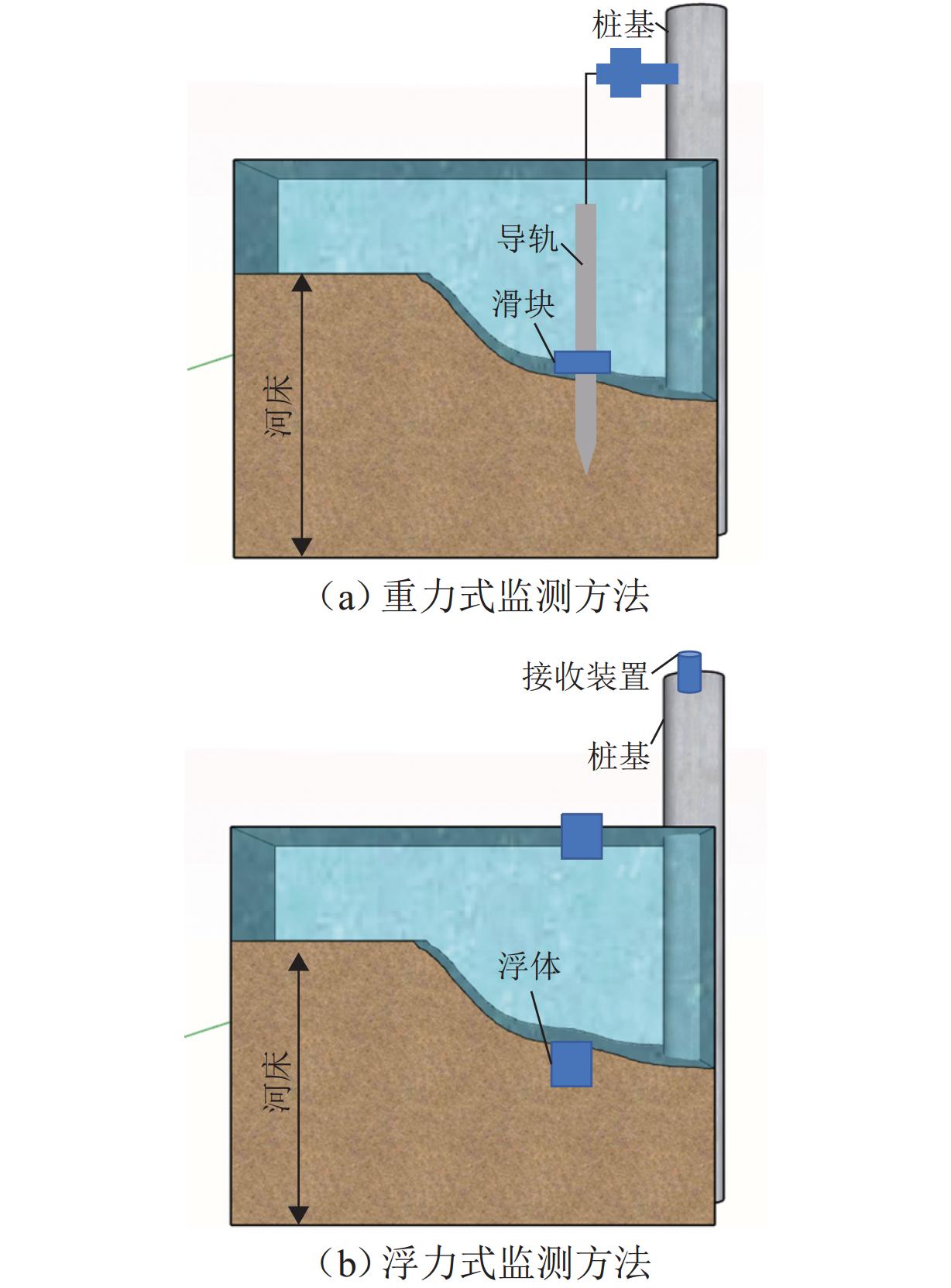
方法 花费/美元 精度 耐久性 安装 优缺点 目视检测法 500~ 1000 低 难以测量洪峰冲刷深度,精度取决于工作人员 力学原理监测方法 3000 中 差 简单 原理简单,难以监测回填过程 电磁原理监测方法 2000 ~10000 高 中、高 简单 测量精度高,容易受外界磁场干扰 声波监测方法 5~ 15000 高 中 简单 简单精度高,精度受外界环境干扰 光栅光纤传感器 5000 ~10000 高 中 较难 精度高,价格相对较高,多用于实验室
下载: 导出CSV
表 5 近年不同预测冲刷的人工智能模型和算法对比
Table 5. Comparison of different artificial intelligence models and algorithms for predicting scour in recent years
学者 模型 结构 输入特征 Ahmadianfar 等[92] 最小二乘法结合高斯过程归、随机森林模型 非均匀间距群桩 水文特征:水深、平均流速、临界流速
结构特征:桩径、流向桩间距、横向桩间距、流向桩个数、横向桩个数
土体特征:泥沙中值粒径Marulasiddappa 等[86] 自适应模糊推理系统、极端梯度树提升、数据处理群体法、多元自适应回归样条 桥台 水文特征:平均流速、水深
结构特征:桥台长度、宽度
土体特征:泥沙粒径Kim 等[87] 极端梯度提升和沙普利加性解释算法 桥墩 水文特征:水深、流速、泥沙启动流速
结构特征:桥墩宽度
土体特征:泥沙中值粒径Nandi 等[93] 分类增强、堆叠回归器 桥墩 水文特征:流量强度、水深、弗劳德数、雷诺数
结构特征:收缩比
土体特征:粗细、粒度组成Choi 等[94] 自适应模糊推理系统、人工神经网络 桥墩 水文特征:平均流速、水深、临界流速
结构特征:桥墩宽度
土体特征:泥沙粒径Feng 等[88] 支持向量机 桥墩 结构特征:桩尺寸、桩型、桩帽厚度、墩尺寸、频率
土体特征:密度、密实度Chen 等[89] 物理信息神经网络 单桩 结构特征:结构尺寸、频率
土体特征:弹性模量、密实度、重度、内摩擦角Guo 等[91] 自适应模糊推理系统 单桩 结构特征:频率变化率、曲率、曲差
下载: 导出CSV
-
[1] ETTEMA R, CONSTANTINESCU G, MELVILLE B W. Flow-field complexity and design estimation of pier-scour depth: sixty years since laursen and toch[J]. Journal of Hydraulic Engineering, 2017, 143(9): 03117006. doi: 10.1061/(ASCE)HY.1943-7900.0001330 [2] ARNESON L A, ZEVENBERGEN L W, LAGASSE P F, et al. Evaluating Scour at Bridges(HEC-18)[M]. Washington D. C.: [s.n.], 2012. [3] GUO J, WU J Y, WANG T. Prediction of local scour depth of sea-crossing bridges based on the energy balance theory[J]. Ships and Offshore Structures, 2022, 17(11): 2574-2587. doi: 10.1080/17445302.2021.2005362 [4] LAGASSE P F, SCHALL J D, JOHNSON F, et al. Hydraulic engineering circular 20 (HEC-20): stream stability at highway structures, FHWA-HIF-12-004[M]. 4th ed. FHWA: Department of Transportation, 2012. [5] 高宗余, 阮怀圣, 秦顺全, 等. 我国海洋桥梁工程技术发展现状、挑战及对策研究[J]. 中国工程科学, 2019, 21(3): 1-4.GAO Zongyu, RUAN Huaisheng, QIN Shunquan, et al. Technical status, challenges, and solutions of marine bridge engineering[J]. Strategic Study of CAE, 2019, 21(3): 1-4. [6] 郭健, 蒋兵. 近30年桥梁基础冲刷研究进展及关键问题[J]. 中国公路学报, 2020, 33(7): 1-16. doi: 10.3969/j.issn.1001-7372.2020.07.001GUO Jian, JIANG Bing. Research progress and key issues of bridge pile scour in recent 30 years[J]. China Journal of Highway and Transport, 2020, 33(7): 1-16. doi: 10.3969/j.issn.1001-7372.2020.07.001 [7] 李军堂, 秦顺全, 张瑞霞. 桥梁深水基础的发展和展望[J]. 桥梁建设, 2020, 50(3): 17-24. doi: 10.3969/j.issn.1003-4722.2020.03.003LI Juntang, QIN Shunquan, ZHANG Ruixia. Developments and prospects of deep water foundations for bridge[J]. Bridge Construction, 2020, 50(3): 17-24. doi: 10.3969/j.issn.1003-4722.2020.03.003 [8] BRIAUD J L, CHEN H C, CHANG K A, et al. Scour at bridges due to debris accumulation: A review[C]//Proc. , ICSE 2006, 3rd Int. Conf. on Scour and Erosion. Gouda: [s.n.], 2006. [9] 郭健. 桥梁局部冲刷分析与安全防护[M]. 北京: 科学出版社, 2020. [10] PANICI D, KRIPAKARAN P, DJORDJEVIĆ S, et al. A practical method to assess risks from large wood debris accumulations at bridge piers[J]. Science of the Total Environment, 2020, 728: 138575. doi: 10.1016/j.scitotenv.2020.138575 [11] SHA F, XU J Z, GU S J, et al. A review on fluid-sediment and foundation-sediment coupling mechanisms and anti-scour countermeasures[J]. Marine Structures, 2025, 103: 103843. doi: 10.1016/j.marstruc.2025.103843 [12] SUMER B M, FREDSØE J. The mechanics of scour in the marine environment[M]. Singapore: World Scientific, 2002. [13] TANG Z H, MELVILLE B, SHAMSELDIN A, et al. Experimental study of collar protection for local scour reduction around offshore wind turbine monopile foundations[J]. Coastal Engineering, 2023, 183: 104324. doi: 10.1016/j.coastaleng.2023.104324 [14] GONG E Y, CHEN S G, CHEN X, et al. Large-scale experimental study on scour around offshore monopile under combined wave and current condition[J]. Ocean Engineering, 2023, 283: 115186. doi: 10.1016/j.oceaneng.2023.115186 [15] 程永舟, 姜松, 吕行, 等. 波流共同作用下大直径圆柱局部冲刷试验研究[J]. 应用基础与工程科学学报, 2021, 29(3): 606-616.CHENG Yongzhou, JIANG Song, LV Xing, et al. Experimental study of local scour around a large-diameter vertical cylinder in combined waves and current[J]. Journal of Basic Science and Engineering, 2021, 29(3): 606-616. [16] 宫恩宇, 陈松贵, 陈鑫, 等. 波浪条件下单桩冲刷大比尺试验研究[J]. 清华大学学报(自然科学版), 2024, 64(4): 619-625.GONG Enyu, CHEN Songgui, CHEN Xin, et al. Large-scale experimental study on scour around monopile under the action of waves[J]. Journal of Tsinghua University (Science and Technology), 2024, 64(4): 619-625. [17] GUMGUM F, GUNEY M S. Time dependent live-bed scour around circular piers under flood waves[J]. Periodica Polytechnica Civil Engineering, 2019, 64(1): 65-72. doi: 10.3311/ppci.14664 [18] KHAJAVI M, MAHMOOD KASHEFIPOUR S, SHAFAI BEJESTAN M. Temporal variation of scour depth around bridge abutment in presence and absence of permeable spur dike under unsteady flow conditions[J]. Ain Shams Engineering Journal, 2024, 15(9): 102961. doi: 10.1016/j.asej.2024.102961 [19] KOHANDEL GARGARI M, OZGUR KIRCA V S, YAGCI O. Experimental investigation of gradually-varied unsteady flow passed a circular pile[J]. Coastal Engineering, 2021, 168: 103926. doi: 10.1016/j.coastaleng.2021.103926 [20] MCGOVERN D J, ILIC S, FOLKARD A M, et al. Time development of scour around a cylinder in simulated tidal currents[J]. Journal of Hydraulic Engineering, 2014, 140(6): 04014014. doi: 10.1061/(ASCE)HY.1943-7900.0000857 [21] GUO J, WENG B W, WU J Y. Investigation of the energy loss in cylindrical bridge piers scour depth prediction on sand-bed[J]. Ocean Engineering, 2024, 309: 118513. doi: 10.1016/j.oceaneng.2024.118513 [22] YU P, CHEN J C, ZHOU J L, et al. Experimental investigation of local scour around complex bridge pier of sea-crossing bridge under tidal currents[J]. Ocean Engineering, 2023, 290: 116374. doi: 10.1016/j.oceaneng.2023.116374 [23] ETTEMA R, KIRKIL G, MUSTE M. Similitude of large-scale turbulence in experiments on local scour at cylinders[J]. Journal of Hydraulic Engineering, 2006, 132(1): 33-40. doi: 10.1061/(ASCE)0733-9429(2006)132:1(33) [24] SUMER B M, FREDSØE J, CHRISTIANSEN N. Scour around vertical pile in waves[J]. Journal of Waterway, Port, Coastal, and Ocean Engineering, 1992, 118(1): 15-31. doi: 10.1061/(ASCE)0733-950X(1992)118:1(15) [25] QI W G, GAO F P. Physical modeling of local scour development around a large-diameter monopile in combined waves and current[J]. Coastal Engineering, 2014, 83: 72-81. doi: 10.1016/j.coastaleng.2013.10.007 [26] HUANG W R, YANG Q P, XIAO H. CFD modeling of scale effects on turbulence flow and scour around bridge piers[J]. Computers & Fluids, 2009, 38(5): 1050-1058. doi: 10.1016/j.compfluid.2008.01.029 [27] 向琪芪. 桥梁沉井基础局部冲刷试验及计算方法研究[D]. 成都: 西南交通大学, 2020. [28] 邱旭, 马文冠, 张宇, 等. 海上风电场单桩基础局部冲刷深度计算方法适应性研究[J]. 太阳能学报, 2023, 44(11): 287-293. doi: 10.19912/j.0254-0096.tynxb.2022-1112QIU Xu, MA Wenguan, ZHANG Yu, et al. Study on adaptability of calculation method for local scouring depth of single pile foundation in offshore wind farm[J]. Acta Energiae Solaris Sinica, 2023, 44(11): 287-293. doi: 10.19912/j.0254-0096.tynxb.2022-1112 [29] HOSSEINI R, AMINI A. Scour depth estimation methods around pile groups[J]. KSCE Journal of Civil Engineering, 2015, 19(7): 2144-2156. doi: 10.1007/s12205-015-0594-7 [30] DIETZ J W. Kolkbildung an einem kreiszylindrischen pfeilerpaar[J]. Bautechnik, 1973, 50(6): 203-208. [31] HANNAH C. Scour at pile groups[D]. Christchurch: University of Canterbury, 1978. [32] SUMER B M, and FREDSØE J. Hydrodynamics around cylindrical structures[M]. Singapore: World Scientific, 1997. [33] AMINI A, MELVILLE B W, ALI T M, et al. Clear-water local scour around pile groups in shallow-water flow[J]. Journal of Hydraulic Engineering, 2012, 138(2): 177-185. doi: 10.1061/(ASCE)HY.1943-7900.0000488 [34] 卢中一, 高正荣. 大型涉水群桩桥基局部冲刷特性试验研究[J]. 海洋工程, 2009, 27(1): 70-76. doi: 10.3969/j.issn.1005-9865.2009.01.011LU Zhongyi, GAO Zhengrong. Characteristics of local scour about large-scale pile groups in water[J]. The Ocean Engineering, 2009, 27(1): 70-76. doi: 10.3969/j.issn.1005-9865.2009.01.011 [35] BEHERA J, KAR A K, KHAMARI A. Scour at the downstream of Ghatakeswar spillway using non-cohesive hydraulic model[J]. ISH Journal of Hydraulic Engineering, 2022, 28(4): 461-471. doi: 10.1080/09715010.2021.1929520 [36] ZAIDAN J, BENNABI A, POUPARDIN A, et al. Spatio-temporal characterisation of local scour around a circular bridge pier in cohesive soil with different clay/silt ratio[J]. European Journal of Environmental and Civil Engineering, 2024, 28(14): 3328-3347. doi: 10.1080/19648189.2024.2338784 [37] ZANG Z P, ZHAO M, CHEN E B, et al. Numerical modeling of local scour around a subsea pipeline on cohesive seabed under steady currents[J]. Marine Georesources & Geotechnology, 2025, 43(3): 467-479. doi: 10.1080/1064119X.2024.2340649 [38] XU H, CAO Z X. Experimental study of reservoir flushing through a bottom tunnel initially covered by cohesive sediment[J]. International Journal of Sediment Research, 2024, 39(3): 327-339. doi: 10.1016/j.ijsrc.2024.03.004 [39] PALERMO M, DI NARDI J, BOMBARDELLI F A, et al. Scour due to circular jets in cohesive soils: Physical evidence from three-dimensional laboratory tests[J]. Physics of Fluids, 2024, 36(9): 095169. doi: 10.1063/5.0228218 [40] CHEN X G, LIU X X, LI H, et al. Effects of seabed geotechnical properties on scour mechanism at the pile in non-cohesive soils: Experimental study[J]. Ocean Engineering, 2022, 254: 111302. doi: 10.1016/j.oceaneng.2022.111302 [41] 黄诗茗. 洪水作用下桥墩结构灾变损伤机理与失效模式[D]. 长春: 吉林大学, 2024. [42] 张新华, 薛睿瑛, 王明, 等. 金沙江白格滑坡堰塞坝溃决洪水灾害调查与致灾浅析[J]. 工程科学与技术, 2020, 52(5): 89-100. doi: 10.15961/j.jsuese.202000466ZHANG Xinhua, XUE Ruiying, WANG Ming, et al. Field investigation and analysis on flood disasters due to baige landslide dam break in Jinsha River[J]. Advanced Engineering Sciences, 2020, 52(5): 89-100. doi: 10.15961/j.jsuese.202000466 [43] 毕钰璋, 何思明, 王东坡, 等. 碎屑流冲击下的桥墩动力响应特征分析[J]. 中国地质灾害与防治学报, 2017, 28(4): 16-21. doi: 10.16031/j.cnki.issn.1003-8035.2017.04.03BI Yuzhang, HE Siming, WANG Dongpo, et al. Discrete-element investigation of rock avalanches impact on the bridge pier[J]. The Chinese Journal of Geological Hazard and Control, 2017, 28(4): 16-21. doi: 10.16031/j.cnki.issn.1003-8035.2017.04.03 [44] 陈欢欢. 泥石流冲击作用下圆形桥墩动力响应试验研究[D]. 重庆: 重庆交通大学, 2022. [45] FURLAN P. Blocking probability of large wood and resulting head increase at ogee crest spillways[D]. Lausanne: Ecole Polytechnique Fédérale de Lausanne, 2019. [46] MINER N, ALIPOUR A. Bridge damage, repair costs, and fragilities for inland flood events[J]. Journal of Bridge Engineering, 2022, 27(8): 04022057. doi: 10.1061/(ASCE)BE.1943-5592.0001865 [47] MALAVASI S, GUADAGNINI A. Hydrodynamic loading on river bridges[J]. Journal of Hydraulic Engineering, 2003, 129(11): 854-861. doi: 10.1061/(ASCE)0733-9429(2003)129:11(854) [48] NAUDASCHER E, MEDLARZ H J. Hydrodynamic loading and backwater effect of partially submerged bridges[J]. Journal of Hydraulic Research, 1983, 21(3): 213-232. doi: 10.1080/00221688309499416 [49] AASHTO. LRFD bridge design specifications[S]. Washington D. C.: American Association of State Highway and Transportation Officials, 2024. [50] 中华人民共和国交通运输部. 公路桥涵设计通用规范: JTG D60—2015[S]. 北京: 人民交通出版社, 2015. [51] Committee BD-090. Bridge design: part 2: design loads: AS 5100.2[S]. Sydney: Standards Australia, 2017. [52] ELGHAMRY O A. Uplift forces on platform decks[C]//3rd Annual Offshore Technology Conference. Houston: Offshore Technology Conference, 1971: 537-544. [53] 杨万理, 秦军武, 侯海林, 等. 竹巴龙金沙江大桥水毁破坏机理[J]. 西南交通大学学报, 2022, 57(1): 120-128. doi: 10.3969/j.issn.0258-2724.20200732YANG Wanli, QIN Junwu, HOU Hailin, et al. Failure mechanism of flood damage to Jinsha River bridge at zhubalong[J]. Journal of Southwest Jiaotong University, 2022, 57(1): 120-128. doi: 10.3969/j.issn.0258-2724.20200732 [54] KABIR S M I, AHMARI H, MOWLA Q A. Investigation of flow dynamics around submerged bridges[J]. Physics of Fluids, 2025, 37(4): 045118. doi: 10.1063/5.0259229 [55] DENSON K H. Wave forces on causeway-type coastal bridges[J]. NASA STI/Recon Technical Report N, 1978, 79: 20293. [56] CUOMO G, SHIMOSAKO K I, TAKAHASHI S. Wave-in-deck loads on coastal bridges and the role of air[J]. Coastal Engineering, 2009, 56(8): 793-809. doi: 10.1016/j.coastaleng.2009.01.005 [57] MCPHERSON R L. Hurricane induced wave and surge forces on bridge decks[D]. College Station: Texas A&M University, 2010. [58] HAYATDAVOODI M, SEIFFERT B, ERTEKIN R C. Experiments and computations of solitary-wave forces on a coastal-bridge deck. Part Ⅱ: Deck with girders[J]. Coastal Engineering, 2014, 88: 210-228. doi: 10.1016/j.coastaleng.2014.02.007 [59] SEIFFERT B R, HAYATDAVOODI M, ERTEKIN R C. Experiments and calculations of cnoidal wave loads on a coastal-bridge deck with girders[J]. European Journal of Mechanics-B/Fluids, 2015, 52: 191-205. doi: 10.1016/j.euromechflu.2015.03.010 [60] 赵实达. 堰塞湖溃决洪水演进及冲击桥梁荷载研究[D]. 成都: 西南交通大学, 2023. [61] HUANG W R, XIAO H. Numerical modeling of dynamic wave force acting on escambia bay bridge deck during hurricane ivan[J]. Journal of Waterway, Port, Coastal, and Ocean Engineering, 2009, 135(4): 164-175. doi: 10.1061/(ASCE)0733-950X(2009)135:4(164) [62] CROWLEY R, ROBECK C, DOMPE P. A three-dimensional computational analysis of bridges subjected to monochromatic wave attack[J]. Journal of Fluids and Structures, 2018, 79: 76-93. doi: 10.1016/j.jfluidstructs.2018.02.001 [63] HUANG S, LIU C Z. Dynamic behavior analysis of bridge pier under impact of dam-break flood in different directions[J]. Natural Hazards, 2024, 120(3): 2705-2730. doi: 10.1007/s11069-023-06301-6 [64] LIU Y. Research on water flow characteristics and stress around bridges during floods[J]. Water Infrastructure, Ecosystems and Society, 2024, 73(12): 2361-2376. doi: 10.2166/aqua.2024.281 [65] KONG X, CAI C S. Scour effect on bridge and vehicle responses under bridge–vehicle–wave interaction[J]. Journal of Bridge Engineering, 2016, 21(4): 04015083. doi: 10.1061/(ASCE)BE.1943-5592.0000868 [66] WANG J G, WEI K, CAI H W. Dynamic response of cylindrical bridge pier subjected to the impact of flash flooding considering the effect of soil–structure interactions[J]. Structures, 2025, 72: 108199. doi: 10.1016/j.istruc.2025.108199 [67] LIN T K, CHEN P W, CHANG H T. A fluid-structure interaction model for bridge safety assessment under scour conditions[J]. Shock and Vibration, 2022, 2022(1): 2090470. doi: 10.1155/2022/2090470 [68] PUCCI A, SOUSA H S, GIRESINI L, et al. Fragility of bridge decks exposed to hydraulic and driftwood actions[J]. Structure and Infrastructure Engineering, 2025, 21(9): 1498-1511. doi: 10.1080/15732479.2023.2272725 [69] MAJTAN E, CUNNINGHAM L S, ROGERS B D. Riverine flow and floating wooden debris interaction with an arch bridge: flume experiments[J]. Journal of Hydraulic Research, 2024, 62(6): 542-559. doi: 10.1080/00221686.2024.2437688 [70] ARGYROUDIS S A, MITOULIS S Α, WINTER M G, et al. Fragility of transport assets exposed to multiple hazards: State-of-the-art review toward infrastructural resilience[J]. Reliability Engineering & System Safety, 2019, 191: 106567. doi: 10.1016/j.ress.2019.106567 [71] LI Y, AHUJA A, PADGETT J E. Review of methods to assess, design for, and mitigate multiple hazards[J]. Journal of Performance of Constructed Facilities, 2012, 26(1): 104-117. doi: 10.1061/(ASCE)CF.1943-5509.0000279 [72] BRUNEAU M, BARBATO M, PADGETT J E, et al. State of the art of multihazard design[J]. Journal of Structural Engineering, 2017, 143(10): 03117002. doi: 10.1061/(ASCE)ST.1943-541X.0001893 [73] GIDARIS I, PADGETT J E, BARBOSA A R, et al. Multiple-hazard fragility and restoration models of highway bridges for regional risk and resilience assessment in the United States: state-of-the-art review[J]. Journal of Structural Engineering, 2017, 143(3): 04016188. doi: 10.1061/(ASCE)ST.1943-541X.0001672 [74] 魏凯, 赵文玉, 洪杰, 等. 卷破波斜向作用下方形桥墩砰击荷载研究[J]. 工程力学, 2023, 40(5): 41-48. doi: 10.6052/j.issn.1000-4750.2021.10.0830WEI Kai, ZHAO Wenyu, HONG Jie, et al. Investigation of the wave slamming load on the square pier subjected to oblique plunging breaking waves[J]. Engineering Mechanics, 2023, 40(5): 41-48. doi: 10.6052/j.issn.1000-4750.2021.10.0830 [75] CHEN G D, SCHAFER B P, LIN Z B, et al. Maximum scour depth based on magnetic field change in smart rocks for foundation stability evaluation of bridges[J]. Structural Health Monitoring, 2015, 14(1): 86-99. doi: 10.1177/1475921714554141 [76] PRENDERGAST L J, GAVIN K. A review of bridge scour monitoring techniques[J]. Journal of Rock Mechanics and Geotechnical Engineering, 2014, 6(2): 138-149. doi: 10.1016/j.jrmge.2014.01.007 [77] WANG K, LIN C P, CHUNG C C. A bundled time domain reflectometry-based sensing cable for monitoring of bridge scour[J]. Structural Control and Health Monitoring, 2019, 26(5): e2345. doi: 10.1002/stc.2345 [78] FORDE M C, MCCANN D M, CLARK M R, et al. Radar measurement of bridge scour[J]. NDT & E International, 1999, 32(8): 481-492. doi: 10.1016/S0963-8695(99)00026-2 [79] FISHER M, CHOWDHURY M N, KHAN A A, et al. An evaluation of scour measurement devices[J]. Flow Measurement and Instrumentation, 2013, 33: 55-67. doi: 10.1016/j.flowmeasinst.2013.05.001 [80] ROGERS A, MANES C, TSUZAKI T. Measuring the geometry of a developing scour hole in clear-water conditions using underwater sonar scanning[J]. International Journal of Sediment Research, 2020, 35(1): 105-114. doi: 10.1016/j.ijsrc.2019.07.005 [81] HUANG Z L, ZHU Y J, XIONG W, et al. Bridge scour morphology identification and reconstruction using 3D sonar point cloud data[J]. Automation in Construction, 2025, 175: 106205. doi: 10.1016/j.autcon.2025.106205 [82] KARIYAWASAM K D, MIDDLETON C R, MADABHUSHI G, et al. Assessment of bridge natural frequency as an indicator of scour using centrifuge modelling[J]. Journal of Civil Structural Health Monitoring, 2020, 10(5): 861-881. doi: 10.1007/s13349-020-00420-5 [83] BAO T, LIU Z. Bridge scour characteristic curve for natural frequency-based bridge scour monitoring using simulation-based optimization[J]. Structural Control and Health Monitoring, 2021, 28(8): e2773. doi: 10.1002/stc.2773 [84] JIANG W Y, LIN C. Scour effects on lateral responses of pile groups in clays[J]. Computers and Geotechnics, 2022, 149: 104851. doi: 10.1016/j.compgeo.2022.104851 [85] WANG Z L, ZHOU H, FRANZA A, et al. Numerical evaluation of scour effects on lateral behavior of pile groups in clay[J]. Computers and Geotechnics, 2022, 150: 104913. doi: 10.1016/j.compgeo.2022.104913 [86] MARULASIDDAPPA S B, PATIL A P, KUNTOJI G, et al. Prediction of scour depth around bridge abutments using ensemble machine learning models[J]. Neural Computing and Applications, 2024, 36(3): 1369-1380. doi: 10.1007/s00521-023-09109-4 [87] KIM T, SHAHRIAR A R, LEE W D, et al. Interpretable machine learning scheme for predicting bridge pier scour depth[J]. Computers and Geotechnics, 2024, 170: 106302. doi: 10.1016/j.compgeo.2024.106302 [88] FENG C W, JU S H, HUANG H Y. Using a simple soil spring model and support vector machine to determine bridge scour depth and bridge safety[J]. Journal of Performance of Constructed Facilities, 2016, 30(4): 04015088. doi: 10.1061/(ASCE)CF.1943-5509.0000837 [89] CHEN X W, YU Y, LIU L. Physics-informed neural network for prediction of scour depth using natural frequency of monopiles[J]. Ocean Engineering, 2025, 339: 122054. doi: 10.1016/j.oceaneng.2025.122054 [90] ABDELHAK M, TOTT-BUSWELL J, PRENDERGAST L J, et al. Scour identification around offshore wind turbine monopile foundations using an unsupervised anomaly detection approach[J]. Ocean Engineering, 2025, 340: 122365. doi: 10.1016/j.oceaneng.2025.122365 [91] GUO J, HU C Y. A method for scour depth identification of single pile foundations based on adaptive neuro-fuzzy inference system[J]. Ocean Engineering, 2025, 342: 122932. doi: 10.1016/j.oceaneng.2025.122932 [92] AHMADIANFAR I, JAMEI M, KARBASI M, et al. A novel boosting ensemble committee-based model for local scour depth around non-uniformly spaced pile groups[J]. Engineering with Computers, 2022, 38(4): 3439-3461. doi: 10.1007/s00366-021-01370-2 [93] NANDI B, PATEL G, DAS S. Machine learning prediction of flow-induced scour depth around isolated pier comparing stand-alone and ensemble models[J]. Engineering Applications of Artificial Intelligence, 2025, 156: 111318. doi: 10.1016/j.engappai.2025.111318 [94] CHOI S U, CHOI B, LEE S. Prediction of local scour around bridge piers using the ANFIS method[J]. Neural Computing and Applications, 2017, 28(2): 335-344. doi: 10.1007/s00521-015-2062-1 [95] TUBALDI E, WHITE C J, PATELLI E, et al. Invited perspectives: Challenges and future directions in improving bridge flood resilience[J]. Natural Hazards and Earth System Sciences, 2022, 22(3): 795-812. doi: 10.5194/nhess-22-795-2022 [96] ZHANG D N, XIONG W, MA X L, et al. Fragility evaluation of bridge pile foundation considering scour development under floods[J]. Journal of Bridge Engineering, 2024, 29(8): 04024052. doi: 10.1061/JBENF2.BEENG-6665 [97] PATIL D, KADAM S, NAIK B. Assessment of damage levels in reinforced concrete bridge piers subjected to flooding using a deflection based damage index[J]. Innovative Infrastructure Solutions, 2024, 9(12): 489. doi: 10.1007/s41062-024-01799-6 [98] WU G Y, LIU C G, DONG Z Q, et al. Multihazard resilience and economic loss evaluation method for cable-stayed bridges under the combined effects of scour and earthquakes[J]. Engineering Structures, 2024, 314: 118033. doi: 10.1016/j.engstruct.2024.118033 [99] PREGNOLATO M, GIORDANO P F, PANICI D, et al. A comparison of the UK and Italian national risk-based guidelines for assessing hydraulic actions on bridges[J]. Structure and Infrastructure Engineering, 2024, 20(1): 117-130. doi: 10.1080/15732479.2022.2081709 [100] DEGAN DI DIECO G, BARBOSA A R, PREGNOLATO M. A taxonomy of bridges at risk of flooding: towards bridge classes and damage models[J]. Proceedings of the Institution of Civil Engineers - Bridge Engineering, 2022, 175(3): 172-178. doi: 10.1680/jbren.21.00065 -

 下载:
下载:

 点击查看大图
计量
- 文章访问数: 627
- HTML全文浏览量: 282
- PDF下载量: 58
- 被引次数: 0