



Review on Research of Damage Mechanism of Ballastless Track Concrete Under Coupled Freeze-Thaw and Fatigue Actions in Cold Regions
-
摘要:
随着高速铁路向高寒、高海拔地区延伸,无砟轨道混凝土结构在长期冻融循环与高频列车荷载耦合作用下面临严峻的耐久性挑战. 本文系统综述冻融循环、疲劳荷载及其耦合作用下无砟轨道混凝土的损伤演化机理与研究进展. 首先,阐述冻融循环的循环作用特征,总结无砟轨道混凝土跨尺度试验研究结果,以揭示冻融循环作用下无砟轨道混凝土损伤发展规律;进一步地探究列车荷载统计特征及传递规律,从材料试件与足尺结构试验层面论述列车荷载作用下无砟轨道混凝土结构与层间界面的力学性能,概括引入混凝土损伤力学的无砟轨道理论分析框架;最后,归纳冻融-疲劳耦合作用的协同损伤效应,指出耦合作用显著加剧混凝土微观孔隙发展与宏观力学性能劣化. 文中回顾评述了在此方面的研究现状与最新进展,阐明目前研究存在的技术问题以及未来研究的发展趋势,以期为高寒地区无砟轨道的安全运维与长效设计提供理论支撑.
Abstract:With the extension of high-speed railways into cold and high-altitude regions, ballastless track concrete structures face severe durability challenges under the long-term coupling action of freeze-thaw cycles and high-frequency train loads. The damage evolution mechanism and research progress of ballastless track concrete under freeze-thaw cycle, fatigue load, and their coupling action were systematically reviewed. Firstly, the cyclic action characteristic of the freeze-thaw cycle was elaborated, and the cross-scale experimental research results of ballastless track concrete were summarized to reveal the damage development law of ballastless track concrete under the freeze-thaw cycle. Furthermore, the statistical characteristics and transfer law of train load were explored. The mechanical properties of the ballastless track concrete structure and the interlayer interface under train load were discussed from the levels of material specimen and full-scale structure tests, and the theoretical analysis framework of ballastless track introducing concrete damage mechanics was generalized. Finally, the synergistic damage effect of freeze-thaw and fatigue coupling action was generalized, and it was pointed out that the coupling action significantly exacerbated the micro-pore development and macro-mechanical property degradation of concrete. The research status and latest progress in this field were reviewed and evaluated, and the existing technical problems in current research and the development trend of future research were clarified to provide theoretical support for the safe operation and maintenance and long-term design of ballastless tracks in cold regions.
-
Key words:
- ballastless track /
- concrete /
- freeze-thaw cycle /
- fatigue load /
- damage evolution
-
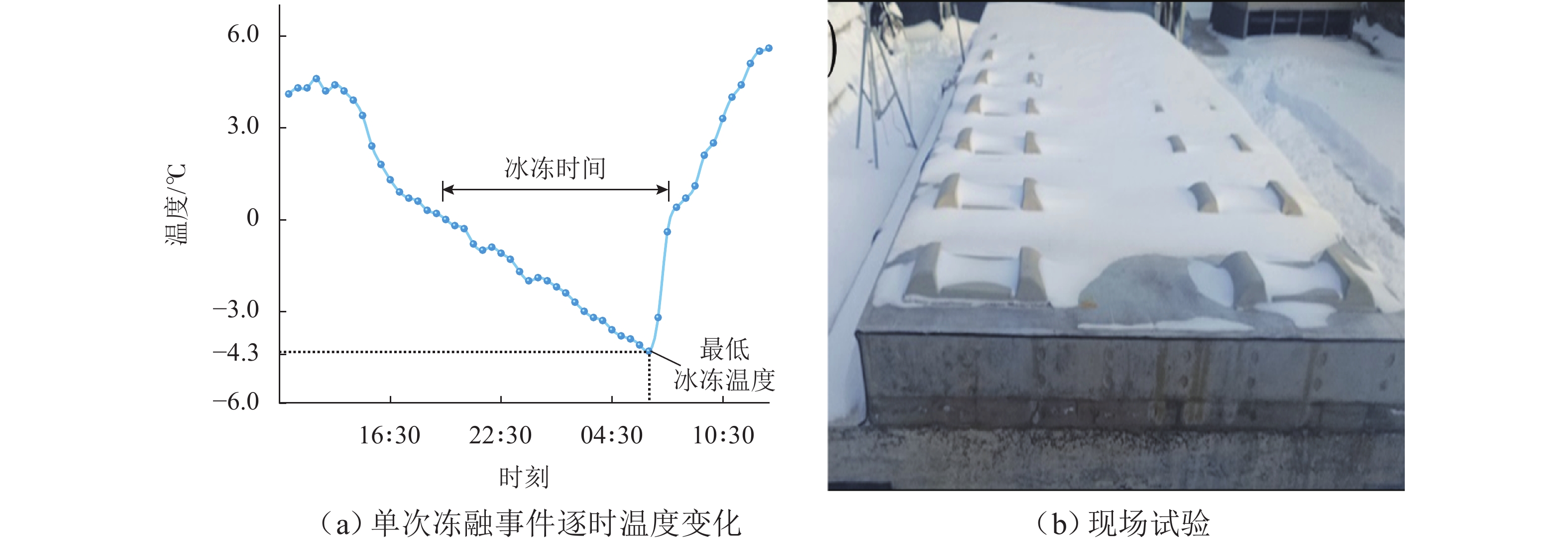
图 1 沈阳地区无砟轨道混凝土自然冻融条件下逐时温度演化过程
Figure 1. Hourly temperature evolution process of ballastless track concrete under natural freeze-thaw condition in Shenyang
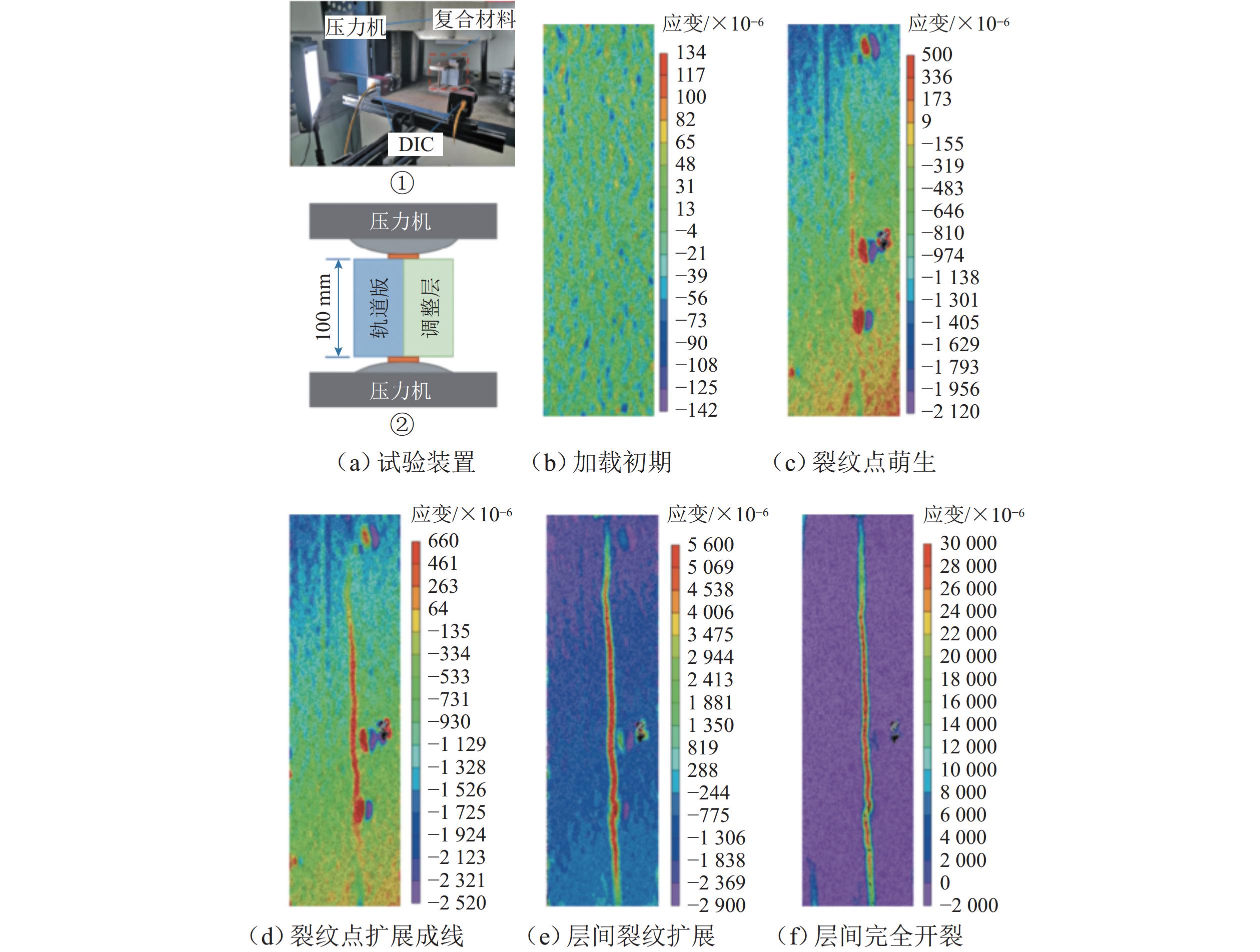
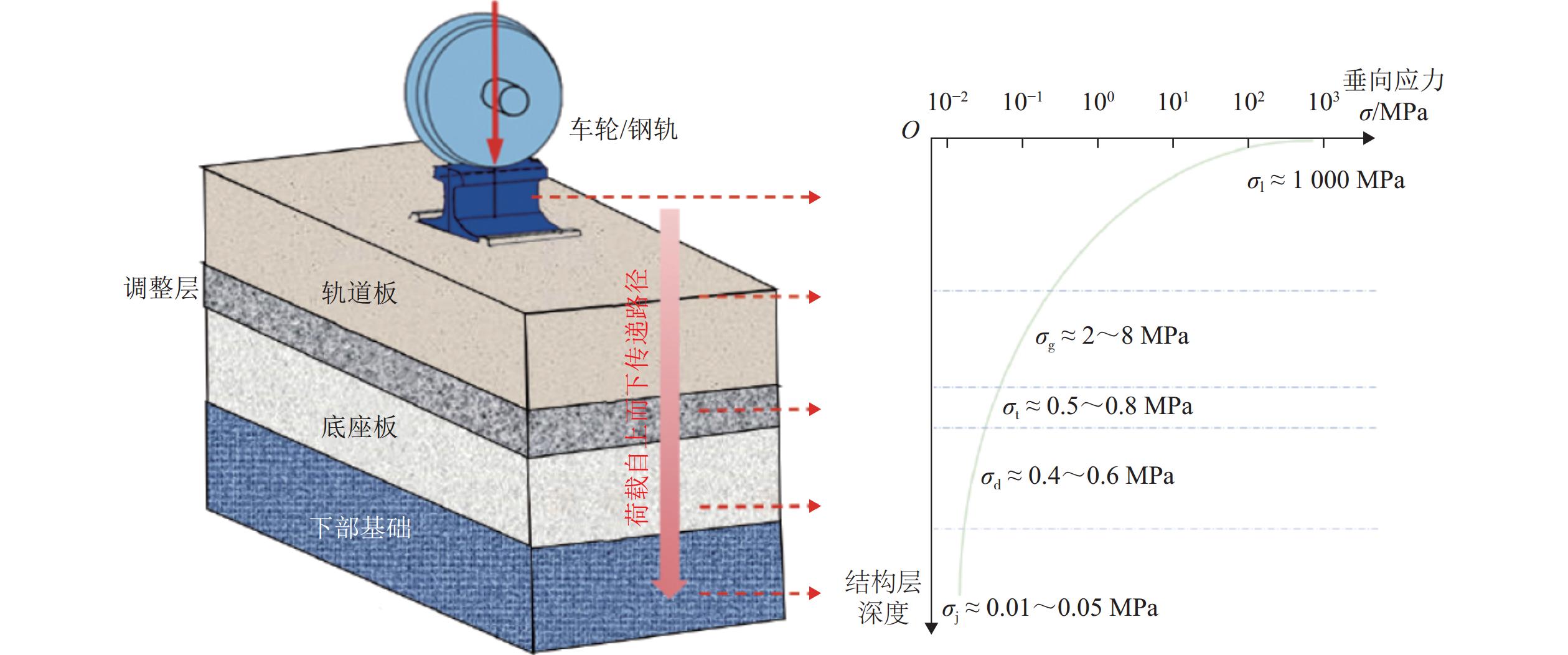
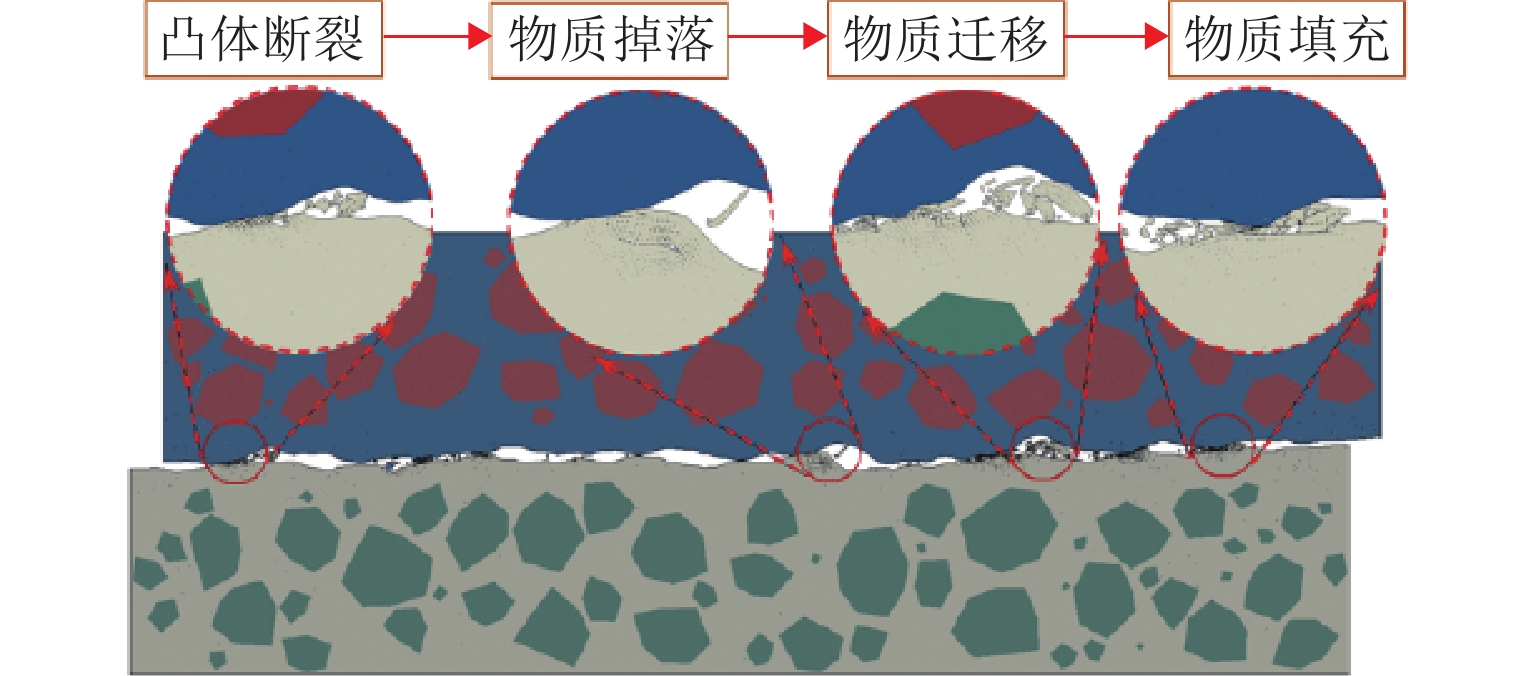
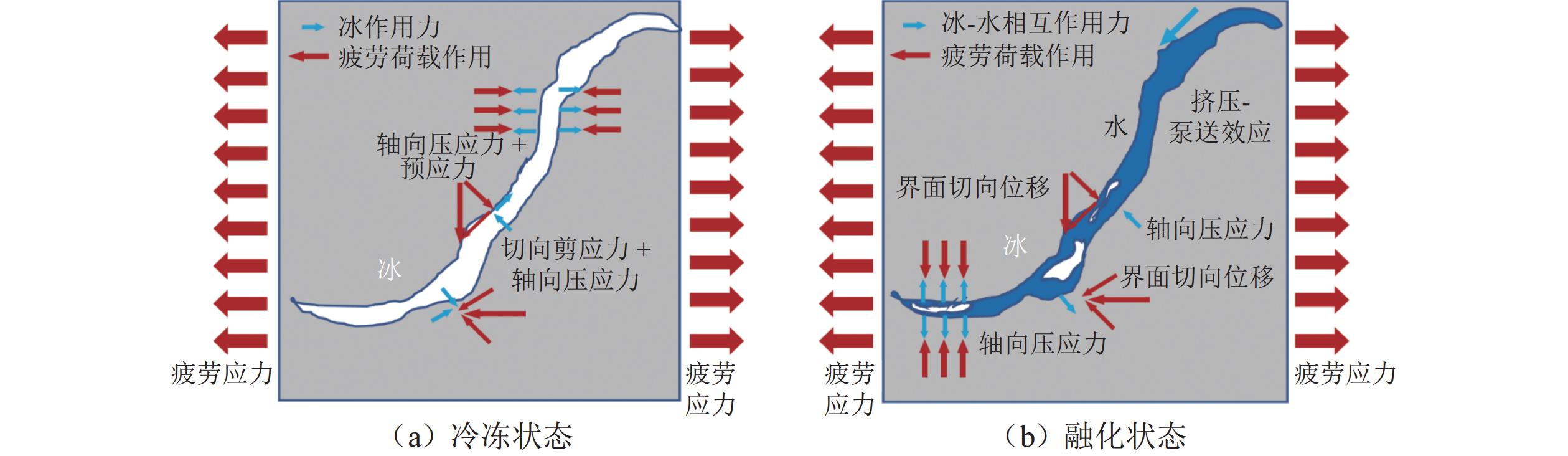
图 8 界面离缝形态细观演化机制
Figure 8. Mesoscopic evolution mechanism of interface separation morphology
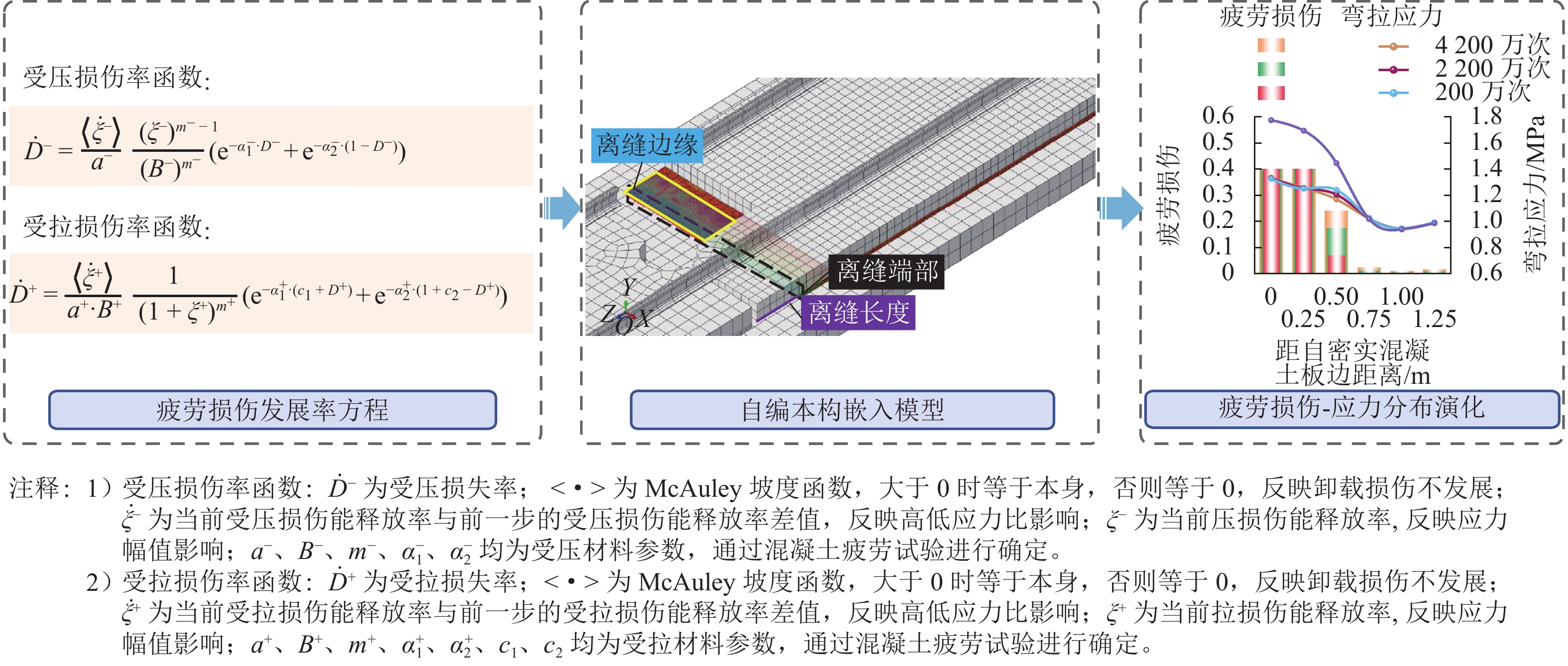
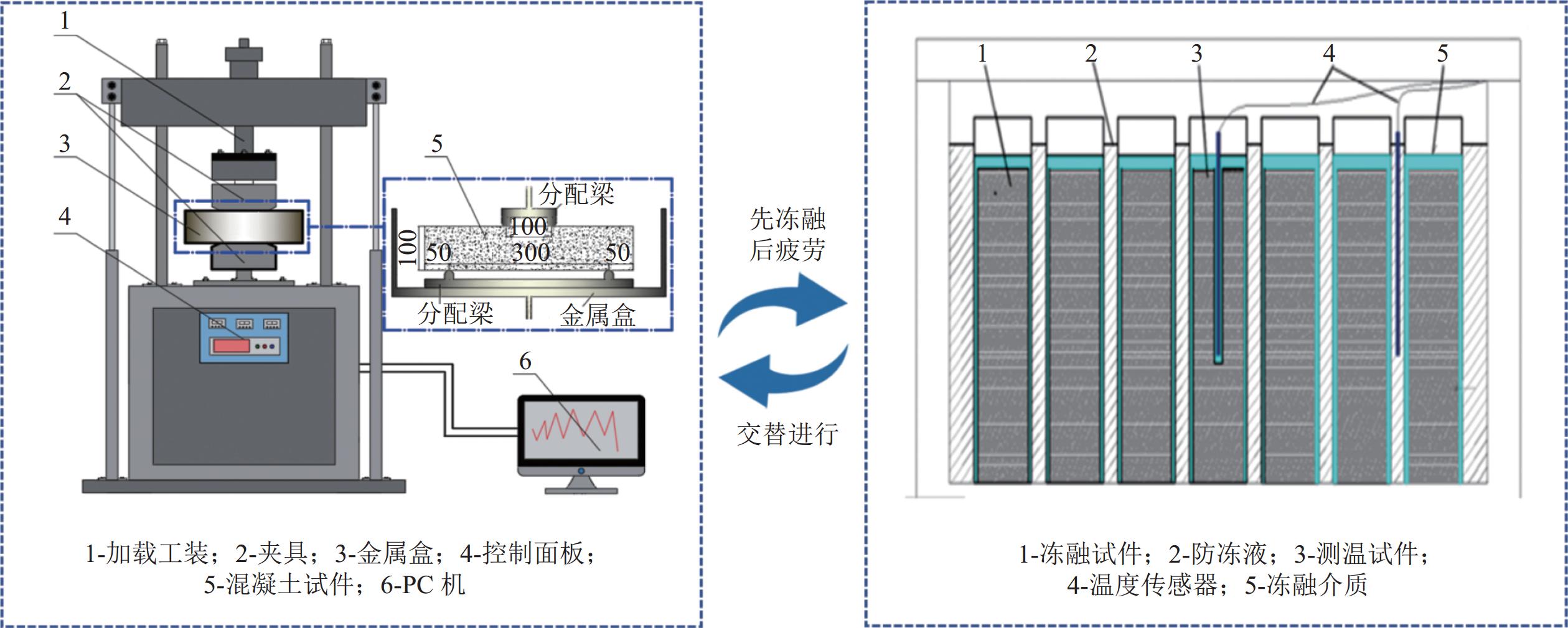
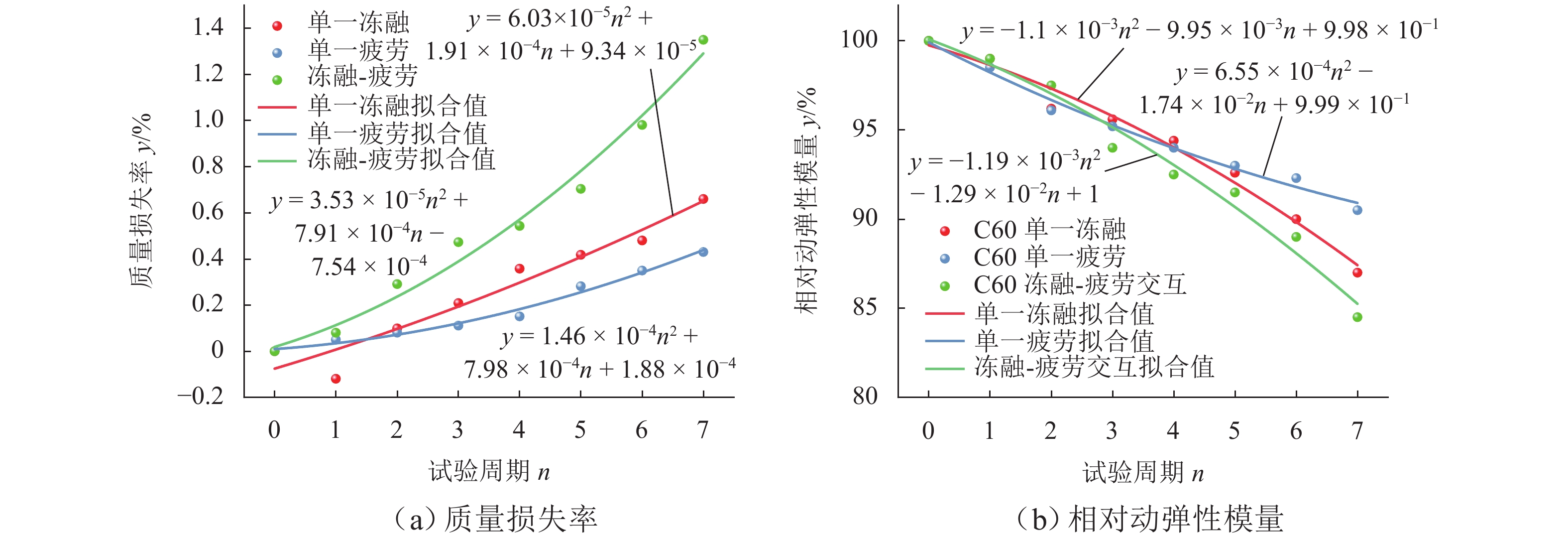
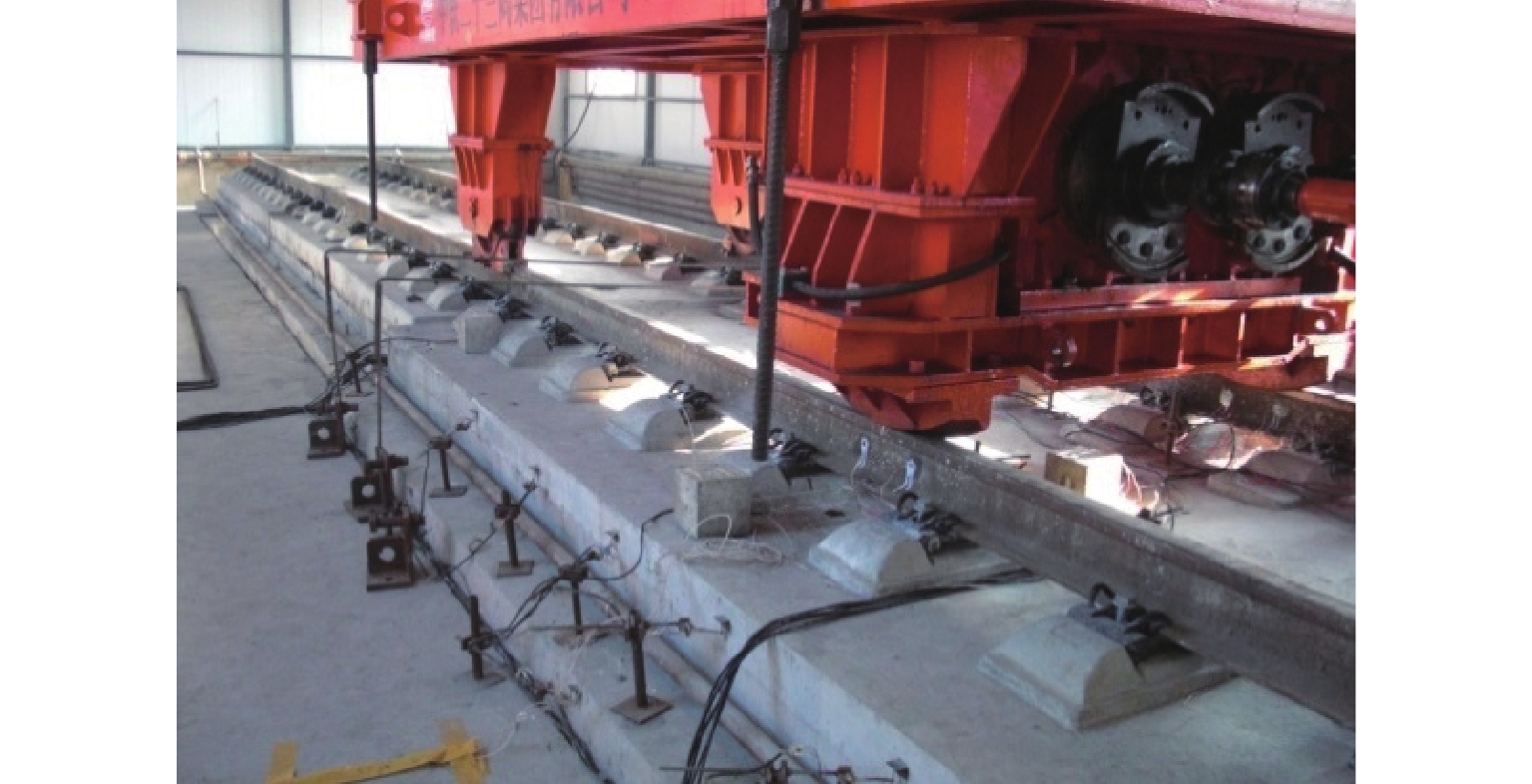
图 12 冻融与疲劳顺序耦合试验加载形式与装置
Figure 12. Loading form and device of freeze-thaw and fatigue sequential coupling test
城市 最冷月平均气温/℃ 年冻融循环次数/次 城市 最冷月平均气温/℃ 年冻融循环次数/次 哈尔滨 −19.7 129 拉萨 −2.3 100 牡丹江 −18.8 126 石家庄 −3.1 78 沈阳 −12.7 118 北京 −4.7 84 那曲 −13.8 183 银川 −9.2 89 长春 −16.7 120 大连 −5.3 109 延吉 −14.8 112 天津 −4.2 81 西宁 −10.9 157 济南 −1.7 70 乌鲁木齐 −8.6 111 西安 −1.3 87 兰州 −7.3 107 青岛 −2.6 68 呼和浩特 −13.2 123 郑州 −0.3 58 太原 −7.0 100 武汉 −0.3 47  下载: 导出CSV
表 2 冻融损伤比例系数K
Table 2. Freeze-thaw damage proportion coefficient K
气候区最冷月平均气温/℃ 受冻等级 K (−∞,−8] 严重受冻区 7 (−8,−4) 受冻区 12 [−4,0) 微冻区 17 [0,+∞) 偶冻区 23
下载: 导出CSV
表 3 冻融损伤微观表征方法及其适用性
Table 3. Microscopic characterization method of freeze-thaw damage and its applicability
方法 表征对象 可获取信息 主要优势 关键局限 MIP[38] 孔隙体系 孔径分布、连通性 可定量孔隙结构演化 破坏性,无法原位 低场 NMR[45] 冻结水与未冻水 水分状态、饱和度 直接反映冻融本质 空间分辨率低 XRD[39] 水化与结晶相 Ca(OH)2、CaCO3等 表征化学退化 无法空间表征 SEM[40] 微裂纹、界面过渡区 界面与裂纹形貌 分辨率高 仅局部视野 工业 CT[48] 孔隙与裂隙网络 三维损伤结构 非破坏、可视化 微米级分辨 超声波/弹性波[51] 整体损伤 波速、动态模量 可连续监测 间接表征 声发射(AE)[50] 裂纹活动 裂纹萌生与扩展 实时损伤监测 定位精度有限 DIC[52] 表面裂纹与界面 变形与开裂过程 原位力学可视 不反映内部
下载: 导出CSV
表 4 冻融劣化理论的核心假设及其在无砟轨道中的适用性
Table 4. Core assumption of freeze-thaw deterioration theory and its applicability in ballastless track
理论类型 核心物理机制 关键假设 无砟轨道适用性 主要局限 静水压理论[66] 冻结膨胀引起孔隙水压力 孔隙体系封闭、材料均质 可解释轨道板表层冻胀与剥落 难描述裂缝与界面处水分快速迁移 渗透压理论[68] 浓度梯度驱动水迁移 孔隙溶液连续、扩散控制 适用于盐冻区轨道板与砂浆层 难反映动力荷载下界面抽吸效应 热力学理论[69] 相变潜热与温度应力 冰晶均匀生长 可解释骨料-浆体界面开裂 难模拟轨道多层结构非均匀性 临界饱和度[70] 只有超饱和才冻损 饱和度空间均匀 适用于整体含水率评价 难描述裂缝尖端局部高饱和区 Weibull 统计损伤[72] 微单元随机失效 微裂纹服从概率分布 适合描述冻融导致的强度退化 不能反映界面损伤空间分布特征 指数型退化模型[73] 强度随冻融衰减 劣化过程可等效 适用于轨道板可靠度计算 不能给出裂缝与界面机理
下载: 导出CSV
表 5 混凝土材料疲劳损伤模型
Table 5. Fatigue damage model of concrete material
研究人员 损伤模型 说明 Lemaitre[130] $ D=B{Y}_{{\mathrm{p}}}\dot{\pi }\left(f,{\overline{\sigma }}_{{\mathrm{eq}}},R,T\right) $ 从细观角度探讨了微塑性损伤的演化机理 Marigo[131] $ D={\dot{\lambda }}_{{\mathrm{d}}}{f}^{{n_{\mathrm{s}}}}\dfrac{\partial f_{\mathrm{nor}}}{\partial Y} $ 以损伤加卸载准则取代经典损伤力学理论中的损伤面概念 MAZARS[132] $ D={\alpha }_{{\mathrm{t}}}{D}_{{\mathrm{t}}} + {\alpha }_{{\mathrm{c}}}{D}_{{\mathrm{c}}} $ 利用等效应变概念定义损伤阀值,将损伤变量分解为拉、压两部分 丁兆东、李杰[135-136] $ D=\displaystyle\int\nolimits_{0}^{1}\left[1-H\left({E}_{{\mathrm{s}}}-{E}_{{\mathrm{f}}}\right)\right]{\mathrm{d}}x $ 将疲劳过程能量耗散表达式引入上述细观随机断裂模型中
下载: 导出CSV
-
[1] 中国交通新闻网. 我国高铁营业里程突破五万公里 [EB/OL]. (2025-12-28)[2026-01-20]. https://www.mot.gov.cn/jiaotongyaowen/202512/t20251228_4191871.html. [2] 任娟娟, 张书义, 许雪山, 等. 寒区无砟轨道服役性能演化与提升技术研究进展[J]. 中国铁路, 2022(8): 76-87.REN Juanjuan, ZHANG Shuyi, XU Xueshan, et al. Progress of research on service performance evolution and improvement technology of ballastless track in cold regions[J]. China Railway, 2022(8): 76-87. [3] 许雪山. 冻融循环下无砟轨道混凝土损伤劣化及层间界面粘结性能研究[D]. 成都: 西南交通大学, 2023. [4] 刘大园, 庞玲, 姚力. 莫斯科至喀山高铁轨道设计综述[J]. 山西建筑, 2020, 46(11): 126-127, 184. doi: 10.3969/j.issn.1009-6825.2020.11.058LIU Dayuan, PANG Ling, YAO Li. The track design summary of high-speed railway from Moscow to Kazan[J]. Shanxi Architecture, 2020, 46(11): 126-127, 184. doi: 10.3969/j.issn.1009-6825.2020.11.058 [5] 张东卿, 薛元, 罗强, 等. 俄罗斯莫喀高铁抗冻胀基床结构研究[J]. 铁道工程学报, 2018, 35(4): 29-33.ZHANG Dongqing, XUE Yuan, LUO Qiang, et al. Research on the anti-frost subgrade bed structure of Moscow—Kazan high-speed railway in Russia[J]. Journal of Railway Engineering Society, 2018, 35(4): 29-33. [6] 刘启宾. 川藏铁路活动断层区域轨道结构设计方案研究[J]. 铁道标准设计, 2021, 65(8): 33-36.LIU Qibin. Research on design scheme of track structure in active fault zone of Sichuan—Tibet railway[J]. Railway Standard Design, 2021, 65(8): 33-36. [7] 李兵. 混凝土冻融蠕变特性及损伤破裂机理研究[D]. 徐州: 中国矿业大学, 2016. [8] Akagawa S, Hori M. Frost heaving in ballast railway tracks[J]. Sciences in Cold and Arid Regions, 2015, 7(05): 632-636. doi: 10.1016/j.proeng.2017.05.087 [9] BOGOMOLOVA N, BRYN M, NIKITCHIN A, et al. The study of railway embankment deformations in cold regions[C]//Transportation Soil Engineering in Cold Regions. Singapore: Springer, 2020: 223-229. [10] ROUSTAEI M, HENDRY M T. Frost action in Canadian railways: a review of assessment and treatment methods[J]. Journal of Cold Regions Engineering, 2023, 37(4): 03123001. doi: 10.1061/JCRGEI.CRENG-668 [11] KÖLIÖ A, RANTALA T, LAHDENSIVU J, et al. Freeze-thaw resistance testing of concrete railway sleepers[C]//Concrete Solutions 2014. Boca Raton: CRC Press, 2014: 533-539. [12] 池田泰博, 松田芳範, 三浦秀一朗. 鉄道コンクリート構造物の凍害と空気量調査[J]. インフラメンテナンス実践研究論文集, 2022, 1(1): 423-428. [13] MURATA I, YOSHIDA T, WATANABE Y. Evaluation of strength and maintenance methods for railway reinforced concrete structures with aged deterioration[C]//3rd International Conference on Sustainable Construction Materials and Technologies. Kyoto: [s.n.], 2013: 1-12. [14] 翟婉明, 赵春发, 夏禾, 等. 高速铁路基础结构动态性能演变及服役安全的基础科学问题[J]. 中国科学: 技术科学, 2014, 44(7): 645-660.ZHAI Wanming, ZHAO Chunfa, XIA He, et al. Basic scientific issues on dynamic performance evolution of the high-speed railway infrastructure and its service safety[J]. Scientia Sinica (Technologica), 2014, 44(7): 645-660. [15] 李洪攀, 刘琳, 韦悦. 冻融环境下水泥净浆吸水性能和微结构劣化[J]. 硅酸盐学报, 2023, 51(5): 1302-1310.LI Hongpan, LIU Lin, WEI Yue. Water absorption and microstructure deterioration of cement paste under freeze-thaw environment[J]. Journal of the Chinese Ceramic Society, 2023, 51(5): 1302-1310. [16] LI H J, YANG Z Q, WEN J X, et al. Service life prediction of ballastless track concrete under the coupling effect of fatigue loads and environmental actions: a review[J]. Journal of Sustainable Cement-Based Materials, 2023, 12(6): 672-686. doi: 10.1080/21650373.2022.2113172 [17] YANG Y Z, KHAN N M, AMIN M N, et al. Comparative study of statistical computational approaches to investigate the degraded compressive strength of concrete under the freeze-thaw effect[J]. Case Studies in Construction Materials, 2024, 21: e03744. doi: 10.1016/j.cscm.2024.e03744 [18] 王晨霞, 张炜泽, 曹芙波, 等. 干湿-冻融-盐侵作用下再生混凝土的寿命预测及敏感性分析[J/OL]. 西南交通大学学报, 2026-04-02. https://link.cnki.net/urlid/51.1277.u.20250424.0903.002. [19] 李林洁, 刘清风. 冻融循环下混凝土内部结冰及氯离子传输规律的数值研究[J]. 硅酸盐学报, 2022, 50(8): 2245-2256.LI Linjie, LIU Qingfeng. Numerical analysis on freezing rate and chloride transport in concrete subjected to freeze-thaw cycles[J]. Journal of the Chinese Ceramic Society, 2022, 50(8): 2245-2256. [20] 谢剑, 崔宁, 姜晓峰. 混凝土超低温冻融循环损伤机理及控制措施[J]. 硅酸盐通报, 2018, 37(8): 2367-2371, 2377.XIE Jian, CUI Ning, JIANG Xiaofeng. Mechanism and improvement of freeze-thaw deterioration of concrete under ultra-low temperature[J]. Bulletin of the Chinese Ceramic Society, 2018, 37(8): 2367-2371, 2377. [21] 娄平, 黄新德, 李传书, 等. 基于GEV模型的西南高原无砟轨道温度试验研究[J]. 铁道科学与工程学报, 2023, 20(3): 900-908. doi: 10.19713/j.cnki.43-1423/u.T20220315LOU Ping, HUANG Xinde, LI Chuanshu, et al. Experimental study on temperature of ballastless track in southwest plateau by GEV model[J]. Journal of Railway Science and Engineering, 2023, 20(3): 900-908. doi: 10.19713/j.cnki.43-1423/u.T20220315 [22] 张鹏飞, 余路, 江浩宇, 等. 持续高温环境下桥上CRTS Ⅲ型无砟轨道热响应分析[J]. 华东交通大学学报, 2025, 42(4): 80-87.ZHANG Pengfei, YU Lu, JIANG Haoyu, et al. Thermal response analysis of the CRTS Ⅲ type ballastless track on bridge under sustained high temperature environment[J]. Journal of East China Jiaotong University, 2025, 42(4): 80-87. [23] 张鹏飞, 余路, 江浩宇, 等. 高温条件下桥上Ⅲ型无砟轨道温度效应环境影响因素分析[J/OL]. 西南交通大学学报, 2026-01-30. https://link.cnki.net/urlid/51.1277.U.20250115.1618.017. [24] REN J J, QU C H, LIANG J, et al. Experimental study on temperature field characteristics of CRTS Ⅲ prefabricated slab track in cold regions[J]. Archives of Civil and Mechanical Engineering, 2024, 24(3): 152. doi: 10.1007/s43452-024-00921-w [25] LIN C, OU J P. Study and application of China's freeze-thaw action spectrums for life-cycle structure design[J]. Applied Mechanics and Materials, 2011, 9: 777-783. doi: 10.4028/www.scientific.net/amm.105-107.777 [26] 苏怀智, 谢威. 寒区水工混凝土冻融损伤及其防控研究进展[J]. 硅酸盐通报, 2021, 40(4): 1053-1071. doi: 10.16552/j.cnki.issn1001-1625.2021.04.001SU Huaizhi, XIE Wei. Review on frost damages of hydraulic concrete in cold region and its preventive control[J]. Bulletin of the Chinese Ceramic Society, 2021, 40(4): 1053-1071. doi: 10.16552/j.cnki.issn1001-1625.2021.04.001 [27] 李晔, 姚祖康, 孙旭毅, 等. 铺面水泥混凝土冻融环境量化研究[J]. 同济大学学报(自然科学版), 2004, 32(10): 1408-1412.LI Ye, YAO Zukang, SUN Xuyi, et al. Quantification research on the frost environment of pavement cement concrete[J]. Journal of Tongji University (Natural Science), 2004, 32(10): 1408-1412. [28] LIU T J, ZHANG M, ZOU D J, et al. Analysis and zonation of freeze–thaw action in the Chinese Plateau Region considering spatiotemporal climate characteristics[J]. Engineering, 2024, 42: 308-325. doi: 10.1016/j.eng.2024.04.016 [29] 谢浩然. 考虑冻融劣化损伤的无砟轨道力学特性研究[J]. 中国铁路, 2024(9): 15-23. doi: 10.19549/j.issn.1001-683x.2024.06.01.003XIE Haoran. Mechanical characteristics of ballastless track considering freeze-thaw deterioration damage[J]. Chinese Railways, 2024(9): 15-23. doi: 10.19549/j.issn.1001-683x.2024.06.01.003 [30] 全洪珠, 王存哲, 逄增铭, 等. 多孔生态混凝土抗冻耐久性能试验研究[J]. 混凝土, 2017(11): 191-194.QUAN Hongzhu, WANG Cunzhe, PANG Zengming, et al. Experimental research on antifreeze performance of eco-porous concrete[J]. Concrete, 2017(11): 191-194. [31] 张玫, 潘志忠, 王文仲, 等. 单面盐冻法评价路面混凝土抗冻性的适用性研究[J]. 混凝土, 2011(1): 5-8, 13.ZHANG Mei, PAN Zhizhong, WANG Wenzhong, et al. Applicability of single surface salt frost to evaluate frost resistance of pavement concrete[J]. Concrete, 2011(1): 5-8, 13. [32] FENG X H. Study on freeze-thaw relationship of concrete under laboratory and natural conditions[J]. IOP Conference Series: Earth and Environmental Science, 2019, 358(4): 042038. doi: 10.1088/1755-1315/358/4/042038 [33] 张伟杰, 盛广侠, 王兰心, 等. 复杂服役环境下无砟轨道水泥基材料性能演变的研究综述[J]. 材料导报, 2024, 38(22): 139-156.ZHANG Weijie, SHENG Guangxia, WANG Lanxin, et al. A review of the property evolution of cement-based materials for ballastless track under complex service environment[J]. Materials Reports, 2024, 38(22): 139-156. [34] 陆晨浩. 冻融及杂散电流环境下地铁工程混凝土耐久性研究[D]. 南京: 南京理工大学, 2020. [35] LIU X C, YANG X, ZHENG W Q, et al. Experimental study on the fatigue and freeze-thaw properties of geotextile isolation layer in CRTS Ⅲ ballastless tracks[J]. Case Studies in Construction Materials, 2023, 18: e01988. doi: 10.1016/j.cscm.2023.e01988 [36] 刘西拉, 唐光普. 现场环境下混凝土冻融耐久性预测方法研究[J]. 岩石力学与工程学报, 2007, 26(12): 2412-2419. doi: 10.3321/j.issn:1000-6915.2007.12.005LIU Xila, TANG Guangpu. Research on prediction method of concrete freeze-thaw durability under field environments[J]. Chinese Journal of Rock Mechanics and Engineering, 2007, 26(12): 2412-2419. doi: 10.3321/j.issn:1000-6915.2007.12.005 [37] 周明岩. 严寒地区高速铁路板式无砟轨道养护维修技术研究[D]. 北京: 中国铁道科学研究院, 2017. [38] LI B, MAO J Z, NAWA T, et al. Mesoscopic damage model of concrete subjected to freeze-thaw cycles using mercury intrusion porosimetry and differential scanning calorimetry (MIP-DSC)[J]. Construction and Building Materials, 2017, 147: 79-90. [39] JIANG L, NIU D T, YUAN L D, et al. Durability of concrete under sulfate attack exposed to freeze–thaw cycles[J]. Cold Regions Science and Technology, 2015, 112: 112-117. [40] MOLERO M, APARICIO S, AL-ASSADI G, et al. Evaluation of freeze–thaw damage in concrete by ultrasonic imaging[J]. NDT & E International, 2012, 52: 86-94. [41] 汪在芹, 李家正, 周世华, 等. 冻融循环过程中混凝土内部微观结构的演变[J]. 混凝土, 2012(1): 13-14.WANG Zaiqin, LI Jiazheng, ZHOU Shihua, et al. Development of microscopic structure of concrete exposed to freeze-thaw cycles[J]. Concrete, 2012(1): 13-14. [42] NG K, SUN Y, DAI Q L, et al. Investigation of internal frost damage in cementitious materials with micromechanics analysis, SEM imaging and ultrasonic wave scattering techniques[J]. Construction and Building Materials, 2014, 50: 478-485. [43] CHEN J X, DENG X H, LUO Y B, et al. Investigation of microstructural damage in shotcrete under a freeze–thaw environment[J]. Construction and Building Materials, 2015, 83: 275-282. [44] LI X L, BAI J P, WANG G X. Review of characterization and testing methods for the mechanical, microstructure, pore, permeability and freeze-thaw properties of porous concrete[J]. Advances in Research, 2025, 26(2): 428-436. [45] WANG Y Z, YANG W C, GE Y, et al. Analysis of freeze-thaw damage and pore structure deterioration of mortar by low-field NMR[J]. Construction and Building Materials, 2022, 319: 126097. [46] YANG J, ZHENG Z, YE X P, et al. Damage mechanism of airport pavement concrete undergoing freeze-thaw: the coupling effects of low-concentration deicers and carbonation[J]. Construction and Building Materials, 2025, 467: 140365. [47] SUZUKI T, SHIOTANI T, OHTSU M. Evaluation of cracking damage in freeze-thawed concrete using acoustic emission and X-ray CT image[J]. Construction and Building Materials, 2017, 136: 619-626. [48] ZHAO Y R, LI N, NIU H M, et al. Study on in-situ CT damage of concrete subjected to compressive loading after freeze-thaw cycles based on deep learning and DVC technology[J]. Construction and Building Materials, 2025, 482: 141599. [49] 李福海, 黄绍宁, 肖赛, 等. 高温-干湿循环作用下混凝土分区抗硫酸盐的侵蚀性能[J]. 西南交通大学学报, 2026, 61(1): 41-51.LI Fuhai, HUANG Shaoning, XIAO Sai, et al. Resistance against sulfate erosion of concrete partition under high temperature and dry-wet cycle[J]. Journal of Southwest Jiaotong University, 2026, 61(1): 41-51. [50] BAI W F, SONG Z, YUAN C Y, et al. Study on mechanical properties and damage mechanism of recycled concrete containing silica fume in freeze–thaw environment[J]. Construction and Building Materials, 2023, 375: 130872. [51] KIM R, MIN J, AHN E, et al. Assessment of degradation index in freeze-thaw damaged concrete using multi-channel contactless ultrasound[J]. Construction and Building Materials, 2022, 349: 128815. [52] LIU J H, ZHOU D W, CHENG L N, et al. Analysis of damage and fracture characteristics for concrete subjected to cryogenic freeze-thaw cycles: an acoustic emission and digital image correlation study[J]. Journal of Building Engineering, 2024, 94: 109841. [53] LI S G, CHEN G X, JI G J, et al. Quantitative damage evaluation of air-entrained concrete suffered freezing-thawing by digital-image-processing technique[J]. Journal of the Chinese Ceramic Society, 2014, 42(8): 951-959. [54] CHI K Y, LI J, SHAO R Z, et al. Experimental study on dynamic characterisation of ultra-high performance concrete (UHPC) after cryogenic freeze-thaw cycles[J]. Cement and Concrete Composites, 2025, 160: 106011. [55] ZHANG W, DUAN Z H, LIU C, et al. Performance optimisation and predictive modelling of rice husk ash recycled concrete under the coupled action of freeze-thaw cycles and chloride erosion: Experimental study and machine learning[J]. Construction and Building Materials, 2025, 481: 141467. [56] LIU S G, LU S, YIN L Q, et al. Mechanical strength model of engineered cementitious composites with freeze–thaw damage based on pore structure evolution[J]. Cement and Concrete Composites, 2022, 134: 104706. [57] 徐向美. 高速铁路无砟轨道现浇道床冻融破坏寿命预测分析[J]. 黑龙江交通科技, 2025, 48(9): 96-99, 124.XU Xiangmei. Prediction and analysis of freeze-thaw damage life of cast-in-place track bed for ballastless track of high-speed railway[J]. Communications Science and Technology Heilongjiang, 2025, 48(9): 96-99, 124. [58] 董昊良, 李化建, 杨志强, 等. 高速铁路无砟轨道现浇道床混凝土冻融破坏机理及寿命预测[J]. 铁道学报, 2024, 46(8): 112-120.DONG Haoliang, LI Huajian, YANG Zhiqiang, et al. Freeze-thaw damage mechanism and service life prediction of high-speed railway ballastless cast-in-place track concrete[J]. Journal of the China Railway Society, 2024, 46(8): 112-120. [59] CHEN W, LI S Q, WANG W D, et al. Analysis on crack propagation of CRTS Ⅲ slab ballastless track under temperature loads and freeze–thaw deterioration[J]. Theoretical and Applied Fracture Mechanics, 2024, 129: 104206. [60] LIU W G, DENG S J, REN J J, et al. Time-dependent reliability analysis of track slab in cold region under different thermal insulation measures[J]. Construction and Building Materials, 2025, 460: 139332. [61] 刘鹏, 王帅峰, 余志武, 等. CRTSⅢ型轨道层间劣化机理与协同工作性能评定研究综述[J/OL]. 铁道科学与工程学报, 2026-04-07. https://doi.org/10.19713/j.cnki.43-1423/u.T20251694. [62] XIE H R, XU L Y, YAN B. Mechanical properties of ballastless track considering freeze–thaw deterioration damage[J]. Mathematics, 2023, 11(10): 2289. [63] REN J J, DU W, YE W L, et al. Experimental and numerical analysis on interface damage of slab track under freeze-thaw cycles[J]. Journal of Central South University, 2024, 31(10): 3782-3806. [64] REN J J, LIU W G, LAI J L, et al. Performance deterioration and structural state diagnosis of slab tracks for high-speed railways: a review[J]. Engineering Failure Analysis, 2024, 158: 107955. [65] WANG Z D, ZENG Q, WANG L, et al. Characterizing blended cement pastes under cyclic freeze–thaw actions by electrical resistivity[J]. Construction and Building Materials, 2013, 44: 477-486. [66] KIM S, LEE Y, KIM J, et al. Influence of air content on the behavior of RC beams subjected to freezing and thawing[J]. International Journal of Concrete Structures and Materials, 2025, 19(1): 1-12. [67] 赵宗锐, 张文敏, 胡作龙, 等. 冻融循环作用对混凝土侵蚀及性能劣化研究综述[J]. 水利水电技术(中英文), 2025, 56(10): 226-242.ZHAO Zongrui, ZHANG Wenmin, HU Zuolong, et al. Review of influence of freeze-thaw cycles on concrete erosion and performance deterioration[J]. Water Resources and Hydropower Engineering, 2025, 56(10): 226-242. [68] POWERS T, HELMUTH R. Theory of volume changes in hardened portland cement paste during freezing[J]. Highway Research Board Proceedings, 1953, 32: 285-297. [69] EVERETT D H. The thermodynamics of frost damage to porous solids[J]. Transactions of the Faraday Society, 1961, 57: 1541-1551. [70] FAGERLUND G. The critical degree of saturation method of assessing the freeze/thaw resistance of concrete[J]. Matériaux et Construction, 1977, 10(4): 217-229. [71] 杨全兵. 混凝土盐冻破坏机理(Ⅰ): 毛细管饱水度和结冰压[J]. 建筑材料学报, 2007, 10(5): 522-527.YANG Quanbing. Mechanisms of deicer-frost scaling of concrete (Ⅰ): capillary-uptake degree of saturation and ice-formation pressure[J]. Journal of Building Materials, 2007, 10(5): 522-527. [72] 关虓, 牛荻涛, 王家滨, 等. 基于Weibull强度理论的混凝土冻融损伤本构模型研究[J]. 混凝土, 2015(5): 5-9, 13.GUAN Xiao, NIU Ditao, WANG Jiabin, et al. Study of the freezing-thawing damage constitutive model of concrete based on Weibull’s strength theory[J]. Concrete, 2015(5): 5-9, 13. [73] 祝金鹏, 李术才, 刘宪波, 等. 冻融环境下混凝土力学性能退化模型[J]. 建筑科学与工程学报, 2009, 26(1): 62-67.ZHU Jinpeng, LI Shucai, LIU Xianbo, et al. Mechanical property deterioration model for concrete in environment with freezing-thawing[J]. Journal of Architecture and Civil Engineering, 2009, 26(1): 62-67. [74] 徐善华, 王友德, 李安邦, 等. 冻融损伤混凝土重复受压本构关系[J]. 哈尔滨工业大学学报, 2015, 47(4): 104-110.XU Shanhua, WANG Youde, LI Anbang, et al. Dynamic constitutive relation of concrete with freeze-thaw damage under repeated loading[J]. Journal of Harbin Institute of Technology, 2015, 47(4): 104-110. [75] 曹大富, 富立志, 杨忠伟, 等. 冻融循环作用下混凝土受压本构特征研究[J]. 建筑材料学报, 2013, 16(1): 17-23, 32.CAO Dafu, FU Lizhi, YANG Zhongwei, et al. Study on constitutive relations of compressed concrete subjected to action of freezing-thawing cycles[J]. Journal of Building Materials, 2013, 16(1): 17-23, 32. [76] GUAN X, NIU D T, WANG J B, et al. Study of the freeze-thaw damage constitutive model of concrete based on WEIBULL’s strength theory[J]. Applied Mechanics and Materials, 2014, 584/585/586: 1322-1327. [77] 洪锦祥, 缪昌文, 黄卫, 等. 冻融损伤对混凝土疲劳性能的影响[J]. 土木工程学报, 2012, 45(6): 83-89.HONG Jinxiang, MIAO Changwen, HUANG Wei, et al. Influence of freeze-thaw damage on the fatigue life of concrete[J]. China Civil Engineering Journal, 2012, 45(6): 83-89. [78] 商怀帅, 欧进萍, 宋玉普. 混凝土结构冻融损伤理论及冻融可靠度分析[J]. 工程力学, 2011, 28(1): 70-74.SHANG Huaishuai, OU Jinping, SONG Yupu. Analysis on reliability and freeze-thaw damage theory of concrete[J]. Engineering Mechanics, 2011, 28(1): 70-74. [79] 龙广成, 刘赫, 马昆林, 等. 考虑冻融作用的混凝土单轴压缩损伤本构模型[J]. 中南大学学报(自然科学版), 2018, 49(8): 1884-1892.LONG Guangcheng, LIU He, MA Kunlin, et al. Uniaxial compression damage constitutive model of concrete subjected to freezing and thawing[J]. Journal of Central South University (Science and Technology), 2018, 49(8): 1884-1892. [80] 乔宏霞, 苏睿, 李琼, 等. 基于Weibull分布的不同冻融介质下再生骨料透水混凝土耐久性能研究[J]. 功能材料, 2023, 54(3): 134-142.QIAO Hongxia, SU Rui, LI Qiong, et al. Study on durability of recycled aggregate pervious concrete under different freezing-thawing media based on weibull distribution[J]. Journal of Functional Materials, 2023, 54(3): 134-142. [81] REN J J, XU H, LIU W G, et al. Damage and deformation of concrete base under the sunny-shady slopes effect in seasonal freeze regions[J]. Engineering Failure Analysis, 2025, 169: 109228. [82] 祝文君, 任懿, 于中旭, 等. 日本寒冷地区无砟轨道砂浆层病害与维护进展[J]. 铁道建筑技术, 2023(8): 59-61, 74.ZHU Wenjun, REN Yi, YU Zhongxu, et al. Advances in the maintenance technique of mortar layer defects in slab ballastless track in cold regions of Japan[J]. Railway Construction Technology, 2023(8): 59-61,74. [83] 闫斌, 谢浩然, 沈青川, 等. 季冻区CRTSⅠ型无砟轨道不平顺规律及受力特性[J]. 哈尔滨工业大学学报, 2021, 53(3): 110-117.YAN Bin, XIE Haoran, SHEN Qingchuan, et al. Irregularity properties and stress characteristics of CRTS Ⅰ ballastless track in seasonal frozen area[J]. Journal of Harbin Institute of Technology, 2021, 53(3): 110-117. [84] GE X, TAN Y B, DU S, et al. A new test method for freeze-thaw resistance of ballastless track structure concrete: experiment and model[J]. Magazine of Concrete Research, 2022, 75(9): 464-475. [85] 翟婉明, 蔡成标, 王开云. 高速列车-轨道-桥梁动态相互作用原理及模型[J]. 土木工程学报, 2005, 38(11): 132-137.ZHAI Wanming, CAI Chengbiao, WANG Kaiyun. Mechanism and model of high-speed train-track-bridge dynamic interaction[J]. China Civil Engineering Journal, 2005, 38(11): 132-137. [86] GRASSE J S, WEI S H, EDWARDS J R, et al. Field study of load path in rail and concrete crosstie system[J]. Electronic Journal of Structural Engineering, 2014, 14: 29-38. [87] LI D Q, DICK S, SUSSMANN T, et al. Long-term performance of slab track designed for shared passenger and freight operations and tested under heavy freight train[EB/OL]. (2016-05-12)[2026-04-02]. https://www.researchgate.net/publication/303667476. [88] 张一喆, 张志超, 杜瑞涛, 等. 不同线路条件下高速列车轮轨力的试验研究[J]. 机械工程学报, 2023, 59(10): 323-332.ZHANG Yizhe, ZHANG Zhichao, DU Ruitao, et al. Experimental research on wheel-rail force of EMU under different line conditions[J]. Journal of Mechanical Engineering, 2023, 59(10): 323-332. [89] 高亮, 殷浩, 徐旸, 等. 基于离散元法的散体道床与基床表层耦合变形机理研究[J]. 振动与冲击, 2018, 37(07): 186-192, 226.GAO Liang, YIN Hao, XU Yang, et al. Mechanism of ballast bed-bedding surface coupled deformation based on DEM[J]. Journal of Vibration and Shock, 2018, 37(07): 186-192, 226. [90] 祁亚运, 张文谦, 贺星, 等. 制动工况下重载货车车辆动力学响应分析[J/OL]. 西南交通大学学报, 2026-04-02. https://link.cnki.net/urlid/51.1277.U.20250226.1308.002. [91] 练松良, 刘加华, 李新国, 等. 客运专线缓和曲线参数合理性的试验验证[J]. 铁道学报, 2006, 28(6): 88-92.LIAN Songliang, LIU Jiahua, LI Xinguo, et al. Test verification of rationality of transition curve parameters of dedicated passenger traffic railway lines[J]. Journal of the China Railway Society, 2006, 28(6): 88-92. [92] CAI Y, ZHANG L F. Vibration responses of fixed-simply supported thin-walled beams under moving random wheel–rail forces[J]. Mechanics Based Design of Structures and Machines, 2025, 53(11): 7662-7687. [93] WANG B, YU H L, WANG Z W, et al. Closed-form solutions for non-stationary responses of Euler beams with general boundary conditions under fully coherent stochastic wheel-rail forces[J]. Probabilistic Engineering Mechanics, 2025, 81: 103796. [94] 任娟娟, 徐家铎, 田根源, 等. 客货共线无砟轨道轮轨力统计特征研究[J]. 工程力学, 2018, 35(2): 239-248.REN Juanjuan, XU Jiaduo, TIAN Genyuan, et al. Field test and statistical characteristics of wheel-rail force for slab track with passenger and freight traffic[J]. Engineering Mechanics, 2018, 35(2): 239-248. [95] 周颖, 陈瑾. 高速铁路无砟轨道路基结构荷载传递规律研究[J]. 铁道工程学报, 2016, 33(5): 18-24.ZHOU Ying, CHEN Jin. Research on the load transfer rule in ballastless track subgrade system of high-speed railway[J]. Journal of Railway Engineering Society, 2016, 33(5): 18-24. [96] 郭杰, 赵坪锐. 无砟轨道荷载分配特征与影响因素研究[J]. 铁道建筑, 2021, 61(3): 103-106, 112.GUO Jie, ZHAO Pingrui. Study on load distribution characteristics and influencing factors of ballastless track[J]. Railway Engineering, 2021, 61(3): 103-106,112. [97] 任娟娟, 闫亚飞, 胡华锋, 等. 客货共线无砟轨道钢轨支点压力时程特性分析方法[J]. 交通运输工程学报, 2019, 19(2): 82-91.REN Juanjuan, YAN Yafei, HU Huafeng, et al. Analysis method on time-history characteristics of rail supporting force for mixed passenger and freight railway with ballastless track[J]. Journal of Traffic and Transportation Engineering, 2019, 19(2): 82-91. [98] 赵国堂, 张鲁顺, 赵磊. 高速铁路CRTSⅢ型板式无砟轨道车辆荷载横向传递规律研究[J]. 北京交通大学学报, 2019, 43(1): 7-17.ZHAO Guotang, ZHANG Lushun, ZHAO Lei. Study on lateral transmission law of vehicle load on CRTS Ⅲ ballastless track of high-speed railway[J]. Journal of Beijing Jiaotong University, 2019, 43(1): 7-17. [99] 翟婉明, 王少林. 桥梁结构刚度对高速列车—轨道—桥梁耦合系统动力特性的影响[J]. 中国铁道科学, 2012, 33(1): 19-26.ZHAI Wanming, WANG Shaolin. Influence of bridge structure stiffness on the dynamic performance of high-speed train-track-bridge coupled system[J]. China Railway Science, 2012, 33(1): 19-26. [100] 蔡成标, 翟婉明, 王开云. 遂渝线路基上板式轨道动力性能计算及评估分析[J]. 中国铁道科学, 2006, 27(4): 17-21.CAI Chengbiao, ZHAI Wanming, WANG Kaiyun. Calculation and assessment analysis of the dynamic performance for slab track on Sui-yu railway[J]. China Railway Science, 2006, 27(4): 17-21. [101] 任娟娟, 邓世杰, 闫亚飞, 等. 列车荷载对板式无砟轨道力学性能的影响分析[J]. 西南交通大学学报, 2019, 54(6): 1210-1218.REN Juanjuan, DENG Shijie, YAN Yafei, et al. Influence of train load on mechanical property of prefabricated slab track[J]. Journal of Southwest Jiaotong University, 2019, 54(6): 1210-1218. [102] SADEGHI J, LIRAVI H, ESMAEILI M H. Experimental investigation on loading pattern of railway concrete slabs[J]. Construction and Building Materials, 2017, 153: 481-495. [103] YANG J W, LIU P S, WANG X H, et al. Dynamic analysis of slab track with crack considering rail corrugation[J]. KSCE Journal of Civil Engineering, 2023, 27(12): 5190-5202. [104] 梁飞. CRTSI型板式无砟轨道力学特性研究[D]. 长沙: 中南大学, 2013. [105] LIU X C, YU Z W, XIANG P, et al. Composite action of the track slab and the self-compacting concrete filling layer subjected to train-induced fatigue load: an experimental investigation[J]. Proceedings of the Institution of Mechanical Engineers, Part F: Journal of Rail and Rapid Transit, 2019, 233(5): 580-592. [106] REN J J, DENG S J, WEI K, et al. Mechanical property deterioration of the prefabricated concrete slab in mixed passenger and freight railway tracks[J]. Construction and Building Materials, 2019, 208: 622-637. [107] DENG S J, REN J J, XU H, et al. Analysis of damage evolution in ballastless track concrete under freeze–thaw and fatigue interactions[J]. International Journal of Fatigue, 2025, 200: 109121. [108] 温家馨, 李化建, 黄法礼, 等. 高速铁路无砟轨道混凝土疲劳性能试验制度[J]. 铁道建筑, 2022, 62(12): 7-11.WEN Jiaxin, LI Huajian, HUANG Fali, et al. Fatigue performance test system for ballastless track concrete of high speed railway[J]. Railway Engineering, 2022, 62(12): 7-11. [109] WEN J X, LI H J, YANG Z Q, et al. Damage evaluation of ballastless track concrete under high frequency flexural fatigue loading based on surface resistivity[J]. Construction and Building Materials, 2024, 411: 134363. [110] WEN J X, LI H J, SHI H N, et al. Fatigue behavior of ballastless track concrete in high-speed railways under different operating speeds[J]. Railway Engineering Science, 2026, 34(1): 149-158. [111] 徐桂弘, 任旭, 汪权明, 等. “轨道板-CA砂浆-支承层”复合模型(TCC)试件累积损伤特性研究[J]. 铁道学报, 2021, 43(3): 142-148.XU Guihong, REN Xu, WANG Quanming, et al. Study on cumulative damage characteristics of TCC composite model specimen under bending fatigue loading[J]. Journal of the China Railway Society, 2021, 43(3): 142-148. [112] 王明昃, 蔡成标, 张嘉伟, 等. 双块式无砟轨道混凝土界面疲劳性能试验研究[J]. 铁道学报, 2021, 43(4): 117-124.WANG Mingze, CAI Chengbiao, ZHANG Jiawei, et al. Experimental study on fatigue performance of concrete interface of double-block ballastless track[J]. Journal of the China Railway Society, 2021, 43(4): 117-124. [113] 张子龙. CRTS Ⅲ型板式无砟轨道复合板界面损伤力学模型试验研究[D]. 长沙: 中南大学, 2022. [114] 冯什. CRTSⅠ型板式无砟轨道原型疲劳试验研究[D]. 成都: 西南交通大学, 2014. [115] 张嘉伟. 高速车辆及环境荷载下无砟轨道层间损伤力学行为及演化研究[D]. 成都: 西南交通大学, 2022. [116] 刘学毅, 刘丹, 赵坪锐, 等. CRTS Ⅲ型板式无砟轨道疲劳性能试验研究[J]. 铁道工程学报, 2016, 33(11): 51-56, 112.LIU Xueyi, LIU Dan, ZHAO Pingrui, et al. Experimental research on the fatigue behavior test of CRTS Ⅲ slab track[J]. Journal of Railway Engineering Society, 2016, 33(11): 51-56, 112. [117] 吴斌, 朱坤腾, 曾志平, 等. 列车荷载作用下CRTSⅢ型板式无砟轨道力学特性试验研究[J]. 铁道科学与工程学报, 2016, 13(7): 1229-1233.WU Bin, ZHU Kunteng, ZENG Zhiping, et al. Experimental study on the mechanical characteristics of CRTSⅢ slab ballastless track under train load[J]. Journal of Railway Science and Engineering, 2016, 13(7): 1229-1233. [118] 曾志平, 何贤丰, 余志武, 等. 重载列车作用下CRTSⅢ型板式轨道结构力学特性试验研究[J]. 铁道科学与工程学报, 2018, 15(3): 581-588.ZENG Zhiping, HE Xianfeng, YU Zhiwu, et al. Experimental study on the mechanical characteristics of CRTSⅢ slab ballastless track under heavy-haul train[J]. Journal of Railway Science and Engineering, 2018, 15(3): 581-588. [119] ZENG Z P, WANG J D, SHEN S W, et al. Experimental study on evolution of mechanical properties of CRTS Ⅲ ballastless slab track under fatigue load[J]. Construction and Building Materials, 2019, 210: 639-649. [120] 许钊荣, 李莹, 董昆灵, 等. 桥上长枕埋入式无砟轨道疲劳试验[J]. 铁道科学与工程学报, 2022, 19(4): 917-924.XU Zhaorong, LI Ying, DONG Kunling, et al. Fatigue test of buried ballastless track with long sleepers over bridge deck[J]. Journal of Railway Science and Engineering, 2022, 19(4): 917-924. [121] 苗帅杰, 钟阳龙, 高亮, 等. 列车循环荷载下完全装配式无砟轨道结构疲劳性能试验研究[J]. 中南大学学报(自然科学版), 2023, 54(12): 4933-4945.MIAO Shuaijie, ZHONG Yanglong, GAO Liang, et al. Experimental study on fatigue performance of fully assembled ballastless track structure under vehicle cyclic load[J]. Journal of Central South University (Science and Technology), 2023, 54(12): 4933-4945. [122] POVEDA E, YU R C, LANCHA J C, et al. A numerical study on the fatigue life design of concrete slabs for railway tracks[J]. Engineering Structures, 2015, 100: 455-467. [123] 杨俊斌, 赵坪锐, 刘永孝, 等. 列车荷载对CRTSⅠ型板式轨道疲劳损伤的影响研究[J]. 铁道标准设计, 2013, 57(10): 19-23.YANG Junbin, ZHAO Pingrui, LIU Yongxiao, et al. Influence of train load on fatigue damage to CRTS Ⅰ slab track[J]. Railway Standard Design, 2013, 57(10): 19-23. [124] YU Z W, XIE Y, SHAN Z, et al. Fatigue performance of CRTS Ⅲ slab ballastless track structure under high-speed train load based on concrete fatigue damage constitu-tive law[J]. Journal of Advanced Concrete Technology, 2018, 16(5): 233-249. [125] 朱胜阳, 蔡成标. 一种高速铁路无砟轨道混凝土结构疲劳损伤模型[J]. 中国科学(技术科学), 2014, 44(7): 714-721.ZHU Shengyang, CAI Chengbiao. A fatigue damage model of concrete structure for ballastless track in high-speed railway[J]. Scientia Sinica (Technologica), 2014, 44(7): 714-721. [126] WIEDMANN A, WEISE F, KOTAN E, et al. Effects of fatigue loading and alkali–silica reaction on the mechanical behavior of pavement concrete[J]. Structural Concrete, 2017, 18(4): 539-549. [127] VICENTE M A, RUIZ G, GONZÁLEZ D C, et al. CT-Scan study of crack patterns of fiber-reinforced concrete loaded monotonically and under low-cycle fatigue[J]. International Journal of Fatigue, 2018, 114: 138-147. [128] SKARŻYŃSKI Ł, MARZEC I, TEJCHMAN J. Fracture evolution in concrete compressive fatigue experiments based on X-ray micro-CT images[J]. International Journal of Fatigue, 2019, 122: 256-272. [129] 邓世杰. 基于损伤-有限元耦合的无砟轨道疲劳损伤演化行为研究[D]. 成都: 西南交通大学, 2022. [130] LEMAITRE J. Coupled elasto-plasticity and damage constitutive equations[J]. Computer Methods in Applied Mechanics and Engineering, 1985, 51(1/2/3): 31-49. [131] MARIGO J J. Modelling of brittle and fatigue damage for elastic material by growth of microvoids[J]. Engineering Fracture Mechanics, 1985, 21(4): 861-874. [132] MAZARS J. A description of micro- and macroscale damage of concrete structures[J]. Engineering Fracture Mechanics, 1986, 25(5/6): 729-737. [133] YADAV I N, THAPA K B. Fatigue damage model of concrete materials[J]. Theoretical and Applied Fracture Mechanics, 2020, 108: 102578. [134] TITSCHER T, UNGER J F. Efficient higher-order cycle jump integration of a continuum fatigue damage model[J]. International Journal of Fatigue, 2020, 141: 105863. [135] 丁兆东, 李杰. 基于微-细观机理的混凝土疲劳损伤本构模型[J]. 力学学报, 2014, 46(6): 911-919.DING Zhaodong, LI Jie. The fatigue constitutive model of concrete based on micro-meso mechanics[J]. Chinese Journal of Theoretical and Applied Mechanics, 2014, 46(6): 911-919. [136] LIANG J S, REN X D, LI J. A competitive mechanism driven damage-plasticity model for fatigue behavior of concrete[J]. International Journal of Damage Mechanics, 2016, 25(3): 377-399. [137] SONG L, SHI J R, WU J, et al. Investigating the fatigue performance of conventional reinforced concrete CRTS Ⅲ ballastless track structures using a fatigue damage constitutive model[J]. Engineering Structures, 2024, 303: 117504. [138] 黄进新. 混凝土疲劳损伤快速分析方法及其在高铁无砟轨道板中的应用[D]. 广州: 华南理工大学, 2020. [139] 梁俊松. 混凝土疲劳损伤本构关系与结构随机疲劳可靠性分析[D]. 上海: 同济大学, 2017. [140] DENG S J, REN J J, LIANG J Y, et al. Fatigue damage evolution process of the slab track considering T-C asymmetric damage energy release rate[J]. Construction and Building Materials, 2025, 505: 144773. [141] CAI H, LIU X. Freeze-thaw durability of concrete: ice formation process in pores[J]. Cement and Concrete Research, 1998, 28(9): 1281-1287. [142] LI W T, SUN W, JIANG J Y. Damage of concrete experiencing flexural fatigue load and closed freeze/thaw cycles simultaneously[J]. Construction and Building Materials, 2011, 25(5): 2604-2610. [143] QIAO Y F, SUN W, JIANG J Y. Damage process of concrete subjected to coupling fatigue load and freeze/thaw cycles[J]. Construction and Building Materials, 2015, 93: 806-811. [144] XU Y Q, YUAN Q, DE SCHUTTER G, et al. Detecting the damage of concrete subjected to fatigue load coupled with freeze-thaw cycles using alternating current electric impedance spectroscopy[J]. Cement and Concrete Composites, 2023, 142: 105224. [145] XU Y Q, YUAN Q, DE SCHUTTER G, et al. Mechanism of concrete damage under the coupled action of freeze-thaw cycle and low-stress impact fatigue load: From pore structure to energy dissipation[J]. Construction and Building Materials, 2024, 436: 136980. [146] YIN T Y, ZHU W Q, XU B, et al. Deterioration law of flexural performance of RC beams with initial cracks under alternating action of salt freeze-thaw cycles and fatigue[J]. Construction and Building Materials, 2023, 409: 134052. [147] SHEN A Q, LIN S L, GUO Y C, et al. Relationship between flexural strength and pore structure of pavement concrete under fatigue loads and Freeze-thaw interaction in seasonal frozen regions[J]. Construction and Building Materials, 2018, 174: 684-692. [148] YI H N, YANG R S, LIANG S Q, et al. Micromechanical behavior of ballastless track structures concrete in cold region[J]. Construction and Building Materials, 2025, 484: 141855. [149] LIU W G, DENG S J, REN J J, et al. Time-dependent reliability analysis and life prediction of track slab considering freeze–thaw and fatigue loads[J]. Engineering Failure Analysis, 2026, 183: 110248. [150] LU J Z, ZHU K F, TIAN L Z, et al. Dynamic compressive strength of concrete damaged by fatigue loading and freeze-thaw cycling[J]. Construction and Building Materials, 2017, 152: 847-855. [151] 田立宗, 逯静洲, 朱孔峰, 等. 冻融循环与疲劳荷载作用下混凝土损伤研究[J]. 长江科学院院报, 2018, 35(2): 140-144, 150.TIAN Lizong, LU Jingzhou, ZHU Kongfeng, et al. Damage of concrete under freeze-thaw cycles and fatigue load[J]. Journal of Yangtze River Scientific Research Institute, 2018, 35(2): 140-144, 150. [152] 张益多, 刘荣桂, 陈好, 等. 冻融和疲劳对预应力受弯构件损伤的影响[J]. 力学与实践, 2011, 33(6): 55-58, 34.ZHANG Yiduo, LIU Ronggui, CHEN Hao, et al. The influence of freeze-thawing and fatigue load on the damage of prestressed concrete beams[J]. Mechanics in Engineering, 2011, 33(6): 55-58, 34. [153] PAROLKAR R, CHAUDHARY S. Dynamic Duo: understanding the interplay between fatigue and freeze-thaw in concrete durability[J]. Construction and Building Materials, 2025, 489: 142309. [154] CHENG H B, AHMAD I, SHOKOUHIAN M, et al. Enhancing flexural fatigue performance of recycled aggregate concrete under freeze–thaw cycles through aggregate and cement matrix modification: effects, prediction models, and mechanisms[J]. Construction and Building Materials, 2025, 481: 141571. [155] LI H Z, XU H N, TAN Y Q, et al. Investigation of asphalt concrete damage under the combined action of freeze-thaw and load using DIC-CT method[J]. Engineering Failure Analysis, 2026, 186: 110535. [156] 李福海, 李洲, 张宇轩, 等. 聚合物混杂纤维增强水泥基复合材料性能研究与评估[J/OL]. 西南交通大学学报, 2026-04-02. https://link.cnki.net/urlid/51.1277.u.20250605.1108.004. [157] 洪杰, 张悦, 彭宁波, 等. 冻融循环作用下的建筑灰岩风化特性演变[J]. 西南交通大学学报, 2026, 61(2): 616-625.HONG Jie, ZHANG Yue, PENG Ningbo, et al. Evolution of weathering characteristics of building limestone under freeze-thaw cycles[J]. Journal of Southwest Jiaotong University, 2026, 61(2): 616-625. [158] HASAN M, UEDA T, SATO Y. Stress-strain relationship of frost-damaged concrete subjected to fatigue loading[J]. Journal of Materials in Civil Engineering, 2008, 20(1): 37-45. [159] FORGERON D, TROTTIER J. Evaluating the effects of combined freezing and thawing and flexural fatigue loading cycles on the fracture properties of FRC[J]. WIT Transactions on the Built Environment, 2004, 76: 138017547. [160] LAPPA E S. High strength fibre reinforced concrete [D]. Berlin: Technische Universität, 2007. [161] 刘荣桂, 刘涛, 周伟玲, 等. 受疲劳荷载作用后的预应力混凝土构件冻融循环试验与损伤模型[J]. 南京工业大学学报(自然科学版), 2011, 33(3): 22-27.LIU Ronggui, LIU Tao, ZHOU Weiling, et al. Freeze-thaw cycle test and damage mechanics model of PC members after fatigue loads[J]. Journal of Nanjing Tech University (Natural Science Edition), 2011, 33(3): 22-27. [162] 韩文宇. 冻融循环-疲劳荷载耦合条件下混凝土损伤本构关系研究[D]. 烟台: 烟台大学, 2023. [163] YU Z X, HOU Y L, LV D S. Study on the mechanism and service life prediction of freeze resistance in basalt fiber-reinforced recycled aggregate concrete (BFRAC) under flexural fatigue loading[J]. Construction and Building Materials, 2025, 492: 143084. [164] 温家馨, 李化建, 石贺男, 等. 寒区无砟轨道机制砂混凝土疲劳性能[J]. 硅酸盐学报, 2024, 52(11): 3383-3393.WEN Jiaxin, LI Huajian, SHI Henan, et al. Fatigue performance of manufactured sand concrete for ballastless track in cold regions[J]. Journal of the Chinese Ceramic Society, 2024, 52(11): 3383-3393. -

 下载:
下载:

 点击查看大图
计量
- 文章访问数: 979
- HTML全文浏览量: 486
- PDF下载量: 63
- 被引次数: 0