



Generative Artificial Intelligence-Empowered Secure Communications: from Endogenous Security to Proactive Defense
-
摘要:
智能化、自适应威胁的持续演化对通信系统物理层安全构成严峻挑战,构建兼具稳健性、可预测性与主动性的安全信号处理机制是实现可信通信的重要基础. 为促进生成式人工智能(GAI)赋能安全通信技术的发展,在系统梳理现有研究基础上,分析并总结GAI在安全通信中的理论基础、关键机制与应用进展. 首先,将GAI形式化为求解物理层逆问题的学习型信号先验;并基于该生成式先验,通过信道预测、信道状态信息补全以及硬件失真校正等方式,缓解系统内生性脆弱性,提升物理层稳定性并建立可靠的安全基线;进一步,构建由智能威胁感知、动态对抗博弈以及基于噪声对齐的隐蔽波形生成构成的三层主动防御框架;最后,展望GAI赋能安全通信的关键挑战与发展方向,包括实时推理时延、仿真到现实的性能差距、物理信息约束的引入、安全数字孪生及自主安全智能体的构建等,并强调建立统一理论视角与可操作设计范式对未来研究的重要意义.
Abstract:The continuous evolution of intelligent and adaptive threats poses severe challenges to the physical layer security of communication systems. Constructing a secure signal processing mechanism with robustness, predictability, and proactivity is an important foundation for achieving trustworthy communications. To promote the development of generative artificial intelligence (GAI)-empowered secure communication technologies, based on a systematic review of existing studies, the theoretical foundations, key mechanisms, and application progress of GAI in secure communications were analyzed and summarized. First, GAI was formalized as a learning-based signal prior for solving inverse problems at the physical layer. Based on this generative prior, endogenous vulnerabilities could be mitigated; physical layer stability was improved, and a reliable security baseline was established through channel prediction, channel state information completion, and hardware distortion correction. Furthermore, a three-layer proactive defense framework composed of intelligent threat perception, dynamic adversarial game, and covert waveform generation based on noise alignment was constructed. Finally, the key challenges and development directions of GAI-empowered secure communications were prospected, including real-time inference latency, the simulation-to-reality performance gap, the introduction of physics-informed constraints, security digital twins, and the construction of autonomous security agents, and the significance of establishing a unified theoretical perspective and an actionable design paradigm for future research was emphasized.
-
Key words:
- generative AI /
- physical layer /
- proactive defense /
- channel prediction /
- covert communication /
- adversarial game
-
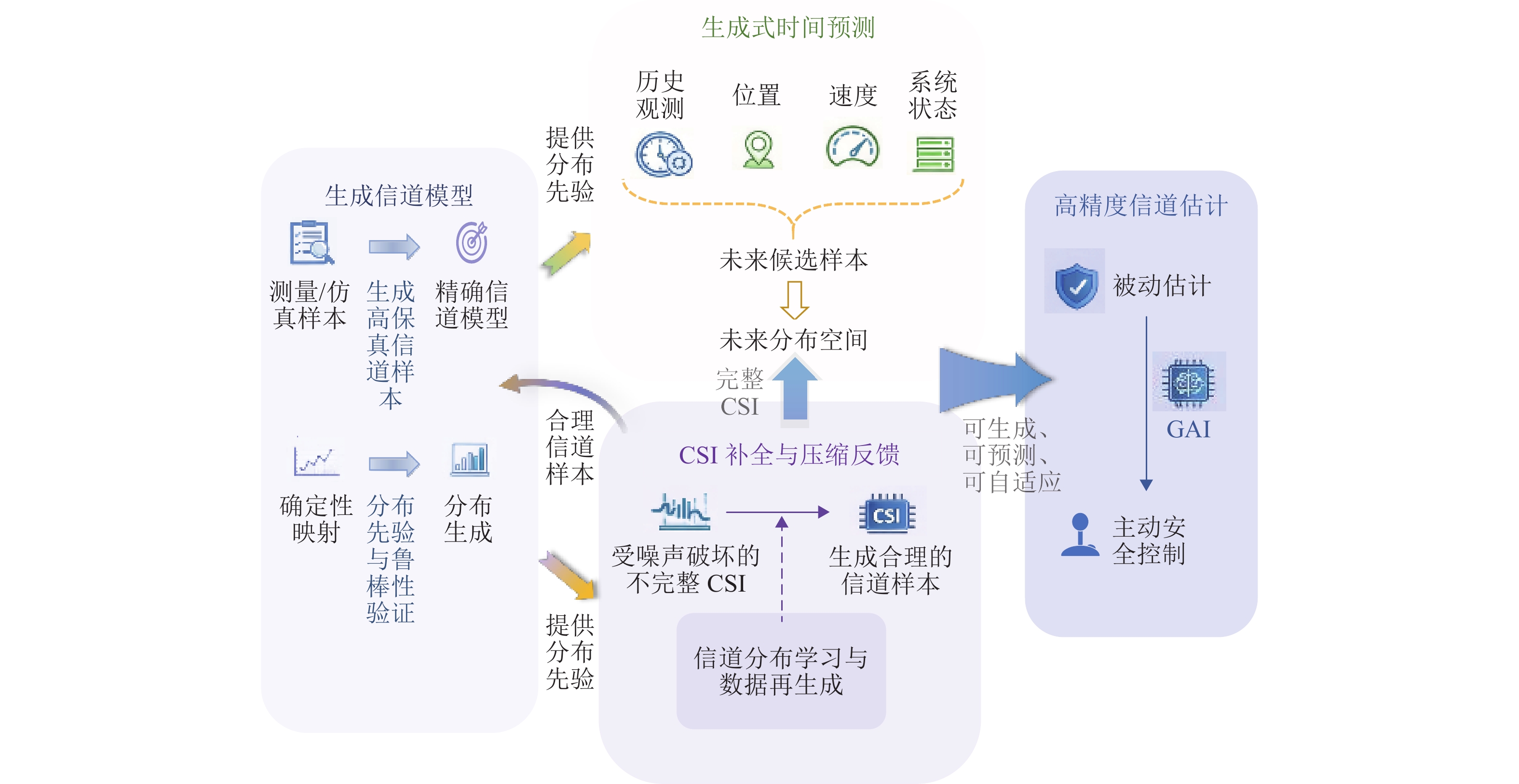
图 1 面向GAI赋能信道估计与预测的一体化框架
Figure 1. Integrated framework for GAI-empowered channel estimation and prediction
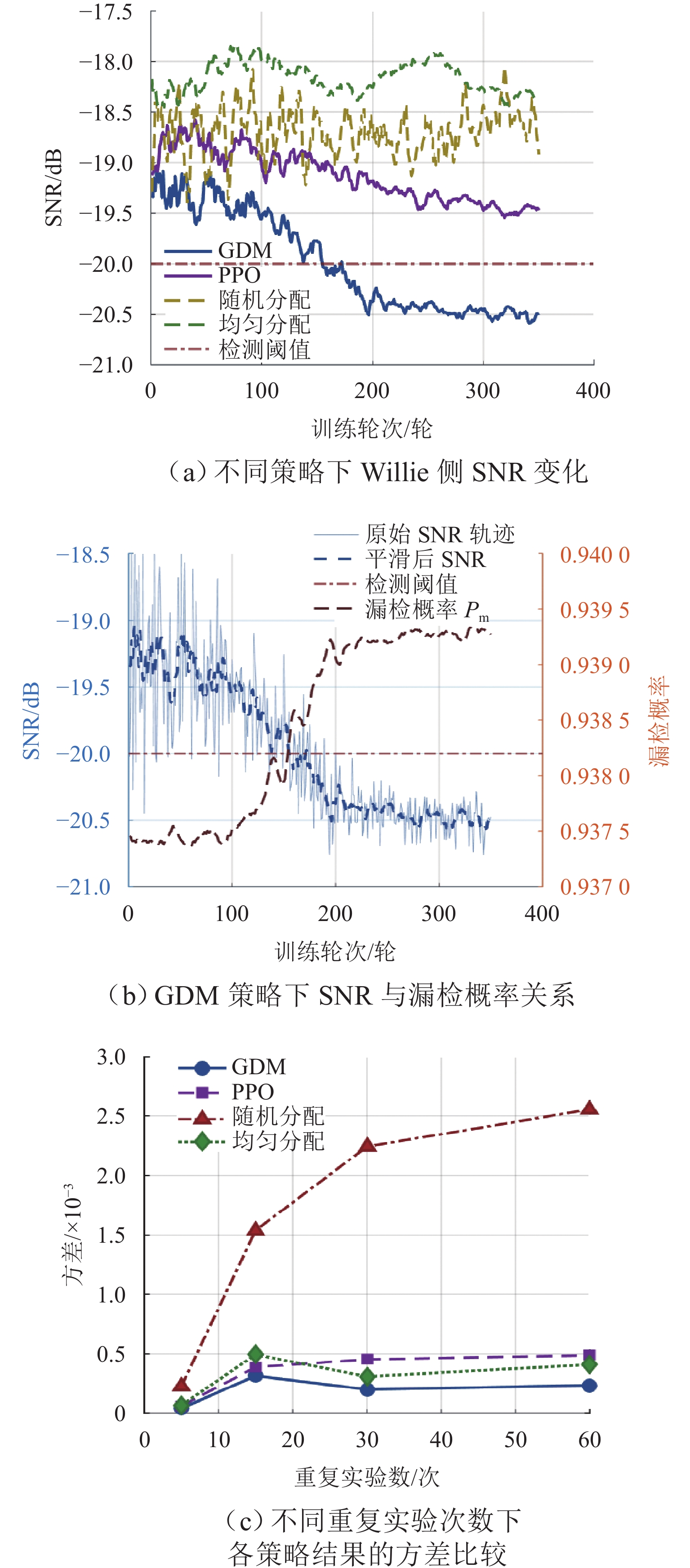
图 3 生成式决策对低可检测传输的影响
Figure 3. Impact of generative decision on low-detectability transmission
表 1 代表性生成模型在安全通信中的机制定位
Table 1. Mechanistic positioning of representative generative models in secure communications
模型 统计机制 物理层适配点 安全适用性 主要约束 GAN 对抗分布逼近 擅长构造最坏伪造样本与对抗边界 伪造检测、鲁棒训练、攻防博弈 训练不稳定,需精心调参;无显式似然 VAE 潜变量概率建模 适合正常流形学习与异常评分 异常检测、隐私表示、辅助密钥一致性 生成结果偏平滑;生成保真度较低 DPM 得分函数学习与逐步去噪 适合复杂背景对齐与高保真恢复 隐蔽波形生成、信号补全、低可探测传输 计算复杂度高;采样需多次去噪  下载: 导出CSV
表 2 典型安全威胁分类与3类GAI模型适配性比较
Table 2. Classification of typical security threats and comparison of adaptability of three types of GAI models
威胁类别 典型问题 关键目标 模型 适配性与局限 鉴权认证与接入控制 RF 指纹伪造、身份冒充、认证绕过 提升合法/伪造样本可分性 GAN 适合伪造对抗与鲁棒训练;训练稳定性弱 VAE 适合异常认证与未知设备检测;细节易过平滑 DPM 适合离线高保真指纹建模;在线时延较高 抗干扰与抗欺骗 压制干扰、智能干扰、导频污染、频谱欺骗 异常检测、鲁棒恢复与主动反制 GAN 适合攻防博弈与对抗训练 VAE 适合异常检测与不确定性判决 DPM 适合高保真恢复、波形补全与预测防御 保密传输与低可探测传输 密钥失配、侧信息泄露、行为检测 提升密钥一致性与抗泄露能力,降低可检测性 GAN 适合对抗伪装与流量混淆;多样性可能不足 VAE 适合潜表示脱敏与概率扰动以及辅助密钥一致性提升;隐蔽精度有限 DPM 适合噪声对齐波形生成与低截获传输;采样开销较大
下载: 导出CSV
-
[1] MAHDAVIFAR H, VARDY A. Achieving the secrecy capacity of wiretap channels using polar codes[J]. IEEE Transactions on Information Theory, 2011, 57(10): 6428-6443. doi: 10.1109/TIT.2011.2162275 [2] DEVI P, BHARTI M R, GAUTAM D. A survey on physical layer security for 5G/6G communications over different fading channels: Approaches, challenges, and future directions[J]. Vehicular Communications, 2025, 53: 100891. doi: 10.1016/j.vehcom.2025.100891 [3] SONG Z, TAO Y, HUA Z Z, et al. Generative artificial intelligence-empowered multidomain Internet of vehicles systems: scalability, efficiency, and suitability[J]. IEEE Vehicular Technology Magazine, 2025, 20(2): 53-62. doi: 10.1109/MVT.2025.3534973 [4] SHI Y, DAVASLIOGLU K, SAGDUYU Y E. Generative adversarial network in the air: deep adversarial learning for wireless signal spoofing[J]. IEEE Transactions on Cognitive Communications and Networking, 2021, 7(1): 294-303. doi: 10.1109/TCCN.2020.3010330 [5] WANG S, ZHANG J L, LI J Y, et al. Covert communications for RIS assisted systems with UAV based cognitive jamming[J/OL]. IEEE Transactions on Vehicular Technology, 2025-10-28. https://ieeexplore.ieee.org/document/11219224. [6] LU Q, YANG Z K, ZHANG H L, et al. MRFE: a deep-learning-based multidimensional radio frequency fingerprinting enhancement approach for IoT device identification[J]. IEEE Internet of Things Journal, 2024, 11(18): 30442-30454. doi: 10.1109/JIOT.2024.3414195 [7] ZHAO J H, LIU C C, LIAO J Y, et al. Deep learning in wireless communications for physical layer[J]. Physical Communication, 2024, 67: 102503. doi: 10.1016/j.phycom.2024.102503 [8] VU T H, JAGATHEESAPERUMAL S K, NGUYEN M D, et al. Applications of generative AI (GAI) for mobile and wireless networking: a survey[J]. IEEE Internet of Things Journal, 2025, 12(2): 1266-1290. doi: 10.1109/JIOT.2024.3487627 [9] VAN HUYNH N, WANG J C, DU H Y, et al. Generative AI for physical layer communications: a survey[J]. IEEE Transactions on Cognitive Communications and Networking, 2024, 10(3): 706-728. doi: 10.1109/TCCN.2024.3384500 [10] LIU Y J, DU H Y, XU X Y, et al. A survey of integrating generative artificial intelligence and 6G mobile services: architectures, solutions, technologies and outlooks[J]. IEEE Transactions on Cognitive Communications and Networking, 2025, 11(3): 1334-1356. doi: 10.1109/TCCN.2025.3558992 [11] XU M R, DU H Y, NIYATO D, et al. Unleashing the power of edge-cloud generative AI in mobile networks: a survey of AIGC services[J]. IEEE Communications Surveys & Tutorials, 2024, 26(2): 1127-1170. doi: 10.1109/COMST.2024.3353265 [12] ZHAO C Y, DU H Y, NIYATO D, et al. Generative AI for secure physical layer communications: a survey[J]. IEEE Transactions on Cognitive Communications and Networking, 2025, 11(1): 3-26. doi: 10.1109/TCCN.2024.3438379 [13] DU H Y, NIYATO D, KANG J W, et al. The age of generative AI and AI-generated everything[J]. IEEE Network, 2024, 38(6): 501-512. doi: 10.1109/mnet.2024.3422241 [14] 吴建军, 孙黎, 王东晖, 等. 面向6G网络的内生安全架构和关键技术思考[J]. 中国科学: 信息科学, 2024, 54(12): 2881-2904. doi: 10.1360/SSI-2023-0325WU Jianjun, SUN Li, WANG Donghui, et al. 6G-oriented endogenous security architecture and key technologies[J]. Science in China (Information Sciences), 2024, 54(12): 2881-2904. doi: 10.1360/SSI-2023-0325 [15] ARVINTE M, TAMIR J I. MIMO channel estimation using score-based generative models[J]. IEEE Transactions on Wireless Communications, 2023, 22(6): 3698-3713. doi: 10.1109/TWC.2022.3220784 [16] LI Z A, WANG C X, HUANG C, et al. A GAN-GRU based space-time predictive channel model for 6G wireless communications[J]. IEEE Transactions on Vehicular Technology, 2024, 73(7): 9370-9386. doi: 10.1109/TVT.2024.3367386 [17] YE M, LIANG X, PAN C H, et al. GAN-based near-field channel estimation for extremely large-scale MIMO systems[J]. IEEE Transactions on Green Communications and Networking, 2025, 9(1): 304-316. doi: 10.1109/TGCN.2024.3416617 [18] ZHAO T Y, SARKAR S, KRIJESTORAC E, et al. GAN-RXA: a practical scalable solution to receiver-agnostic transmitter fingerprinting[J]. IEEE Transactions on Cognitive Communications and Networking, 2024, 10(2): 403-416. doi: 10.1109/TCCN.2023.3329012 [19] XIE R J, XU W, YU J B, et al. Disentangled representation learning for RF fingerprint extraction under unknown channel statistics[J]. IEEE Transactions on Communications, 2023, 71(7): 3946-3962. doi: 10.1109/TCOMM.2023.3268286 [20] DENG J T, CHEN E, CHEN V. Intrusion into RF fingerprint authorized wireless communications with generative-adversarial-network-based attackers[J]. IEEE Transactions on Wireless Communications, 2025, 24(5): 4146-4159. doi: 10.1109/TWC.2025.3535874 [21] RAJENDRAN S, MEERT W, LENDERS V, et al. Unsupervised wireless spectrum anomaly detection with interpretable features[J]. IEEE Transactions on Cognitive Communications and Networking, 2019, 5(3): 637-647. doi: 10.1109/TCCN.2019.2911524 [22] HAN H, WANG X M, GU F L, et al. Better late than never: GAN-enhanced dynamic anti-jamming spectrum access with incomplete sensing information[J]. IEEE Wireless Communications Letters, 2021, 10(8): 1800-1804. doi: 10.1109/LWC.2021.3081509 [23] ZHOU K Q, ZHANG G Y, CAI Y L, et al. ROME: robust model ensembling for semantic communication against semantic jamming attacks[J]. IEEE Transactions on Wireless Communications, 2026, 25: 2589-2606. doi: 10.1109/TWC.2025.3597672 [24] WEN Y K, HUO Y, LI J H, et al. Generative adversarial network-aided covert communication for cooperative jammers in CCRNs[J]. IEEE Transactions on Information Forensics and Security, 2025, 20: 1278-1289. doi: 10.1109/TIFS.2025.3526058 [25] HU Q Q, HUANG N, CHEN Y W, et al. Covert water-to-air optical wireless communication based on an adversarial autoencoder[J]. IEEE Transactions on Cognitive Communications and Networking, 2025, 11(4): 2700-2714. doi: 10.1109/TCCN.2024.3524625 [26] FADUL M K M, REISING D R, ARASU K T, et al. Adversarial machine learning for enhanced spread spectrum communications[C]//MILCOM 2021—2021 IEEE Military Communications Conference (MILCOM). Piscataway: IEEE, 2021: 783-788. [27] ISLAM N, SHIN S. Deep learning in physical layer: review on data driven end-to-end communication systems and their enabling semantic applications[J]. IEEE Open Journal of the Communications Society, 2024, 5: 4207-4240. doi: 10.1109/OJCOMS.2024.3425314 [28] 夏蕊, 马宏斌. 生成式对抗网络的通信网络安全技术[J]. 移动通信, 2019, 43(8): 21-24. doi: 10.3969/j.issn.1006-1010.2019.08.004XIA Rui, MA Hongbin. Communication network security technology based on generative adversarial networks[J]. Mobile Communications, 2019, 43(8): 21-24. doi: 10.3969/j.issn.1006-1010.2019.08.004 [29] 朱威. 生成式对抗网络的通信网络安全技术分析[J]. 电子技术与软件工程, 2020, 9(13): 236-237. doi: 10.20109/j.cnki.etse.2020.13.108 [30] MAO B M, LIU J J, WU Y Y, et al. Security and privacy on 6G network edge: a survey[J]. IEEE Communications Surveys & Tutorials, 2023, 25(2): 1095-1127. doi: 10.1109/COMST.2023.3244674 [31] ADESINA D, HSIEH C C, SAGDUYU Y E, et al. Adversarial machine learning in wireless communications using RF data: a review[J]. IEEE Communications Surveys & Tutorials, 2023, 25(1): 77-100. doi: 10.1109/COMST.2022.3205184 [32] LI M X, LI O, LIU G Y, et al. Generative adversarial networks-based semi-supervised automatic modulation recognition for cognitive radio networks[J]. Sensors, 2018, 18(11): 3913. doi: 10.3390/s18113913 [33] SHIN J, PARK J, JEON Y S. Entropy-constrained VQ-VAE for deep-learning-based CSI feedback[J]. IEEE Transactions on Vehicular Technology, 2025, 74(6): 9870-9875. doi: 10.1109/TVT.2025.3542267 [34] EUCHNER F, SANZI J, HENNINGER M, et al. GAN-based massive MIMO channel model trained on measured data[C]//2024 27th International Workshop on Smart Antennas (WSA). Piscataway: IEEE, 2024: 109-116. [35] JIANG Q, SHA J. Radio frequency fingerprint identification using conditional generative adversarial network for SAT-AIS[J]. IEEE Transactions on Aerospace and Electronic Systems, 2025, 61(1): 593-602. doi: 10.1109/TAES.2024.3452706 [36] CAI Y. Robust and adaptive semantic noise for complex secure communication networks[J]. Physical Communication, 2025, 72: 102763. doi: 10.1016/j.phycom.2025.102763 [37] BALI R, BAILEY T, BULLOCK M S, et al. Experimental covert communication using software-defined radio[C]//MILCOM 2025—2025 IEEE Military Communications Conference (MILCOM). Piscataway: IEEE, 2026: 935-941. [38] SCARLETT J, HECKEL R, RODRIGUES M R D, et al. Theoretical perspectives on deep learning methods in inverse problems[J]. IEEE Journal on Selected Areas in Information Theory, 2022, 3(3): 433-453. doi: 10.1109/JSAIT.2023.3241123 [39] WEI X Y, VAN GORP H, GONZALEZ-CARABARIN L, et al. Deep unfolding with normalizing flow priors for inverse problems[J]. IEEE Transactions on Signal Processing, 2022, 70: 2962-2971. doi: 10.1109/TSP.2022.3179807 [40] CHEN J Y, SHI Y, YI C Y, et al. Generative-AI-driven human digital twin in IoT healthcare: a comprehensive survey[J]. IEEE Internet of Things Journal, 2024, 11(21): 34749-34773. doi: 10.1109/JIOT.2024.3421918 [41] AYANOGLU E, DAVASLIOGLU K, SAGDUYU Y E. Machine learning in NextG networks via generative adversarial networks[J]. IEEE Transactions on Cognitive Communications and Networking, 2022, 8(2): 480-501. doi: 10.1109/TCCN.2022.3153004 [42] MENG R, XU X D, WANG B Z, et al. Physical-layer authentication based on hierarchical variational autoencoder for industrial Internet of Things[J]. IEEE Internet of Things Journal, 2023, 10(3): 2528-2544. doi: 10.1109/JIOT.2022.3213593 [43] FENG Q, ZHANG J Y, CHEN L, et al. Waveform reconstruction of DSSS signal based on VAE-GAN[J]. Wireless Communications and Mobile Computing, 2022, 2022(1): 3667592. doi: 10.1155/2022/3667592 [44] LIU L Q, CHEN B W, CHEN H, et al. Diverse hyperspectral remote sensing image synthesis with diffusion models[J]. IEEE Transactions on Geoscience and Remote Sensing, 2023, 61: 5532616. doi: 10.1109/tgrs.2023.3335975 [45] KIM D, SHIN C, CHOI J, et al. Diffusion-Stego: Training-free diffusion generative steganography via message projection[J]. Information Sciences, 2025, 718: 122358. doi: 10.1016/j.ins.2025.122358 [46] XU X X, MU X D, LIU Y W, et al. Generative artificial intelligence for mobile communications: a diffusion model perspective[J]. IEEE Communications Magazine, 2025, 63(7): 98-105. doi: 10.1109/MCOM.001.2400284 [47] KUMAR J, GUPTA A, TANWAR S, et al. A review on 5G and beyond wireless communication channel models: Applications and challenges[J]. Physical Communication, 2024, 67: 102488. doi: 10.1016/j.phycom.2024.102488 [48] YE M, PAN C H, XU Y F, et al. Generative adversarial networks-based channel estimation for intelligent reflecting surface assisted mmWave MIMO systems[J]. IEEE Transactions on Cognitive Communications and Networking, 2024, 10(5): 1883-1896. doi: 10.1109/TCCN.2024.3391309 [49] 谢健骊, 李琳, 张泽鹏, 等. RIS辅助D2D通信网络资源分配算法[J/OL]. 西南交通大学学报, 2024-11-29.https://link.cnki.net/urlid/51.1277.U.20241129.0922.004. [50] BANERJEE B, ELLIOTT R C, KRZYMIEŃ W A, et al. Downlink channel estimation for FDD massive MIMO using conditional generative adversarial networks[J]. IEEE Transactions on Wireless Communications, 2023, 22(1): 122-137. doi: 10.1109/TWC.2022.3191605 [51] BÖCK B, OELDEMANN A, MAYER T, et al. Physics-informed generative modeling of wireless channels[C]//Proceedings of 42nd International Conference on Machine Learning (ICML), Vancouver: ML Research, 2025: 4602-4626. [52] ZHU E, SUN H J, JI M Y. Physics-informed generalizable wireless channel modeling with segmentation and deep learning: fundamentals, methodologies, and challenges[J]. IEEE Wireless Communications, 2024, 31(6): 170-177. doi: 10.1109/MWC.015.2300603 [53] NI Y Y, ZHANG Q, CHEN G J, et al. Conditional diffusion model-driven generative channels for double RIS-aided wireless systems[J/OL]. IEEE Transactions on Vehicular Technology, 2025-12-24. https://ieeexplore.ieee.org/document/11314712. [54] WEI Z X, LIU F, MASOUROS C, et al. Fundamentals of physical layer anonymous communications: sender detection and anonymous precoding[J]. IEEE Transactions on Wireless Communications, 2022, 21(1): 64-79. doi: 10.1109/TWC.2021.3093722 [55] MOMEN-TAYEFEH M, MOMEN-TAYEFEH M, GHAHRAMANI S A G, et al. Channel estimation for Massive MIMO systems aided by intelligent reflecting surface using semi-super resolution GAN[J]. Signal Processing, 2025, 227: 109710. doi: 10.1016/j.sigpro.2024.109710 [56] YADAV J D, DWIVEDI V K, CHATURVEDI S. Optimizing channel estimation in wireless massive MIMO networks using advanced Wasserstein GANs and ResNet[J]. Physical Communication, 2025, 72: 102750. doi: 10.1016/j.phycom.2025.102750 [57] CHEN Z X, SHIN H, NALLANATHAN A. Generative diffusion model-based variational inference for MIMO channel estimation[J]. IEEE Transactions on Communications, 2025, 73(10): 9254-9269. doi: 10.1109/TCOMM.2025.3556753 [58] ANAYA-LOPEZ G J, GOMEZ G, LOPEZ-MARTINEZ F J. A product channel attack to wireless physical layer security[J]. IEEE Wireless Communications Letters, 2021, 10(5): 943-947. doi: 10.1109/LWC.2021.3050957 [59] MENTZELOPOULOS A P, FAN D X, SAPSIS T P, et al. Variational autoencoders and transformers for multivariate time-series generative modeling and forecasting: applications to vortex-induced vibrations[J]. Ocean Engineering, 2024, 310: 118639. doi: 10.1016/j.oceaneng.2024.118639 [60] JIANG H, CUI M Y, NG D W K, et al. Accurate channel prediction based on transformer: making mobility negligible[J]. IEEE Journal on Selected Areas in Communications, 2022, 40(9): 2717-2732. doi: 10.1109/JSAC.2022.3191334 [61] 刘涛. 基于端到端学习的物理层安全通信技术研究[D]. 北京: 北京邮电大学, 2025. [62] 韩伊媚, 郑庆河, 叶迎晖, 等. 感知通信一体化中的物理层安全与隐蔽通信[J/OL]. 无线电通信技术, 2025-11-04. https://link.cnki.net/urlid/13.1099.tn.20251104.0943.004. [63] LETAFATI M, ALI S, LATVA-AHO M. Conditional denoising diffusion probabilistic models for data reconstruction enhancement in wireless communications[J]. IEEE Transactions on Machine Learning in Communications and Networking, 2025, 3: 133-146. doi: 10.1109/TMLCN.2024.3522872 [64] MORGAN D R, MA Z, KIM J, et al. A generalized memory polynomial model for digital predistortion of RF power amplifiers[J]. IEEE Transactions on Signal Processing, 2006, 54(10): 3852-3860. doi: 10.1109/TSP.2006.879264 [65] BANERJEE B, ELLIOTT R C, KRZYMIEŃ W A, et al. Hybrid beamforming for mmWave massive MIMO systems using conditional generative adversarial networks[J]. IEEE Transactions on Vehicular Technology, 2024, 73(10): 15803-15808. doi: 10.1109/TVT.2024.3409192 [66] WU C Y, LIN Y K, WU C K, et al. Deep learning-based end-to-end design for OFDM systems with hardware impairments[J]. IEEE Open Journal of the Communications Society, 2023, 4: 2468-2482. doi: 10.1109/OJCOMS.2023.3322989 [67] 梁磊, 符杰林. 基于改进生成式对抗网络的OAM-FSO通信系统自适应解调[J]. 计算机应用与软件, 2023, 40(8): 142-147. doi: 10.3969/j.issn.1000-386x.2023.08.024LIANG Lei, FU Jielin. Adaptive demodulation technique of oam-fso communication system based on improved generative adversarial network[J]. Computer Applications and Software, 2023, 40(8): 142-147. doi: 10.3969/j.issn.1000-386x.2023.08.024 [68] LU Z Y, TU M, XIE X, et al. Concealing radio frequency fingerprints via active adversarial perturbation[J]. IEEE Transactions on Network Science and Engineering, 2025, 12(5): 4098-4113. doi: 10.1109/TNSE.2025.3568824 [69] CHI G X, YANG Z, WU C S, et al. RF-diffusion: radio signal generation via time-frequency diffusion[C]//Proceedings of the 30th Annual International Conference on Mobile Computing and Networking. New York: ACM, 2024: 77-92. [70] JIANG H, BI S, DAI L L, et al. Residual-aided end-to-end learning of communication system without known channel[J]. IEEE Transactions on Cognitive Communications and Networking, 2022, 8(2): 631-641. doi: 10.1109/TCCN.2022.3161936 [71] LI T T, WEN Z Y, JIN C D, et al. Meta-RFF: meta-task adaptive-based few-shot open-set incremental learning for RF fingerprint recognition[J]. IEEE Transactions on Cognitive Communications and Networking, 2026, 12: 2115-2130. doi: 10.1109/TCCN.2025.3592942 [72] DARBAN Z Z, WEBB G I, PAN S R, et al. Deep learning for time series anomaly detection: a survey[J]. ACM Computing Surveys, 2025, 57(1): 1-42. doi: 10.14264/f82c56d [73] XIA X, PAN X Z, LI N, et al. GAN-based anomaly detection: a review[J]. Neurocomputing, 2022, 493: 497-535. doi: 10.1016/j.neucom.2021.12.093 [74] AI H J, HU T, XU T S. RAD-GAN: radio map anomaly detection for fingerprint indoor positioning with GAN[C]//2021 International Conference on Indoor Positioning and Indoor Navigation (IPIN). Piscataway: IEEE, 2022: 1-8. [75] LI Y F, PENG X Y, ZHANG J, et al. DCT-GAN: dilated convolutional transformer-based GAN for time series anomaly detection[J]. IEEE Transactions on Knowledge and Data Engineering, 2023, 35(4): 3632-3644. doi: 10.1109/TKDE.2021.3130234 [76] SHINGNE H, CHIKMURGE D, PARKHI P, et al. Design of an integrated model using deep reinforcement learning and Variational Autoencoders for enhanced quantum security[J]. MethodsX, 2025, 15: 103445. doi: 10.1016/j.mex.2025.103445 [77] HE S S, ZHU L, YAO C H, et al. A novel approach based on generative adversarial network for interference detection in wireless communications[J]. Wireless Communications and Mobile Computing, 2022, 2022(1): 7050573. doi: 10.1155/2022/7050573 [78] ROY D, MUKHERJEE T, CHATTERJEE M, et al. RFAL: adversarial learning for RF transmitter identification and classification[J]. IEEE Transactions on Cognitive Communications and Networking, 2020, 6(2): 783-801. doi: 10.1109/TCCN.2019.2948919 [79] YU N, SKRIPNIUK V, ABDELNABI S, et al. Artificial fingerprinting for generative models: rooting deepfake attribution in training data[C]//2021 IEEE/CVF International Conference on Computer Vision (ICCV). Piscataway: IEEE, 2022: 14428-14437. [80] TEJA P R, MISHRA P K. Energy efficient D2D-mode-selection based on battery life constraint with a POMDP and deep Q learning-perspective[C]//2023 International Conference for Advancement in Technology (ICONAT). Piscataway: IEEE, 2023: 1-6. [81] LI M K, WANG P Y, DONG Y H, et al. Diffusion model empowered data augmentation for automatic modulation recognition[J]. IEEE Wireless Communications Letters, 2025, 14(4): 1224-1228. doi: 10.1109/LWC.2025.3539821 [82] WANG Z Q, MAO S W. AIGC for wireless sensing: diffusion-empowered human activity sensing[J]. IEEE Transactions on Cognitive Communications and Networking, 2025, 11(2): 657-671. doi: 10.1109/TCCN.2025.3525588 [83] HAN H, XU Y F, JIN Z, et al. Primary-user-friendly dynamic spectrum anti-jamming access: a GAN-enhanced deep reinforcement learning approach[J]. IEEE Wireless Communications Letters, 2022, 11(2): 258-262. doi: 10.1109/LWC.2021.3125337 [84] DONG S H, CHEN B J, MA K J, et al. Active defense against voice conversion through generative adversarial network[J]. IEEE Signal Processing Letters, 2024, 31: 706-710. doi: 10.1109/LSP.2024.3365034 [85] JAYABALAN E, PUGAZENDI R. Generative adversarial networks for secure data transmission in wireless network[J]. Intelligent Automation & Soft Computing, 2023, 35(3): 3757-3784. doi: 10.32604/iasc.2023.031200 [86] BOUZABIA H, DO T N, KADDOUM G. Deep learning-enabled deceptive jammer detection for low probability of intercept communications[J]. IEEE Systems Journal, 2023, 17(2): 2166-2177. doi: 10.1109/JSYST.2022.3180481 [87] 廖晓闽. 基于深度学习的认知隐蔽通信技术研究[D]. 西安: 西安电子科技大学, 2021. [88] 冯钰. 基于生成式对抗网络的隐蔽通信性能优化方法研究[D]. 安庆: 安庆师范大学, 2024. [89] BARANCHUK M, BOLINA V, DE WITT C, et al. Secret collusion among AI agents: multi-agent deception via steganography[C]//Proceedings of the 38th International Conference on Neural Information Processing Systems. Vancouver: Neural Information Processing Systems Foundation, Inc. (NeurIPS), 2024: 73439-73486. [90] ZHANG R C, TANG S P, LIU Y Q, et al. Toward agentic AI: generative information retrieval inspired intelligent communications and networking[J]. IEEE Communications Magazine, 2026, 64(1): 197-204. doi: 10.1109/MCOM.001.2500073 [91] LIU T H, LIU J Q, ZHANG T, et al. Generative AI-driven cross-layer covert communication: fundamentals, framework, and case study[J]. IEEE Communications Magazine, 2025, 63(10): 128-134. doi: 10.1109/MCOM.004.2500025 [92] DU H Y, LIU G Y, NIYATO D, et al. Generative AI-aided joint training-free secure semantic communications via multi-modal prompts[C]//ICASSP 2024—2024 IEEE International Conference on Acoustics, Speech and Signal Processing (ICASSP). Piscataway: IEEE, 2024: 12896-12900. [93] WANG S, ZHANG X R, SONG Z, et al. Generative AI empowered covert communications: autonomy, efficiency, and suitability[J]. IEEE Wireless Communications, 2026, 33(2): 208-216. doi: 10.1109/MWC.2025.3596961 [94] MA Y L, ZHANG C Y, HE C L, et al. Radio map estimation using a CycleGAN-based learning framework for 6G wireless communication[J]. Digital Communications and Networks, 2025, 11(6): 1822-1830. doi: 10.1016/j.dcan.2025.08.001 [95] LEE C, HASEGAWA H, GAO S C. Complex-valued neural networks: a comprehensive survey[J]. IEEE/CAA Journal of Automatica Sinica, 2022, 9(8): 1406-1426. doi: 10.1109/JAS.2022.105743 [96] BENGESI S, EL-SAYED H, SARKER M K, et al. Advancements in generative AI: a comprehensive review of GANs, GPT, autoencoders, diffusion model, and transformers[J]. IEEE Access, 2024, 12: 69812-69837. doi: 10.1109/ACCESS.2024.3397775 [97] WANG J C, DU H Y, NIYATO D, et al. Generative AI for integrated sensing and communication: insights from the physical layer perspective[J]. IEEE Wireless Communications, 2024, 31(5): 246-255. doi: 10.1109/MWC.013.2300485 [98] WANG J C, DU H Y, NIYATO D, et al. Acceleration estimation of signal propagation path length changes for wireless sensing[J]. IEEE Transactions on Wireless Communications, 2024, 23(9): 11476-11492. doi: 10.1109/TWC.2024.3382425 [99] 丁国富, 刘名远, 谢家翔, 等. 数字孪生制造装备高可用运行协同的计算方法[J]. 西南交通大学学报, 2025, 60(1): 194-204. doi: 10.3969/j.issn.0258-2724.20230074DING Guofu, LIU Mingyuan, XIE Jiaxiang, et al. Collaborative computing method for highly available operation of digital twin manufacturing equipment[J]. Journal of Southwest Jiaotong University, 2025, 60(1): 194-204. doi: 10.3969/j.issn.0258-2724.20230074 [100] 谢驰, 熊瑛畅, 朱宏, 等. 基于分层可演进架构模型的自主式交通系统代际演进路径分析[J/OL]. 西南交通大学学报, 2025-10-21. https://link.cnki.net/urlid/51.1277.U.20251021.1317.002. -

 下载:
下载:

 点击查看大图
计量
- 文章访问数: 390
- HTML全文浏览量: 191
- PDF下载量: 38
- 被引次数: 0