



Bridge Structural Health Monitoring Based on Physics-Informed Neural Networks: Research Advances and Review
-
摘要:
桥梁结构健康监测(BSHM)在保障桥梁安全运营和延长服役寿命方面具有重要意义. 然而,传统的物理驱动和数据驱动BSHM方法在复杂运营环境、噪声干扰、数据不完备以及模型不确定性等因素影响下,其监测精度与工程适用性往往受到制约. 近年来,物理信息神经网络(PINNs)及广义的物理信息机器学习(PIML)方法发展迅速,为克服传统BSHM方法的局限性提供了新的思路与技术手段. PINNs核心思想是将物理控制方程和边界条件等物理先验知识,显式或隐式地嵌入深度神经网络,从而引导模型在数据学习的同时满足物理一致性并提升泛化性能. 系统梳理PINNs/PIML的理论基础,并对特征空间物理增强、物理模型数据增强、物理知情网络正则化及物理引导网络架构设计等典型物理嵌入策略的优缺点进行比较分析;围绕BSHM中的结构行为建模、参数识别、信号分解与重构以及损伤检测与识别等典型任务,系统总结PINNs在桥梁结构健康监测领域的最新研究进展;讨论基于PINNs的BSHM在实际工程应用中面临的主要挑战与潜在发展方向. 随着深度学习方法与物理建模策略的不断融合,PINNs有望成为桥梁智能运维中的重要技术手段,为提升桥梁状态评估能力和运维决策水平提供支撑.
Abstract:Bridge structural health monitoring (BSHM) plays a critical role in ensuring the safe operation and extending the service life of bridges. However, the monitoring accuracy and engineering applicability of conventional physics-driven and data-driven BSHM methods are often constrained under the influence of complex operational environments, noise interference, data incompleteness, and model uncertainties. In recent years, physics-informed neural networks (PINNs) and generalized physics-informed machine learning (PIML) methods have developed rapidly, providing new ideas and technical means to overcome the limitations of traditional BSHM methods. The core idea of PINNs is to explicitly or implicitly embed physical prior knowledge, such as physical governing equations and boundary conditions, into deep neural networks, thereby guiding the model to satisfy physical consistency while learning data and improving generalization performance. The theoretical foundations of PINNs/PIML were systematically reviewed, and the advantages and disadvantages of typical physics-embedding strategies, including physical enhancement of feature spaces, physical model data augmentation, physics-informed network regularization, and physics-guided network architecture design, were comparatively analyzed. Focusing on typical tasks in BSHM, such as structural behavior modeling, parameter identification, signal decomposition and reconstruction, as well as damage detection and identification, the latest research advances of PINNs in the field of BSHM were systematically summarized. The main challenges and potential development directions faced by PINNs-based BSHM in practical engineering applications were discussed. With the continuous integration of deep learning methods and physical modeling strategies, PINNs are expected to become an important technical means in intelligent bridge operation and maintenance, providing support for improving bridge condition assessment capabilities and operation and maintenance decision-making levels.
-
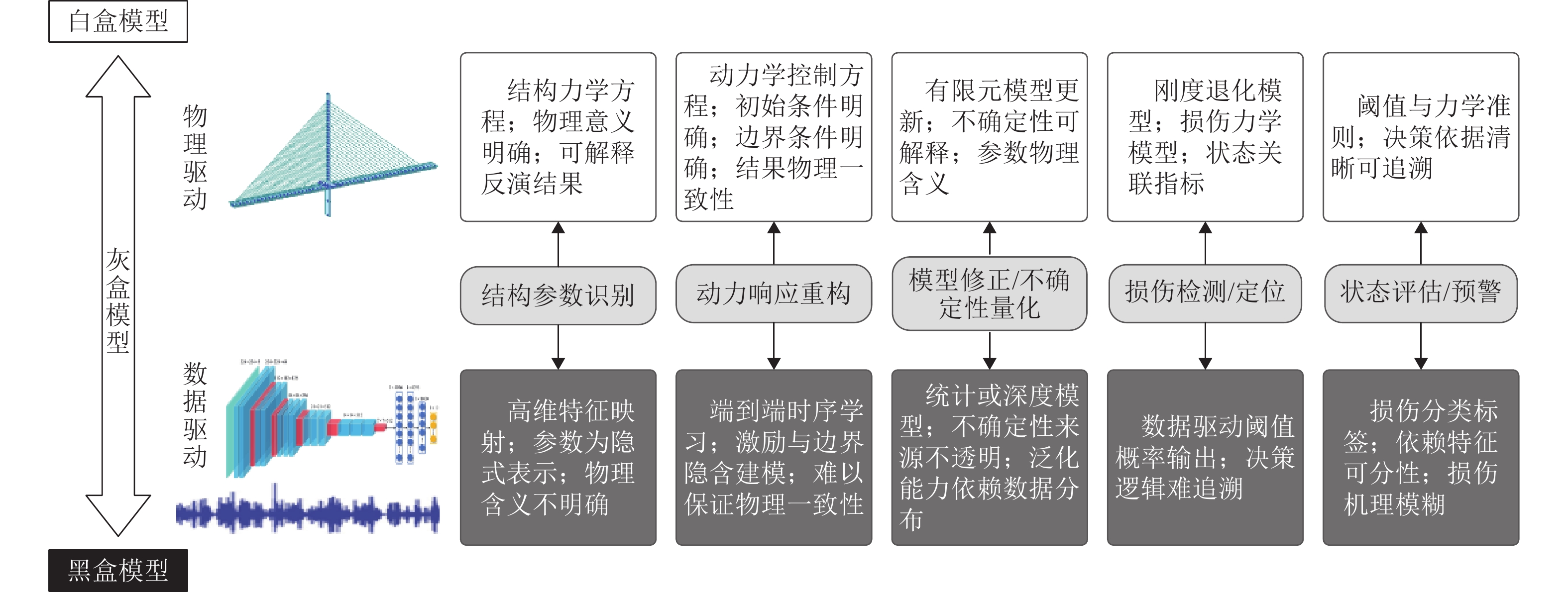
图 2 PINNs中SHM各方向的可解释性描述
Figure 2. Descriptions of interpretability in various SHM domains within PINNs
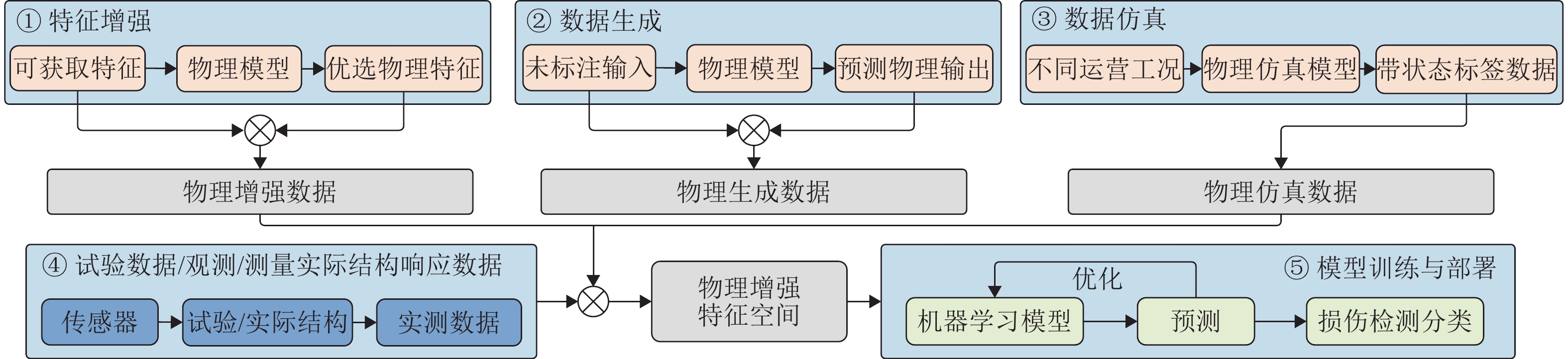
图 4 基于特征空间物理增强的物理约束嵌入流程
Figure 4. Physical constraint embedding process based on physical enhancement of feature space
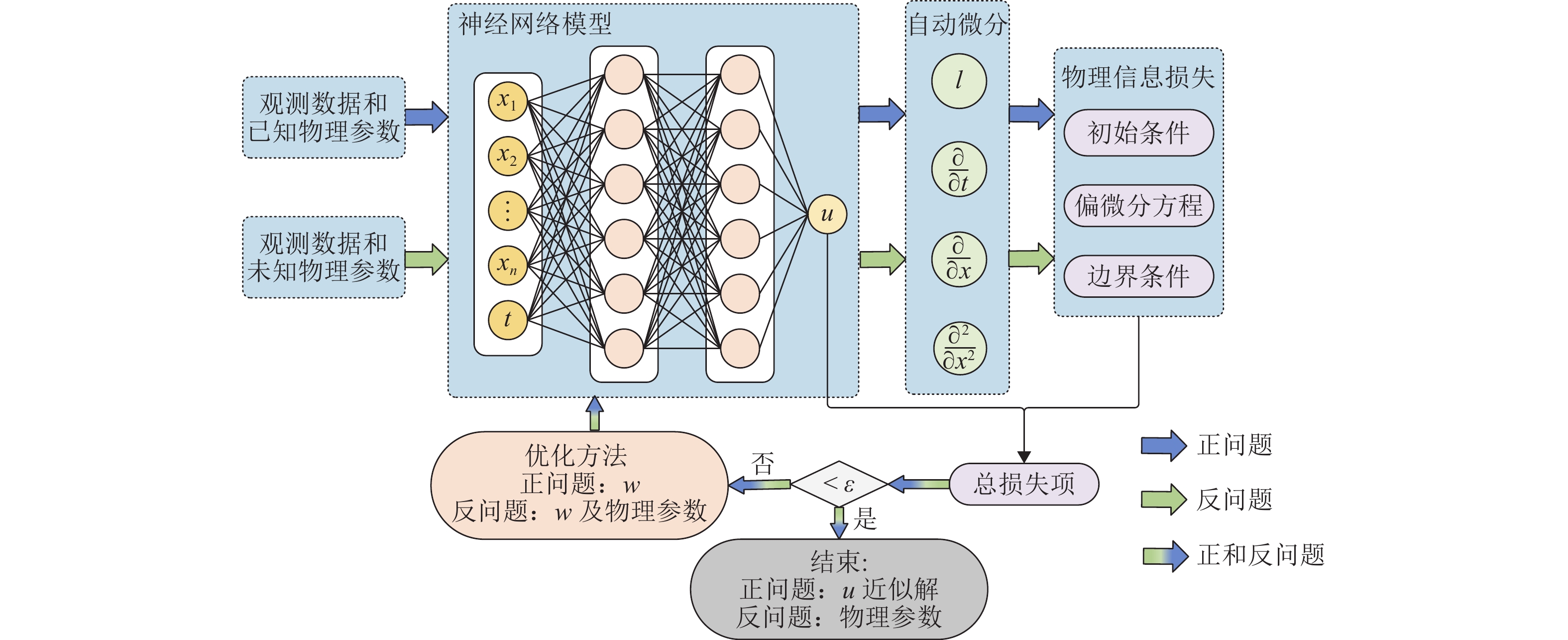
图 5 物理知情网络正则化一般架构
Figure 5. General architecture of physics-informed network regularization
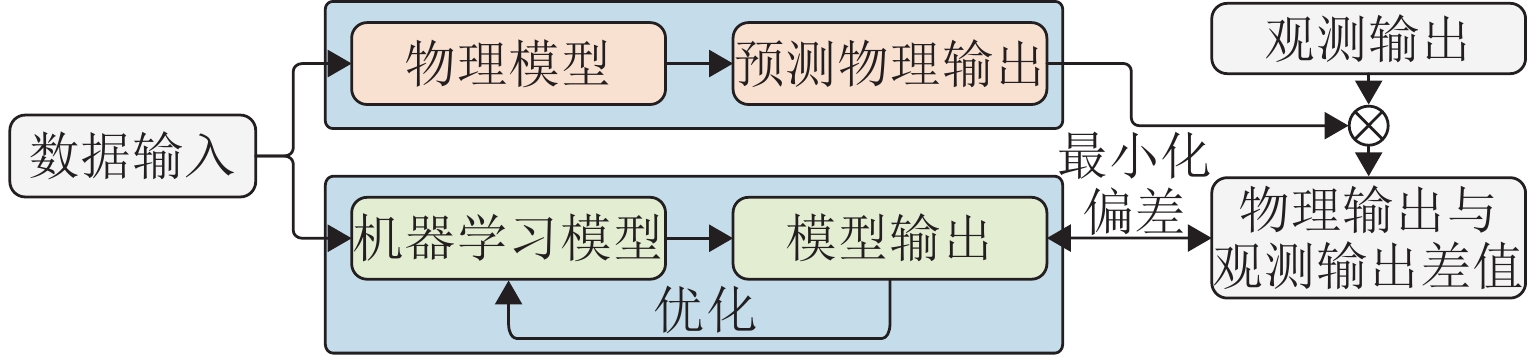
图 6 基于物理模型数据增强的物理约束嵌入流程
Figure 6. Physical constraint embedding process based on physical model data augmentation
表 1 结构行为建模与正反问题求解的PINNs相关研究统计
Table 1. Statistics of PINNs-related studies for structural behavior modeling and positive and negative problem solving
文献来源 物理信息类型 嵌入方式 应用场景 Zhang 等[106] 运动微分方程 + Bouc-Wen 模型 ② 非线性结构动力系统的小样本建模与响应预测 Zhang 等[109] 热膨胀效应 + 结构长周期演化趋势 ① 环境变异条件下斜拉桥桥面位移预测 Li 等[108] Euler-Bernoulli 梁偏微分运动方程 ② 非线性梁结构参数求解 Li 等[110] 结构线性状态空间方程 ③ 四自由度框架与悬臂梁的动力响应预测 Meethal 等[107] 静力平衡 ③ 高层建筑风效应不确定性量化 Oh 等[111] 状态空间方程 ③ 梁结构动力响应预测和荷载识别 Guo 等[112] 数值积分时间步进器 ③ + ④ 非线性结构地震响应预测 Kapoor 等[113] Euler-Bernoulli 梁偏微分运动方程 ② 弹性地基梁结构动力学模拟 Kapoo r等[114] Euler-Bernoulli 梁与 Timoshenko 梁的无量
纲运动方程② 单梁与双梁结构动力学模拟与参数求解 Liang 等[115] 结构运动频域方程 ② 移动荷载下的梁动力响应预测和参数求解 Xing 等[116] 四阶龙格-库塔方程与梯度方程 ① + ④ 桥梁结构地震响应预测 Al-adly 等[117] 薄板挠曲控制方程 ② 结构静力学建模与响应预测 Zhang 等[118] 位移、转角连续及力的平衡方程 ② 连续结构系统状态参数估计 Chen 等[119] Koopman 算子线性化 ③ + ④ 多自由度系统动力学建模 Li 等[120] 连续时间状态空间方程 ① + ④ 受迫振动系统的动力响应分析与预测 Li 等[121] 运动微分方程 ① + ④ 混合结构的地震响应建模与实时动力分析 Jeon 等[122] Euler-Bernoulli 梁偏微分运动方程 ③ 复杂大型桥梁结构动力响应预测 Söyleyici 等[123] Euler-Bernoulli 梁偏微分运动方程 ② 梁结构横向振动响应预测 Xiong 等[124] 弹性力学势能变分原理 ② + ③ 结构弹性力学建模与响应预测 注:嵌入方式 ①~④ 分别代表特征空间物理增强、物理知情网络正则化、物理模型数据增强和物理引导网络架构设计.  下载: 导出CSV
表 2 结构响应分解与重构的PINNs相关研究统计
Table 2. Statistics of PINNs-related studies for structural response decomposition and reconstruction
文献来源 物理信息类型 嵌入方式 应用场景 Zhang 等[129] 运动微分方程 ② 结构地震响应预测与易损性评估 Ni 等[77] 状态变量间的导数关系 ② + ④ 桥梁结构的交通荷载位移重构 Lai 等[130] 基于有限元模型的物理振型与模态解耦 ① + ④ 结构全场响应重建 Baddoo 等[131] 满足矩阵的物理流形 ④ 多域复杂动力系统的响应重构 Fan 等[132] 响应信号的空间位置关联性 ④ 超高建筑缺失响应的时序重构与全场预测 Li 等[127] 基于有限元模型的冲激响应矩阵 ② + ④ 结构全场响应重构 Xu 等[128] 状态变量间的导数关系 ② + ④ 板梁组合结构的动态响应预测及全场动静态位移重构 Liu 等[133] 功率谱密度的一致性、信号高阶统计矩
的物理真实性② + ④ 强震激励下建筑结构缺失响应的重构 孙榕徽等[134] DMD 系统矩阵的流形约束 ② 桥梁结构动态监测信号降噪 Eischens 等[135] 状态变量间的导数关系 ① + ④ 地震激励下Duffing振子的响应重构
下载: 导出CSV
表 3 结构参数识别的PINNs相关研究统计
Table 3. Statistics of PINNs-related studies for structural parameter identification
文献来源 物理信息类型 嵌入方式 应用场景 Liu 等[136] 功率谱密度矩阵分解 ③ + ④ 海上风电结构的实时模态参数识别 Guo 等[137] 频率与刚度显式关系 ② + ③ 框架结构的层间刚度识别 Guo 等[138] 频响函数、交叉特征置信准则 ② 大跨度桥梁的索力识别 徐皓等[91] 运动微分方程 ② 大跨度桥梁的索力识别 Mahar 等[139] 运动微分方程 ② + ④ 框架结构的层间刚度及模态频率识别 Mahar 等[140] 运动微分方程、离散状态空间方程 ② 框架结构的参数估计 DE O Teloli 等[141] Euler-Bernoulli 梁偏微分运动方程 ② 悬臂钢梁的物理参数识别 Luo 等[142] 数值积分算法的动力平衡方程算法层编码 ④ 双跨连续梁模型及悬臂梁试验模型的刚度识别 Liu 等[143] 结构冲激响应矩阵 ④ 简支梁模型的移动荷载识别
下载: 导出CSV
表 4 结构损伤检测与识别的PINNs相关研究统计
Table 4. Statistics of PINNs-related studies for structural damage detection and identification
文献来源 物理信息类型 嵌入方式 应用场景 Figueiredo 等[144] 结构刚度与温度的物理关联模型 ① 桥梁结构损伤检测 Das 等[145] 动态模式分解的结构动力特性提取 ① 混凝土裂缝识别与裂缝扩展预测 Zhang 等[146] 有限元模型的结构特征 ① 风机叶片结构损伤识别 Zhang 等[147] 有限元模型的结构动力特征方程 ① 钢桁人行桥梁损伤识别 Feng 等[148] 断裂力学相场模型 ① 结构剩余寿命预测与损伤演化 Goswami 等[149] 控制方程的变分形式 ② 脆性断裂问题中的替代建模与失效预测 Huang 等[150] 有限元模态参数流形对齐 ① 有限监测数据下的结构损伤检测与识别 Hu 等[151] 结构劣化与退化机理的数学物理模型 ① 混凝土桥面板劣化预测与状态评估 Rojas 等[152] 相场偏微分方程 ② 结构材料参数识别与损伤演化分析 Yamaguchi 等[153] 运动微分方程 + Bouc-Wen 模型 ② 震后 RC 桥墩的损伤识别与状态评估 Chen 等[154] 运动微分方程、结构连接关系矩阵 ① + ④ 结构系统响应预测与局部异常/损伤识别 Peng 等[155] 地震响应信号变分模态分解的分量 ④ 震后轨-桥系统的损伤预测与状态评估 Lei 等[156] 模态参数对损伤变量的灵敏度 ② 简支梁桥结构损伤定位与损伤程度量化 Wang 等[90] 运动微分方程 ② 简支梁结构损伤定位与损伤程度量化
下载: 导出CSV
表 5 基于PINNs的BSHM需求和存在的优缺点总结
Table 5. Summary of PINNs-based BSHM requirements and existing advantages and disadvantages
考虑维度 重点需求 优势 局限性 数据需求 数据类型,数据量,数据质量 少样本学习,物理约束补偿,稀疏数据鲁棒性 噪声敏感,高阶导数放大多源异构融合困难 物理信息依赖 物理模型准确性,完备性 控制方程嵌入,物理一致性,可解释性 模型误差敏感,非线性损伤刻画不足 网络架构设计 网络深度,物理嵌入方式 架构灵活,CNN/GNN 扩展架构级物理引导 架构无统一范式,经验依赖强多尺度建模困难 损失函数构造 物理损失-数据损失平衡 物理残差约束,模态/动力学一致性 损失权重调整困难,训练不稳定 计算代价 训练与推理效率 离线预测高效,参数反演能力 训练成本高,自动微分开销大实时性受限 泛化能力 跨工况,跨结构 外推能力增强,跨工况鲁棒性强 结构依赖性强,跨桥泛化有限 工程可实施性 实际监测条件 物理-数据统一框架,工程潜力高 高质量物理模型依赖,应用门槛高
下载: 导出CSV
-
[1] 《中国公路学报》编辑部. 中国桥梁工程学术研究综述•2024[J]. 中国公路学报, 2024, 37(12): 1-160. [2] AN Y H, CHATZI E, SIM S H, et al. Recent progress and future trends on damage identification methods for bridge structures[J]. Structural Control and Health Monitoring, 2019, 26(10): e2416. doi: 10.1002/stc.2416 [3] FIGUEIREDO E, BROWNJOHN J. Three decades of statistical pattern recognition paradigm for SHM of bridges[J]. Structural Health Monitoring, 2022, 21(6): 3018-3054. doi: 10.1177/14759217221075241 [4] BROWNJOHN J M W, KRIPAKARAN P, HARVEY B, et al. Structural health monitoring of short to medium span bridges in the United Kingdom[J]. Structural Monitoring and Maintenance, 2016, 3(3): 259-276. doi: 10.12989/smm.2016.3.3.259 [5] KHODADOOST S, NOUHI B, TALATAHARI S, et al. Intelligent vibration-based structural health monitoring systems: Methodological advances and challenges[J]. Sensors and Actuators A: Physical, 2025, 394: 1-38. doi: 10.1016/j.sna.2025.116886 [6] ZHANG B C, REN Y H, HE S M, et al. A review of methods and applications in structural health monitoring (SHM) for bridges[J]. Measurement, 2025, 245: 116575. doi: 10.1016/j.measurement.2024.116575 [7] WANG X P, ZHAO Q Z, XI R J, et al. Review of bridge structural health monitoring based on GNSS: from displacement monitoring to dynamic characteristic identification[J]. IEEE Access, 2021, 9: 80043-80065. doi: 10.1109/ACCESS.2021.3083749 [8] FLAH M, NUNEZ I, BEN CHAABENE W, et al. Machine learning algorithms in civil structural health monitoring: a systematic review[J]. Archives of Computational Methods in Engineering, 2021, 28(4): 2621-2643. doi: 10.1007/s11831-020-09471-9 [9] QUQA S, LASRI O, DELO G, et al. Regional-scale bridge health monitoring: survey of current methods and roadmap for future opportunities under changing climate[J]. Structural Health Monitoring, 2025, 24(4): 2309-2337. doi: 10.1177/14759217241310525 [10] CROSS E J, GIBSON S J, JONES M R, et al. Physics-informed machine learning for structural health monitoring[M]//Structural Health Monitoring Based on Data Science Techniques. Cham: Springer International Publishing, 2021: 347-367. [11] SUN L M, SHANG Z Q, XIA Y, et al. Review of bridge structural health monitoring aided by big data and artificial intelligence: from condition assessment to damage detection[J]. Journal of Structural Engineering, 2020, 146(5): 04020073. doi: 10.1061/(ASCE)ST.1943-541X.0002535 [12] YU Z R, SHAN D S, SUN R H. State of the art for knowledge transfer in bridge structural health monitoring: methodology, applications, and challenges[J]. Measurement, 2026, 262: 120008. doi: 10.1016/j.measurement.2025.120008 [13] KHAN S, YAIRI T, TSUTSUMI S, et al. A review of physics-based learning for system health management[J]. Annual Reviews in Control, 2024, 57: 100932. doi: 10.1016/j.arcontrol.2024.100932 [14] ZHOU X, KIM C W, ZHANG F L, et al. Vibration-based Bayesian model updating of an actual steel truss bridge subjected to incremental damage[J]. Engineering Structures, 2022, 260: 114226. doi: 10.1016/j.engstruct.2022.114226 [15] HAYWOOD-ALEXANDER M, LIU W, BACSA K, et al. Discussing the spectrum of physics-enhanced machine learning: a survey on structural mechanics applications[J]. Data-Centric Engineering, 2024, 5: e31. doi: 10.1017/dce.2024.33 [16] GOPALAKRISHNAN S, RUZZENE M, HANAGUD S. Computational Techniques for Structural Health Monitoring[M]. London: Springer London, 2011. [17] ABEDIN M, DE CASO Y BASALO F J, KIANI N, et al. Bridge load testing and damage evaluation using model updating method[J]. Engineering Structures, 2022, 252: 113648. doi: 10.1016/j.engstruct.2021.113648 [18] BURDZIK R, KHAN D. An overview of the current state of knowledge and technology on techniques and procedures for signal processing, analysis, and accurate inference for transportation noise and vibration[J]. Measurement, 2025, 252: 117314. doi: 10.1016/j.measurement.2025.117314 [19] ZHANG E H, WU D, SHAN D S. Novel tensor subspace system identification algorithm to identify time-varying modal parameters of bridge structures[J]. Structural Health Monitoring, 2022, 21(4): 1541-1554. doi: 10.1177/14759217211036024 [20] SENGUPTA P, CHAKRABORTY S. A state-of-the-art review on model reduction and substructuring techniques in finite element model updating for structural health monitoring applications[J]. Archives of Computational Methods in Engineering, 2025, 32(5): 3031-3062. doi: 10.1007/s11831-025-10231-w [21] MORAVVEJ M, EL-BADRY M. Reference-free vibration-based damage identification techniques for bridge structural health monitoring: a critical review and perspective[J]. Sensors, 2024, 24(3): 876. doi: 10.3390/s24030876 [22] AZIMI M, ESLAMLOU A D, PEKCAN G. Data-driven structural health monitoring and damage detection through deep learning: state-of-the-art review[J]. Sensors, 2020, 20(10): 2778. doi: 10.3390/s20102778 [23] MONDAL T G, CHEN G D. Artificial intelligence in civil infrastructure health monitoring: Historical perspectives, current trends, and future visions[J]. Frontiers in Built Environment, 2022, 8: 1007886. doi: 10.3389/fbuil.2022.1007886 [24] GORDAN M, SABBAGH-YAZDI S R, ISMAIL Z, et al. State-of-the-art review on advancements of data mining in structural health monitoring[J]. Measurement, 2022, 193: 110939. doi: 10.1016/j.measurement.2022.110939 [25] ZINNO R, HAGHSHENAS S S, GUIDO G, et al. Artificial intelligence and structural health monitoring of bridges: a review of the state-of-the-art[J]. IEEE Access, 2022, 10: 88058-88078. doi: 10.1109/ACCESS.2022.3199443 [26] KARIMI S, GÜNDEL M. Advancing structural health monitoring in civil engineering with greybox modelling: a review[J]. e-Journal of Nondestructive Testing, 2024, 29(7): 1-9. doi: 10.58286/29668 [27] PAN H, AZIMI M, YAN F, et al. Time-frequency-based data-driven structural diagnosis and damage detection for cable-stayed bridges[J]. Journal of Bridge Engineering, 2018, 23(6): 04018033. doi: 10.1061/(ASCE)BE.1943-5592.0001199 [28] ZHANG H, LIN J, HUA J D, et al. Data anomaly detection for bridge SHM based on CNN combined with statistic features[J]. Journal of Nondestructive Evaluation, 2022, 41(1): 28. doi: 10.1007/s10921-022-00857-2 [29] LI S G, WANG W T, LU B, et al. Long-term structural health monitoring for bridge based on back propagation neural network and long and short-term memory[J]. Structural Health Monitoring, 2023, 22(4): 2325-2345. doi: 10.1177/14759217221122337 [30] HUANG N. Anomaly detection in structural health monitoring with ensemble learning and reinforcement learning[J]. International Journal of Advanced Computer Science and Applications, 2024, 15(1): 1-15. doi: 10.14569/ijacsa.2024.0150112 [31] YUAN F G, ZARGAR S A, CHEN Q Y, et al. Machine learning for structural health monitoring: challenges and opportunities[C]//Sensors and Smart Structures Technologies for Civil, Mechanical, and Aerospace Systems 2020. [S.l.]: SPIE, 2020: 2. [32] ENTEZAMI A, SARMADI H, BEHKAMAL B, et al. Early warning of structural damage via manifold learning-aided data clustering and non-parametric probabilistic anomaly detection[J]. Mechanical Systems and Signal Processing, 2025, 224: 111984. doi: 10.1016/j.ymssp.2024.111984 [33] TANG Z Y, CHEN Z C, BAO Y Q, et al. Convolutional neural network-based data anomaly detection method using multiple information for structural health monitoring[J]. Structural Control and Health Monitoring, 2019, 26(1): e2296. doi: 10.1002/stc.2296 [34] ZHANG Y, YUEN K V. Review of artificial intelligence-based bridge damage detection[J]. Advances in Mechanical Engineering, 2022, 14(9): 16878132221122770. [35] RIZVI S H M, ABBAS M. From data to insight, enhancing structural health monitoring using physics-informed machine learning and advanced data collection methods[J]. Engineering Research Express, 2023, 5(3): 032003. doi: 10.1088/2631-8695/acefae [36] LAGARIS I E, LIKAS A, FOTIADIS D I. Artificial neural networks for solving ordinary and partial differential equations[J]. IEEE Transactions on Neural Networks, 1998, 9(5): 987-1000. doi: 10.1109/72.712178 [37] KARPATNE A, ATLURI G, FAGHMOUS J H, et al. Theory-guided data science: a new paradigm for scientific discovery from data[J]. IEEE Transactions on Knowledge and Data Engineering, 2017, 29(10): 2318-2331. [38] RAISSI M, PERDIKARIS P, KARNIADAKIS G E. Physics-informed neural networks: a deep learning framework for solving forward and inverse problems involving nonlinear partial differential equations[J]. Journal of Computational Physics, 2019, 378: 686-707. doi: 10.1016/j.jcp.2018.10.045 [39] KARNIADAKIS G E, KEVREKIDIS I G, LU L, et al. Physics-informed machine learning[J]. Nature Reviews Physics, 2021, 3(6): 422-440. doi: 10.1038/s42254-021-00314-5 [40] FAROUGHI S A, RAISSI M, DAS S, et al. Physics-guided, physics-informed, and physics-encoded neural networks and operators in scientific computing: fluid and solid mechanics[J]. Journal of Computing and Information Science in Engineering, 2024, 24(4): 040802. doi: 10.1115/1.4064449 [41] ZIDEH M J, CHATTERJEE P, SRIVASTAVA A K. Physics-informed machine learning for data anomaly detection, classification, localization, and mitigation: a review, challenges, and path forward[J]. IEEE Access, 2024, 12: 4597-4617. doi: 10.1109/ACCESS.2023.3347989 [42] DENG W K, NGUYEN K T P, MEDJAHER K, et al. Physics-informed machine learning in prognostics and health management: State of the art and challenges[J]. Applied Mathematical Modelling, 2023, 124: 325-352. doi: 10.1016/j.apm.2023.07.011 [43] LUO K, ZHAO J S, WANG Y P, et al. Physics-informed neural networks for PDE problems: a comprehensive review[J]. Artificial Intelligence Review, 2025, 58(10): 323. doi: 10.1007/s10462-025-11322-7 [44] GUO J T, ZHU H, YANG Y J, et al. Advances in physics-informed neural networks for solving complex partial differential equations and their engineering applications: a systematic review[J]. Engineering Applications of Artificial Intelligence, 2025, 161: 112044. doi: 10.1016/j.engappai.2025.112044 [45] HABIB A, AL HOURI A, JUNAID M T, et al. A systematic and bibliometric review on physics-based neural networks applications as a solution for structural engineering partial differential equations[J]. Structures, 2024, 69: 107361. doi: 10.1016/j.istruc.2024.107361 [46] 王一铮, 庄晓莹, TIMON R, 等. AI for PDEs在固体力学领域的研究进展[J]. 力学进展, 2025, 55(2): 231-287. doi: 10.6052/1000-0992-24-016WANG Yizheng, ZHUANG Xiaoying, TIMON R, et al. AI for PDEs in solid mechanics: a review[J]. Advances in Mechanics, 2025, 55(2): 231-287. doi: 10.6052/1000-0992-24-016 [47] SEYYEDI A, BOHLOULI M, OSKOEE S N. Machine learning and physics: a survey of integrated models[J]. ACM Computing Surveys, 2024, 56(5): 1-33. doi: 10.1145/3611383 [48] CHEW A W Z, HE R F, ZHANG L M. Physics informed machine learning (PIML) for design, management and resilience-development of urban infrastructures: a review[J]. Archives of Computational Methods in Engineering, 2025, 32(1): 399-439. doi: 10.1007/s11831-024-10145-z [49] ZHU S P, WANG L Y, LUO C Q, et al. Physics-informed machine learning and its structural integrity applications: state of the art[J]. Philosophical Transactions of the Royal Society A: Mathematical, Physical and Engineering Sciences, 2023, 381(2260): 20220406. doi: 10.1098/rsta.2022.0406 [50] XU Y W, KOHTZ S, BOAKYE J, et al. Physics-informed machine learning for reliability and systems safety applications: State of the art and challenges[J]. Reliability Engineering & System Safety, 2023, 230: 108900. doi: 10.1016/j.ress.2022.108900 [51] VADYALA S R, BETGERI S N, MATTHEWS J C, et al. A review of physics-based machine learning in civil engineering[J]. Results in Engineering, 2022, 13: 100316. [52] WU Y D, SICARD B, GADSDEN S A. Physics-informed machine learning: a comprehensive review on applications in anomaly detection and condition monitoring[J]. Expert Systems with Applications, 2024, 255: 124678. doi: 10.1016/j.eswa.2024.124678 [53] LI H Q, ZHANG Z X, LI T M, et al. A review on physics-informed data-driven remaining useful life prediction: Challenges and opportunities[J]. Mechanical Systems and Signal Processing, 2024, 209: 111120. doi: 10.1016/j.ymssp.2024.111120 [54] MAMMERI S, BARROS B, CONDE-CARNERO B, et al. From traditional damage detection methods to Physics-Informed Machine Learning in bridges: a review[J]. Engineering Structures, 2025, 330: 119862. doi: 10.1016/j.engstruct.2025.119862 [55] MENG C Z, GRIESEMER S, CAO D F, et al. When physics meets machine learning: a survey of physics-informed machine learning[J]. Machine Learning for Computational Science and Engineering, 2025, 1(1): 20. doi: 10.1007/s44379-025-00016-0 [56] SOHLBERG B, JACOBSEN E W. Grey box modelling–branches and experiences[J]. IFAC Proceedings Volumes, 2008, 41(2): 11415-11420. [57] PENG K, LAI Z P, JIANG L Z, et al. A high-precision surrogate model for seismic vehicle-track-bridge system based on hybrid deep learning for nonlinear structural restoring forces[J]. Computers & Structures, 2025, 316: 107870. doi: 10.1016/j.compstruc.2025.107870 [58] ZHEN B, XU C Y, OUYANG L J. Physics-informed neural networks-based wide-range parameter displacement inference for Euler–Bernoulli beams on foundations under a moving load using sparse local measurements[J]. Applied Sciences, 2025, 15(11): 6213. doi: 10.3390/app15116213 [59] HIELSCHER T, KHALIL S, VIRGONA N, et al. A neural network based digital twin model for the structural health monitoring of reinforced concrete bridges[J]. Structures, 2023, 57: 105248. doi: 10.1016/j.istruc.2023.105248 [60] OMORI YANO M, DA SILVA S, FIGUEIREDO E, et al. Damage quantification using transfer component analysis combined with Gaussian process regression[J]. Structural Health Monitoring, 2023, 22(2): 1290-1307. doi: 10.1177/14759217221094500 [61] FENG D Y, TAN Z L, HE Q Z. Physics-informed neural networks of the saint-venant equations for downscaling a large-scale river model[J]. Water Resources Research, 2023, 59(2): e2022WR033168. [62] WILLARD J, JIA X W, XU S M, et al. Integrating scientific knowledge with machine learning for engineering and environmental systems[EB/OL]. [2025-12-21]. https://arxiv.org/abs/2003.04919. [63] CHEN G, ZUO Y T, SUN J, et al. Support-vector-machine-based reduced-order model for limit cycle oscillation prediction of nonlinear aeroelastic system[J]. Mathematical Problems in Engineering, 2012, 2012(1): 152123. [64] WAN Z Y, VLACHAS P, KOUMOUTSAKOS P, et al. Data-assisted reduced-order modeling of extreme events in complex dynamical systems[J]. PLoS One, 2018, 13(5): e0197704. [65] PAN S W, DURAISAMY K. Physics-informed probabilistic learning of linear embeddings of nonlinear dynamics with guaranteed stability[J]. SIAM Journal on Applied Dynamical Systems, 2020, 19(1): 480-509. [66] HE X W, LI K P, WANG S, et al. Toward an online monitoring of structural performance based on physics-informed hybrid modeling method[J]. Journal of Mechanical Design, 2024, 146: 011702. doi: 10.1115/1.4063403 [67] HAGHIGHAT E, RAISSI M, MOURE A, et al. A physics-informed deep learning framework for inversion and surrogate modeling in solid mechanics[J]. Computer Methods in Applied Mechanics and Engineering, 2021, 379: 113741. doi: 10.1016/j.cma.2021.113741 [68] VAMARAJU J, SEN M K. Unsupervised physics-based neural networks for seismic migration[J]. Interpretation, 2019, 7(3): SE189-SE200. doi: 10.1190/INT-2018-0230.1 [69] PETTIT C L. Uncertainty quantification in aeroelasticity: recent results and research challenges[J]. Journal of Aircraft, 2004, 41(5): 1217-1229. doi: 10.2514/1.3961 [70] MANZONI A, PAGANI S, LASSILA T. Accurate solution of Bayesian inverse uncertainty quantification problems combining reduced basis methods and reduction error models[J]. ASA Journal on Uncertainty Quantification, 2016, 4(1): 380-412. [71] CROSS E J, ROGERS T J, GIBBONS T J. Grey-box modelling for structural health monitoring: physical constraints on machine learning algorithms[C]// Structural Health Monitoring 2019. [S.l.]: DEStech Publications, Inc. , 2019: 323-349. [72] FALLAH A, AGHDAM M M. Physics-informed neural network for bending and free vibration analysis of three-dimensional functionally graded porous beam resting on elastic foundation[J]. Engineering with Computers, 2024, 40(1): 437-454. doi: 10.1007/s00366-023-01799-7 [73] XU S S, NOH H Y. PhyMDAN: Physics-informed knowledge transfer between buildings for seismic damage diagnosis through adversarial learning[J]. Mechanical Systems and Signal Processing, 2021, 151: 107374. doi: 10.1016/j.ymssp.2020.107374 [74] NASCIMENTO R G, FRICKE K, VIANA F A C. A tutorial on solving ordinary differential equations using Python and hybrid physics-informed neural network[J]. Engineering Applications of Artificial Intelligence, 2020, 96: 103996. doi: 10.1016/j.engappai.2020.103996 [75] BRUNTON S L, PROCTOR J L, KUTZ J N. Discovering governing equations from data by sparse identification of nonlinear dynamical systems[J]. Proceedings of the National Academy of Sciences of the United States of America, 2016, 113(15): 3932-3937. doi: 10.1073/pnas.1517384113 [76] RUDY S H, BRUNTON S L, PROCTOR J L, et al. Data-driven discovery of partial differential equations[J]. Science Advances, 2017, 3(4): e1602614. doi: 10.1126/sciadv.1602614 [77] NI P, LI Y X, SUN L M, et al. Traffic-induced bridge displacement reconstruction using a physics-informed convolutional neural network[J]. Computers & Structures, 2022, 271: 106863. doi: 10.1016/j.compstruc.2022.106863 [78] DA SILVA S, FIGUEIREDO E, MOLDOVAN I. Damage detection approach for bridges under temperature effects using Gaussian process regression trained with hybrid data[J]. Journal of Bridge Engineering, 2022, 27(11): 04022107. doi: 10.1061/(ASCE)BE.1943-5592.0001949 [79] TENG S, CHEN X D, CHEN G F, et al. Structural damage detection based on transfer learning strategy using digital twins of bridges[J]. Mechanical Systems and Signal Processing, 2023, 191: 110160. doi: 10.1016/j.ymssp.2023.110160 [80] MIELE S, KARVE P, MAHADEVAN S. Multi-fidelity physics-informed machine learning for probabilistic damage diagnosis[J]. Reliability Engineering & System Safety, 2023, 235: 109243. doi: 10.1016/j.ress.2023.109243 [81] PAN S J, YANG Q. A survey on transfer learning[J]. IEEE Transactions on Knowledge and Data Engineering, 2010, 22(10): 1345-1359. doi: 10.1109/TKDE.2009.191 [82] REULAND Y, MARTAKIS P, CHATZI E. A comparative study of damage-sensitive features for rapid data-driven seismic structural health monitoring[J]. Applied Sciences, 2023, 13(4): 2708. doi: 10.3390/app13042708 [83] YAJIMA Y, PETLADWALA M, KUMURA T, et al. Probabilistic damage identification for bridges using multiple damage-sensitive features and FE model update[J]. Structural Health Monitoring, 2025, 24(4): 2400-2409. doi: 10.1177/14759217241247130 [84] SU X, MAO J X, WANG H, et al. Reconstruction of missing vibration data for long-span bridges by fusing multiple-frequency information utilizing LSTM with Bayesian optimization[J/OL]. 2026-01-05. International Journal of Structural Stability and Dynamics. https://doi.org/10.1142/S0219455426502196. [85] SEVENTEKIDIS P, GIAGOPOULOS D, ARAILOPOULOS A, et al. Structural Health Monitoring using deep learning with optimal finite element model generated data[J]. Mechanical Systems and Signal Processing, 2020, 145: 106972. doi: 10.1016/j.ymssp.2020.106972 [86] LULECI F, CATBAS F N, AVCI O. Generative adversarial networks for labeled acceleration data augmentation for structural damage detection[J]. Journal of Civil Structural Health Monitoring, 2023, 13(1): 181-198. doi: 10.1007/s13349-022-00627-8 [87] RAISSI M. Deep hidden physics models: deep learning of nonlinear partial differential equations [EB/OL]. [2025-12-12]. https://arxiv.org/abs/1801.06637. [88] ZHOU W, XU Y F. Damage identification for plate structures using physics-informed neural networks[J]. Mechanical Systems and Signal Processing, 2024, 209: 111111. doi: 10.1016/j.ymssp.2024.111111 [89] YUAN L, NI Y Q, RUI E Z, et al. Structural damage inverse detection from noisy vibration measurement with physics-informed neural networks[J]. Journal of Physics: Conference Series, 2024, 2647(19): 192013. doi: 10.1088/1742-6596/2647/19/192013 [90] WANG R H, LI J, LI L, et al. Structural damage identification by using physics-guided residual neural networks[J]. Engineering Structures, 2024, 318: 118703. doi: 10.1016/j.engstruct.2024.118703 [91] 徐皓, 单德山, 吴康, 等. 基于物理信息神经网络的斜拉索索力识别[J/OL]. 土木与环境工程学报(中英文), 2026-04-14. https://link.cnki.net/urlid/50.1218.TU.20241216.0912.002. [92] SVENDSEN B T, ØISETH O, FRØSETH G T, et al. A hybrid structural health monitoring approach for damage detection in steel bridges under simulated environmental conditions using numerical and experimental data[J]. Structural Health Monitoring, 2023, 22(1): 540-561. doi: 10.1177/14759217221098998 [93] SUBRAMANIAN A, MAHADEVAN S. Probabilistic physics-informed machine learning for dynamic systems[J]. Reliability Engineering & System Safety, 2023, 230: 108899. doi: 10.1016/j.ress.2022.108899 [94] WAN H P, REN W X. A residual-based Gaussian process model framework for finite element model updating[J]. Computers & Structures, 2015, 156: 149-159. doi: 10.1016/j.compstruc.2015.05.003 [95] LI Z H, ZHOU J, NASSIF H, et al. Fusing physics-inferred information from stochastic model with machine learning approaches for degradation prediction[J]. Reliability Engineering & System Safety, 2023, 232: 109078. doi: 10.1016/j.ress.2022.109078 [96] LI Z, KOVACHKI N, AZIZZADENESHELI K, et al. Fourier neural operator for parametric partial differential equations[EB/OL]. [2026-01-15]. https://arxiv.org/abs/2010.08895. [97] WANG X Y, XIA Y. Knowledge transfer for structural damage detection through re-weighted adversarial domain adaptation[J]. Mechanical Systems and Signal Processing, 2022, 172: 108991. doi: 10.1016/j.ymssp.2022.108991 [98] UTEULIYEVA M, ZHUMEKENOV A, TAKHANOV R, et al. Fourier neural networks: a comparative study[J]. Intelligent Data Analysis, 2020, 24(5): 1107-1120. doi: 10.3233/IDA-195050 [99] GUPTA G, XIAO X Y, BOGDAN P. Multiwavelet-based operator learning for differential equations[C]//Proceedings of the 35th International Conference on Neural Information Processing Systems. [S.l.]: ACM, 2021: 24048-24062. [100] TRIPURA T, CHAKRABORTY S. Wavelet Neural Operator for solving parametric partial differential equations in computational mechanics problems[J]. Computer Methods in Applied Mechanics and Engineering, 2023, 404: 115783. doi: 10.1016/j.cma.2022.115783 [101] WEN G G, LI Z Y, AZIZZADENESHELI K, et al. U-FNO: an enhanced Fourier neural operator-based deep-learning model for multiphase flow[J]. Advances in Water Resources, 2022, 163: 104180. doi: 10.1016/j.advwatres.2022.104180 [102] WANG Z X, SHAHRIAR A, MONTOYA A. Physics-informed machine learning for hybrid digital twin–enhanced damage detection and localization[J]. Journal of Engineering Mechanics, 2025, 151(12): 04025080. doi: 10.1061/JENMDT.EMENG-8325 [103] LULECI F, AVCI O, CATBAS F N. Improved undamaged-to-damaged acceleration response translation for structural health monitoring[J]. Engineering Applications of Artificial Intelligence, 2023, 122: 106146. doi: 10.1016/j.engappai.2023.106146 [104] XIN J Z, ZHOU C Y, JIANG Y, et al. A signal recovery method for bridge monitoring system using TVFEMD and encoder-decoder aided LSTM[J]. Measurement, 2023, 214: 112797. doi: 10.1016/j.measurement.2023.112797 [105] CHOU Y T, CHANG W T, JEAN J G, et al. StructGNN: an efficient graph neural network framework for static structural analysis[J]. Computers & Structures, 2024, 299: 107385. doi: 10.1016/j.compstruc.2024.107385 [106] ZHANG R Y, LIU Y, SUN H. Physics-informed multi-LSTM networks for metamodeling of nonlinear structures[J]. Computer Methods in Applied Mechanics and Engineering, 2020, 369: 113226. doi: 10.1016/j.cma.2020.113226 [107] MEETHAL R E, KODAKKAL A, KHALIL M, et al. Finite element method-enhanced neural network for forward and inverse problems[J]. Advanced Modeling and Simulation in Engineering Sciences, 2023, 10(1): 6. doi: 10.1186/s40323-023-00243-1 [108] LI X Y, BOLANDI H, SALEM T, et al. NeuralSI: structural parameter identification in nonlinear dynamical systems[M]//Computer Vision–ECCV 2022 Workshops. Cham: Springer Nature Switzerland, 2023: 332-348. [109] ZHANG S K, ROGERS T J, CROSS E J. Gaussian process based grey-box modelling for SHM of structures under fluctuating environmental conditions[M]//European Workshop on Structural Health Monitoring. Cham: Springer International Publishing, 2021: 55-66. [110] LI X, ZHANG W. Physics-informed deep learning model in wind turbine response prediction[J]. Renewable Energy, 2022, 185: 932-944. doi: 10.1016/j.renene.2021.12.058 [111] OH S, LEE H, LEE J K, et al. Real-time response estimation of structural vibration with inverse force identification[J]. Structural Control and Health Monitoring, 2023, 2023(1): 2691476. [112] GUO J, ENOKIDA R, LI D W, et al. Combination of physics-based and data-driven modeling for nonlinear structural seismic response prediction through deep residual learning[J]. Earthquake Engineering & Structural Dynamics, 2023, 52(8): 2429-2451. doi: 10.1002/eqe.3863 [113] KAPOOR T, WANG H R, NÚÑEZ A, et al. Transfer learning for improved generalizability in causal physics-informed neural networks for beam simulations[J]. Engineering Applications of Artificial Intelligence, 2024, 133: 108085. doi: 10.1016/j.engappai.2024.108085 [114] KAPOOR T, WANG H R, NÚNEZ A, et al. Physics-informed neural networks for solving forward and inverse problems in complex beam systems[J]. IEEE Transactions on Neural Networks and Learning Systems, 2024, 35(5): 5981-5995. doi: 10.1109/TNNLS.2023.3310585 [115] LIANG R H, LIU W F, FU Y G, et al. Physics-informed deep learning for structural dynamics under moving load[J]. International Journal of Mechanical Sciences, 2024, 284: 109766. doi: 10.1016/j.ijmecsci.2024.109766 [116] XING C X, XU Z D, WANG H. Structural seismic responses prediction using the gradient-enhanced hybrid PINN[J]. Advances in Structural Engineering, 2024, 27(11): 1962-1970. doi: 10.1177/13694332241260140 [117] AL-ADLY A I F, KRIPAKARAN P. Physics-informed neural networks for structural health monitoring: a case study for Kirchhoff–Love plates[J]. Data-Centric Engineering, 2024, 5: e6. doi: 10.1017/dce.2024.4 [118] ZHANG R, WARN G P, RADLIŃSKA A. Dual state-parameter estimation of continuous structural systems with physics-informed parallel neural networks[J]. Journal of Sound and Vibration, 2024, 571: 118138. doi: 10.1016/j.jsv.2023.118138 [119] CHEN Z, SUN H, XIONG W. Forecasting dynamics by an incomplete equation of motion and an auto-encoder Koopman operator[J]. Mechanical Systems and Signal Processing, 2024, 220: 111599. doi: 10.1016/j.ymssp.2024.111599 [120] LI H W, NI Y Q, WANG Y W, et al. Modeling of forced-vibration systems using continuous-time state-space neural network[J]. Engineering Structures, 2024, 302: 117329. doi: 10.1016/j.engstruct.2023.117329 [121] LI H W, HAO S, NI Y Q, et al. Hybrid structural analysis integrating physical model and continuous-time state-space neural network model[J]. Computer-Aided Civil and Infrastructure Engineering, 2025, 40(2): 166-180. [122] JEON J, SONG J. Neural network–augmented physics models using modal truncation for dynamic MDOF systems under response-dependent forces[J]. Journal of Engineering Mechanics, 2025, 151: 04024103. doi: 10.1061/jenmdt.emeng-7845 [123] SÖYLEYICI C, ÜNVER H Ö. A Physics-Informed Deep Neural Network based beam vibration framework for simulation and parameter identification[J]. Engineering Applications of Artificial Intelligence, 2025, 141: 109804. doi: 10.1016/j.engappai.2024.109804 [124] XIONG W, LONG X Y, BORDAS S P A, et al. The deep finite element method: a deep learning framework integrating the physics-informed neural networks with the finite element method[J]. Computer Methods in Applied Mechanics and Engineering, 2025, 436: 117681. doi: 10.1016/j.cma.2024.117681 [125] LUO L F, SHAN D S, ZHANG E H. Component extraction method for GNSS displacement signals of long-span bridges[J]. Journal of Civil Structural Health Monitoring, 2023, 13(2): 591-603. doi: 10.1007/s13349-022-00661-6 [126] FAN G, LI J, HAO H. Lost data recovery for structural health monitoring based on convolutional neural networks[J]. Structural Control and Health Monitoring, 2019, 26(10): e2433. [127] LI Y X, NI P, SUN L M, et al. Finite element model-informed deep learning for equivalent force estimation and full-field response calculation[J]. Mechanical Systems and Signal Processing, 2024, 206: 110892. doi: 10.1016/j.ymssp.2023.110892 [128] XU K K, WANG Q Y, YANG X S, et al. Novel physics-informed neural network approach for dynamic and static displacement reconstruction via strain and acceleration[J]. Measurement, 2024, 231: 114588. [129] ZHANG R Y, LIU Y, SUN H. Physics-guided convolutional neural network (PhyCNN) for data-driven seismic response modeling[J]. Engineering Structures, 2020, 215: 110704. doi: 10.1016/j.engstruct.2020.110704 [130] LAI Z L, LIU W, JIAN X D, et al. Neural modal ordinary differential equations: Integrating physics-based modeling with neural ordinary differential equations for modeling high-dimensional monitored structures[J]. Data-Centric Engineering, 2022, 3: e34. doi: 10.1017/dce.2022.35 [131] BADDOO P J, HERRMANN B, MCKEON B J, et al. Physics-informed dynamic mode decomposition[J]. Proceedings of the Royal Society A: Mathematical, Physical and Engineering Sciences, 2023, 479(2271): 20220576. doi: 10.1098/rspa.2022.0576 [132] FAN G, HE Z Y, LI J. Structural dynamic response reconstruction using self-attention enhanced generative adversarial networks[J]. Engineering Structures, 2023, 276: 115334. doi: 10.1016/j.engstruct.2022.115334 [133] LIU B, XU Q, CHEN J Y, et al. Structural seismic response reconstruction method based on multidomain feature-guided generative adversarial neural networks[J]. Smart Materials and Structures, 2024, 33(5): 055032 doi: 10.1088/1361-665X/ad3d17 [134] 孙榕徽, 单德山, 余忠儒, 等. 桥梁结构动态监测信号的流形约束DMD降噪[J]. 振动与冲击, 2025, 44(17): 226-235. doi: 10.13465/j.cnki.jvs.2025.17.023SUN Ronghui, SHAN Deshan, YU Zhongru, et al. Manifold constrained DMD denoising for dynamic monitoring signals of bridge structure[J]. Journal of Vibration and Shock, 2025, 44(17): 226-235. doi: 10.13465/j.cnki.jvs.2025.17.023 [135] EISCHENS R, LI T, VOGL G W, et al. State space neural network with nonlinear physics for mechanical system modeling[J]. Reliability Engineering & System Safety, 2025, 259: 110946. doi: 10.1016/j.ress.2025.110946 [136] LIU F S, YU Q X, SONG H, et al. A novel physics-informed framework for real-time adaptive modal parameters estimation of offshore structures[J]. Ocean Engineering, 2023, 280: 114517. doi: 10.1016/j.oceaneng.2023.114517 [137] GUO X Y, FANG S G. Structural parameter identification using physics-informed neural networks[J]. Measurement, 2023, 220: 113334. doi: 10.1016/j.measurement.2023.113334 [138] GUO X Y, FANG S G. A physics-informed auto-encoder based cable force identification framework for long-span bridges[J]. Structures, 2024, 60: 105906. doi: 10.1016/j.istruc.2024.105906 [139] MAHAR N, SEN S, MEVEL L. A parallel framework of physics-informed neural networks for model identification of linear and nonlinear systems[J]. Structures, 2025, 79: 109454. doi: 10.1016/j.istruc.2025.109454 [140] MAHAR N, SEN S, MEVEL L. An attention-augmented long short-term memory network for PINN-based structural health monitoring[J]. Engineering Structures, 2025, 340: 120673. doi: 10.1016/j.engstruct.2025.120673 [141] DE O TELOLI R, TITTARELLI R, BIGOT M, et al. A physics-informed neural networks framework for model parameter identification of beam-like structures[J]. Mechanical Systems and Signal Processing, 2025, 224: 112189. doi: 10.1016/j.ymssp.2024.112189 [142] LUO L X, SUN L M, SONG M M, et al. Joint load-parameter-response identification using a physics-encoded neural network[J]. Mechanical Systems and Signal Processing, 2025, 230: 112597. doi: 10.1016/j.ymssp.2025.112597 [143] LIU J X, LI Y X, SUN L M, et al. Physics and data hybrid-driven interpretable deep learning for moving force identification[J]. Engineering Structures, 2025, 329: 119801. doi: 10.1016/j.engstruct.2025.119801 [144] FIGUEIREDO E, MOLDOVAN I, SANTOS A, et al. Finite element–based machine-learning approach to detect damage in bridges under operational and environmental variations[J]. Journal of Bridge Engineering, 2019, 24(7): 04019061. doi: 10.1061/(ASCE)BE.1943-5592.0001432 [145] DAS S, DUTTA S, PUTCHA C, et al. A data-driven physics-informed method for prognosis of infrastructure systems: theory and application to crack prediction[J]. ASCE-ASME Journal of Risk and Uncertainty in Engineering Systems, Part A: Civil Engineering, 2020, 6(2): 04020013. doi: 10.1061/ajrua6.0001053 [146] ZHANG Z. Data-driven and model-based methods with physics-guided machine learning for damage identification[D]. Baton Rouge: Louisiana State University and Agricultural & Mechanical College, 2020. [147] ZHANG Z M, SUN C. Structural damage identification via physics-guided machine learning: a methodology integrating pattern recognition with finite element model updating[J]. Structural Health Monitoring, 2021, 20(4): 1675-1688. doi: 10.1177/1475921720927488 [148] FENG S Z, XU Y, HAN X, et al. A phase field and deep-learning based approach for accurate prediction of structural residual useful life[J]. Computer Methods in Applied Mechanics and Engineering, 2021, 383: 113885. [149] GOSWAMI S, YIN M L, YU Y, et al. A physics-informed variational DeepONet for predicting crack path in quasi-brittle materials[J]. Computer Methods in Applied Mechanics and Engineering, 2022, 391: 114587. doi: 10.1016/j.cma.2022.114587 [150] HUANG Z, YIN X F, LIU Y. Physics-guided deep neural network for structural damage identification[J]. Ocean Engineering, 2022, 260: 112073. doi: 10.1016/j.oceaneng.2022.112073 [151] HU X, LIU K J. Structural deterioration knowledge ontology towards physics-informed machine learning for enhanced bridge deterioration prediction[J]. Journal of Computing in Civil Engineering, 2023, 37: 04022051. doi: 10.1061/(ASCE)CP.1943-5487.0001066 [152] ROJAS C J G, BOLDRINI J L, BITTENCOURT M L. Parameter identification for a damage phase field model using a physics-informed neural network[J]. Theoretical and Applied Mechanics Letters, 2023, 13(3): 100450. doi: 10.1016/j.taml.2023.100450 [153] YAMAGUCHI T, MIZUTANI T. A physics-informed neural network for the nonlinear damage identification in a reinforced concrete bridge pier using seismic responses[J]. Structural Control and Health Monitoring, 2024, 2024(1): 5532909. doi: 10.1155/2024/5532909 [154] CHEN Z, WANG N, SUN H. Graph oscillators: Physics-guided graph modeling of mass–spring– damper systems for trajectory prediction and damage localization[J]. Mechanical Systems and Signal Processing, 2024, 212: 111297. doi: 10.1016/j.ymssp.2024.111297 [155] PENG K, ZHOU W B, JIANG L Z, et al. VHXLA: a post-earthquake damage prediction method for high-speed railway track-bridge system using VMD and hybrid neural network[J]. Engineering Structures, 2024, 298: 117048. doi: 10.1016/j.engstruct.2023.117048 [156] LEI Y Z, LI J, HAO H. Physics-guided deep learning based on modal sensitivity for structural damage identification with unseen damage patterns[J]. Engineering Structures, 2024, 316: 118510. doi: 10.1016/j.engstruct.2024.118510 [157] REULAND Y, GARCIA-RAMONDA L, MARTAKIS P, et al. A full-scale case study of vibration-based structural health monitoring of bridges: prospects and open challenges[C]//Proceedings in Civil Engineering. [S.l.]: Ernst & Sohn GmbH, 2023: 329-336. [158] LAWAL Z K, YASSIN H, LAI D T C, et al. Physics-informed neural network (PINN) evolution and beyond: a systematic literature review and bibliometric analysis[J]. Big Data and Cognitive Computing, 2022, 6(4): 140. doi: 10.3390/bdcc6040140 [159] BLUM A L, RIVEST R L. Training a 3-node neural network is NP-complete[M]//Machine Learning: From Theory to Applications. Heidelberg: Springer, 1993: 9-28. [160] RAISSI M. Open problems in applied deep learning[EB/OL]. [2025-12-26]. https://arxiv.org/abs/2301.11316. [161] CIPOLLA R, GAL Y, KENDALL A. Multi-task learning using uncertainty to weigh losses for scene geometry and semantics[C]//2018 IEEE/CVF Conference on Computer Vision and Pattern Recognition. Salt Lake City: IEEE, 2018: 7482-7491. [162] BISIO I, GARIBOTTO C, GRATTAROLA A, et al. SHM with low-cost, low-energy, and low-rate IoT devices: reducing transmission burden with compressive sensing[J]. IEEE Internet of Things Journal, 2024, 11(13): 24323-24333. doi: 10.1109/JIOT.2024.3390803 [163] PARK S, VAN HENTENRYCK P. Self-supervised primal-dual learning for constrained optimization[J]. Proceedings of the AAAI Conference on Artificial Intelligence, 2023, 37(4): 4052-4060. doi: 10.1609/aaai.v37i4.25520 [164] WORDEN K, BULL L A, GARDNER P, et al. A brief introduction to recent developments in population-based structural health monitoring[J]. Frontiers in Built Environment, 2020, 6: 146. doi: 10.3389/fbuil.2020.00146 [165] DAMIANO S, MIOTELLO F, PEZZOLI M, et al. A zero-shot physics-informed dictionary learning approach for sound field reconstruction[C]//ICASSP 2025-2025 IEEE International Conference on Acoustics, Speech and Signal Processing (ICASSP). Hyderabad: IEEE, 2025: 1-5. [166] WENG Y M, PAAL S G. Physics-informed few-shot learning for wind pressure prediction of low-rise buildings[J]. Advanced Engineering Informatics, 2023, 56: 102000. doi: 10.1016/j.aei.2023.102000 [167] LIU X, ZHANG X Y, PENG W, et al. A novel meta-learning initialization method for physics-informed neural networks[J]. Neural Computing and Applications, 2022, 34(17): 14511-14534. doi: 10.1007/s00521-022-07294-2 -

 下载:
下载:


 点击查看大图

计量
- 文章访问数: 353
- HTML全文浏览量: 254
- PDF下载量: 61
- 被引次数: 0