



Optimized Dispatch of Electricity-Hydrogen Integrated Energy System Considering Chinese Certified Emission Reduction, Green Certificate, and Green Electricity Trading
-
摘要:
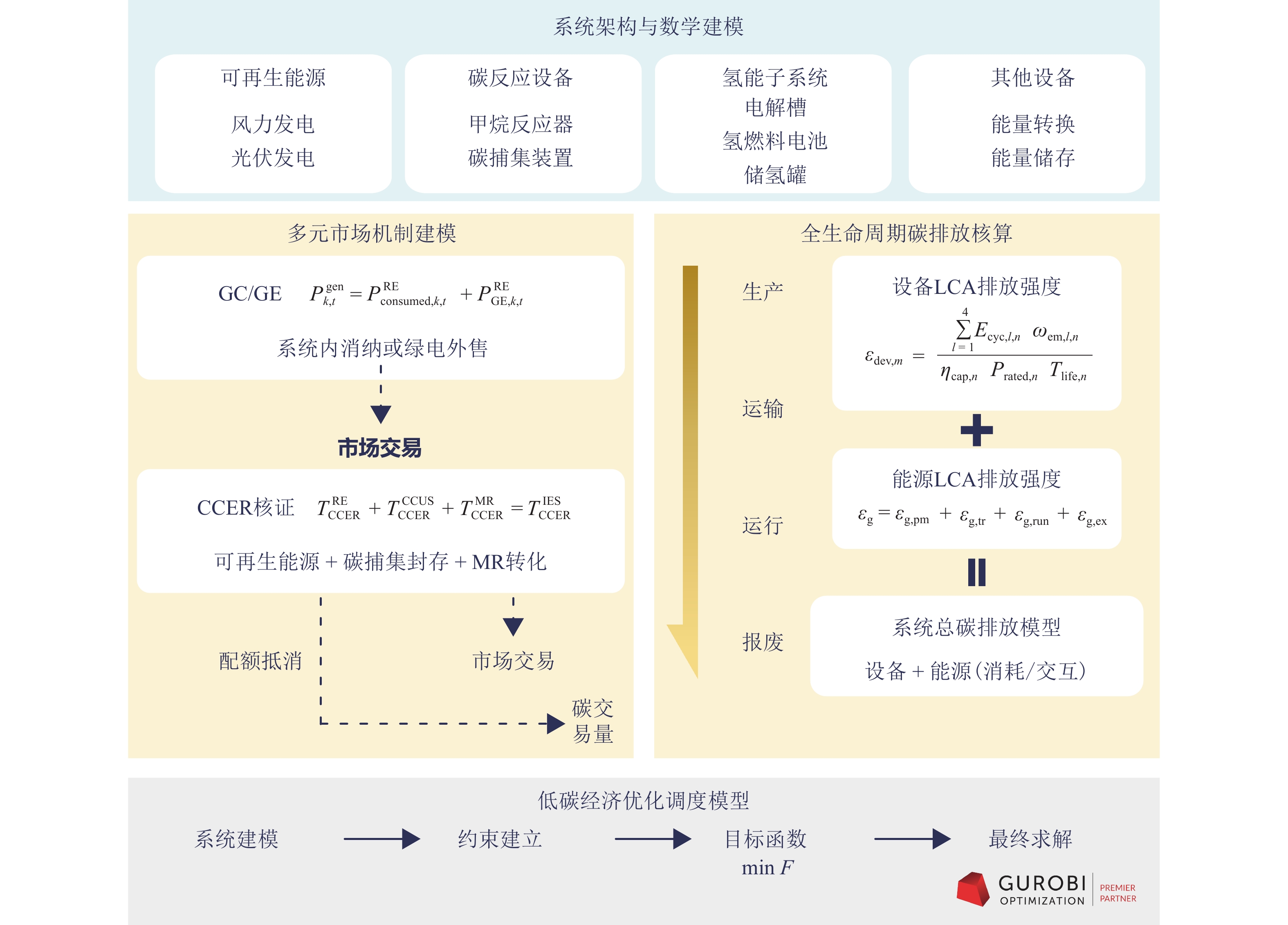
针对“双碳”目标下综合能源系统在电碳多元市场机制协同下经济与减排效益不明确的问题,本文面向含氢能子系统的综合能源系统,提出一种融合中国核证自愿减排量(CCER)、绿色电力证书与绿电交易的多元市场协同优化调度方法. 首先,构建电-氢综合能源系统架构,建立各设备的数学模型并深入分析系统内部能量流与碳流关系;其次,考虑系统可再生能源的内部消纳与外部供应,基于电-碳-氢耦合特性量化系统实际核证减排量,提出系统参与CCER、绿证与绿电多元市场的协同交易方法;基于全生命周期评估方法,建立了涵盖设备生产、运输建设、运行投产和退役处理全阶段的碳排放核算模型;最后,以系统运行成本最小为优化目标,构建考虑阶梯式碳交易成本的综合能源系统优化调度模型,采用混合整数线性规划方法求解,并通过算例验证所提方法的有效性. 研究结果表明:多元化市场交易实现了激励效应叠加,系统总成本较基准场景降低19.38%,达成了系统“降本-减排-消纳”的协同优化.
Abstract:Objective Under the carbon peaking and carbon neutrality goals, integrated energy systems (IESs) cut regional carbon emissions through multi-energy complementarity and cascaded utilization, yet their combined economic and emission reduction benefits stay unclear when several electricity-carbon market mechanisms operate jointly. Existing models often treat carbon capture and power-to-gas (P2G) as independent modules and overlook the bridging role of hydrogen, so the synergistic mitigation potential of electricity-carbon-hydrogen coupling stays underused. Moreover, most carbon-trading studies count only direct operational emissions and thus misjudge the real reduction under full-life-cycle accounting. The green certificate (GC), green electricity (GE), and Chinese certified emission reduction (CCER) mechanisms have mostly been studied independently, and their interaction in IES dispatch has seldom been examined. The objective was to quantify and coordinate the economic and low-carbon performance of an electricity-hydrogen IES that participates simultaneously in the CCER, GC, and GE markets under life-cycle carbon accounting.
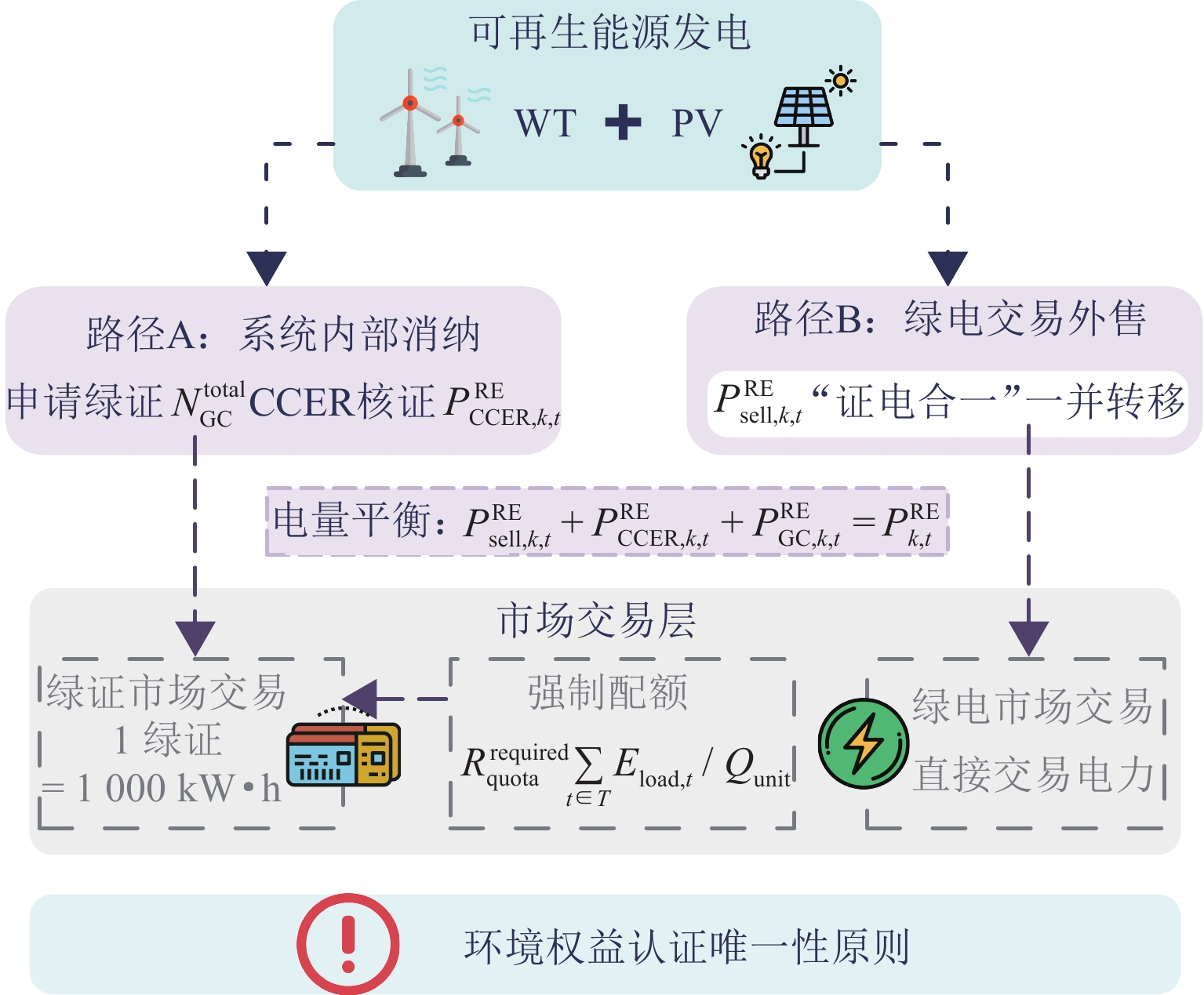
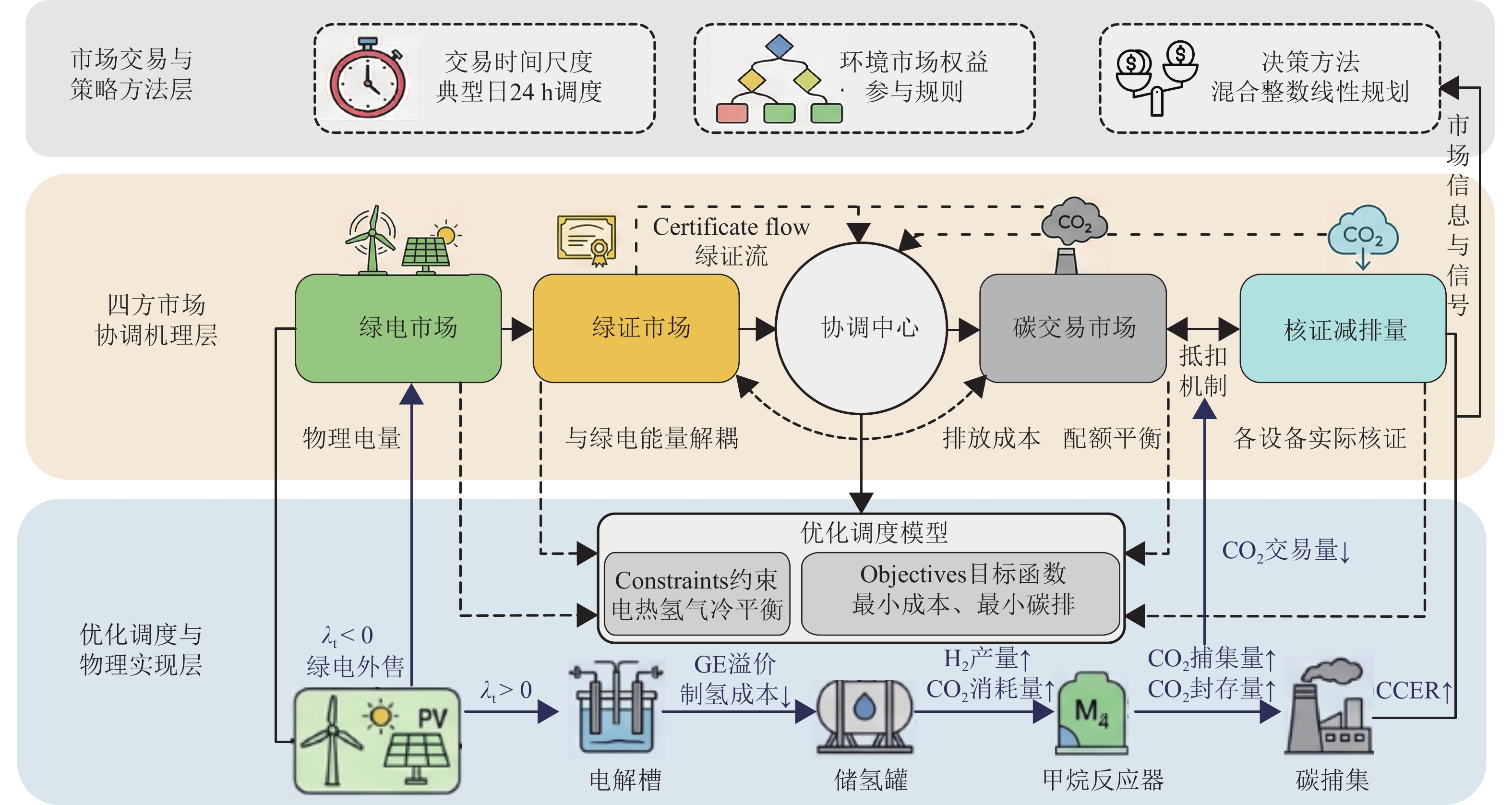
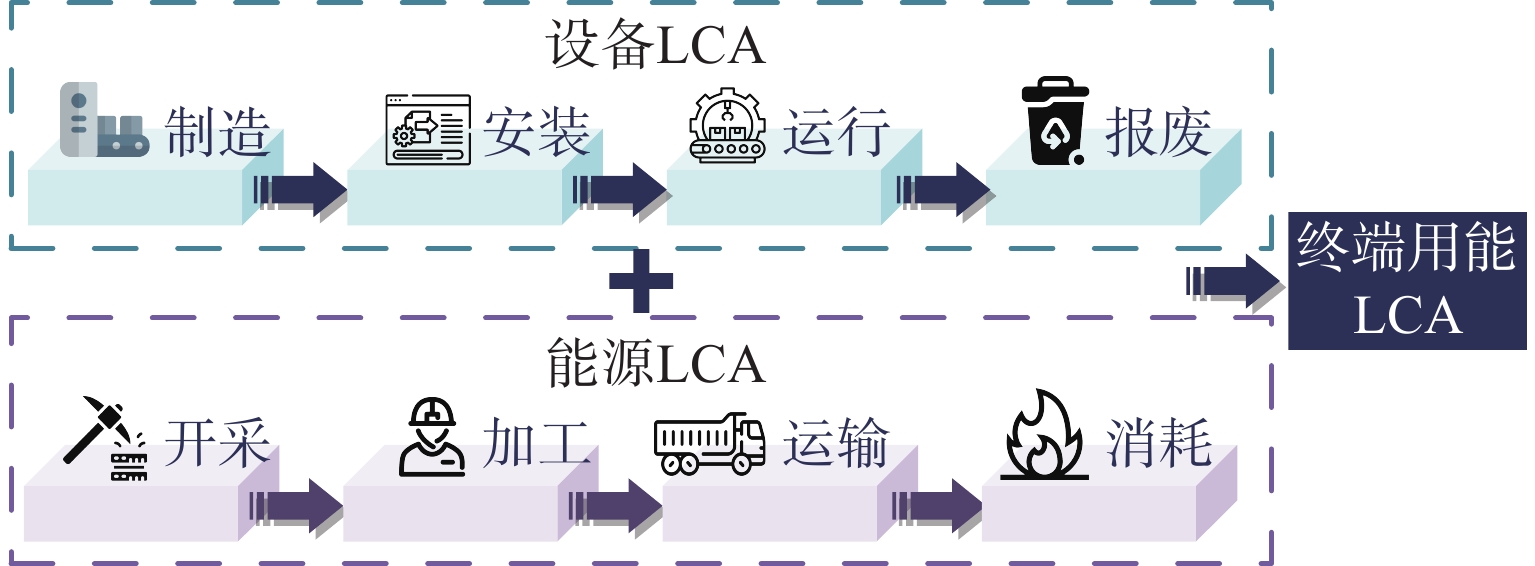
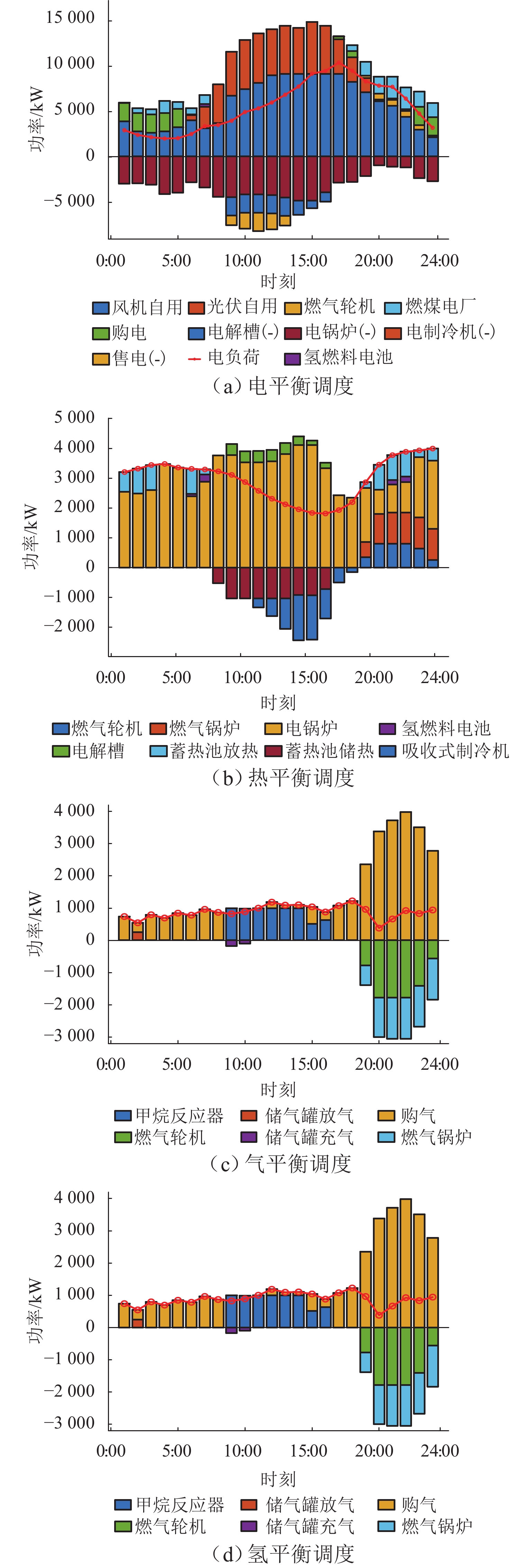
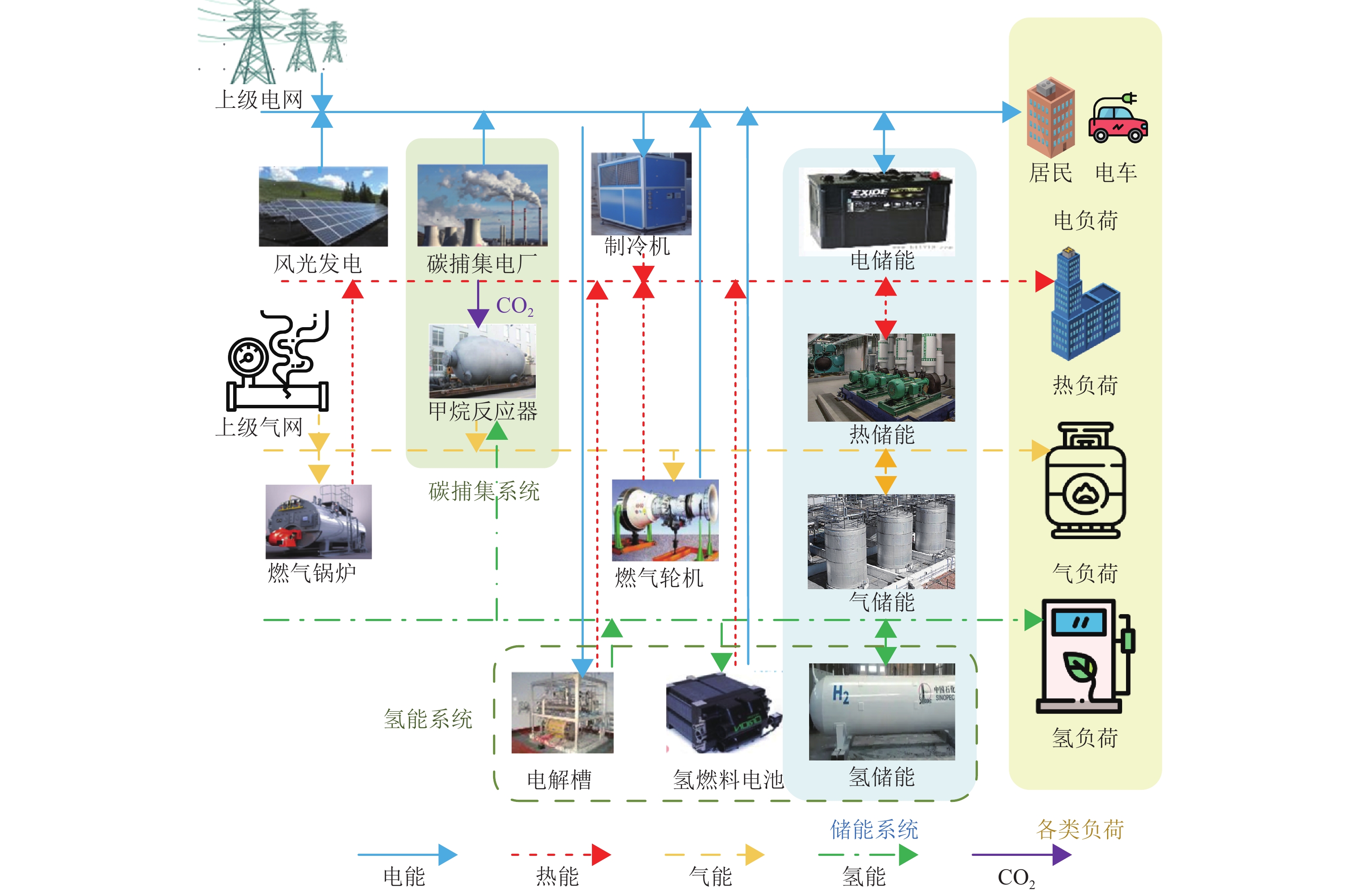
Method An electricity-hydrogen IES architecture was established, and mathematical models were built for the wind turbine (WT), the photovoltaic array (PV), the methane reactor (MR), the carbon capture, utilization and storage (CCUS) unit, the electrolyzer (EL), the hydrogen fuel cell (HFC), the hydrogen storage tank (HST), and other energy-conversion and energy-storage devices. Electricity-carbon-hydrogen coupling was achieved through water electrolysis and CO2 methanation, which formed a carbon capture, hydrogen conversion, and gas utilization cycle. The actual certified emission reduction was quantified from internally consumed renewable generation, directly stored CO2, and CO2 converted in the methane reactor. Under the principle of unique environmental rights certification, a synergistic trading method was formulated for the CCER, GC, and GE markets, and a price-coupling coefficient was introduced to merge the three market signals into a single marginal criterion for renewable allocation. A life-cycle-assessment (LCA) carbon-accounting model was developed for equipment production, transportation and construction, operation, commissioning, and decommissioning, in which a carbon-intensity-per-unit-electricity (CIUE) index was defined to unify device-level emissions. A tiered carbon-trading cost was embedded, and a dispatch model that minimizes the total cost, namely annualized investment, operation and maintenance, energy purchase, carbon, GC-trading, and CCER costs, was constructed. The mixed-integer linear programming model was solved by the GUROBI solver through YALMIP in MATLAB. A typical-day case of an industrial park in southwest China supplied the inputs, with measured wind speed, solar irradiance, and ambient temperature, and five scenarios were compared: a conventional IES; the same system with a hydrogen subsystem; the hydrogen system further combined with GC and GE, with CCER, and with all three mechanisms together.
Result The hydrogen subsystem builds an electricity-hydrogen-methane path that consumes captured CO2; relative to the conventional system, it lowers total carbon emissions by 10.53%, carbon trading cost by 16.32%, and gas-purchase cost by 3.74%, raises operation and maintenance cost by 43.63%, and reduces total cost by 2.14%. Under the GC and GE mechanism, the value of self-consumed renewable power, including certificate revenue plus avoided purchase and lower carbon-trading cost, exceeds the revenue from electricity sales, so on-site sales fall by 37.89%, with renewable curtailment of 1 702.17 kW•h; the carbon-capture rate stays at 75.32%, as end-of-pipe capture receives little direct incentive. The CCER mechanism shifts the strategy from source-side cleaning to coordinated source-and-end abatement, cuts carbon-trading cost by 51.15%, raises the capture rate to 79.40%, and lowers curtailment to 1 123.81 kW•h. The combination of all three mechanisms yields the lowest total cost, 39 375.96 yuan, 19.38% below the baseline scenario; stronger hydrogen-production economics push the methane reactor and the capture unit to high-intensity operation, raise the capture rate to 83.91% and captured CO2 to 38 354.28 kg, hold the net traded carbon to 6 828.04 kg despite the largest CO2 generation of 45 708.78 kg, and achieve zero renewable curtailment. The three mechanisms couple through the renewable-allocation constraint rather than act as independent additive incentives.
Conclusion The hydrogen subsystem links carbon capture with gas supply and turns captured CO2 into a usable carbon source, so the electricity-carbon-hydrogen coupling improves both economy and emissions over a conventional IES. The CCER, GC, and GE mechanisms act on dispatch through a shared renewable-allocation constraint and produce synergistic amplification rather than a linear sum of separate incentives. Coordinated participation in the three markets achieves the joint optimization of cost reduction, emission mitigation, and renewable accommodation and provides a reference for the planning and operation of IESs in industrial parks.
-
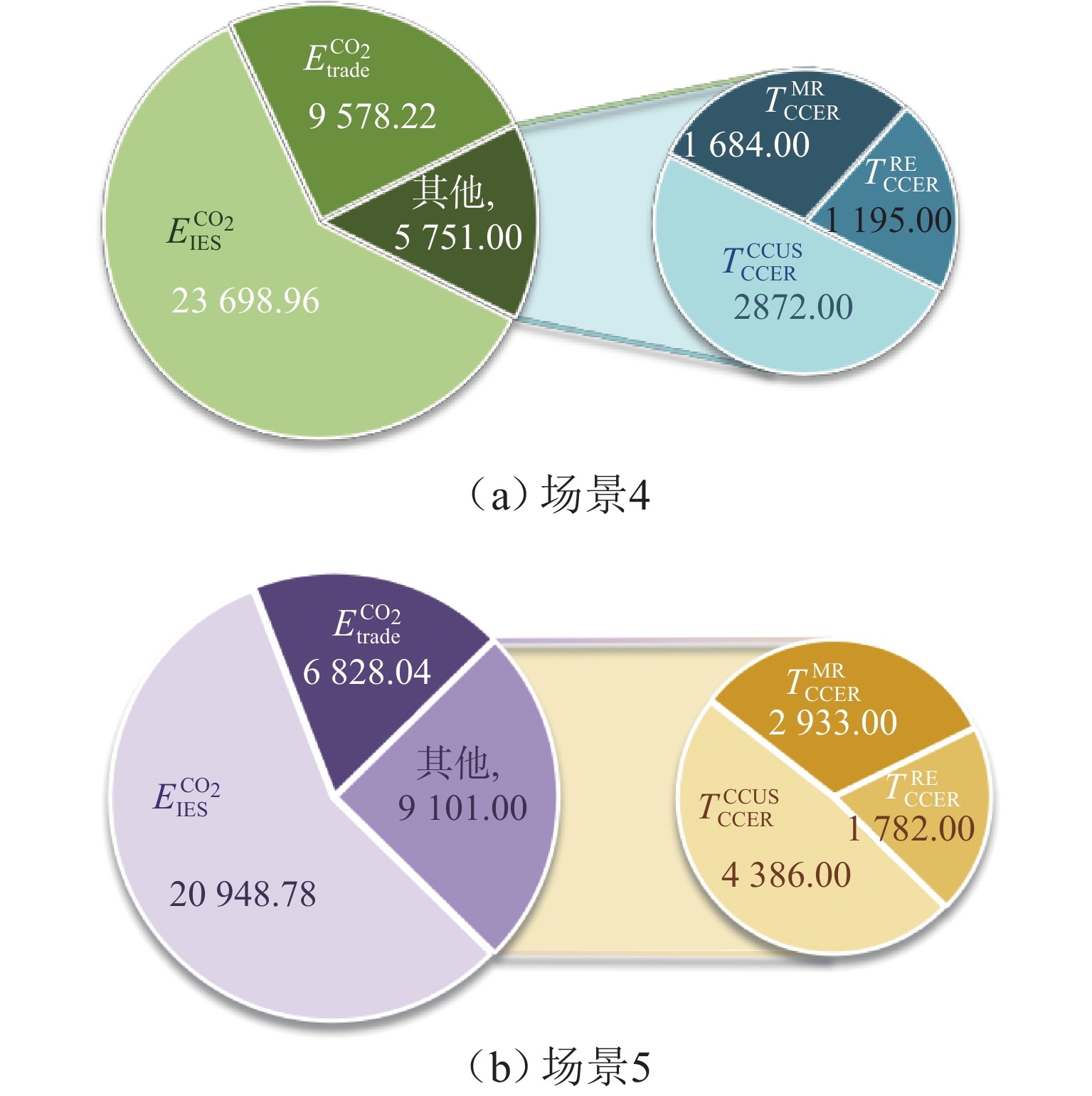
图 7 各场景下的系统碳量构成(单位:kg)
Figure 7. System carbon composition under various scenarios (unit: kg)
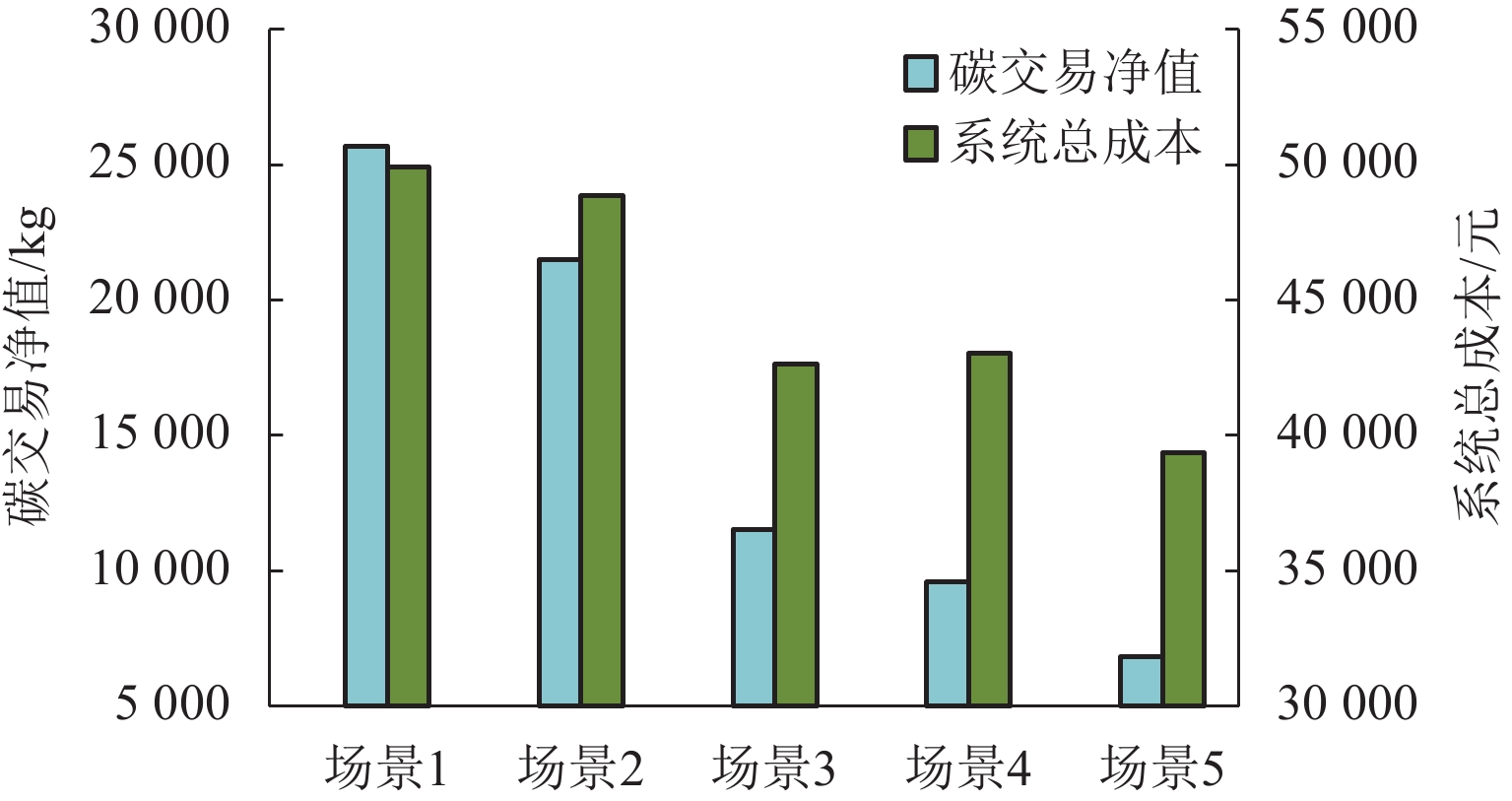
图 9 各场景碳交易与总成本对比
Figure 9. Comparison of carbon trading costs and total costs across different scenarios
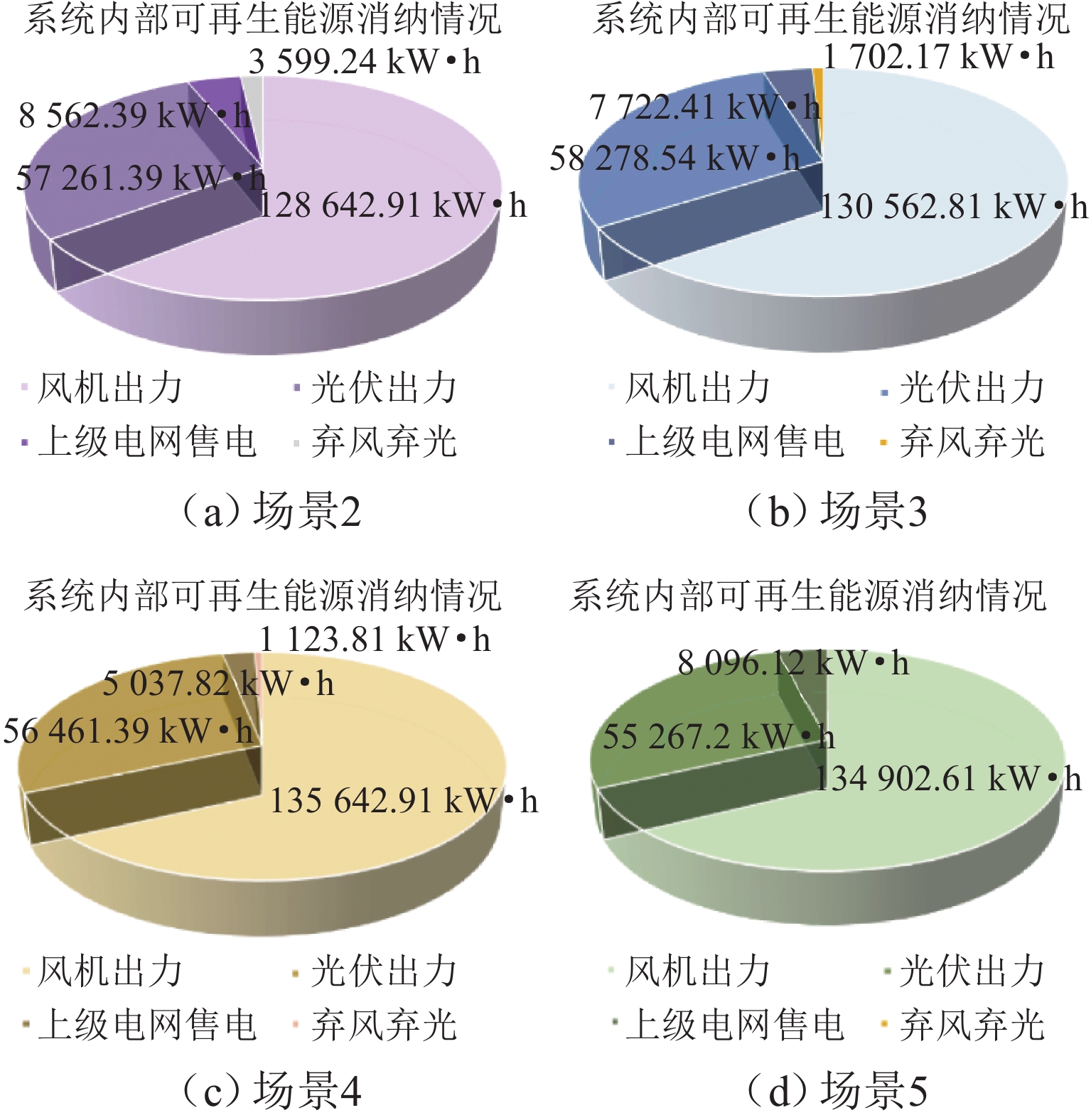
图 10 各场景下的可再生能源消纳比例(单位:kg•h)
Figure 10. Renewable energy consumption ratio under different scenarios (unit: kg•h)
表 1 场景设置
Table 1. Setting of scenarios
场景 考虑
氢能考虑 GC
和 GE考虑CCER GC、GE 和
CCER 交互1 × × × × 2 √ × × × 3 √ √ × × 4 √ × √ × 5 √ √ √ √  下载: 导出CSV
表 2 场景1、2成本对比分析
Table 2. Cost analysis for scenarios 1 and 2
元 成本 场景 1 场景 2 运维成本 3587.99 5153.37 燃煤成本 19800.33 17855.82 碳封存成本 1350.22 1541.38 碳交易成本 7702.47 6445.25 购电成本 5724.92 5448.61 售电成本 − 6427.90 − 5103.98 购气成本 18172.59 17492.64 总成本/元 49910.63 48843.09
下载: 导出CSV
表 3 场景1、2碳排放对比分析
Table 3. Comparative analysis of carbon emissions for scenarios 1 and 2
kg 项目 场景 1 场景 2 碳排放总量 39795.62 35604.87 碳交易净值 25674.91 21484.16
下载: 导出CSV
表 4 场景3、4、5成本对比分析
Table 4. Comparative analysis of cost for scenarios 3, 4, and 5
元 成本 场景 3 场景 4 场景 5 运维成本 5134.10 5004.37 5133.44 燃煤成本 15217.04 17429.14 16233.03 碳封存成本 1480.43 1465.58 1615.54 碳交易成本 3460.10 3148.41 2911.62 购电成本 5410.80 5509.01 5685.22 售电成本 − 3170.10 − 2724.08 − 4371.90 购气成本 15933.92 14938.12 15338.70 绿证成本 −842.54 0 −949.71 CCER成本 0 − 1446.39 − 2219.98 总成本 42623.78 43024.16 39375.96
下载: 导出CSV
表 5 场景3、4、5碳捕集效益对比
Table 5. Comparison of carbon capture benefits for scenarios 3, 4, and 5
项目 场景 3 场景 4 场景 5 总发电量/(kW•h) 39135.80 41497.96 45792.92 净发电量/(kW•h) 11523.04 8996.72 12176.31 碳捕集耗电/(kW•h) 28612.77 32501.24 33616.61 CO2生成量/kg 39098.52 42327.92 45708.78 CO2捕获量/kg 29449.01 33608.65 38354.28 碳捕集率/% 75.32 79.40 83.91
下载: 导出CSV
表 6 场景3、4、5碳排放对比分析
Table 6. Comparison of carbon emissions for scenarios 3, 4, and 5
kg 项目 场景 3 场景 4 场景 5 碳排放总量 25654.39 23698.96 20948.78 碳交易净值 11533.65 9578.22 6828.04
下载: 导出CSV
-
[1] Li Y, Liu Z H, Sang Y F, et al. Optimization of integrated energy system for low-carbon community considering the feasibility and application limitation[J]. Applied Energy, 2023, 348: 121528. doi: 10.1016/j.apenergy.2023.121528 [2] Yang T, Wang Q C, Wang X D, et al. Low-carbon economic distributed dispatch for district-level integrated energy system considering privacy protection and demand response[J]. Applied Energy, 2025, 383: 125389. doi: 10.1016/j.apenergy.2025.125389 [3] Zhao N X, Gu W B, Zheng Z P, et al. Multi-objective bi-level planning of the integrated energy system considering uncertain user loads and carbon emission during the equipment manufacturing process[J]. Renewable Energy, 2023, 216: 119070. doi: 10.1016/j.renene.2023.119070 [4] Lu X, Fan X Z, Lu S, et al. An operation model for integrated electricity and heat systems emphasizing modeling of both networks and uncertainties[J]. Applied Energy, 2024, 370: 123595. doi: 10.1016/j.apenergy.2024.123595 [5] 王成山, 吕超贤, 李鹏, 等. 园区型综合能源系统多时间尺度模型预测优化调度[J]. 中国电机工程学报, 2019, 39(23): 6791-6803. doi: 10.13334/j.0258-8013.pcsee.181058Wang Chengshan, Lü Chaoxian, Li Peng, et al. Multiple time-scale optimal scheduling of community integrated energy system based on model predictive control[J]. Proceedings of the CSEE, 2019, 39(23): 6791-6803. doi: 10.13334/j.0258-8013.pcsee.181058 [6] Li Y X, Zhang J L, Wu X, et al. Stochastic-robust planning optimization method based on tracking-economy extreme scenario tradeoff for CCHP multi-energy system[J]. Energy, 2023, 283: 129025. doi: 10.1016/j.energy.2023.129025 [7] 孙雯, 陈紫薇, 张玉琼, 等. 基于动态规划的SOFC冷热电三联供综合能源系统日前经济调度[J]. 中国电机工程学报, 2022, 42(21): 7775-7783. doi: 10.13334/j.0258-8013.pcsee.211743Sun Wen, Chen Ziwei, Zhang Yuqiong, et al. Economic day-ahead scheduling of SOFC-based integrated tri-generation energy system using dynamic programming[J]. Proceedings of the CSEE, 2022, 42(21): 7775-7783. doi: 10.13334/j.0258-8013.pcsee.211743 [8] Xing X T, Lin J, Song Y H, et al. Modeling and operation of the power-to-gas system for renewables integration: a review[J]. CSEE Journal of Power and Energy Systems, 2018, 4(2): 168-178. doi: 10.17775/CSEEJPES.2018.00260 [9] 李红伟, 吴佳航, 王佳怡, 等. 计及P2G及碳捕集的风光氢储综合能源系统低碳经济调度[J]. 电力系统保护与控制, 2024, 52(16): 26-36. doi: 10.19783/j.cnki.pspc.240247Li Hongwei, Wu Jiahang, Wang Jiayi, et al. Low-carbon economic dispatch of a wind, solar, and hydrogen storage integrated energy system considering P2G and carbon capture[J]. Power System Protection and Control, 2024, 52(16): 26-36. doi: 10.19783/j.cnki.pspc.240247 [10] Cavana M, Mazza A, Chicco G, et al. Electrical and gas networks coupling through hydrogen blending under increasing distributed photovoltaic generation[J]. Applied Energy, 2021, 290: 116764. doi: 10.1016/j.apenergy.2021.116764 [11] Ma Y M, Wang H X, Hong F, et al. Modeling and optimization of combined heat and power with power-to-gas and carbon capture system in integrated energy system[J]. Energy, 2021, 236: 121392. doi: 10.1016/j.energy.2021.121392 [12] 郭静蓉, 向月, 吴佳婕, 等. 考虑CCUS电转气技术及碳市场风险的电–气综合能源系统低碳调度[J]. 中国电机工程学报, 2023, 43(4): 1290-1302. doi: 10.13334/j.0258-8013.pcsee.221255Guo Jingrong, Xiang Yue, Wu Jiajie, et al. Low-carbon optimal scheduling of integrated electricity-gas energy systems considering CCUS-P2G technology and risk of carbon market[J]. Proceedings of the CSEE, 2023, 43(4): 1290-1302. doi: 10.13334/j.0258-8013.pcsee.221255 [13] 刘妍, 胡志坚, 陈锦鹏, 等. 含碳捕集电厂与氢能多元利用的综合能源系统低碳经济调度[J]. 电力系统自动化, 2024, 48(1): 31-40. doi: 10.7500/AEPS20230221001Liu Yan, Hu Zhijian, Chen Jinpeng, et al. Low-carbon economic dispatch of integrated energy system considering carbon capture power plant and multi-utilization of hydrogen energy[J]. Automation of Electric Power Systems, 2024, 48(1): 31-40. doi: 10.7500/AEPS20230221001 [14] Wang T H, Hua H C, Shi T Y, et al. A bi-level dispatch optimization of multi-microgrid considering green electricity consumption willingness under renewable portfolio standard policy[J]. Applied Energy, 2024, 356: 122428. doi: 10.1016/j.apenergy.2023.122428 [15] 黄铭浩, 唐坤杰, 董树锋, 等. 基于碳流理论考虑用户侧碳排放配额的最优潮流[J]. 电网技术, 2023, 47(7): 2703-2712.Huang Minghao, Tang Kunjie, Dong Shufeng, et al. Optimal power flow considering user-side carbon emission allowances based on carbon flow theory[J]. Power System Technology, 2023, 47(7): 2703-2712. [16] 郭文凯, 王果, 闵永智. 计及阶梯式碳交易的牵引供电系统混合储能容量配置[J]. 西南交通大学学报, 2025, 60(3): 550-560.Guo Wenkai, Wang Guo, Min Yongzhi. Hybrid energy storage capacity configuration for traction power supply systems considering ladder-type carbon trading mechanism[J]. Journal of Southwest Jiaotong University, 2025, 60(3): 550-560. [17] 邹宇航, 曾艾东, 郝思鹏, 等. 阶梯式碳交易机制下综合能源系统多时间尺度优化调度[J]. 电网技术, 2023, 47(6): 2185-2195.Zou Yuhang, Zeng Aidong, Hao Sipeng, et al. Multi-time-scale optimal dispatch of integrated energy systems under stepped carbon trading mechanism[J]. Power System Technology, 2023, 47(6): 2185-2195. [18] 张笑演, 王橹裕, 黄蕾, 等. 考虑扩展碳排放流和碳交易议价模型的园区综合能源优化调度[J]. 电力系统自动化, 2023, 47(9): 34-46. doi: 10.7500/AEPS20220614001Zhang Xiaoyan, Wang Luyu, Huang Lei, et al. Optimal dispatching of park-level integrated energy system considering augmented carbon emission flow and carbon trading bargain model[J]. Automation of Electric Power Systems, 2023, 47(9): 34-46. doi: 10.7500/AEPS20220614001 [19] 余洋, 吴千, 霍宇航, 等. 计及自适应阶梯碳势-碳价与供需双响应基于主从博弈的综合能源系统低碳经济调度[J]. 电网技术, 2024, 48(7): 2702-2714.Yu Yang, Wu Qian, Huo Yuhang, et al. Low-carbon economic dispatch for integrated energy system based on Stackelberg game considering adaptive stepped carbon potential-carbon price and dual response of supply and demand[J]. Power System Technology, 2024, 48(7): 2702-2714. [20] 李伊竹林, 韩肖清, 李廷钧, 等. 基于动态电-碳需求响应的综合能源系统日前多元低碳交易方法[J]. 电力系统自动化, 2024, 48(12): 24-35. doi: 10.7500/AEPS20231023003Li Yizhulin, Han Xiaoqing, Li Tingjun, et al. Multifaceted day-ahead low-carbon trading method for integrated energy systems based on dynamic electricity-carbon demand response[J]. Automation of Electric Power Systems, 2024, 48(12): 24-35. doi: 10.7500/AEPS20231023003 [21] Zhou Y, Wu J, Long C, et al. Integrated energy system multi-objective optimization scheduling considering tradable green certificate and carbon trading mechanism[J]. Energy, 2023, 278: 127811. [22] Eggleston H, Buendia L, Miwa K, et al. 2006 IPCC guidelines for national greenhouse gas inventories, volume 2: energy[M]. Hayama: the Institute for Global Environmental Strategies (IGES), 2006. [23] 国家统计局能源统计司. 中国能源统计年鉴-2022[M]. 北京: 中国统计出版社, 2023. [24] Alcalde J, Flude S, Wilkinson M, et al. Estimating geological CO2 storage security to deliver on climate mitigation[J]. Nature Communications, 2018, 9: 2201. doi: 10.1038/s41467-018-04423-1 [25] Vasudevan S, Farooq S, Karimi I A, et al. Energy penalty estimates for CO2 capture: comparison between fuel types and capture-combustion modes[J]. Energy, 2016, 103: 709-714. doi: 10.1016/j.energy.2016.02.154 [26] 国家气候战略中心. 2023年减排项目中国区域电网基准线排放因子[R]. 北京: 国家气候战略中心, 2024. [27] Zhang Q, Wang D X, Zhao C J, et al. Low-carbon operation of smart distribution grid based on life cycle assessment and ladder-type carbon trading[J]. Renewable Energy, 2024, 231: 120816. doi: 10.1016/j.renene.2024.120816 [28] Dong H Y, Fu Y B, Jia Q Q, et al. Low carbon optimization of integrated energy microgrid based on life cycle analysis method and multi time scale energy storage[J]. Renewable Energy, 2023, 206: 60-71. doi: 10.1016/j.renene.2023.02.034 [29] Wu M, Xu J Z, Li Y, et al. Low carbon economic dispatch of integrated energy systems considering life cycle assessment and risk cost[J]. International Journal of Electrical Power & Energy Systems, 2023, 153: 109287. doi: 10.1016/j.ijepes.2023.109287 -

 下载:
下载:

 点击查看大图
计量
- 文章访问数: 130
- HTML全文浏览量: 128
- PDF下载量: 55
- 被引次数: 0