



Application of Green and Low-Carbon Technologies in Bridge Engineering: A Review
-
摘要:
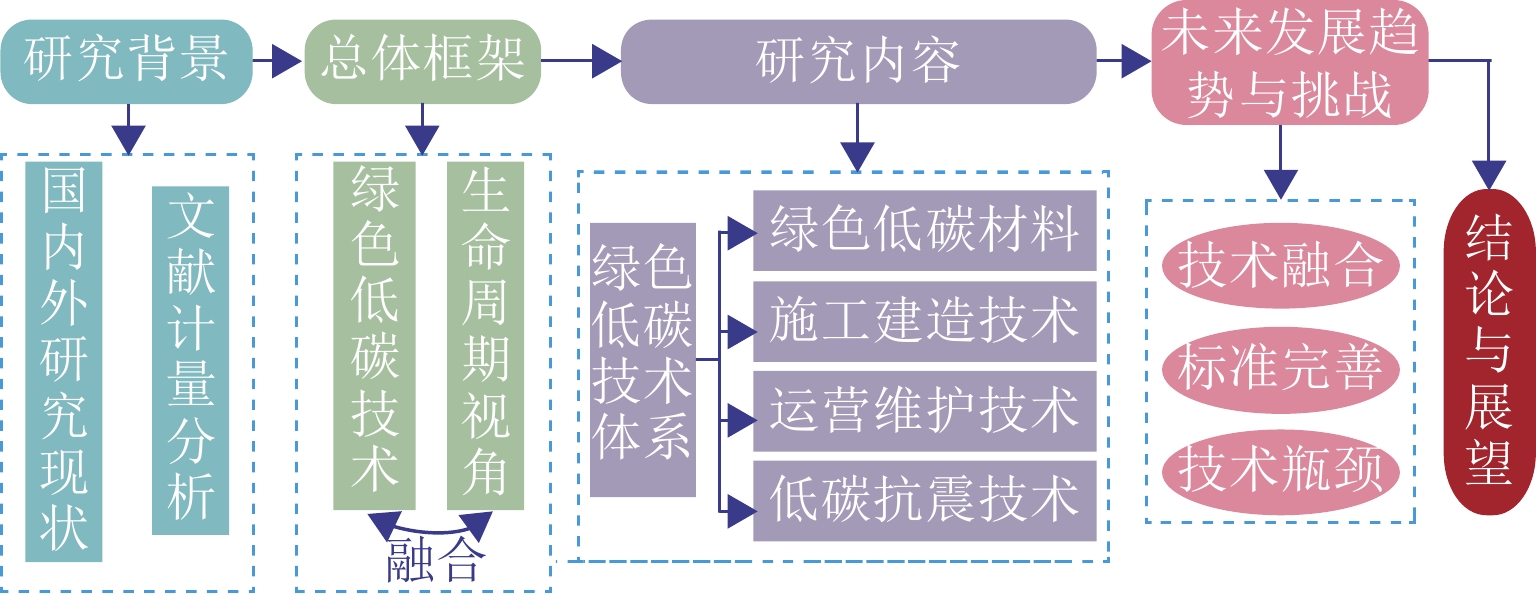
在全球气候治理与我国“双碳”目标驱动下,桥梁工程作为交通基础设施的重要组成部分,其绿色低碳转型对于降低交通领域碳排放、推动可持续发展具有重要意义. 本文系统梳理绿色低碳技术在桥梁工程中的研究进展、技术体系与工程应用,覆盖桥梁全生命周期,从材料、设计、施工、运维、退役5个环节协同减排,评述其在全生命周期减碳、耐久性提升及抗震性能协同优化中的作用. 材料端以低熟料/高掺量胶凝材料、再生骨料与循环用钢等降低隐含碳并提升耐久性;设计端以寿命周期成本、环境影响协同优化实现控碳决策;施工建造端通过装配化施工、施工装备高效化及运输-组织优化实现直接减排;运维端依托 BIM/物联网/人工智能的状态感知与预测性养护,提高能效并减少不必要的维修活动;末端以退役友好型设计、分级拆解与精细化分选-再生-再制造技术实现材料闭环与最终处置减量. 现阶段仍存在多目标协同设计方法不完善、碳排放评价标准与数据体系不统一以及低碳与抗震性能协同优化不足等关键问题,未来应加强数字孪生与智能优化技术应用,推动低碳新材料研发,完善绿色建造与智能运维体系,并构建材料循环利用与闭环管理机制,深化低碳与抗震韧性协同设计理论,以实现桥梁工程“安全、耐久、低碳、韧性”的可持续发展目标.
-
关键词:
- 绿色低碳技术 /
- 桥梁全生命周期 /
- 碳排放核算与减排 /
- 耐久性提升与绿色养护 /
- 低碳抗震设计与韧性
Abstract:Under the impetus of global climate governance and China’s carbon peaking and carbon neutrality goals, bridge engineering serves as a vital component of transportation infrastructure. Its green and low-carbon transformation is of great significance for reducing carbon emissions in the transportation sector and promoting sustainable development. The research progress, technical systems, and engineering applications of green and low-carbon technologies in bridge engineering were systematically reviewed. It covered the full life cycle of bridges, ranging from material, design, construction, operation, and maintenance to demolition, aiming to achieve coordinated emission reduction in the five aforementioned stages. The roles in reducing carbon emissions in the full life cycle, enhancing durability, and optimizing seismic performance in a coordinated manner were reviewed. On the material side, low-clinker/high-blended cementitious materials, recycled aggregates, and circular steel were used to reduce embodied carbon and enhance durability. On the design side, the coordinated optimization of life cycle cost and environmental impact was adopted to achieve carbon control decisions. On the construction side, direct emission reduction was achieved through prefabricated construction, efficient construction equipment, and optimized transportation, as well as organization. On the operation and maintenance side, building information modeling (BIM)/Internet of Things/artificial intelligence were utilized for condition perception and predictive maintenance to improve energy efficiency and reduce unnecessary maintenance activities. At the end of the life cycle, retirement-friendly design, hierarchical dismantling, as well as refined sorting, recycling, and remanufacturing technologies were employed to achieve the closed loop of material and final disposal reduction. Currently, there are still key issues such as the imperfection of multi-objective coordinated design methods, the lack of unified carbon emission evaluation standards and data systems, and the insufficient coordinated optimization of low-carbon and seismic performance. In the future, efforts should be made to strengthen the application of digital twin and intelligent optimization technologies, promote the research and development of low-carbon new materials, improve the green construction and intelligent operation and maintenance systems, and establish a material recycling and closed-loop management mechanism. The theory of coordinated design for low-carbon and seismic resilience should also be deepened to achieve the sustainable development goals of “safety, durability, low carbon, and resilience” in bridge engineering.
-

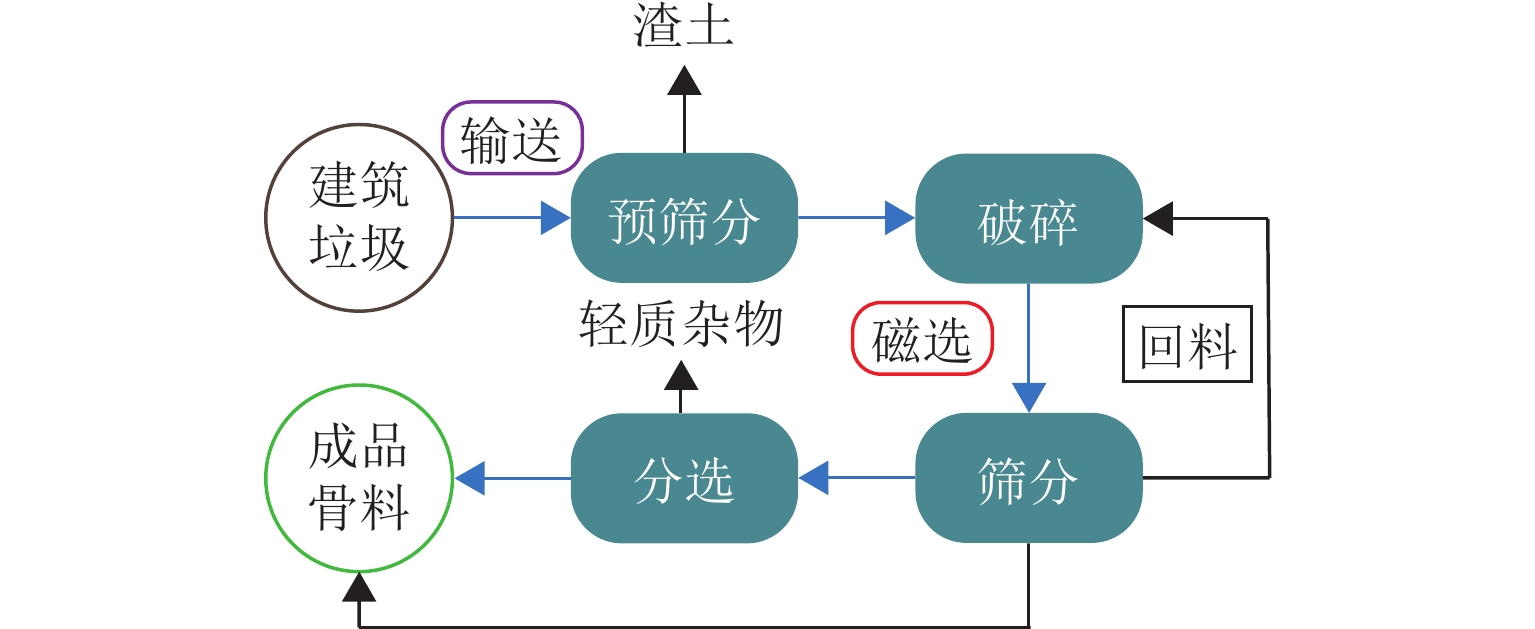
图 6 建筑废材与石料的绿色低碳循环利用
Figure 6. Green, low-carbon, and circular utilization of construction waste and stone materials
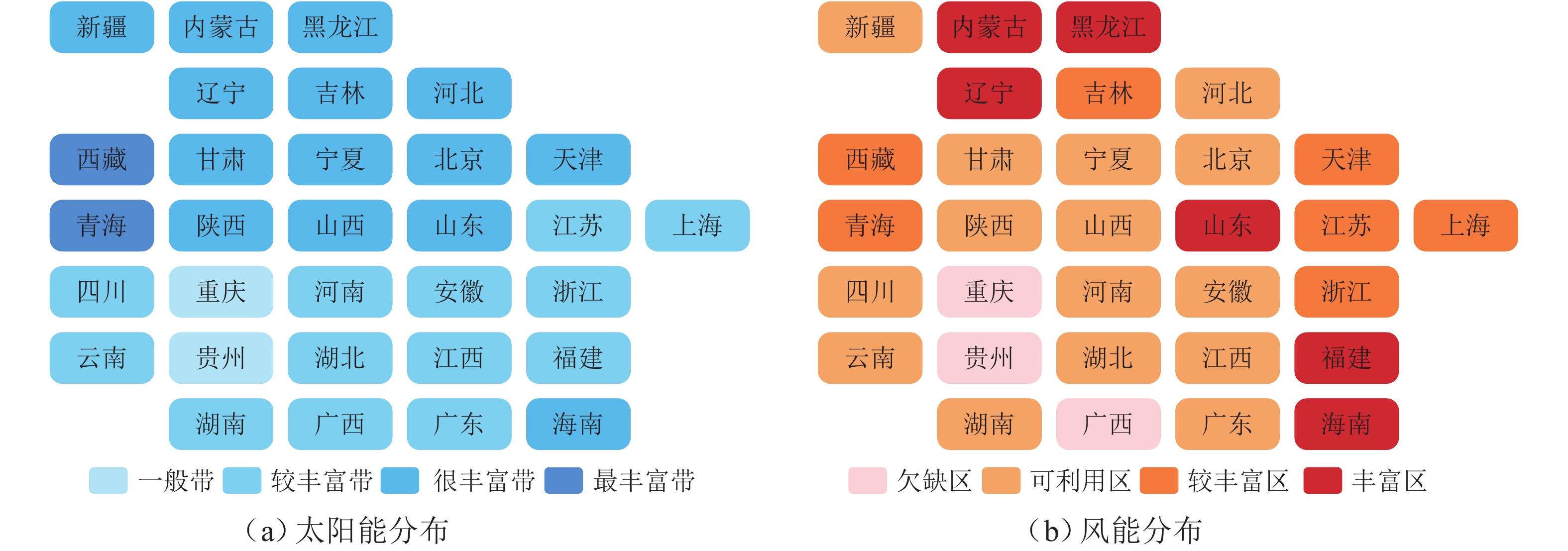
图 7 中国部分可再生能源分布示意
注:色块颜色代表资源等级,非实际地理边界.
Figure 7. Distribution of some renewable energy in China
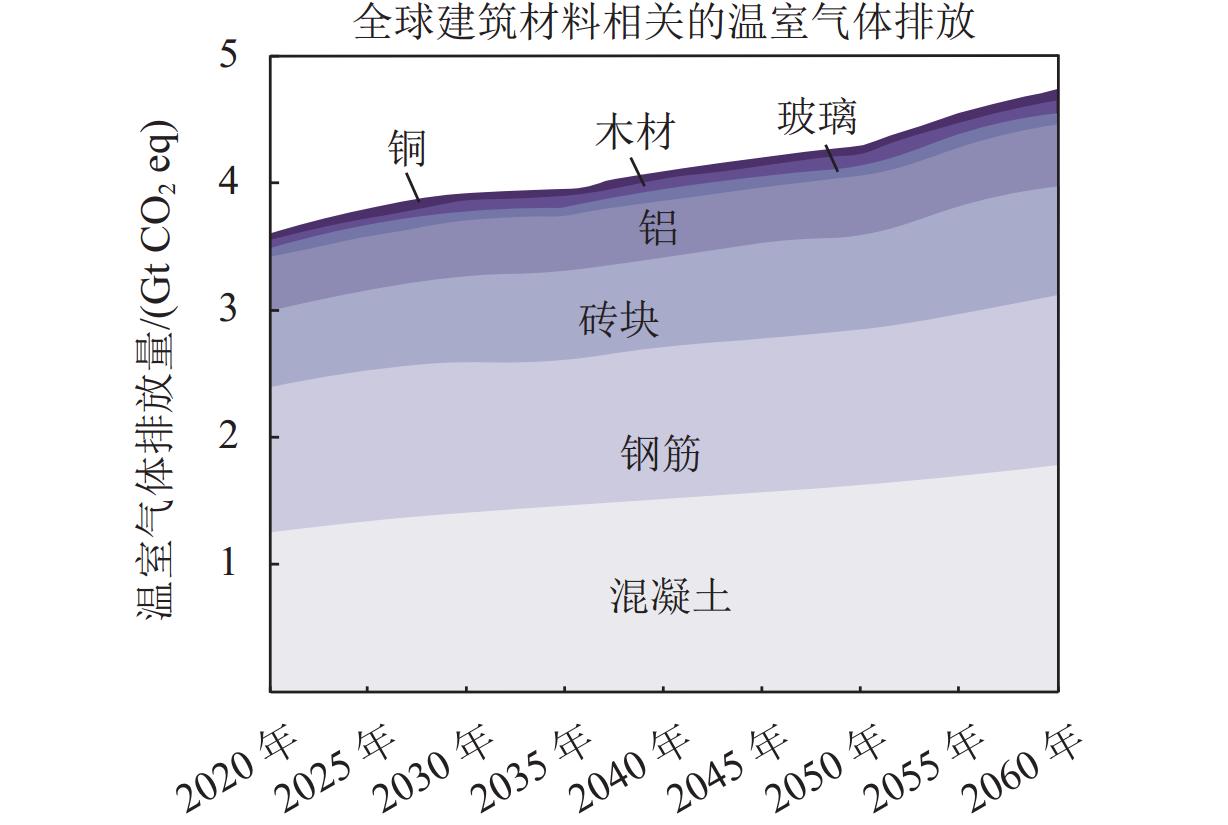
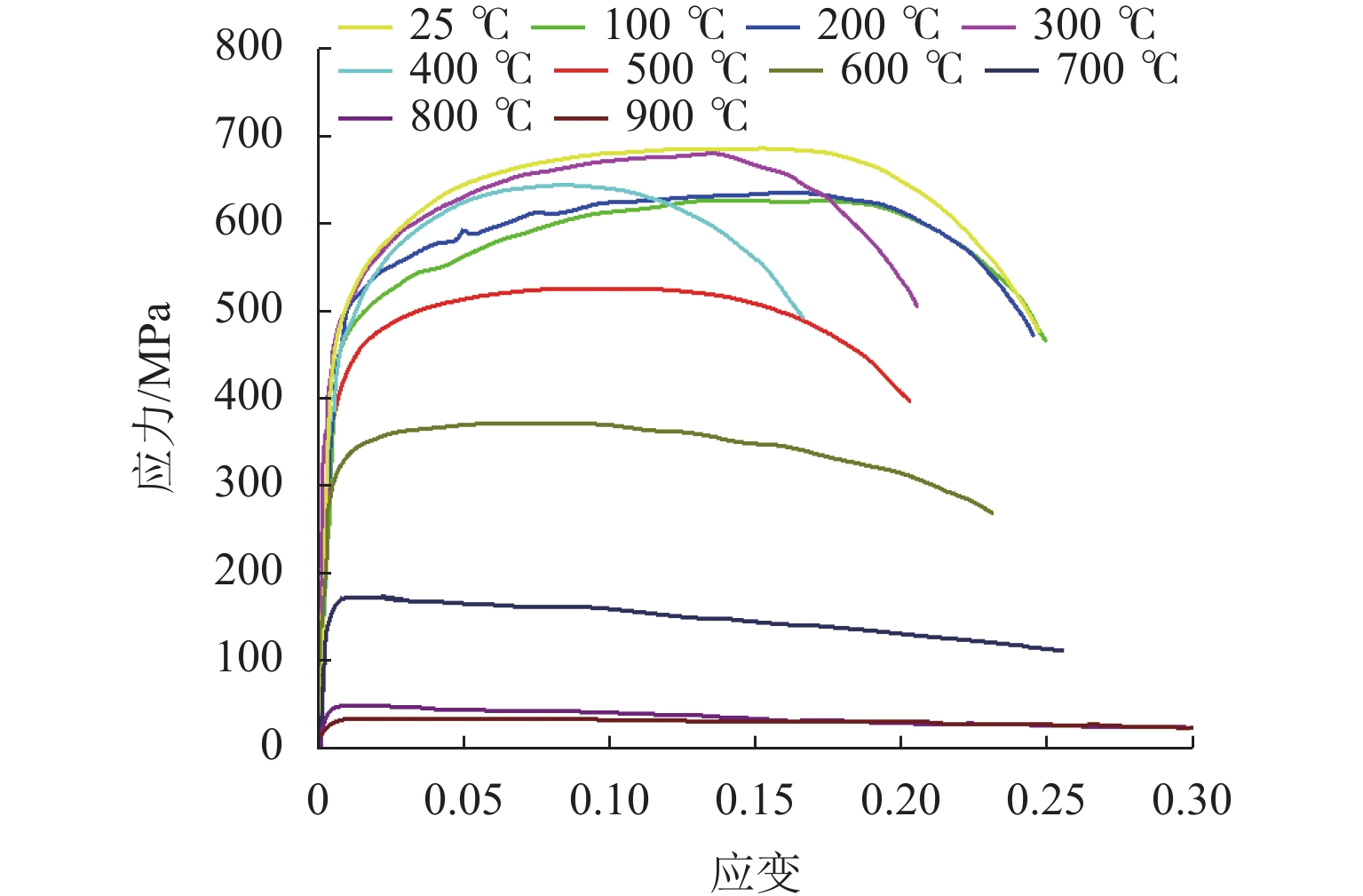
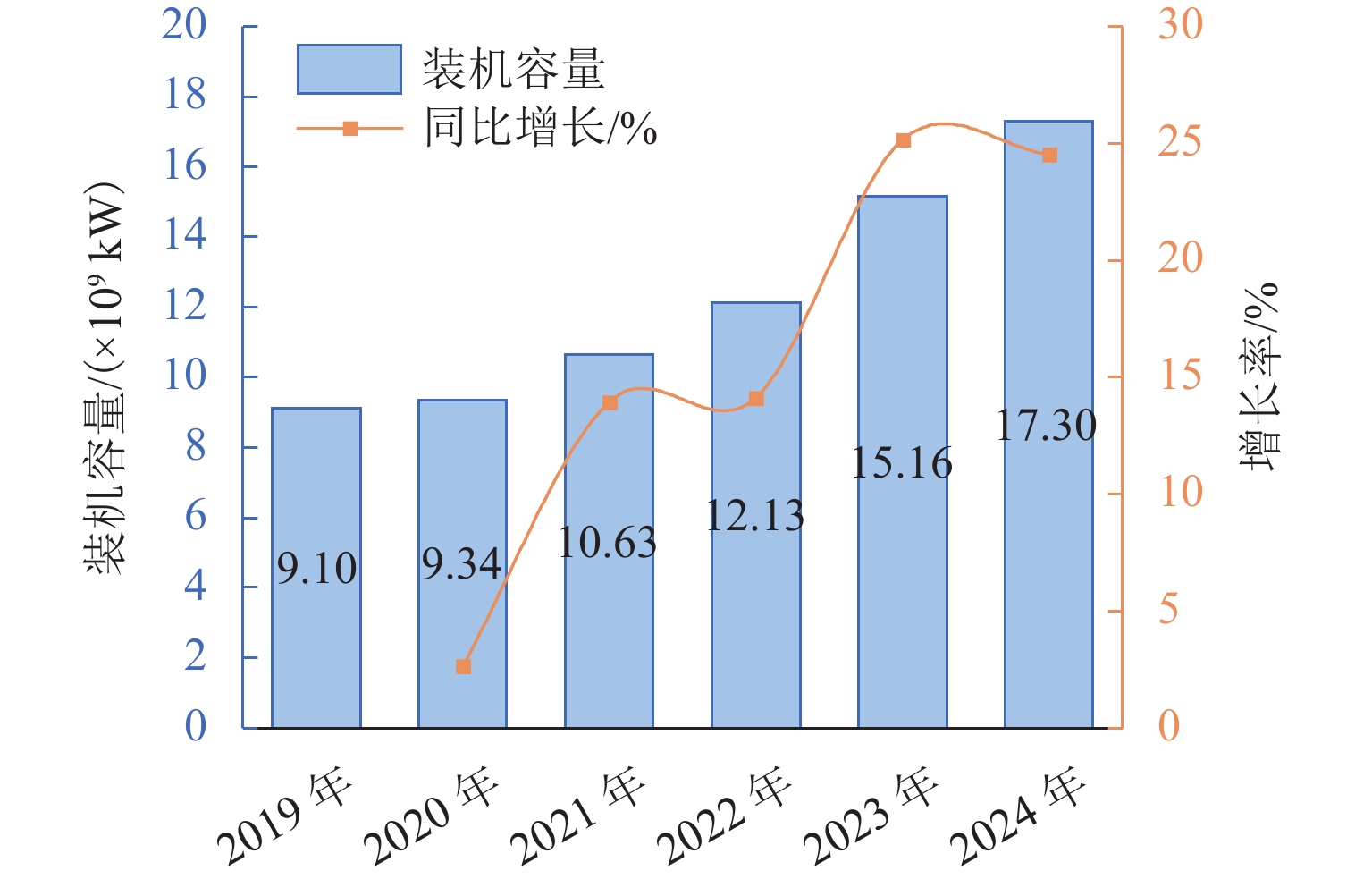
图 16 2019—2024年中国可再生能源累计装机容量及同比增长情况
Figure 16. Cumulative installed capacity and year-on-year growth of renewable energy in China from 2019 to 2024
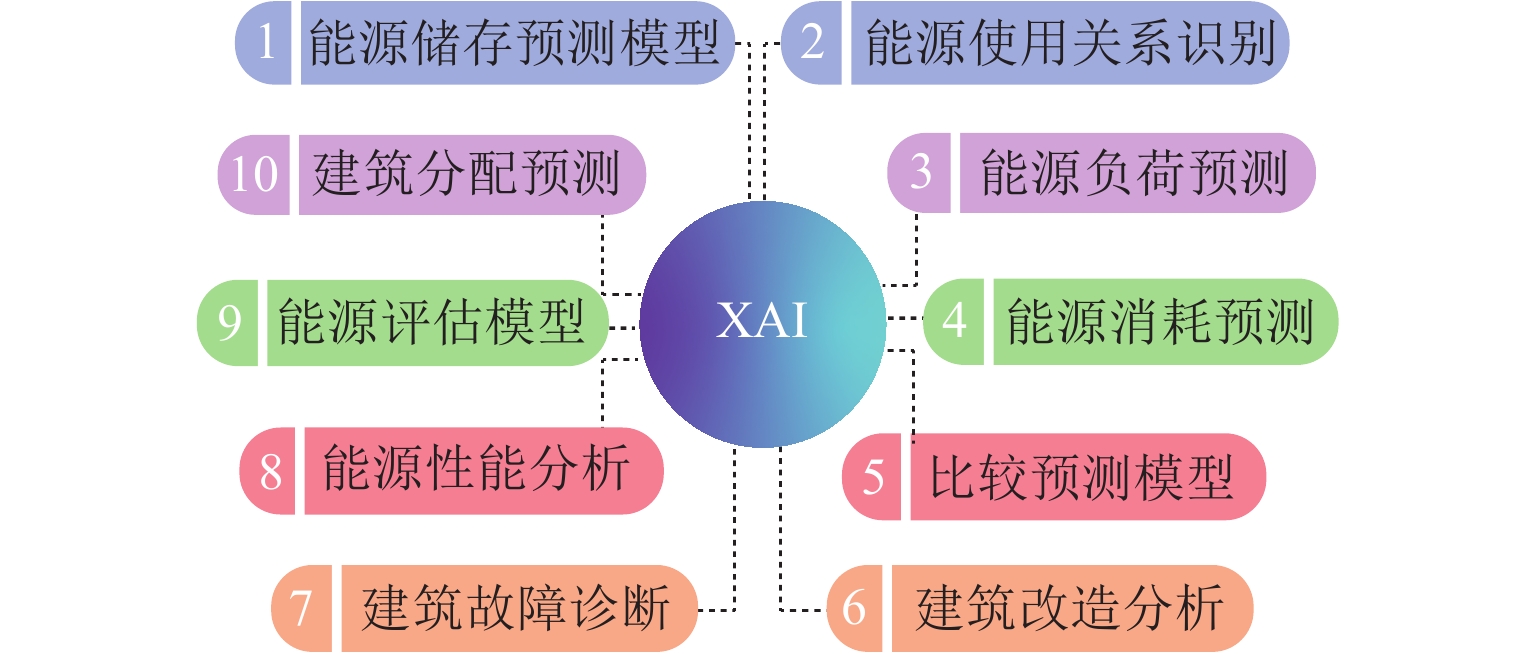
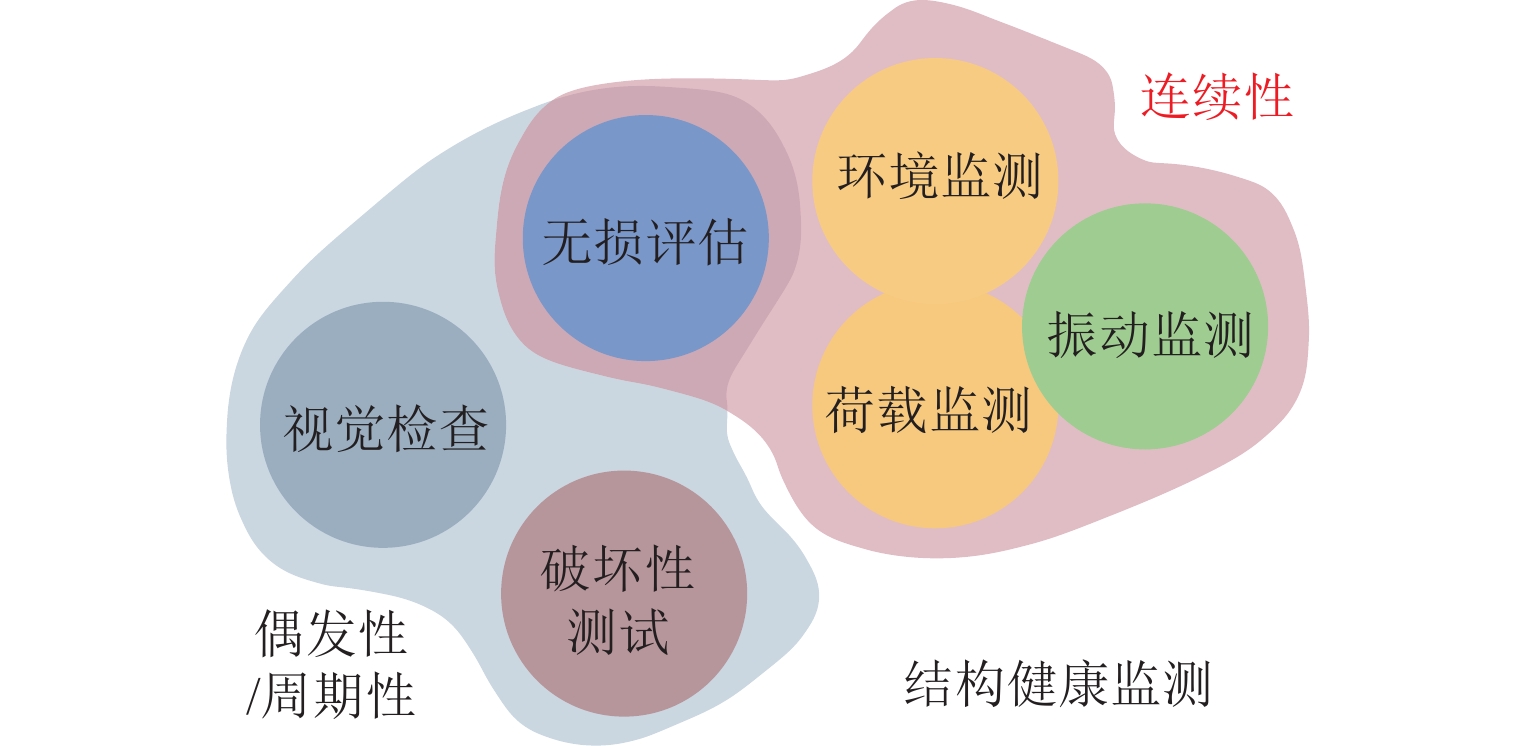
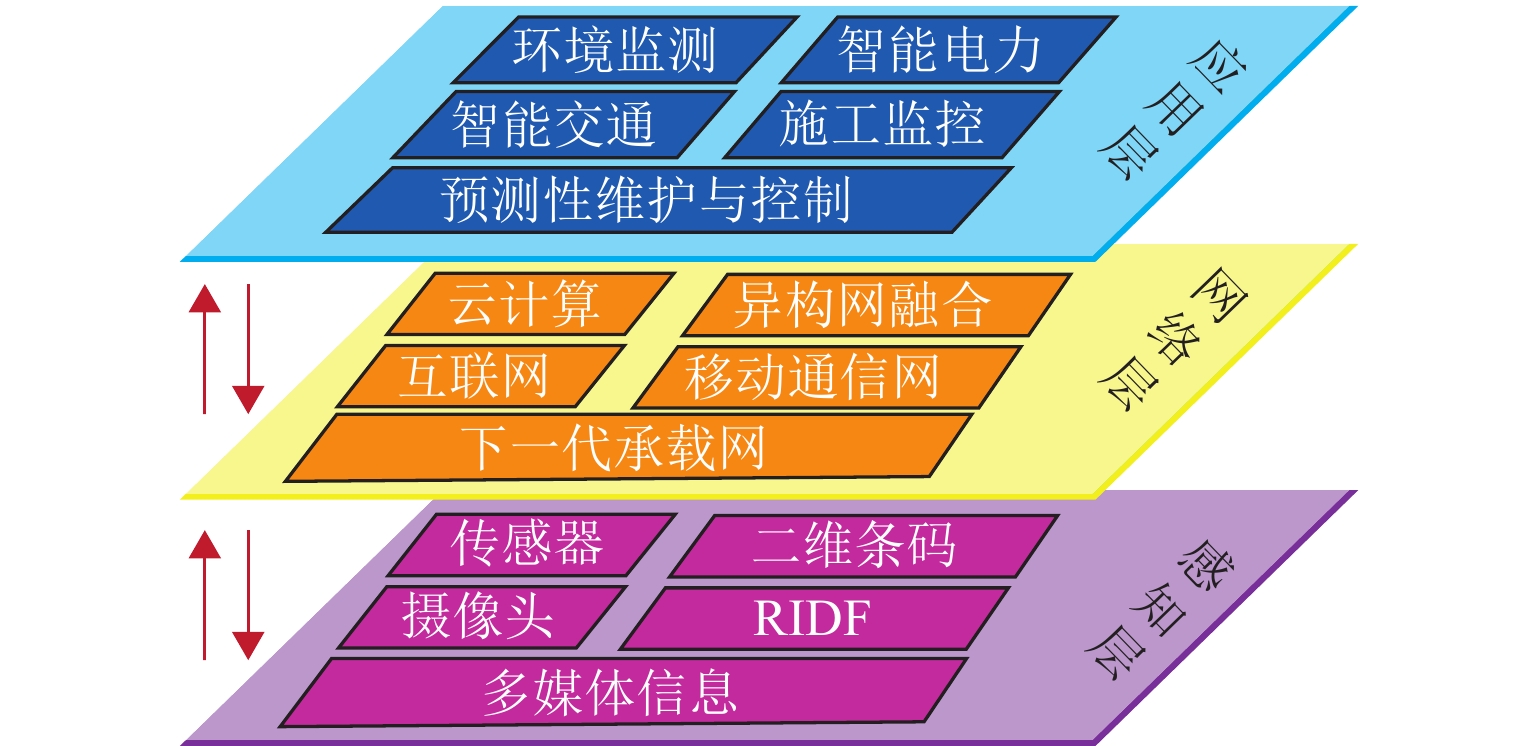
图 25 物联网在桥梁中的应用体系架构
Figure 25. Application system architecture of Internet of Things in bridges
中点方法评价指标 终点方法评价指标 臭氧消耗、全球变暖、烟雾形成、富营养化、酸化、生态毒性、人类健康(癌症)、人类健康(非癌症)、人类健康标准污染物和化石燃料消耗 气候变化、臭氧层消耗、酸化、富营养化、呼吸影响、致癌、电离辐射、生态毒性、土地利用、矿产资源、化石资源  下载: 导出CSV
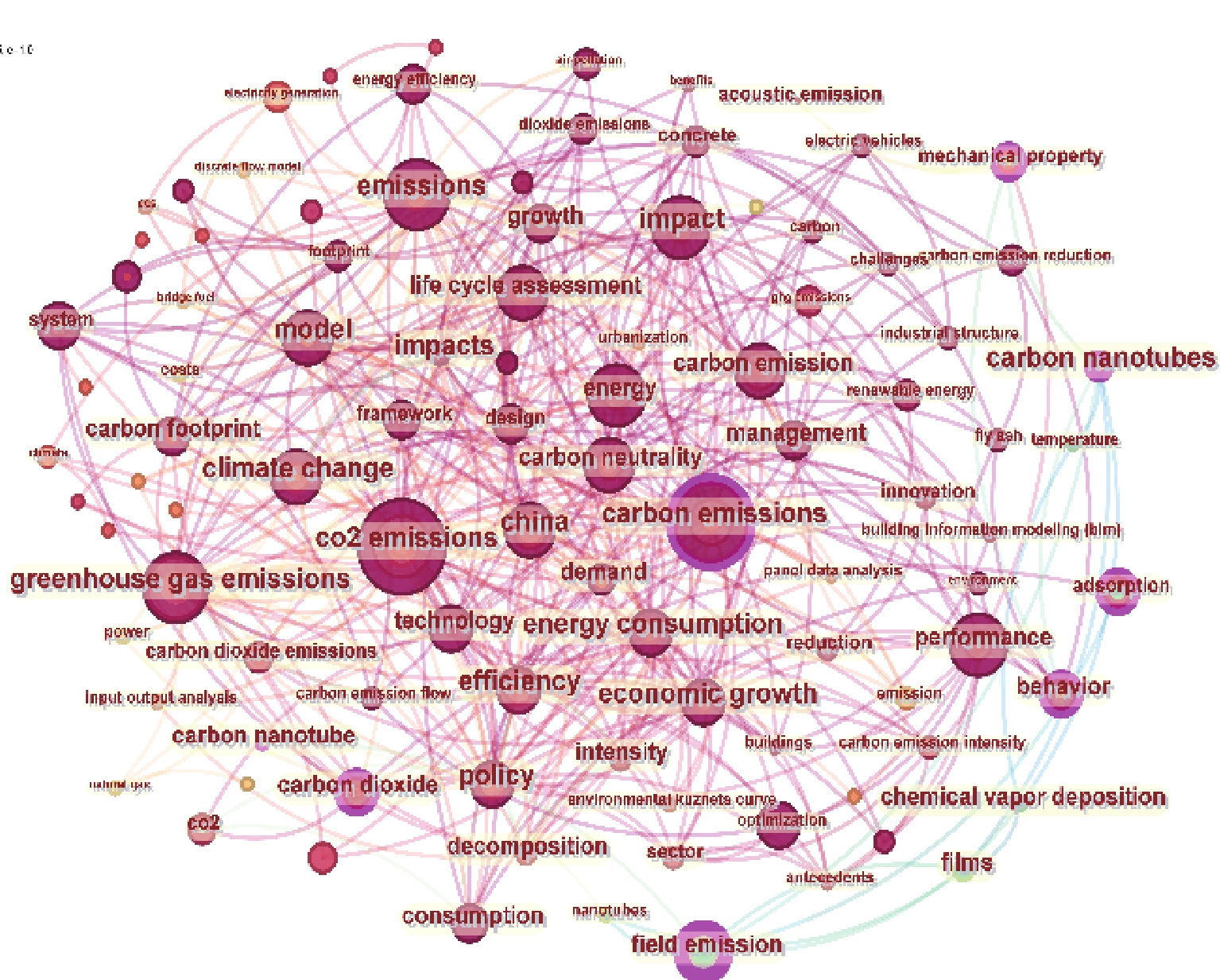
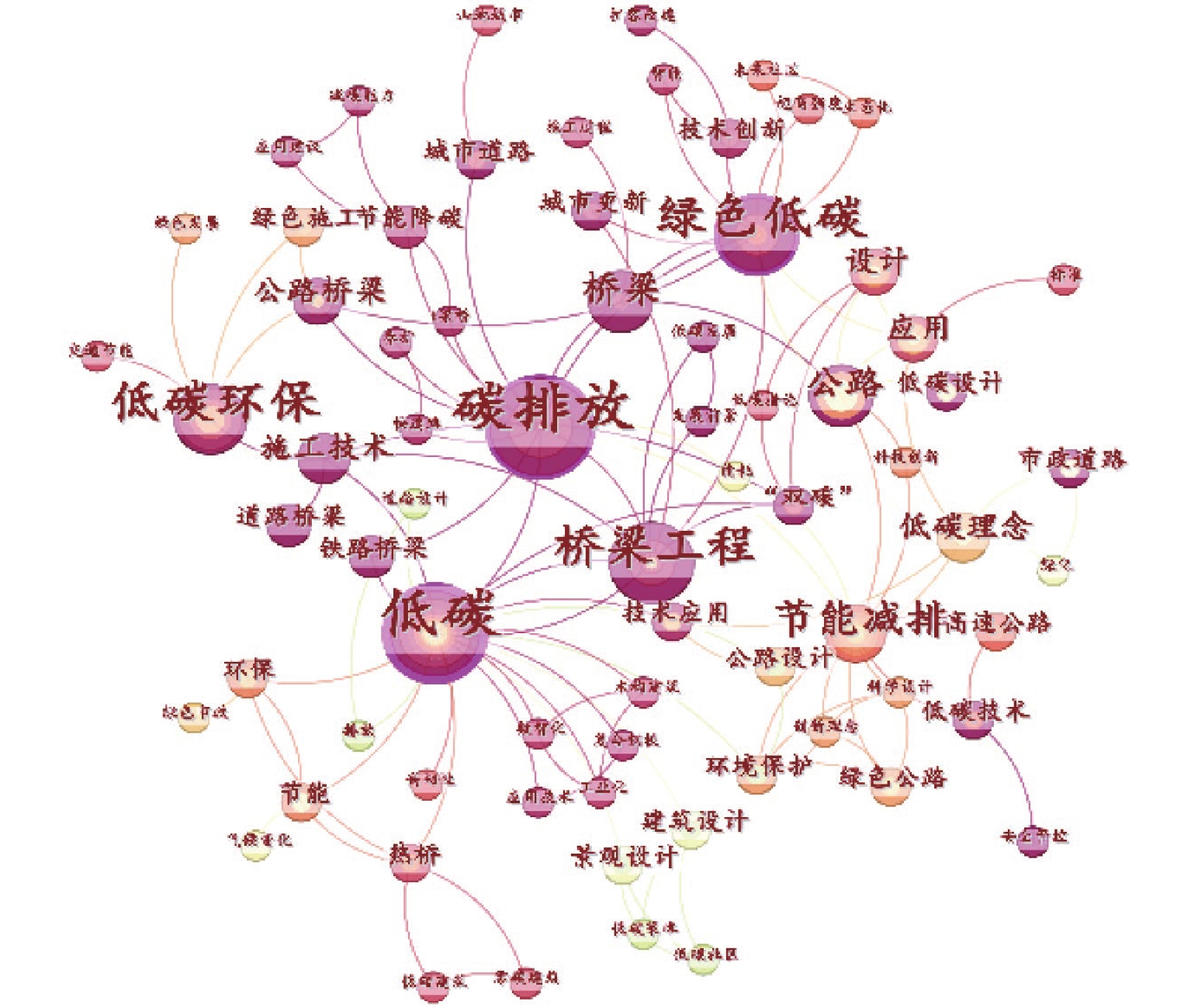
表 2 文献计量分析检索策略
Table 2. Bibliometric analysis search strategy
项目 内容 数据库 Web of Science、CNKI (2025年12月版本) 检索日期 2025-12-15 检索字段 题名 + 摘要 + 关键词 文献类型 期刊论文、会议论文 检索式 “桥梁工程”或“桥梁结构”和“碳排放”或“绿色低碳”或“生命周期评价” 去重标准 通过 EndNote 与人工校核去重 纳入标准 与桥梁工程低碳技术、生命周期碳排放、绿色材料或低碳施工相关的研究
下载: 导出CSV
表 3 CiteSpace分析参数
Table 3. CiteSpace analysis parameters
参数 设置 时间切片 1 年 节点类型 关键词 阈值 Top 50/片 剪枝策略 Pathfinder 聚类算法 Log-Likelihood Ratio
下载: 导出CSV
表 4 英文文献关键词突现词谱
Table 4. Keyword burst spectrum of English literature
关键词 年份 强度 起止年 2000—2025 年 carbon nanotubes 2003 年 2.89 2003—2014 年 
climate change 2005 年 3.05 2011—2019 年 
emissions 2012 年 4.40 2016—2019 年 
china 2019 年 4.17 2019—2023 年 
energy consumption 2019 年 3.48 2019—2023 年 
model 2017 年 2.83 2020—2021 年 
GHG emissions 2008 年 3.68 2021—2025 年 
design 2022 年 2.83 2022—2023 年 
performance 2022 年 2.76 2022—2025 年 
carbon dioxide 2004 年 2.74 2022—2025 年 
carbon emission 2014 年 4.77 2023—2025 年 
efficiency 2008 年 4.16 2023—2025 年  下载: 导出CSV
表 5 中文文献关键词突现词谱
Table 5. Keyword burst spectrum of Chinese literature
关键词 年份 强度 起止年 2000—2025 年 建筑设计 2011 年 1.15 2011—2013 年 
景观设计 2011 年 1.15 2011—2013 年 
高性能 2016 年 1.20 2016—2017 年 
低碳环保 2015 年 1.40 2017—2018 年 
绿色施工 2017 年 1.21 2017—2018 年 
节能减排 2014 年 1.40 2018—2020 年 
高速公路 2019 年 1.21 2019—2020 年 
桥梁钢 2008 年 1.11 2020—2021 年 
绿色低碳 2014 年 0.51 2020—2021 年 
桥梁工程 2015 年 1.78 2023—2025 年 
斜拉桥 2023 年 0.99 2023—2025 年 
技术创新 2023 年 0.99 2023—2025 年  下载: 导出CSV
-
[1] 冉茂平, 邓须红, 关佳希, 等. 基于LCA的道路基础设施碳排放核算与低碳减排技术综述[J]. 交通运输工程学报, 2025, 25(5): 23-37.RAN Maoping, DENG Xuhong, GUAN Jiaxi, et al. Review on road infrastructure carbon emission accounting and low-carbon reduction technologies based on LCA[J]. Journal of Traffic and Transportation Engineering, 2025, 25(5): 23-37. [2] 中国建筑节能协会建筑能耗与碳排放数据专业委员会, 重庆大学城乡建设发展与研究院. 2024 年中国城乡建设领域碳排放研究报告[R]. 重庆: 中国建筑节能协会, 重庆大学, 2025. [3] 宋泰宇, 邓青儿. 桥梁工程碳排量计算和低碳性能评价研究进展与展望[J]. 桥梁建设, 2025, 55(1): 33-40. doi: 10.20051/j.issn.1003-4722.2025.01.005SONG Taiyu, DENG Qinger. Research progress and prospects of carbon emission calculation and low-carbon performance evaluation of bridge engineering[J]. Bridge Construction, 2025, 55(1): 33-40. doi: 10.20051/j.issn.1003-4722.2025.01.005 [4] 孙晓燕, 董伟伟, 王海龙, 等. 桥梁全寿命周期碳强度指标模糊综合评估[J]. 应用基础与工程科学学报, 2013, 21(4): 735-747. doi: 10.3969/j.issn.1005-0930.2013.04.015SUN Xiaoyan, DONG Weiwei, WANG Hailong, et al. Comprehensive fussy assessment of bridge life-cycle carbon intensity index[J]. Journal of Basic Science and Engineering, 2013, 21(4): 735-747. doi: 10.3969/j.issn.1005-0930.2013.04.015 [5] 贾宏宇, 杨健, 郑史雄, 等. 跨断层桥梁抗震综述[J]. 西南交通大学学报, 2021, 56(5): 1075-1093.JIA Hongyu, YANG Jian, ZHENG Shixiong, et al. A review on aseismic bridges crossing fault rupture regions[J]. Journal of Southwest Jiaotong University, 2021, 56(5): 1075-1093. [6] DU G L, SAFI M, PETTERSSON L, et al. Life cycle assessment as a decision support tool for bridge procurement: environmental impact comparison among five bridge designs[J]. The International Journal of Life Cycle Assessment, 2014, 19(12): 1948-1964. doi: 10.1007/s11367-014-0797-z [7] XIA B, XIAO J Z, DING T, et al. Life cycle assessment of carbon emissions for bridge renewal decision and its application for Maogang Bridge in Shanghai[J]. Journal of Cleaner Production, 2024, 448: 141724. doi: 10.1016/j.jclepro.2024.141724 [8] PICARDO A, SOLTERO V M, PERALTA E. Life cycle assessment of sustainable road networks: current state and future directions[J]. Buildings, 2023, 13(10): 2648. doi: 10.3390/buildings13102648 [9] LEE S H, AN L S, KIM H K. Risk-based bridge life cycle cost and environmental impact assessment considering climate change effects[J]. Scientific Reports, 2025, 15: 725. doi: 10.1038/s41598-024-82568-4 [10] PENADÉS-PLÀ V, MARTÍNEZ-MUÑOZ D, GARCÍA-SEGURA T, et al. Environmental and social impact assessment of optimized post-tensioned concrete road bridges[J]. Sustainability, 2020, 12(10): 4265. doi: 10.3390/su12104265 [11] KAEWUNRUEN S, SRESAKOOLCHAI J, ZHOU Z H. Sustainability-based lifecycle management for bridge infrastructure using 6D BIM[J]. Sustainability, 2020, 12(6): 2436. doi: 10.3390/su12062436 [12] JALAEI F, ZHANG J Y, MCNEIL- AYUK N, et al. Environmental life cycle assessment (LCA) for design of climate-resilient bridges–a comprehensive review and a case study[J]. International Journal of Construction Management, 2025, 25(1): 99-114. doi: 10.1080/15623599.2024.2304479 [13] ALAUX N, RUSCHI MENDES SAADE M, HOXHA E, et al. Future trends in materials manufacturing for low carbon building stocks: a prospective macro-scale analysis at the provincial level[J]. Journal of Cleaner Production, 2023, 382: 135278. doi: 10.1016/j.jclepro.2022.135278 [14] HABERT G, ARRIBE D, DEHOVE T, et al. Reducing environmental impact by increasing the strength of concrete: quantification of the improvement to concrete bridges[J]. Journal of Cleaner Production, 2012, 35: 250-262. doi: 10.1016/j.jclepro.2012.05.028 [15] ITOH Y, KITAGAWA T. Using CO2 emission quantities in bridge lifecycle analysis[J]. Engineering Structures, 2003, 25(5): 565-577. doi: 10.1016/S0141-0296(02)00167-0 [16] ANDRÉ A, JUNTIKKA M, MATTSSON C, et al. Sustainable repurpose of end-of-life fiber reinforced polymer composites: a new circular pedestrian bridge concept[J]. Journal of Environmental Management, 2024, 367: 122015. doi: 10.1016/j.jenvman.2024.122015 [17] HAMMERVOLD J, REENAAS M, BRATTEBØ H. Environmental life cycle assessment of bridges[J]. Journal of Bridge Engineering, 2013, 18(2): 153-161. doi: 10.1061/(ASCE)BE.1943-5592.0000328 [18] AL HAWARNEH A, ALAM M S, RUPARATHNA R, et al. Life-cycle thinking and performance-based design of bridges: a state-of-the-art review[J]. Resilient Cities and Structures, 2025, 4(2): 30-45. doi: 10.1016/j.rcns.2025.03.003 [19] MILIĆ I, BLEIZIFFER J. Life cycle assessment of the sustainability of bridges: methodology, literature review and knowledge gaps[J]. Frontiers in Built Environment, 2024, 10: 1410798. doi: 10.3389/fbuil.2024.1410798 [20] 马佳星, 蒋建男, 谢含军, 等. 斜拉桥全寿命周期碳排放核算与优化策略[J]. 低温建筑技术, 2023, 45(12): 75-79. doi: 10.13905/j.cnki.dwjz.2023.12.018MA Jiaxing, JIANG Jiannan, XIE Hanjun, et al. Lifecycle carbon emissions accounting and optimization strategies for cable-stayed bridges[J]. Low Temperature Architecture Technology, 2023, 45(12): 75-79. doi: 10.13905/j.cnki.dwjz.2023.12.018 [21] 袁浩允, 李昊天, 李昊, 等. 装配式T梁全生命周期碳排放计算模型研究[C]//2024 世界交通运输大会. 青岛: 人民交通出版社, 2024: 637-645. [22] 王银辉, 蒋建男, 谢含军, 等. 桥梁工程全寿命周期碳排放流计算与分析[J]. 科学技术与工程, 2023, 23(22): 9605-9614. doi: 10.3969/j.issn.1671-1815.2023.22.033WANG Yinhui, JIANG Jiannan, XIE Hanjun, et al. Calculation and analysis of life-cycle carbon emission flow of bridge engineering[J]. Science Technology and Engineering, 2023, 23(22): 9605-9614. doi: 10.3969/j.issn.1671-1815.2023.22.033 [23] 刘沐宇, 欧阳丹. 桥梁工程生命周期碳排放计算方法[J]. 土木建筑与环境工程, 2011, 33(增1): 125-129.LIU Muyu, OUYANG Dan. Calculation method of life cycle carbon emissions on bridges[J]. Journal of Civil and Environmental Engineering, 2011, 33(S1): 125-129. [24] 马佳星, 蒋建男, 谢含军, 等. 斜拉桥全寿命周期碳排放计算模型[J]. 天津大学学报(自然科学与工程技术版), 2024, 57(1): 31-41. doi: 10.11784/tdxbz202208035MA Jiaxing, JIANG Jiannan, XIE Hanjun, et al. Carbon emission calculation model over the life cycle of cable-stayed bridges[J]. Journal of Tianjin University (Science and Technology), 2024, 57(1): 31-41. doi: 10.11784/tdxbz202208035 [25] 鲍学英, 薛春燕, 李子龙, 等. 铁路桥梁物化阶段碳排放计算及影响因素分析[J]. 安全与环境学报, 2025, 25(3): 1224-1232. doi: 10.13637/j.issn.1009-6094.2024.1308BAO Xueying, XUE Chunyan, LI Zilong, et al. Analysis of carbon emission calculation and influencing factors in the physicochemical stage of railway bridges[J]. Journal of Safety and Environment, 2025, 25(3): 1224-1232. doi: 10.13637/j.issn.1009-6094.2024.1308 [26] 刘宽, 白云, 王创, 等. 交通基础设施项目的综合碳排放评估探究[J]. 环境科学与技术, 2017, 40(10): 185-190.LIU Kuan, BAI Yun, WANG Chuang, et al. Study on the comprehensive carbon-emission assessment of infrastructure projects[J]. Environmental Science & Technology, 2017, 40(10): 185-190. [27] 刘强. 绿色循环低碳理念下的高速公路设计优化策略[J]. 交通世界, 2019(32): 37-38.LIU Qiang. Optimization strategy of expressway design under the concept of green circulation and low carbon[J]. TranspoWorld, 2019(32): 37-38. [28] 肖建庄, 王玻, 段珍华, 等. 建筑固废“正-逆向”协同资源化理论构建与应用前瞻[J/OL]. 中国工程科学, 2025-12-01. https://link.cnki.net/urlid/11.4421.G3.20251117.1418.002. [29] WANG C Q, YU L, ZHANG J J. Production forecast, comprehensive utilization, management measures and visualization analysis of construction waste[J]. Sustainable Chemistry and Pharmacy, 2024, 41: 101720. doi: 10.1016/j.scp.2024.101720 [30] 肖建庄, 关湘烁, 王佃超, 等. 再生混凝土碳排放因子研究[J]. 建筑科学与工程学报, 2023, 40(4): 1-11. doi: 10.19815/j.jace.2022.07032XIAO Jianzhuang, GUAN Xiangshuo, WANG Dianchao, et al. Researches on carbon emission factors of recycled concrete[J]. Journal of Architecture and Civil Engineering, 2023, 40(4): 1-11. doi: 10.19815/j.jace.2022.07032 [31] 张韦倩. 道路桥梁废弃物资源化利用生命周期节能减排效果评估体系和案例研究[D]. 上海: 复旦大学, 2014. [32] 刘小明, 韩磊, 马小云, 等. 在役连续小箱梁部分桥跨维修-置换的绿色改造方法研究[J]. 公路, 2024, 69(3): 226-234. [33] XU L, YU D, ZHOU J Y, et al. A review of key technologies for green and low-carbon future buildings in China[J]. Processes, 2025, 13(2): 574. doi: 10.3390/pr13020574 [34] XU R F, YIN Y, MIAO Y M, et al. Carbon emission calculation method of steel-concrete composite girder bridge based on LCA: A case study of Yanchong Expressway (Hebei Section)[C]//E3S Web of Conferences. Les Ulis: EDP Sciences, 2024: 02015. [35] QIN X C, WANGARI V W, GONG W W, et al. Quantifying and scenario modelling carbon emissions in cable-stayed bridge construction: analysing materials production, transportation, and machinery use with openLCA and LEAP[J]. Clean Technologies and Environmental Policy, 2025, 27(11): 6887-6911. doi: 10.1007/s10098-025-03211-y [36] WATARI T, YAMASHITA N, SERRENHO A C. Net-zero embodied carbon in buildings with today’s available technologies[J]. Environmental Science & Technology, 2024, 58(4): 1793-1801. doi: 10.1021/acs.est.3c04618 [37] 翟世鸿, 沈立龙, 肖建庄, 等. 大体积混凝土结构绿色低碳建造技术研究——以平陆运河枢纽工程为例[J/OL]. 水利水运工程学报, 2025-10-17. https://link.cnki.net/urlid/32.1613.TV.20250917.1809.004. [38] LIU Y S, WANG Y F, SHI C C, et al. Assessing the CO2 reduction target gap and sustainability for bridges in China by 2040[J]. Renewable and Sustainable Energy Reviews, 2022, 154: 111811. doi: 10.1016/j.rser.2021.111811 [39] 刘鑫, 李潇, 邓峰, 等. 高速公路桥梁预防性养护与绿色环保[J]. 交通节能与环保, 2024, 20(3): 185-188. doi: 10.3969/j.issn.1673-6478.2024.03.041LIU Xin, LI Xiao, DENG Feng, et al. Preventive maintenance and environmental protection of highway bridges[J]. Transport Energy Conservation & Environmental Protection, 2024, 20(3): 185-188. doi: 10.3969/j.issn.1673-6478.2024.03.041 [40] 龚颖, 王锴. 基于碳排放的西南地区高速铁路桥梁结构类型及施工工艺对比分析[J]. 高速铁路技术, 2023, 14(6): 57-61.GONG Ying, WANG Kai. Comparison analysis of bridge structure and construction technology based on carbon emission for high-speed railways in southwest region[J]. High Speed Railway Technology, 2023, 14(6): 57-61. [41] ZHANG D L, DING Y, WANG Y, et al. Towards ultra-low energy consumption buildings: Implementation path strategy based on practical effects in China[J]. Energy for Sustainable Development, 2022, 70: 537-548. doi: 10.1016/j.esd.2022.08.025 [42] ZHANG C Q, LUO H X. Research on carbon emission peak prediction and path of China’s public buildings: Scenario analysis based on LEAP model[J]. Energy and Buildings, 2023, 289: 113053. doi: 10.1016/j.enbuild.2023.113053 [43] 孙利民, 尚志强, 夏烨. 大数据背景下的桥梁结构健康监测研究现状与展望[J]. 中国公路学报, 2019, 32(11): 1-20. doi: 10.19721/j.cnki.1001-7372.2019.11.001SUN Limin, SHANG Zhiqiang, XIA Ye. Development and prospect of bridge structural health monitoring in the context of big data[J]. China Journal of Highway and Transport, 2019, 32(11): 1-20. doi: 10.19721/j.cnki.1001-7372.2019.11.001 [44] 钟正强, 汤聪. 基于大数据的桥梁智能管理与维护框架[J]. 土木工程学报, 2025, 58(6): 69-79.ZHONG Zhengqiang, TANG Cong. A framework for intelligent management and maintenance of bridges based on big data[J]. China Civil Engineering Journal, 2025, 58(6): 69-79. [45] PARISI F, MANGINI A M, FANTI M P, et al. Automated location of steel truss bridge damage using machine learning and raw strain sensor data[J]. Automation in Construction, 2022, 138: 104249. doi: 10.1016/j.autcon.2022.104249 [46] 王婷, 黄天熠, 陈小燕. 全生命周期视角下的重大基础设施工程技术协同创新驱动因素研究: 以港珠澳大桥为例[J]. 工程管理学报, 2025, 39(4): 108-114.WANG Ting, HUANG Tianyi, CHEN Xiaoyan. Research on the driving factors of collaborative innovation of mega infrastructure projects from the perspective of whole life cycle: a case study of the Hong Kong-Zhuhai-Macao bridge[J]. Journal of Engineering Management, 2025, 39(4): 108-114. [47] 孟凡强, 龚勋, 叶子临, 等. 铁路隧道工程全生命周期碳排放模型构建及量化特征分析[J/OL]. 西南交通大学学报, 2025-10-17. https://link.cnki.net/urlid/51.1277.U.20251010.1650.004. [48] 曹申, 董聪. 绿色建筑全生命周期成本效益评价[J]. 清华大学学报(自然科学版), 2012, 52(6): 843-847.CAO Shen, DONG Cong. Life cycle cost benefit assessments for green buildings[J]. Journal of Tsinghua University (Science and Technology), 2012, 52(6): 843-847. [49] 钱枫. 桥梁工程BIM技术应用研究[J]. 铁道标准设计, 2015, 59(12): 50-52.QIAN Feng. Research on application of BIM technology in bridge engineering[J]. Railway Standard Design, 2015, 59(12): 50-52. [50] 徐骏, 李安洪, 刘厚强, 等. BIM在铁路行业的应用及其风险分析[J]. 铁道工程学报, 2014, 31(3): 129-133.XU Jun, LI Anhong, LIU Houqiang, et al. Application and risk analysis of BIM in railway systems[J]. Journal of Railway Engineering Society, 2014, 31(3): 129-133. [51] 李静, 刘燕. 基于全生命周期的建筑工程碳排放计算模型[J]. 工程管理学报, 2015, 29(4): 12-16. doi: 10.13991/j.cnki.jem.2015.04.003LI Jing, LIU Yan. The carbon emission accounting model based on building lifecycle[J]. Journal of Engineering Management, 2015, 29(4): 12-16. doi: 10.13991/j.cnki.jem.2015.04.003 [52] PAN Y, ZHANG L M. Automated process discovery from event logs in BIM construction projects[J]. Automation in Construction, 2021, 127: 103713. doi: 10.1016/j.autcon.2021.103713 [53] DING Y, GUO Z Z, ZHOU S X, et al. Research on carbon emissions during the construction process of prefabricated buildings based on BIM and LCA[J]. Journal of Asian Architecture and Building Engineering, 2025, 24(3): 1426-1438. doi: 10.1080/13467581.2024.2345312 [54] ZHONG X Y, HU M M, DEETMAN S, et al. Global greenhouse gas emissions from residential and commercial building materials and mitigation strategies to 2060[J]. Nature Communications, 2021, 12: 6126. doi: 10.1038/s41467-021-26212-z [55] WU C, ZHOU P Y, LI Q, et al. Assessing the carbon reduction potential of high-performance concrete in urban construction[J]. Sustainable Chemistry and Pharmacy, 2025, 47: 102170. doi: 10.1016/j.scp.2025.102170 [56] 潘钻峰, 樊烽, 王云飞, 等. 基于再生材料利用的低碳超高性能混凝土力学性能和碳减排研究[J]. 施工技术(中英文), 2024, 53(22): 24-28.PAN Zuanfeng, FAN Feng, WANG Yunfei, et al. Research on mechanical properties and carbon reduction of low carbon UHPC based on utilization of recycled materials[J]. Construction Technology, 2024, 53(22): 24-28. [57] 肖建庄, 潘玉珀, 王春晖, 等. 全再生混凝土大跨梁的变形性能与低碳评价[J]. 中国工程科学, 2025, 27(3): 129-141. doi: 10.15302/J-SSCAE-2025.04.013XIAO Jianzhuang, PAN Yupo, WANG Chunhui, et al. Deformation behavior and low-carbon assessment of large-span beam with fully recycled concrete[J]. Strategic Study of Chinese Academy of Engineerng, 2025, 27(3): 129-141. doi: 10.15302/J-SSCAE-2025.04.013 [58] 胡晓龙, 肖建庄, 上官一宝, 等. 海水海砂再生混凝土碳化特性及其低碳潜力[J]. 同济大学学报(自然科学版), 2025, 53(8): 1229-1239.HU Xiaolong, XIAO Jianzhuang, SHANGGUAN Yibao, et al. Carbonation characteristics and low carbon potential of seawater sea sand recycled aggregate concrete[J]. Journal of Tongji University (Natural Science), 2025, 53(8): 1229-1239. [59] 王庆贺, 赵亚云, 张信龙, 等. 基于LCA的再生粗骨料制备过程环境影响研究[J]. 混凝土, 2024(12): 39-43, 50. doi: 10.3969/j.issn.1002-3550.2024.12.008WANG Qinghe, ZHAO Yayun, ZHANG Xinlong, et al. Environmental impact of recycled coarse aggregate preparation process based on LCA[J]. Concrete, 2024(12): 39-43, 50. doi: 10.3969/j.issn.1002-3550.2024.12.008 [60] 马丽丽, 曾庆鑫, 吴峰, 等. 基于LCA的低碳高性能再生混凝土环境和经济效应评价[J]. 环境工程, 2026, 44(1): 206-215. doi: 10.13205/j.hjgc.202601022MA Lili, ZENG Qingxin, WU Feng, et al. Environmental and economic effect assessment of low-carbon high performance recycled aggregate concrete based on life cycle assessment (LCA)[J]. Environmental Engineering, 2026, 44(1): 206-215. doi: 10.13205/j.hjgc.202601022 [61] 彭立港. 再生骨料混凝土结构长期性能劣化机理及低碳强化技术[D]. 杭州: 浙江大学, 2024. [62] 沈祖炎, 罗金辉, 李元齐. 以钢结构建筑为抓手 推动建筑行业绿色化、工业化、信息化协调发展[J]. 建筑钢结构进展, 2016, 18(2): 1-6, 25.SHEN Zuyan, LUO Jinhui, LI Yuanqi. Discussion on coordinated development of greenization, industrialization and informatization with steel buildings as objects in construction industry[J]. Progress in Steel Building Structures, 2016, 18(2): 1-6, 25. [63] BJORHOVDE R. Development and use of high performance steel[J]. Journal of Constructional Steel Research, 2004, 60(3/4/5): 393-400. doi: 10.1016/s0143-974x(03)00118-4 [64] 石永久, 余香林, 班慧勇. 高性能结构钢材应用技术研究与进展[J]. 钢结构(中英文), 2024, 39(10): 97-104.SHI Yongjiu, YU Xianglin, BAN Huiyong. Research and progress on application of high performance steel[J]. Steel Construction (Chinese & English), 2024, 39(10): 97-104. [65] 王春生, 张静雯, 段兰, 等. 长寿命高性能耐候钢桥研究进展与工程应用[J]. 交通运输工程学报, 2020, 20(1): 1-26. doi: 10.19818/j.cnki.1671-1637.2020.01.001WANG Chunsheng, ZHANG Jingwen, DUAN Lan, et al. Research progress and engineering application of long lasting high performance weathering steel bridges[J]. Journal of Traffic and Transportation Engineering, 2020, 20(1): 1-26. doi: 10.19818/j.cnki.1671-1637.2020.01.001 [66] 石永久, 余香林, 班慧勇, 等. 高性能结构钢材与钢结构体系研究与应用[J]. 建筑结构, 2021, 51(17): 145-151, 128. doi: 10.19701/j.jzjg.2021.17.021SHI Yongjiu, YU Xianglin, BAN Huiyong, et al. Research and application on high performance structural steel and its structural system[J]. Building Structure, 2021, 51(17): 145-151, 128. doi: 10.19701/j.jzjg.2021.17.021 [67] PACHECO-TORGAL F, JALALI S. Cementitious building materials reinforced with vegetable fibres: a review[J]. Construction and Building Materials, 2011, 25(2): 575-581. doi: 10.1016/j.conbuildmat.2010.07.024 [68] LI W, FENG T, LU T Y, et al. Optimization of compression molding parameters and lifecycle carbon impact assessment of bamboo fiber-reinforced polypropylene composites[J]. Polymers, 2024, 16(23): 3435. doi: 10.3390/polym16233435 [69] BIANCHI I, FORCELLESE A, MIGNANELLI C, et al. Integrated sustainability assessment of filament winding for CFRP components: process efficiency and life cycle impacts[J]. Journal of Cleaner Production, 2025, 518: 145888. doi: 10.1016/j.jclepro.2025.145888 [70] BHAGAT D, BHALLA S, WEST R P. Fabrication and structural evaluation of fibre reinforced bamboo composite beams as green structural elements[J]. Composites Part C: Open Access, 2021, 5: 100150. doi: 10.1016/j.jcomc.2021.100150 [71] MCLELLAN B C, WILLIAMS R P, LAY J, et al. Costs and carbon emissions for geopolymer pastes in comparison to ordinary Portland cement[J]. Journal of Cleaner Production, 2011, 19(9/10): 1080-1090. doi: 10.1016/j.jclepro.2011.02.010 [72] LI J Q, ZHANG W X, LI C, et al. Green concrete containing diatomaceous earth and limestone: Workability, mechanical properties, and life-cycle assessment[J]. Journal of Cleaner Production, 2019, 223: 662-679. doi: 10.1016/j.jclepro.2019.03.077 [73] SHI X S, ZHANG C, LIANG Y C, et al. Life cycle assessment and impact correlation analysis of fly ash geopolymer concrete[J]. Materials, 2021, 14(23): 7375. doi: 10.3390/ma14237375 [74] HASNAOUI A, GHORBEL E, WARDEH G. Performance of metakaolin/slag-based geopolymer concrete made with recycled fine and coarse aggregates[J]. Journal of Building Engineering, 2021, 42: 102813. doi: 10.1016/j.jobe.2021.102813 [75] AL-MASHHADANI M M, CANPOLAT O, AYGÖRMEZ Y, et al. Mechanical and microstructural characterization of fiber reinforced fly ash based geopolymer composites[J]. Construction and Building Materials, 2018, 167: 505-513. doi: 10.1016/j.conbuildmat.2018.02.061 [76] CAO X Y, LI X D, ZHU Y M, et al. A comparative study of environmental performance between prefabricated and traditional residential buildings in China[J]. Journal of Cleaner Production, 2015, 109: 131-143. doi: 10.1016/j.jclepro.2015.04.120 [77] YU L, WANG Y, LI D Z. Calculating and analyzing carbon emission factors of prefabricated components[J]. Sustainability, 2023, 15(11): 8706. doi: 10.3390/su15118706 [78] 史一丹, 鲍学英, 刘北胜, 等. 铁路桥梁不同建造方案碳排放对比及减碳策略分析[J]. 铁道标准设计, 2026, 70(1): 79-86.SHI Yidan, BAO Xueying, LIU Beisheng, et al. Comparison of carbon emissions and analysis of carbon reduction strategies for different railway bridge construction schemes[J]. Railway Standard Design, 2026, 70(1): 79-86. [79] 李思慧, 李仪弟, 黄世清. 铁路桥梁建设期不同预制方案碳排放对比分析[J]. 铁道标准设计, 2024, 68(12): 67-75.LI Sihui, LI Yidi, HUANG Shiqing. Comparative analysis of carbon emissions from different precast schemes during the railway bridge construction[J]. Railway Standard Design, 2024, 68(12): 67-75. [80] LIU G W, GU T Y, XU P P, et al. A production line-based carbon emission assessment model for prefabricated components in China[J]. Journal of Cleaner Production, 2019, 209: 30-39. doi: 10.1016/j.jclepro.2018.10.172 [81] LIU G W, CHEN R D, XU P P, et al. Real-time carbon emission monitoring in prefabricated construction[J]. Automation in Construction, 2020, 110: 102945. doi: 10.1016/j.autcon.2019.102945 [82] ZHAO S Y, QU X R, ZHAO X J. The carbon emissions of prefabricated building in urban renewal: assessment and emission reduction path[J]. Energy and Buildings, 2025, 341: 115830. doi: 10.1016/j.enbuild.2025.115830 [83] 肖玉麒, 张庚午, 谷立, 等. 建筑施工用能分析及可再生能源应用研究[C]//土木工程建造行业科技论坛(2024)暨第十五届中建八局科技论坛论文集. 上海: 中国建筑第八工程局有限公司, 2024: 246-248. [84] ELBA H, HEGAZY H, ZHANG J S, et al. Exploring critical barriers towards the uptake of renewable energy usage in Egypt[J]. Innovative Infrastructure Solutions, 2024, 9(7): 255. doi: 10.1007/s41062-024-01578-3 [85] CHU K F. Application and impact assessment of renewable energy in construction projects[J]. Renewable Energy and Power Quality Journal, 2024, 22(6): 7-16. doi: 10.52152/4045 [86] HORZELA-MIS A, SEMRAU J. Enhancing energy efficiency in Poland’s construction sector: simulating renewable energy and storage integration[J]. International Journal of Energy Research, 2025, 2025: 6646016. doi: 10.1155/er/6646016 [87] TRĘBSKA P, WYSOKIŃSKI M, TROCEWICZ A, et al. The use of renewable energy sources in households in Poland: current status and prospects for the development of energy prosumption[J]. Energies, 2024, 17(23): 5935. doi: 10.3390/en17235935 [88] CHEN L, HU Y, WANG R Y, et al. Green building practices to integrate renewable energy in the construction sector: a review[J]. Environmental Chemistry Letters, 2024, 22(2): 751-784. doi: 10.1007/s10311-023-01675-2 [89] LI X, XIAO J Z, ZHU L Y, et al. Assessing carbon emissions of the innovative renovation project of Yihe Bridge on Beijing Road[J]. Low-Carbon Materials and Green Construction, 2025, 3(1): 9. doi: 10.1007/s44242-025-00071-z [90] ZARZOUR N, SANTISI D’AVILA M P, MERCERAT E D, et al. Seismic design of a low-carbon building constructed with in-situ produced compressed earth blocks[J]. Soil Dynamics and Earthquake Engineering, 2024, 187: 108990. doi: 10.1016/j.soildyn.2024.108990 [91] SUN L P, LIU Y J, HAN Q, et al. Conceptual design of lightweight assembled double-skinned UHPC composite pylons for large-span suspension bridges[J]. Structures, 2024, 70: 107725. doi: 10.1016/j.istruc.2024.107725 [92] Saiidi M S, Mohebbi A, Itani A, et al. New horizons in seismic design of highway bridges with advanced materials and construction methods[C]//14th International Symposium on Structural Engineering (ISSE-14). Beijing: Science Press, 2016: 105-113. [93] 赵灿晖, 梁晋豪, 卢皓, 等. 基于粘弹性阻尼器的铁路梁式桥抗震韧性提升研究[J/OL]. 西南交通大学学报, 2025-12-17. https://link.cnki.net/urlid/51.1277.U.20251030.0919.002. [94] XU T F, YANG J N, WANG C Q, et al. Comparative sustainability and seismic performance analysis of reinforced conventional concrete and UHPC bridge piers[J]. Journal of Cleaner Production, 2024, 467: 142959. doi: 10.1016/j.jclepro.2024.142959 [95] ZHANG H Y, YANG Y. Optimization of mechanical performance of seismic isolation bearings for continuous beam bridges[J]. Journal of Vibration Engineering & Technologies, 2024, 12(3): 3653-3665. doi: 10.1007/s42417-023-01076-3 [96] HAGHIGHAT M, MOHAMMADISAVADKOOHI E, SHAFIABADY N. Applications of explainable artificial intelligence (XAI) and interpretable artificial intelligence (AI) in smart buildings and energy savings in buildings: a systematic review[J]. Journal of Building Engineering, 2025, 107: 112542. doi: 10.1016/j.jobe.2025.112542 [97] SIVASANKARI N, RATHIKA P. IoT driven building automation systems: a review on energy efficiency, occupant comfort, and sustainability[J]. Journal of Building Engineering, 2025, 104: 112347. doi: 10.1016/j.jobe.2025.112347 [98] BILISZCZUK J, HAWRYSZKÓW P, TEICHGRAEBER M. SHM system and a FEM model-based force analysis assessment in stay cables[J]. Sensors, 2021, 21(6): 1927. doi: 10.3390/s21061927 [99] MIYAMOTO A, KAWAMURA K, NAKAMURA H. Bridge management system and maintenance optimization for existing bridges[J]. Computer-Aided Civil and Infrastructure Engineering, 2000, 15(1): 45-55. [100] XU G W, GUO F D. Sustainability-oriented maintenance management of highway bridge networks based on Q-learning[J]. Sustainable Cities and Society, 2022, 81: 103855. doi: 10.1016/j.scs.2022.103855 [101] LEI X M, DONG Y, FRANGOPOL D M. Sustainable life-cycle maintenance policymaking for network-level deteriorating bridges with a convolutional autoencoder–structured reinforcement learning agent[J]. Journal of Bridge Engineering, 2023, 28(9): 04023063. doi: 10.1061/JBENF2.BEENG-6159 [102] 谢明志, 樊丁萌, 蒋志鹏, 等. 基于计算机视觉的混凝土结构裂缝检测研究现状与展望[J/OL]. 西南交通大学学报, 2025-12-17. https://link.cnki.net/urlid/51.1277.u.20240913.1853.002. [103] 何庆, 周思源, 万秋实, 等. 基于数据分析和物理模型的高速铁路梁端一体化装置监测管理建议[J/OL]. 西南交通大学学报, 2025-12-17. https://link.cnki.net/urlid/51.1277.U.20250311.1421.002. [104] KARAKOSTAS C, QUARANTA G, CHATZI E, et al. Seismic assessment of bridges through structural health monitoring: a state-of-the-art review[J]. Bulletin of Earthquake Engineering, 2024, 22(3): 1309-1357. doi: 10.1007/s10518-023-01819-3 [105] COBÎRZAN N, VOINEA M, KOPENETZ L, et al. Assessment of cost and embodied carbon for masonry structures located in low and high seismic zones[J]. Procedia Engineering, 2017, 181: 418-424. doi: 10.1016/j.proeng.2017.02.410 [106] 李天翊, 张东昱, 张晓宇. 考虑构件震害影响的城市桥梁震后通行功能损失评估方法[J]. 哈尔滨工业大学学报, 2025, 57(1): 35-45. doi: 10.11918/202405059LI Tianyi, ZHANG Dongyu, ZHANG Xiaoyu. Post-earthquake urban bridge traffic capacity loss assessment considering effects of structural component damage[J]. Journal of Harbin Institute of Technology, 2025, 57(1): 35-45. doi: 10.11918/202405059 [107] ZHOU G Y, ZHU Z H, ZHENG W Q, et al. Performance-based comprehensive functional damage probability assessment framework for high-speed railway bridge under earthquake[J]. Railway Engineering Science, 2026, 34(2): 201-216. doi: 10.1007/s40534-025-00395-3 [108] CHOWDHURY A O, MUNTASIR BILLAH A H M, ALAM M S. Performance-based seismic design for retrofitting deficient bridge bents: developing performance-based damage states[J]. Journal of Bridge Engineering, 2024, 29(7): 04024046. doi: 10.1061/JBENF2.BEENG-6236 [109] LI J B, GONG J X, WANG L C. Seismic behavior of corrosion-damaged reinforced concrete columns strengthened using combined carbon fiber-reinforced polymer and steel jacket[J]. Construction and Building Materials, 2009, 23(7): 2653-2663. doi: 10.1016/j.conbuildmat.2009.01.003 [110] POOJA K, TARANNUM N. Self-healing concrete: a path towards advancement of sustainable infrastructure[J]. Discover Applied Sciences, 2025, 7(7): 703. doi: 10.1007/s42452-025-06529-w [111] ZHAO H B, WANG Q Z, SHANG R P, et al. Development, challenges, and applications of concrete coating technology: exploring paths to enhance durability and standardization[J]. Coatings, 2025, 15(4): 409. doi: 10.3390/coatings15040409 [112] THISSEN P, BOGNER A, DEHN F. Surface treatments on concrete: an overview on organic, inorganic and nano-based coatings and an outlook about surface modification by rare-earth oxides[J]. RSC Sustainability, 2024, 2(8): 2092-2124. doi: 10.1039/D3SU00482A [113] ZHU Q, CHUA M H, ONG P J, et al. Recent advances in nanotechnology-based functional coatings for the built environment[J]. Materials Today Advances, 2022, 15: 100270. doi: 10.1016/j.mtadv.2022.100270 [114] YEO D, POTRA F A. Sustainable design of reinforced concrete structures through CO2 emission optimization[J]. Journal of Structural Engineering, 2015, 141(3): B4014002. doi: 10.1061/(ASCE)ST.1943-541X.0000888 [115] MERGOS P E. Contribution to sustainable seismic design of reinforced concrete members through embodied CO2 emissions optimization[J]. Structural Concrete, 2018, 19(2): 454-462. doi: 10.1002/suco.201700064 [116] MERGOS P E. Seismic design of reinforced concrete frames for minimum embodied CO2 emissions[J]. Energy and Buildings, 2018, 162: 177-186. doi: 10.1016/j.enbuild.2017.12.039 [117] MERGOS P E. Sustainable and resilient seismic design of reinforced concrete frames with rocking isolation on spread footings[J]. Engineering Structures, 2023, 292: 116605. doi: 10.1016/j.engstruct.2023.116605 [118] YAN Z H, SUN Z P, MA J, et al. Effect of copper slag fineness on rheological behavior, mechanical performance and CO2 emission in cement-based cementitious materials[J]. Construction and Building Materials, 2025, 492: 142937. doi: 10.1016/j.conbuildmat.2025.142937 [119] FRAGIADAKIS M, LAGAROS N D. An overview to structural seismic design optimisation frameworks[J]. Computers & Structures, 2011, 89(11/12): 1155-1165. doi: 10.1016/j.compstruc.2010.10.021 [120] MOHAMED M, GUO W, WANG Y. Experimental and numerical investigation of Permanent Magnet Coupler Damper (PMCD) for adaptive energy dissipation in structural systems[J]. Structures, 2025, 75: 108771. doi: 10.1016/j.istruc.2025.108771 [121] SHI X, LI J Z, ZHU S Y, et al. Negative stiffness energy-harvesting electromagnetic damper for vibration control of bridge stay cable[J]. Engineering Structures, 2025, 332: 120072. doi: 10.1016/j.engstruct.2025.120072 [122] VIJAY P V, SOTI P R, GANGARAO H V S, et al. Repair and strengthening of submerged steel piles using GFRP composites[J]. Journal of Bridge Engineering, 2016, 21(7): 04016038. doi: 10.1061/(ASCE)BE.1943-5592.0000903 [123] KHORGADE P, RETTINGER M, BURGHARTZ A, et al. A comparative cradle-to-gate life cycle assessment of carbon fiber-reinforced polymer and steel-reinforced bridges[J]. Structural Concrete, 2023, 24(2): 1737-1750. [124] BERMANY T H R, OSMAN S A, YATIM M Y M. A state-of-the-art analysis of base isolation systems and future directions for developing a novel multi-directional smart-hybrid isolation system integrated with earthquake early warning system for building structures[J]. Results in Engineering, 2025, 25: 104501. doi: 10.1016/j.rineng.2025.104501 [125] PATEL D, PANDEY G, MOURYA V K, et al. Sustainable base isolation: a review of techniques, implementation, and extreme events[J]. Sādhanā, 2024, 49(2): 173. doi: 10.1007/s12046-024-02511-1 [126] GHAFAR W A, ZHONG T, LAI Z C, et al. Seismic isolation for existing structures: a review of retrofitting techniques, case studies, and trends[J]. Discover Civil Engineering, 2025, 2(1): 137. doi: 10.1007/s44290-025-00300-1 [127] HONG T Z, WANG Z, LUO X, et al. State-of-the-art on research and applications of machine learning in the building life cycle[J]. Energy and Buildings, 2020, 212: 109831. doi: 10.1016/j.enbuild.2020.109831 [128] ERSOZ A B, PEKCAN O. UAV-based automated earthwork progress monitoring using deep learning with image inpainting[J]. Automation in Construction, 2025, 175: 106211. doi: 10.1016/j.autcon.2025.106211 [129] ELMOUSALAMI H H. Artificial intelligence and parametric construction cost estimate modeling: state-of-the-art review[J]. Journal of Construction Engineering and Management, 2020, 146: 03119008. doi: 10.1061/(ASCE)CO.1943-7862.0001678 [130] NILIMAA J. Smart materials and technologies for sustainable concrete construction[J]. Developments in the Built Environment, 2023, 15: 100177. doi: 10.1016/j.dibe.2023.100177 [131] ELMOUSALAMI H, MAXY M, HUI F K P, et al. AI in automated sustainable construction engineering management[J]. Automation in Construction, 2025, 175: 106202. doi: 10.1016/j.autcon.2025.106202 [132] LAALI A, NOURZAD S H H, FAGHIHI V. Optimizing sustainability of infrastructure projects through the integration of building information modeling and envision rating system at the design stage[J]. Sustainable Cities and Society, 2022, 84: 104013. doi: 10.1016/j.scs.2022.104013 [133] SALEHABADI Z M, RUPARATHNA R. User-centric sustainability assessment of single family detached homes (SFDH): a BIM-based methodological framework[J]. Journal of Building Engineering, 2022, 50: 104139. doi: 10.1016/j.jobe.2022.104139 [134] JIA S, ZHAN D J. Resilience and sustainability assessment of individual buildings under hazards: a review[J]. Structures, 2023, 53: 924-936. doi: 10.1016/j.istruc.2023.04.095 [135] SUWONDO R, KEINTJEM M, CUNNINGHAM L. Towards sustainable seismic design: assessing embodied carbon in concrete moment frames[J]. Asian Journal of Civil Engineering, 2024, 25(4): 3791-3801. doi: 10.1007/s42107-024-01011-1 [136] JIA S, ZHAN D J, JIANG H, et al. Life-cycle seismic resilience and sustainability assessment method of reinforced concrete buildings[J]. Structures, 2025, 80: 109919. doi: 10.1016/j.istruc.2025.109919 [137] AHMED H A, WANG Z R, LI Y H. Life cycle sustainability assessment and optimization of seismic retrofit solutions for RC frame structures[J]. Case Studies in Construction Materials, 2025, 22: e04315. doi: 10.1016/j.cscm.2025.e04315 [138] NOURI A, ASADI P, TAHERIYOUN M. Life-cycle sustainability design of RC frames under the seismic loads[J]. Asian Journal of Civil Engineering, 2020, 21(2): 293-310. doi: 10.1007/s42107-019-00199-x -

 下载:
下载:

 点击查看大图
计量
- 文章访问数: 379
- HTML全文浏览量: 316
- PDF下载量: 42
- 被引次数: 0