



Energy Management Strategy for Fuel Cell Buses Integrating Speed Prediction and Reinforcement Learning
-
摘要:
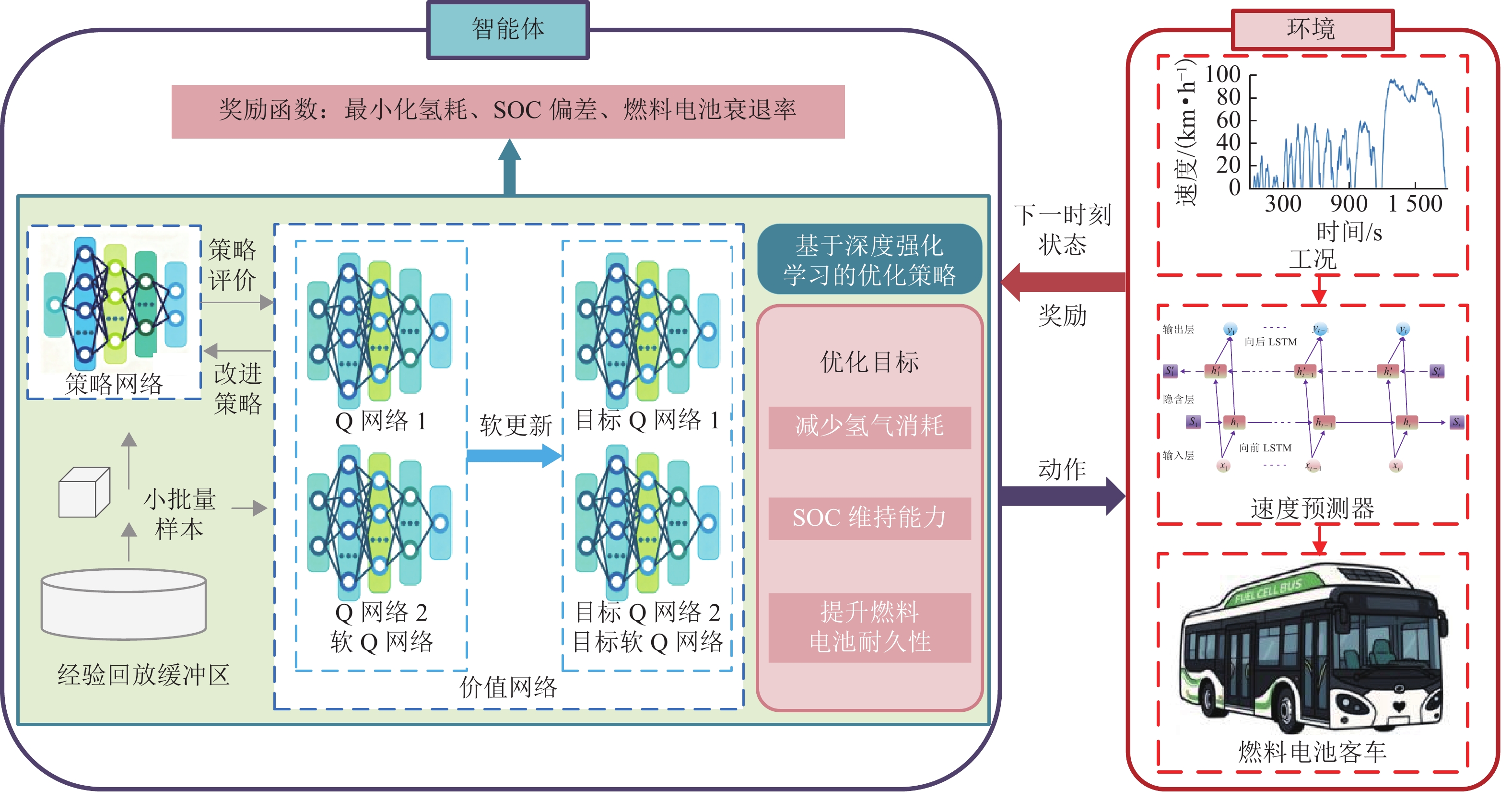
为解决燃料经济性与耐久性难以兼顾的问题,提出一种基于双向长短期记忆神经网络(BiLSTMNN)与软演员-评论家(SAC)算法相结合的燃料电池混合动力客车能量管理策略(SAC-V). 首先,应用BiLSTMNN实现短时车速预测;其次,将预测车速与车辆实时状态共同作为SAC强化学习智能体的输入,并在奖励函数中引入氢耗、动力电池荷电状态偏差以及燃料电池衰退等约束项,实现车辆燃料经济性与动力系统耐久性的动态协调优化;最后,通过离线仿真和硬件在环试验对所提策略进行验证. 研究结果表明:相较于传统SAC和深度确定性策略梯度方法,本文提出的SAC-V策略在等效氢耗、燃料电池功率波动和燃料电池衰退率方面分别降低了3.46%、35.56%和3.67%,展现出更优的综合性能,且在实际工程中具有较好的实时应用潜力.
-
关键词:
- 燃料电池混合动力客车 /
- 能量管理策略 /
- 双向长短期记忆神经网络 /
- 软演员–评论家算法 /
- 短时车速预测
Abstract:To address the difficulty of balancing fuel economy and durability, an energy management strategy (SAC-V) for fuel cell hybrid electric buses was proposed by combining a bidirectional long short-term memory neural network (BiLSTMNN) with a soft actor-critic (SAC) algorithm. First, BiLSTMNN was applied to achieve short-term vehicle speed prediction. Second, the predicted speed and real-time vehicle states were jointly used as inputs to the SAC reinforcement learning agent, and constraint terms including hydrogen consumption, power battery state of charge deviation, and fuel cell degradation were introduced into the reward function to achieve dynamic coordinated optimization of vehicle fuel economy and powertrain durability. Finally, the proposed strategy was validated through offline simulation and hardware-in-the-loop tests. The research results show that, compared with the conventional SAC method and the deep deterministic policy gradient method, the proposed SAC-V strategy reduces equivalent hydrogen consumption, fuel cell power fluctuation, and fuel cell degradation rate by 3.46%, 35.56%, and 3.67%, respectively, exhibiting better overall performance and favorable real-time application potential in practical engineering.
-
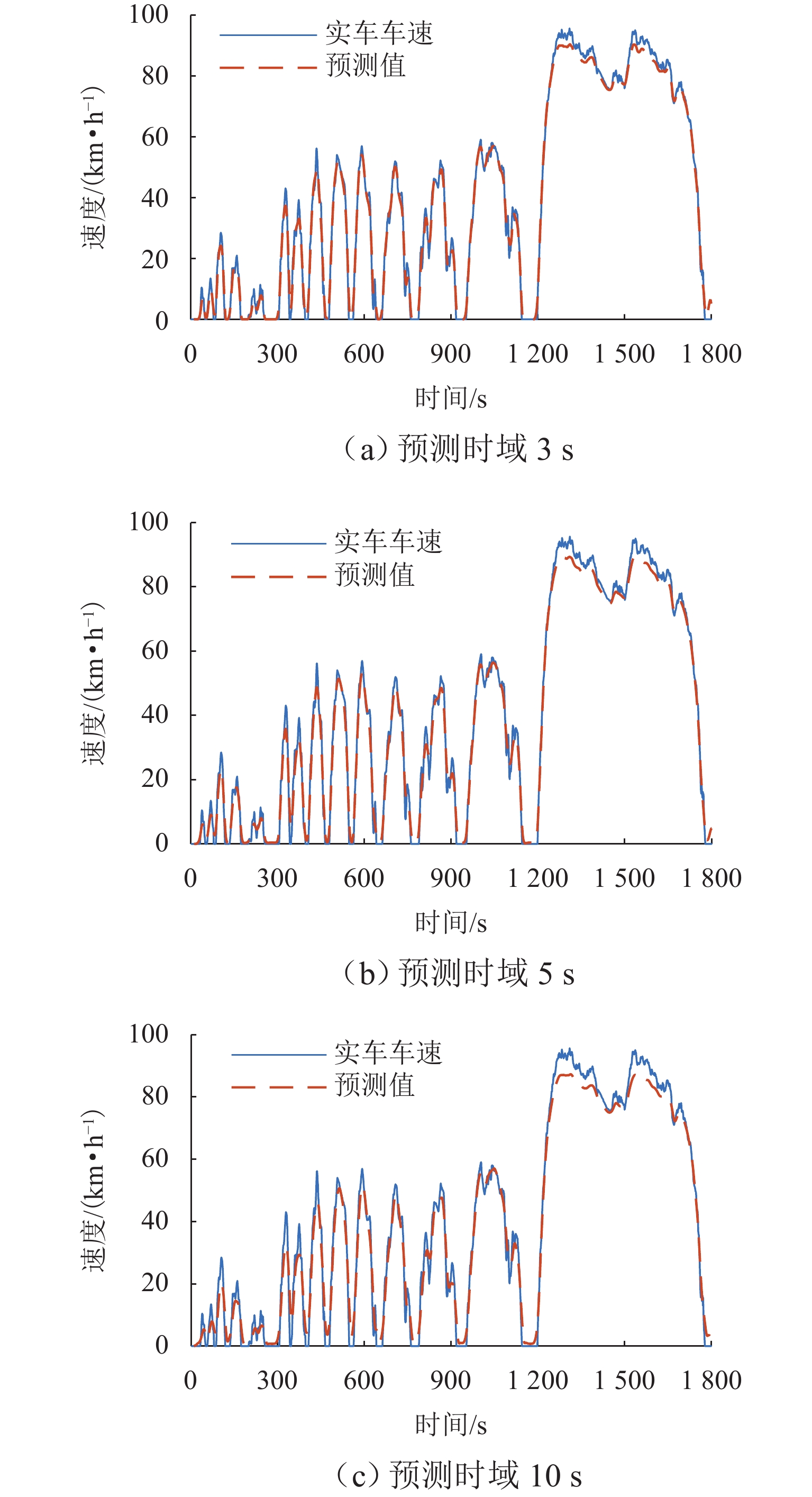
图 8 基于BiLSTM神经网络的不同时域车速预测结果
Figure 8. Vehicle speed prediction results under different time horizons based on BiLSTM neural network
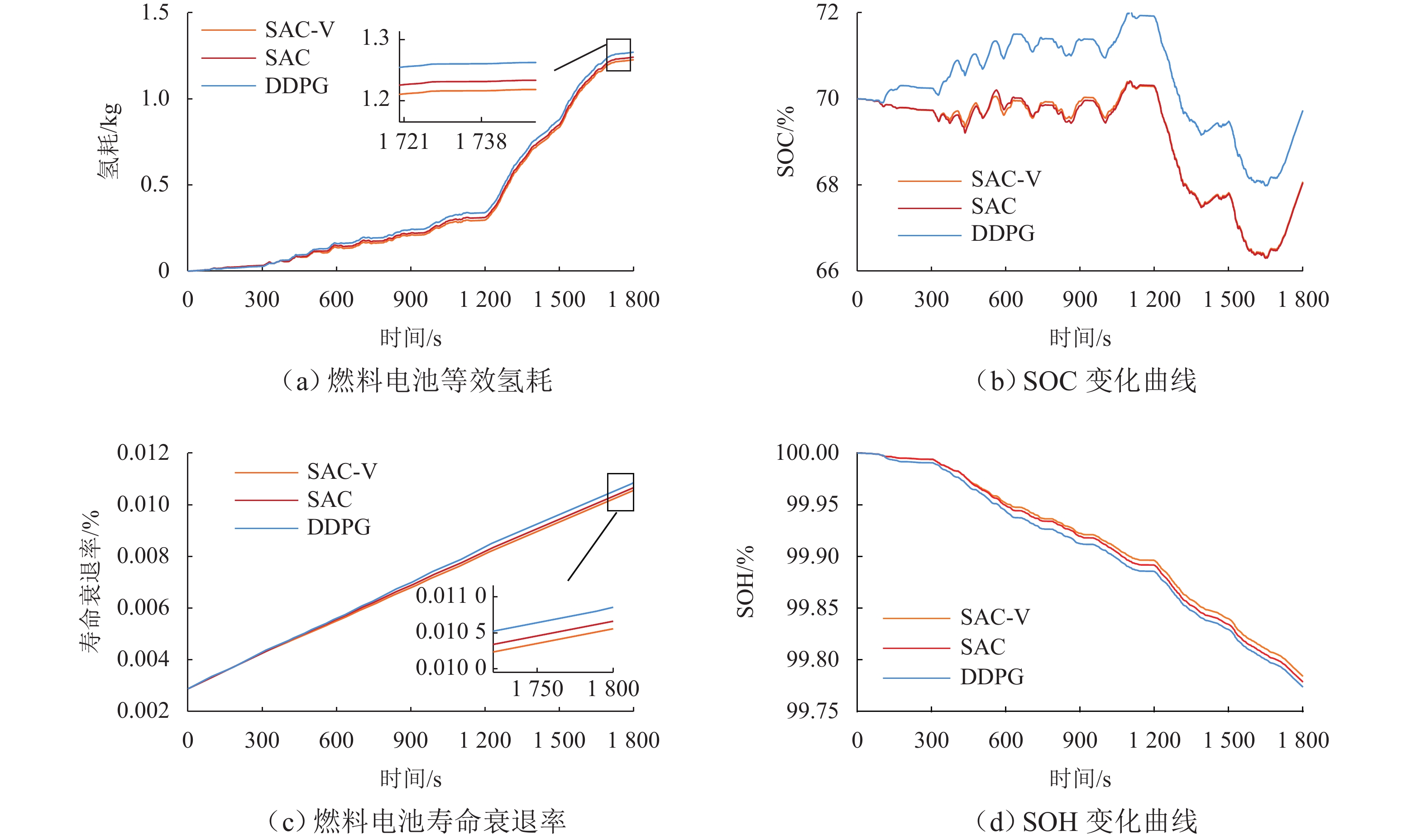
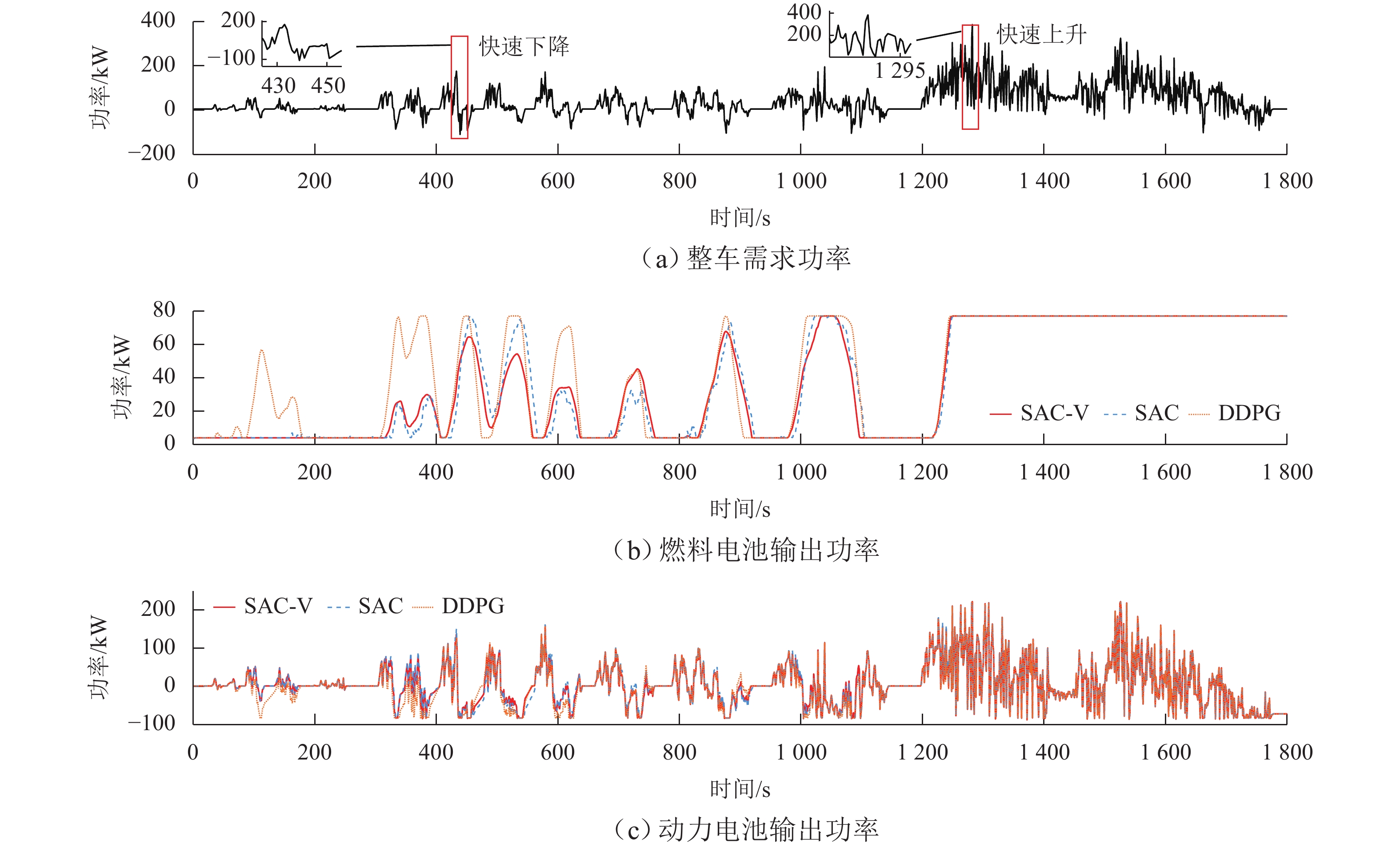
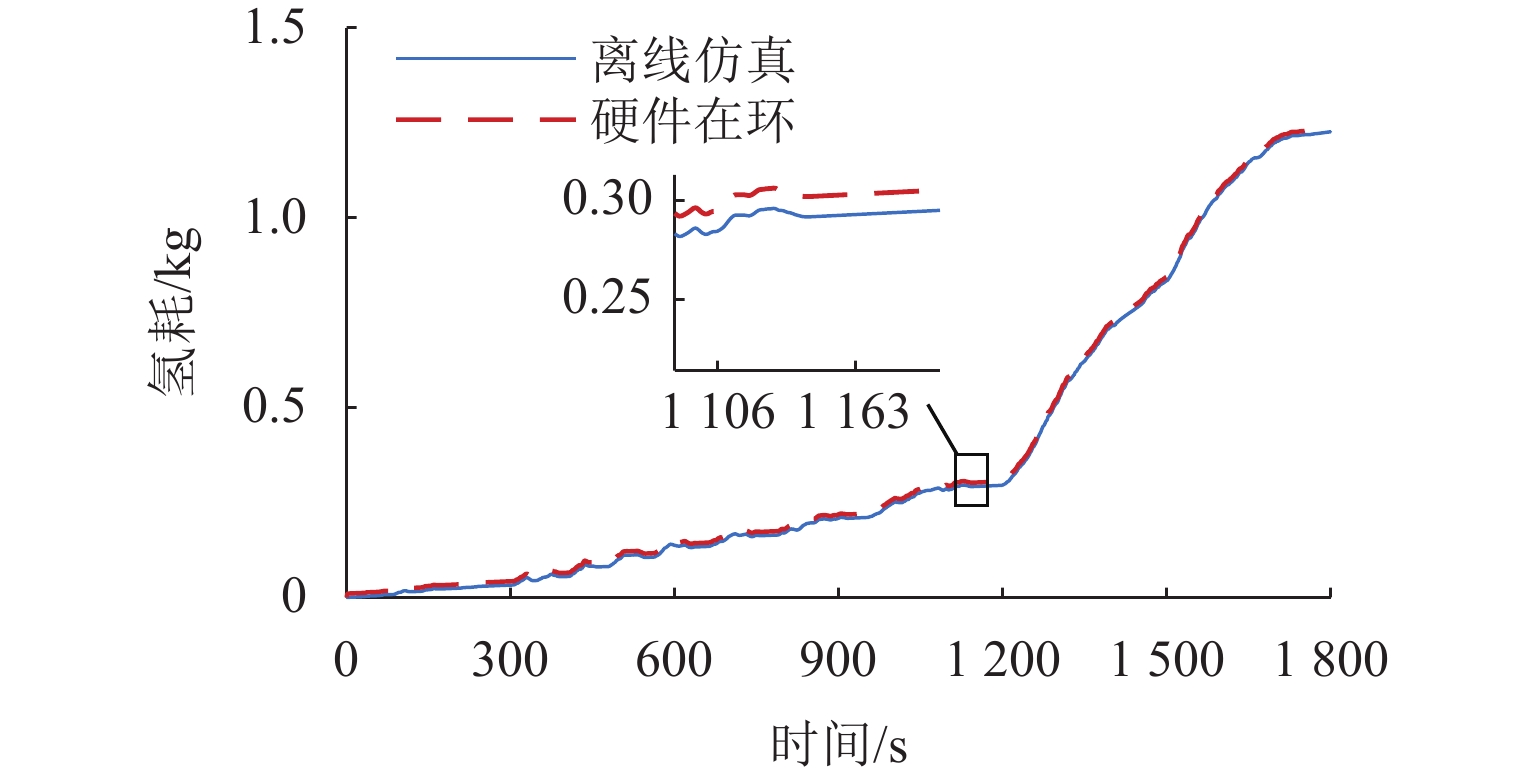
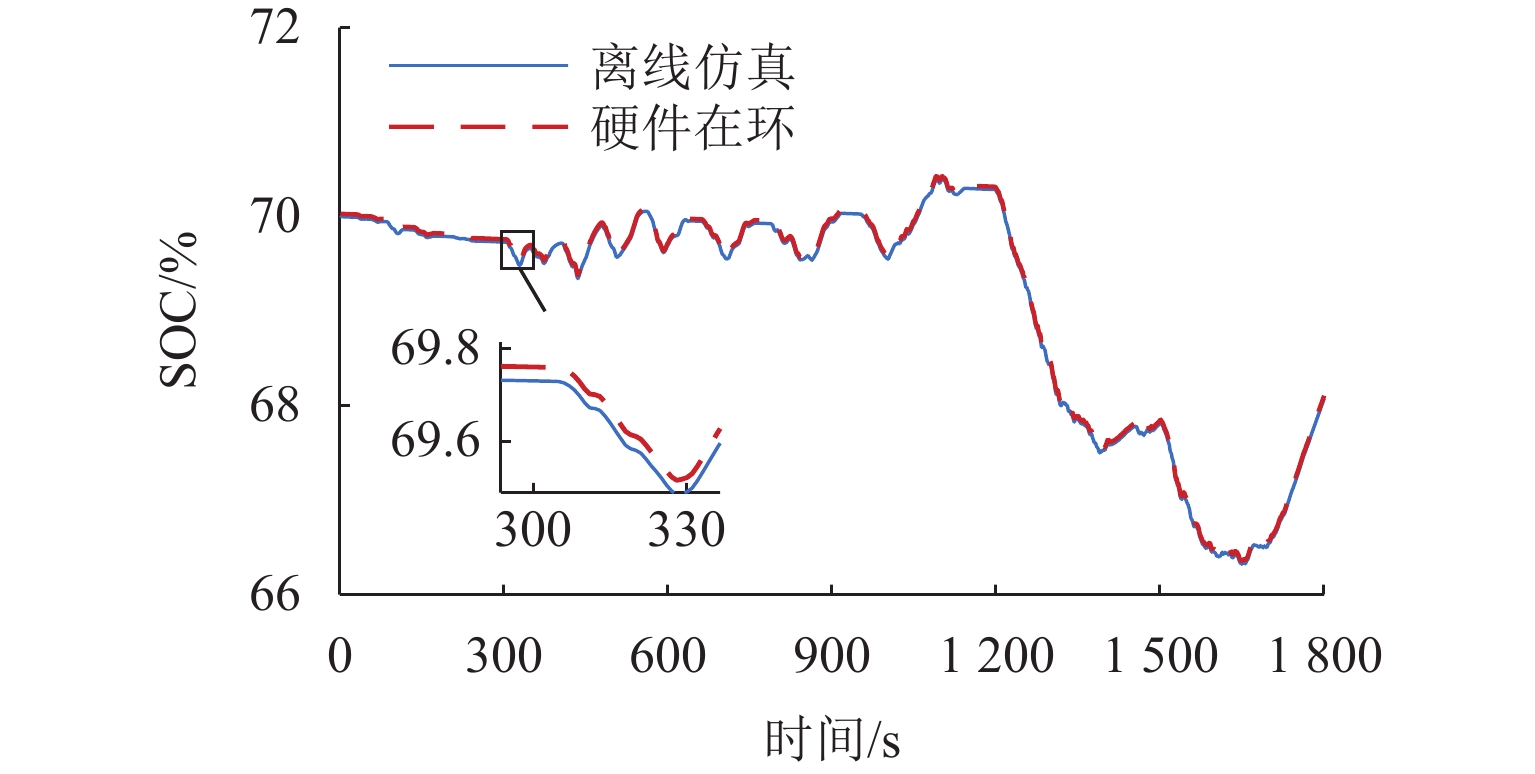
图 11 燃料电池客车能量管理策略性能对比分析
Figure 11. Comparative analysis of energy management strategies for fuel cell buses
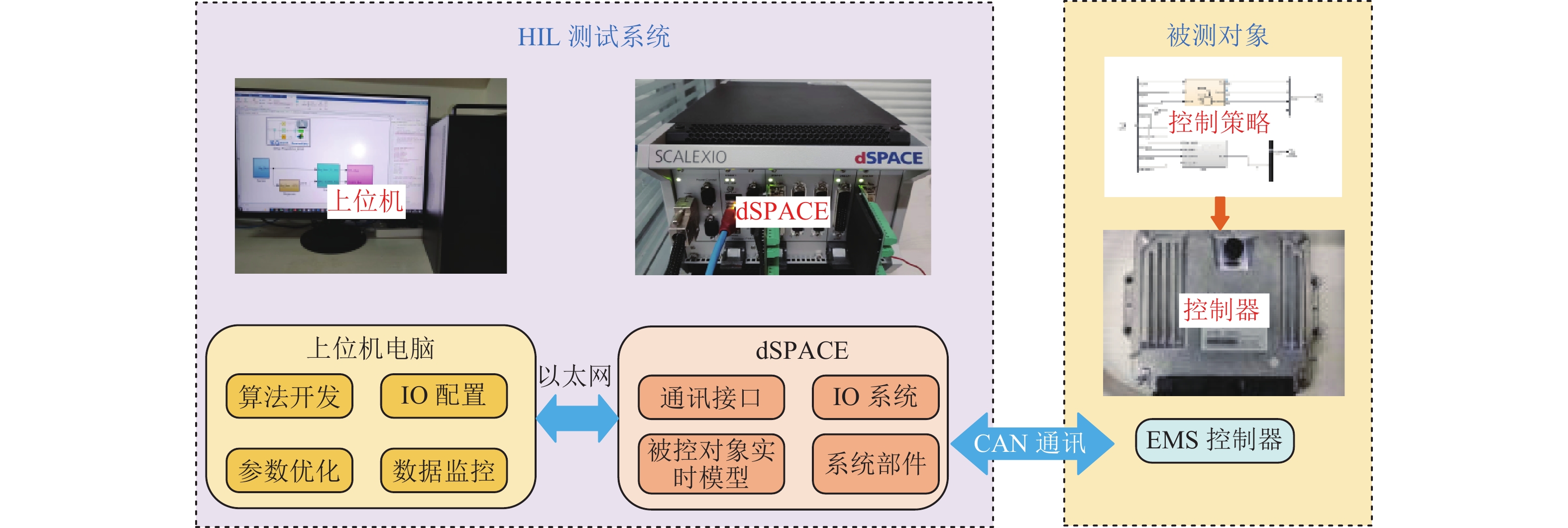
图 12 硬件在环实验平台实物连接图
Figure 12. Physical connection diagram of hardware-in-the-loop test platform
表 1 燃料电池客车的主要参数
Table 1. Main parameters of fuel cell bus
参数名称 参数值 整车总质量/kg 9850 空气阻力系数 0.65 客车迎风面积/m2 7.5 旋转质量换算系数 1.05 车轮滚动半径/m 0.435 主减速器传动比 6.14 传动系统效率 0.96  下载: 导出CSV
表 2 不同能量管理策略的仿真结果对比
Table 2. Comparison of simulation results of different energy management strategies
策略 等效氢气消耗量 动力电池 SOC 终值/% 燃料电池寿命衰退率/% 燃料电池输出功率变化量绝对值的均值 数值/kg 相对差异/% 数值 相对差异 数值 相对差异 数值/W 相对差异/% SAC-V 1.227 −3.46 68.074 −2.38 0.0105 −3.67 436.282 −35.56 SAC 1.242 −2.28 68.049 −2.41 0.0107 −1.83 571.969 −15.51 DDPG 1.271 69.731 0.0109 676.930
下载: 导出CSV
-
[1] 王浩, 张祖涛, 崔叔岩, 等. 面向小型无人运载工具的分布式能量采集技术综述[J/OL]. 西南交通大学学报, 2026-01-13. https://link.cnki.net/urlid/51.1277.u.20260113.1041.004. [2] 李群湛, 郭锴, 周福林. 交流电气化铁路AT供电牵引网电气分析[J]. 西南交通大学学报, 2012, 47(1): 1-6. doi: 10.3969/j.issn.0258-2724.2012.01.001LI Qunzhan, GUO Kai, ZHOU Fulin. Analysis of AT power supply network in AC electrified railway[J]. Journal of Southwest Jiaotong University, 2012, 47(1): 1-6. doi: 10.3969/j.issn.0258-2724.2012.01.001 [3] MIAN S H, NAZIR M S, AHMAD I, et al. Optimized nonlinear controller for fuel cell, supercapacitor, battery, hybrid photoelectrochemical and photovoltaic cells based hybrid electric vehicles[J]. Energy, 2023, 283: 129121. doi: 10.1016/j.energy.2023.129121 [4] ZHANG C Z, ZHANG Y Q, WANG L, et al. A health management review of proton exchange membrane fuel cell for electric vehicles: Failure mechanisms, diagnosis techniques and mitigation measures[J]. Renewable and Sustainable Energy Reviews, 2023, 182: 113369. doi: 10.1016/j.rser.2023.113369 [5] 李奇, 刘嘉蔚, 陈维荣. 质子交换膜燃料电池剩余使用寿命预测方法综述及展望[J]. 中国电机工程学报, 2019, 39(8): 2365-2375, 19. doi: 10.13334/j.0258-8013.pcsee.181308LI Qi, LIU Jiawei, CHEN Weirong. Review and prospect of remaining useful life prediction methods for proton exchange membrane fuel cell[J]. Proceedings of the CSEE, 2019, 39(8): 2365-2375, 19. doi: 10.13334/j.0258-8013.pcsee.181308 [6] YANG J B, WANG L, ZHANG B, et al. Remaining useful life prediction of vehicle-oriented PEMFC systems based on IGWO-BP neural network under real-world traffic conditions[J]. Energy, 2024, 291: 130334. doi: 10.1016/j.energy.2024.130334 [7] 杨澜, 王筱珂, 房山, 等. 基于时空特征增强的交叉口多车轨迹预测方法[J/OL]. 西南交通大学学报, 2026-02-04. https://link.cnki.net/urlid/51.1277.u.20260204.1343.002 [8] XU L F, OUYANG M G, LI J Q, et al. Optimal sizing of plug-in fuel cell electric vehicles using models of vehicle performance and system cost[J]. Applied Energy, 2013, 103: 477-487. doi: 10.1016/j.apenergy.2012.10.010 [9] 曾小华, 王星琦, 宋大凤, 等. 考虑电池寿命的插电式混合动力汽车能量管理优化[J]. 浙江大学学报(工学版), 2019, 53(11): 2206-2214.ZENG Xiaohua, WANG Xingqi, SONG Dafeng, et al. Battery-health conscious energy management optimization in plug-in hybrid electric vehicles[J]. Journal of Zhejiang University (Engineering Science), 2019, 53(11): 2206-2214. [10] 王志福, 徐崧, 罗崴. 基于动态规划的燃料电池车能量管理策略研究[J]. 太阳能学报, 2023, 44(10): 550-556. doi: 10.19912/j.0254-0096.tynxb.2022-0852WANG Zhifu, XU Song, LUO Wei. Research on energy management strategy of fuel cell vehicle based on dynamic programming[J]. Acta Energiae Solaris Sinica, 2023, 44(10): 550-556. doi: 10.19912/j.0254-0096.tynxb.2022-0852 [11] ZHANG S, HU X S, XIE S B, et al. Adaptively coordinated optimization of battery aging and energy management in plug-in hybrid electric buses[J]. Applied Energy, 2019, 256: 113891. doi: 10.1016/j.apenergy.2019.113891 [12] 武小花, 邹佩佩, 傅家豪, 等. 燃料电池电动汽车动力系统能量管理策略研究进展[J]. 西华大学学报(自然科学版), 2020, 39(4): 89-96. doi: 10.12198/j.issn.1673−159X.3593WU Xiaohua, ZOU Peipei, FU Jiahao, et al. Research progress on energy management strategies of fuel cell electric vehicle power systems[J]. Journal of Xihua University (Natural Science Edition), 2020, 39(4): 89-96. doi: 10.12198/j.issn.1673−159X.3593 [13] LI Y C, HE H W, KHAJEPOUR A, et al. Deep reinforcement learning for intelligent energy management systems of hybrid-electric powertrains: recent advances, open issues, and prospects[J]. IEEE Transactions on Transportation Electrification, 2024, 10(4): 9877-9903. doi: 10.1109/TTE.2024.3377809 [14] PAN M Z, FU C C, CAO X X, et al. An energy management strategy for fuel cell hybrid electric vehicle based on HHO-BiLSTM-TCN-self attention speed prediction[J]. Energy, 2024, 307: 132734. doi: 10.1016/j.energy.2024.132734 [15] LIU H C, WANG H L, YU M, et al. Long short-term memory–model predictive control speed prediction-based double deep Q-network energy management for hybrid electric vehicle to enhanced fuel economy[J]. Sensors, 2025, 25(9): 2784. doi: 10.3390/s25092784 [16] LU L W, ZHAO H, LIU X T, et al. MPC-ECMS energy management of extended-range vehicles based on LSTM multi-signal speed prediction[J]. Electronics, 2023, 12(12): 2642. doi: 10.3390/electronics12122642 [17] XIN W W, ZHENG W G, QIN J R, et al. Energy management of fuel cell vehicles based on model prediction control using radial basis functions[J]. Journal of Sensors, 2021, 2021(1): 9985063. doi: 10.1155/2021/9985063 [18] YUE M L, JEMEI S, ZERHOUNI N. Health-conscious energy management for fuel cell hybrid electric vehicles based on prognostics-enabled decision-making[J]. IEEE Transactions on Vehicular Technology, 2019, 68(12): 11483-11491. doi: 10.1109/TVT.2019.2937130 [19] WANG S Y, YANG D, YAN F H, et al. Comparison of deep reinforcement learning-based energy management strategies for fuel cell vehicles considering economics, durability and adaptability[J]. Energy, 2024, 307: 132771. doi: 10.1016/j.energy.2024.132771 [20] TIAN X L, TAO F Z, FU Z M, et al. Optimizing fuel economy of fuel cell hybrid electric vehicle based on energy management strategy with integrated rapid thermal regulation[J]. Engineering Applications of Artificial Intelligence, 2024, 132: 107880. doi: 10.1016/j.engappai.2024.107880 [21] ZHAO J, LI X G. A review of polymer electrolyte membrane fuel cell durability for vehicular applications: Degradation modes and experimental techniques[J]. Energy Conversion and Management, 2019, 199: 112022. doi: 10.1016/j.enconman.2019.112022 [22] PEI P C, CHANG Q F, TANG T. A quick evaluating method for automotive fuel cell lifetime[J]. International Journal of Hydrogen Energy, 2008, 33(14): 3829-3836. doi: 10.1016/j.ijhydene.2008.04.048 [23] JIA C C, HE H W, ZHOU J M, et al. A novel deep reinforcement learning-based predictive energy management for fuel cell buses integrating speed and passenger prediction[J]. International Journal of Hydrogen Energy, 2025, 100: 456-465. doi: 10.1016/j.ijhydene.2024.12.338 [24] HE H W, SU Q C, HUANG R C, et al. Enabling intelligent transferable energy management of series hybrid electric tracked vehicle across motion dimensions via soft actor-critic algorithm[J]. Energy, 2024, 294: 130933. doi: 10.1016/j.energy.2024.130933 [25] HUO W W, ZHAO T Y, YANG F, et al. An improved soft actor-critic based energy management strategy of fuel cell hybrid electric vehicle[J]. Journal of Energy Storage, 2023, 72: 108243. doi: 10.1016/j.est.2023.108243 [26] WU T Y, HE S Z, LIU J P, et al. A brief overview of ChatGPT: the history, status quo and potential future development[J]. IEEE/CAA Journal of Automatica Sinica, 2023, 10(5): 1122-1136. doi: 10.1109/JAS.2023.123618 [27] WANG L, MA C, FENG X Y, et al. A survey on large language model based autonomous agents[J]. Frontiers of Computer Science, 2024, 18(6): 186345. doi: 10.1007/s11704-024-40231-1 [28] SALEHPOUR M J, HOSSAIN M J. Leveraging machine learning for efficient EV integration as mobile battery energy storage systems: Exploring strategic frameworks and incentives[J]. Journal of Energy Storage, 2024, 92: 112151. doi: 10.1016/j.est.2024.112151 [29] WANG Z X, HE H W, PENG J K, et al. A comparative study of deep reinforcement learning based energy management strategy for hybrid electric vehicle[J]. Energy Conversion and Management, 2023, 293: 117442. doi: 10.1016/j.enconman.2023.117442 [30] WANG H C, YE Y M, ZHANG J F, et al. A comparative study of 13 deep reinforcement learning based energy management methods for a hybrid electric vehicle[J]. Energy, 2023, 266: 126497. doi: 10.1016/j.energy.2022.126497 [31] HUANG R C, HE H W. Naturalistic data-driven and emission reduction-conscious energy management for hybrid electric vehicle based on improved soft actor-critic algorithm[J]. Journal of Power Sources, 2023, 559: 232648. doi: 10.1016/j.jpowsour.2023.232648 [32] KOFLER S, DU Z P, JAKUBEK S, et al. Predictive energy management strategy for fuel cell vehicles combining long-term and short-term forecasts[J]. IEEE Transactions on Vehicular Technology, 2024, 73(11): 16364-16374. doi: 10.1109/TVT.2024.3424422 -

 下载:
下载:

 点击查看大图
计量
- 文章访问数: 780
- HTML全文浏览量: 288
- PDF下载量: 55
- 被引次数: 0