



Transport Capacity of Medium-Speed Maglev Lines Based on Blocking Time
-
摘要:
中速磁浮交通系统在城际和市域轨道交通运输领域具备广阔的应用前景,但沿用传统轮轨系统的计算方法无法有效解决磁浮线路通过能力精确计算问题. 根据运行组织的实际需求,立足中速磁浮系统技术特性并融合运行控制与安全防护的约束要求,针对中速磁浮线路通过能力计算方法开展研究. 首先,通过对中速磁浮列车运行所遵循的“一分区一运行车”刚性防护约束,以及对运行控制系统采用的停车点步进控制机制与准移动闭塞追踪防护模式的深入分析,论证闭塞时间理论与中速磁浮运行控制系统技术特性的适配性;在此基础上,以“闭塞时间理论——最不利分区交接申请点识别”为核心研究范式,构建区间运行、到站停车、站台发车和站后折返四类全流程典型运营场景下的分区闭塞时间量化模型,提出基于时间窗压缩的线路通过能力求解算法;最后,选取具体线路案例,通过仿真实验与极限压力测试相结合的双重验证体系,对所提计算模型与算法的输出结果进行有效性验证. 仿真结果表明:目标线路通过能力的理论极限值为11列/h,若额外再添加一条运行线,后行列车的运行过程将不可避免地受到前行列车的运行干涉,本文所提模型与算法具备良好的计算精度和工程适用性.
Abstract:The medium-speed maglev transportation system has broad application prospects in the field of intercity and urban rail transit. However, the exact calculation problem of the transport capacity of maglev lines cannot be effectively solved by using the calculation methods of traditional wheel-rail systems. According to the actual needs of operation organizations, based on the technical characteristics of the medium-speed maglev system and integrating the constraint requirements of operation control and safety protection, the calculation method of transport capacity of medium-speed maglev lines was studied. Firstly, through an in-depth analysis of the rigid protection constraint of “one block partition for one running train” followed by medium-speed maglev trains, as well as the stop-point stepping control mechanism and quasi-moving block tracking protection mode adopted by the operation control system, the adaptability between the blocking time theory and the technical characteristics of the medium-speed maglev operation control system was demonstrated. On this basis, taking “blocking time theory and identification of the most unfavorable partition handover application point” as the core research paradigm, quantitative models of partition blocking time under four types of typical full-process operation scenarios, including interval operation, station arrival stop, platform departure, and station rear turn-back, were constructed, and an algorithm for solving transport capacity of lines based on time window compression was proposed. Finally, a specific line case was selected, and the validity of the output results of the proposed calculation models and algorithms was verified through a dual verification system combining simulation experiments and limit pressure tests. Simulation results indicate that the theoretical limit value of the transport capacity of the target line is 11 trains/h. If an extra running line is added, the running process of the following train is inevitably interfered by the preceding train. The proposed models and algorithms possess good calculation accuracy and engineering applicability.
-
Key words:
- maglev /
- transport capacity /
- blocking time /
- operation control system /
- signal system
-
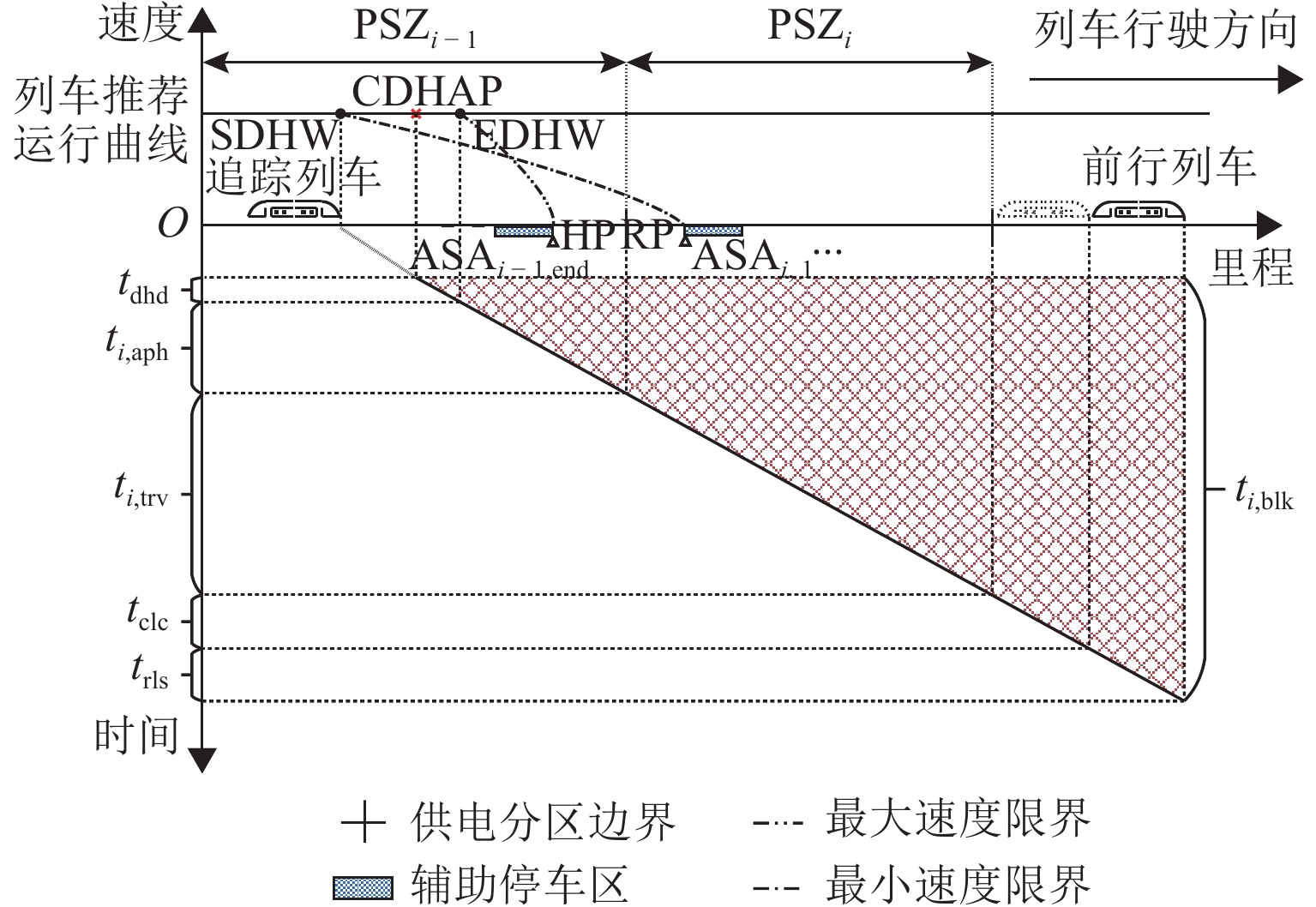
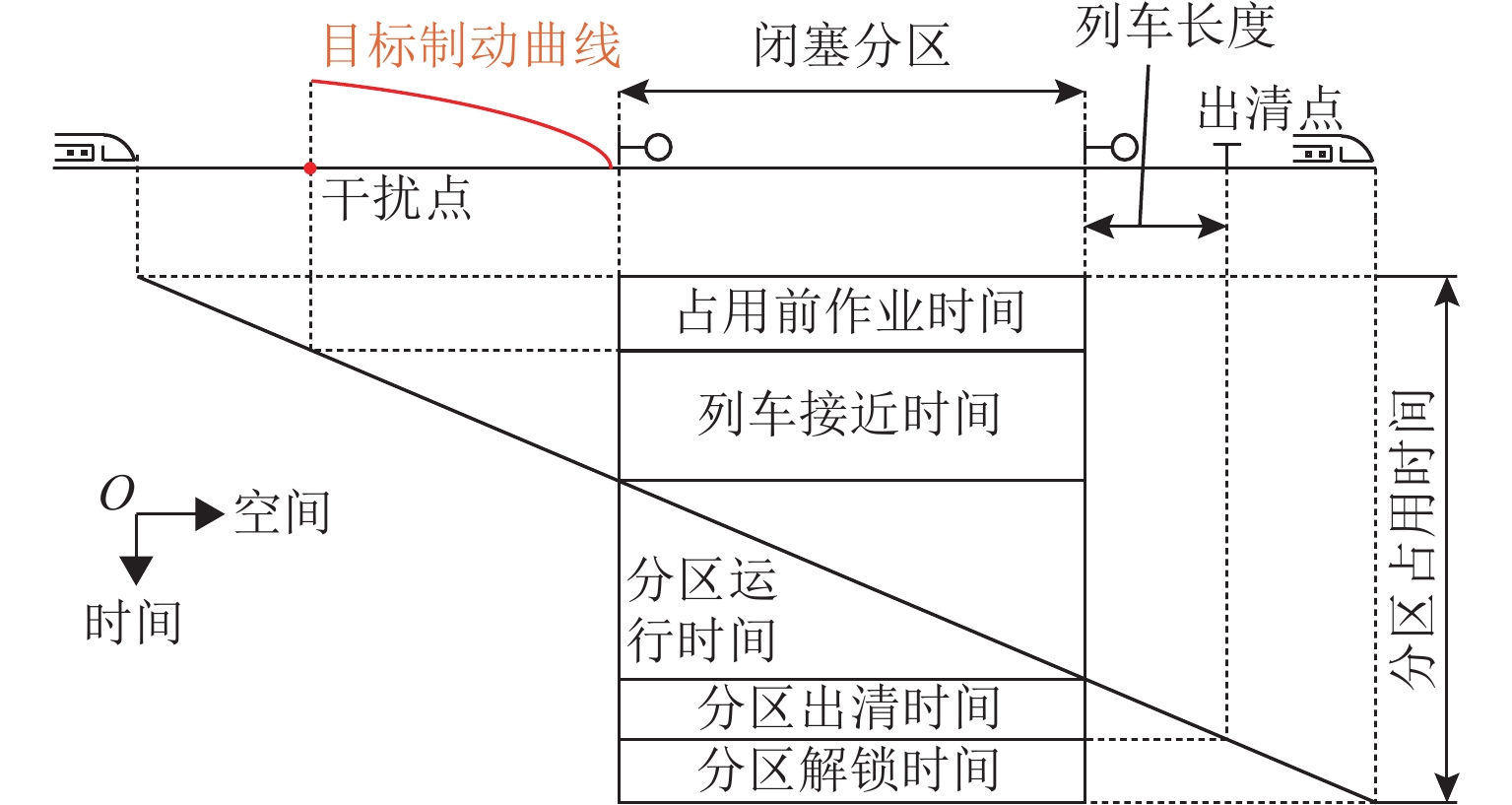
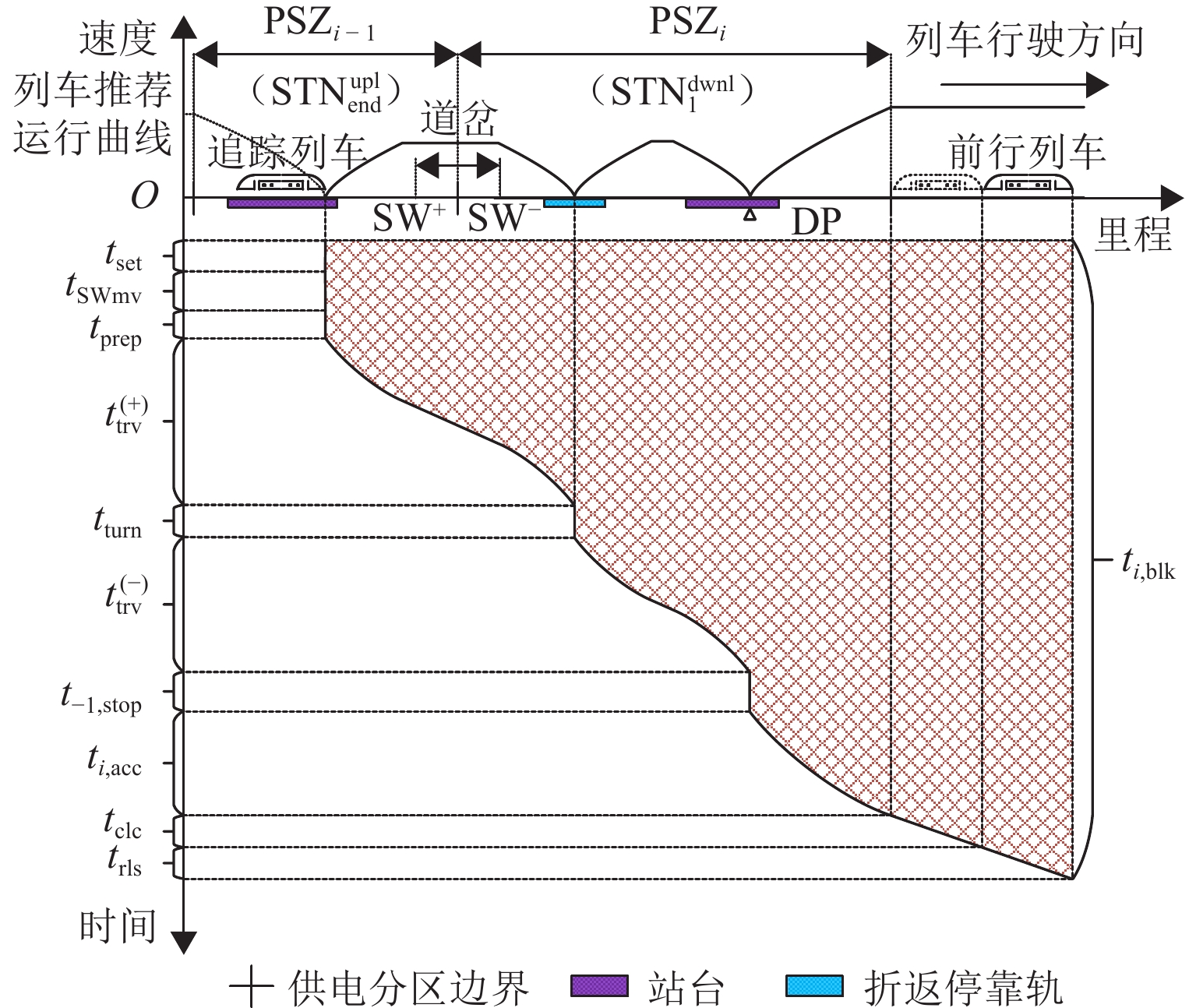
图 4 区间运行场景的分区闭塞时间模型
Figure 4. Partition blocking time model of interval operation scenario
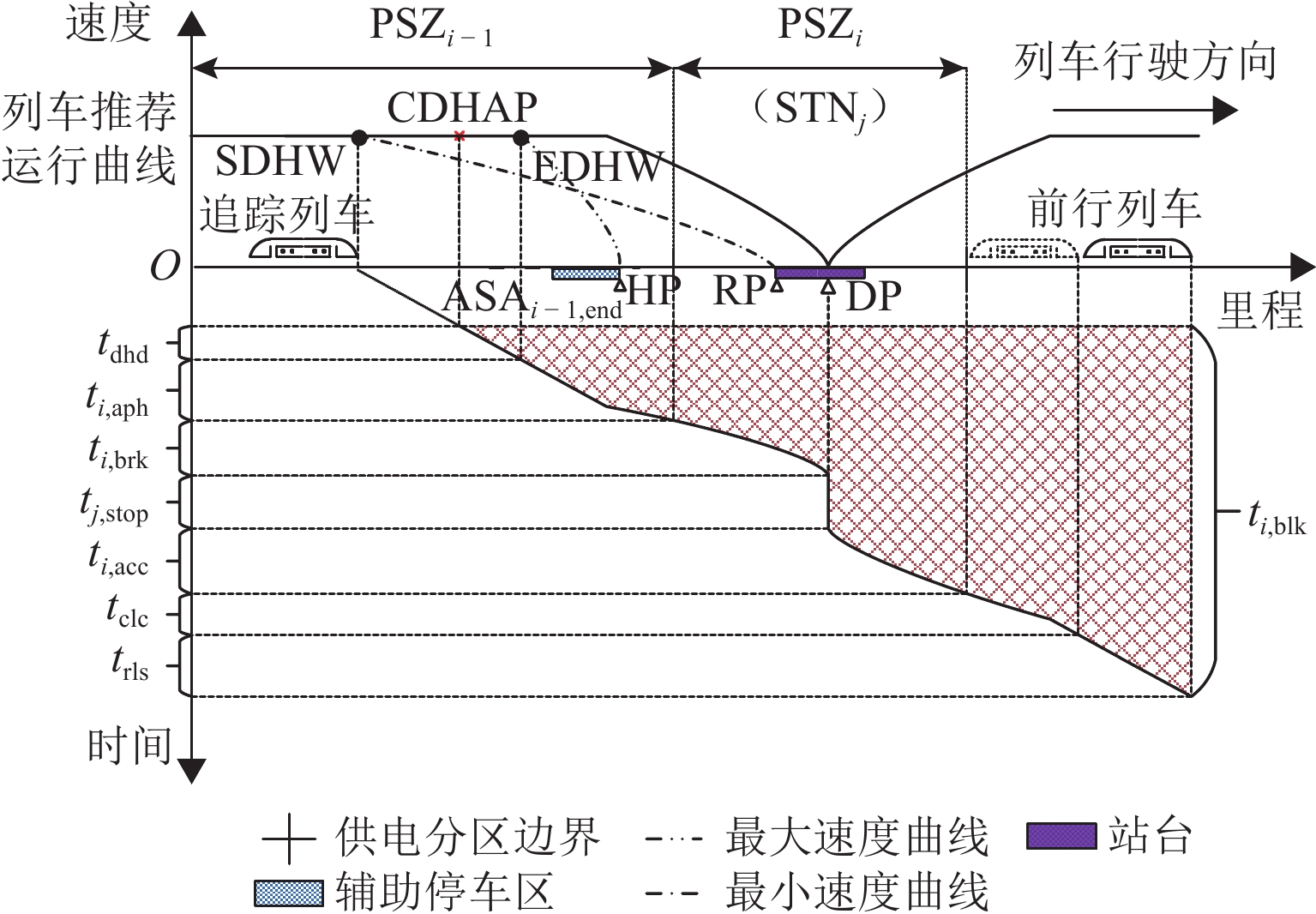
图 5 到站停车场景的分区闭塞时间模型
Figure 5. Partition blocking time model of station arrival stop scenario
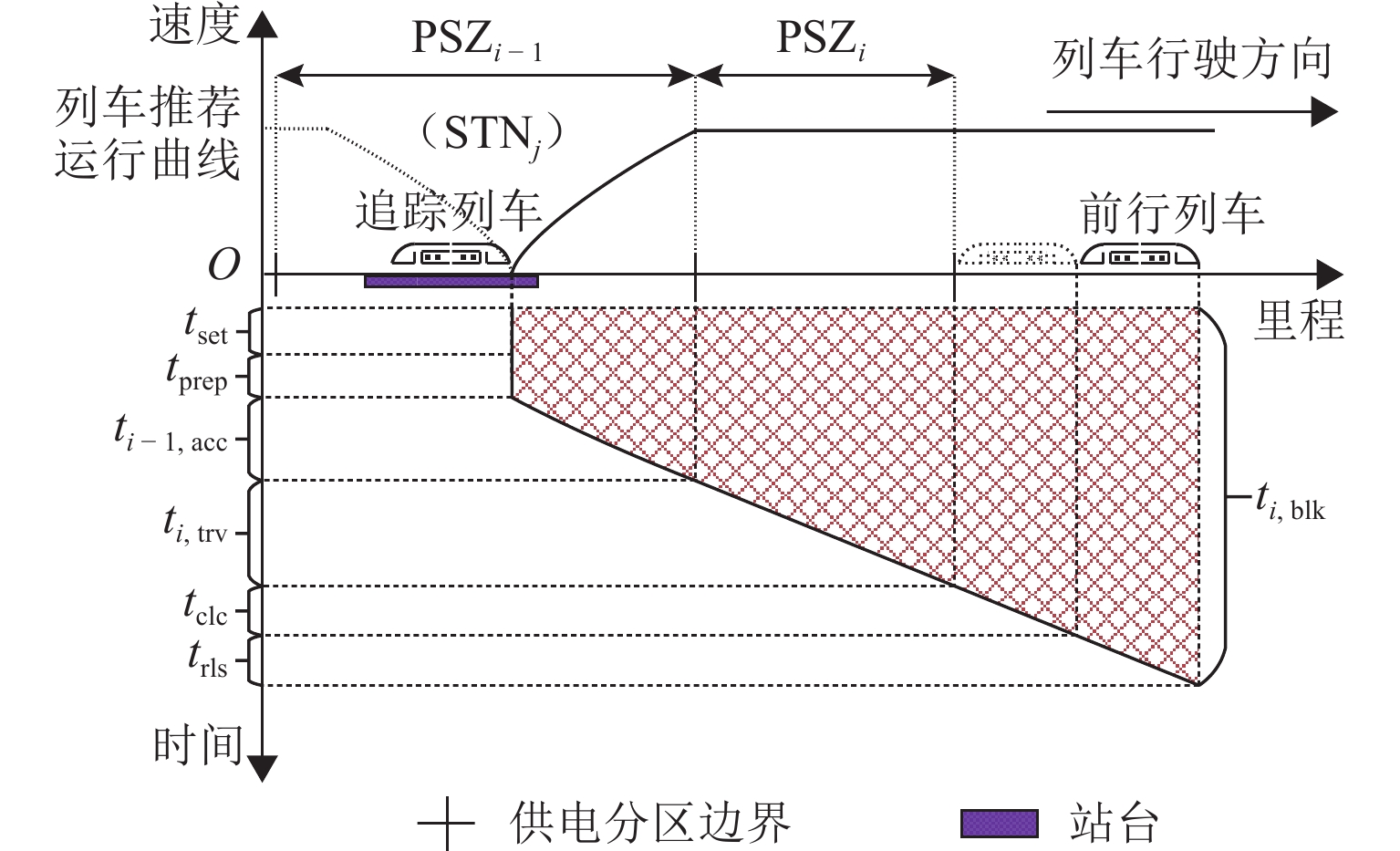
图 6 站台发车场景的分区闭塞时间模型
Figure 6. Partition blocking time model of platform departure scenario
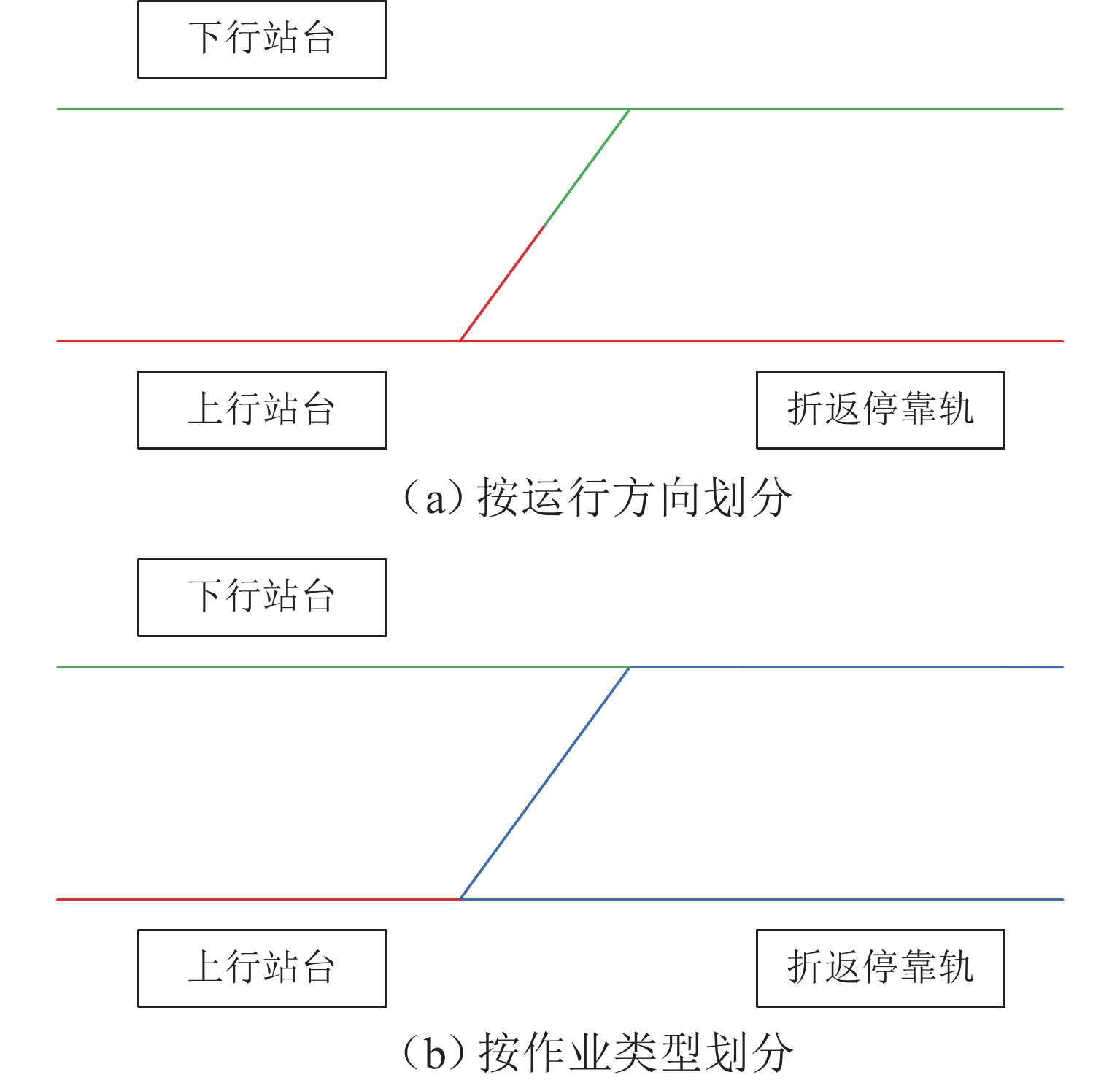
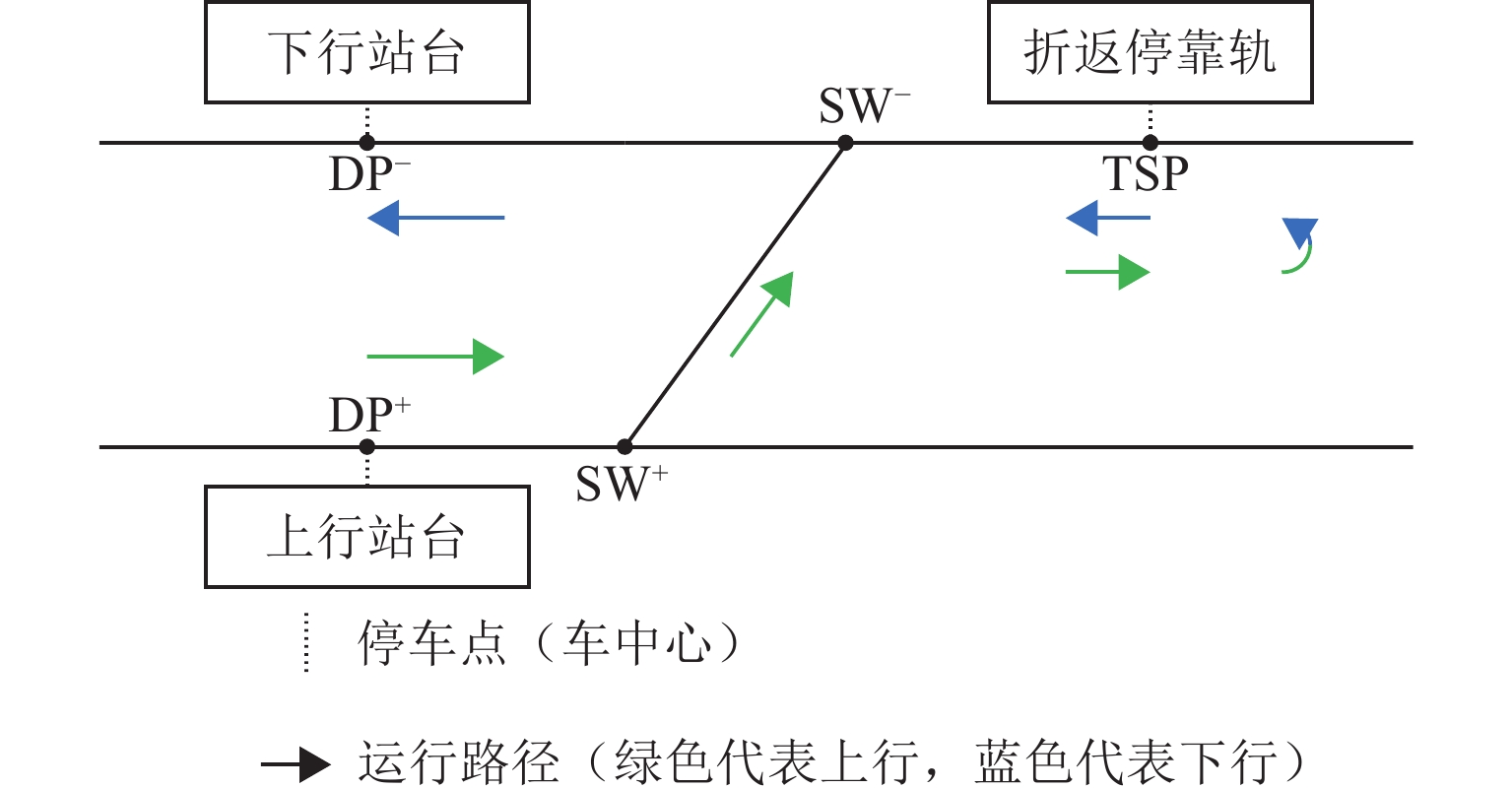
图 7 折返站PSZ划分类型示意图
Figure 7. Schematic diagram of PSZ division types at turn-back station
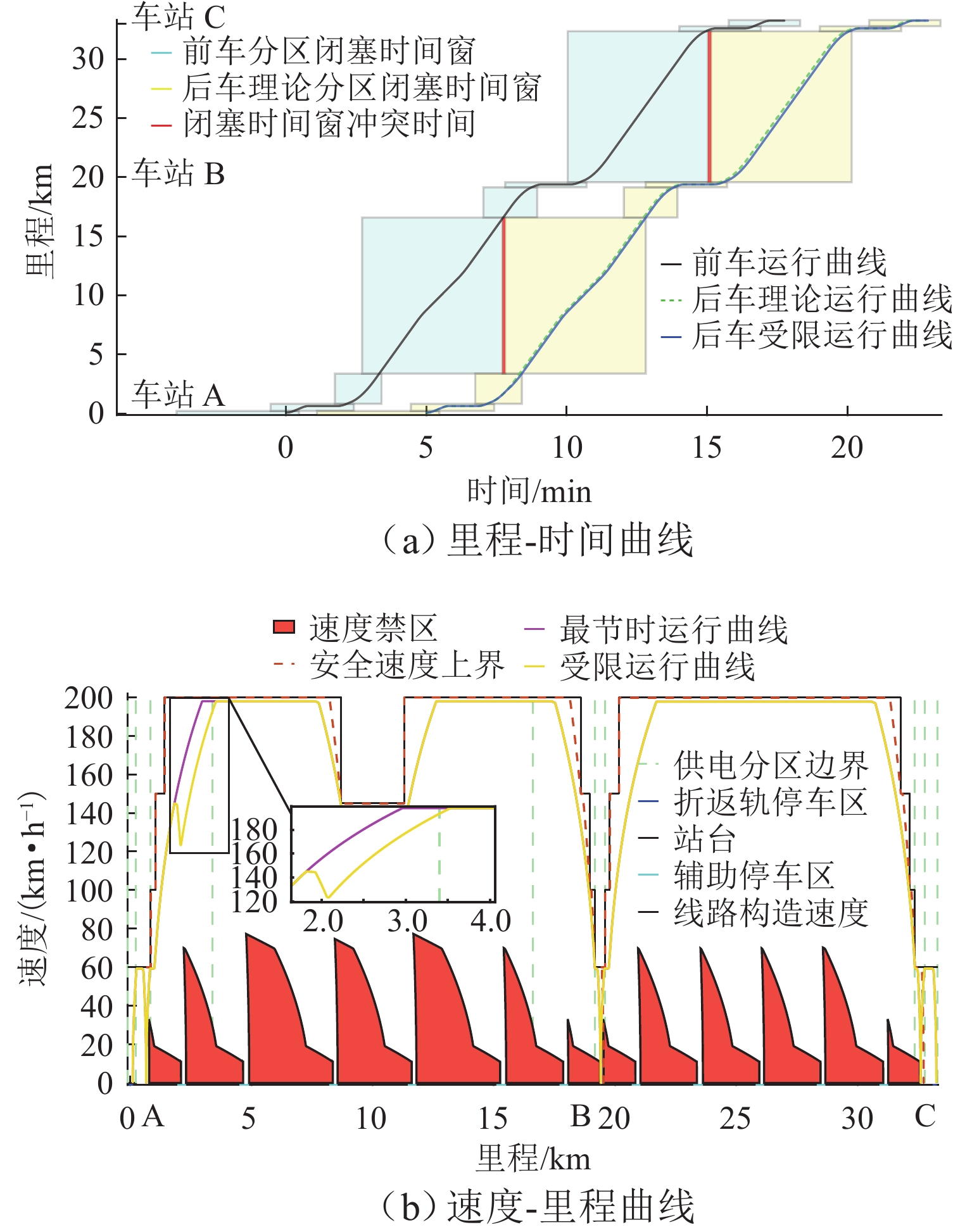
图 11 上行方向压力测试量化结果
Figure 11. Quantitative results of pressure test in upward direction
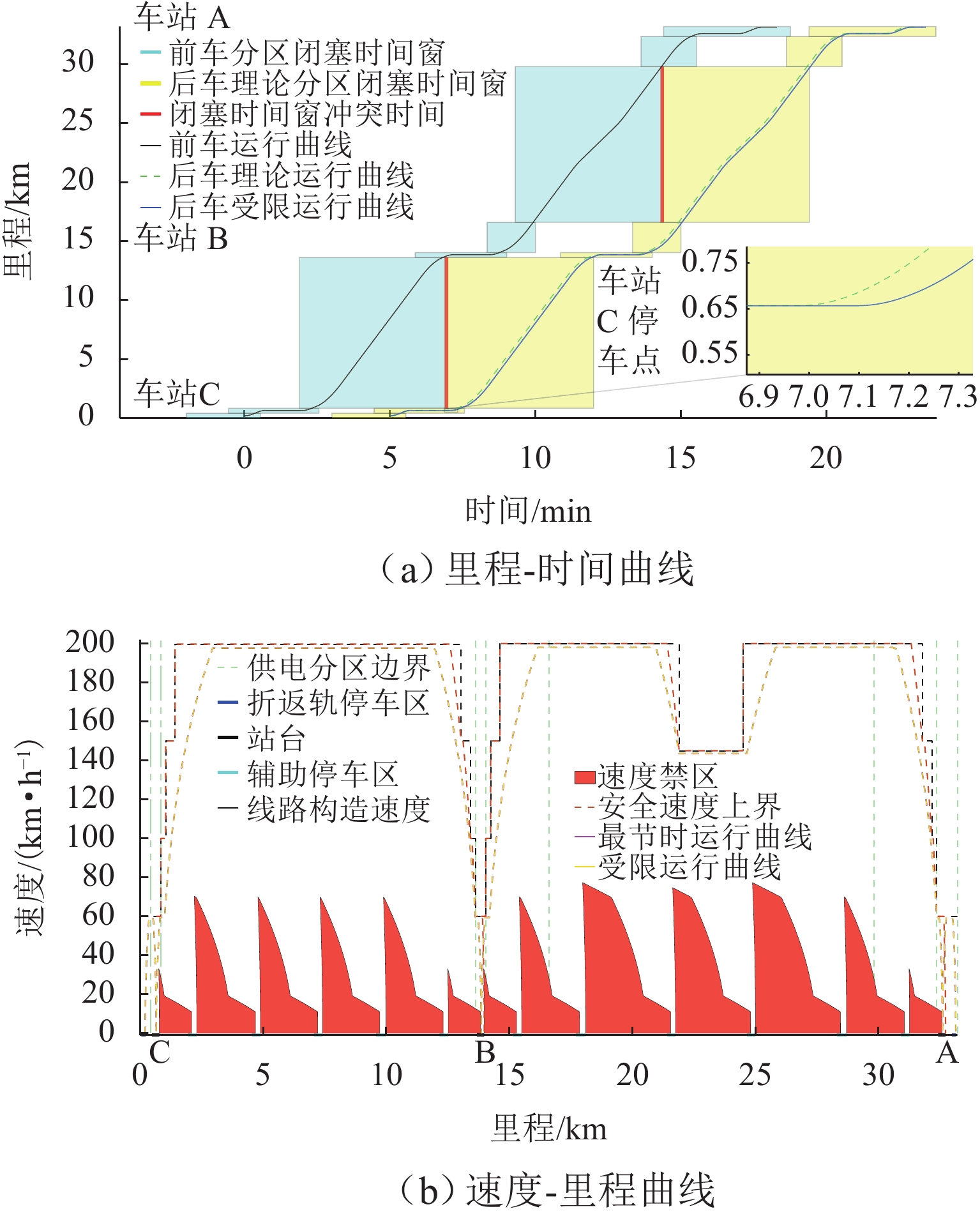
图 12 下行方向压力测试量化结果
Figure 12. Quantitative results of pressure test in downward direction
表 1 系统基础设施符号定义
Table 1. Symbol definitions of system infrastructure
符号 定义 $ i $ 线路上行或下行方向上 PSZ 的索引号 $ j $ 线路上行或下行方向上车站(STN)的索引号 $ k $ 指定 PSZ 内 ASA 的索引号 $ P_{{\text{ASA}},{i,k}} $ 第 $ i $ 个 PSZ 内的第 $ k $ 个 ASA $ M、M' $ 第一、二列中速磁浮列车的标识号  下载: 导出CSV
表 2 基于时间窗压缩的能力求解算法具体步骤
Table 2. Specific steps of algorithm for solving transport capacity based on time window compression
步骤 步骤内容 步骤 1 导入线路布局、车辆及信号系统的相关参数数据集 步骤 2 基于式(1)求解前行列车的最节时运行曲线 步骤 3 依据式(3)~(15),计算前行列车途经所有 PSZ 的 TOTW 步骤 4 设定系统通过能力迭代初始值为 N=2 条 步骤 5 基于式(15),求解后车途经所有 PSZ 的分区TOTW 步骤 6 依据式(16),判定前行列车与后行列车在每一个分区的 TOTW 重叠状态 步骤 7 若未检测到分区 TOTW 重叠,即$ \varOmega (i)=0 $对所有 PSZ 成立,更新$ N=N + 1 $;迭代执行步骤5~7,直至在瓶颈区段出现 TOTW 重叠现象(存在$ \varOmega (i) $=1) 步骤 8 输出$ N-1 $为线路通过能力理论极限值
下载: 导出CSV
-
[1] 邓自刚, 刘宗鑫, 李海涛, 等. 磁悬浮列车发展现状与展望[J]. 西南交通大学学报, 2022, 57(3): 455-474, 530. doi: 10.3969/j.issn.0258-2724.20220001Deng Zigang, Liu Zongxin, Li Haitao, et al. Development status and prospect of maglev train[J]. Journal of Southwest Jiaotong University, 2022, 57(3): 455-474, 530. doi: 10.3969/j.issn.0258-2724.20220001 [2] 龚俊虎, 谢海林, 鄢巨平, 等. 全速度谱系磁浮交通的技术发展与应用前景[J]. 城市轨道交通研究, 2020, 23(9): 61-64, 69. doi: 10.16037/j.1007-869x.2020.09.014Gong Junhu, Xie Hailin, Yan Juping, et al. Development and application prospect of full-speed spectrum maglev transportation technology[J]. Urban Mass Transit, 2020, 23(9): 61-64, 69. doi: 10.16037/j.1007-869x.2020.09.014 [3] 闫海峰, 鲁工圆, 薛锋. 铁路通过能力计算方法[M]. 成都: 西南交通大学出版社, 2019. [4] 丁文亮. 中速磁浮列车追踪间隔时间计算方法及供电分区划分优化研究[D]. 北京: 北京交通大学, 2019. [5] Ding W L, Miao J R, Lai Q Y, et al. Calculation method of train tracking interval for medium-speed maglev train with consideration of auxiliary-stop area[C]//AIP Conference Proceedings. Wuhan: [s.n.], 2019, 2073(1): 020106. [6] 姜西, 邓志翔, 陈光. 常导高速磁浮列车折返间隔时间研究[J]. 城市轨道交通研究, 2024, 27(10): 244-248. doi: 10.16037/j.1007-869x.2024.10.043Jiang Xi, Deng Zhixiang, Chen Guang. Turn-back interval time of normal conducting high-speed maglev trains[J]. Urban Mass Transit, 2024, 27(10): 244-248. doi: 10.16037/j.1007-869x.2024.10.043 [7] Bai W, Liu J, Xu Y Z, et al. Method for calculating the tracking interval distance of medium-speed maglev trains in the scenario of mixed passenger and freight operations[C]//International Conference on Traffic and Transportation Studies. Singapore: Springer Nature Singapore, 2025: 416-427. [8] Lai Q Y. Train headway estimation for maglev with blocking time theory[J]. Journal of Computational Methods in Sciences and Engineering, 2024, 24(1): 253-262. doi: 10.3233/JCM-237058 [9] 郑勇. 基于改进NSGA-Ⅱ优化的超高速磁悬浮设计能力分析方法[D]. 北京: 北京交通大学, 2022. [10] 马琳, 郑勇, 金成日. 超高速磁悬浮列车闭塞分区设计与优化模型[J]. 北京交通大学学报, 2022, 46(5): 131-141. doi: 10.11860/j.issn.1673-0291.20210095Ma Lin, Zheng Yong, Jin Chengri. Design and optimization model of block section in ultra-high-speed maglev train[J]. Journal of Beijing Jiaotong University, 2022, 46(5): 131-141. doi: 10.11860/j.issn.1673-0291.20210095 [11] 王群燕. 中速磁浮线路通过能力计算与加强方法[D]. 北京: 北京交通大学, 2018. [12] Wang Q Y, Meng L Y, Lai Q Y, et al. A method for calculating capacity of a medium-speed maglev line[C]//2018 International Conference on Intelligent Rail Transportation (ICIRT). Piscataway: IEEE, 2018: 1-5. [13] 郑彦喜, 葛琼璇, 张波, 等. 高速磁浮牵引系统供电分区与定子段优化设计[J].西南交通大学学报, 2026, 61(4): 1150-1160, 1170.Zheng Yanxi, Ge Qiongxuan, Zhang Bo, et al. Optimization design of power supply partitions and stator segments in high-speed maglev traction system[J]. Journal of Southwest Jiaotong University, 2026, 61(4): 1150-1160, 1170. [14] 杨光, 唐祯敏. 高速磁浮列车的安全速度防护问题研究[J]. 北京交通大学学报(自然科学版), 2007, 31(2): 38-42.Yang Guang, Tang Zhenmin. Study on safety speed protection of the high maglev train[J]. Journal of Beijing Jiaotong University, 2007, 31(2): 38-42. [15] 虞翊, 姜西, 林辉, 等. 基于防护速度的高速磁浮辅助停车区设置[J]. 同济大学学报(自然科学版), 2019, 47(9): 1310-1316. doi: 10.11908/j.issn.0253-374x.2019.09.011Yu Yi, Jiang Xi, Lin Hui, et al. Setting method of auxiliary stopping area for high-speed maglev based on protection speed[J]. Journal of Tongji University (Natural Science), 2019, 47(9): 1310-1316. doi: 10.11908/j.issn.0253-374x.2019.09.011 [16] Wen J K, Ma L C, Li K C, et al. Research on calculation method of two-dimensiona dual-limit speed safety protection curve for high speed maglev[C]//2020 5th International Conference on Electromechanical Control Technology and Transportation (ICECTT). Piscataway: IEEE, 2020: 615-621. [17] Yu Y, Chu P Z, Dong D Y, et al. Auxiliary stopping area layout method for high-speed maglev operated bidirectionally on single track[J]. Journal of Advanced Transportation, 2021, 2021: 5571788. doi: 10.1155/2021/5571788 [18] Zhao H H, Chen Y J, Liao Z M, et al. Study of speed curve monitoring technology for a high-speed maglev train operation[C]//CICTP 2016. Reston: ASCE, 2016: 1033-1045. [19] Chen Y J, Zhang F Q, Zhao H H, et al. Analysis of district handover procedure of high-speed maglev operation control system[C]//2021 the 5th International Conference on Management Engineering, Software Engineering and Service Sciences. New York: ACM, 2021: 175-180. [20] 朱中毅, 彭其渊, 鲁工圆. 准移动闭塞与移动闭塞条件下列车追踪间隔仿真对比分析[J]. 铁道经济研究, 2020(6): 27-33.Zhu Zhongyi, Peng Qiyuan, Lu Gongyuan. Simulation and comparative analysis of train tracking interval under different automatic blocking modes[J]. Railway Economics Research, 2020(6): 27-33. [21] 刘文慧, 苗建瑞. 基于闭塞时间理论的移动闭塞追踪间隔时间特性研究[J]. 山东科学, 2018, 31(6): 55-61.Liu Wenhui, Miao Jianrui. Study on tracking headway of moving block based on blocking time[J]. Shandong Science, 2018, 31(6): 55-61. [22] 赵建勋, 田长海, 张守帅. 基于闭塞时间的高速铁路列车间隔时间研究[J]. 铁道运输与经济, 2020, 42(增刊1): 37-46, 59.Zhao Jianxun, Tian Changhai, Zhang Shoushuai. A study on the train headway of high-speed railway based on the theory of blocking time[J]. Railway Transport and Economy, 2020, 42(S 1): 37-46, 59. [23] 汤永, 李辉, 张涛. 基于闭塞时间模型的列车追踪间隔时间研究[J]. 机车电传动, 2016(5): 55-58, 119. doi: 10.13890/j.issn.1000-128x.2016.05.104Tang Yong, Li Hui, Zhang Tao. Train headway based on blocking time model[J]. Electric Drive for Locomotives, 2016(5): 55-58, 119. doi: 10.13890/j.issn.1000-128x.2016.05.104 [24] 邱莹辉. 600 km/h高速磁浮列车追踪间隔时间计算方法及车站参数设计研究[J]. 铁道运输与经济, 2025, 47(3): 122-132. doi: 10.16668/j.cnki.issn.1003-1421.2025.03.12Qiu Yinghui. Calculation method of tracking interval and station parameter design for 600 km/h high speed maglev trains[J]. Railway Transport and Economy, 2025, 47(3): 122-132. doi: 10.16668/j.cnki.issn.1003-1421.2025.03.12 [25] 姜西, 虞翊, 邓志翔, 等. 考虑追踪运行的高速磁浮辅助停车区设置优化[J]. 铁道科学与工程学报, 2021, 18(2): 325-333. doi: 10.19713/j.cnki.43-1423/u.T20200324Jiang Xi, Yu Yi, Deng Zhixiang, et al. Setting optimization of auxiliary stopping area for high-speed maglev considering train tracking operation[J]. Journal of Railway Science and Engineering, 2021, 18(2): 325-333. doi: 10.19713/j.cnki.43-1423/u.T20200324 -

 下载:
下载:

 点击查看大图
计量
- 文章访问数: 201
- HTML全文浏览量: 108
- PDF下载量: 77
- 被引次数: 0