



Influence of Motor Arrangement Modes on Response of Maglev Vehicle-Bridge System
-
摘要:
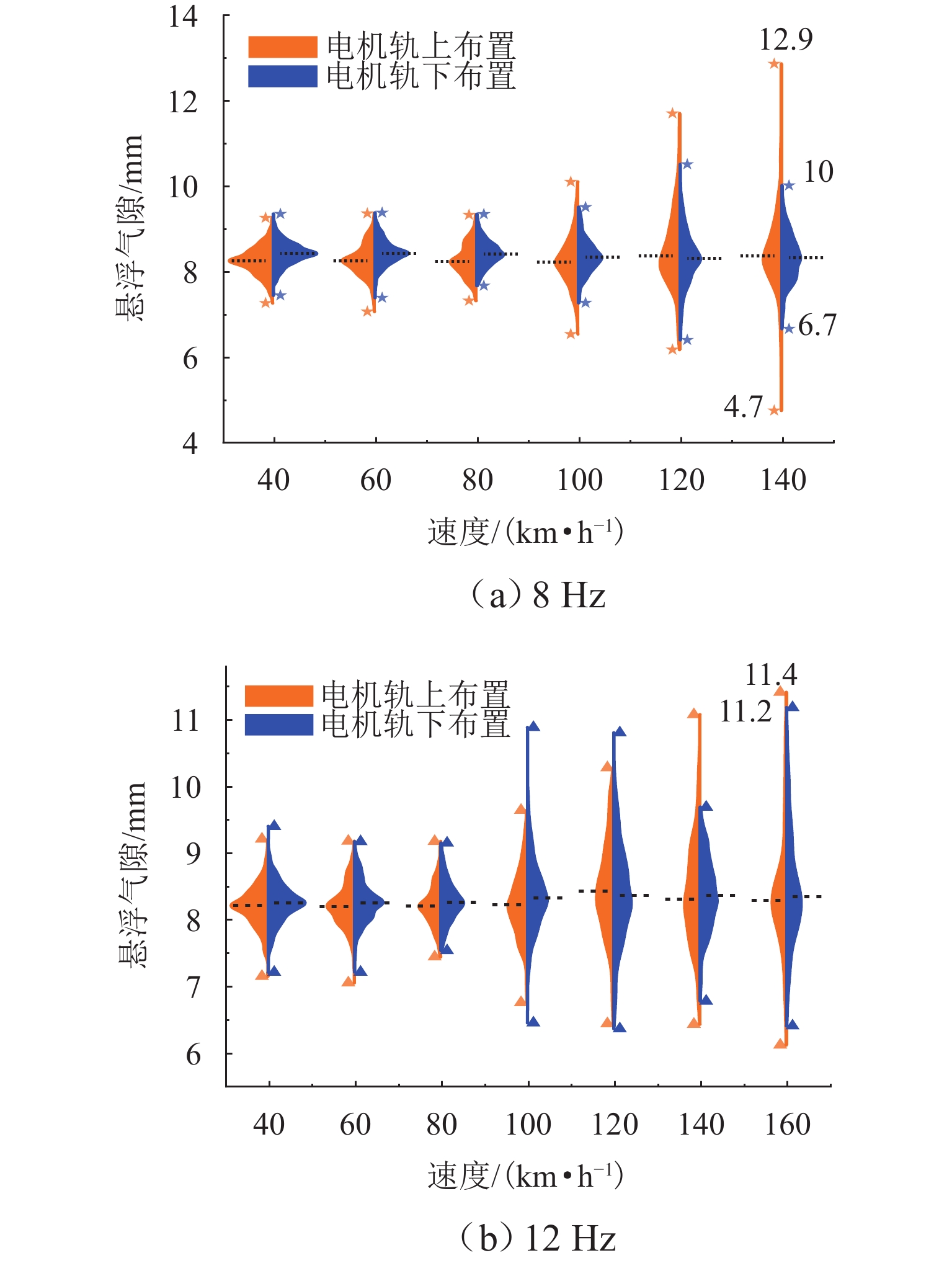
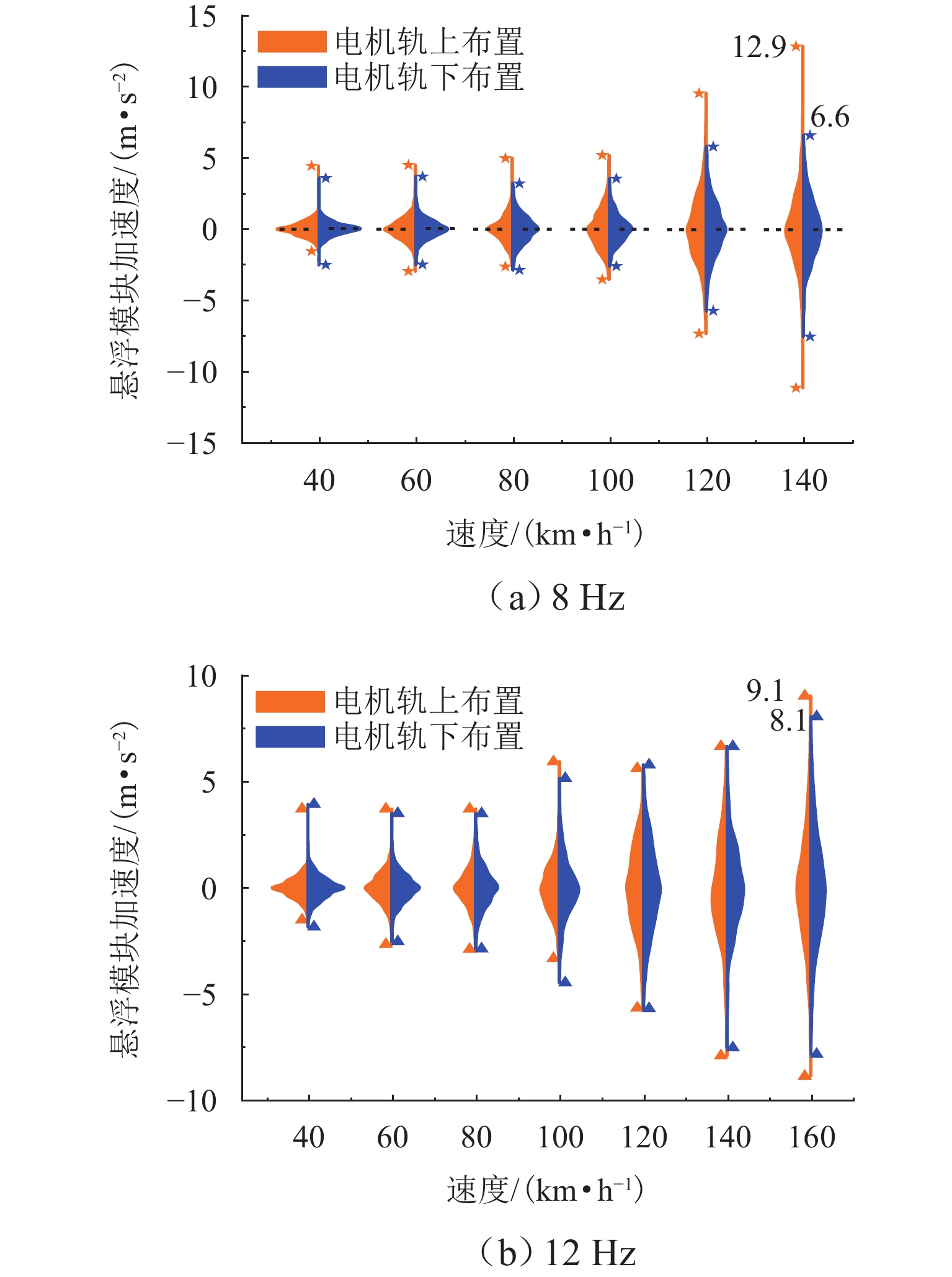
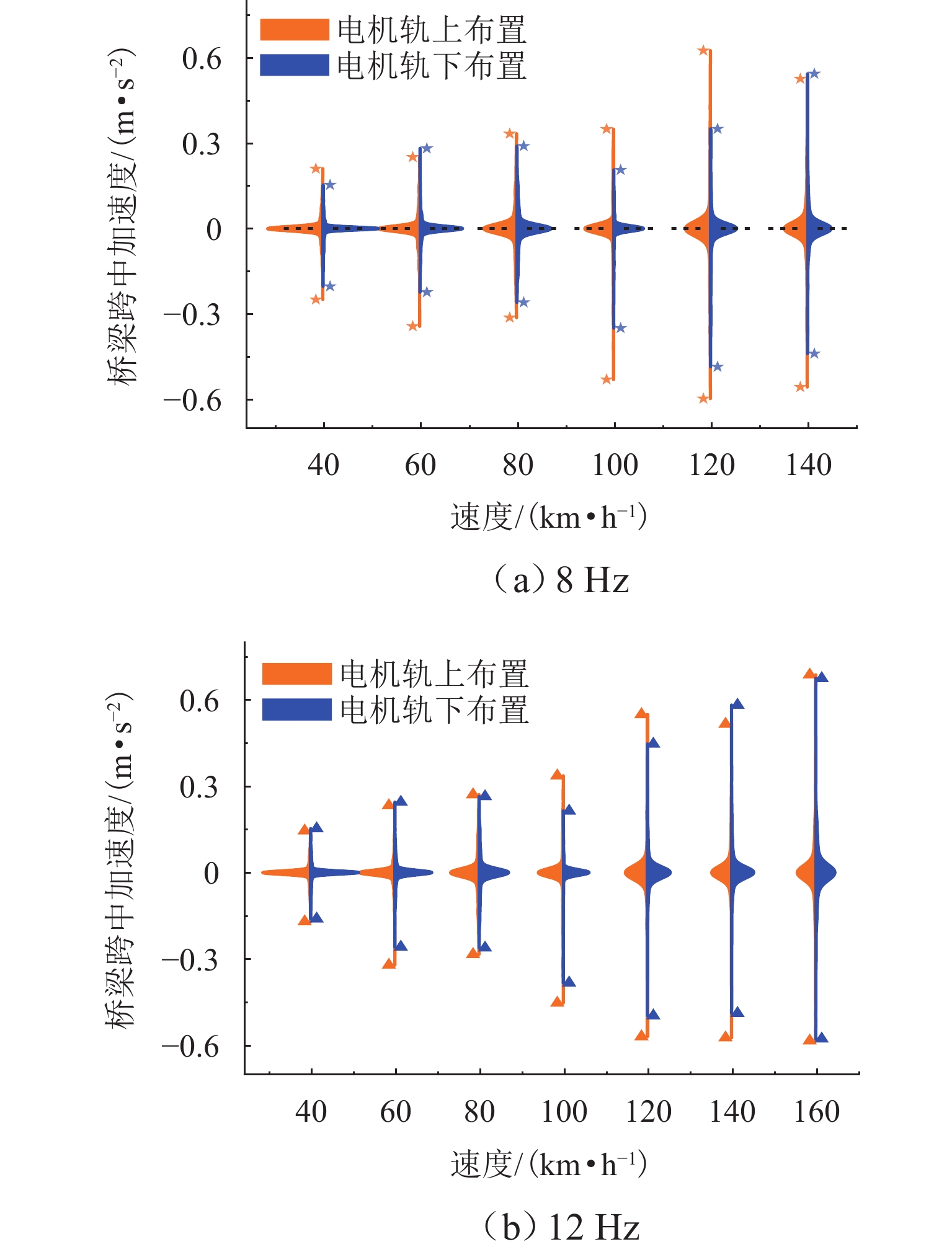
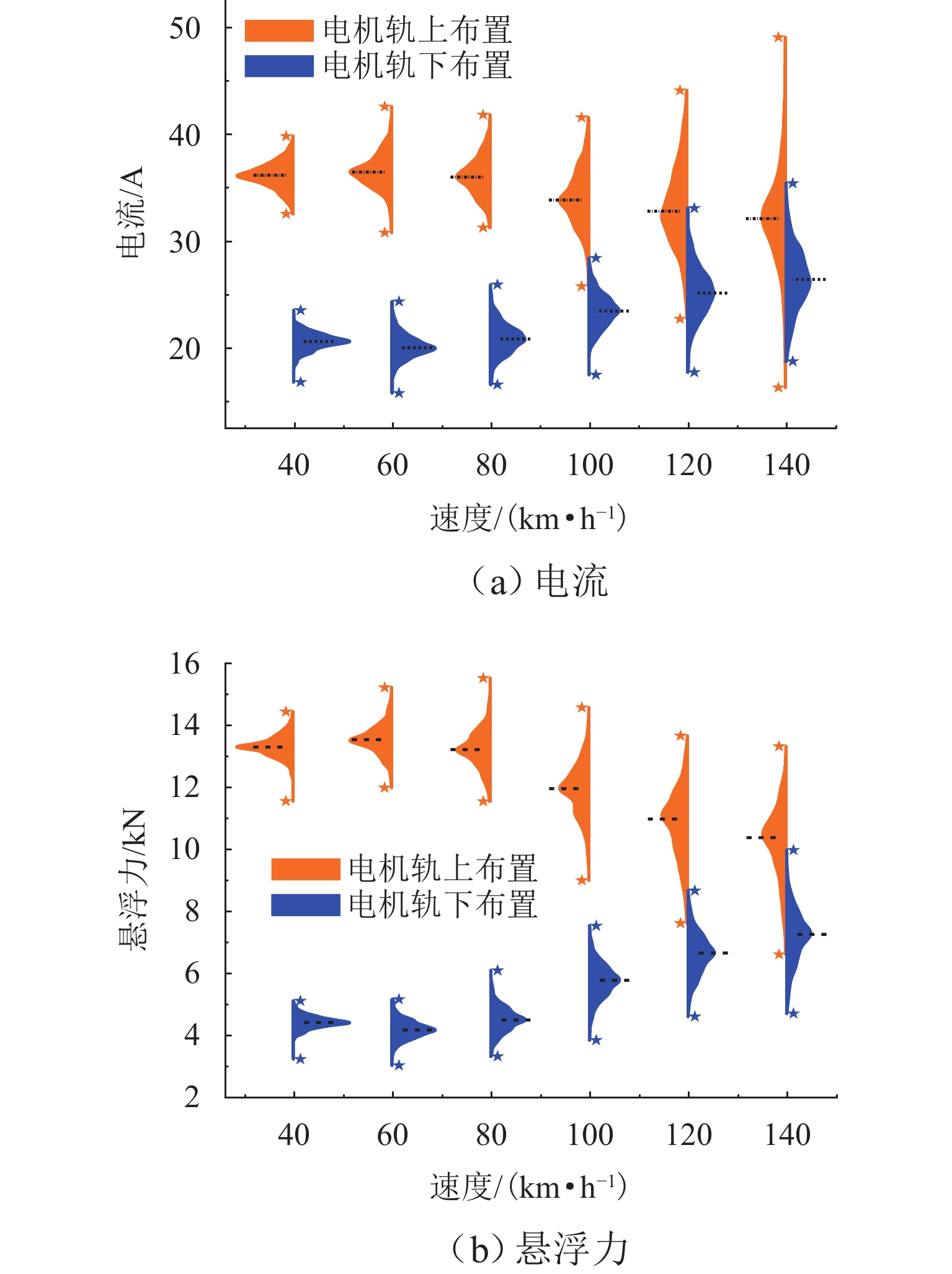
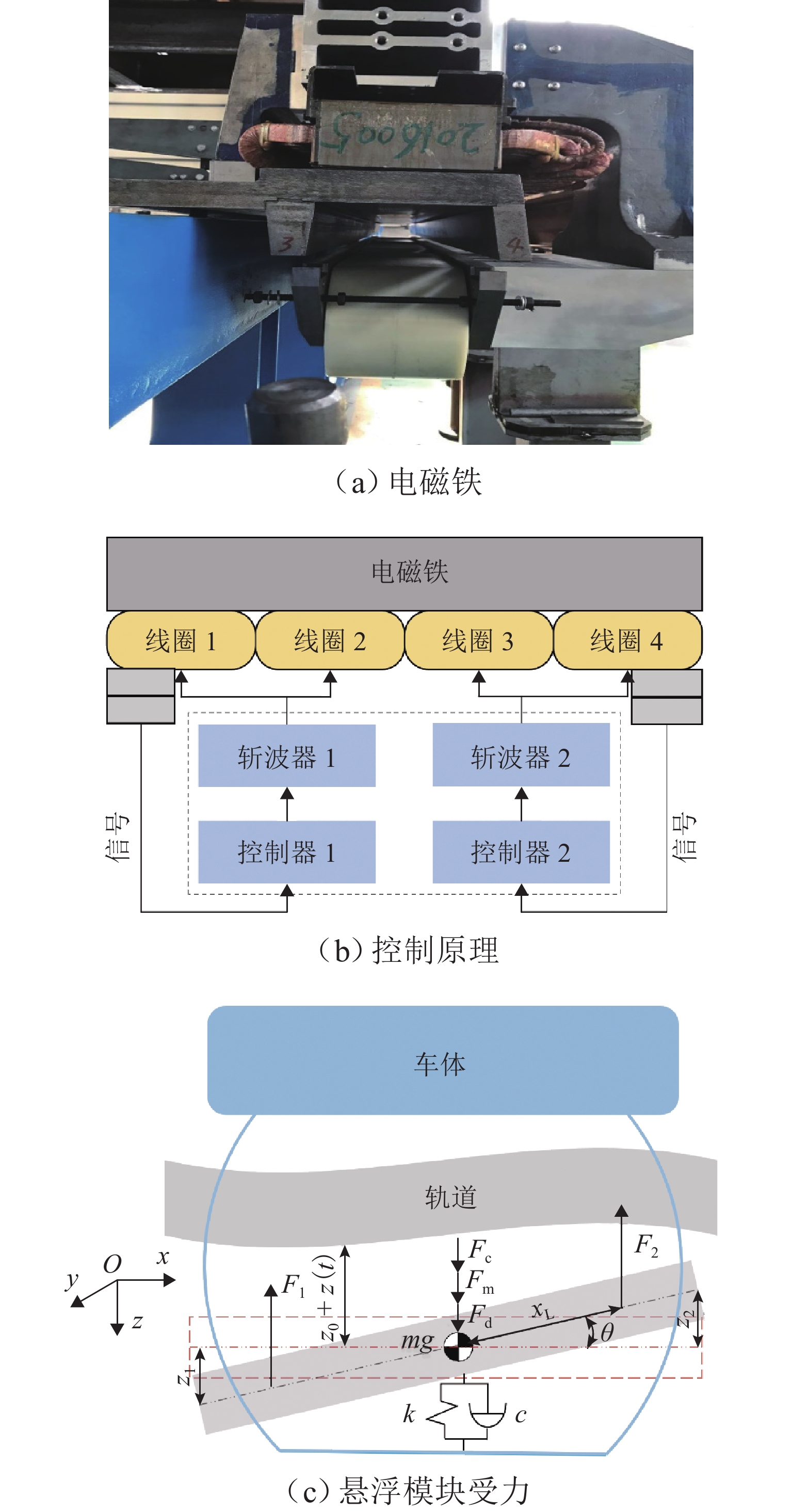
直线电机的法向力具有时变性和可控性,对磁浮列车的稳定运行至关重要. 为研究电机不同布置方式所导致法向力方向变化对悬浮系统动态响应及车辆运行行为的影响,本文建立悬浮模块运动方程,分析法向力对悬浮系统传递函数和额定工作点的影响;在此基础上,通过构建包含悬浮控制、磁饱和效应、电机电磁力、桥梁柔性及轨道不平顺等因素的磁浮车-桥耦合系统动力学模型,探究电机布置方式、滑差频率以及运行速度对系统响应的影响. 研究结果表明:当采用电机轨下布置(轨下)方案时,电机法向力越大,悬浮额定电流越小,电磁铁铁芯相对磁导率越高,磁感应强度对线圈电流变化的敏感度越高,悬浮系统可控性越好. 同时,悬浮气隙波动和悬浮模块振动加速度可显著降低;且滑差频率越小、速度越高,效果越显著:在8 Hz滑差频率、140 km/h速度工况下,轨下方案的悬浮气隙波动和悬浮模块振动加速度幅值较电机轨上布置(轨上)方案分别降低59%和49%. 此外,轨下方案使电磁铁额定电流和悬浮力显著降低,且滑差频率越小、速度越低,差异越大——8 Hz 滑差频率、40 km/h速度下,额定电流和悬浮力分别减小43%和67%. 研究成果可为中低速磁浮走行机构优化和电机滑差频率选择提供理论依据和技术指导.
Abstract:The normal force of linear motors possesses time-varying characteristics and controllability, which are critical to the stable operation of maglev trains. To investigate the influence of normal force direction variations caused by different motor arrangement modes on the dynamic response of the levitation system and vehicle operating behavior, the motion equation of the levitation module was established, and the influence of normal force on the transfer function and rated operating point of the levitation system was analyzed. Furthermore, a dynamic model of the maglev vehicle-bridge coupled system was constructed, which incorporated levitation control, magnetic saturation effect, electromagnetic force of motor, bridge flexibility, rail irregularity, and other factors. The influences of motor arrangement mode, slip frequency, and operating speed on the system response were studied. The results show that with the under-rail motor arrangement (abbreviated as under-rail mode) scheme, a larger normal force of the motor leads to a smaller rated levitation current, a higher relative permeability of the electromagnet core, higher sensitivity of magnetic induction intensity to coil current variation, and better controllability of the levitation system. Meanwhile, the levitation air gap fluctuation and vibration acceleration of the levitation module are significantly reduced. The effect becomes more prominent with a smaller slip frequency and a higher speed. Under the conditions of 8-Hz slip frequency and 140 km/h operating speed, the levitation air gap fluctuation and the vibration acceleration amplitude of the levitation module under the under-rail scheme are reduced by 59% and 49%, respectively, compared with those under the on-rail motor arrangement (abbreviated as on-rail mode) scheme. In addition, the under-rail scheme significantly reduces the rated current and levitation force of the electromagnet, and the difference is more significant with a smaller slip frequency and a lower speed. Under the conditions of 8-Hz slip frequency and 40 km/h speed, the rated current and levitation force are reduced by 43% and 67%, respectively. The results can provide a theoretical basis and technical guidance for the optimization of the running gear of medium-low-speed maglev and the selection of motor slip frequency.
-
表 1 动力学模型主要参数
Table 1. Key parameters of dynamic model
参数 数值 参数 数值 车体长度/m 15 桥梁跨长/m 25 车体质量/t 24 空簧刚度/(N•m−1) 1.25 × 10⁵ 悬浮模块长度/m 2.8 二系悬挂阻尼/
(N•s•m−1)5 × 10³ 悬浮模块质量/t 1.2 额定悬浮气隙/mm 8  下载: 导出CSV
-
[1] Lee H W, Kim K C, Lee J. Review of maglev train technologies[J]. IEEE Transactions on Magnetics, 2006, 42(7): 1917-1925. doi: 10.1109/TMAG.2006.875842 [2] 马卫华, 罗世辉, 张敏, 等. 中低速磁浮车辆研究综述[J]. 交通运输工程学报, 2021, 21(1): 199-216.Ma Weihua, Luo Shihui, Zhang Min, et al. Research review on medium and low speed maglev vehicle[J]. Journal of Traffic and Transportation Engineering, 2021, 21(1): 199-216. [3] Jiang S H, Shen D, Zhang T B, et al. Nonlinear robust composite levitation control for high-speed EMS trains with input saturation and track irregularities[J]. IEEE Transactions on Intelligent Transportation Systems, 2022, 23(11): 20323-20336. doi: 10.1109/TITS.2022.3178122 [4] 卜秀孟, 王力东, 黎清蓉, 等. 高速磁浮车-桥耦合振动控制参数影响分析[J]. 西南交通大学学报, 2024, 59(4): 848-857, 866.Bu Xiumeng, Wang Lidong, Li Qingrong, et al. Influence analysis of vibration control parameters for high-speed maglev train-bridge coupling[J]. Journal of Southwest Jiaotong University, 2024, 59(4): 848-857, 866. [5] Kim K J, Han J B, Han H S, et al. Coupled vibration analysis of maglev vehicle-guideway while standing still or moving at low speeds[J]. Vehicle System Dynamics, 2015, 53(4): 587-601. doi: 10.1080/00423114.2015.1013039 [6] 周丹峰, 朱鹏翔, 屈鸣鹤, 等. 桥梁参数对磁浮系统车-桥耦合稳定性的影响[J]. 西南交通大学学报, 2025, 60(4): 823-832.Zhou Danfeng, Zhu Pengxiang, Qu Minghe, et al. Influence of bridge parameters on vehicle-bridge coupling stability of maglev system[J]. Journal of Southwest Jiaotong University, 2025, 60(4): 823-832. [7] Zhang M, Luo S H, Gao C, et al. Research on the mechanism of a newly developed levitation frame with mid-set air spring[J]. Vehicle System Dynamics, 2018, 56(12): 1797-1816. doi: 10.1080/00423114.2018.1435892 [8] 张敏. 时速160公里常导磁浮列车直线电机和电磁铁效能提升研究[D]. 成都: 西南交通大学, 2020. [9] Zhang M, Gao C, Ma W H. Effect of different connection modes of electromagnets on the performance of levitation control[J]. Proceedings of the Institution of Mechanical Engineers, Part F: Journal of Rail and Rapid Transit, 2018, 232(8): 2111-2125. doi: 10.1177/0954409718762171 [10] Liu J, Zhang M, Zuo F F, et al. Influences of feedback gains on vehicle–bridge coupled vibration for a mid-mounted maglev train[J]. Transportation Research Record: Journal of the Transportation Research Board, 2025, 2679(5): 536-551. doi: 10.1177/03611981241308870 [11] Chen C, Xu J Q, Rong L J, et al. Neural-network-state-observation-based adaptive inversion control method of maglev train[J]. IEEE Transactions on Vehicular Technology, 2022, 71(4): 3660-3669. doi: 10.1109/TVT.2022.3142144 [12] Kong E, Song J S, Kang B B, et al. Dynamic response and robust control of coupled maglev vehicle and guideway system[J]. Journal of Sound and Vibration, 2011, 330(25): 6237-6253. doi: 10.1016/j.jsv.2011.05.031 [13] Wang H, Zhong X B, Shen G. Analysis and experimental study on the MAGLEV vehicle-guideway interaction based on the full-state feedback theory[J]. Journal of Vibration and Control, 2015, 21(2): 408-416. doi: 10.1177/1077546313488431 [14] Sun Y G, Xu J Q, Qiang H Y, et al. Adaptive sliding mode control of maglev system based on RBF neural network minimum parameter learning method[J]. Measurement, 2019, 141: 217-226. doi: 10.1016/j.measurement.2019.03.006 [15] Schmid P, Eberhard P, Dignath F. Nonlinear model predictive control for a maglev vehicle regarding magnetic saturation and guideway irregularities[J]. IFAC-PapersOnLine, 2019, 52(15): 145-150. doi: 10.1016/j.ifacol.2019.11.665 [16] Ni F, Mu S Y, Kang J S, et al. Robust controller design for maglev suspension systems based on improved suspension force model[J]. IEEE Transactions on Transportation Electrification, 2021, 7(3): 1765-1779. doi: 10.1109/TTE.2021.3058137 [17] 张济民, 汪杭生, 任乔. 基于磁场非线性的中低速磁悬浮鲁棒自适应控制[J]. 同济大学学报(自然科学版), 2024, 52(11): 1776-1785.Zhang Jimin, Wang Hangsheng, Ren Qiao. Robust adaptive control of medium-low speed maglev based on magnetic nonlinearity[J]. Journal of Tongji University (Natural Science), 2024, 52(11): 1776-1785. [18] Lee J S, Kwon S D, Kim M Y, et al. A parametric study on the dynamics of urban transit maglev vehicle running on flexible guideway bridges[J]. Journal of Sound and Vibration, 2009, 328(3): 301-317. doi: 10.1016/j.jsv.2009.08.010 [19] Wang D X, Li X Z, Liang L, et al. Influence of the track structure on the vertical dynamic interaction analysis of the low-to-medium-speed maglev train-bridge system[J]. Advances in Structural Engineering, 2019, 22(14): 2937-2950. doi: 10.1177/1369433219854550 [20] Han H S, Yim B H, Lee N J, et al. Effects of the guideway’s vibrational characteristics on the dynamics of a Maglev vehicle[J]. Vehicle System Dynamics, 2009, 47(3): 309-324. doi: 10.1080/00423110802054342 [21] Wang D X, Li X Z, Wang Y W, et al. Dynamic interaction of the low-to-medium speed maglev train and bridges with different deflection ratios: experimental and numerical analyses[J]. Advances in Structural Engineering, 2020, 23(11): 2399-2413. doi: 10.1177/1369433220913367 [22] Zhou D F, Li J, Hansen C H. Suppression of the stationary maglev vehicle–bridge coupled resonance using a tuned mass damper[J]. Journal of Vibration and Control, 2013, 19(2): 191-203. doi: 10.1177/1077546311430716 [23] Suzuki S, Kawashima M, Hosoda Y, et al. HSST-03 system[J]. IEEE Transactions on Magnetics, 1984, 20(5): 1675-1677. doi: 10.1109/TMAG.1984.1063210 [24] Zhang M, Liu J, Cao Y, et al. Reducing vehicle-bridge coupled vibration of a new-type maglev vehicle with mid-mounted suspension on curve via forced guidance device[J]. Vehicle System Dynamics, 2024, 62(7): 1780-1801. doi: 10.1080/00423114.2023.2260024 [25] 胡帛茹, 赵春发, 蔡文锋, 等. 两种中低速磁浮车辆动力学性能仿真对比分析[J]. 机械工程学报, 2023, 59(10): 311-322. doi: 10.3901/JME.2023.10.311Hu Boru, Zhao Chunfa, Cai Wenfeng, et al. Numerical simulation and comparative analysis on dynamic performances of two types of medium-low speed maglev vehicles[J]. Journal of Mechanical Engineering, 2023, 59(10): 311-322. doi: 10.3901/JME.2023.10.311 [26] Wang K R, Luo S H, Ma W H, et al. Dynamic characteristics analysis for a new-type maglev vehicle[J]. Advances in Mechanical Engineering, 2017, 9(12): 168781401774541. [27] Zhang M, Yuan C, Ma W H, et al. Effect of suspension form on the vehicle-bridge coupled vibration of the maglev vehicle[J]. Vehicle System Dynamics, 2024, 62(2): 511-532. doi: 10.1080/00423114.2023.2180756 [28] 黄文杰. 内嵌式中低速磁浮系统牵引与悬浮导向特性研究[D]. 北京: 北京交通大学, 2022. [29] Zare-Bazghaleh A, Meshkatoddini M R, Fallah-Choolabi E. Force study of single-sided linear induction motor[J]. IEEE Transactions on Plasma Science, 2016, 44(5): 849-856. doi: 10.1109/TPS.2016.2541865 [30] 张敏, 骆淑娟, 曹毅, 等. 相邻直线电机边端效应及电磁力特性分析[J]. 西南交通大学学报, 2025, 60(4): 842-850. doi: 10.3969/j.issn.0258-2724.20240250Zhang Min, Luo Shujuan, Cao Yi, et al. End effect and electromagnetic force characteristics of two adjacent linear induction motors[J]. Journal of Southwest Jiaotong University, 2025, 60(4): 842-850. doi: 10.3969/j.issn.0258-2724.20240250 [31] 朱羽箫. 轨道交通用磁通切换直线电机法向力及列车动力学研究[D]. 石家庄: 石家庄铁道大学, 2025. [32] 张敏, 范屹立, 马卫华, 等. 滑差频率对磁浮车辆运行性能的影响[J]. 交通运输工程学报, 2019, 19(5): 64-73. doi: 10.3969/j.issn.1671-1637.2019.05.008Zhang Min, Fan Yili, Ma Weihua, et al. Influence of slip frequency on running performance of maglev vehicle[J]. Journal of Traffic and Transportation Engineering, 2019, 19(5): 64-73. doi: 10.3969/j.issn.1671-1637.2019.05.008 [33] 李梦雪, 张敏, 马卫华, 等. 电机法向力对两种磁浮车辆动力学的影响[J]. 机械, 2023, 50(12): 25-33.Li Mengxue, Zhang Min, Ma Weihua, et al. Influence of linear induction motor normal force on dynamics of two types of maglev vehicles[J]. Machinery, 2023, 50(12): 25-33. [34] Li M, Luo S H, Ma W H, et al. Experimental and numerical investigations of the dynamic responses of low and medium speed maglev train-track-bridge coupled system[J]. Vehicle System Dynamics, 2022, 60(5): 1555-1578. doi: 10.1080/00423114.2020.1864417 -

 下载:
下载:

 点击查看大图
计量
- 文章访问数: 206
- HTML全文浏览量: 165
- PDF下载量: 61
- 被引次数: 0