



Parameter Optimization of Decoupling Transmission Mechanisms for Ultra-High-Speed Maglev Trains
-
摘要:
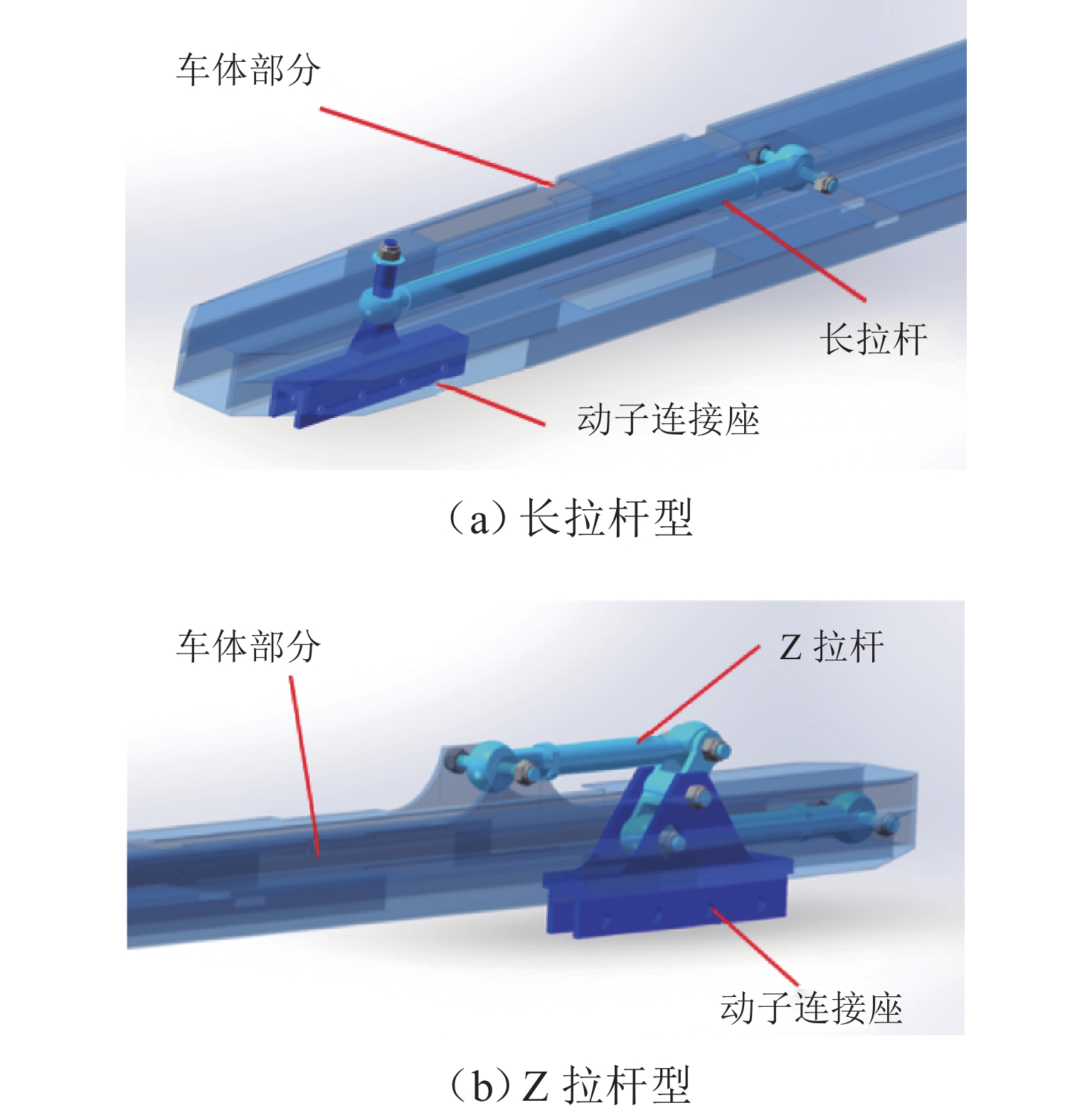
针对车体与双边永磁直线同步电机动子之间需传递纵向牵引和制动载荷,同时隔离垂向及横向运动的问题,提出采用Z形拉杆和长拉杆连接形式的2种解耦传动机构,并基于多体动力学理论,建立包含车辆、解耦传动机构、导轨、轨道不平顺激励及空气阻力的动力学模型. 首先,基于所建立模型对2种解耦传动机构的动力学响应进行对比,考察不同连接形式对杜瓦、牵引电机动子及悬浮系统振动特性的影响;其次,分析解耦连接点间距、机构刚度和阻尼等参数变化对动子振动响应、悬浮系统动力学性能及动子摩擦块受力的影响规律;最后,结合结构受力和动力学响应,对解耦传动机构的关键参数进行优化. 结果表明:Z形拉杆和长拉杆在杜瓦及动子动力学响应控制方面各具优势,其中,Z形拉杆在解耦连接点处的最大受力较小;随着解耦连接点间距增大,动子横向加速度逐渐增大,垂向加速度先增大后减小,建议将解耦点间距控制在2.6~3.0 m;解耦传动机构刚度和阻尼对动子及杜瓦的动力学指标影响不明显,但对摩擦块横向受力影响显著;在满足结构安全要求的条件下,机构刚度取约0.8 × 10⁷ N/m,阻尼取1 × 103~3 × 10³ N•s/m. 研究结果可为超高速磁浮列车解耦传动机构的结构设计与参数匹配提供参考.
Abstract:To transmit longitudinal traction and braking loads while decoupling vertical and lateral motions between the vehicle body and the movers of a double-sided permanent-magnet linear synchronous motor, two decoupling transmission mechanisms were proposed, one using a Z-shaped tie rod and the other a long tie rod. Based on multibody dynamics theory, a coupled dynamic model incorporating the vehicle, decoupling transmission mechanism, guideway, track irregularity excitation, and aerodynamic resistance was established. First, the dynamic responses of the two decoupling transmission mechanisms were compared to investigate the effects of the connection configurations on the vibration characteristics of the Dewar vessel, traction-motor mover, and suspension system. Second, the effects of the spacing between decoupling connection points, mechanism stiffness, and damping on the vibration responses of the mover, the dynamic performance of the suspension system, and the forces acting on mover friction blocks were analyzed. Finally, the key parameters of the decoupling transmission mechanism were optimized by considering structural loads and dynamic responses. The results indicate that the Z-shaped tie rod and the long tie rod offer different advantages in controlling the dynamic responses of the Dewar vessel and the mover. In particular, the Z-shaped tie rod produces a lower maximum force at the decoupling connection points. As the spacing between decoupling connection points increases, the lateral acceleration of the mover increases gradually, whereas its vertical acceleration first increases and then decreases. A spacing of 2.6–3.0 m is recommended. The stiffness and damping of the decoupling transmission mechanism have no significant effect on the dynamic performance indicators of the mover and the Dewar vessel but significantly affect the lateral forces acting on the friction blocks. Subject to structural safety requirements, a stiffness of approximately 8.0 × 10⁶ N/m and a damping coefficient of 1.0 × 10³–3.0 × 10³ N•s/m are recommended. The results provide a reference for structural design and parameter matching of decoupling transmission mechanisms for ultra-high-speed maglev trains.
-
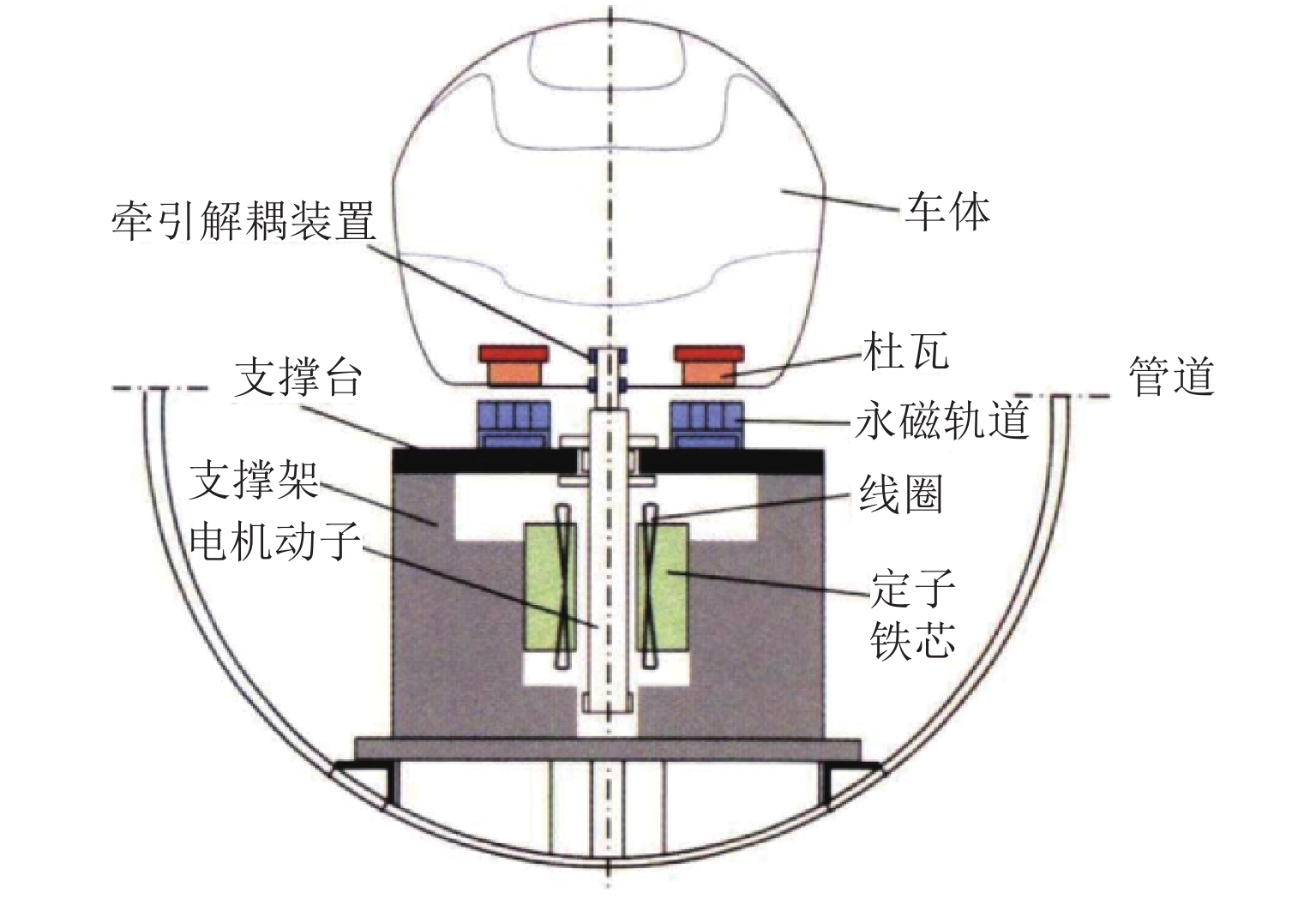
图 1 超高速磁浮系统横截面结构
Figure 1. Cross-sectional structure of ultra-high-speed maglev system
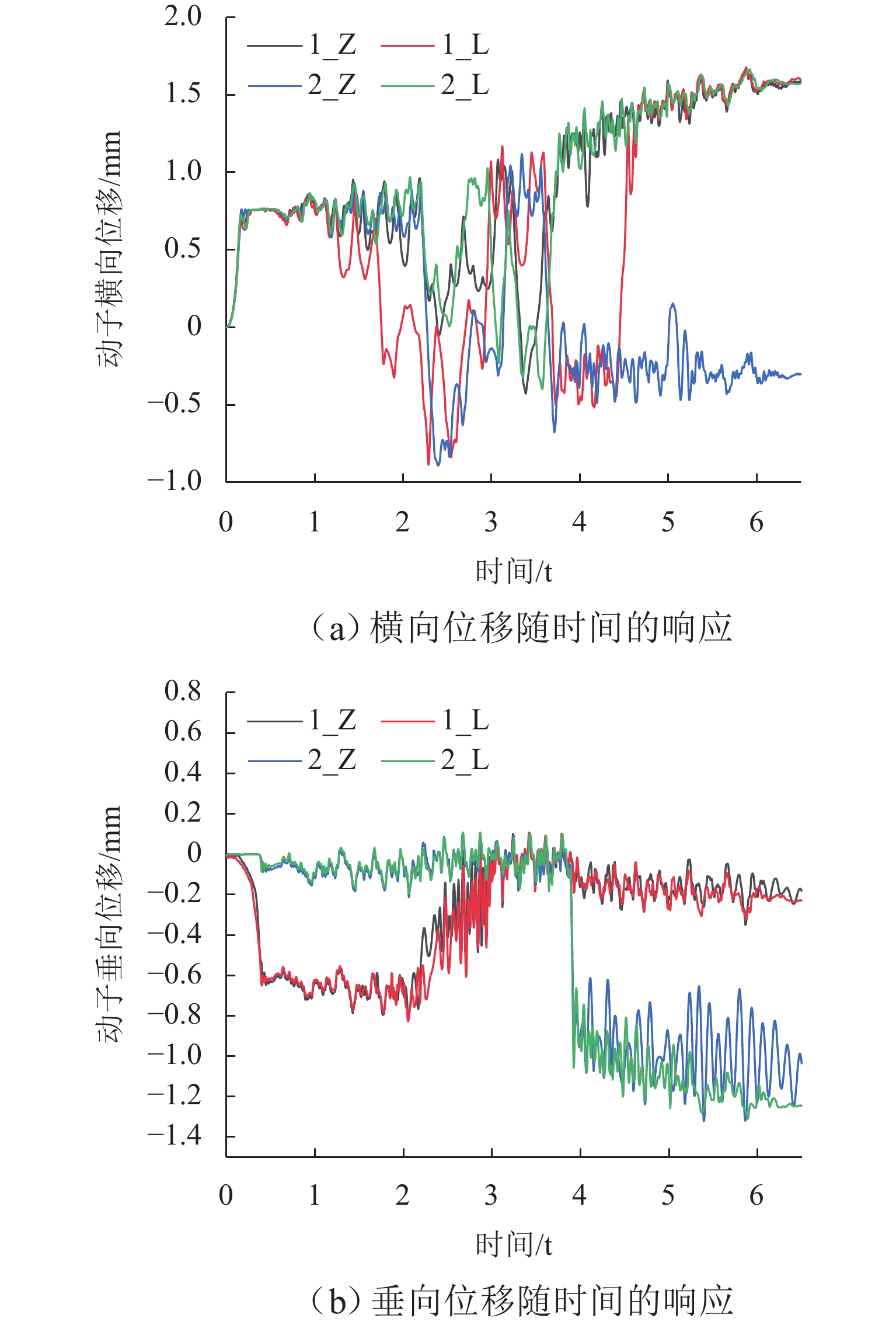
图 9 不同拉杆下动子位移随时间的响应
Figure 9. Time histories of mover lateral displacement with different tie-rod configurations
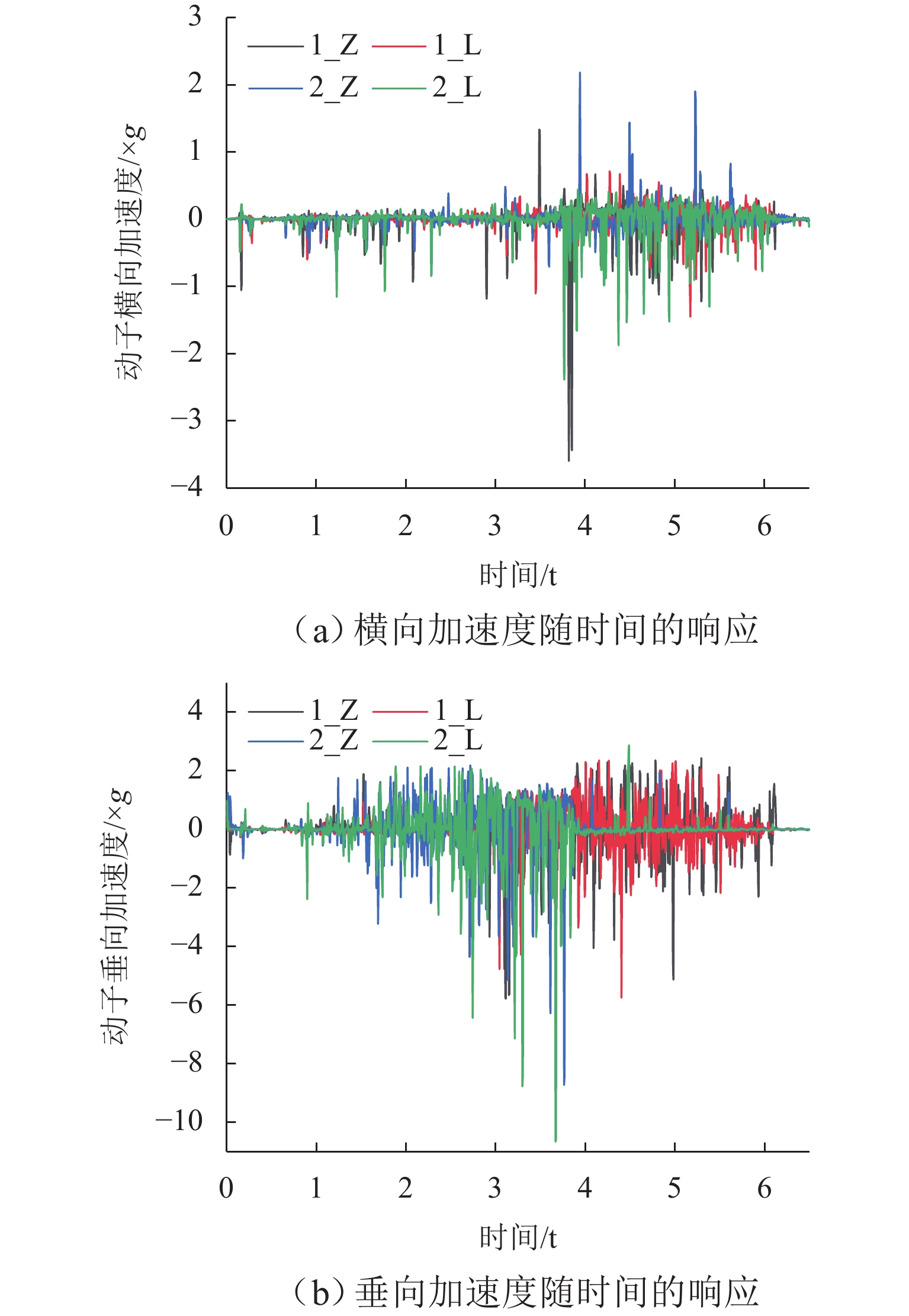
图 10 不同拉杆下动子位位移随时间的响应
Figure 10. Time histories of mover vertical displacement with different tie-rod configurations
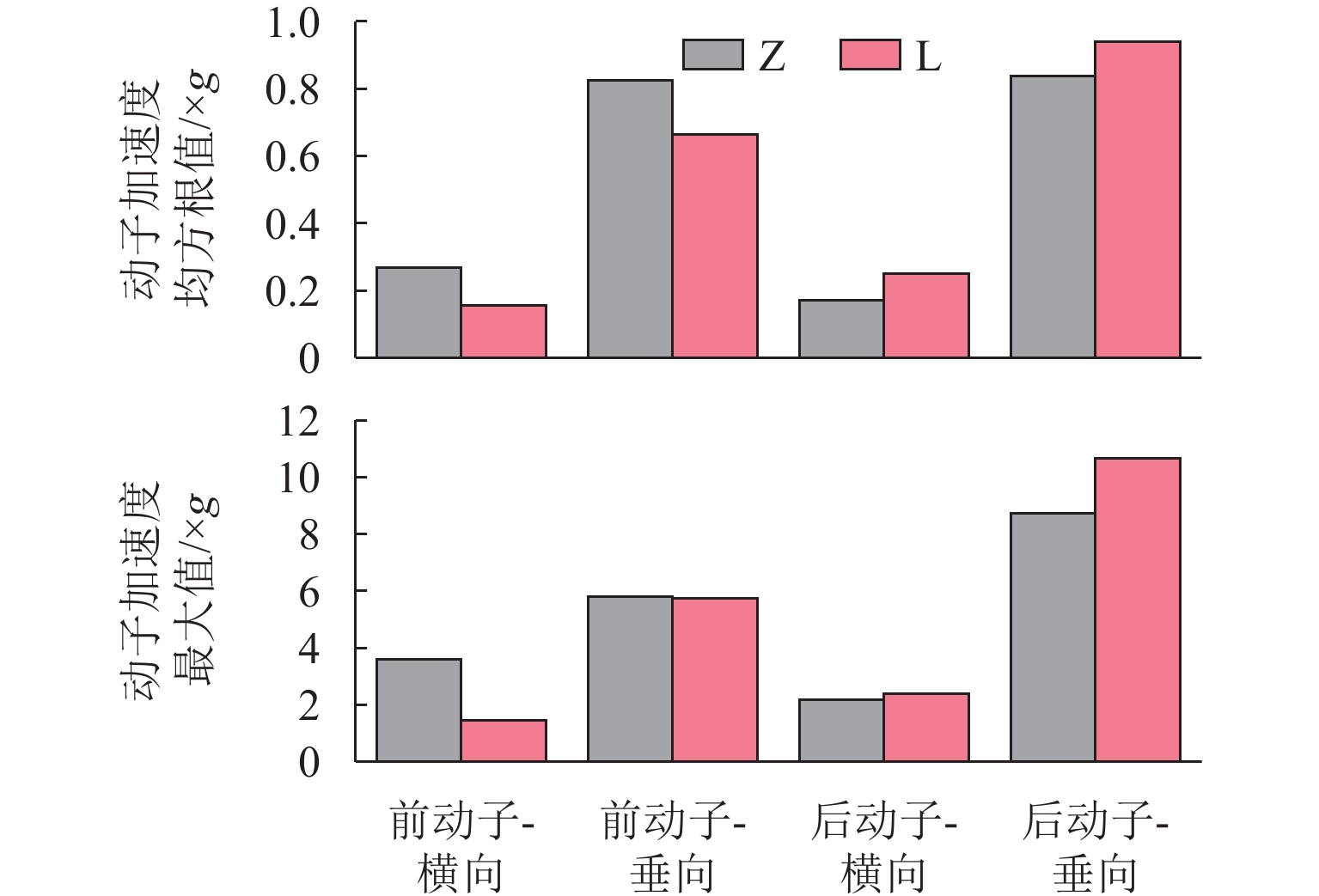
图 11 不同拉杆下动子位加速度均方根值与幅值
Figure 11. Root-mean-square values and amplitudes of mover acceleration with different tie-rod configurations
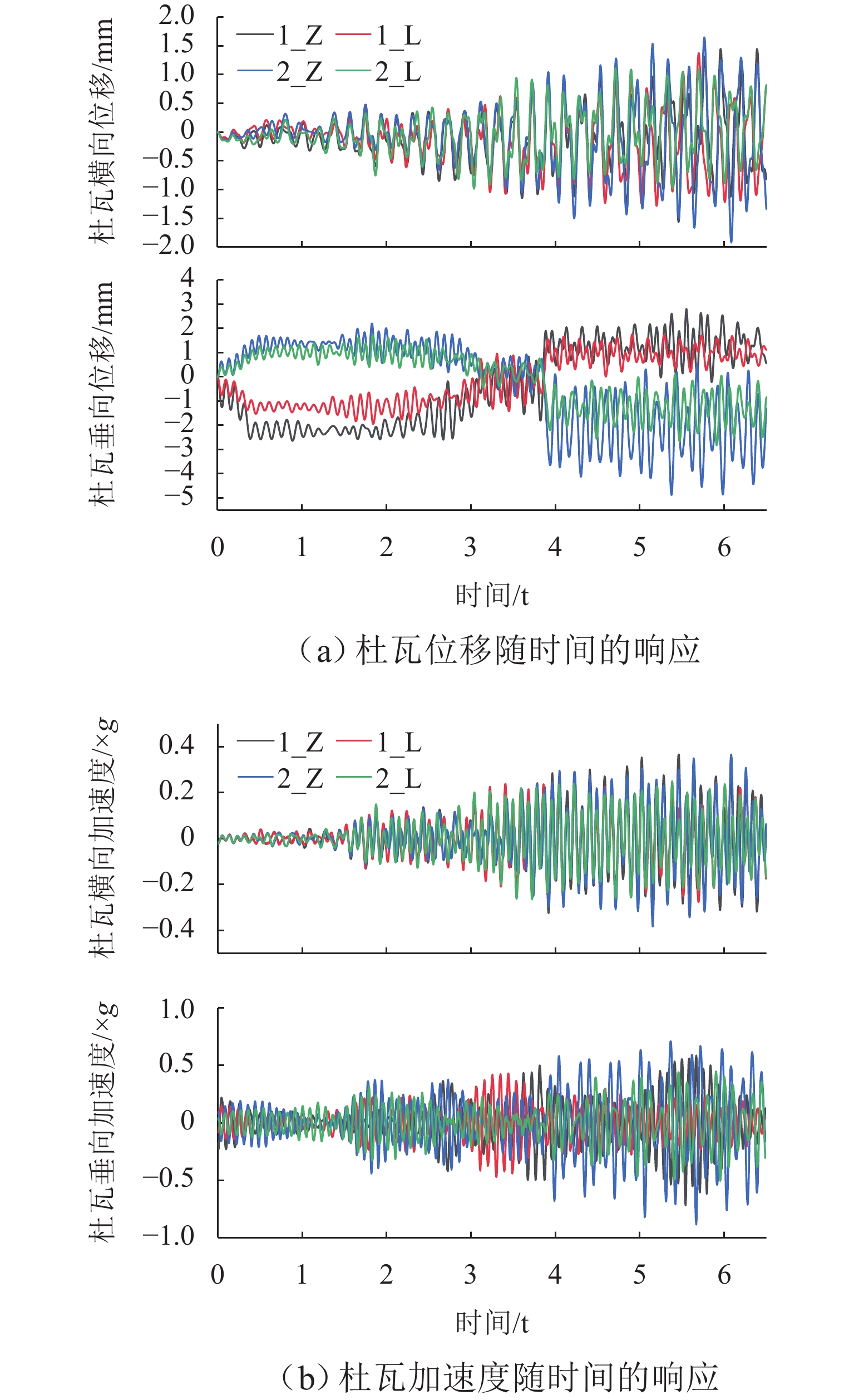
图 12 不同拉杆下杜瓦位移、加速度随时间的响应
Figure 12. Time histories of Dewar vessel acceleration with different tie-rod configurations
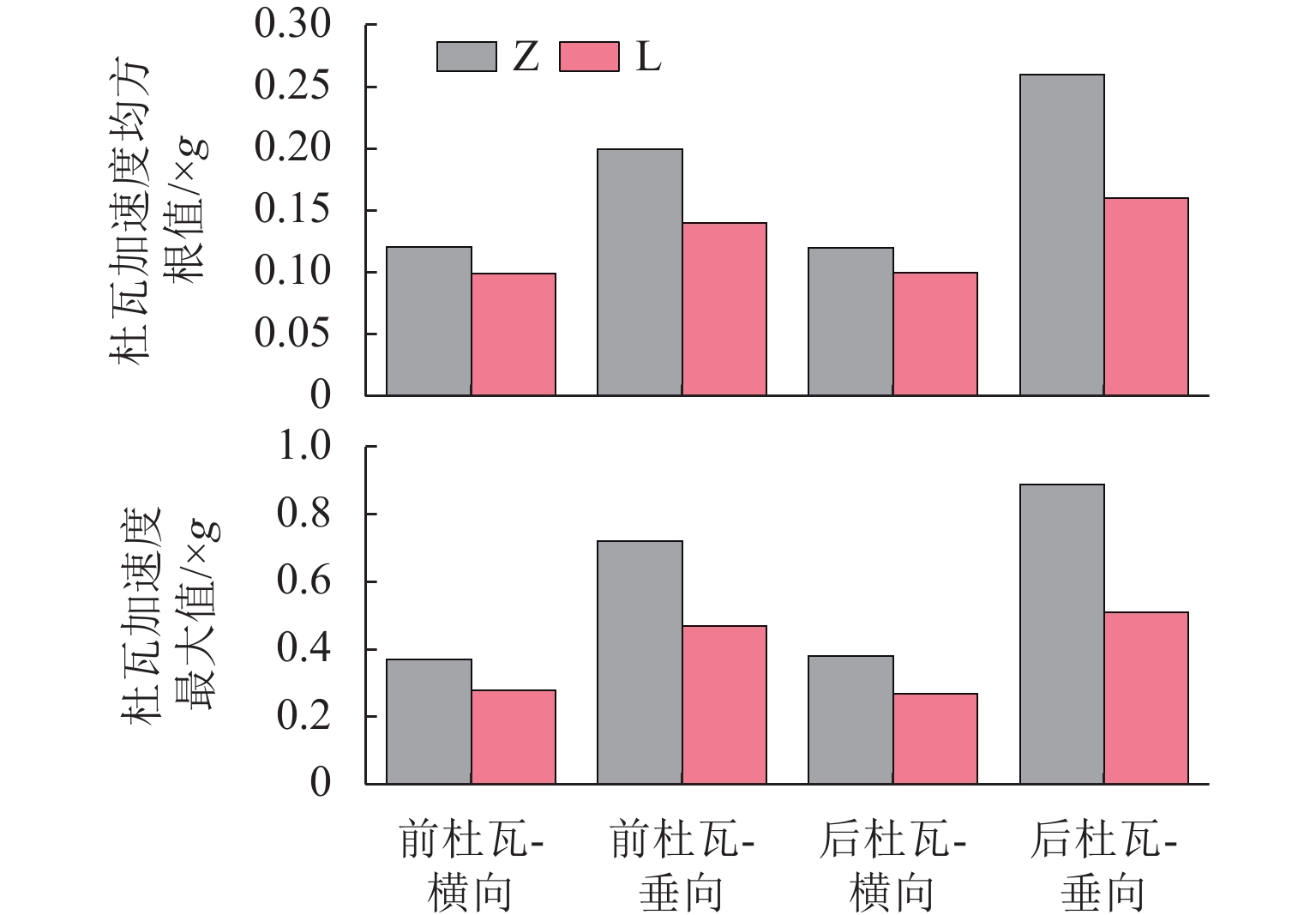
图 13 不同拉杆下杜瓦位加速度均方根值与幅值
Figure 13. Root-mean-square values and amplitudes of Dewar vessel acceleration with different tie-rod configurations
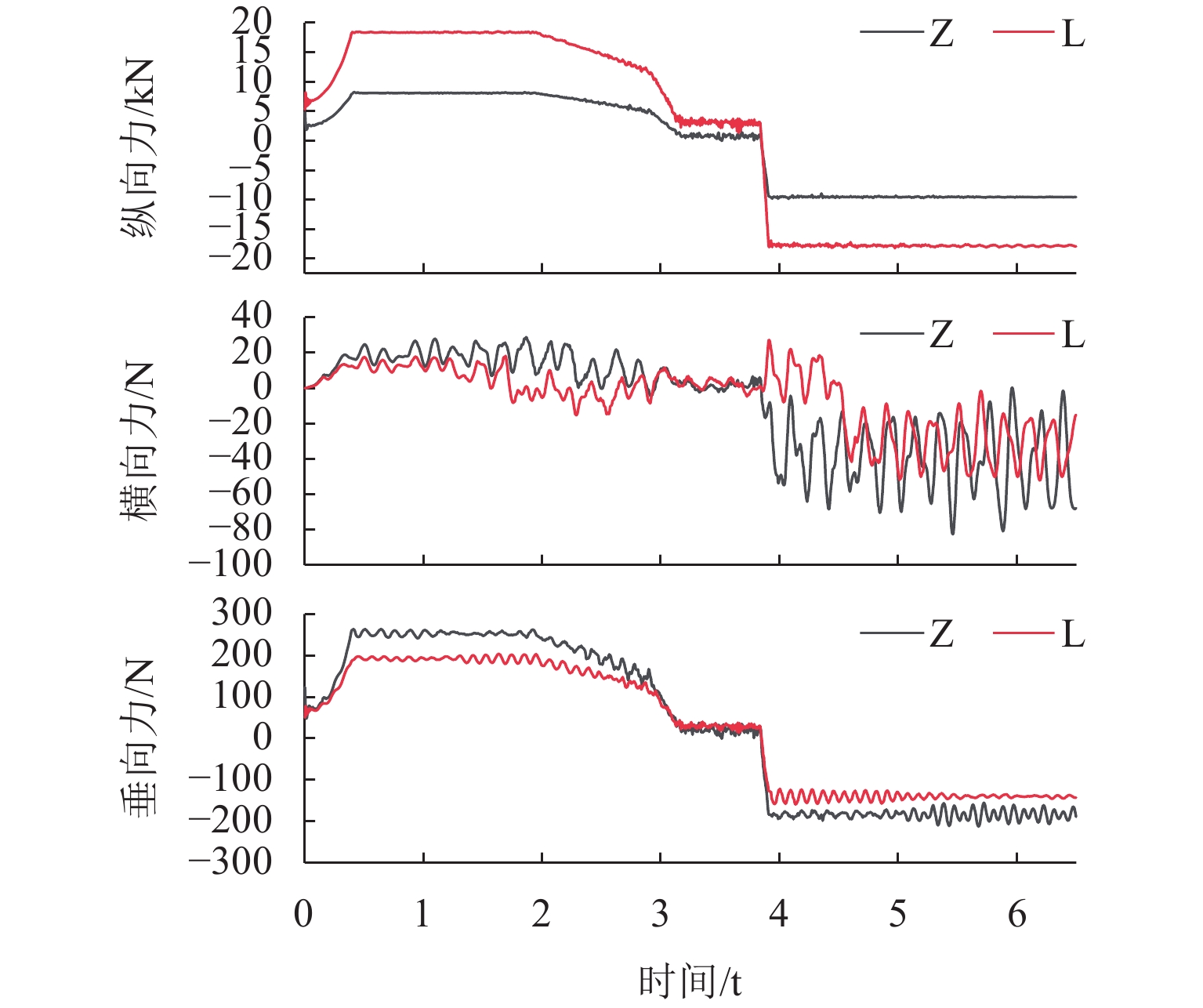
图 14 不同拉杆下解耦装置受力随时间的响应
Figure 14. Time histories of forces acting on decoupling mechanism with different tie-rod configurations
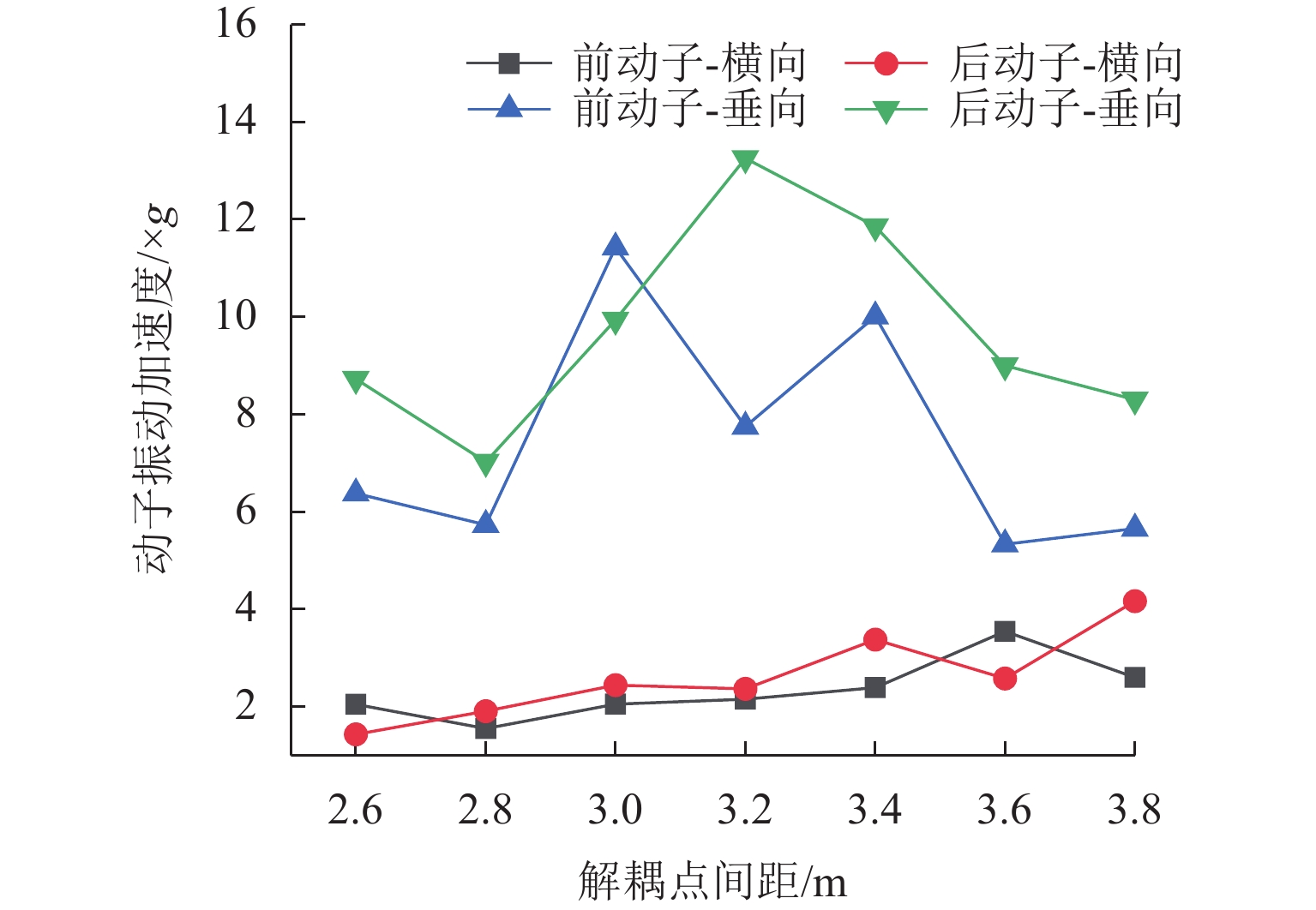
图 15 不同解耦点间距下动子横向和垂向振动加速度
Figure 15. Lateral and vertical vibration accelerations of mover at different decoupling-point spacings
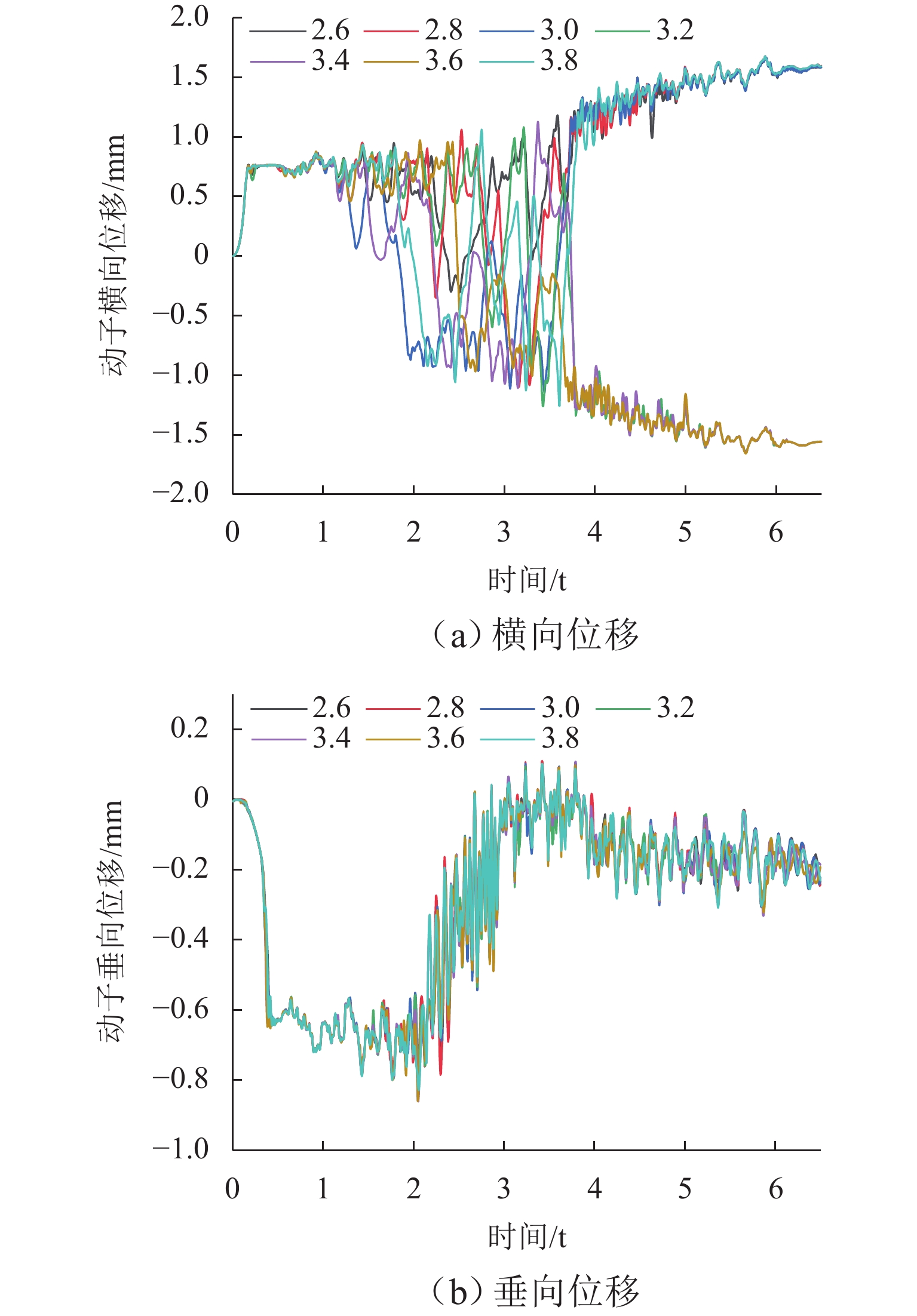
图 16 不同解耦点间距下动子横向、垂向位移
Figure 16. Vertical vibration displacement of mover at different decoupling-point spacings
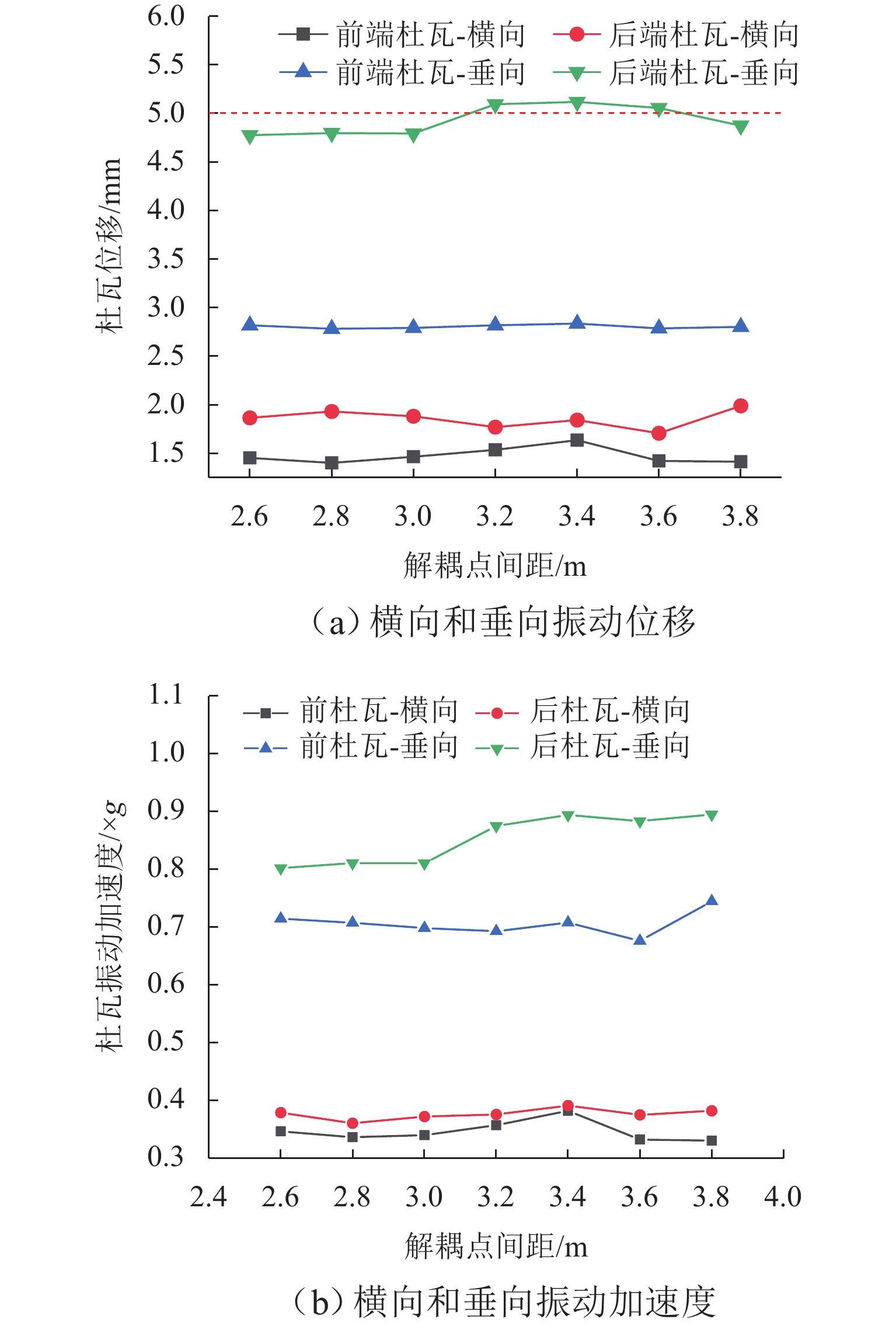
图 17 不同解耦点间距下杜瓦横向和垂向震动位移振动加速度
Figure 17. Lateral and vertical vibration accelerations of Dewar vessel at different decoupling-point spacings
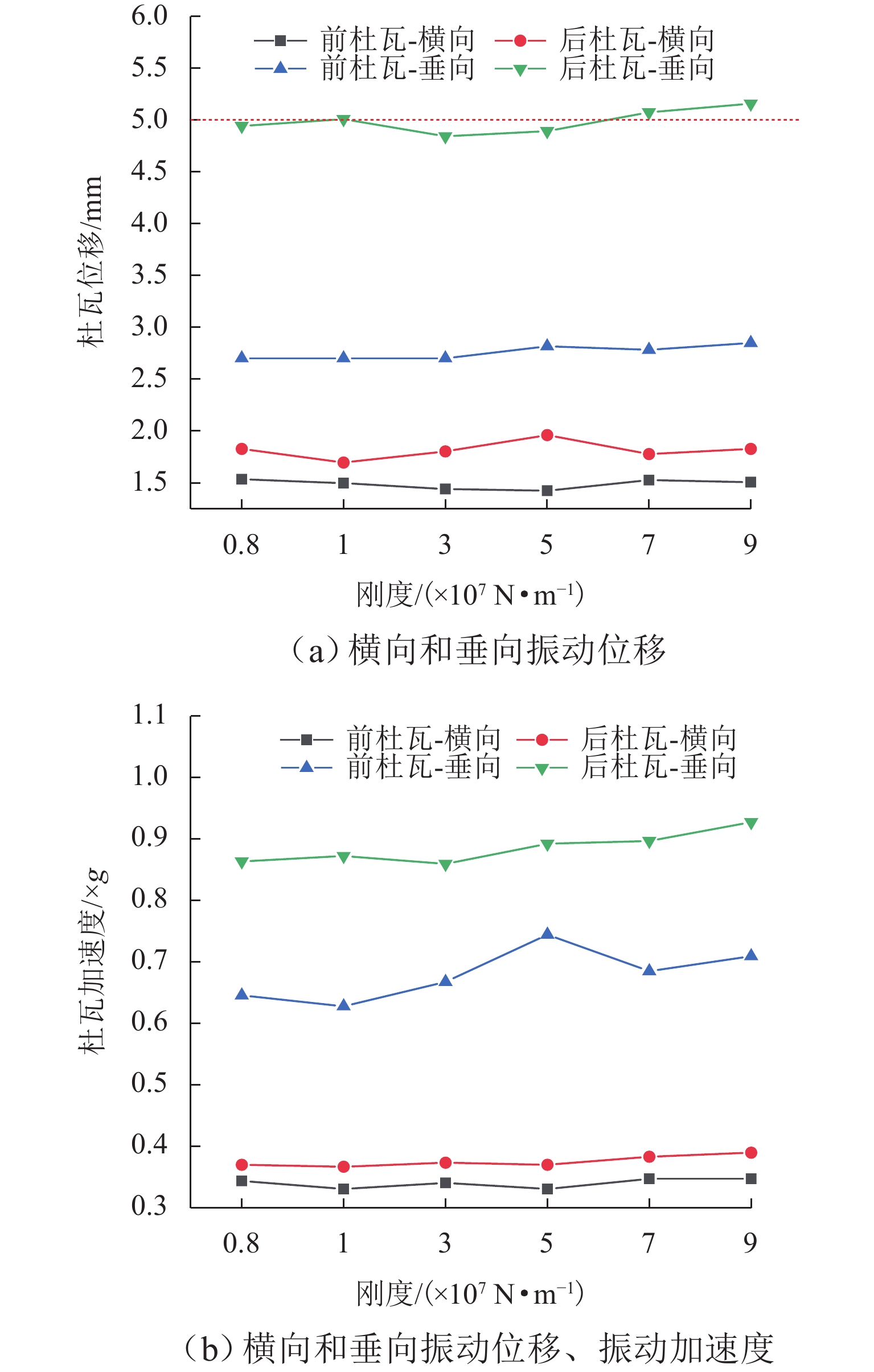
图 18 不同刚度下杜瓦横向和垂向振动位移、振动加速度
Figure 18. Lateral and vertical vibration accelerations of Dewar vessel at different stiffness values
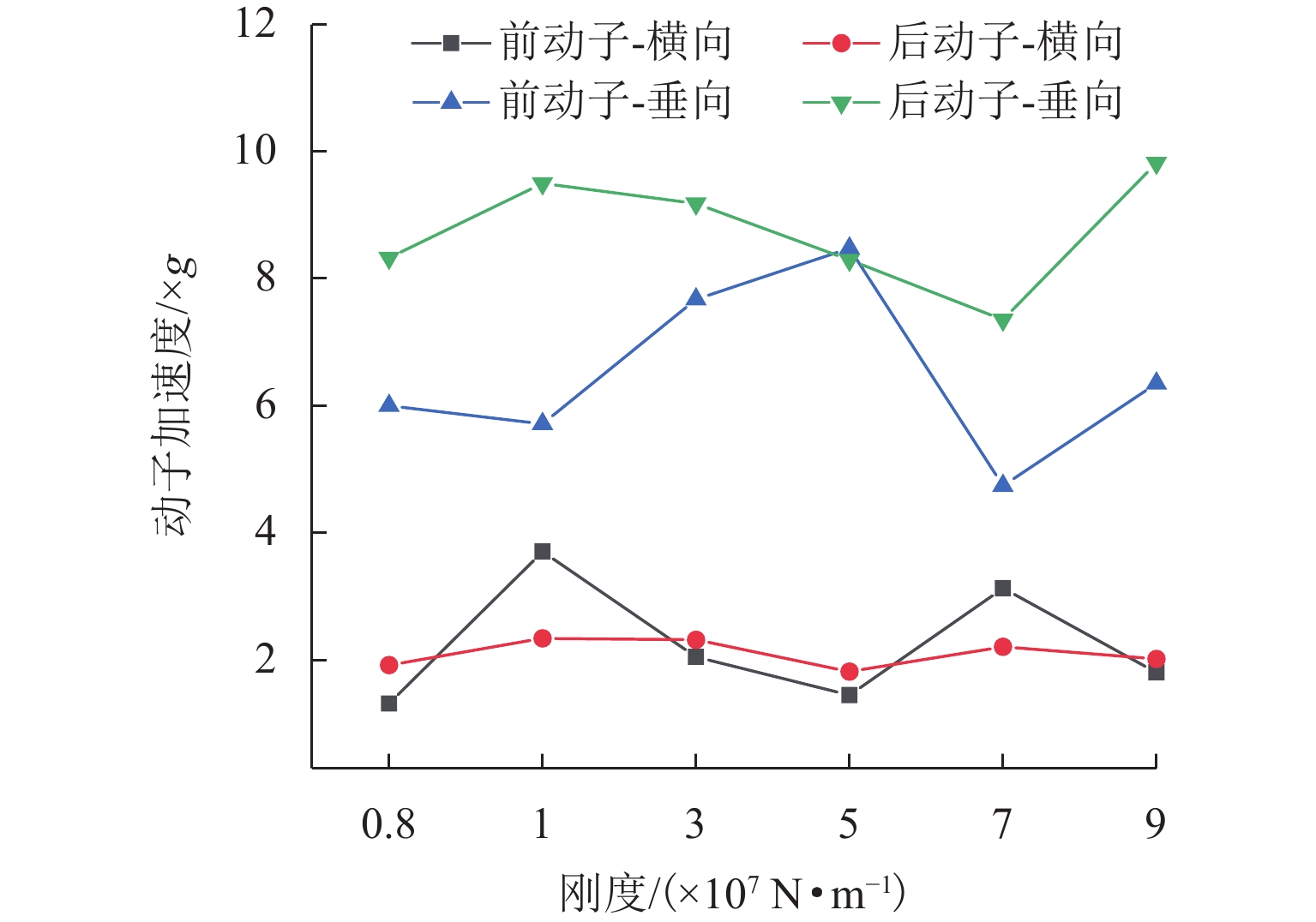
图 19 不同刚度下动子横向和垂向振动加速度
Figure 19. Lateral and vertical vibration accelerations of mover at different stiffness values
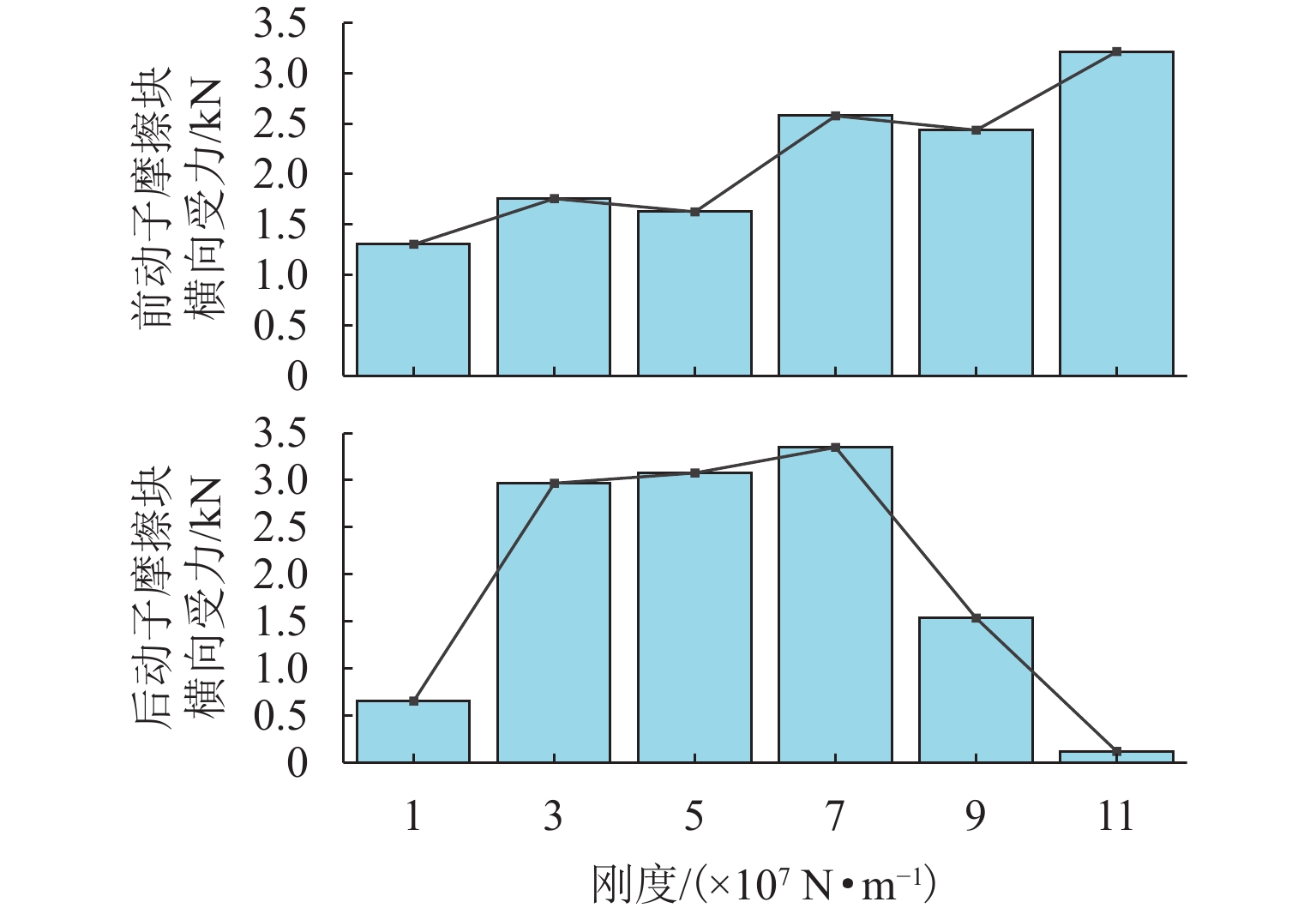
图 20 不同刚度下动子摩擦块受力
Figure 20. Forces acting on mover friction blocks at different stiffness values
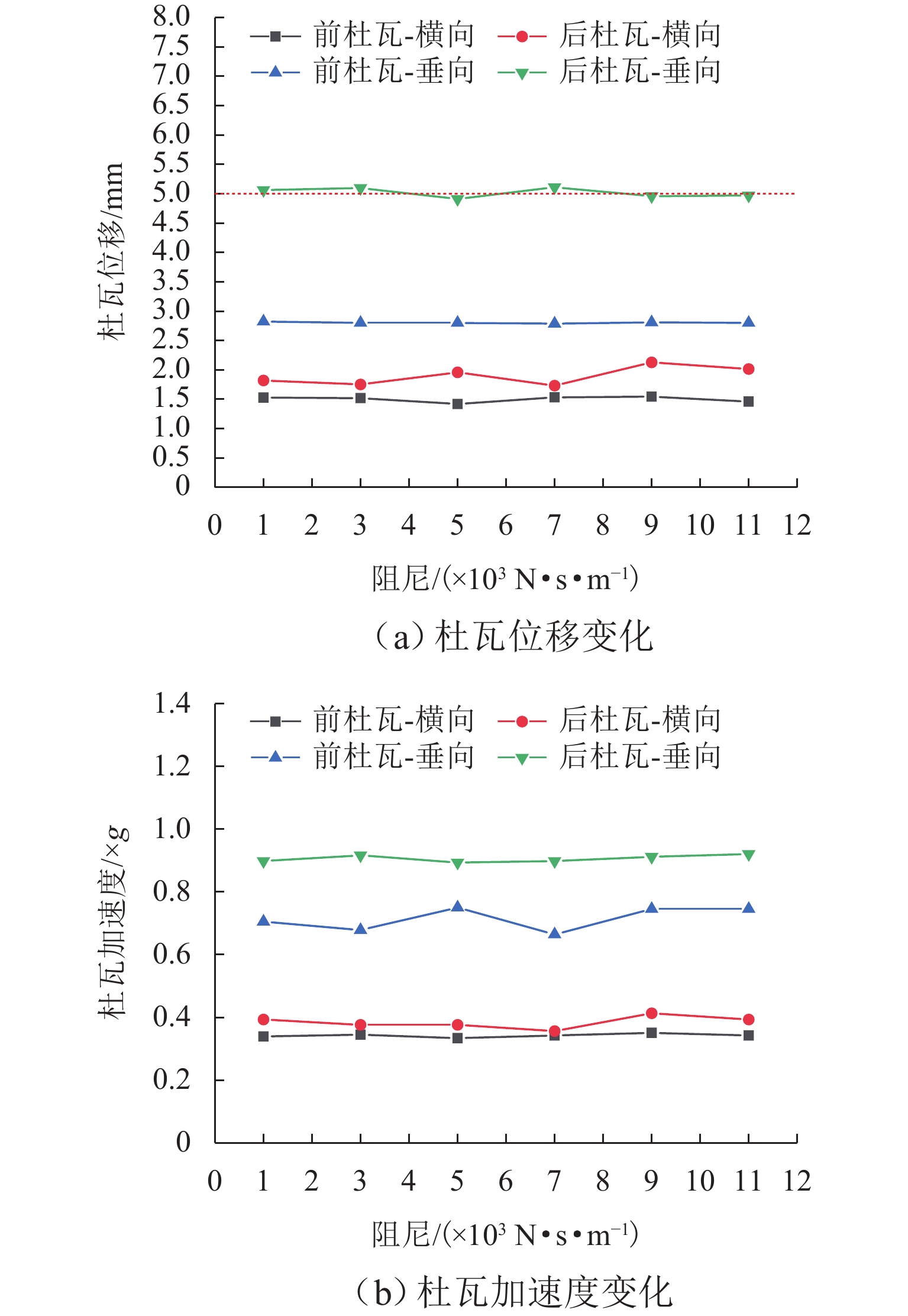
图 21 不同阻尼下杜瓦位移、加速度变化
Figure 21. Dewar vessel acceleration responses at different damping coefficients
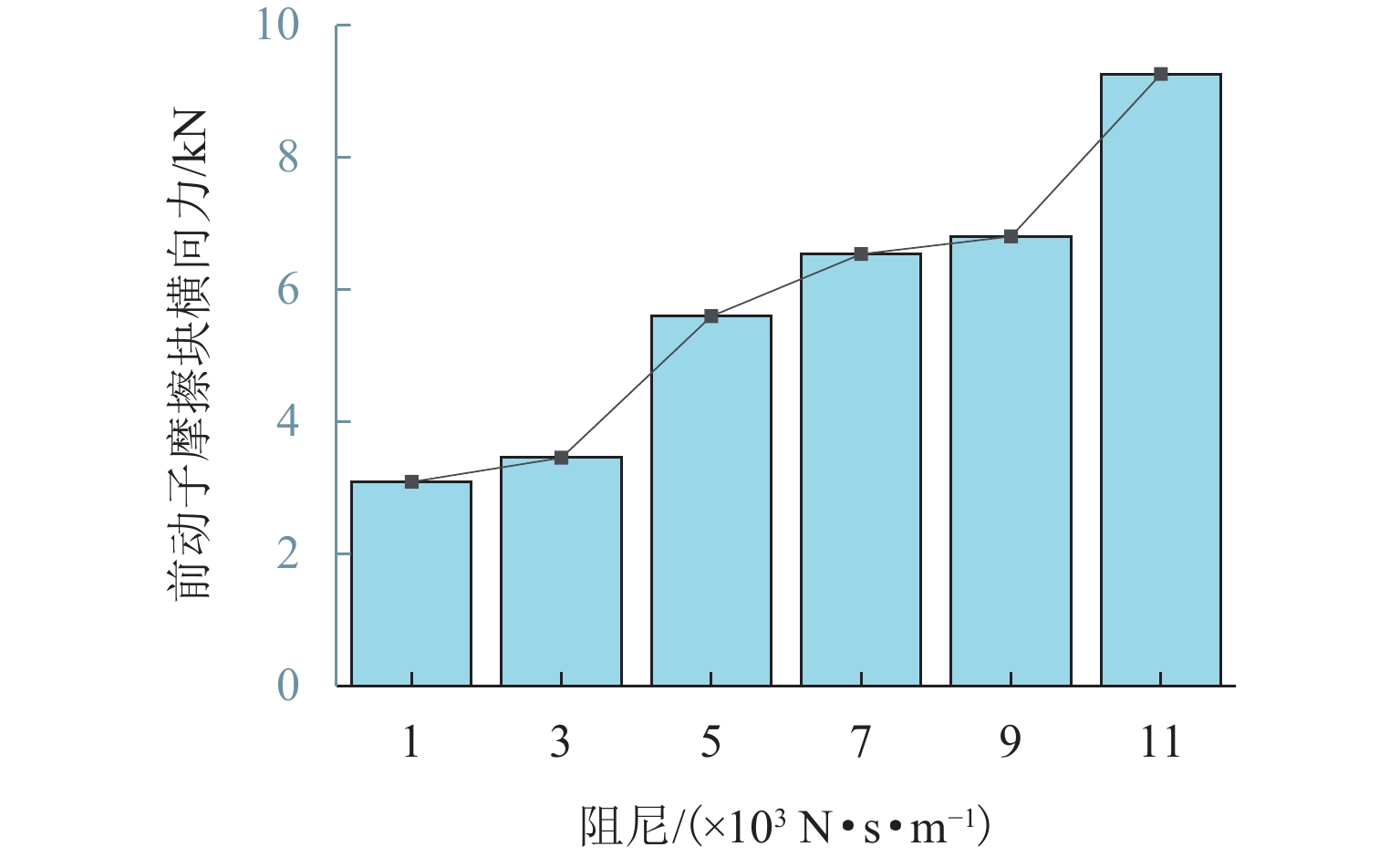
图 22 不同阻尼下摩擦块横向力变化
Figure 22. Lateral forces acting on mover friction blocks at different damping coefficients
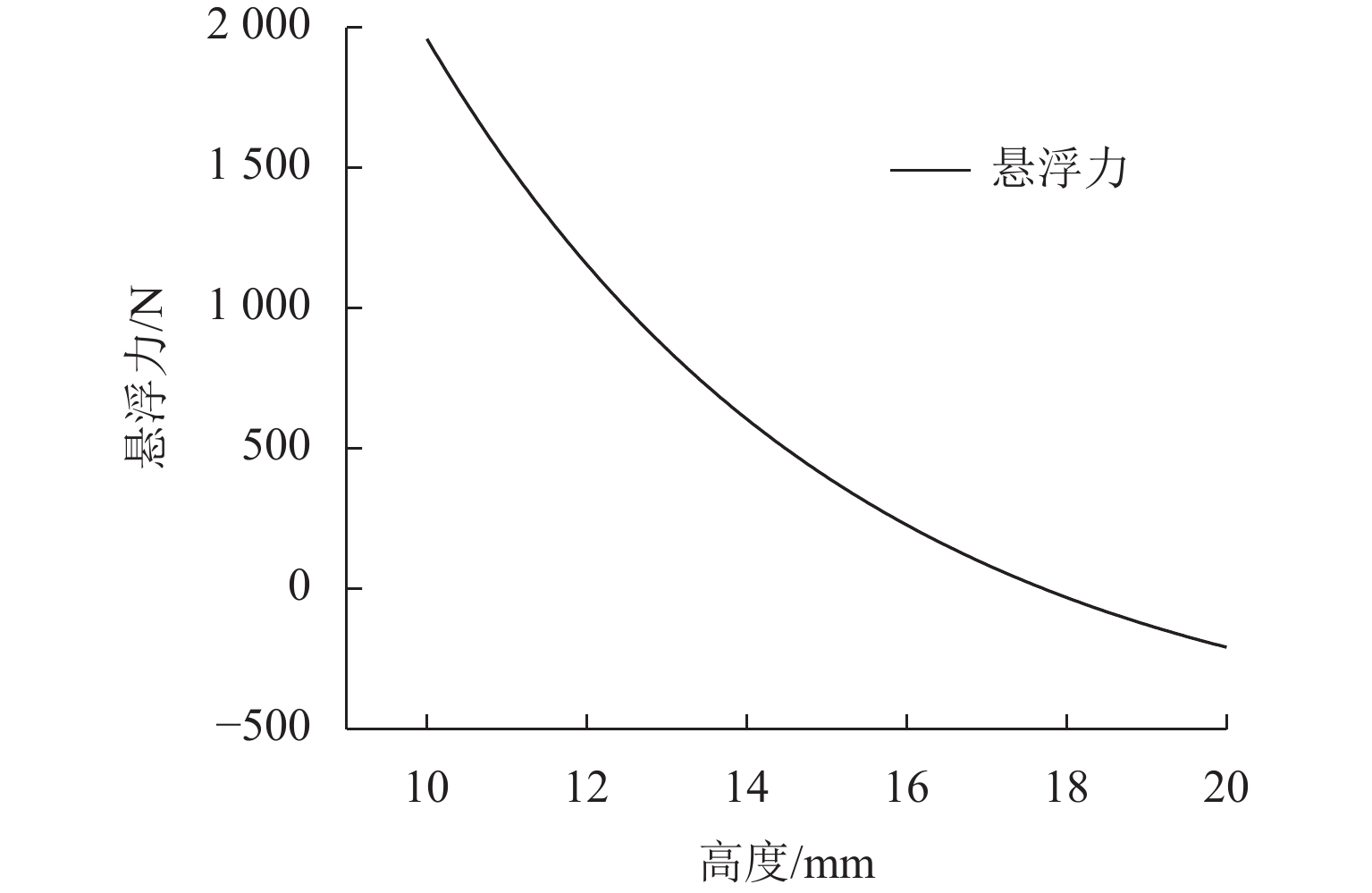
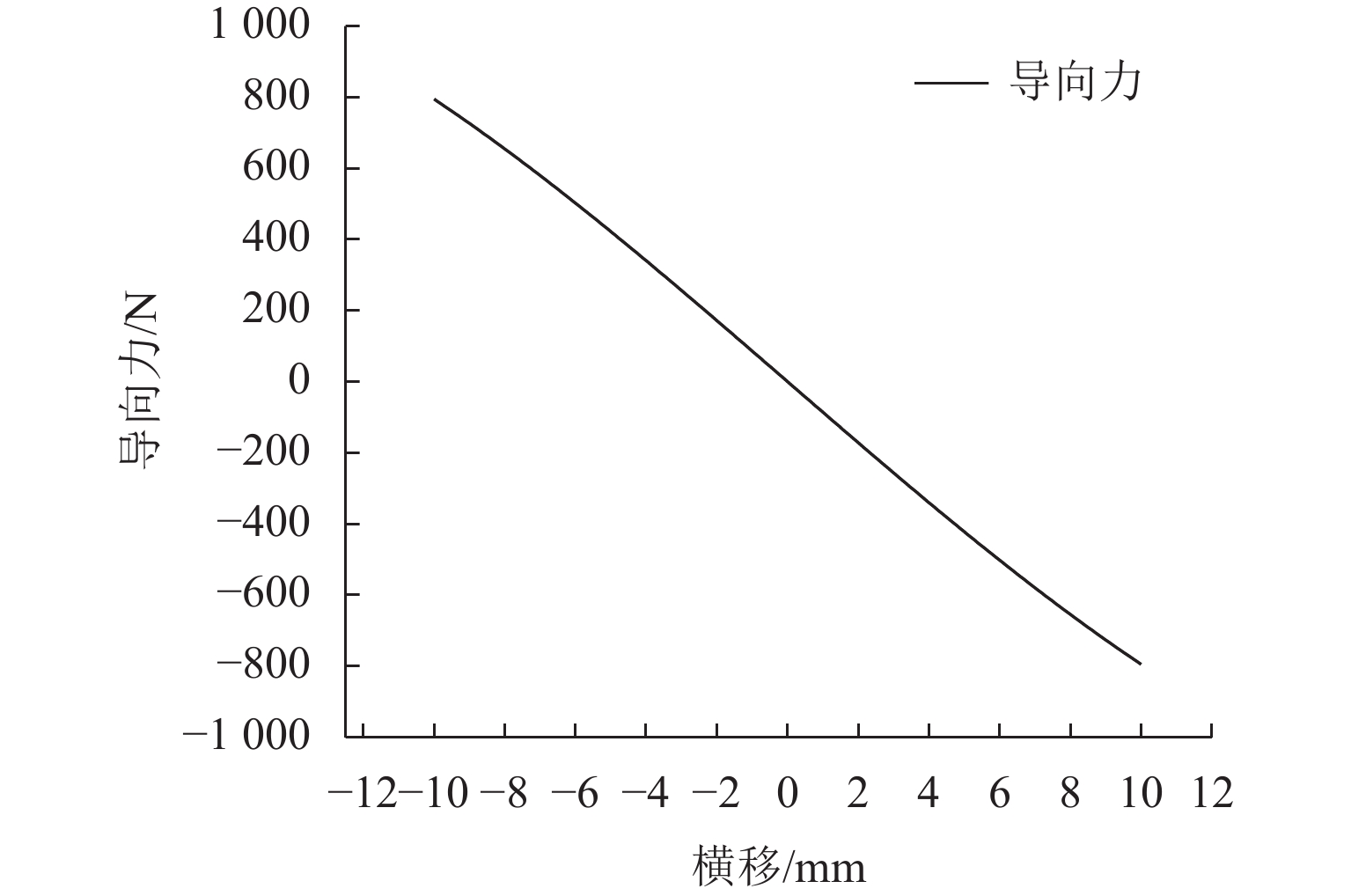
表 1 悬浮力与导向力参数识别结果
Table 1. Identification results for levitation and guidance force parameters
未知参数 识别数值 未知参数 识别数值 $ {\alpha }_{1} $ −527.0 $ {\alpha }_{2} $ 37.02 $ {\eta }_{1} $ 16897.2 $ {\eta }_{2} $ 460.3 $ {\beta }_{1} $ − 0.1890 $ {\beta }_{2} $ −0.239 $ {\lambda }_{1} $ 66.01 $ {\lambda }_{2} $ −25.07 $ \omega $ 8.57 $ \psi $ 0.069 $ {y}_{\text{c}} $ 4.285  下载: 导出CSV
表 2 列车在
1500 km、h-0.005 atm环境下受力Table 2. Forces acting on train at
1500 km/h and 0.005 atmN 受力方向 数值 纵向 70.41 横向 40.82 垂向 −0.17 侧滚力矩 −0.72 点头力矩 1.07 摇头力矩 15.83
下载: 导出CSV
表 3 动力学模型主要参数
Table 3. Main parameters of dynamic model
参数名称 参数值 动子尺寸/m 6.9 × 0.05 × 0.62 动子质量/kg 270 车体尺寸/m 5.1 × 0.4 × 0.3 车体质量/kg 240 止挡摩擦块材料 铸铁 镶条导轨 钢轨钢
下载: 导出CSV
-
[1] 中共中央、国务院. 交通强国建设纲要[M]. 北京: 人民出版社, 2019: 14. [2] 中共中央、国务院. 国家综合立体交通网规划纲要[J]. 铁道技术监督, 2021, 49(3): 1-9. [3] 徐飞, 罗世辉, 邓自刚. 磁悬浮轨道交通关键技术及全速度域应用研究[J]. 铁道学报, 2019, 41(3): 40-49. doi: 10.3969/j.issn.1001-8360.2019.03.006Xu Fei, Luo Shihui, Deng Zigang. Study on key technologies and whole speed range application of maglev rail transport[J]. Journal of the China Railway Society, 2019, 41(3): 40-49. doi: 10.3969/j.issn.1001-8360.2019.03.006 [4] 邓自刚, 李海涛. 高温超导磁悬浮车研究进展[J]. 中国材料进展, 2017, 36(5): 329-334. doi: 10.7502/j.issn.1674-3962.2017.05.02Deng Zigang, Li Haitao. Recent development of high-temperature superconducting maglev[J]. Materials China, 2017, 36(5): 329-334. doi: 10.7502/j.issn.1674-3962.2017.05.02 [5] 关文锦, 杜群贵, 刘丕群. 橡胶O形圈密封性能的有限元分析[J]. 润滑与密封, 2012, 37(6): 60-64. doi: 10.3969/j.issn.0254-0150.2012.06.014Guan Wenjin, Du Qungui, Liu Piqun. Finite element analysis of the sealing performance of rubber O-ring[J]. Lubrication Engineering, 2012, 37(6): 60-64. doi: 10.3969/j.issn.0254-0150.2012.06.014 [6] Lee H W, Kim K C, Lee J. Review of maglev train technologies[J]. IEEE Transactions on Magnetics, 2006, 42(7): 1917-1925. doi: 10.1109/tmag.2006.875842 [7] 吕刚. 直线电机在轨道交通中的应用与关键技术综述[J]. 中国电机工程学报, 2020, 40(17): 5665-5674. doi: 10.13334/j.0258-8013.pcsee.200488Lyu Gang. Review of the application and key technology in the linear motor for the rail transit[J]. Proceedings of the Chinese Society for Electrical Engineering, 2020, 40(17): 5665-5674. doi: 10.13334/j.0258-8013.pcsee.200488 [8] Gkoumas K. Hyperloop academic research: a systematic review and a taxonomy of issues[J]. Applied Sciences, 2021, 11(13): 5951. doi: 10.3390/app11135951 [9] 龚俊虎, 谢海林, 鄢巨平, 等. 全速度谱系磁浮交通的技术发展与应用前景[J]. 城市轨道交通研究, 2020, 23(9): 61-64, 69. doi: 10.16037/j.1007-869x.2020.09.014Gong Junhu, Xie Hailin, Yan Juping, et al. Development and application prospect of full-speed spectrum maglev transportation technology[J]. Urban Mass Transit, 2020, 23(9): 61-64,69. doi: 10.16037/j.1007-869x.2020.09.014 [10] 熊嘉阳, 邓自刚. 高速磁悬浮轨道交通研究进展[J]. 交通运输工程学报, 2021, 21(1): 177-198. doi: 10.19818/j.cnki.1671-1637.2021.01.008Xiong Jiayang, Deng Zigang. Research progress of high-speed maglev rail transit[J]. Journal of Traffic and Transportation Engineering, 2021, 21(1): 177-198. doi: 10.19818/j.cnki.1671-1637.2021.01.008 [11] 贾晓龙. 高速飞车大同(阳高)全尺寸超导电动悬浮试验圆满完成[N]. 大同日报, 2024. [12] 黄志川. 高温超导磁悬浮动态导向性能实验与仿真研究[D]. 成都: 西南交通大学, 2020. [13] 李冠醇, 李杰, 陈强. 应用于高速滑撬的电动悬浮和电磁推进系统设计[J]. 推进技术, 2017, 38(7): 1468-1474. doi: 10.13675/j.cnki.tjjs.2017.07.004Li Guanchun, Li Jie, Chen Qiang. Design of an electrodynamic suspension and electromagnetic propulsion system for high speed test track[J]. Journal of Propulsion Technology, 2017, 38(7): 1468-1474. doi: 10.13675/j.cnki.tjjs.2017.07.004 [14] Li G C, Wang X, Cui P, et al. Analysis of superconducting linear synchronous motor for electromagnetic propulsion[J]. Cluster Computing, 2019, 22(S2): 2709-2717. doi: 10.1007/s10586-017-1434-y [15] 郑晓钦, 徐杰, 陈春涛, 等. 超高速磁浮涡流装置制动力的解析分析[J]. 电工技术学报, 2020, 35(9): 1891-1899. doi: 10.19595/j.cnki.1000-6753.tces.190568Zheng Xiaoqin, Xu Jie, Chen Chuntao, et al. Analytical calculation of braking force of super high speed maglev eddy current device[J]. Transactions of China Electrotechnical Society, 2020, 35(9): 1891-1899. doi: 10.19595/j.cnki.1000-6753.tces.190568 [16] 蔡文涛, 王春江, 滕念管, 等. 超高速磁浮轨道梁体系的跨平台耦合振动分析[J]. 上海交通大学学报, 2021, 55(10): 1228-1236. doi: 10.16183/j.cnki.jsjtu.2020.101Cai Wentao, Wang Chunjiang, Teng Nianguan, et al. Analysis of cross-platform coupling vibration of ultra-high-speed maglev track beam system[J]. Journal of Shanghai Jiao Tong University, 2021, 55(10): 1228-1236. doi: 10.16183/j.cnki.jsjtu.2020.101 [17] Tian X F, Xiang H Y, Li Y L. Modeling and analyzing of high-speed maglev train-bridge systems considering centrifugal force induced by bridge vertical deformation[J]. Structures, 2025, 73: 108240. doi: 10.1016/j.istruc.2025.108240 [18] 邓自刚, 刘宗鑫, 李海涛, 等. 磁悬浮列车发展现状与展望[J]. 西南交通大学学报, 2022, 57(3): 455-474, 530. doi: 10.3969/j.issn.0258-2724.20220001Deng Zigang, Liu Zongxin, Li Haitao, et al. Development status and prospect of maglev train[J]. Journal of Southwest Jiaotong University, 2022, 57(3): 455-474,530. doi: 10.3969/j.issn.0258-2724.20220001 [19] Wang J, Yanoviak M M, Raj R. Type II magnetic levitation on sinter-forged YBa2Cu3OxSuperconductor[J]. Journal of the American Ceramic Society, 1989, 72(5): 846-848. doi: 10.1111/j.1151-2916.1989.tb06230.x [20] 寇龙. 基于Halbach永磁轨道的高温超导磁悬浮二维磁-轨作用力模型与振动特性研究[D]. 成都: 西南交通大学, 2021. [21] Hong Y, Huang Z C, Zheng J, et al. Influence of fluctuant external magnetic field on the lateral unrecoverable distance of HTS bulks[J]. Physica C: Superconductivity and Its Applications, 2025, 630: 1354656. doi: 10.1016/j.physc.2025.1354656 [22] 温鹏. 磁浮动态激扰下高温超导块材温升与悬浮特性研究[D]. 成都: 西南交通大学, 2021. [23] 王友彪, 宣言, 张俊博. 低真空管道交通系统列车气动阻力研究[J]. 中国铁路, 2023(7): 53-59. doi: 10.19549/j.issn.1001-683x.2023.02.13.001Wang Youbiao, Xuan Yan, Zhang Junbo. Train aerodynamic resistance in transportation system of low vacuum tube[J]. China Railway, 2023(7): 53-59. doi: 10.19549/j.issn.1001-683x.2023.02.13.001 [24] 邓自刚, 胡啸, 王潇飞, 等. 真空管道磁浮交通试验平台建设及管内气动特性研究进展[J]. 机械工程学报, 2025, 61(2): 181-197.Deng Zigang, Hu Xiao, Wang Xiaofei, et al. Development of evacuated tube maglev transport test platform and research progress on aerodynamic characteristics inside the tube[J]. Journal of Mechanical Engineering, 2025, 61(2): 181-197. -

 下载:

 点击查看大图
计量
- 文章访问数: 0
- HTML全文浏览量: 0
- PDF下载量: 0
- 被引次数: 0