



Optimization Model for Rolling Stock Operation Scheduling in Urban Rail Transit Under Flexible Maintenance Strategy
-
摘要:
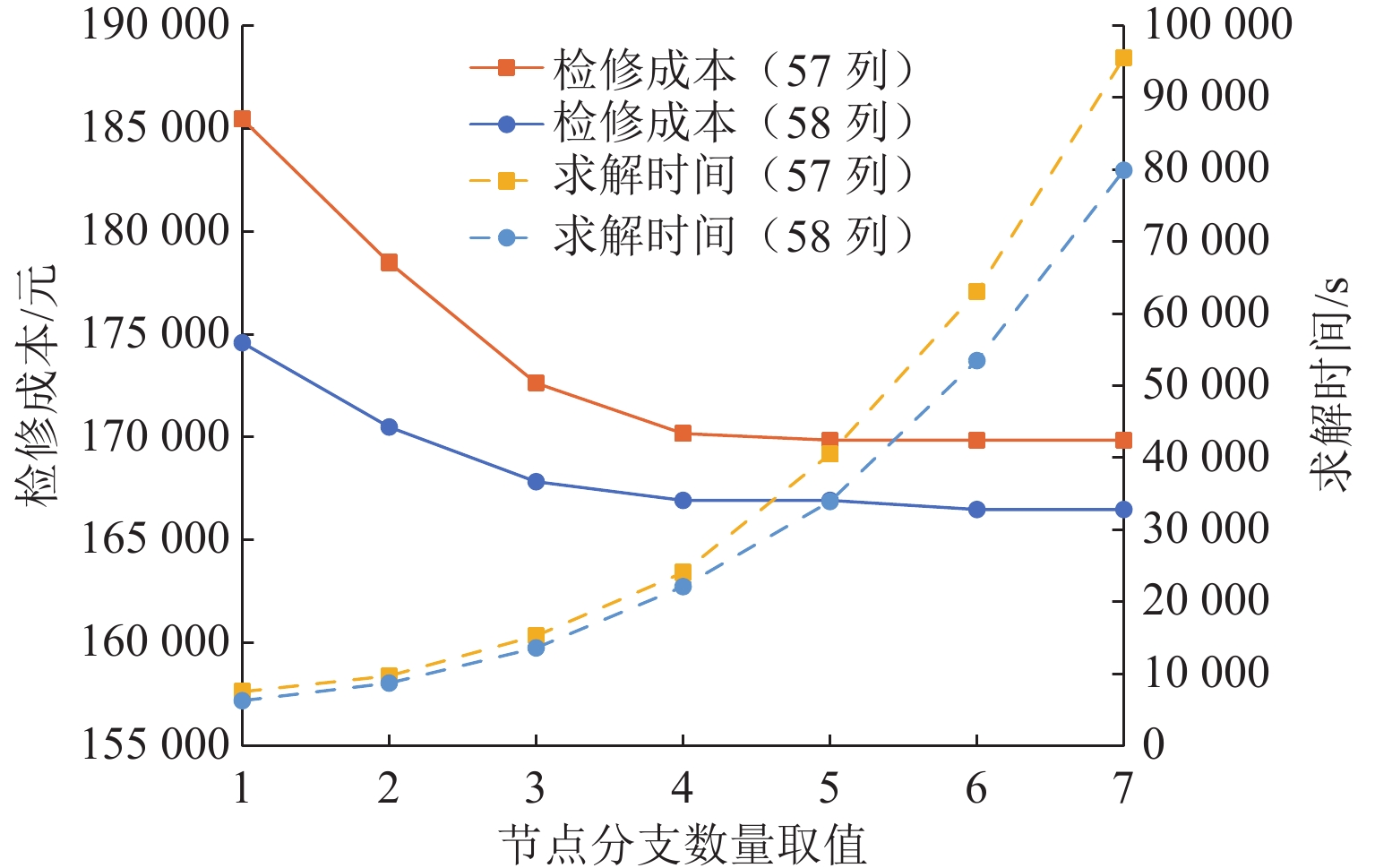
为解决传统检修策略下城市轨道交通列车高强度运用与频繁检修间的冲突问题,在检修作业可分散执行的模式下,研究考虑灵活检修策略的城市轨道交通车底多日运用计划优化方法. 首先,考虑运输任务执行、检修作业执行、车场检修能力、车底检修需求、备用车安排等约束条件,构建以车底固定检修成本、因不均衡检修造成的过修成本与欠修成本之和最小为目标的优化模型. 其次,针对多日运用计划规模大、约束复杂且关联性强等特点,建立以运输任务和检修任务为节点的车底时空接续网络,并设计改进的深度优先搜索算法求解所建模型. 最后,以某城市轨道交通线路为例进行案例研究,结果表明:相较于传统检修策略,灵活检修策略可分别使车底提前检修和延迟检修的里程平均减少59.42%和49.75%,在不同运用车数量场景下使车底总检修成本平均降低6.60%,并节省运用方案所需最小车底数量1列;在同一运用车数量场景下,检修作业分散执行可使所有车底运行里程标准差减少7.08%,并减少2列检修车;相同运行里程水平下的车底欠修成本随故障率参数的减小而增大,因此车底倾向于在到达检修里程标准前执行检修;所提方法在车场检修能力受限、节假日运输任务增加等情况下可灵活调整车底检修地点和检修时机,验证了模型在极端场景下的鲁棒性.
Abstract:To address the conflict between high-intensity operation and frequent maintenance of urban rail transit trains under the traditional maintenance strategy, an optimization method for multi-day operation scheduling of urban rail transit rolling stock considering a flexible maintenance strategy was studied under a decentralized execution mode of maintenance tasks. Firstly, an optimization model was constructed to minimize the sum of the fixed maintenance cost, the over-maintenance cost, and the insufficient-maintenance cost of rolling stock caused by unbalanced maintenance, considering constraints such as transportation task execution, maintenance task execution, depot maintenance capacity, rolling stock maintenance demand, and standby train arrangement. Secondly, in view of the characteristics of the multi-day operation plan, such as large scale, complex constraints, and strong correlation, a rolling stock space-time connection network with transportation tasks and maintenance tasks as nodes was established, and an improved depth-first search algorithm was designed to solve the constructed model. Finally, a case study was conducted taking an urban rail transit line as an example. The results indicate that compared with the traditional maintenance strategy, the flexible maintenance strategy reduces the over-maintenance and insufficient-maintenance mileages of rolling stock by 59.42% and 49.75% on average, respectively, decreases the total maintenance cost of rolling stock by 6.60% on average under scenarios with different numbers of operating rolling stock, and saves the minimum number of rolling stock required for the operation plan by one train; under the scenario with the same number of operating rolling stock, the decentralized execution of maintenance tasks reduces the standard deviation of the operation mileage of all rolling stock by 7.08% and reduces the number of maintenance rolling stock by two trains; the insufficient-maintenance cost of rolling stock under the same operation mileage level increases with the decrease of the failure rate parameter, and thus the rolling stock tends to execute maintenance before reaching the maintenance mileage standard; the proposed method can flexibly adjust the maintenance locations and timings of rolling stock under the conditions of limited depot maintenance capacity and increased transportation tasks during holidays, which verifies the robustness of the model in extreme scenarios.
-
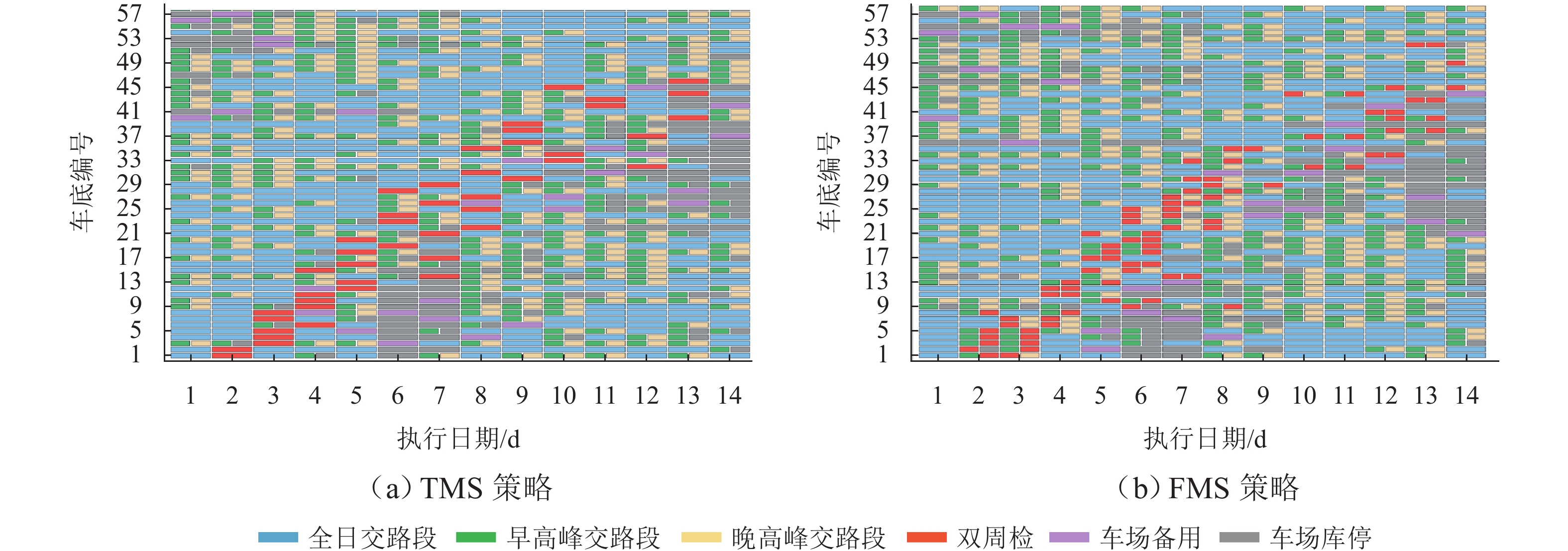
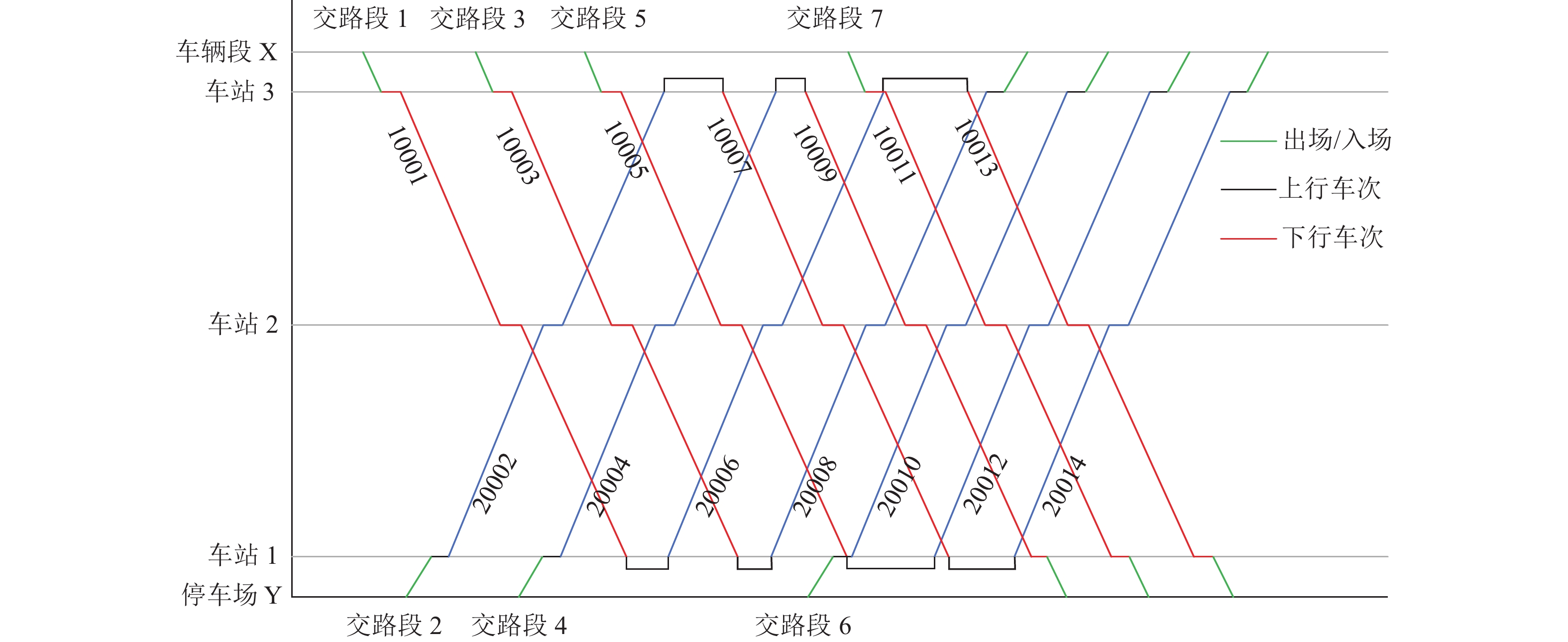
图 6 不同检修策略下的车底运用方案
Figure 6. Rolling stock operation plans under different maintenance strategies
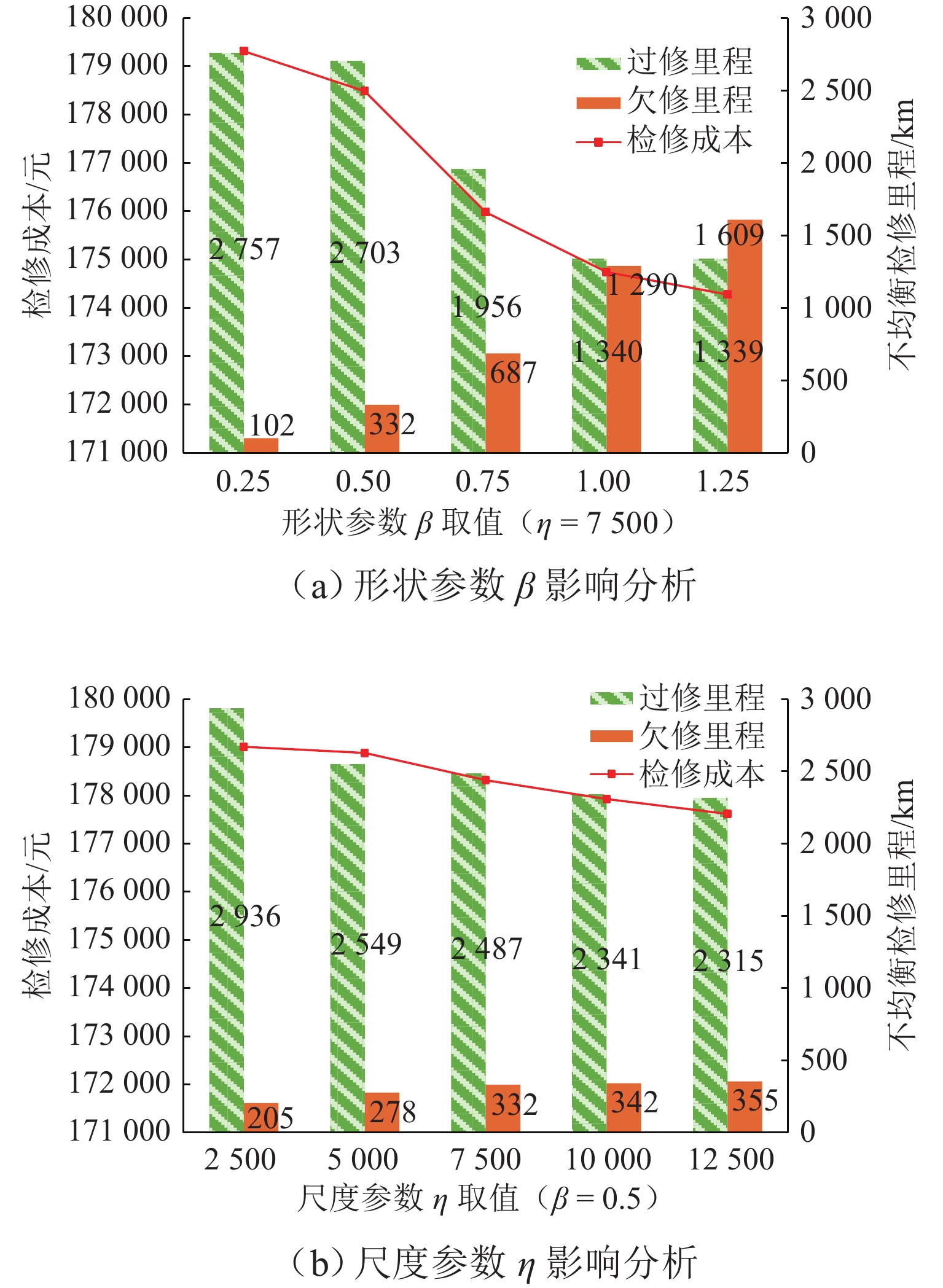
图 8 故障率参数对车底运用计划的影响
Figure 8. Impact of failure rate parameters on rolling stock operation plan
表 1 参数设定
Table 1. Parameter settings
参数名称 符号 取值 检修次数上限/次 $ {N}_{\text{R}} $ 2 检修里程标准/km $ {l}_{\text{std}} $ 5000 检修员工数量/人 $ {b}_{\text{r}} $ 4 检修作业时长/h $ {t}_{\text{r}} $ 8 员工小时薪酬/元 $ {c}_{\text{h}} $ 57.54 检修物料消耗成本/元 $ {c}_{\text{w}} $ 2000 修复性维修成本/元 $ {C}_{\text{m}} $ 5000 故障率参数 $ \eta ,\beta $ 7500 , 0.5均衡性控制参数 $ \varphi $ 0.5 半日修最大日期间隔/d $ {T}_{\text{F}} $ 2 车场检修列位数/列位 $ {V}_{1},{V}_{2} $ 6, 4 检修里程范围/km $ [{L}_{\text{lb}},{L}_{\text{ub}}] $ [ 4600 ,5300 ]节点分支上限 $ Y $ 2  下载: 导出CSV
表 2 不同检修策略下的求解结果
Table 2. Solutions under different maintenance strategies
运用车数量/列 检修策略 总检修成本/元 双周检次数/次 总过修里程/km 总欠修里程/km 求解时间/s 57 TMS FMS 178484.98 45 2703 332 9757 58 TMS 181290.59 45 4845 627 8549 FMS 170500.19 (−5.95%)43 1939 (−59.98%)326(−48.00%) 8758 59 TMS 175944.20 44 4127 547 8337 FMS 166280.06 (−5.49%)42 1562 (−62.15%)292(−46.62%) 8524 60 TMS 172021.83 43 3502 498 7781 FMS 157656.49 (−8.35%)40 1526 (−56.12%)226(−54.62%) 8103
下载: 导出CSV
表 3 算法有效性对比
Table 3. Comparison of algorithm effectiveness
计划
期/d运用车
数量/列求解方法 总检修成本/元 求解
时间/s3 54 Gurobi 23561.23 1876 MMACO 23924.60 ( + 1.54%)503 IDFS 23729.84 ( + 0.72%)482 55 Gurobi 19581.46 1797 MMACO 20024.27 ( + 2.26%)485 IDFS 19795.84 ( + 1.09%)438 14 57 MMACO 185451.82 10328 IDFS 178484.98 (−3.76%)9757 58 MMACO 174558.97 9567 IDFS 170500.19 (−2.33%)8758 28 59 MMACO 328142.92 30118 IDFS 317503.09 (−3.24%)28233 60 MMACO 330750.95 28467 IDFS 322396.10 (−2.53%)26319
下载: 导出CSV
表 4 车场检修能力影响分析
Table 4. Impact analysis of depot maintenance capacity
场景 车场检修列位配置/列位 总检修成本/元 双周检次数/次 车场1半日修数量/次 车场2半日修数量/次 基准场景 6, 4 178484.98 45 63 27 对比场景1 5, 4 179309.24 ( + 0.46%)45 57 33 对比场景2 4, 4 180337.30 ( + 1.04%)45 50 40 对比场景3 6, 3 178786.43 ( + 0.17%)45 65 25 对比场景4 6, 2 179199.10 ( + 0.40%)45 67 23 注:表中第 2 列的2个元素依次表示车场 1 双周检、车场 2 双周检列位数量.
下载: 导出CSV
表 5 运输任务激增影响分析
Table 5. Impact analysis of increased transportation tasks
场景 双休日交路段数量/个 运输车数量/列 双周检次数/次 工作日日均检修车数/列 双休日日均检修车数/列 基准场景 56 57 45 2.9 4 对比场景1 59 57 46 3.1 3.75 对比场景2 62 57 46 3.15 3.625 对比场景3 65 57 48 3.4 3.5 对比场景4 68 58 49 3.6 3.25 注:对比场景 1~4 依次在每个双休日(规划期内的第 6、7、13、14 天)增加3、6、9、12 个全日交路段任务,每个交路段任务里程均为324 km;完成1次半日修的车底记作0.5 列检修车.
下载: 导出CSV
-
[1] 周玮腾, 李卓一, 冉江亮, 等. 基于组合策略的城市轨道交通运营中断列车运行调整模型[J/OL]. 西南交通大学学报, 2025-01-02. https://link.cnki.net/urlid/51.1277.U.20241231.1438.002. [2] Yang Y H, Huo H Y, Bešinović N, et al. An advanced learning environment and a scalable deep reinforcement learning approach for rolling stock circulation on urban rail transit line[J]. Transportation Research Part C: Emerging Technologies, 2025, 171: 104976. doi: 10.1016/j.trc.2024.104976 [3] 张进, 李文权, 郭蓉蓉. 可变线路公交接驳地铁的时刻表构建方法[J]. 西南交通大学学报, 2025, 60(5): 1259-1267. doi: 10.3969/j.issn.0258-2724.20230367Zhang Jin, Li Wenquan, Guo Rongrong. Schedule design method for feeder flex-route transit connecting urban rail transit[J]. Journal of Southwest Jiaotong University, 2025, 60(5): 1259-1267. doi: 10.3969/j.issn.0258-2724.20230367 [4] Pan H C, Yang L X, Liang Z. Demand-oriented integration optimization of train timetabling and rolling stock circulation planning with flexible train compositions: a column-generation-based approach[J]. European Journal of Operational Research, 2023, 305(1): 184-206. doi: 10.1016/j.ejor.2022.05.039 [5] 宋展鹏, 田小鹏, 牛惠民, 等. 灵活编组条件下城市轨道交通列车时刻表与车底运用综合优化[J/OL]. 铁道科学与工程学报, 2025, https://doi.org/10.19713/j.cnki.43-1423/u.T20241530. [6] Gong C C, Luan X J, Yang L X, et al. Integrated optimization of train timetabling and rolling stock circulation problem with flexible short-turning and energy-saving strategies[J]. Transportation Research Part C: Emerging Technologies, 2024, 166: 104756. doi: 10.1016/j.trc.2024.104756 [7] 金波, 郭佑星, 王青元, 等. 考虑大小交路的时刻表与车底运用计划一体化编制方法[J]. 中国铁道科学, 2022, 43(3): 173-181. doi: 10.3969/j.issn.1001-4632.2022.03.19Jin Bo, Guo Youxing, Wang Qingyuan, et al. Integrated scheduling method of timetable and rolling stock assignment scheme considering long and short routing[J]. China Railway Science, 2022, 43(3): 173-181. doi: 10.3969/j.issn.1001-4632.2022.03.19 [8] Zhao S, Yang H, Wu Y H. An integrated approach of train scheduling and rolling stock circulation with skip-stopping pattern for urban rail transit lines[J]. Transportation Research Part C: Emerging Technologies, 2021, 128: 103170. doi: 10.1016/j.trc.2021.103170 [9] 汪波, 韩宝明, 战明辉, 等. 城市轨道交通网络周期运行图编制研究[J]. 铁道学报, 2013(4): 9-15.Wang Bo, Han Baoming, Zhan Minghui, et al. Study on formulation of periodic train diagram of urban rail transit network[J]. Journal of the China Railway Society, 2013(4): 9-15. [10] 王典, 赵军, 钟庆伟, 等. 城轨线路车底空驶出场路径与时刻表综合优化[J]. 铁道学报, 2019, 41(8): 19-31. doi: 10.3969/j.issn.1001-8360.2019.08.003Wang Dian, Zhao Jun, Zhong Qingwei, et al. Integrated optimization of rolling stock deadhead routing and timetabling in urban rail transit line[J]. Journal of the China Railway Society, 2019, 41(8): 19-31. doi: 10.3969/j.issn.1001-8360.2019.08.003 [11] Frisch S, Hungerländer P, Jellen A, et al. Solving a real-world locomotive scheduling problem with maintenance constraints[J]. Transportation Research Part B: Methodological, 2021, 150: 386-409. doi: 10.1016/j.trb.2021.06.017 [12] Canca D, Barrena E. The integrated rolling stock circulation and depot location problem in railway rapid transit systems[J]. Transportation Research Part E: Logistics and Transportation Review, 2018, 109: 115-138. doi: 10.1016/j.tre.2017.10.018 [13] Zhong Q W, Lusby R M, Larsen J, et al. Rolling stock scheduling with maintenance requirements at the Chinese High-Speed Railway[J]. Transportation Research Part B: Methodological, 2019, 126: 24-44. doi: 10.1016/j.trb.2019.05.013 [14] Gao Y, Xia J, D’ariano A, et al. Weekly rolling stock planning in Chinese high-speed rail networks[J]. Transportation Research Part B: Methodological, 2022, 158: 295-322. doi: 10.1016/j.trb.2022.02.005 [15] 彭其渊, 廖珮茹, 何必胜, 等. 全天候运行条件下的城市轨道交通车底运用与检修协同优化[J]. 中国铁道科学, 2022, 43(6): 194-206. doi: 10.3969/j.issn.1001-4632.2022.06.20Peng Qiyuan, Liao Peiru, He Bisheng, et al. Collaborative optimization of rolling stock operation and maintenance of urban rail transit under all-day operation[J]. China Railway Science, 2022, 43(6): 194-206. doi: 10.3969/j.issn.1001-4632.2022.06.20 [16] 许得杰, 曹雨彤, 巩亮, 等. 共享车辆基地下城轨车底运用与检修计划协同优化[J/OL]. 铁道科学与工程学报, 2025, https://doi.org/10.19713/j.cnki.43-1423/u.T20250529. [17] 陈然, 吴首蓉, 路超. 疫情下城市轨道交通车底运用计划编制[J]. 中国安全科学学报, 2022, 32(增刊 1): 51-56.Chen Ran, Wu Shourong, Lu Chao. Study on generating train stock utilization plans during epidemic period[J]. China Safety Science Journal, 2022, 32(S1): 51-56. [18] 赵冰倩. 考虑列车运用均衡性的城市轨道交通车底运用计划优化方法研究[D]. 北京: 北京交通大学, 2021. [19] 姜建萍, 徐永能, 吴任飞, 等. 基于时空网络的地铁车辆运用与检修优化模型[J]. 兵器装备工程学报, 2020, 41(11): 171-176. doi: 10.11809/bqzbgcxb2020.11.031Jiang Jianping, Xu Yongneng, Wu Renfei, et al. Optimization model of metro vehicle operation and maintenance based on spatio-temporal network[J]. Journal of Sichuan Ordnance, 2020, 41(11): 171-176. doi: 10.11809/bqzbgcxb2020.11.031 [20] Lai Y C, Fan D C, Huang K L. Optimizing rolling stock assignment and maintenance plan for passenger railway operations[J]. Computers & Industrial Engineering, 2015, 85: 284-295. doi: 10.1016/j.cie.2015.03.016 [21] 徐鹏, 辛丽平, 张增超, 等. 基于改进果蝇算法的地铁列车运用计划编制研究[J]. 铁道运输与经济, 2024, 46(9): 195-207.Xu Peng, Xin Liping, Zhang Zengchao, et al. Scheduling of train operation plans for subway based on improved drosophila algorithm[J]. Railway Transport and Economy, 2024, 46(9): 195-207. [22] Folco P, Sahli A, Belmokhtar-berraf S, et al. A rolling horizon for rolling stock maintenance scheduling problem with cyclical activities[J]. Computers & Industrial Engineering, 2024, 196: 110460. doi: 10.1016/j.cie.2024.110460 [23] 龙翔宇, 刘葛辉, 陈绍宽, 等. 基于延迟时间的地铁车辆多级维修计划优化模型[J]. 铁道学报, 2021, 43(2): 30-36. doi: 10.3969/j.issn.1001-8360.2021.02.004Long Xiangyu, Liu Gehui, Chen Shaokuan, et al. Optimum multi-level maintenance scheduling model for metro vehicles with delay time theory[J]. Journal of the China Railway Society, 2021, 43(2): 30-36. doi: 10.3969/j.issn.1001-8360.2021.02.004 [24] 王志建, 刘士杰, 周锦瑶, 等. 考虑个性化出行需求的多模式公交路径规划[J]. 西南交通大学学报, 2022, 57(6): 1319-1325, 1333. doi: 10.3969/j.issn.0258-2724.20210633Wang Zhijian, Liu Shijie, Zhou Jinyao, et al. Multimodal public transportation route planning considering personalized travel demand[J]. Journal of Southwest Jiaotong University, 2022, 57(6): 1319-1325,1333. doi: 10.3969/j.issn.0258-2724.20210633 [25] 张波. 考虑车底检修计划的城市轨道交通车底运用计划编制优化研究与系统研发[D]. 北京: 北京交通大学, 2019. -

 下载:
下载:



 点击查看大图
计量
- 文章访问数: 98
- HTML全文浏览量: 68
- PDF下载量: 55
- 被引次数: 0