



Simulation Research of Transient Cavitation Flow Characteristics of Diesel in High-Pressure Nozzles Considering Thermal Effects
-
摘要:
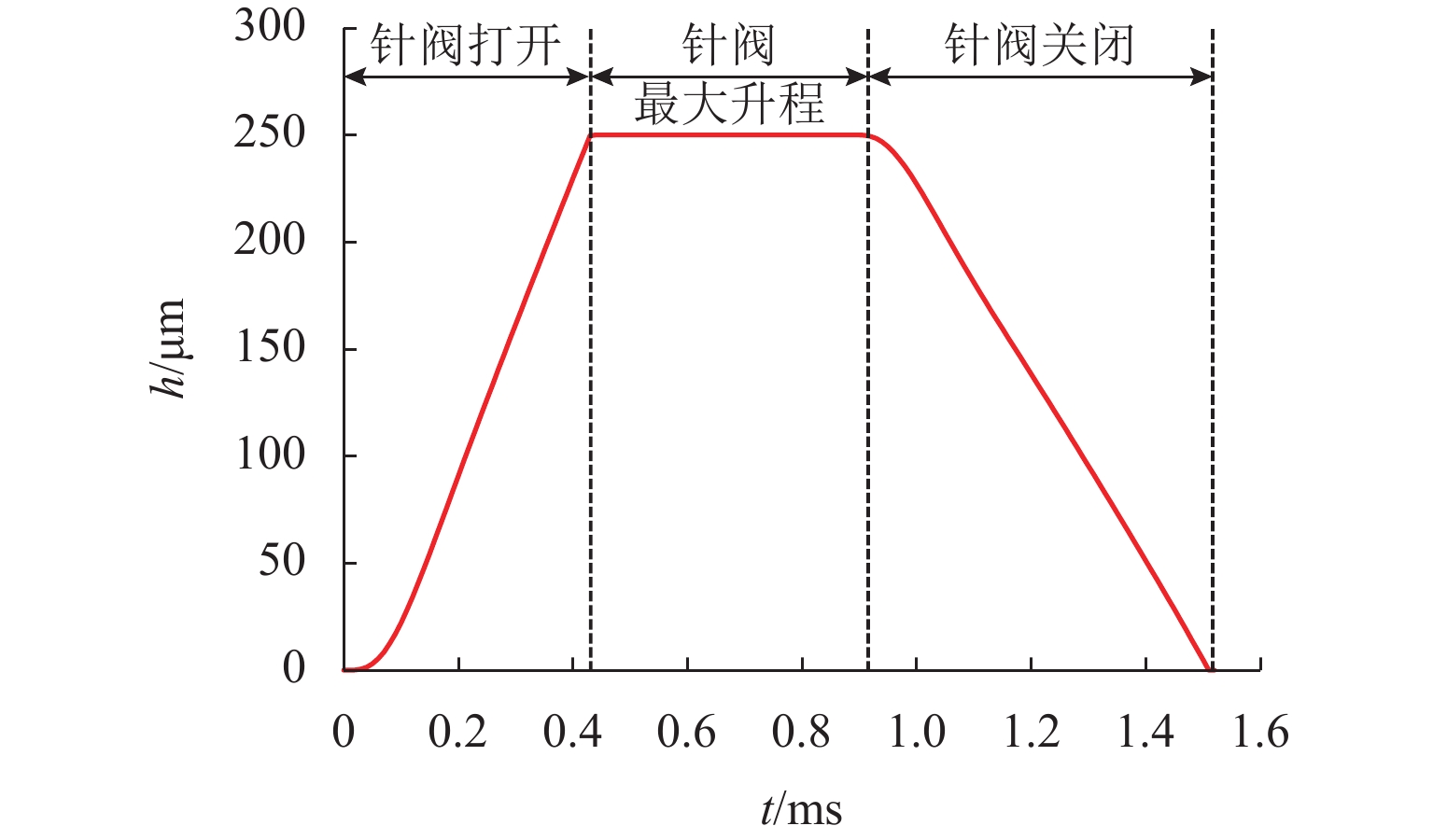
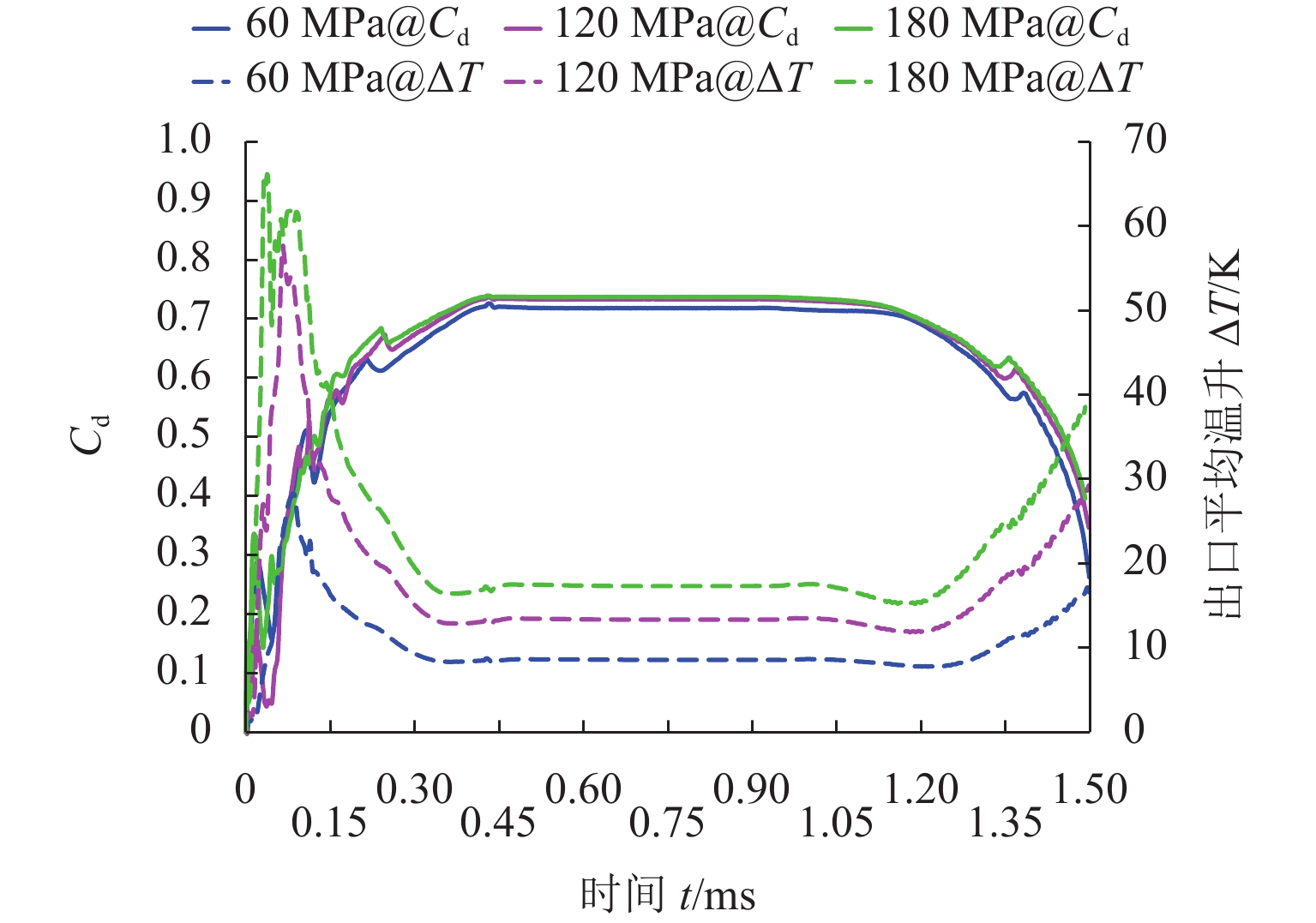
高压喷嘴内燃油流动具有压差大、流速高等特点,极易发生气/液两相流动,同时伴随着强烈的瞬态热,空化流动与热效应存在耦合作用. 本文考虑热效应影响修正湍流模型和空化模型,建立喷嘴内燃油非等温可压缩流动模型,并开展高压喷嘴内柴油瞬态空化流动仿真研究. 研究结果表明:1)在针阀打开阶段,空化快速发展,且空化强度受入口压力影响,与60 MPa相比,180 MPa下喷孔内空化体积分数平均增加约24%,空化使得燃油质量流量显著波动,进而影响喷射稳定性;在针阀关闭阶段,喷孔几乎被空化堵塞,有效流通面积减小,质量流量显著降低. 2)喷嘴内燃油温度呈不均匀分布,燃油减压膨胀及相变吸热导致局部温度降低,形成过冷区域;喷孔核心区域与近壁面之间存在速度梯度,燃油黏性摩擦导致温升区域出现,最高温度可达410 K. 3)燃油空化和温度变化相互影响,空化导致燃油流速降低,使得各流层间速度梯度增大,燃油内摩擦和动能损失增加,促使燃油温升增大,温度升高又使得饱和蒸汽压增加,促进空化发展.
Abstract:The fuel flow inside the high-pressure nozzle exhibits significant pressure drops and high flow velocities, leading to a high tendency towards gas-liquid two-phase flow with intense transient heat and a coupling between cavitation flow and thermal effect. Turbulence and cavitation models were corrected to incorporate thermal effects, and a non-isothermal compressible flow model for fuel within the nozzle was established. Simulation research of the transient cavitation flow of diesel in a high-pressure nozzle was conducted. Results show that 1) during the opening stage of the needle valve, cavitation develops rapidly, with its cavitation intensity influenced by the inlet pressure. At 180 MPa, the average cavitation volume fraction inside the orifice increases by approximately 24% compared to that at 60 MPa. Cavitation induces significant fluctuations in the fuel mass flow rate, thereby influencing injection stability. During the closing stage of the needle valve, the orifice is almost blocked by cavitation; the effective flow area is reduced, and the mass flow rate is significantly decreased. 2) The fuel temperature within the nozzle exhibits a non-uniform distribution. Fuel decompression, expansion, and endothermic phase transition reduce the local temperature and form a supercooled region. Temperature rise regions result from viscous friction of fuel caused by velocity gradients between the core orifice region and the near-wall region, with the maximum temperature reaching 410 K. 3) Fuel cavitation and temperature variations interact. Cavitation reduces fuel flow velocity, increasing velocity gradients between fluid layers and amplifying internal friction and kinetic energy losses of fuel, which elevates fuel temperature. The temperature rise subsequently increases saturated vapor pressure, further promoting cavitation development.
-
Key words:
- thermal effect /
- cavitation flow /
- diesel nozzle /
- high-pressure common rail system
-
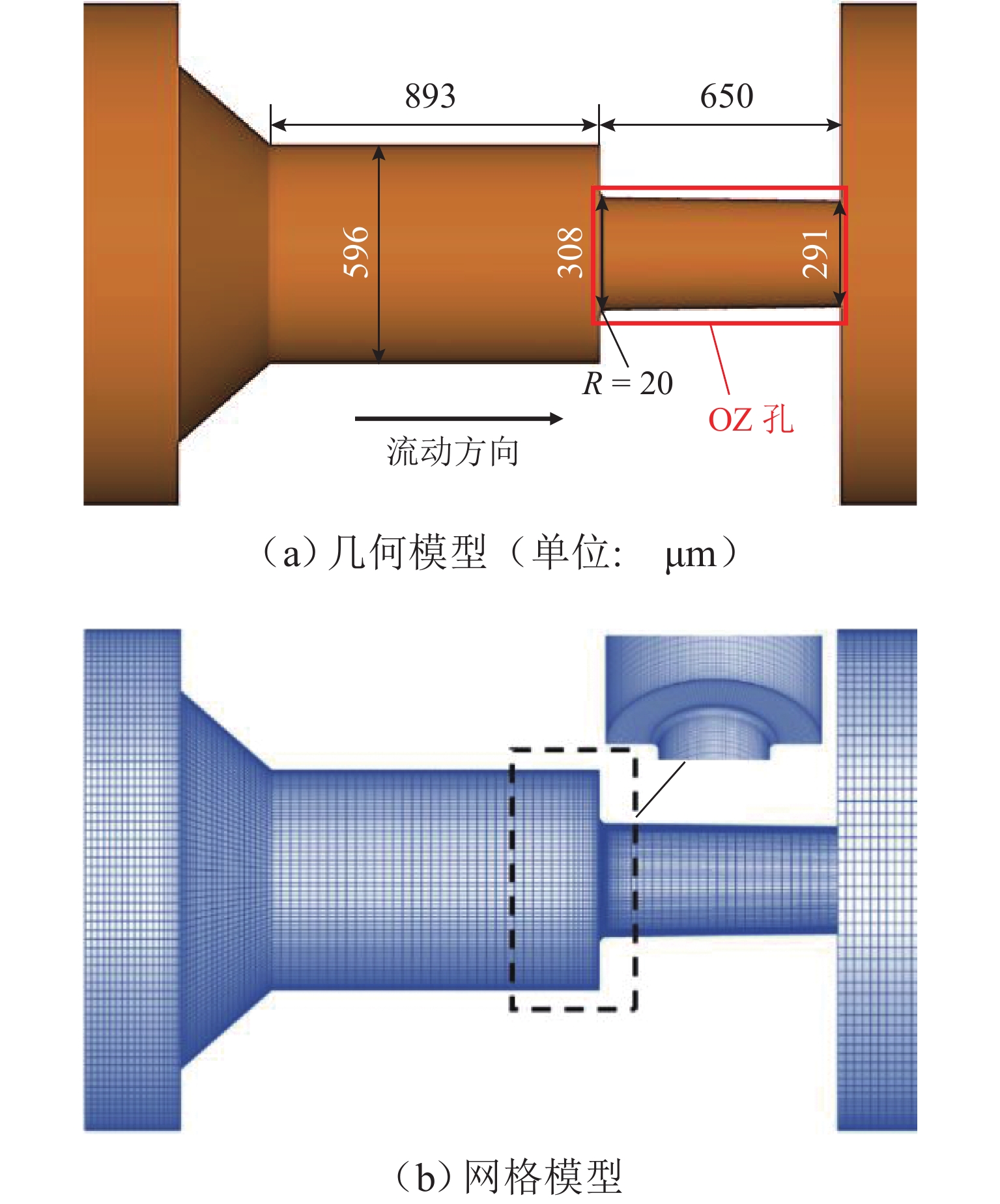
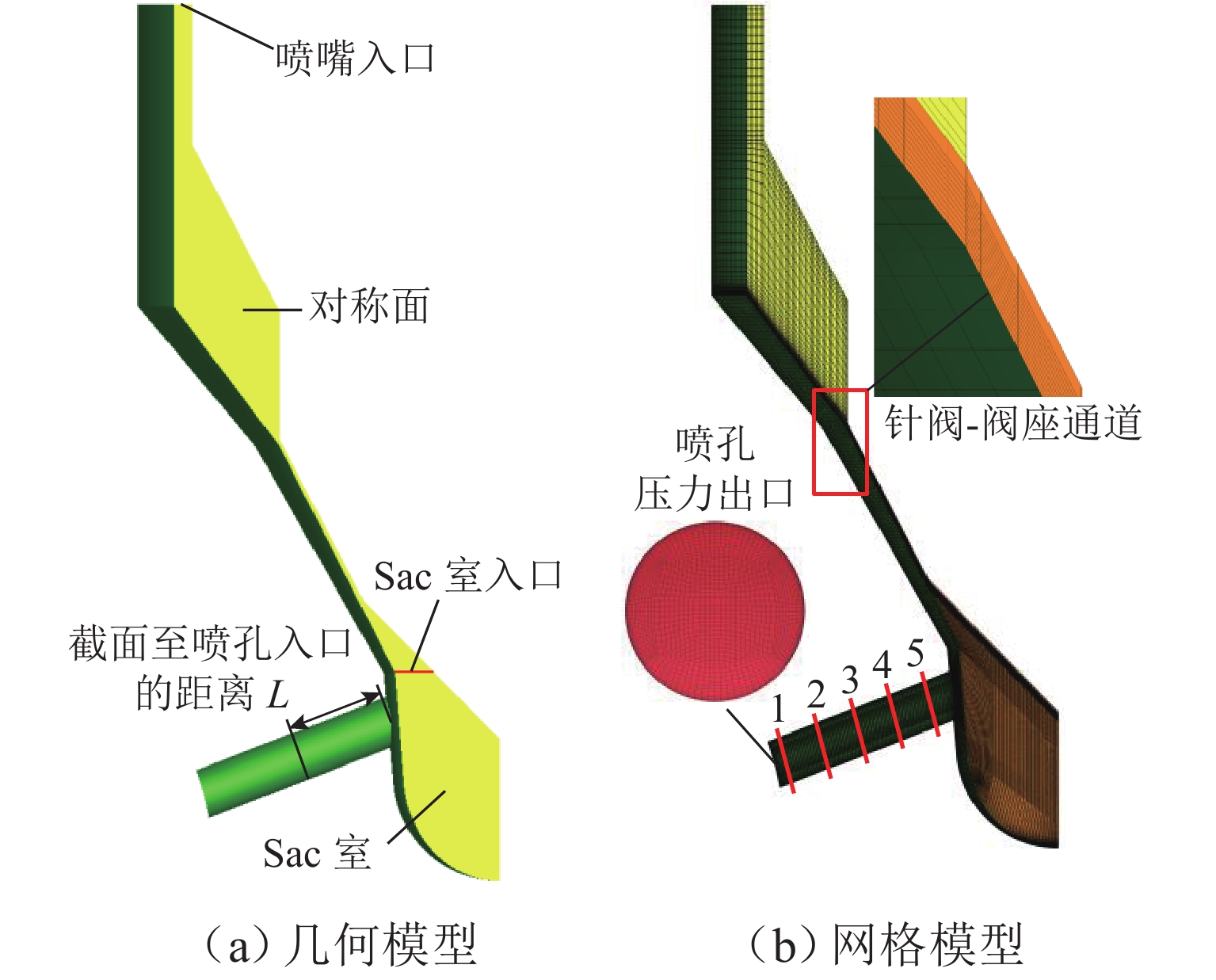
图 1 Hult实验的喷油器喷嘴仿真模型
Figure 1. Simulation model of injector nozzle from Hult’s experiment
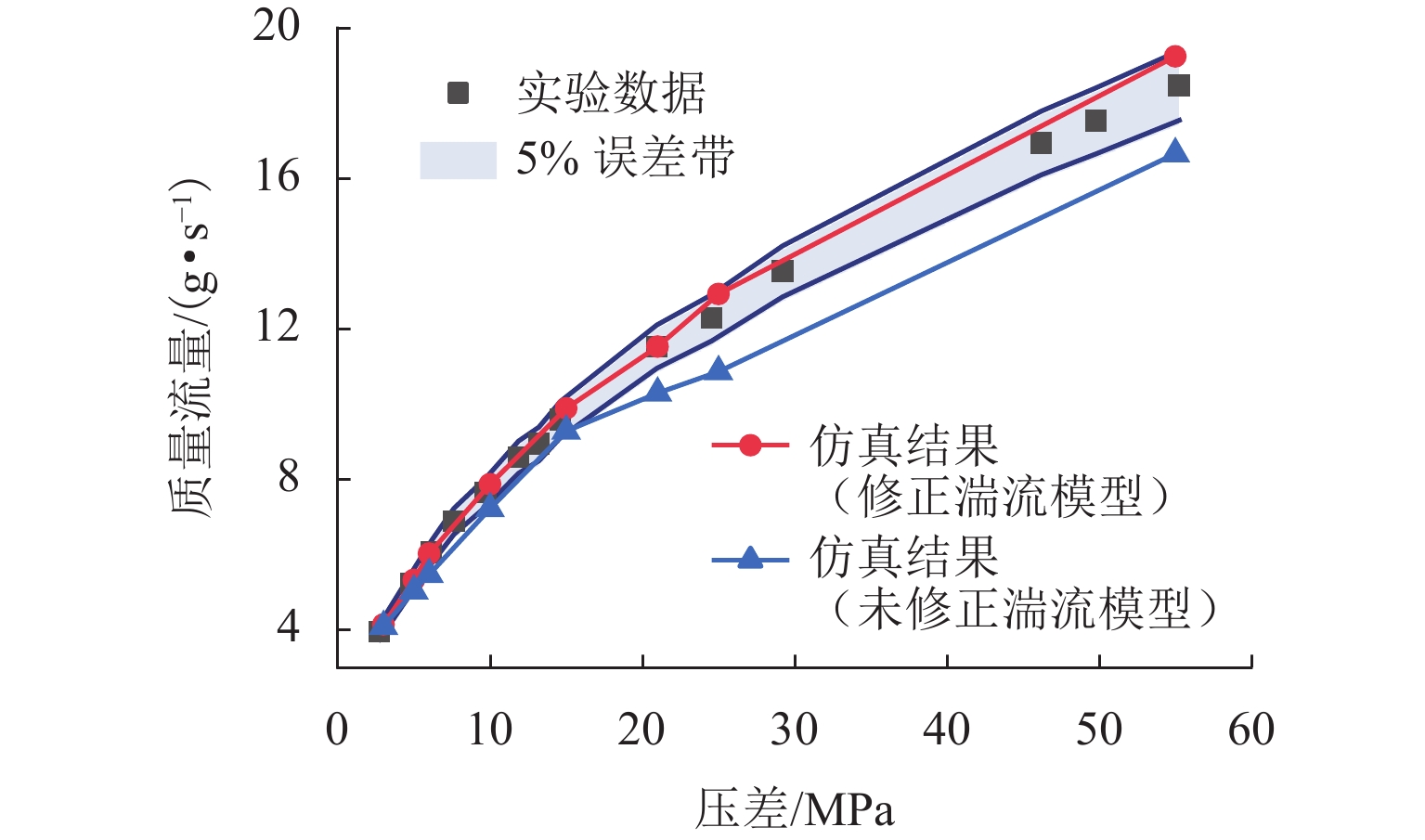
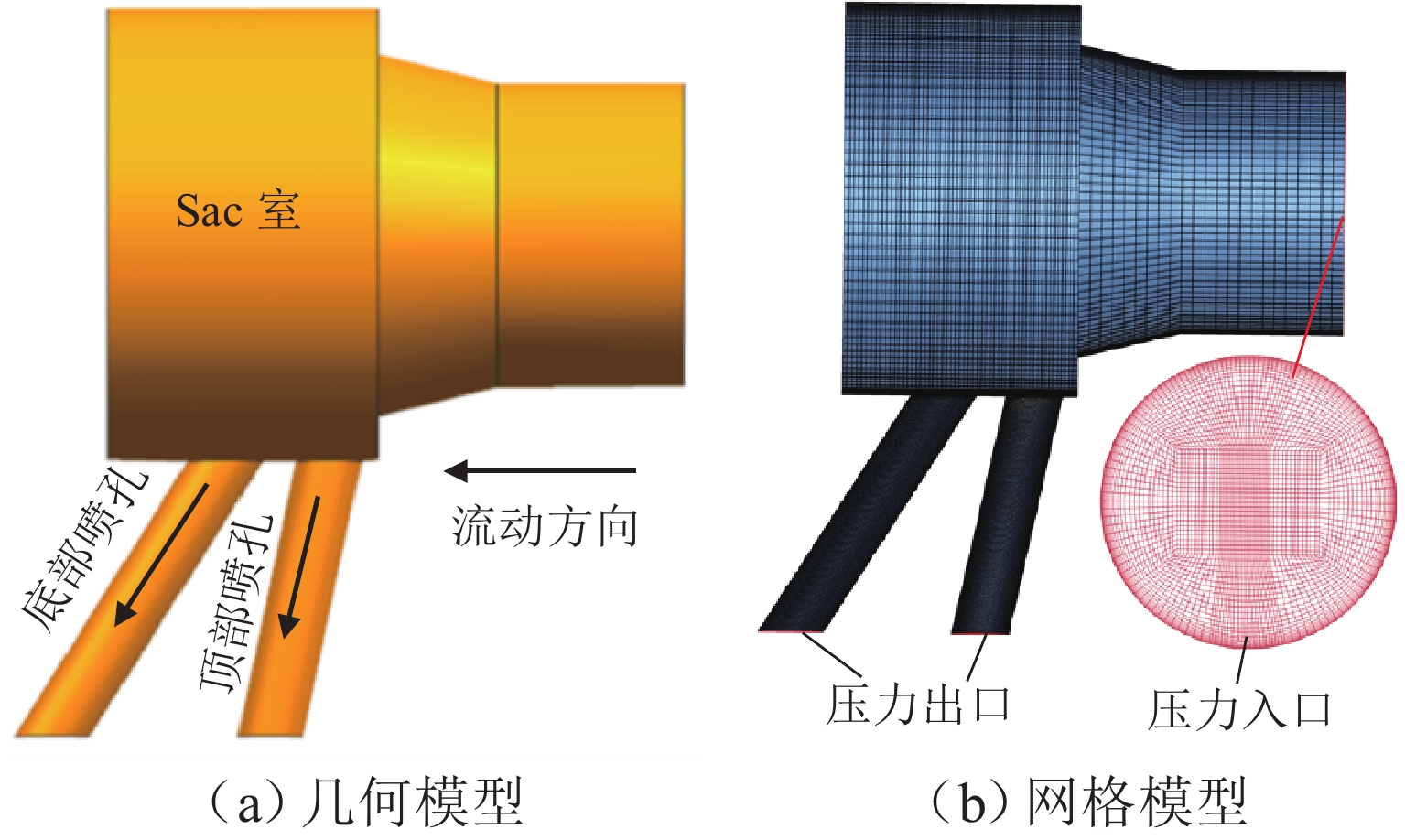
图 3 Hult实验的喷油器喷嘴仿真模型
Figure 3. Simulation model of injector nozzle from Hult’s experiment
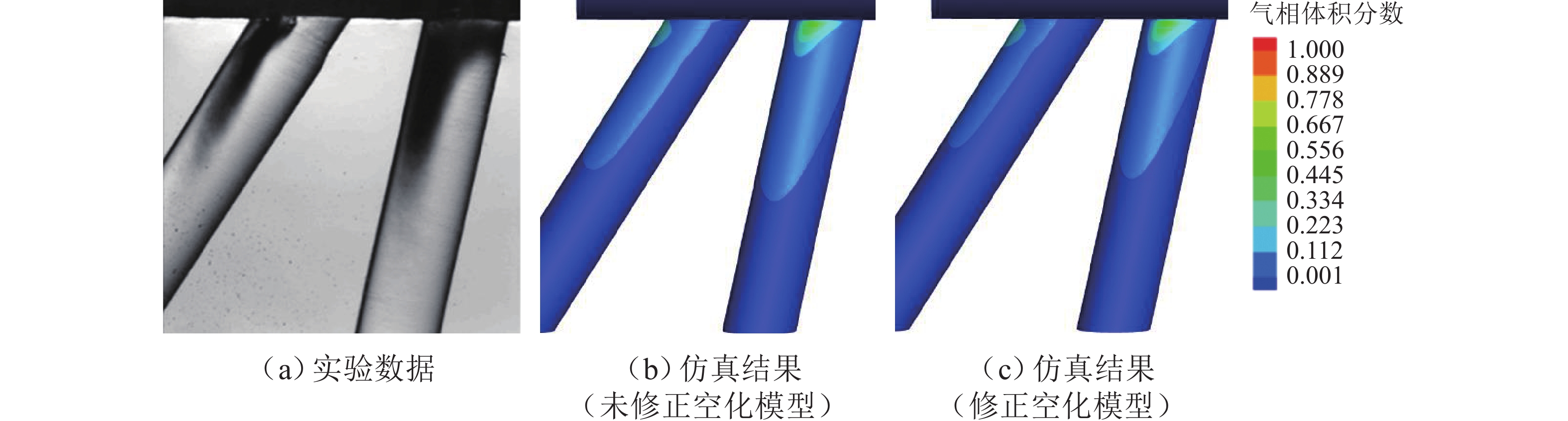
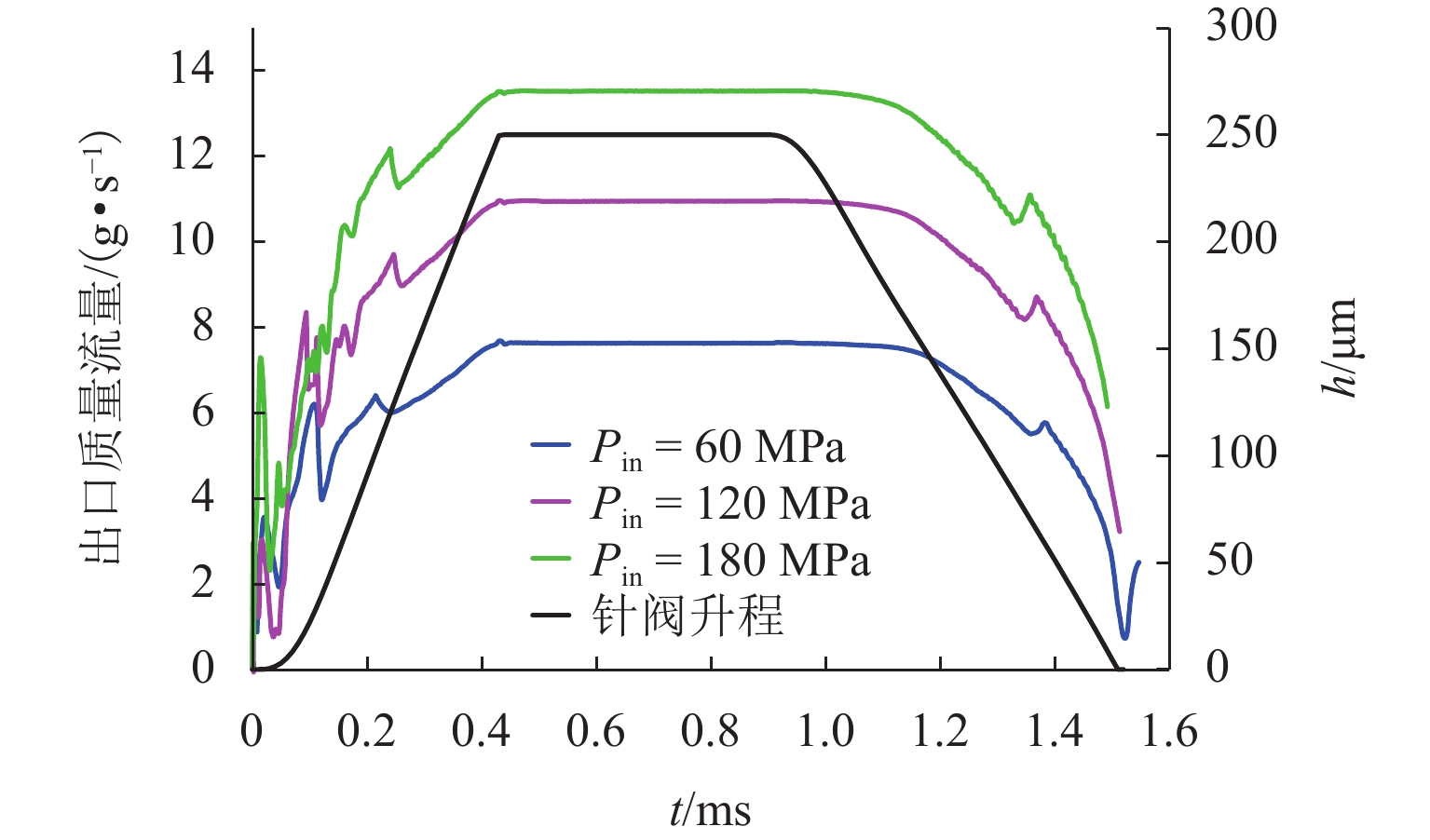
图 7 不同Pin下喷孔出口质量流量随时间变化
Figure 7. Variation of outlet mass flow rate with time at nozzle orifice under different Pin
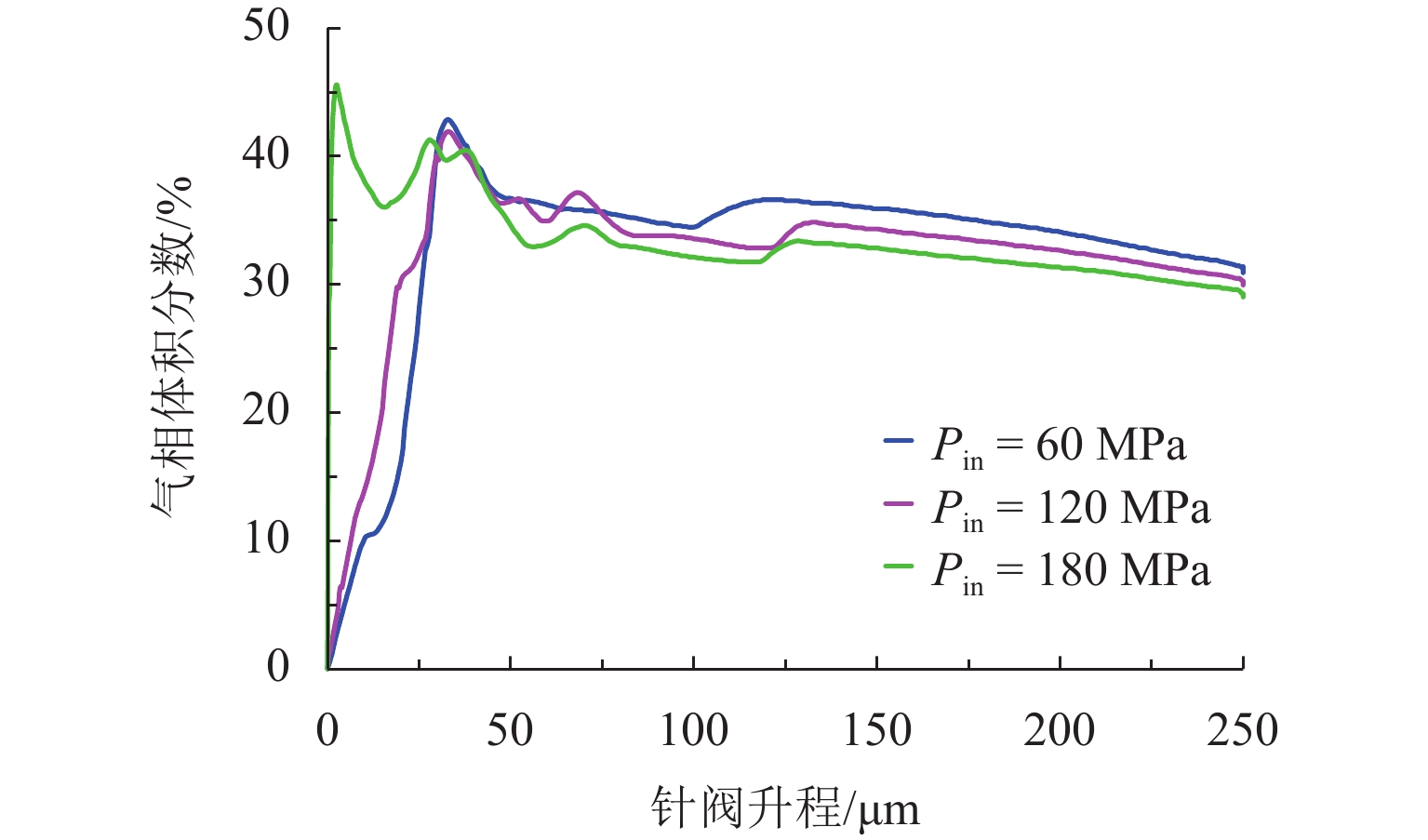
图 8 针阀打开过程中喷孔内空化变化
Figure 8. Cavitation variation in nozzle orifice during opening stage of needle valve
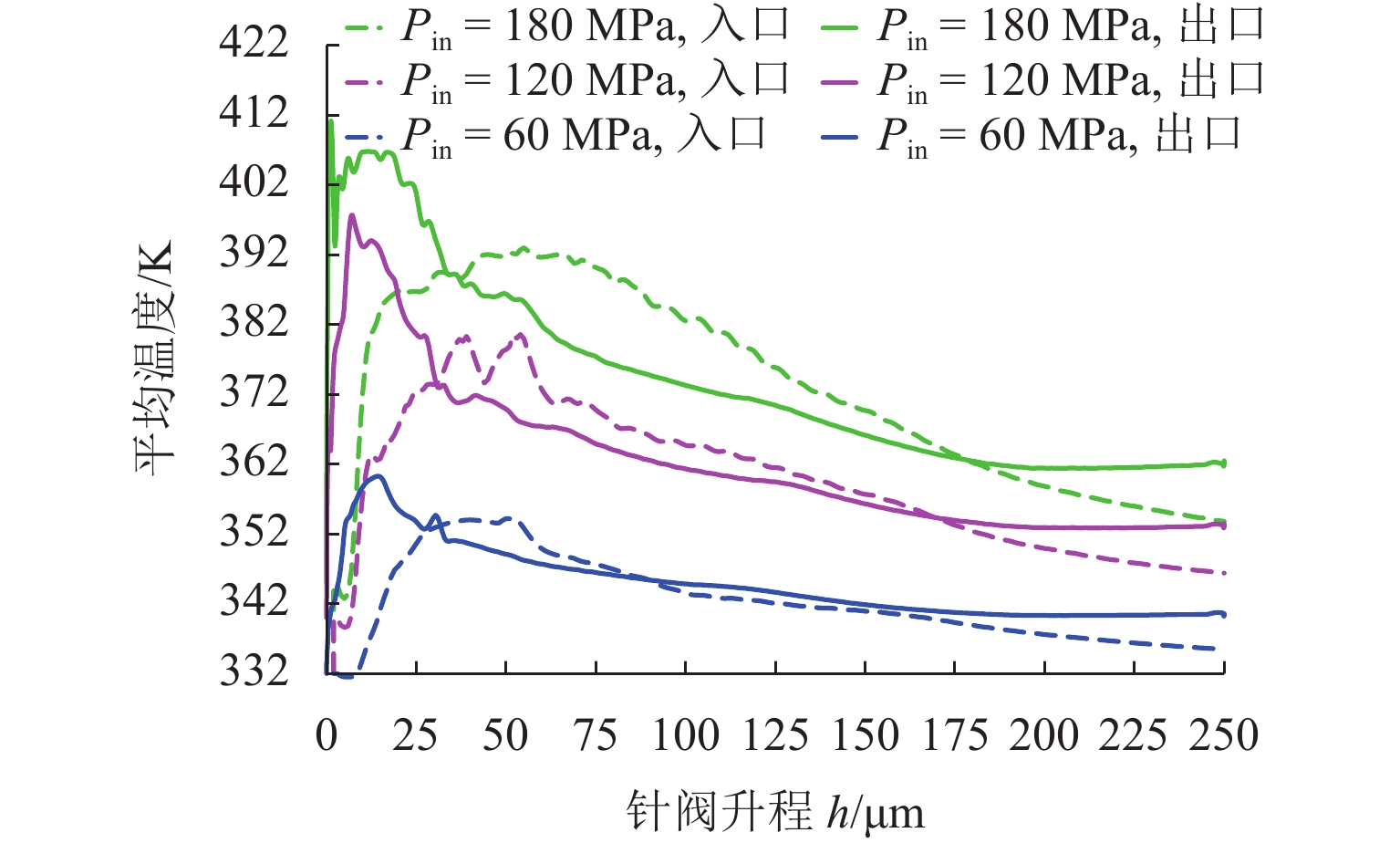
图 10 压力室入口与喷孔出口平均温度随针阀升程变化
Figure 10. Variation of average temperature at pressure chamber inlet and orifice outlet with needle valve lift variation
表 1 仿真计算边界条件
Table 1. Boundary conditions for simulation calculation
参数 数值 入口压力Pin/MPa 60、120、180 出口压力Pout/MPa 5 燃油温度T/K 332、340、345 壁面条件 绝热  下载: 导出CSV
表 2 不同针阀位置下喷嘴内空化分布
Table 2. Cavitation distribution in nozzle under different needle valve positions
针阀打开阶段 针阀关闭阶段 h/μm Pin=60 MPa Pin=120 MPa Pin=180 MPa Pin=60 MPa Pin=120 MPa Pin=180 MPa 3.02 


47.51 


119.40 


216.20 


注:  下载: 导出CSV
表 3 不同Pin下喷嘴内压力和速度分布(h = 3.02 μm)
Table 3. Pressure and velocity distributions in nozzle under different Pin (h = 3.02 μm)
打开阶段 关闭阶段 Pin/MPa 压力 速度 压力 速度 60 MPa 
120 MPa 
180 MPa 
注:  下载: 导出CSV
表 4 针阀打开过程中喷嘴内空化和温度分布
Table 4. Cavitation and temperature distribution in nozzle during opening stage of needle valve
Pin=60 MPa Pin=120 MPa Pin=180 MPa h/μm 空化 温度 空化 温度 空化 温度 3.02 
119.4 
216.2 
注:  下载: 导出CSV
表 5 不同针阀位置下喷嘴内过冷区变化
Table 5. Variation of supercooled region in nozzle under different needle valve positions
人/μm 打开阶段 关闭阶段 Pin=60 MPa Pin=120 MPa Pin=180 MPa Pin=60 MPa Pin=120 MPa Pin=180 MPa 3.02 
119.40 
216.20 
注:  下载: 导出CSV
表 6 不同针阀位置下喷嘴内温升区变化
Table 6. Variation of temperature rise region in nozzle under different needle valve positions
打开阶段 关闭阶段 h/μm Pin=60 MPa Pin=120 MPa Pin=180 MPa Pin=60 MPa Pin=120 MPa Pin=180 MPa 3.02 
119.4 
216.2 
注:  下载: 导出CSV
-
[1] 高攀, 方志伟, 赵旭. “碳减排”视域下内河流域梯级枢纽联合通航调度优化[J]. 西南交通大学学报, 2025, 60(2): 308-316. doi: 10.3969/j.issn.0258-2724.20230002Gao Pan, Fang Zhiwei, Zhao Xu. Optimization of joint navigation scheduling of cascade hubs in inland river basin from perspective of carbon emission reduction[J]. Journal of Southwest Jiaotong University, 2025, 60(2): 308-316. doi: 10.3969/j.issn.0258-2724.20230002 [2] 赵建辉, 徐煜, 杨贵春, 等. 基于喷雾动量法的共轨喷油器喷油稳定性试验研究[J]. 西南交通大学学报, 2025, 60(3): 665-670.Zhao Jianhui, Xu Yu, Yang Guichun, et al. Experimental study on injection stability of common rail injector based on spray momentum method[J]. Journal of Southwest Jiaotong University, 2025, 60(3): 665-670. [3] 赵建辉, 陈文菲, 杨贵春, 等. 高速电磁阀能量分布和动态响应耦合关系仿真[J]. 西南交通大学学报, 2024, 59(6): 1398-1405. doi: 10.3969/j.issn.0258-2724.20220452Zhao Jianhui, Chen Wenfei, Yang Guichun, et al. Simulation research on coupling relationship between energy distribution and dynamic response of high-speed solenoid valves[J]. Journal of Southwest Jiaotong University, 2024, 59(6): 1398-1405. doi: 10.3969/j.issn.0258-2724.20220452 [4] Medina M, Bautista A, Wooldridge M, et al. The effects of injector geometry and operating conditions on spray mass, momentum and development using high-pressure gasoline[J]. Fuel, 2021, 294: 120468. doi: 10.1016/j.fuel.2021.120468 [5] 郭根苗, 白天阳, 邵壮, 等. 喷孔锥度和燃油温度对柴油喷嘴内空化流动特性的影响[J]. 西安交通大学学报, 2022, 56(8): 131-140.Guo Genmiao, Bai Tianyang, Shao Zhuang, et al. Effects of hole taper coefficients and diesel temperatures on in-nozzle cavitation[J]. Journal of Xi’an Jiaotong University, 2022, 56(8): 131-140. [6] Kolovos K, Kyriazis N, Koukouvinis P, et al. Simulation of transient effects in a fuel injector nozzle using real-fluid thermodynamic closure[J]. Applications in Energy and Combustion Science, 2021, 7: 100037. doi: 10.1016/j.jaecs.2021.100037 [7] 甘树坤, 陆洪杰, 吕雪飞. 燃油温度及喷嘴结构对燃油内部流动性能影响研究[J]. 吉林化工学院学报, 2021, 38(9): 60-66.Gan Shukun, Lu Hongjie, Lü Xuefei. Study of the effect of fuel temperature and nozzle structure on the internal flow properties of fuel[J]. Journal of Jilin Institute of Chemical Technology, 2021, 38(9): 60-66. [8] De Giorgi M G, Ficarella A, Tarantino M. Evaluating cavitation regimes in an internal orifice at different temperatures using frequency analysis and visualization[J]. International Journal of Heat and Fluid Flow, 2013, 39: 160-172. doi: 10.1016/j.ijheatfluidflow.2012.11.002 [9] Theodorakakos A, Mitroglou N, Gavaises M. Simulation of heating effects caused by extreme fuel pressurisation in cavitating flows through diesel fuel injectors[C]//Proceedings of the 8th International Symposium on Cavitation. Research Publishing Services, 2012: 520-526. [10] 李琛. 高压燃油喷射喷嘴内空化流动热效应及热力相变机理研究[D]. 镇江: 江苏大学, 2024. [11] Strotos G, Koukouvinis P, Theodorakakos A, et al. Transient heating effects in high pressure Diesel injector nozzles[J]. International Journal of Heat and Fluid Flow, 2015, 51: 257-267. doi: 10.1016/j.ijheatfluidflow.2014.10.010 [12] Salvador F J, Carreres M, De la Morena J, et al. Computational assessment of temperature variations through calibrated orifices subjected to high pressure drops: Application to diesel injection nozzles[J]. Energy Conversion and Management, 2018, 171: 438-451. doi: 10.1016/j.enconman.2018.05.102 [13] Salemi R, Koukouvinis P, Strotos G, et al. Evaluation of friction heating in cavitating high pressure Diesel injector nozzles[J]. Journal of Physics: Conference Series, 2015, 656: 012083. doi: 10.1088/1742-6596/656/1/012083 [14] Zhao J H, Liu W L, Zhao J L, et al. Numerical investigation of gas/liquid two-phase flow in nozzle holes considering the fuel compressibility[J]. International Journal of Heat and Mass Transfer, 2020, 147: 118991. doi: 10.1016/j.ijheatmasstransfer.2019.118991 [15] 金朝光, 程志远, 王运龙. 异形中心体空化喷嘴仿真与实验研究[J]. 哈尔滨工程大学学报, 2025, 46(7): 1279-1286. doi: 10.11990/jheu.202304019Jin Chaoguang, Cheng Zhiyuan, Wang Yunlong. Simulation and experimental study on cavitation nozzle of irregular center body[J]. Journal of Harbin Engineering University, 2025, 46(7): 1279-1286. doi: 10.11990/jheu.202304019 [16] Saha K, Abu-ramadan E, Li X G. Modified single-fluid cavitation model for pure diesel and biodiesel fuels in direct injection fuel injectors[J]. Journal of Engineering for Gas Turbines and Power, 2013, 135(6): 062801. doi: 10.1115/1.4023464 [17] Yakhot V, Orszag S A. Renormalization group analysis of turbulence. I. Basic theory[J]. Journal of Scientific Computing, 1986, 1(1): 3-51. doi: 10.1007/BF01061452 [18] Singhal A K, Athavale M M, Li H Y, et al. Mathematical basis and validation of the full cavitation model[J]. Journal of Fluids Engineering, 2002, 124(3): 617-624. doi: 10.1115/1.1486223 [19] ZWART P J, GERBER A G, BELAMRI T. A two-phase flow model for predicting cavitation dynamics[C]// International Conference on Multiphase Flow (ICMF 2004). Yokohama: [s. n.], 2004: 1-11. [20] SCHNERR G H, SAUER J. Physical and numerical modeling of unsteady cavitation dynamics[C]// International Conference on Multiphase Flow (ICMF 2001). New Orleans: [s. n.], 2001: 1-12. [21] Jablonská J. Modelling on cavitation in a diffuser with vortex generator[J]. EPJ Web of Conferences, 2013, 45: 01045. doi: 10.1051/epjconf/20134501045 [22] Zhao J H, Guo N, Lu X D, et al. Numerical research on characteristics of fuel heating and subcooling in the nozzle hole of common rail injector[J]. International Journal of Heat and Mass Transfer, 2023, 200: 123508. doi: 10.1016/j.ijheatmasstransfer.2022.123508 [23] Sa B W, Klyus O, Markov V, et al. A numerical study of the effect of spiral counter grooves on a needle on flow turbulence in a diesel injector[J]. Fuel, 2021, 290: 120013. doi: 10.1016/j.fuel.2020.120013 [24] 任日娜. 基于试验验证的高压共轨系统喷油器控制阀流通性能研究[D]. 太原: 中北大学, 2023. [25] Liu J B, Liu Z M, Wu J C, et al. Numerical study on cavitation flow characteristics in diesel fuel injector control valve[J]. International Journal of Automotive Technology, 2022, 23(4): 881-897. doi: 10.1007/s12239-022-0078-y [26] He Z X, Guan W, Wang C Q, et al. Assessment of turbulence and cavitation models in prediction of vortex induced cavitating flow in fuel injector nozzles[J]. International Journal of Multiphase Flow, 2022, 157: 104251. doi: 10.1016/j.ijmultiphaseflow.2022.104251 [27] Chorążewski M, Dergal F, Sawaya T, et al. Thermophysical properties of Normafluid (ISO 4113) over wide pressure and temperature ranges[J]. Fuel, 2013, 105: 440-450. doi: 10.1016/j.fuel.2012.05.059 [28] Ndiaye E H I, Bazile J P, Nasri D, et al. High pressure thermophysical characterization of fuel used for testing and calibrating diesel injection systems[J]. Fuel, 2012, 98: 288-294. doi: 10.1016/j.fuel.2012.04.005 [29] Hult J, Simmank P, Matlok S, et al. Interior flow and near-nozzle spray development in a marine-engine diesel fuel injector[J]. Experiments in Fluids, 2016, 57(4): 49. doi: 10.1007/s00348-016-2134-8 -

 下载:
下载:

 点击查看大图
计量
- 文章访问数: 46
- HTML全文浏览量: 27
- PDF下载量: 37
- 被引次数: 0