



Seismic Resilience Enhancement of Railway Beam Bridges Based on Viscoelastic Dampers
-
摘要:
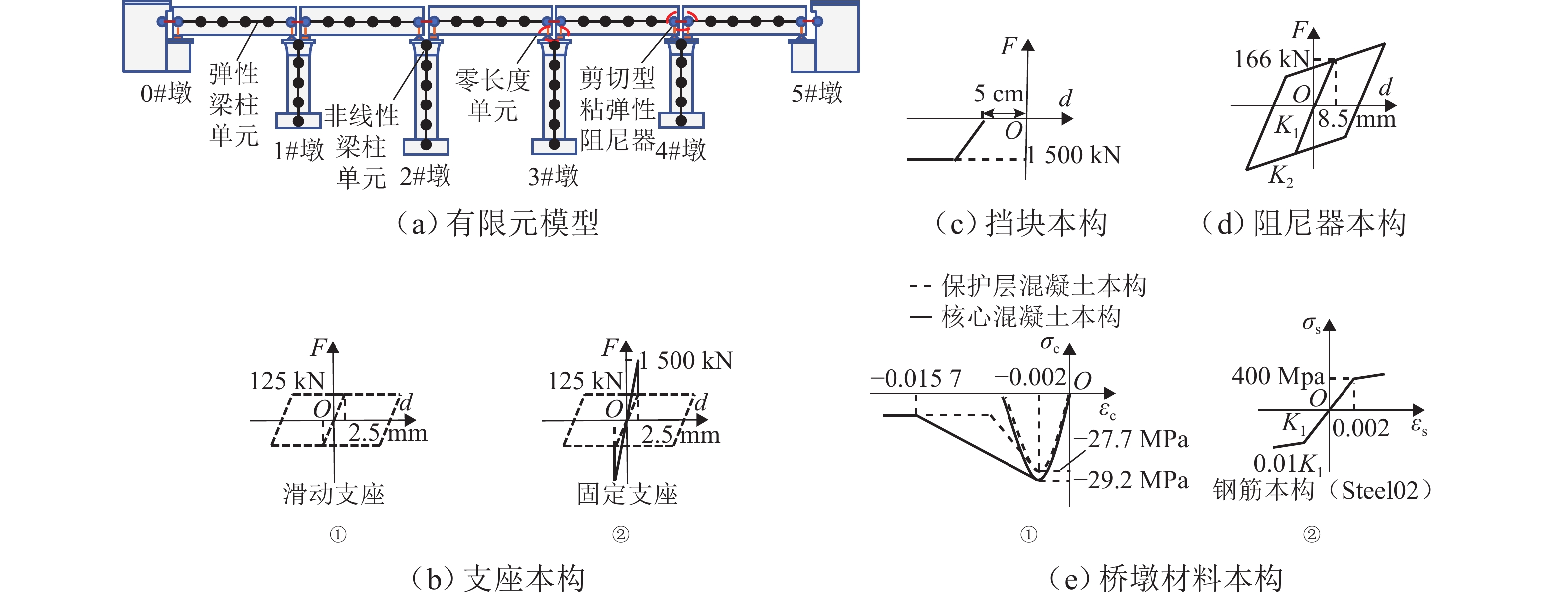
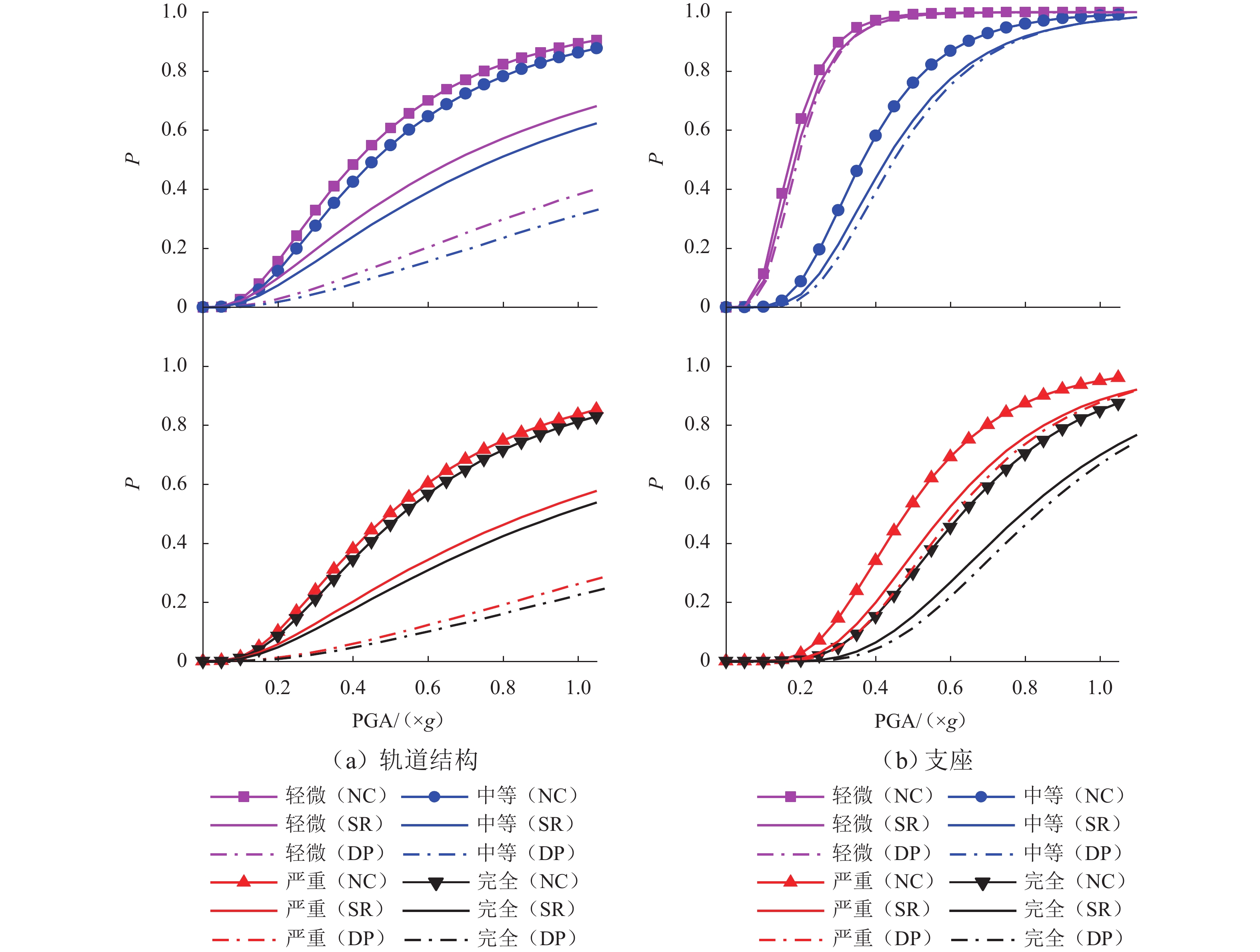
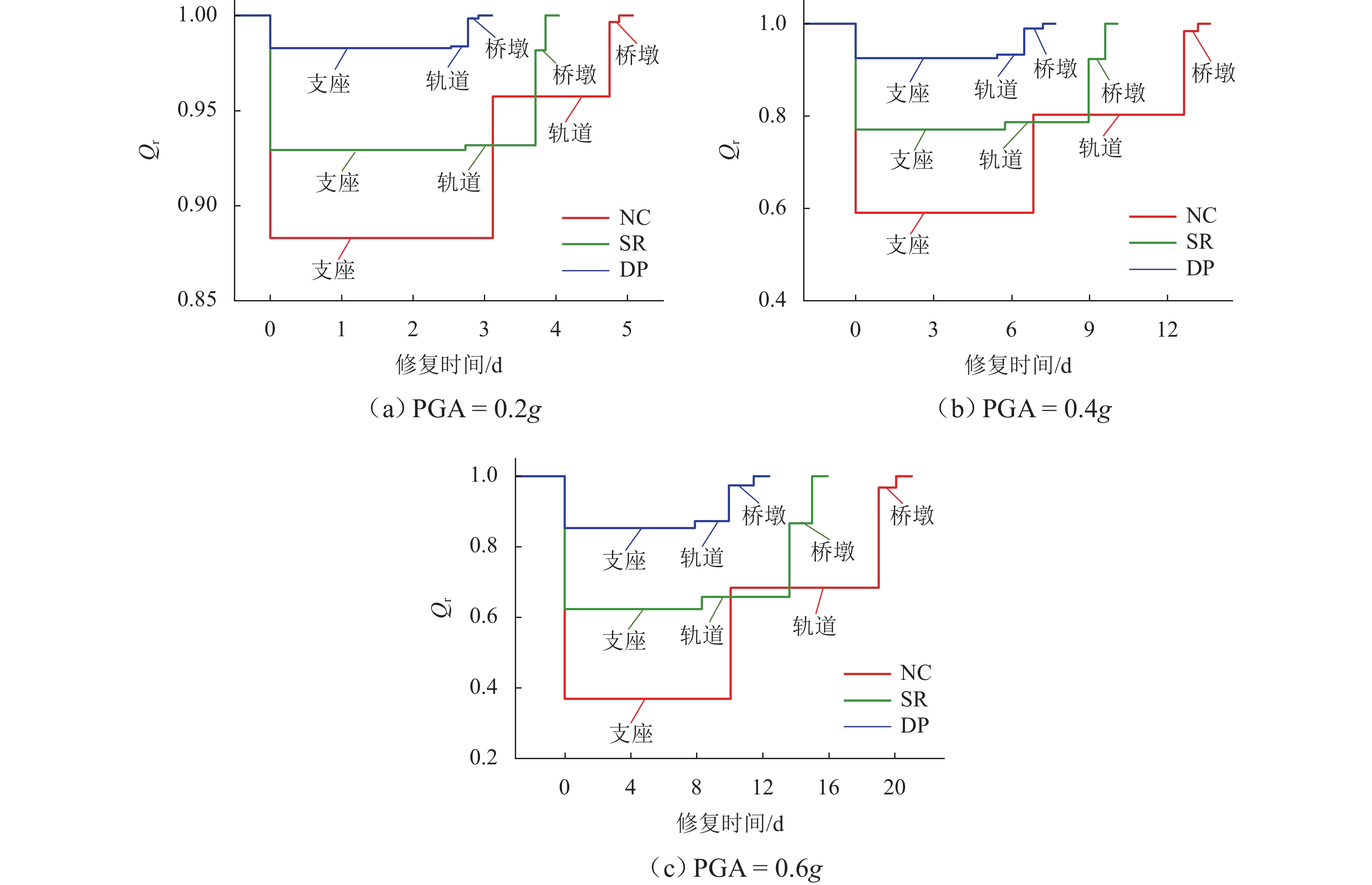
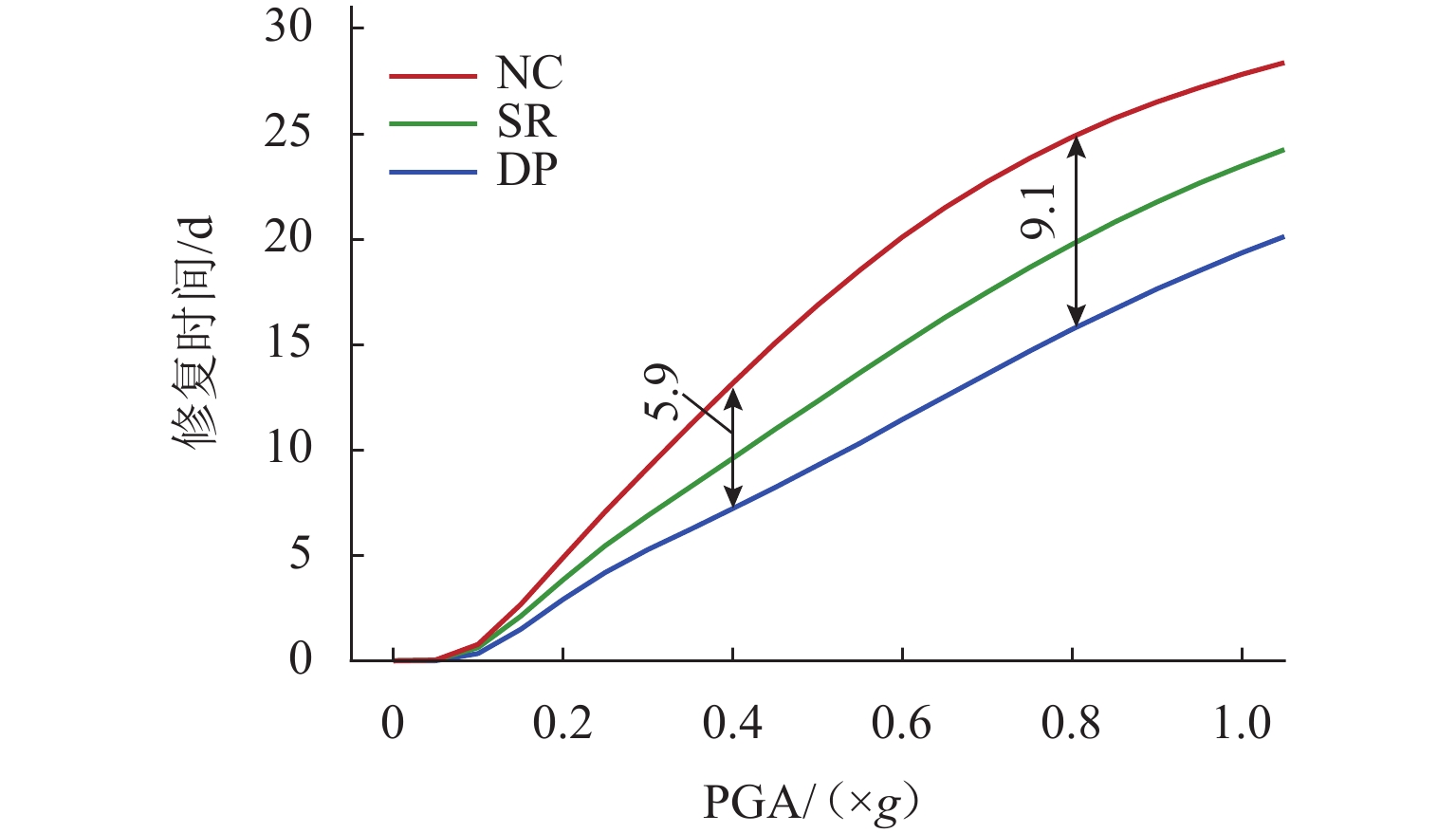
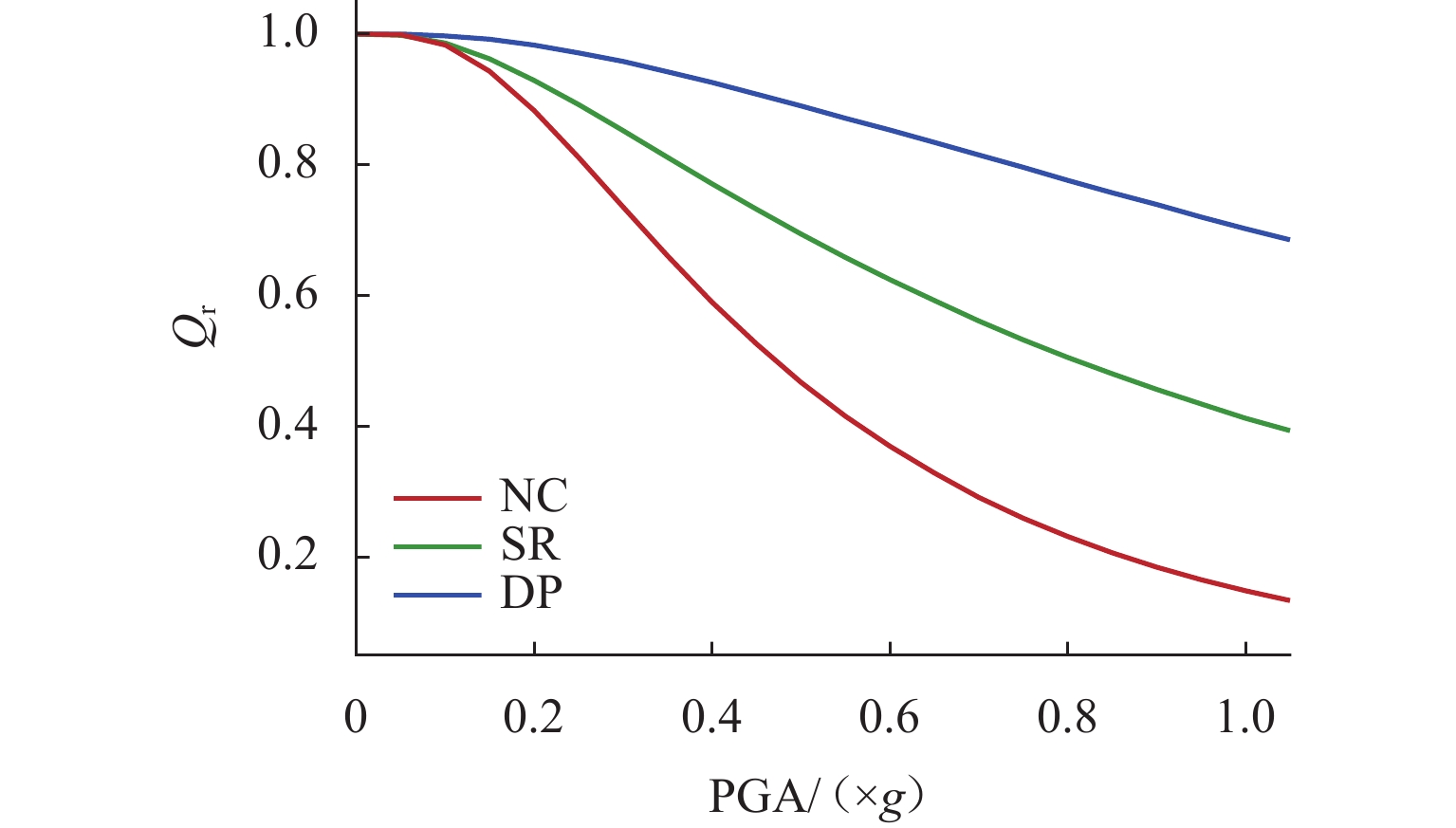
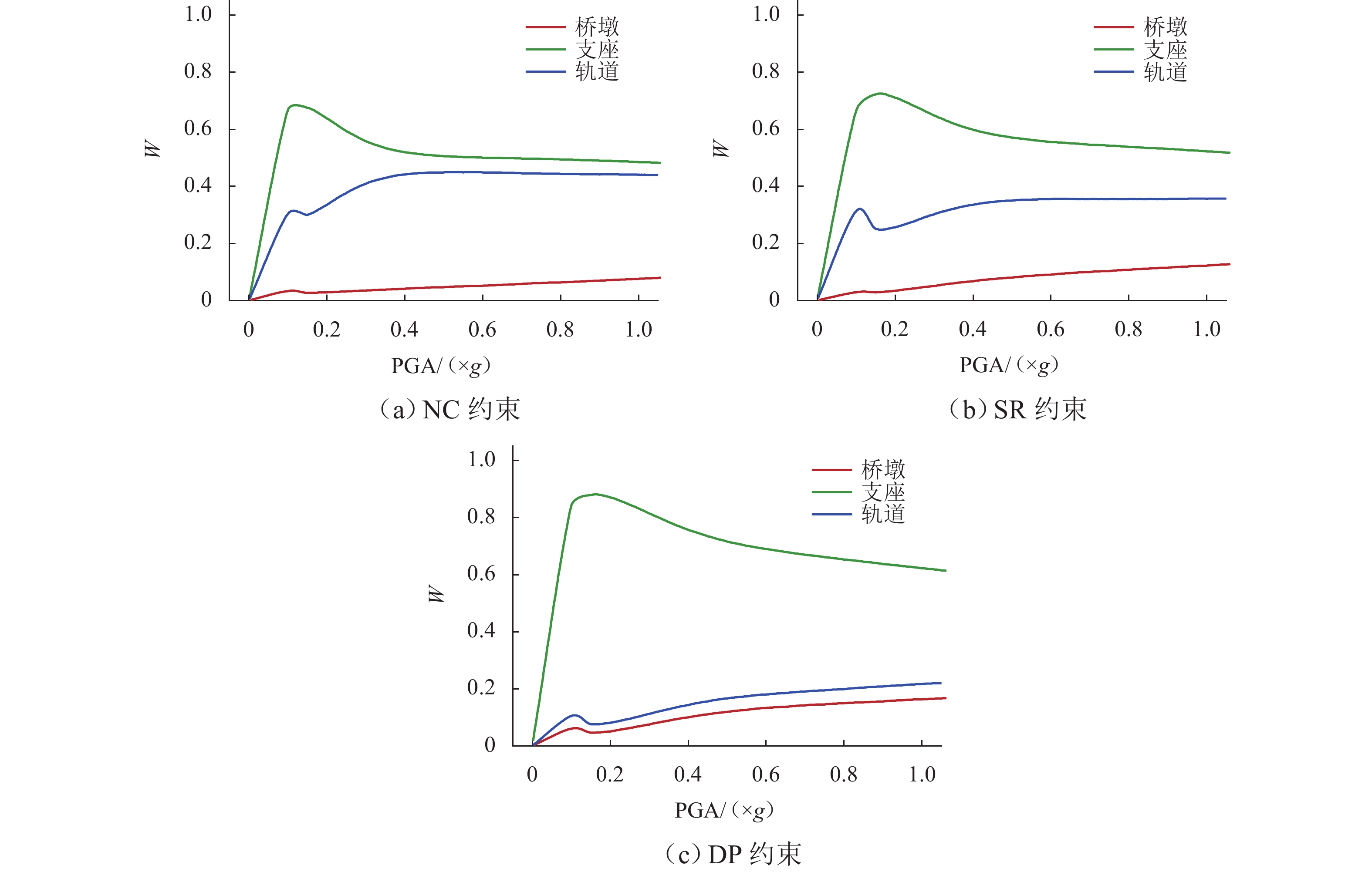
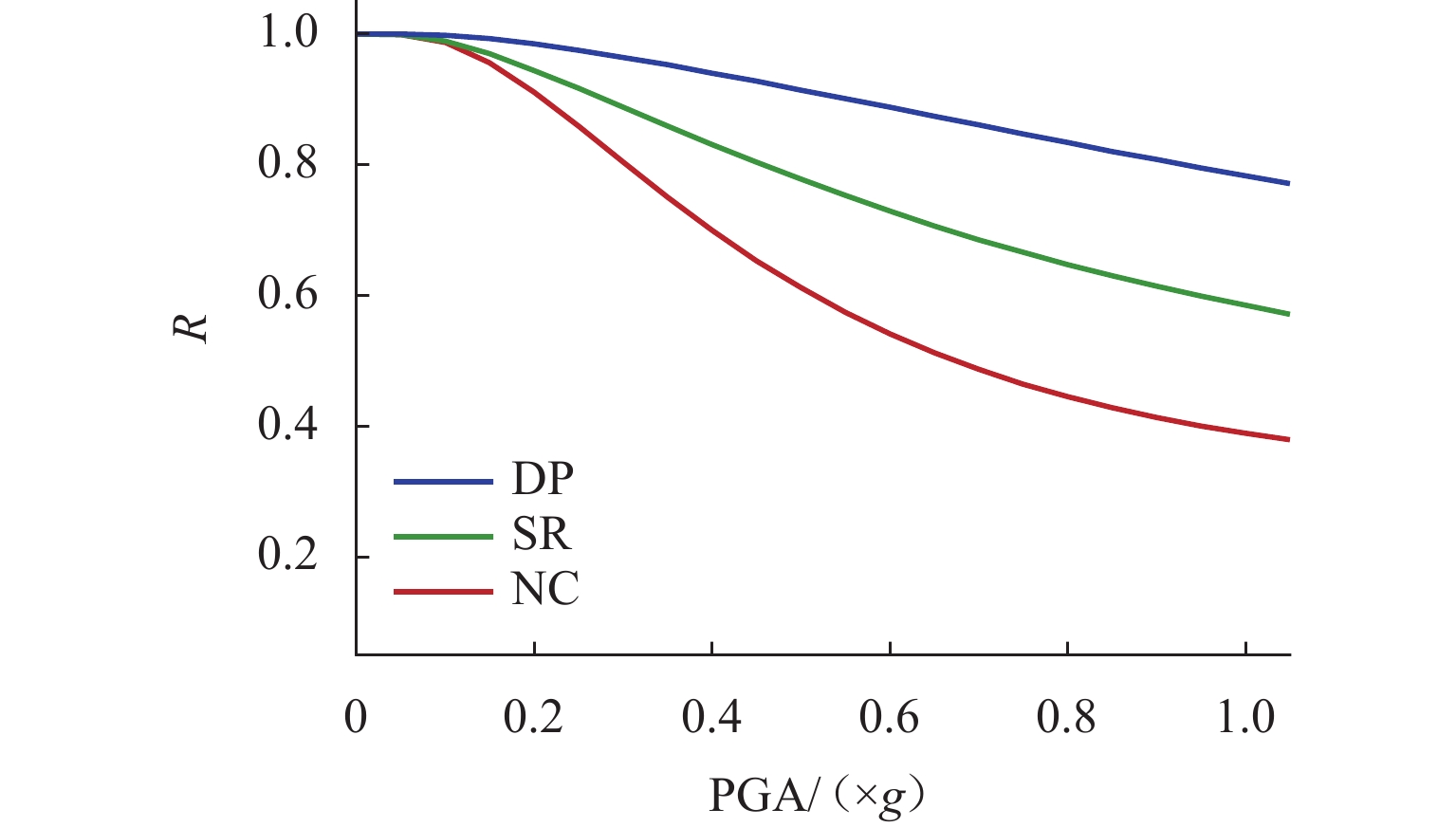
随着桥梁抗震设计理念逐步由基于性能向面向韧性转变,当前的研究重点不仅在于保障结构在地震作用下的安全性,更需关注桥梁在震后通行功能的保持与恢复能力. 铁路桥梁作为交通网络的关键节点,其震后通行能力直接关系到线路的运营效率与震区恢复进程. 基于此,提出一种剪切型黏弹性阻尼器,通过控制主梁相对横向错位来降低轨道损伤风险,进而提升桥梁震后通行功能. 以某5跨典型铁路桥梁为例,对比分析无限位装置(NC)、仅设钢挡块(SR)和钢挡块 + 剪切型黏弹性阻尼器(DP) 3种约束下的通行功能易损性、震后功能恢复能力及抗震韧性. 分析结果表明:1) 提出构件恢复权重系数的概念,为构件修复次序确定提供了定量指标;2) 所提出的剪切型黏弹性阻尼器能够显著控制梁缝处主梁横向相对位移,在强震作用下有效降低轨向不平顺程度,提升桥梁的震后通行功能;3) 在钢挡块基础上增设黏弹性阻尼器可显著缩短震后修复时间,尤其在较高地震动强度下(如地震动加速度(PGA)为0.8
g ),修复时间较NC体系最多可减少9.1 d,并且,DP约束的震后残余通行功能和抗震韧性指数在不同PGA水平下均显著高于SR与NC约束,如震后残余通行功能在PGA=0.4g 时分别提升了20.0%与56.9%,抗震韧性在PGA=0.4g 时分别提升了13.1%与34.4%,表明该装置在提升桥梁震后通行功能和抗震韧性方面具有显著效果.Abstract:As the seismic design philosophy of bridges gradually shifts from performance-based to resilience-oriented, the current research focus lies not only in ensuring structural safety under the action of earthquakes, but also in paying more attention to the preservation and recovery capacities of post-earthquake traffic function. Railway bridges serve as critical nodes in transportation networks, and their post-earthquake traffic capacity directly influences the operational efficiency of the lines and the recovery process of earthquake-stricken areas. Based on this, a shear-type viscoelastic damper was proposed to decrease track damage risk by controlling the relative transverse displacement of main beams, thereby enhancing the bridge’s post-earthquake traffic function. By taking a typical five-span railway simply-supported bridge as a case study, a comparative analysis was conducted on the traffic function vulnerability, post-earthquake function recovery capacity, and seismic resilience in the three constraint conditions of no constraint (NC), steel restrainer (SR) only, and SR combined with the shear-type viscoelastic damper (DP). The analytical results demonstrate that proposing the concept of a “component recovery weight coefficient” provides a quantitative index for determining the sequence of component repairs. Additionally, the proposed shear-type viscoelastic damper can significantly control the relative transverse displacement of main beams at beam ends, effectively reducing track alignment irregularity under the strong action of earthquakes and consequently enhancing the bridge’s post-earthquake traffic function. The addition of the viscoelastic damper to SR can notably shorten the post-earthquake repair time. In particular, under higher ground motion intensities, such as peak ground acceleration (PGA) of 0.8
g , the repair time can be reduced by up to 9.1 days compared to the NC system. Furthermore, the DP configuration demonstrates significantly better post-earthquake residual traffic function and seismic resilience indices than the SR and NC configurations at various PGA levels. For instance, under PGA=0.4g , the post-earthquake residual traffic function improves by 20.0% and 56.9%, and seismic resilience increases by 13.1% and 34.4% respectively, confirming the remarkable effectiveness of this device in enhancing both post-earthquake traffic function and seismic resilience of bridges. -
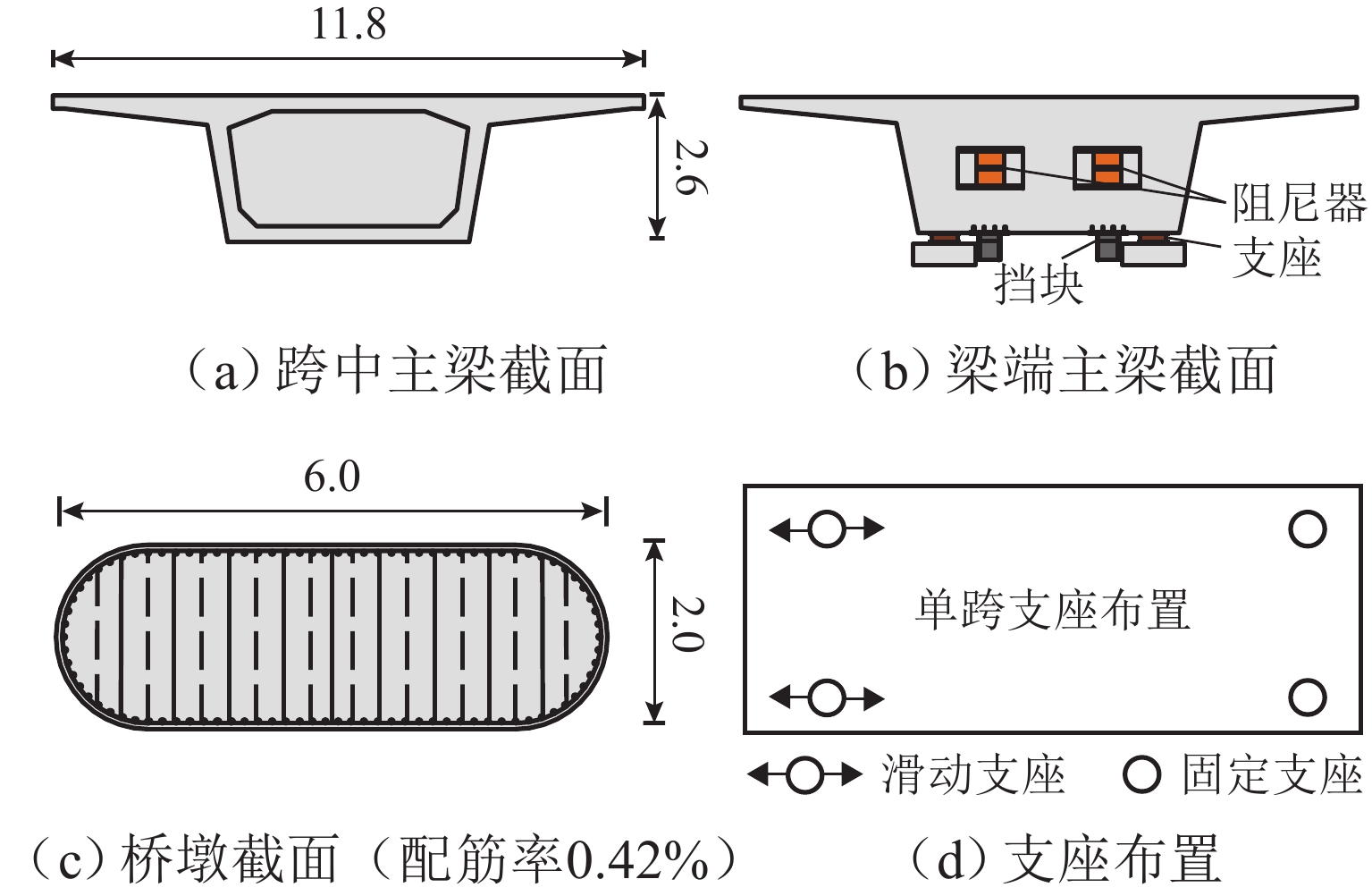
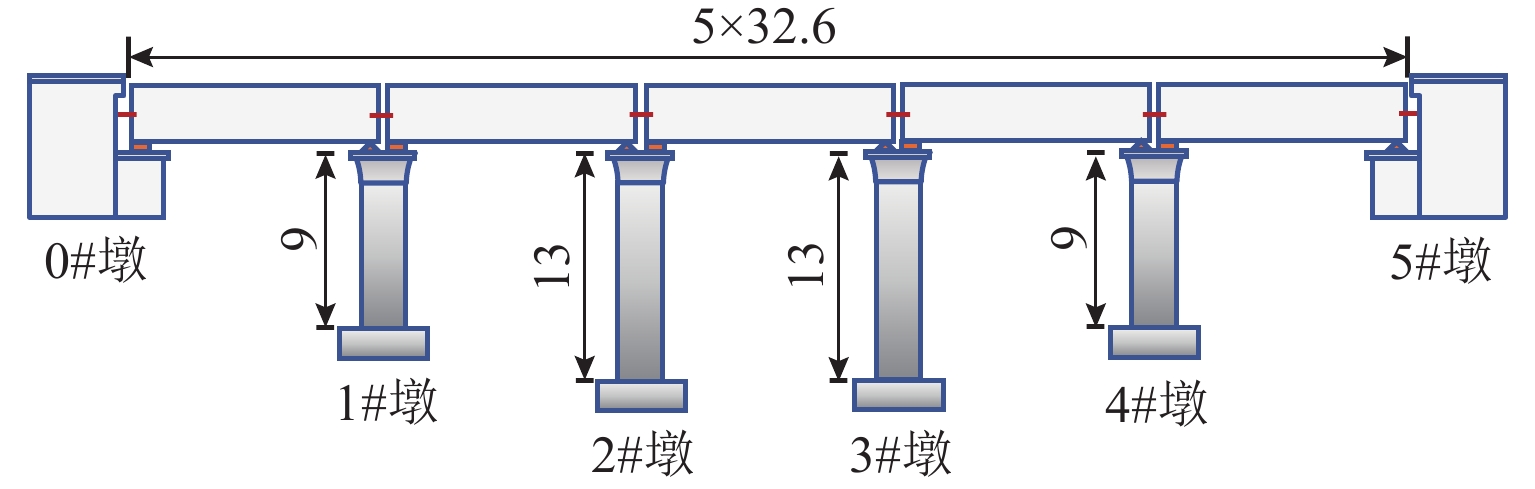
图 4 铁路桥梁结构图(单位:m)
Figure 4. Structure of railway simply-supported beam bridge (unit: m)
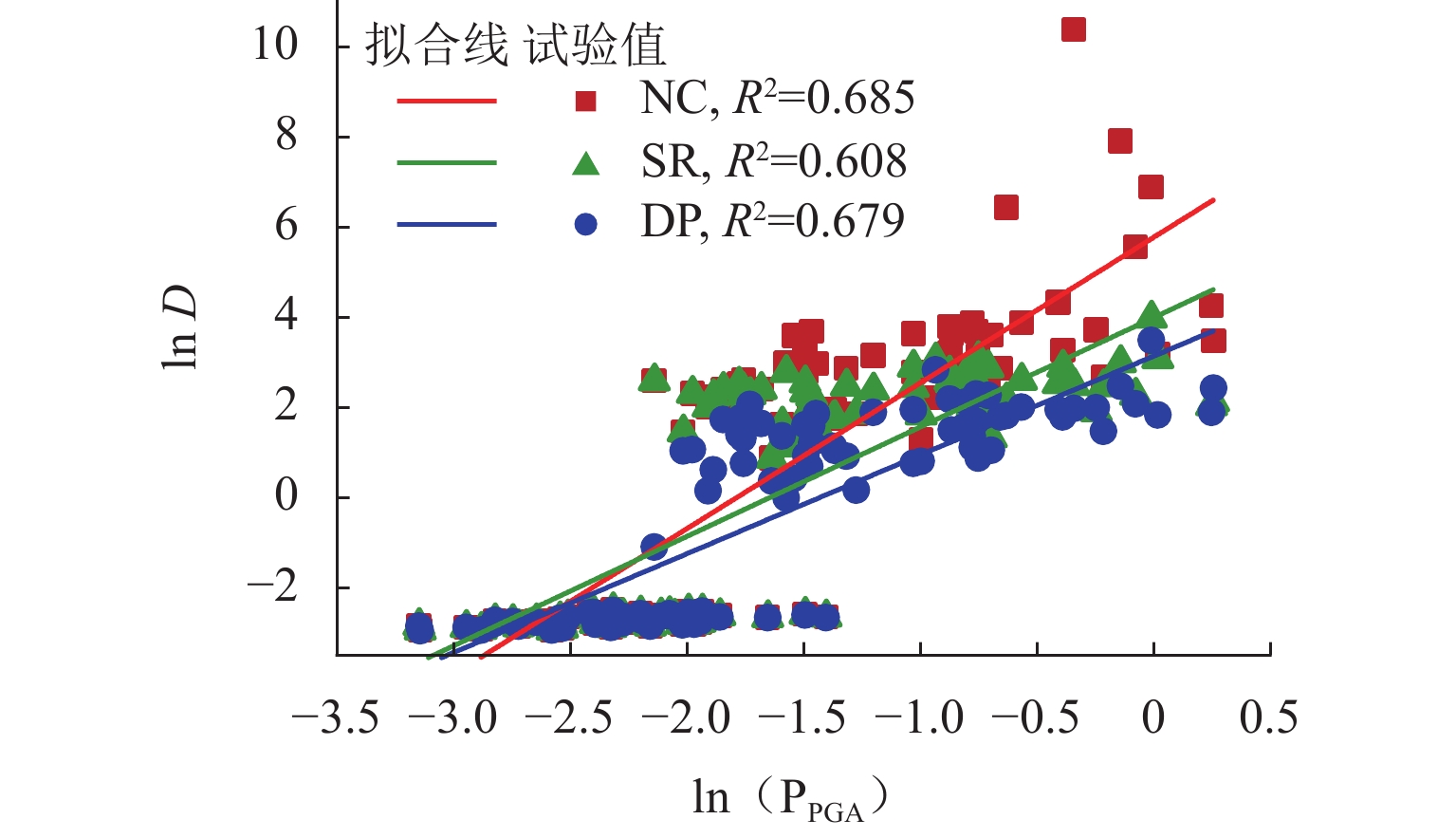
图 7 轨向不平顺概率地震需求模型
Figure 7. Probabilistic seismic demand model for track alignment irregularity
表 1 阻尼器力学性能参数
Table 1. Mechanical property parameters of dampers
性能指标 数值范围 水平屈服力 Qy/kN 52~214 初始水平刚度 K1/(kN·mm−1) 10.72~26.50 屈服后水平刚度 K2/(kN·mm−1) 1.64~3.12  下载: 导出CSV
表 2 通行功能损伤定义及控制指标
Table 2. Definition and control indexes of traffic function damage
功能状态 功能描述 控制指标 第i个功能损失比 Li/% 无损伤 以设计速度 200 km/h 通行 不平顺$ \lt $9 mm 0 轻微损伤 通行速度降至 160 km/h 9 mm$ \leqslant $不平顺$ \lt $12 mm 25.8 中等损伤 通行速度降至 120 km/h 12 mm$ \leqslant $不平顺$ \lt $15 mm 51.6 严重损伤 通行速度降至 80 km/h 15 mm$ \leqslant $不平顺$ \lt $18 mm 77.4 完全损伤 通行速度降至 45 km/h 以下 18 mm$ \lt $不平顺 100
下载: 导出CSV
表 3 构件修复时间统计结果均值
Table 3. Mean of component repair time statistics
构件 无损伤 轻微损伤 中等损伤 严重损伤 完全损伤 桥墩 0 11.61 22.11 46.74 93.83 支座 0 4.58 5.96 7.33 14.66 轨道 0 4.04 7.24 7.24 14.48
下载: 导出CSV
-
[1] 贾宏宇, 杨健, 郑史雄, 等. 跨断层桥梁抗震综述[J]. 西南交通大学学报, 2021, 56(5): 1075-1093.Jia Hongyu, Yang Jian, Zheng Shixiong, et al. A review on aseismic bridges crossing fault rupture regions[J]. Journal of Southwest Jiaotong University, 2021, 56(5): 1075-1093. [2] 陈志强, 曾永平, 陈志伟, 等. 基于Bootstrap的桥梁地震易损性不确定性量化[J/OL]. 西南交通大学学报, 2026-01-14. https://link.cnki.net/urlid/51.1277.U.20250605.1041.002. [3] Hu S C, Chen B K, Song G Q, et al. Resilience-based seismic design optimization of highway RC bridges by response surface method and improved non-dominated sorting genetic algorithm[J]. Bulletin of Earthquake Engineering, 2022, 20(1): 449-476. doi: 10.1007/s10518-021-01232-8 [4] 管仲国, 徐瑜窈, 李建中, 等. 面向韧性的大跨度桥钢筋混凝土桥塔抗震性能设计与控制指标[J]. 同济大学学报(自然科学版), 2025, 53(4): 521-530, 627. doi: 10.11908/j.issn.0253-374x.23320Guan Zhongguo, Xu Yuyao, Li Jianzhong, et al. Specific performance indices and appropriate performance limits for seismic resilience design of reinforced concrete pylons of longspan bridges[J]. Journal of Tongji University (Natural Science), 2025, 53(4): 521-530, 627. doi: 10.11908/j.issn.0253-374x.23320 [5] Ledezma C, Hutchinson T, Ashford S A, et al. Effects of ground failure on bridges, roads, and railroads[J]. Earthquake Spectra, 2012, 28(S1): S119-S143. doi: 10.1193/1.4000024 [6] Zhou G Y, Zhu Z H, Huang Y, et al. Post-earthquake damage probability assessment of high-speed railway simply supported bridge based on traffic capacity[J]. Engineering Structures, 2024, 318: 118741. doi: 10.1016/j.engstruct.2024.118741 [7] 朱颖, 魏永幸. 汶川地震铁路工程震害特征及工程抗震设计对策思考[J]. 岩石力学与工程学报, 2010, 29(增1): 3378-3386.Zhu Ying, Wei Yongxing. Characteristics of railway damage due to Wenchuan earthquake and countermeasure considerations of engineering seismic design[J]. Chinese Journal of Rock Mechanics and Engineering, 2010, 29(S1): 3378-3386. [8] 王军文, 田茂东, 郝玉军, 等. 硫磺沟大桥的地震破坏机理研究[J]. 土木工程学报, 2025, 58(11): 117-127. doi: 10.15951/j.tmgcxb.24010110Wang Junwen, Tian Maodong, Hao Yujun, et al. Study on seismic failure mechanism of Liuhuanggou Bridge[J]. China Civil Engineering Journal, 2025, 58(11): 117-127. doi: 10.15951/j.tmgcxb.24010110 [9] 张金, 刘湘, 黄李佳, 等. 近断层地震作用下高速铁路桥梁结构响应与行车安全性分析[J/OL]. 西南交通大学学报, 2025-12-08. https://link.cnki.net/urlid/51.1277.u.20241021.1742.002. [10] 李鑫, 李智敏, 盖海龙, 等. 青海门源MS6.9地震极震区震害调查与防灾建议[J]. 震灾防御技术, 2022, 17(1): 84-94.Li Xin, Li Zhimin, Gai Hailong, et al. Investigation and prevention suggestion of earthquake disaster in the extreme earthquake area of MS6.9 earthquake in Menyuan County, Qinghai Province[J]. Technology for Earthquake Disaster Prevention, 2022, 17(1): 84-94. [11] 闫磊, 安康, 岳克锋, 等. 可替换式桥梁横向防落梁限位装置抗震性能研究[J]. 世界地震工程, 2020, 36(3): 172-180. doi: 10.3969/j.issn.1007-6069.2020.03.018Yan Lei, An Kang, Yue Kefeng, et al. Study on the seismic performance of replaceable limit device of transverse anti-falling beam for bridge[J]. World Earthquake Engineering, 2020, 36(3): 172-180. doi: 10.3969/j.issn.1007-6069.2020.03.018 [12] 江力强, 刘小志, 蒋丽忠, 等. 含UCSD消能减震装置的高速铁路轨道-桥梁系统震后功能恢复函数[J]. 铁道科学与工程学报, 2025, 22(7): 2859-2871.Jiang Liqiang, Liu Xiaozhi, Jiang Lizhong, et al. Post-earthquake functionality recovery function of high-speed railway track-bridge system with the UCSD energy dissipation devices[J]. Journal of Railway Science and Engineering, 2025, 22(7): 2859-2871. [13] 谷屹童, 袁万城, 党新志. 拉索限位装置对跨断层桥梁地震响应的影响[J]. 同济大学学报(自然科学版), 2020, 48(9): 1256-1263.Gu Yitong, Yuan Wancheng, Dang Xinzhi. Effect of cable restrainers on seismic response of cross-fault bridges[J]. Journal of Tongji University (Natural Science), 2020, 48(9): 1256-1263. [14] 肖长进, 阮坤, 贾康, 等. SMA-LRB复合支座恢复能力及其对简支梁桥韧性的影响[J/OL]. 铁道标准设计, 2025-12-08. https://doi.org/10.13238/j.issn.1004-2954.202405230001. [15] Long X H, Zhou Q L, Ma Y T, et al. Displacement-based seismic design of SMA cable-restrained sliding lead rubber bearing for isolated continuous girder bridges[J]. Engineering Structures, 2024, 300: 117179. doi: 10.1016/j.engstruct.2023.117179 [16] JT/T 842—2012公路桥梁高阻尼隔震橡胶支座[S]. [17] 汤虎, 李建中, 邵长宇. 中小跨径板式橡胶支座梁桥横向抗震性能[J]. 中国公路学报, 2016, 29(3): 55-65.Tang Hu, Li Jianzhong, Shao Changyu. Seismic performance of small and medium span girder bridges with plate type elastomeric pad bearings in the transverse direction[J]. China Journal of Highway and Transport, 2016, 29(3): 55-65. [18] 王晓伟, 叶爱君, 吴学平, 等. 梁式桥抗震韧性评估方法: I. 基于专家意见的构件震后功能恢复模型[J]. 土木工程学报, 2025, 58(1): 65-76.Wang Xiaowei, Ye Aijun, Wu Xueping, et al. Seismic resilience assessment method for girder bridges: I. Expert opinion-based post-earthquake functionality recovery models of bridge components[J]. China Civil Engineering Journal, 2025, 58(1): 65-76. [19] 段佳宏. 大跨度铁路斜拉桥抗震韧性评价方法研究[D]. 成都: 西南交通大学, 2024. [20] 尹伟涛, 远全闯, 邓开来, 等. 铁路桥梁轨道结构震损机理与易损性分析[J/OL]. 土木工程学报, 2025-12-08. https://doi.org/10.15951/j.tmgcxb.24090792. [21] TG-GW 102—2019普速铁路线路修理规则[S]. [22] BRUNEAU M, CHANG S E, EGUCHI R T, et al. A framework to quantitatively assess and enhance the seismic resilience of communities[J]. Earthquake Spectra, 2003, 19(4): 733-752. doi: 10.1193/1.1623497 [23] CHEN X, GUAN Z G, LI J Z, et al. Repair procedure-based recovery pattern for estimating seismic resilience and novel concept of public resilience[J]. Disaster Prevention and Resilience, 2023, 2(3): 16. doi: 10.20517/dpr.2023.23 [24] 尹伟涛, 康炜, 卢皓, 等. 基于专家问卷调查的铁路梁式桥抗震韧性评价方法研究[J/OL]. 土木工程学报, 2025-12-08. https://doi.org/10.15951/j.tmgcxb.25040264. [25] 古泉, 黄素蓉. OpenSees实用教程[M]. 北京: 科学出版社出版, 2016: 1-112 [26] 古泉, 黄素蓉. OpenSees实用教程[M]. 北京: 科学出版社出版, 2016. [27] BAKER J W, LIN T, SHAHI S K, et al. New ground motion selection procedures and selected motions for the PEER transportation research program[R]. Berkeley: University of California, 2011. [28] GB 50111—2006铁路工程抗震设计规范[S]. -

 下载:
下载:

 点击查看大图
计量
- 文章访问数: 260
- HTML全文浏览量: 137
- PDF下载量: 4
- 被引次数: 0