



Construction of Model for Carbon Emissions and Analysis of Quantitative Characteristics for Whole Life Cycle of Railway Tunnel Engineering
-
摘要:
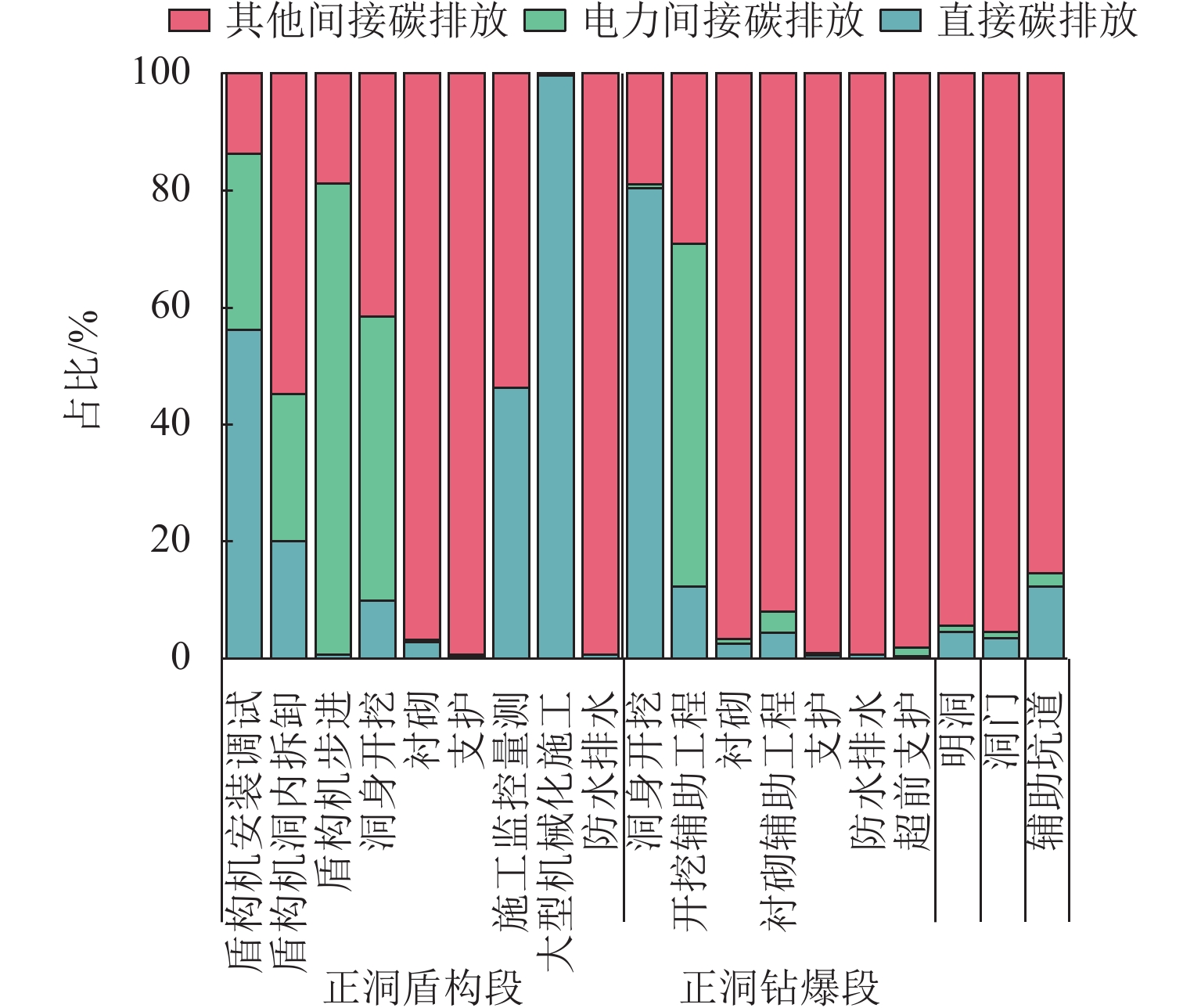
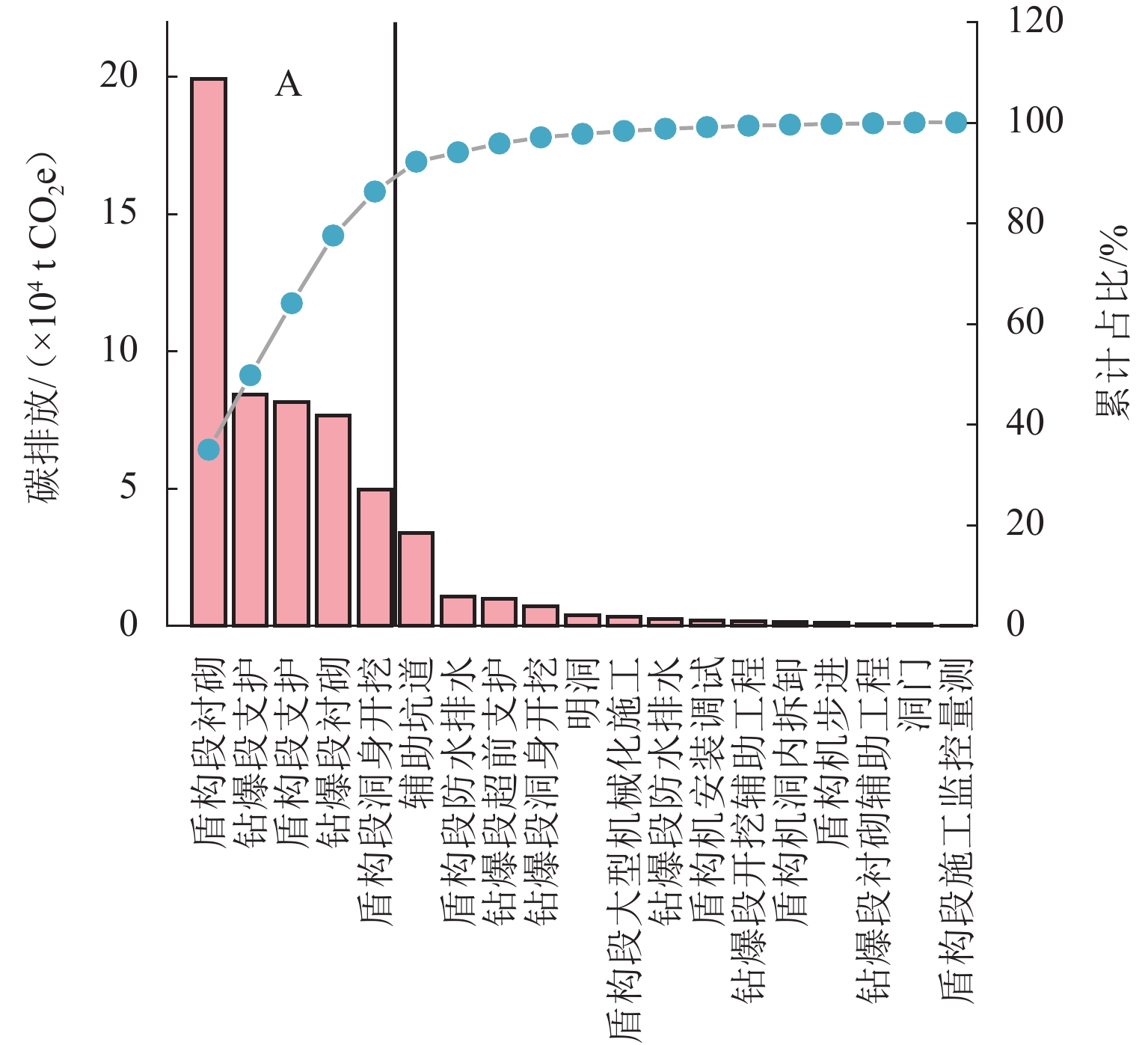
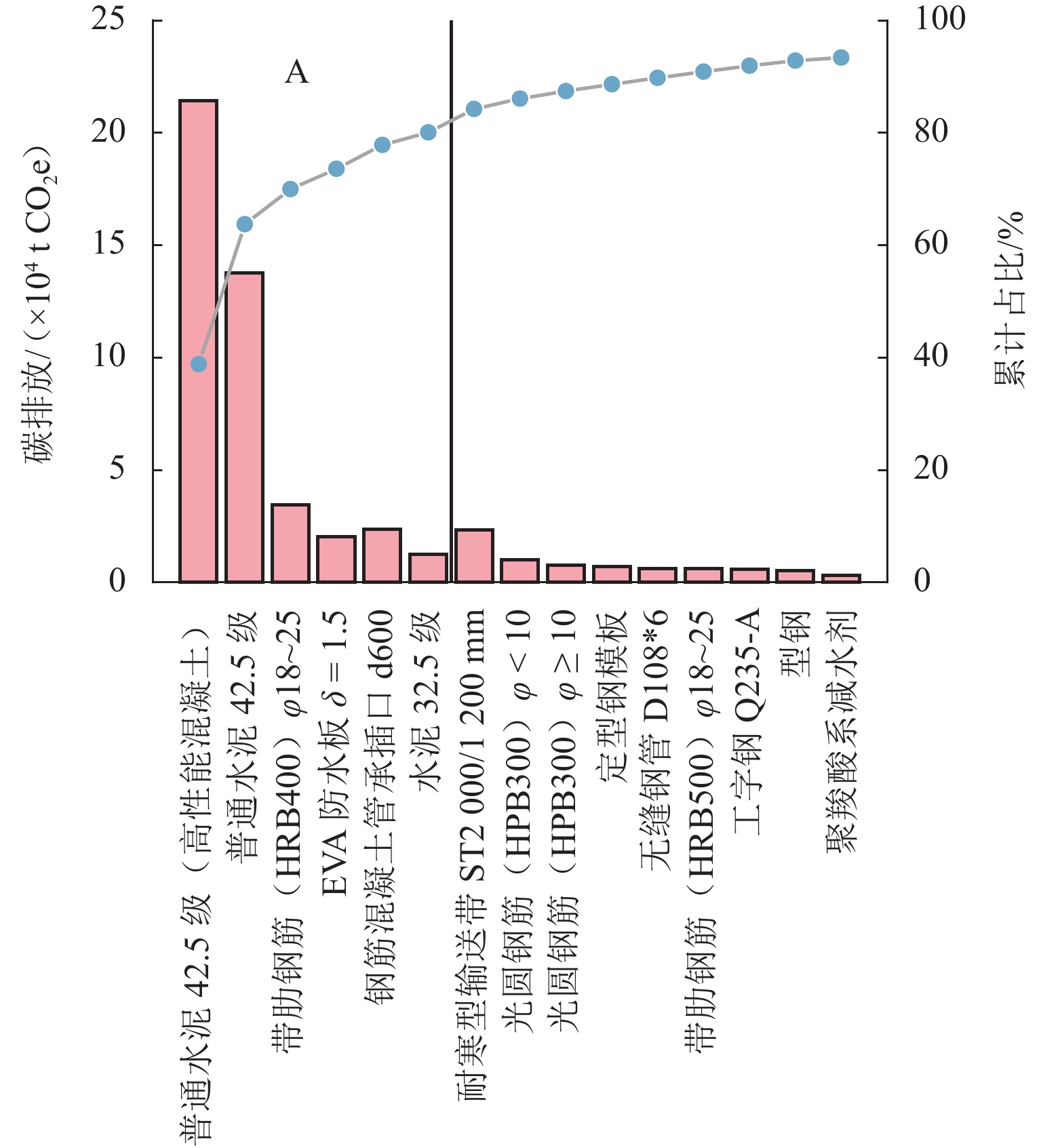
为准确评估铁路隧道工程全生命周期碳排放特征、支持专项分析与减排策略研究,针对铁路隧道施工工艺复杂、工序差异显著的特点,构建了涵盖工程物化阶段和运营维护阶段的碳排放核算模型,并结合分工序定额法与分材料碳因子法在某案例中进行碳排放量化核算与差异分析,进一步采用帕累托分析法识别高排放环节与关键影响因素,实现碳排放分解与分级管理. 结果表明:该案例隧道工程全生命周期碳排放为
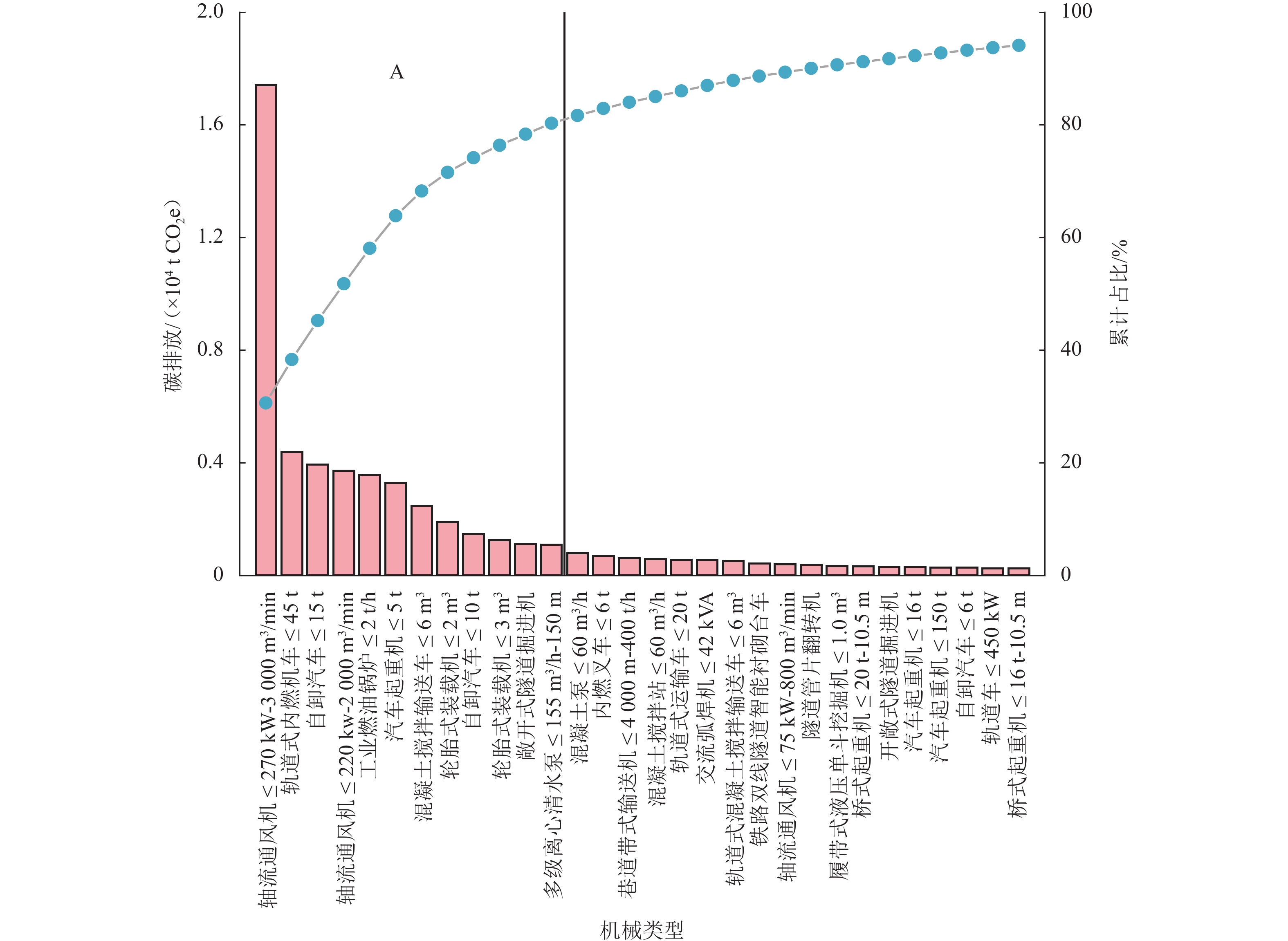
68.1075 × 10⁴ tCO2e,其中工程物化阶段产生碳排放59.4040 × 10⁴ tCO2e(占比87.2%),运营维护阶段碳排放8.7035 × 10⁴ tCO2e(占比12.8%);在工程物化阶段中,材料生产及现场施工过程贡献了高达95.76%的碳排放,其中钻爆段施工碳排放强度为13843 tCO2e/km,盾构段施工碳排放强度为钻爆段施工的39.8%;在运营维护阶段,通风系统、防水排水和钢筋混凝土预制管维护占据73.54%的碳排放;全生命周期中A类碳排材料包括普通水泥42.5级(高性能混凝土)、普通水泥42.5级和带肋钢筋等,A类碳排机械包括轴流通风机、轨道式内燃机车和自卸汽车等;A类碳排工序包括盾构段衬砌、钻爆段支护和盾构段支护等.Abstract:Given the complex construction processes and significant procedural variations in railway tunnels, a model for accounting carbon emissions covering the engineering materialization phase and the operation and maintenance phase was established to accurately assess carbon emission characteristics throughout the whole life cycle of railway tunnel engineering and support specialized analysis and emission reduction strategies. Combined with the unit rate method by procedure and the carbon factor method by material, quantitative accounting and variance analysis of carbon emissions were conducted in a case study. Furthermore, Pareto analysis was employed to identify high-emission sectors and key influencing factors, realizing the decomposition and hierarchical management of carbon emissions. The results indicate that the total carbon emissions during the whole life cycle of the case tunnel engineering are 68.107 5 × 10⁴ tCO2e, with the engineering materialization phase generating 59.404 0 × 104 tCO2e (accounting for 87.2%) and the operation and maintenance phase generating 8.703 5 × 10⁴ tCO2e (accounting for 12.8%). During the engineering materialization phase, material production and on-site construction processes contribute up to 95.76% of the carbon emissions, among which the carbon emission intensity of drill-and-blast section construction is 13 843 tCO2e/km, and that of shield section construction is 39.8% of the former. During the operation and maintenance phase, the maintenance of ventilation systems, waterproofing and drainage systems, and reinforced concrete precast pipes accounts for 73.54% of the carbon emissions. In the whole life cycle, Class A carbon-emitting materials include ordinary cement 42.5 grade (high-performance concrete), ordinary cement 42.5 grade, and ribbed steel bars; Class A carbon-emitting machinery includes axial flow fans, rail-type internal combustion locomotives, and dump trucks; Class A carbon-emitting processes include the lining of shield section, the support of drill-and-blast section, and the support of shield section.
-
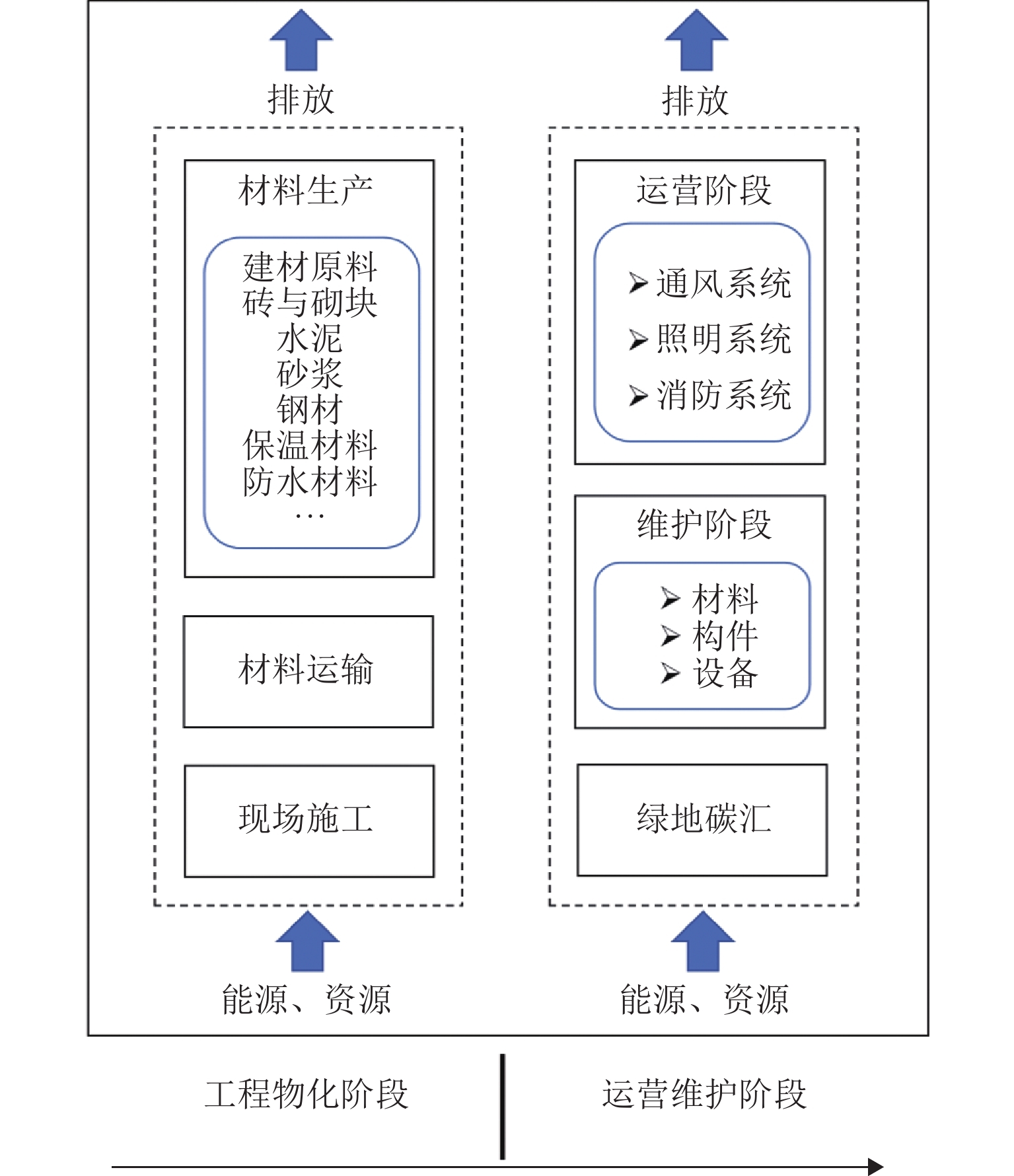
图 1 铁路隧道工程生命周期碳排放核算边界
Figure 1. Boundary of carbon emission accounting in life cycle of railway tunnel engineering
表 1 案例工程分阶段碳排放量
Table 1. Carbon emissions of case project by stage
阶段 项目 碳排放/(×104 tCO2e) 工程物化 材料生产 51.1046 材料运输 2.5193 现场施工 5.7801 运营维护 运营阶段 3.6536 维护阶段 5.0591 绿地碳汇 - 0.0092 生命周期 68.1075  下载: 导出CSV
表 2 不同阶段直接/间接碳排放情况
Table 2. Direct/indirect carbon emissions at different stages
直接/间接
排放工程物化阶段/
(×104 tCO2e)运营维护阶段/
(×104 tCO2e)生命周期/
(×104 tCO2e)直接碳排放 2.7920 0.4269 3.2189 电力间接碳排放 2.9702 4.1472 7.1174 其他间接碳排放 53.6418 4.1293 57.7711 总排放 59.4040 8.7035 68.1075
下载: 导出CSV
表 3 分部工程人材机电碳排放核算结果
Table 3. Accounting results of carbon emissions from labor, materials, machinery, and electricity in sub-projects
×104 tCO2e 隧道施
工工序人工碳
排放材料碳
排放机械碳
排放电力碳
排放占比/
%正洞盾构段 0.0966 30.5738 3.9086 0.2265 61.2 正洞钻爆段 0.0484 17.2096 0.9489 0.0346 32.0 明洞 0.0019 0.3622 0.0190 0.0004 0.7 洞门 0.0002 0.0578 0.0025 0.0000 0.1 辅助坑道 0.0163 2.9013 0.4607 0.0156 6.0
下载: 导出CSV
表 4 正洞钻爆段与盾构段碳排放强度对比
Table 4. Comparison of carbon emission intensity between drill-and-blast section and shield section in main tunnel
tCO2e/km 项目 按阶段 按排放源 合计 材料
生产材料
运输现场
施工直接
排放电力间
接排放其他间
接排放正洞钻
爆段12310 575 958 824 135 12884 13843 正洞盾
构段4600 223 687 277 410 4823 5510
下载: 导出CSV
表 5 运营阶段碳排放核算结果
Table 5. Accounting results of carbon emissions in operation phase
系统 项目 总功率/
kW运行时间/
(×105 h)碳排放/
(×105 tCO2e)通风系统 518.000 2.92 2.3339 照明系统 左线LED 47.450 8.76 0.6414 右线LED 47.425 8.76 0.6410 火灾消防
系统火灾报警
控制器
(联动型)1.200 8.76 0.0162 光纤光栅
处理器0.864 8.76 0.0117 监控计算器 0.700 8.76 0.0095
下载: 导出CSV
表 6 维护阶段碳排放核算结果
Table 6. Accounting results of carbon emissions in maintenance phase
×104 tCO2e 项目 直接
碳排放电力间接
碳排放其他间接
碳排放通风设施更换 0.011 0.314 0.034 高压线管 0.012 0.179 0.058 防水排水 0.008 0 1.306 明洞 0.017 0.004 0.362 中心水沟沟槽 0 0 0 钢筋混凝土
预制管0.379 0 2.374 合计 0.4281 0.4971 4.1339
下载: 导出CSV
表 7 前15种材料碳排放因子DQI值
Table 7. DQI values of carbon emission factors for top 15 materials
材料种类 可靠
性完整
性时间
范围地理
范围技术
范围普通水泥 42.5 级
(高性能混凝土)1 1 1 1 1 普通水泥 42.5 级 2 2 2 1 1 带肋钢筋(HRB400)φ18-25 1 1 1 1 2 水泥 32.5 级 1 1 2 2 1 EVA防水板 δ= 1.5 1 2 1 1 2 耐寒型输送带 ST2000/1200mm 1 1 1 1 1 钢筋混凝土管 承插口 d600 2 1 1 2 1 光圆钢筋(HPB300)φ<10 2 1 2 1 2 光圆钢筋(HPB300)φ>=10 1 2 2 1 2 定型钢模板 1 2 1 1 1 无缝钢管 D108*6 1 1 1 1 1 带肋钢筋(HRB500)φ18-25 2 2 2 2 1 工字钢 Q235-A 1 2 1 1 1 型钢 2 1 1 1 2 聚羧酸系减水剂 1 1 2 1 1
下载: 导出CSV
-
[1] 鲍学英, 王珂, 刘北胜, 等. 基于XGBoost的铁路客站土建工程物化阶段碳排放预测及关键影响因素研究[J/OL]. 西南交通大学学报, 2025-08-29. https://link.cnki.net/urlid/51.1277.U.20250829.1448.002.Bao Xueying, Wang Ke, Liu Beisheng, et al. Research on carbon emission prediction and key influencing factors in the materialization stage of railway station civil engineering based on XGBoost[J/OL]. Journal of Southwest Jiaotong University, 2025-08-29. https://link.cnki.net/urlid/51.1277.U.20250829.1448.002. [2] Zhang Z X, Wang D M, Meng F Q, et al. Navigating Low-Carbon transport in Sichuan Province: a synergistic approach[J]. Transportation Research Part D: Transport and Environment, 2025, 142: 104687. doi: 10.1016/j.trd.2025.104687 [3] Ji S H, Zhang Z X, Meng F Q, et al. Scenario simulation and synergistic effect analysis of CO2 and atmospheric pollutant emission reduction in urban transport sector: a case study of Chengdu, China[J]. Journal of Cleaner Production, 2024, 438: 140841. doi: 10.1016/j.jclepro.2024.140841 [4] 李群湛, 黄小红, 吴波, 等. 电气化铁路绿电利用与零碳贯通供电技术[J/OL]. 西南交通大学学报, 2025-05-19. https://link.cnki.net/urlid/51.1277.u.20250517.1635.002.Li Qunzhan, Huang Xiaohong, Wu Bo, et al. Research on green power utilization and zero-carbon feed-through power supply technology for electrified railways[J/OL]. Journal of Southwest Jiaotong University, 2025-05-19. https://link.cnki.net/urlid/51.1277.u.20250517.1635.002. [5] 郭文凯, 王果, 闵永智. 计及阶梯式碳交易的牵引供电系统混合储能容量配置[J]. 西南交通大学学报, 2025, 60(3): 550-560.Guo Wenkai, Wang Guo, Min Yongzhi. Hybrid energy storage capacity configuration for traction power supply systems considering ladder-type carbon trading mechanism[J]. Journal of Southwest Jiaotong University, 2025, 60(3): 550-560. [6] 曾弘锐, 孙文昊, 何卫, 等. 基于机器学习的铁路隧道施工碳排放预测模型研究[J]. 现代隧道技术, 2023, 60(6): 29-39. doi: 10.13807/j.cnki.mtt.2023.06.004Zeng Hongrui, Sun Wenhao, He Wei, et al. Study on the carbon emission prediction model for railway tunnel construction based on machine learning[J]. Modern Tunnelling Technology, 2023, 60(6): 29-39. doi: 10.13807/j.cnki.mtt.2023.06.004 [7] 吕刚, 刘建友, 于晨昀, 等. 铁路隧道绿色低碳建造技术工程实践与展望[J]. 隧道建设(中英文), 2024, 44(4): 633-642.Lyu Gang, Liu Jianyou, Yu Chenyun, et al. Practice and prospect of green and low-carbon construction technology for railway tunnels[J]. Tunnel Construction, 2024, 44(4): 633-642. [8] 孙文昊, 郭亚林, 曾弘锐, 等. 铁路隧道工程节能减排技术研究现状及展望[J]. 交通节能与环保, 2024, 20(5): 227-232, 237. doi: 10.3969/j.issn.1673-6478.2024.05.048Sun Wenhao, Guo Yalin, Zeng Hongrui, et al. Current status and prospects of energy conservation and emission reduction technology in railway tunnel engineering[J]. Transport Energy Conservation & Environmental Protection, 2024, 20(5): 227-232,237. doi: 10.3969/j.issn.1673-6478.2024.05.048 [9] Ji S H, Wang Y G, He L, et al. Greenhouse gas emission in the whole process of forest fire including rescue: a case of forest fire in Beibei District of Chongqing[J]. Environmental Science and Pollution Research, 2023, 30(52): 113105-113117. doi: 10.1007/s11356-023-30247-8 [10] Li Y, He Q, Luo X, et al. Calculation of life-cycle greenhouse gas emissions of urban rail transit systems: a case study of Shanghai Metro[J]. Resources, Conservation and Recycling, 2018, 128: 451-457. doi: 10.1016/j.resconrec.2016.03.007 [11] Kaewunruen S, Sresakoolchai J, Yu S N. Global warming potentials due to railway tunnel construction and maintenance[J]. Applied Sciences, 2020, 10(18): 6459. doi: 10.3390/app10186459 [12] Hu X D, Zhang X M, Dong L, et al. Carbon emission factors identification and measurement model construction for railway construction projects[J]. International Journal of Environmental Research and Public Health, 2022, 19(18): 11379. doi: 10.3390/ijerph191811379 [13] 李乔松, 白云, 李林. 盾构隧道建造阶段低碳化影响因子与措施研究[J]. 现代隧道技术, 2015, 52(3): 1-7. doi: 10.13807/j.cnki.mtt.2015.03.001Li Qiaosong, Bai Yun, Li Lin. Study of influential factors and measures for low carbonization during the construction of shield tunnels[J]. Modern Tunnelling Technology, 2015, 52(3): 1-7. doi: 10.13807/j.cnki.mtt.2015.03.001 [14] 鲍学英, 廖程涵, 李子龙, 等. 铁路隧道物化阶段碳排放核算方法及管理路径研究[J]. 隧道建设(中英文), 2025, 45(2): 284-294. doi: 10.3973/j.issn.2096-4498.2025.02.004Bao Xueying, Liao Chenghan, Li Zilong, et al. Carbon emission accounting methods and management paths in embodied stage of railway tunnels[J]. Tunnel Construction, 2025, 45(2): 284-294. doi: 10.3973/j.issn.2096-4498.2025.02.004 [15] 王一鹏, 王锦. 铁路隧道钻爆法与盾构法施工碳排放强度分析[J]. 铁路节能环保与安全卫生, 2024, 14(3): 24-30. doi: 10.16374/j.cnki.issn2095-1671.2024.0026Wang Yipeng, Wang Jin. Carbon emission intensity analysis of railway tunnel drilling and blasting method and shield tunneling method construction[J]. Railway Energy Saving & Environmental Protection & Occupational Safety and Health, 2024, 14(3): 24-30. doi: 10.16374/j.cnki.issn2095-1671.2024.0026 [16] 陈进杰, 王兴举, 王祥琴, 等. 高速铁路全生命周期碳排放计算[J]. 铁道学报, 2016, 38(12): 47-55.Chen Jinjie, Wang Xingju, Wang Xiangqin, et al. Calculation of carbon dioxide emissions in the life cycle of high-speed railway[J]. Journal of the China Railway Society, 2016, 38(12): 47-55. [17] 杜建明, 高修强, 房倩, 等. 气动荷载作用下高速铁路隧道衬砌结构的疲劳累积损伤及残余寿命计算方法[J]. 中国铁道科学, 2021, 42(5): 94-102. doi: 10.3969/j.issn.1001-4632.2021.05.11Du Jianming, Gao Xiuqiang, Fang Qian, et al. Calculation method for cumulative fatigue damage and residual life of lining structure of high-speed railway tunnel under aerodynamic load[J]. China Railway Science, 2021, 42(5): 94-102. doi: 10.3969/j.issn.1001-4632.2021.05.11 [18] 郭亚林, 郭春. 铁路隧道施工期碳排放计算模型研究[J]. 交通节能与环保, 2021, 17(6): 5-9.Guo Yalin, Guo Chun. Calculation model of life cycle carbon emissions of railway tunnel[J]. Transport Energy Conservation & Environmental Protection, 2021, 17(6): 5-9. [19] 陈飞, 翁辉, 高硕晗, 等. 隧道工程建设碳排放特征与减碳潜力分析[J]. 公路工程, 2024, 49(3): 186-194. doi: 10.19782/j.cnki.1674-0610.2024.03.025Chen Fei, Weng Hui, Gao Shuohan, et al. Research on carbon emission characteristics and reduction potentials of tunnel construction[J]. Highway Engineering, 2024, 49(3): 186-194. doi: 10.19782/j.cnki.1674-0610.2024.03.025 [20] Sun H W, Park Y. CO2 emission calculation method during construction process for developing BIM-based performance evaluation system[J]. Applied Sciences, 2020, 10(16): 5587. doi: 10.3390/app10165587 [21] 靳春玲, 安祥, 贡力, 等. 基于G2-CRITIC-UMT模型的铁路隧道低碳施工评价研究[J]. 铁道标准设计, 2025, 69(1): 139-146. doi: 10.13238/j.issn.1004-2954.202305100002Jin Chunling, An Xiang, Gong Li, et al. Research on low-carbon construction evaluation of railway tunnels based on G2-CRITIC-UMT model[J]. Railway Standard Design, 2025, 69(1): 139-146. doi: 10.13238/j.issn.1004-2954.202305100002 [22] 齐梦学, 曾绍毅, 杨庆辉, 等. 铁路隧道TBM施工物料运输方式对比分析[J]. 隧道建设(中英文), 2024, 44(5): 1077-1085. doi: 10.3973/j.issn.2096-4498.2024.05.015Qi Mengxue, Zeng Shaoyi, Yang Qinghui, et al. Comparative analysis of material transport methods for railway tunnels constructed with hard rock tunnel boring machines[J]. Tunnel Construction, 2024, 44(5): 1077-1085. doi: 10.3973/j.issn.2096-4498.2024.05.015 [23] 鲍学英, 许锟. 考虑碳排放的铁路隧道施工机械配置优化模型[J]. 铁道学报, 2020, 42(9): 157-164. doi: 10.3969/j.issn.1001-8360.2020.09.020Bao Xueying, Xu Kun. Optimization model of deployment of railway tunnel construction machinery considering carbon emission[J]. Journal of the China Railway Society, 2020, 42(9): 157-164. doi: 10.3969/j.issn.1001-8360.2020.09.020 [24] Guo C, Xu J F, Yang L, et al. Life cycle evaluation of greenhouse gas emissions of a highway tunnel: a case study in China[J]. Journal of Cleaner Production, 2019, 211: 972-980. doi: 10.1016/j.jclepro.2018.11.249 [25] 王祺, 王晓斌, 卢晓东, 等. 铁路隧道养维护作业空气环境综合整治技术研究[J]. 铁路节能环保与安全卫生, 2022, 12(3): 48-54.Wang Qi, Wang Xiaobin, Lu Xiaodong, et al. Study on comprehensive improvement technology of air environment in railway tunnel maintenance operation[J]. Railway Energy Saving & Environmental Protection & Occupational Safety and Health, 2022, 12(3): 48-54. [26] 郭亚林, 孙文昊, 许洪伟, 等. 地铁隧道盾构及钻爆法施工碳排放强度对比[J]. 现代隧道技术, 2023, 60(3): 14-23, 64. doi: 10.13807/j.cnki.mtt.2023.03.002Guo Yalin, Sun Wenhao, Xu Hongwei, et al. Comparison between shield method and drill and blast method regarding carbon emission intensity in subway tunnel construction[J]. Modern Tunnelling Technology, 2023, 60(3): 14-23,64. doi: 10.13807/j.cnki.mtt.2023.03.002 -

 下载:
下载:

 点击查看大图
计量
- 文章访问数: 172
- HTML全文浏览量: 195
- PDF下载量: 65
- 被引次数: 0