



Research on Modular Functionality Recovery Functions for Cable-Stayed Bridges
-
摘要:
为量化斜拉桥抗震韧性评价中的功能恢复权重系数,避免依赖经验或专家问卷的主观性,提出一种基于模块化功能恢复函数的抗震韧性评价方法. 首先,采用Pair Copula分层模型将斜拉桥划分为构件、子系统及系统3个层次,分别计算各层次的地震易损性;其次,基于各子系统在不同损伤状态下的概率比值,进行概率加权,构建功能恢复权重系数的量化模型;进而,综合考虑功能恢复、修复时间与修复路径,建立模块化功能恢复函数,并通过集成子系统修复顺序形成系统级功能恢复函数;最终,建立斜拉桥抗震韧性评价流程,并以某斜拉桥为例进行抗震韧性评价. 结果表明:功能恢复权重系数随地震动强度变化,与各子系统损伤程度密切相关;若采用常数型权重系数,支座子系统的恢复贡献将被低估约50%;斜拉桥各构件地震响应具有较强的相关性,若假设构件完全独立,系统易损性计算误差可达28%~53.3%;在规范规定的地震动强度范围内,忽略子系统修复顺序会使系统韧性指数低估约9%.
Abstract:To quantify the functionality recovery weighting coefficient in the seismic resilience assessment of cable-stayed bridges and avoid the subjectivity relying on experience or expert questionnaires, a seismic resilience assessment method based on a modular functionality recovery function was proposed. First, a Pair Copula hierarchical model was employed to divide a cable-stayed bridge into three levels, i.e., components, subsystems, and the system, and the seismic fragility of each level was calculated. Second, based on the probability ratio of each subsystem under different damage states, probability weighting was performed to construct a quantitative model of the functionality recovery weighting coefficient. Furthermore, a modular functionality recovery function was established by comprehensively considering functionality recovery, repair time, and repair path. Then, a system-level functionality recovery function was formed by integrating the repair sequence of subsystems. Finally, a seismic resilience assessment procedure for cable-stayed bridges was established, and a seismic resilience assessment was conducted taking a cable-stayed bridge as an example. The results indicate that the functionality recovery weighting coefficient varies with the ground motion intensity and is closely related to the damage degree of each subsystem. If a constant weighting coefficient is adopted, the recovery contribution of the bearing subsystem is underestimated by approximately 50%. The seismic responses of the components of cable-stayed bridges have strong correlations; if the components are assumed to be completely independent, the calculation error of the system fragility can reach 28%–53.3%. Within the ground motion intensity range specified by codes, if the repair sequence of subsystems is neglected, the system resilience index is underestimated by approximately 9%.
-

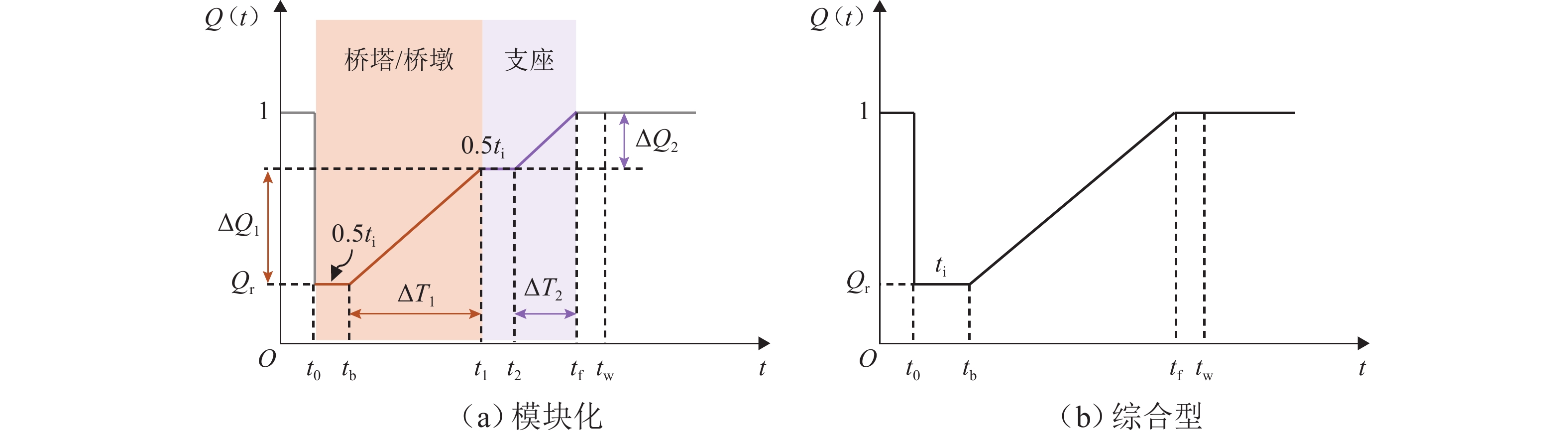
图 3 斜拉桥系统功能恢复函数
Figure 3. System functionality recovery function of cable-stayed bridge

图 5 基于斜拉桥模块化功能恢复函数的抗震韧性评价流程
Figure 5. Seismic resilience assessment procedure based on modular functionality recovery function for cable-stayed bridges

图 6 斜拉桥非线性有限模型
Figure 6. Nonlinear finite element model diagram of cable-stayed bridge
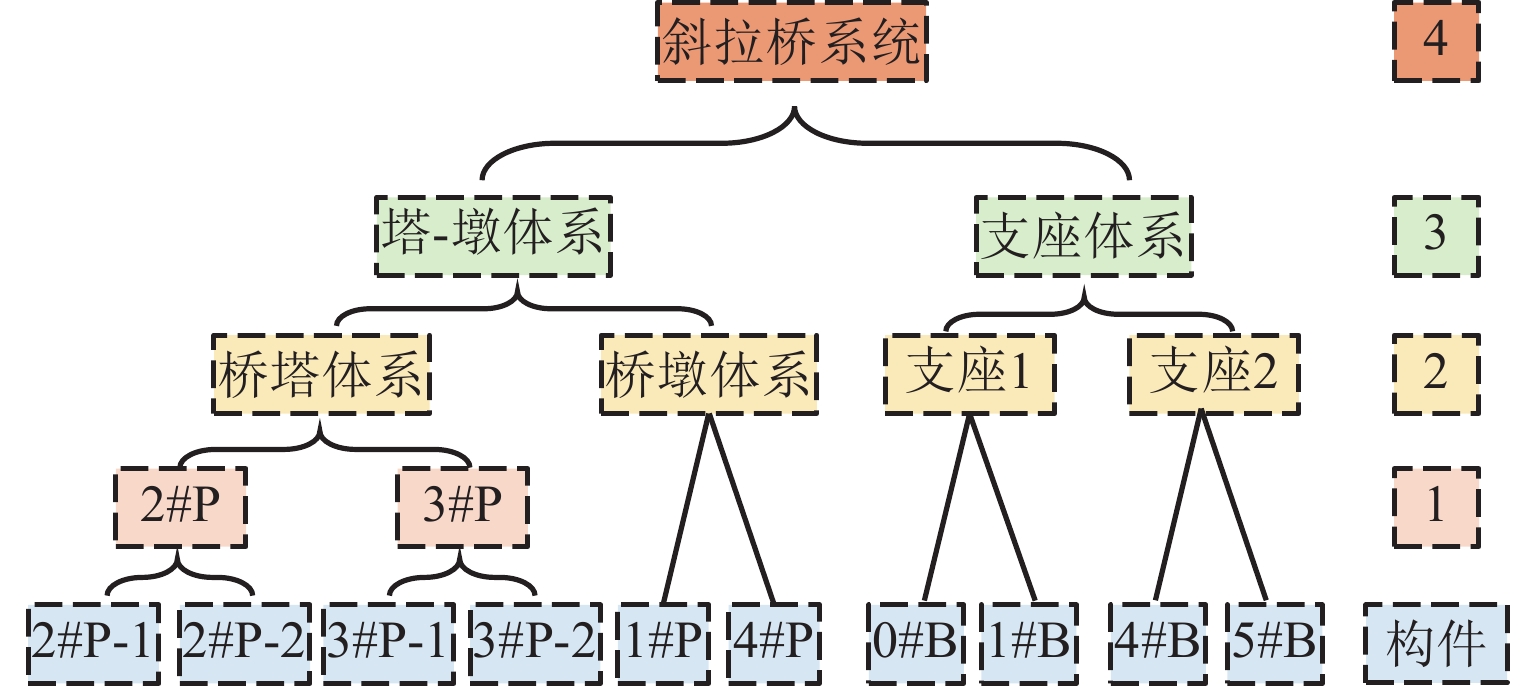
图 8 斜拉桥Pair Copula分层配对模型
Figure 8. Pair Copula hierarchical pairing model diagram of cable-stayed bridge
表 1 斜拉桥损伤状态与功能损失比对应关系表
Table 1. Correspondence between damage states and functionality loss ratios of cable-stayed bridges
损伤状态 Lj/% 轻微损伤 15 中等损伤 30 严重损伤 60 完全破坏 100  下载: 导出CSV
表 2 斜拉桥不同损伤状态下修复时间分布表
Table 2. Repair time distribution of cable-stayed bridges under different damage states
d 损伤程度 tf ti Tb min max min max min max 轻微损伤 5 120 5 30 3 8 中等损伤 15 170 3 8 严重损伤 55 220 5 10 完全破坏 75 270 5 10
下载: 导出CSV
表 3 最优Copula函数及检验结果
Table 3. Optimal Copula function and test results
位置 构件名 Copula函数类型 参数 1 参数 2 KS检验统计量 p 值 第 1 层 2#P Frank 13.94 \ 0.045 0.985 3#P Frank 12.77 \ 0.040 0.997 第 2 层 桥塔体系 Gaussian 0.99 \ 0.040 0.997 桥墩体系 Gumbel 3.42 \ 0.090 0.377 支座 1 Gaussian 0.96 \ 0.110 0.167 支座 2 Gumbel 6.22 \ 0.105 0.208 第 3 层 塔-墩体系 t 0.91 8.36 0.065 0.779 支座体系 Gumbel 8.84 \ 0.095 0.312 第 4 层 斜拉桥系统 Clayton 2.68 \ 0.085 0.449
下载: 导出CSV
-
[1] 陈志强, 曾永平, 陈志伟, 等. 基于Bootstrap的桥梁地震易损性不确定性量化[J/OL]. 西南交通大学学报, 1-10[2025-10-12]. [2] 朱圣春, 崔冰, 宋颖彤, 等. UHPC预应力连接装配式桥墩抗震设计方法研究[J/OL]. 西南交通大学学报, 1-11[2025-10-09]. [3] 梁桓玮, 许春荣, 林昱, 等. 轴压比对钢壳混凝土索塔的滞回性能影响[J/OL]. 西南交通大学学报, 2025-06-19. https://kns.cnki.net/KCMS/detail/detail.aspx filename=XNJT20250604001&dbname=CJFD&dbcode=CJFQ. [4] Cimellaro G P, Reinhorn A M, Bruneau M. Framework for analytical quantification of disaster resilience[J]. Engineering Structures, 2010, 32(11): 3639-3649. doi: 10.1016/j.engstruct.2010.08.008 [5] Applied Technology Council. Earthquake damage evaluation data for California[R]. Redwood City: [s. n], 1999. [6] Federal Emergency Management Agency. Multi-hazard loss estimation methodology: Earthquake model Hazus-MH MR5 technical manual[M]. Washington, D. C. : [s. n. ], 2011. [7] Pang Y T, Wei K, He H F, et al. Assessment of lifetime seismic resilience of a long-span cable-stayed bridge exposed to structural corrosion[J]. Soil Dynamics and Earthquake Engineering, 2022, 157: 107275. doi: 10.1016/j.soildyn.2022.107275 [8] 赵灿晖, 王睿鹏, 杨正浩, 等. 铁路简支梁桥震后残余功能与抗震韧性评价方法研究[J]. 桥梁建设, 2025, 55(4): 33-40.Zhao Canhui, Wang Ruipeng, Yang Zhenghao, et al. Post-earthquake serviceability and seismic resilience evaluation method for simply-supported girder railway bridge[J]. Bridge Construction, 2025, 55(4): 33-40. [9] 杨国俊, 田里, 杜永峰, 等. 基于修复函数的连续梁桥抗震韧性因素及改进评估研究[J]. 土木工程学报, 2022, 55(增刊1): 219-226. doi: 10.15951/j.tmgcxb.2022.S1.0904Yang Guojun, Tian Li, Du Yongfeng, et al. Research on seismic resilience factors and improved evaluation of continuous beam bridges based on recovery function[J]. China Civil Engineering Journal, 2022, 55(S1): 219-226. doi: 10.15951/j.tmgcxb.2022.S1.0904 [10] Chen X, Guan Z G, Li J Z, et al. Repair procedure-based recovery pattern for estimating seismic resilience and novel concept of public resilience[J]. Disaster Prevention and Resilience, 2023, 2(3): 16. doi: 10.20517/dpr.2023.23 [11] Zhang J, Huo Y L. Evaluating effectiveness and optimum design of isolation devices for highway bridges using the fragility function method[J]. Engineering Structures, 2009, 31(8): 1648-1660. doi: 10.1016/j.engstruct.2009.02.017 [12] 王晓伟, 叶爱君, 吴学平, 等. 梁式桥抗震韧性评估方法: Ⅰ. 基于专家意见的构件震后功能恢复模型[J]. 土木工程学报, 2025, 58(1): 65-76. doi: 10.15951/j.tmgcxb.23080638Wang Xiaowei, Ye Aijun, Wu Xueping, et al. Seismic resilience assessment method for girder bridges: Ⅰ. Expert opinion-based post-earthquake functionality recovery models of bridge components[J]. China Civil Engineering Journal, 2025, 58(1): 65-76. doi: 10.15951/j.tmgcxb.23080638 [13] 周连绪, 吴学平, 王晓伟, 等. 板式橡胶支座梁桥抗震韧性评估[J]. 东南大学学报(自然科学版), 2024, 54(6): 1386-1394. doi: 10.3969/j.issn.1001-0505.2024.06.006Zhou Lianxu, Wu Xueping, Wang Xiaowei, et al. Seismic resilience assessment of unbonded rubber-bearing supported girder bridges[J]. Journal of Southeast University (Natural Science Edition), 2024, 54(6): 1386-1394. doi: 10.3969/j.issn.1001-0505.2024.06.006 [14] 尹伟涛, 康炜, 卢皓, 等. 基于专家问卷调查的铁路梁式桥抗震韧性评价方法研究[J/OL]. 土木工程学报, 2025-07-24. https://doi.org/10.15951/j.tmgcxb.25040264. [15] 李天翊, 王志鹏, 张东昱, 等. 考虑交通流影响的立交桥抗震韧性评估方法[J/OL]. 东南大学学报(自然科学版), 2025-07-17. https://kns.cnki.net/kcms/detail/32.1178.N.20250717.1412.002.html. [16] 王海军. 双柱墩桥梁下部结构地震易损性分析及抗震韧性评估[D]. 雅安: 四川农业大学, 2024. [17] 何世杰. 海底地震动作用跨海连续梁桥系统易损性分析及韧性与可持续性评估[D]. 南昌: 南昌大学, 2024. [18] 宋帅, 吴元昊, 徐佰顺, 等. 斜拉桥系统地震易损性评估的Pair Copula技术[J]. 工程力学, 2021, 38(9): 110-123. doi: 10.6052/j.issn.1000-4750.2020.09.0629Song Shuai, Wu Yuanhao, Xu Baishun, et al. Pair copula technique of seismic vulnerability assessment of cable-stayed bridge system[J]. Engineering Mechanics, 2021, 38(9): 110-123. doi: 10.6052/j.issn.1000-4750.2020.09.0629 [19] 李幸钰, 雷鹰, 林树枝, 等. 优化藤Copula的桥梁结构系统地震易损性分析[J]. 土木工程学报, 2023, 56(11): 43-55, 136. doi: 10.15951/j.tmgcxb.22060665Li Xingyu, Lei Ying, Lin Shuzhi, et al. Assessment on seismic fragility of bridge structural systems by optimized vine Copulas[J]. China Civil Engineering Journal, 2023, 56(11): 43-55,136. doi: 10.15951/j.tmgcxb.22060665 [20] 焦驰宇. 基于性能的大跨斜拉桥地震易损性分析[D]. 上海: 同济大学, 2008. [21] Größer J, Okhrin O. Copulae: an overview and recent developments[J]. WIREs Computational Statistics, 2022, 14(3): e1557. doi: 10.1002/wics.1557 [22] 段佳宏. 大跨度铁路斜拉桥抗震韧性评价方法研究[D]. 成都: 西南交通大学, 2024. [23] Pang Y T, Wei K, Yuan W C. Life-cycle seismic resilience assessment of highway bridges with fiber-reinforced concrete piers in the corrosive environment[J]. Engineering Structures, 2020, 222: 111120. doi: 10.1016/j.engstruct.2020.111120 [24] Dong Y, Frangopol D M. Risk and resilience assessment of bridges under mainshock and aftershocks incorporating uncertainties[J]. Engineering Structures, 2015, 83: 198-208. doi: 10.1016/j.engstruct.2014.10.050 [25] JTG/T 2231-01—2020 公路桥梁抗震设计规范[S]. [26] Choi E, Desroches R, Nielson B. Seismic fragility of typical bridges in moderate seismic zones[J]. Engineering Structures, 2004, 26(2): 187-199. doi: 10.1016/j.engstruct.2003.09.006 -

 下载:
下载:




 点击查看大图

计量
- 文章访问数: 91
- HTML全文浏览量: 42
- PDF下载量: 52
- 被引次数: 0