



Numerical Investigation of Flow-Induced Vibration Characteristics Under Typical Cavitation Conditions Around Hydrofoil
-
摘要:
为研究NACA66水翼典型空化阶段的非定常流固耦合特性,基于非定常空化流固耦合数值计算模型,对其水动力及流激振动特性进行了数值计算. 首先,建立非定常空化流固耦合数值计算模型,并将计算结果与吴钦等的实验结果进行对比,验证模型的准确性;其次,基于数值计算方法,分析了典型空化流型分布与非定常流场结构演变的响应特性;最后,探究不同典型空化阶段水动力及其诱导振动特性. 结果表明:典型空化阶段,空泡最大长度随空化数的减小而增加,且云状空化阶段呈明显周期性,升阻力系数随空化数的变化而变化;水翼端部最大振动位移和振动速度在初生空化阶段保持较高水平,在超空化阶段处于较低水平(由于空泡全覆盖效应),而在云状空化阶段受到周期性非定常效应的影响,呈现大幅周期性波动;水翼结构尖端的最大位移和最大扭转角分别与所受升力和俯仰力矩成线性关系;水翼流激振动的频率和空化脱落频率基本一致,且振动频率随着空化数的减小而减小.
Abstract:To investigate the unsteady fluid-structure interaction (FSI) characteristics of the NACA66 hydrofoil during typical cavitation stages, its hydrodynamic and flow-induced vibration characteristics were numerically calculated using an unsteady cavitating FSI model. First, an unsteady cavitating FSI numerical model was established, and the calculated results were compared with the experimental results reported by Wu et al. to verify the accuracy of the model. Second, the characteristics of typical cavitation flow pattern distributions and the evolution of the unsteady flow-field structure were analyzed using the numerical method. Finally, the hydrodynamic and flow-induced vibration characteristics during different typical cavitation stages were further investigated. The results show that, during typical cavitation stages, the maximum cavity length increases as the cavitation number decreases, and cloud cavitation exhibits pronounced periodicity. The lift and drag coefficients vary with the cavitation number. The maximum tip vibration displacement and velocity of the hydrofoil remain relatively high during incipient cavitation but remain low during supercavitation due to the effect of full cavity coverage. During cloud cavitation, the maximum vibration displacement and velocity exhibit substantial periodic fluctuations due to unsteady flow effects. The maximum tip displacement and maximum tip torsion angle of the hydrofoil are linearly related to the lift and pitching moment, respectively. In addition, the flow-induced vibration frequency of the hydrofoil is approximately equal to the cavitation shedding frequency, and the vibration frequency decreases as the cavitation number decreases.
-
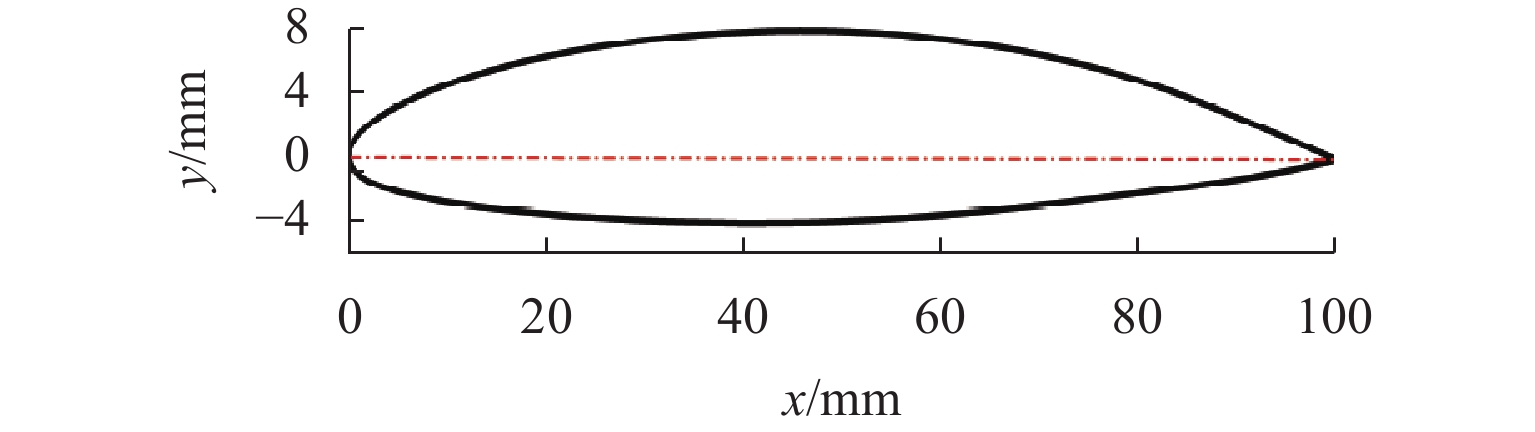
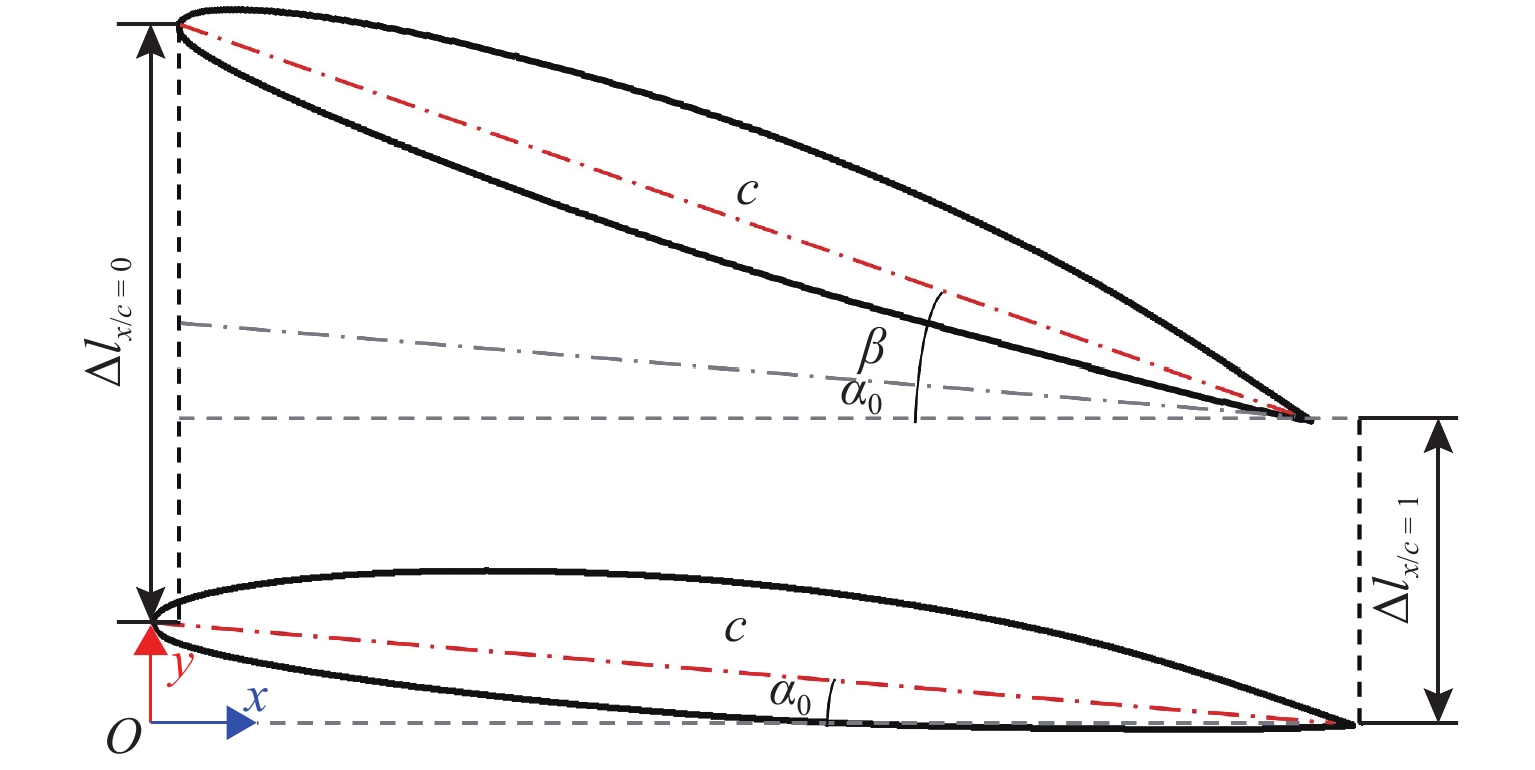
图 1 NACA66型水翼基线形状与坐标系定义
Figure 1. Baseline geometry and coordinate system of NACA66 hydrofoil
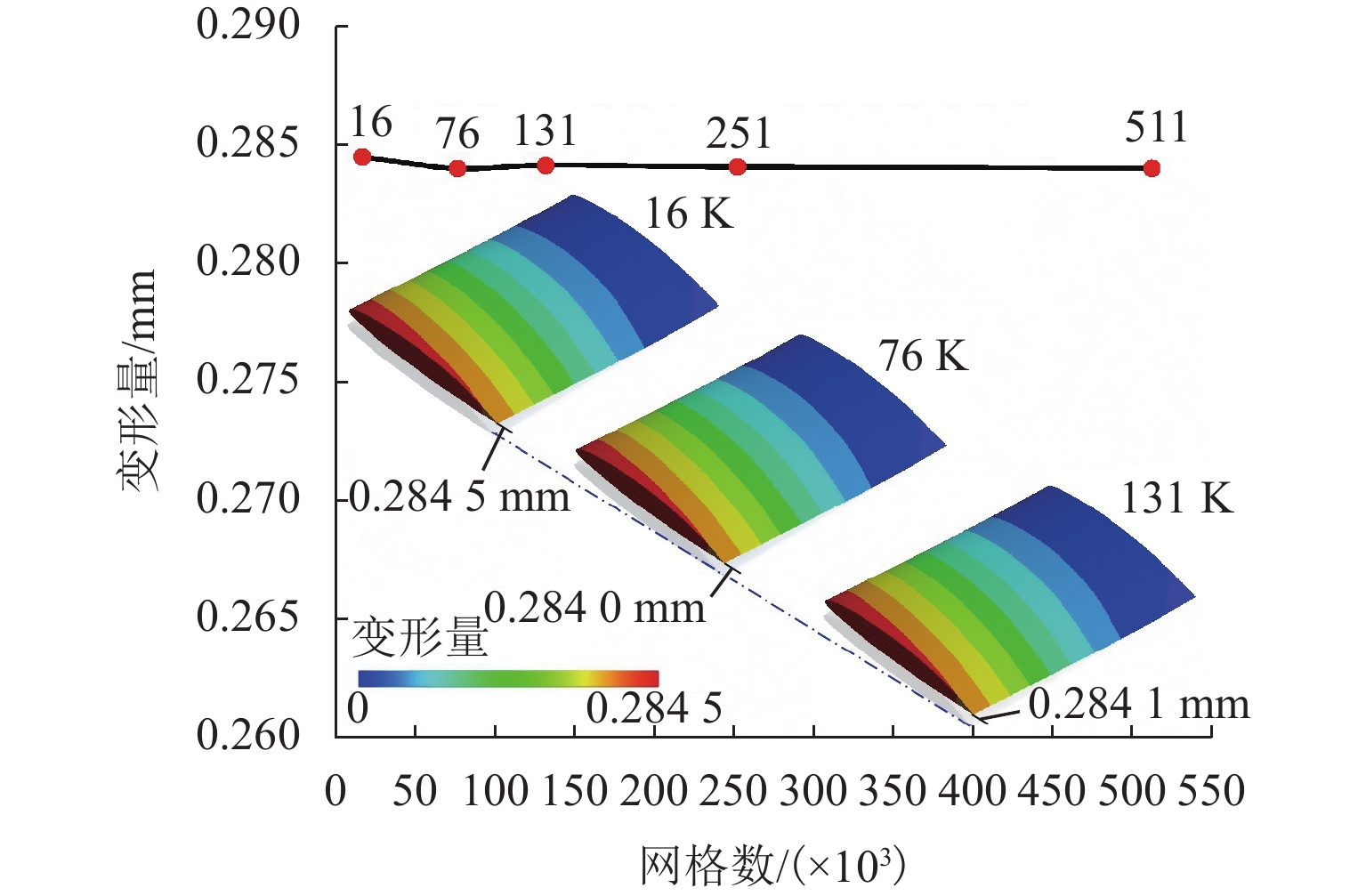
图 5 NACA66水翼结构网格无关性验证
Figure 5. Mesh independence verification for NACA66 hydrofoil structure
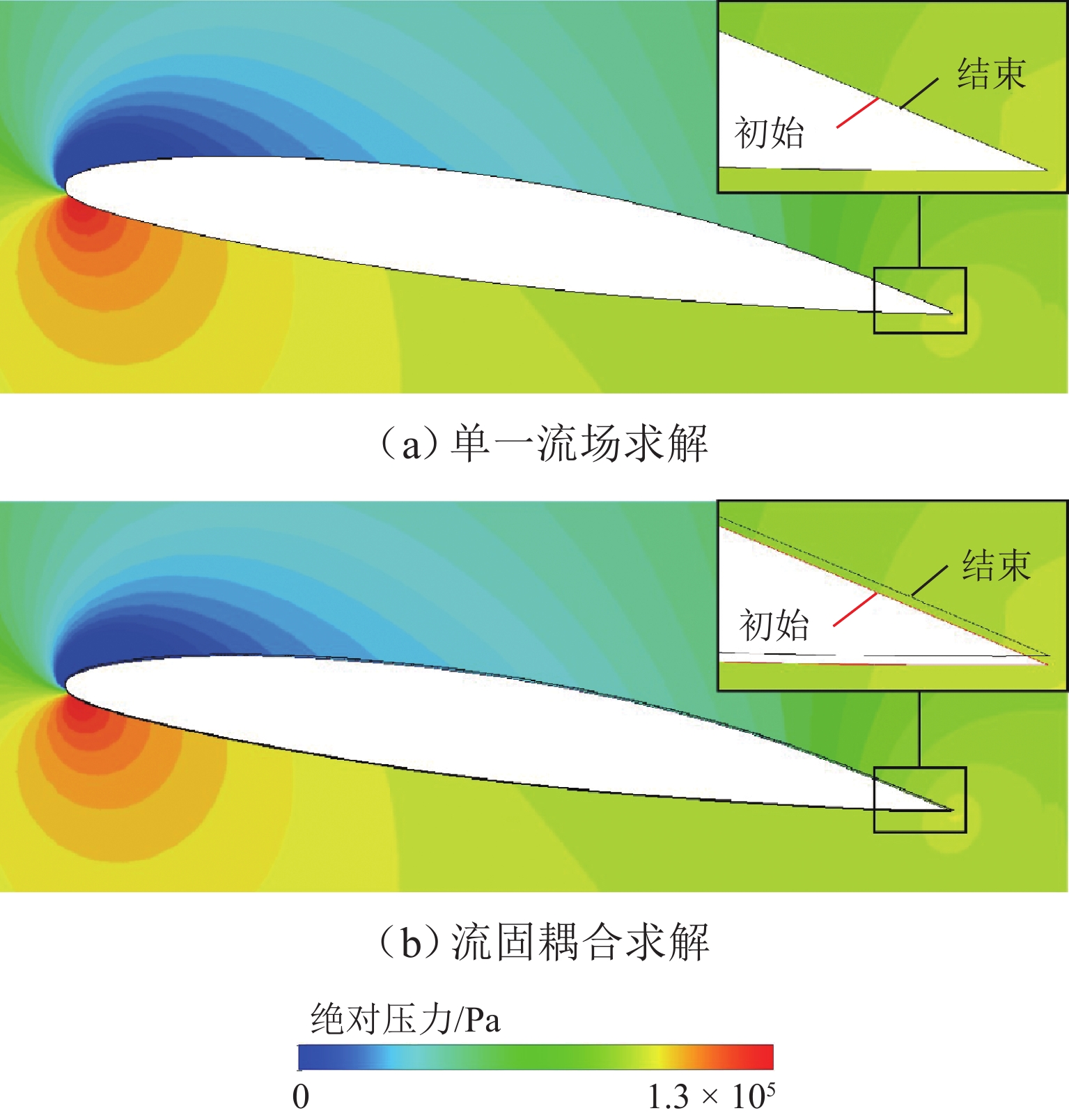
图 7 流场压力分布云图(z/b=0.5)与水翼端部变形
Figure 7. Flow-field pressure contours (z/b = 0.5) and hydrofoil tip deformation
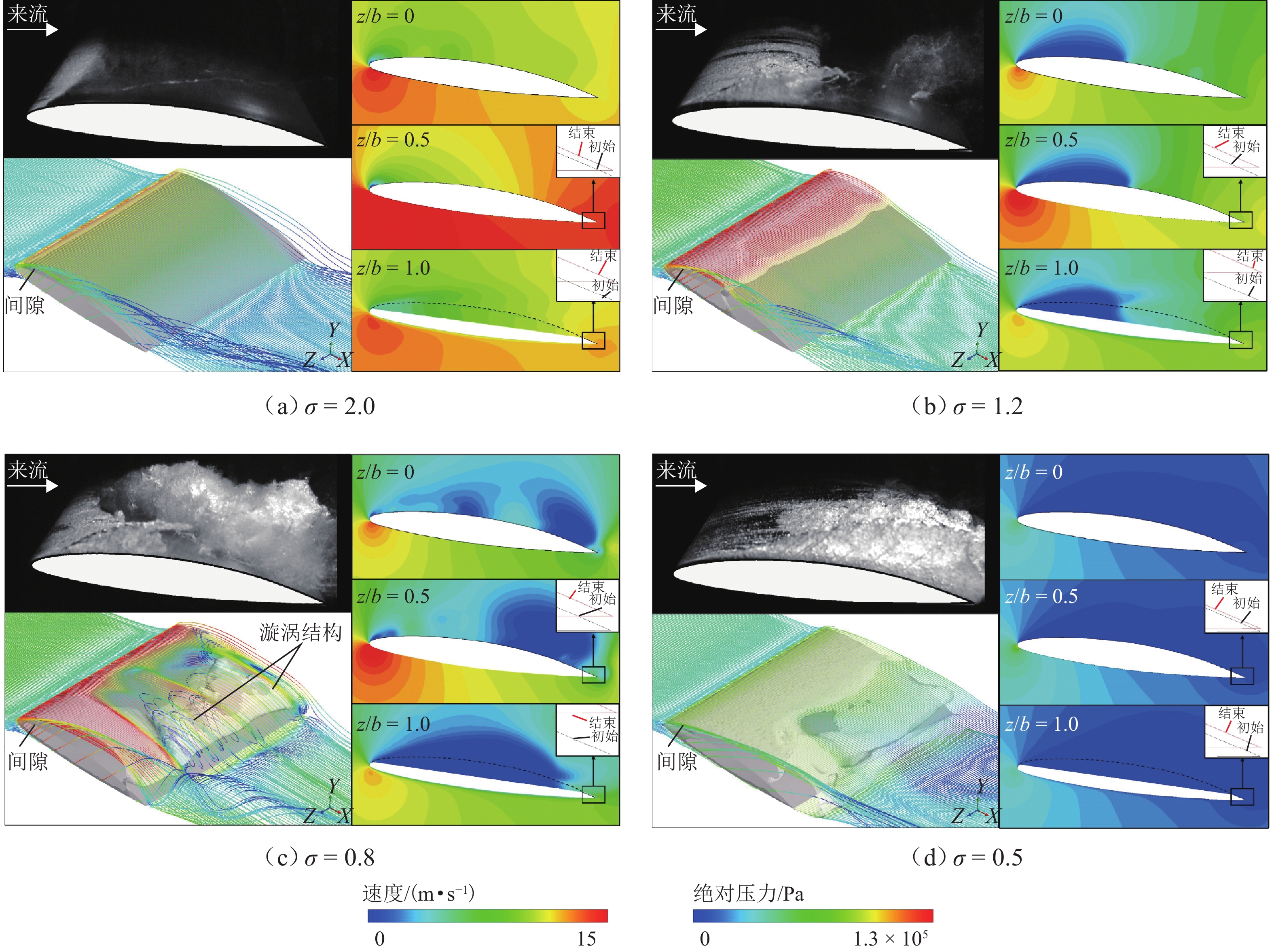
图 8 典型空化阶段的速度分布及典型截面压力分布(含气率0.15)
Figure 8. Velocity distributions and pressure distributions at representative cross sections during typical cavitation stages (gas volume fraction = 0.15)
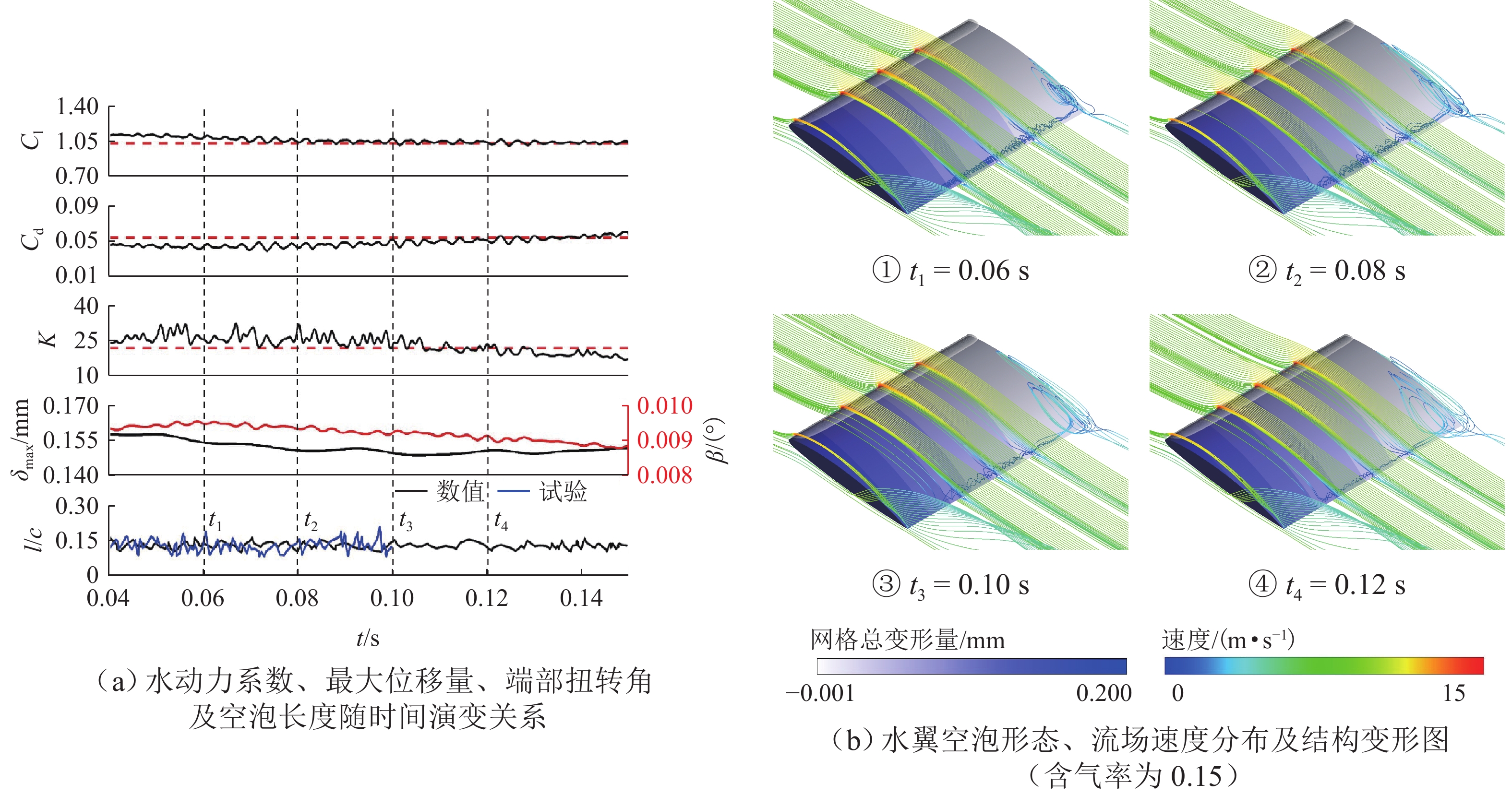
图 9 绕NACA66水翼初生空化水动力系数及流场演变
Figure 9. Hydrodynamic coefficients and flow-field evolution around NACA66 hydrofoil during incipient cavitation
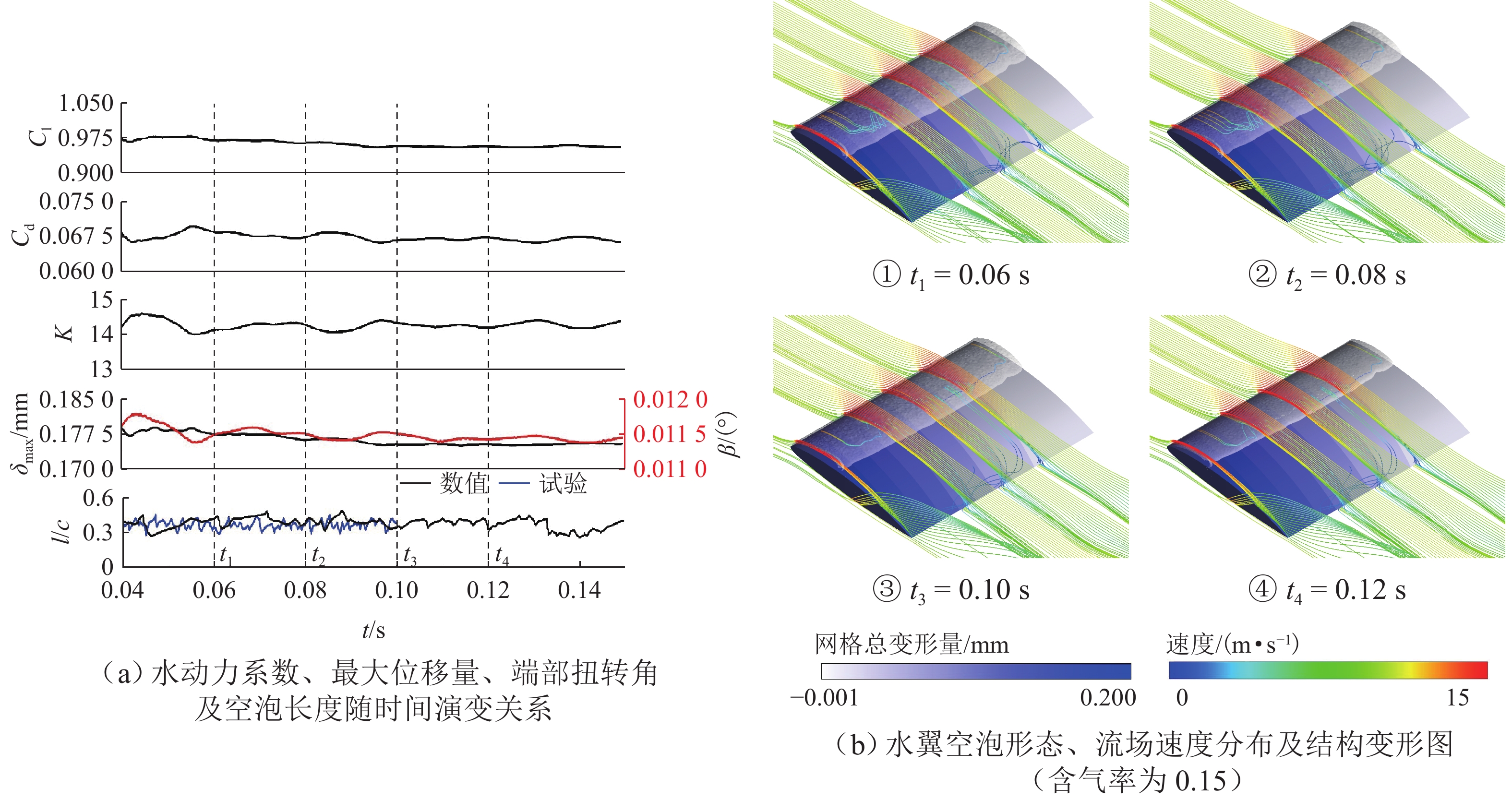
图 10 绕NACA66水翼片状空化水动力系数及流场演变
Figure 10. Hydrodynamic coefficients and flow-field evolution around NACA66 hydrofoil during sheet cavitation
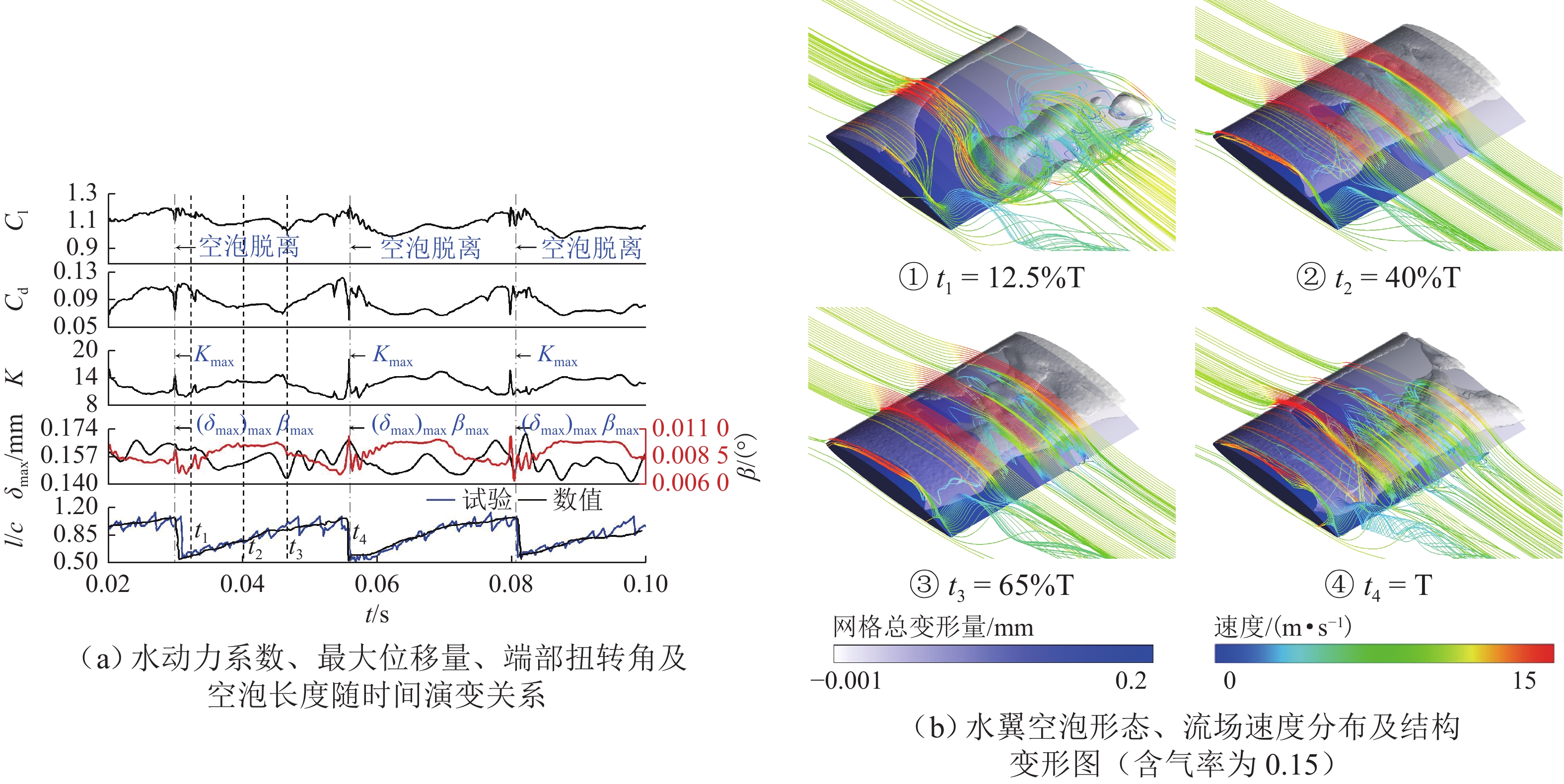
图 11 绕NACA66水翼云状空化水动力系数及流场演变
Figure 11. Hydrodynamic coefficients and flow-field evolution around NACA66 hydrofoil during cloud cavitation
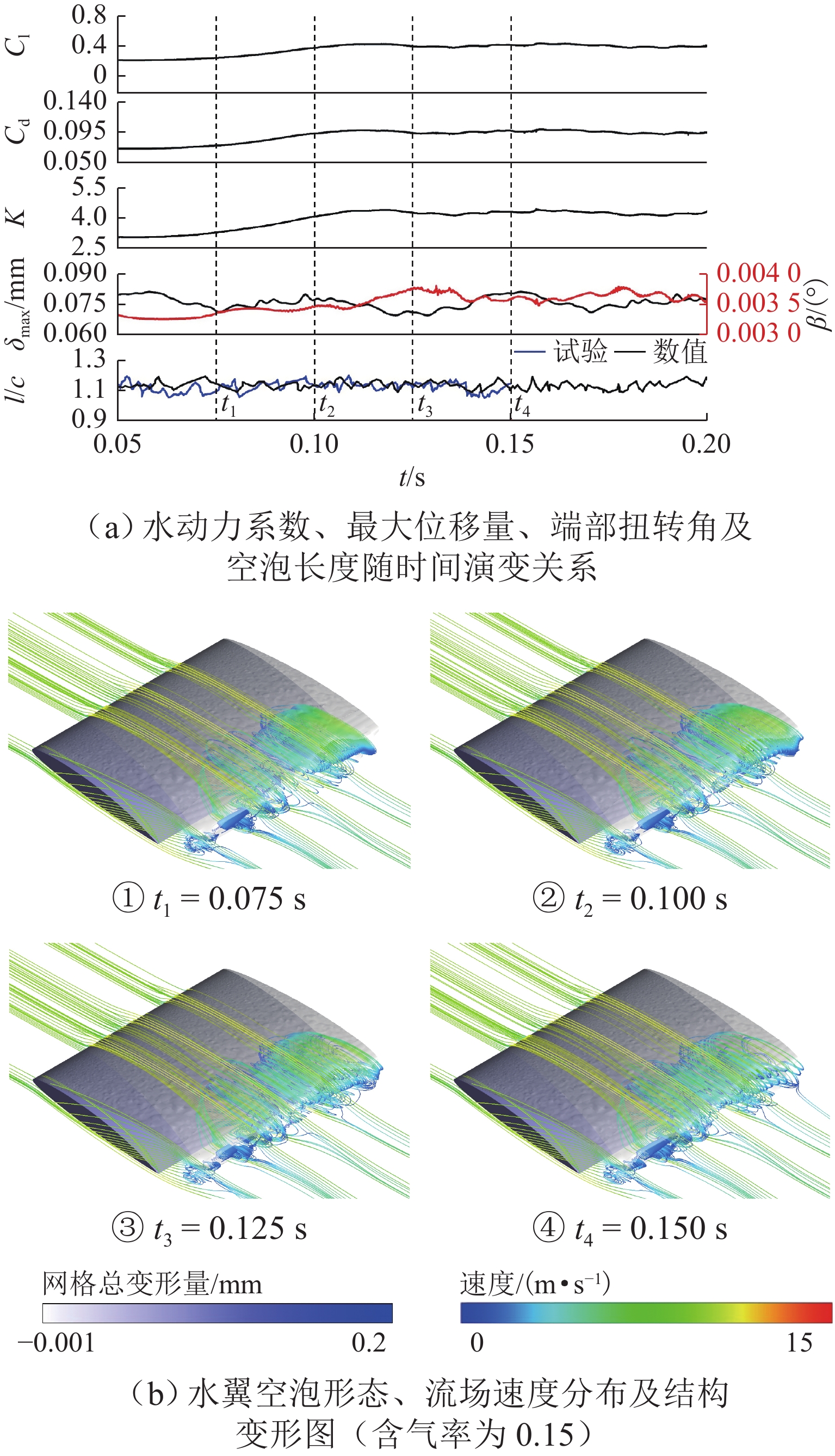
图 12 绕NACA66水翼超空化水动力系数及流场演变
Figure 12. Hydrodynamic coefficients and flow-field evolution around NACA66 hydrofoil during supercavitation
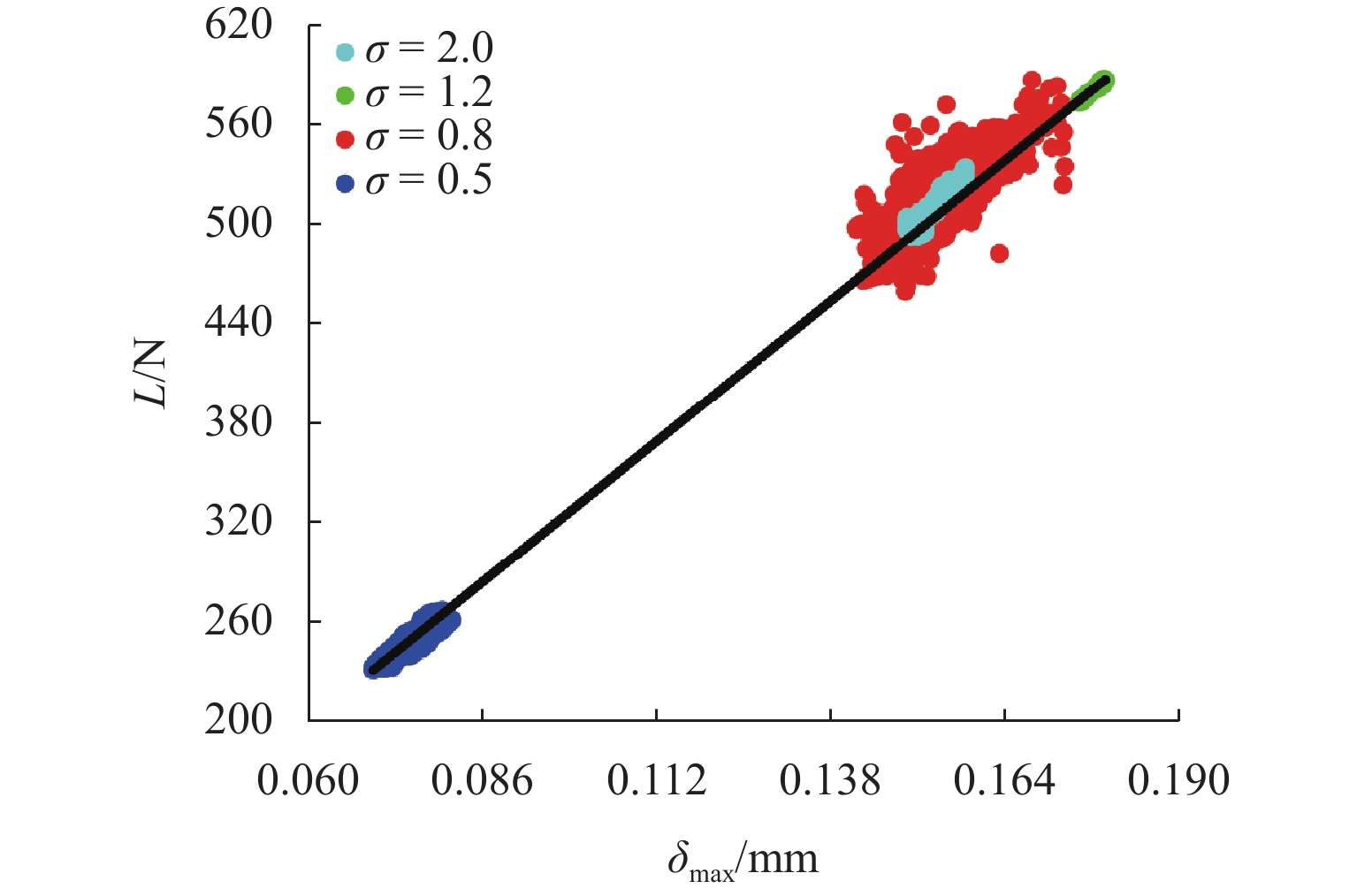
图 13 典型空化阶段水翼升力与端部最大位移的分布情况
Figure 13. Distributions of hydrofoil lift and maximum tip displacement during typical cavitation stages
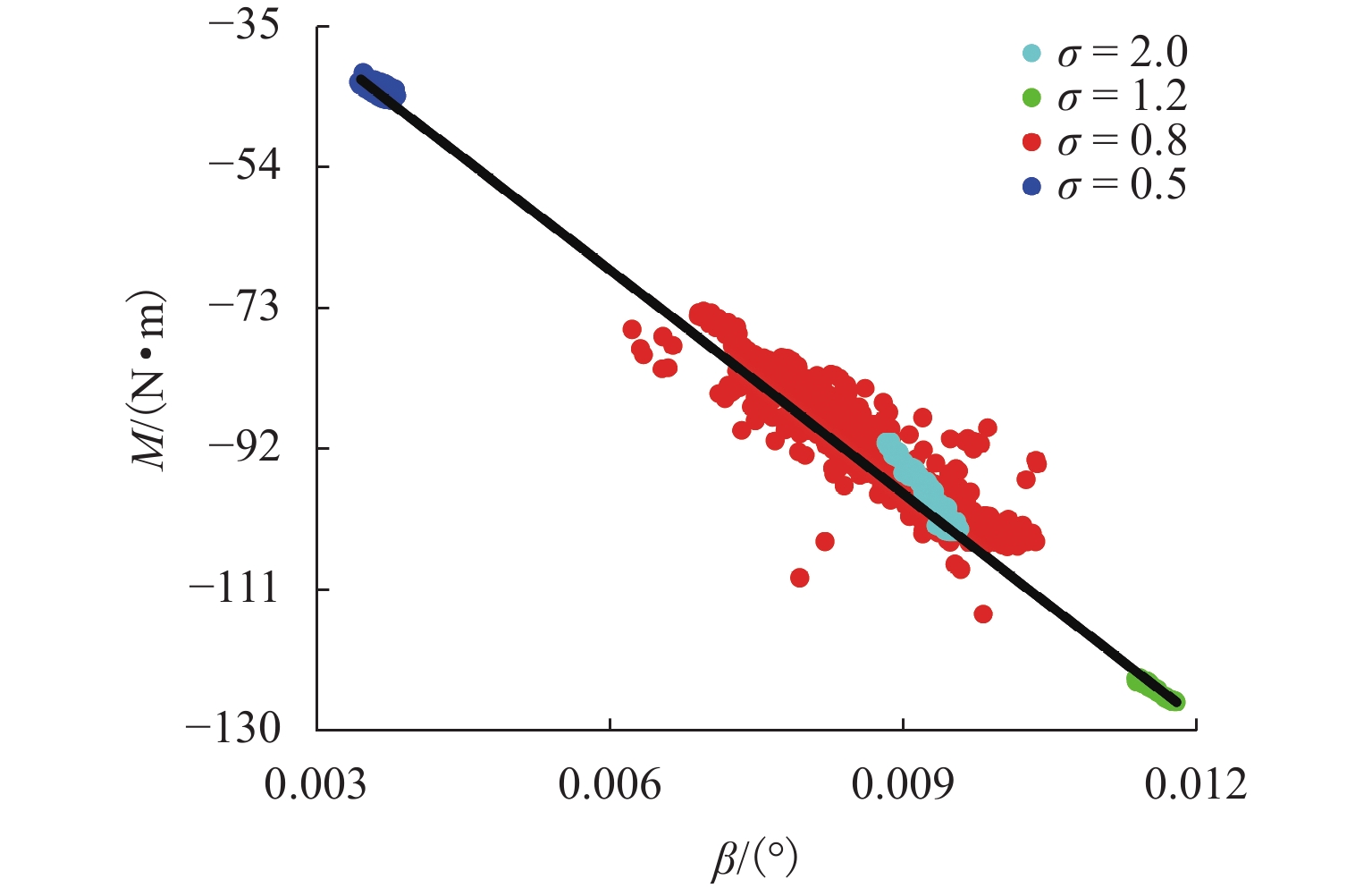
图 15 典型空化阶段水翼俯仰力矩与端部扭转角的分布情况
Figure 15. Distributions of hydrofoil pitching moment and tip torsion angle during typical cavitation stages
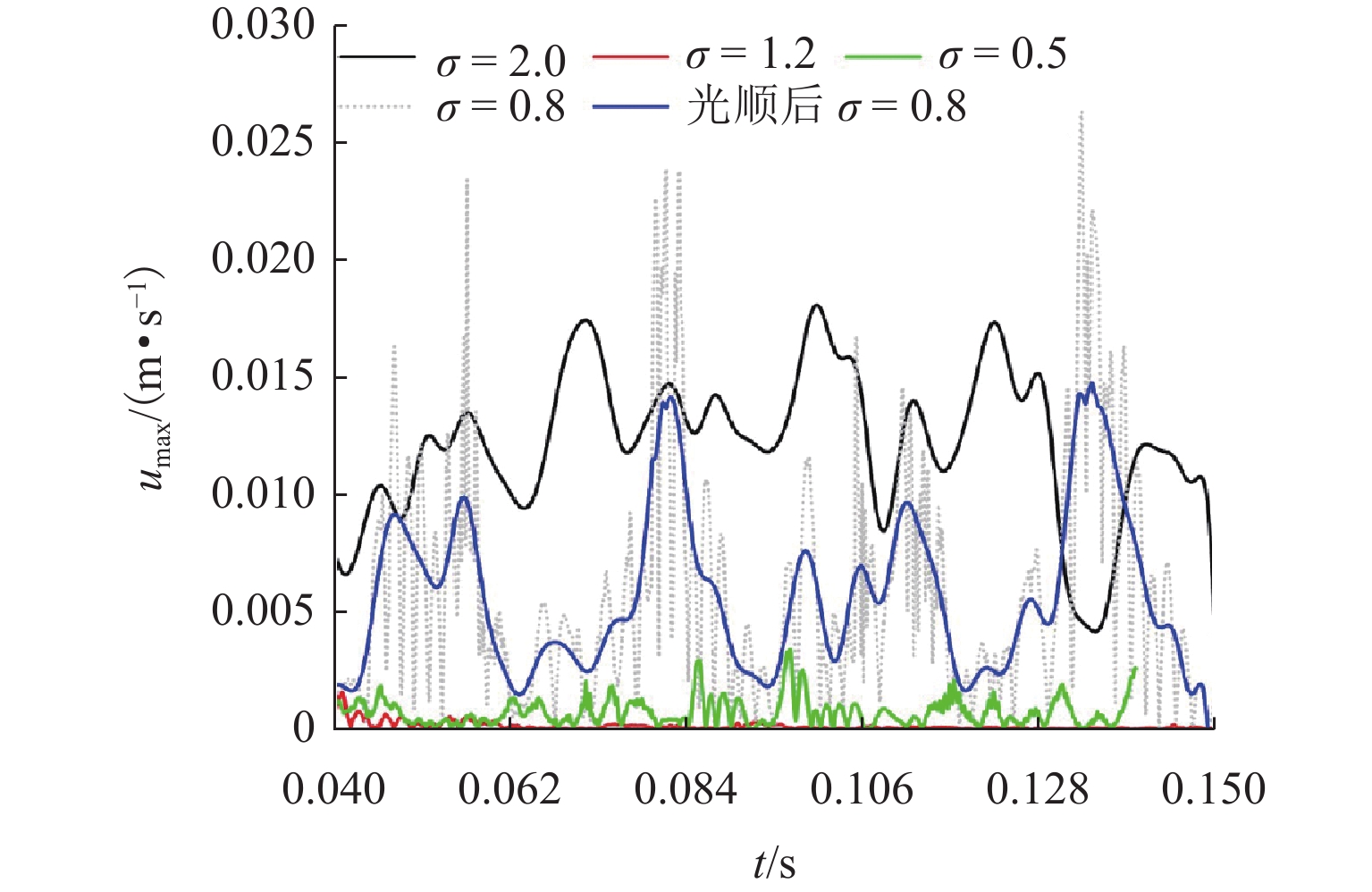
图 16 典型空化阶段结构场最大振动速度随时间的变化曲线图
Figure 16. Time histories of maximum structural vibration velocity during typical cavitation stages
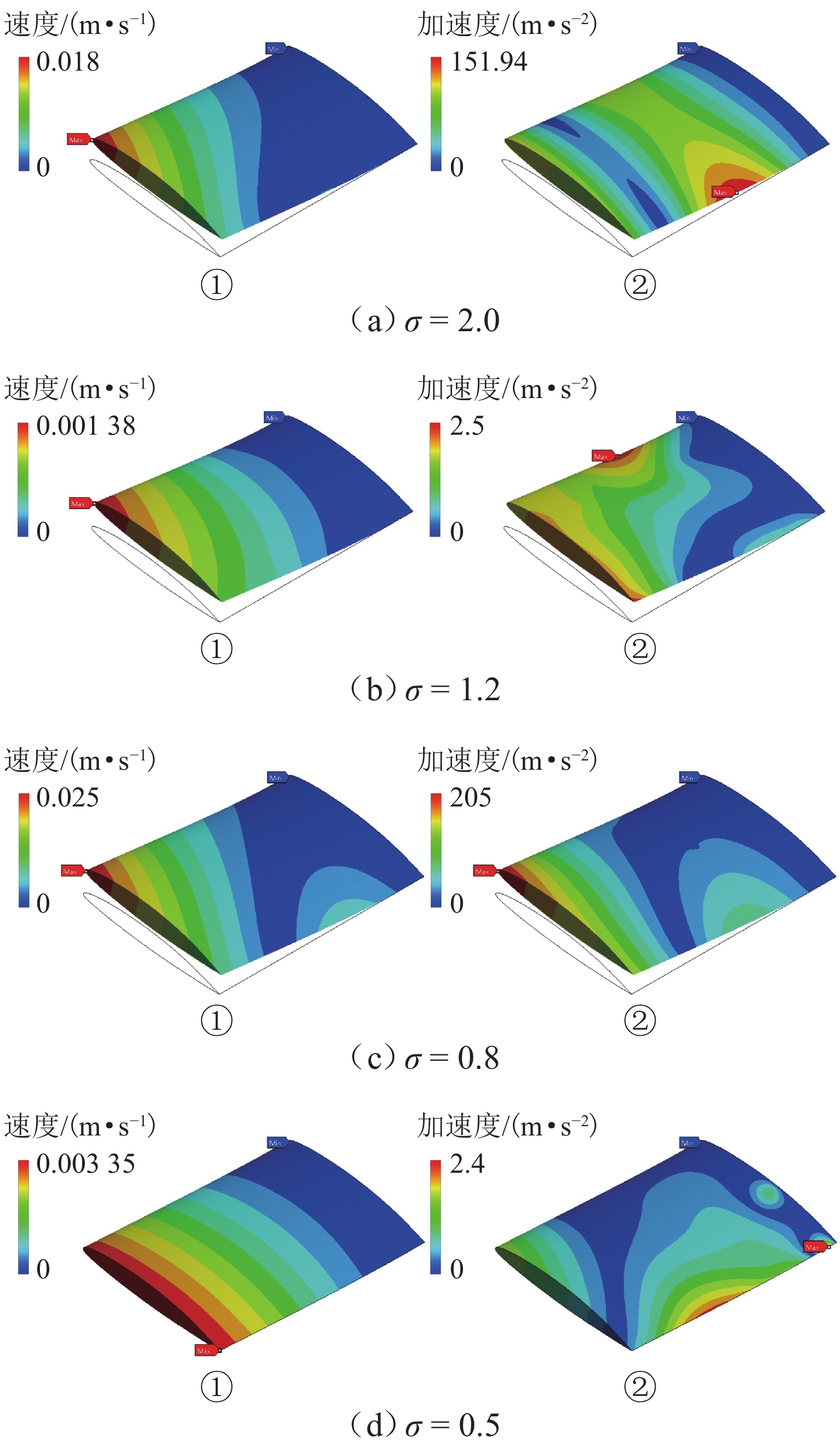
图 17 典型空化阶段水翼结构场最大振动速度和加速度分布云图
Figure 17. Contours of maximum vibration velocity and acceleration of hydrofoil structure during typical cavitation stages
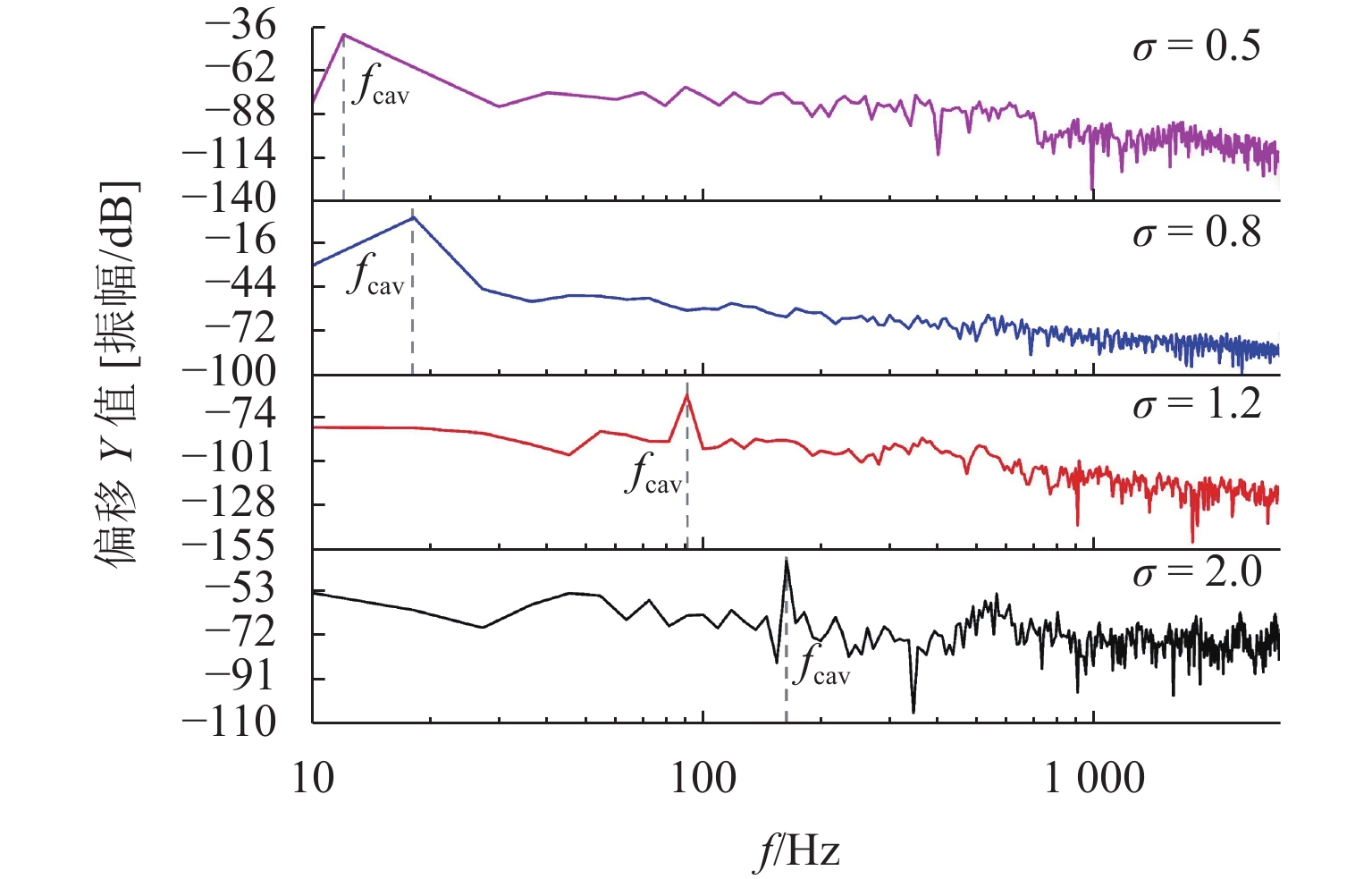
图 18 基于最大振动速度的典型空化阶段的频谱分析
Figure 18. Spectral analysis of maximum vibration velocity during typical cavitation stages
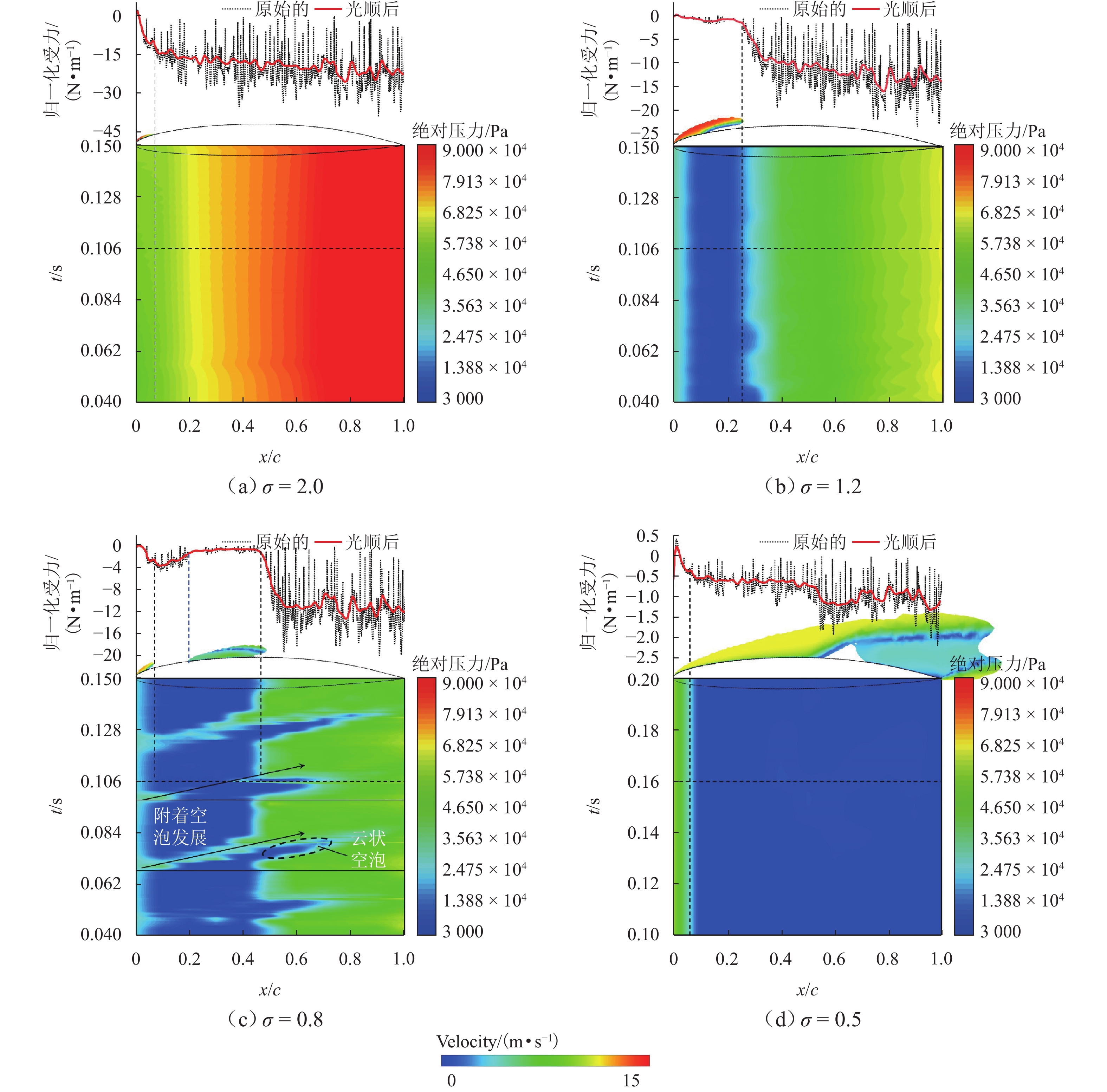
图 19 典型空化阶段z/b=0.5处水翼弦长绝对压力时空演变云图及其吸力面沿Y方向受力情况
Figure 19. Spatiotemporal evolution of chordwise absolute pressure at z/b = 0.5 and Y-direction force distribution on hydrofoil suction surface during typical cavitation stages
表 1 单一流场和流固耦合求解的单相流动水动力系数
Table 1. Hydrodynamic coefficients for single-phase flow obtained from fluid-only and fluid-structure interaction simulations
Cl Cd Cm K 实验值[1] 1.3163 0.0365 − 0.2360 36.0630 流固耦合求解 1.3169 0.0366 − 0.2371 35.9808 单一流场求解 1.3155 0.0361 − 0.2319 36.4404  下载: 导出CSV
表 2 数值计算方法求解的单相流动水动力系数与实验值的相对误差
Table 2. Relative errors between numerical and experimental hydrodynamic coefficients for single-phase flow
Cl Cd Cm K 流固耦合求解 0.05% 0.27% 0.47% 0.23% 单一流场求解 0.06% 1.10% 1.74% 1.05%
下载: 导出CSV
-
[1] 吴钦. 非定常空化流动及其诱导振动特性研究[D]. 北京: 北京理工大学, 2016. [2] 吴钦, 黎勇, 刘韵晴, 等. 非均匀来流条件下螺旋桨空化诱导噪声特性试验研究[J]. 北京理工大学学报, 2025, 45(6): 580-588. doi: 10.15918/j.tbit1001-0645.2024.168Wu Qin, Li Yong, Liu Yunqing, et al. Induced noise characteristics of propeller cavitation under non-uniform inflow conditions[J]. Transactions of Beijing Institute of Technology, 2025, 45(6): 580-588. doi: 10.15918/j.tbit1001-0645.2024.168 [3] Cervone A, Bramanti C, Rapposelli E, et al. Experimental characterization of cavitation instabilities in a two-bladed axial inducer[J]. Journal of Propulsion and Power, 2006, 22(6): 1389-1395. doi: 10.2514/1.19637 [4] 付燕霞. 涡轮泵及诱导轮流动不稳定性及空化特性研究[D]. 镇江: 江苏大学, 2014. [5] Donaldson R M. Hydraulic-turbine runner vibration[J]. Journal of Fluids Engineering, 1956, 78(5): 1141-1144. doi: 10.1115/1.4013957 [6] Amromin E, Kovinskaya S. Vibration of cavitating elastic wing in a periodically perturbed flow: excitation of subharmonics[J]. Journal of Fluids and Structures, 2000, 14(5): 735-751. doi: 10.1006/jfls.2000.0291 [7] Arndt R E A, Song C C S, Kjeldsen M. Instability of partial cavitation: a numerical/experimental approach[C]//In Proceedings of the 23rd Symposium on Naval Hydrodynamics. National Academy Press, 2000: 599-615. DOI: http://purl.umn.edu/49781. [8] Ausoni P, Farhat M, Escaler X, et al. Cavitation influence on von Kármán vortex shedding and induced hydrofoil vibrations[J]. Journal of Fluids Engineering, 2007, 129(8): 966-973. doi: 10.1115/1.2746907 [9] Ducoin A, André Astolfi J, Gobert M L. An experimental study of boundary-layer transition induced vibrations on a hydrofoil[J]. Journal of Fluids and Structures, 2012, 32: 37-51. doi: 10.1016/j.jfluidstructs.2011.04.002 [10] 刘韵晴, 郭一梦, 黄彪, 等. 绕弹性水翼空化流激振动特性实验研究[J]. 空气动力学学报, 2022, 40(1): 41-48.Liu Yunqing, Guo Yimeng, Huang Biao, et al. Experimental investigations of cavitating flow induced vibration around a flexible hydrofoil[J]. Acta Aerodynamica Sinica, 2022, 40(1): 41-48. [11] Liu Y Q, Zhao W, Pan Z, et al. Investigation on the dynamic behavior of cloud cavitation around a flexible hydrofoil[J]. Journal of Hydrodynamics, 2023, 35(4): 712-723. doi: 10.1007/s42241-023-0052-9 [12] Liu Y Q, Wu Q, Zhang H Z, et al. Cavity dynamics and vibrations of a flexible hydrofoil in the cavitating flow[J]. Physical Review Fluids, 2024, 9: 014304. doi: 10.1103/PhysRevFluids.9.014304 [13] Liu Y Q, Huang B, Wu Q, et al. Revealing partial and simultaneous double lock-in phenomena in composite hydrofoils: Effects of bending-twist coupling[J]. Journal of Hydrodynamics, 2025, 37(3): 505-513. doi: 10.1007/s42241-025-0042-1 [14] Zhang D D, Dong L L, Wu Q, et al. Global cavitation and hydrodynamic characteristics of a composite propeller in non-uniform wake[J]. Journal of Hydrodynamics, 2023, 35(3): 498-515. doi: 10.1007/s42241-023-0036-9 [15] Hao H Y, Liu Y Q, Wu Q, et al. Numerical investigation on vortex dynamics of flow around a pitching hydrofoil via the finite-domain impulse theory[J]. Acta Mechanica Sinica, 2025, 41: 323492. doi: 10.1007/s10409-024-23492-x [16] Ryzhakov P B, Rossi R, Idelsohn S R, et al. A monolithic Lagrangian approach for fluid–structure interaction problems[J]. Computational Mechanics, 2010, 46(6): 883-899. doi: 10.1007/s00466-010-0522-0 [17] 马戎, 常兴华, 赫新, 等. 流动/运动松耦合与紧耦合计算方法及稳定性分析[J]. 气体物理, 2016, 1(6): 36-49. doi: 10.19527/j.cnki.2096-1642.2016.06.004Ma Rong, Chang Xinghua, He Xin, et al. Loose and strong coupling methods for flow/kinematics coupled simulations and stability analysis[J]. Physics of Gases, 2016, 1(6): 36-49. doi: 10.19527/j.cnki.2096-1642.2016.06.004 [18] 黄道博, 李建东, 刘勇. 基于CFD/CSD紧耦合的旋翼翼型气弹分析[J]. 航空动力学报, 2016, 31(8): 1820-1829. doi: 10.13224/j.cnki.jasp.2016.08.004Huang Daobo, Li Jiandong, Liu Yong. Aeroelastic analysis of rotor airfoil based on CFD/CSD tight coupling method[J]. Journal of Aerospace Power, 2016, 31(8): 1820-1829. doi: 10.13224/j.cnki.jasp.2016.08.004 [19] 郭智溥, 黄彪, 吴钦, 等. 球体垂直入水空泡内部流场特性的数值模拟研究[J]. 船舶力学, 2024, 28(8): 1141-1154.Guo Zhipu, Huang Biao, Wu Qin, et al. Numerical investigation on the flow structures during vertical water-entry of a sphere[J]. Journal of Ship Mechanics, 2024, 28(8): 1141-1154. [20] 陈倩, 张汉哲, 吴钦, 等. 复合材料水翼水动力与结构强度特性数值研究[J]. 力学学报, 2019, 51(5): 1350-1362.Chen Qian, Zhang Hanzhe, Wu Qin, et al. The numerical investifation on hydrodynamic and structural strength of a composite hydrofoil[J]. Chinese Journal of Theoretical and Applied Mechanics, 2019, 51(5): 1350-1362. [21] Marshall J G, Imregun M. A review of aeroelasticity methods with emphasis on turbomachinery applications[J]. Journal of Fluids and Structures, 1996, 10(3): 237-267. doi: 10.1006/jfls.1996.0015 [22] Menter F. Zonal two equation k-w turbulence models for aerodynamic flows[C]//23rd Fluid Dynamics, Plasmadynamics, and Lasers Conference. Orlando: AIAA, 1993: 2906. [23] Zwart P J, Gerber A G, Belamri T. A two-phase flow model for predicting cavitation dynamics[C]// Fifth international conference on multiphase flow. Yokohama: [s. n. ], 2004: 152. -

 下载:

 点击查看大图
计量
- 文章访问数: 4
- HTML全文浏览量: 3
- PDF下载量: 0
- 被引次数: 0