



Joint Dispatch of Cross-Regional Emergency Supplies Considering Differential Disaster Severity
-
摘要:
为提升重大自然灾害下跨区域应急救援响应效能,考虑地区受灾差异性,对跨区域应急物资联合调度进行优化. 首先,提出差异化灾情分级策略,构建综合评价体系,运用CRITIC-TOPSIS法确定各区域灾情风险等级;然后,构建上层最小化应急总响应调度时间、下层最大化公平性的双层规划模型,上层引入天牛须变量搜索改进粒子群算法求解,得到供应点到集散中心的最短时间及运输物资量,为下层提供物资分配的基础数据和时间约束;下层采用NSGA-Ⅲ算法求解,其结果会影响上层模型中物资在受灾点的分配情况,从而可能导致上层模型重新调整供应点到集散中心的运输方案,以达到整体的优化目标. 最后,以5•12汶川地震为案例仿真模拟,结果表明:在应急总响应时间上,考虑灾情分级方案比未考虑灾情分级方案缩短2.53%;在公平性方面,考虑灾情分级方案下的各级受灾点需求满足率与灾害等级呈正相关,更好地体现了差异化分级施策和应急物资调度公平性.
Abstract:To enhance the response efficiency of cross-regional emergency rescue under major natural disasters, considering differential disaster severity in affected areas, the optimization of cross-regional emergency supplies dispatching with combined transport was conducted. Firstly, a differentiated disaster classification strategy and a comprehensive evaluation system were proposed. The CRITIC-TOPSIS method was employed to determine the risk level of each region. Then, a bi-level programming model was developed, in which the upper level minimizes the total emergency response time and the lower level maximizes fairness. The upper level incorporated the Beetle Antennae Search to improve the Particle Swarm Optimization algorithm for finding solutions, thereby determining the shortest time and the volume of supplies transported from supply points to distribution centers. This provides basic data and time constraints for the lower level. The lower level uses the NSGA-III to solve the supplies allocation problem, where its results influence the distribution of supplies to affected areas in the upper-level model. This interdependence may lead to adjustments in the upper-level transportation scheme, further optimizing the overall objective. Finanly, taking 5•12 Wenchuan Earthquake as a case study for the simulation, the results indicate that, in terms of the total emergency response time, the scheme considering disaster severity classification is 2.53% shorter than that without considering disaster severity classification. Regarding fairness, the scheme under disaster severity classification shows a positive correlation between the satisfaction rate of emergency supplies demands and the disaster severity level at different disaster-affected points, thereby better reflecting the differentiated strategies based on disaster severity levels and the fairness of emergency supplies dispatch.
-
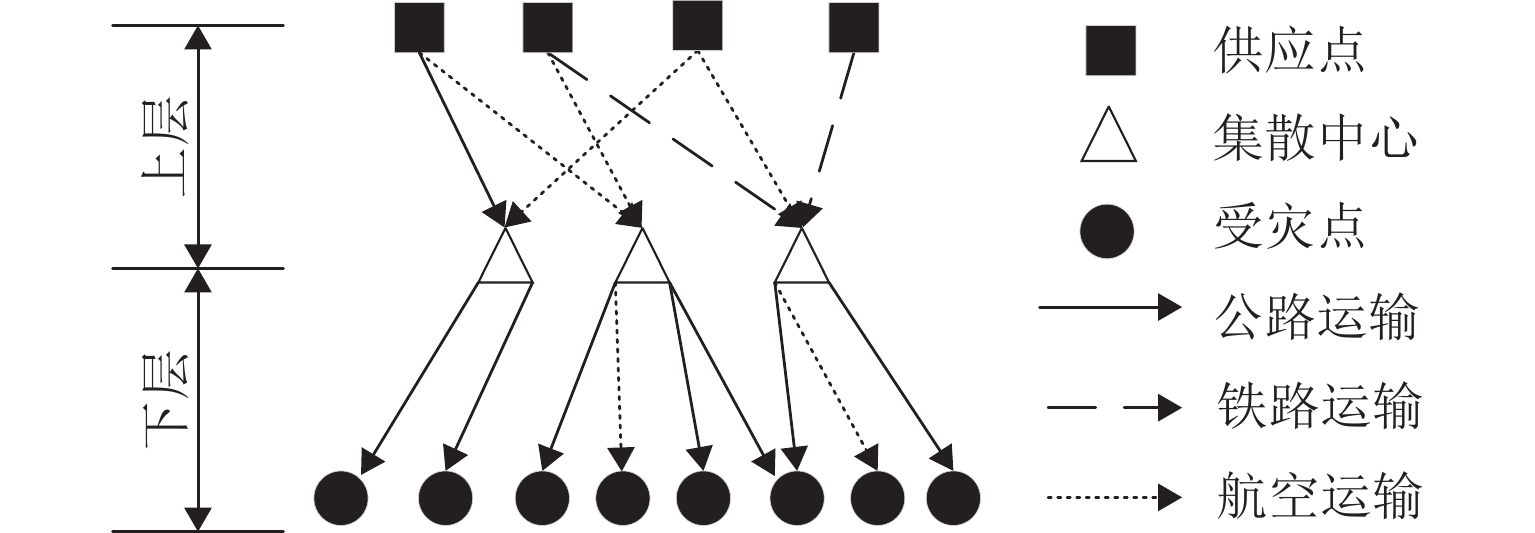
图 1 跨区域应急物资多式联运调度
Figure 1. Cross-regional emergency supplies dispatch with multimodal transportation
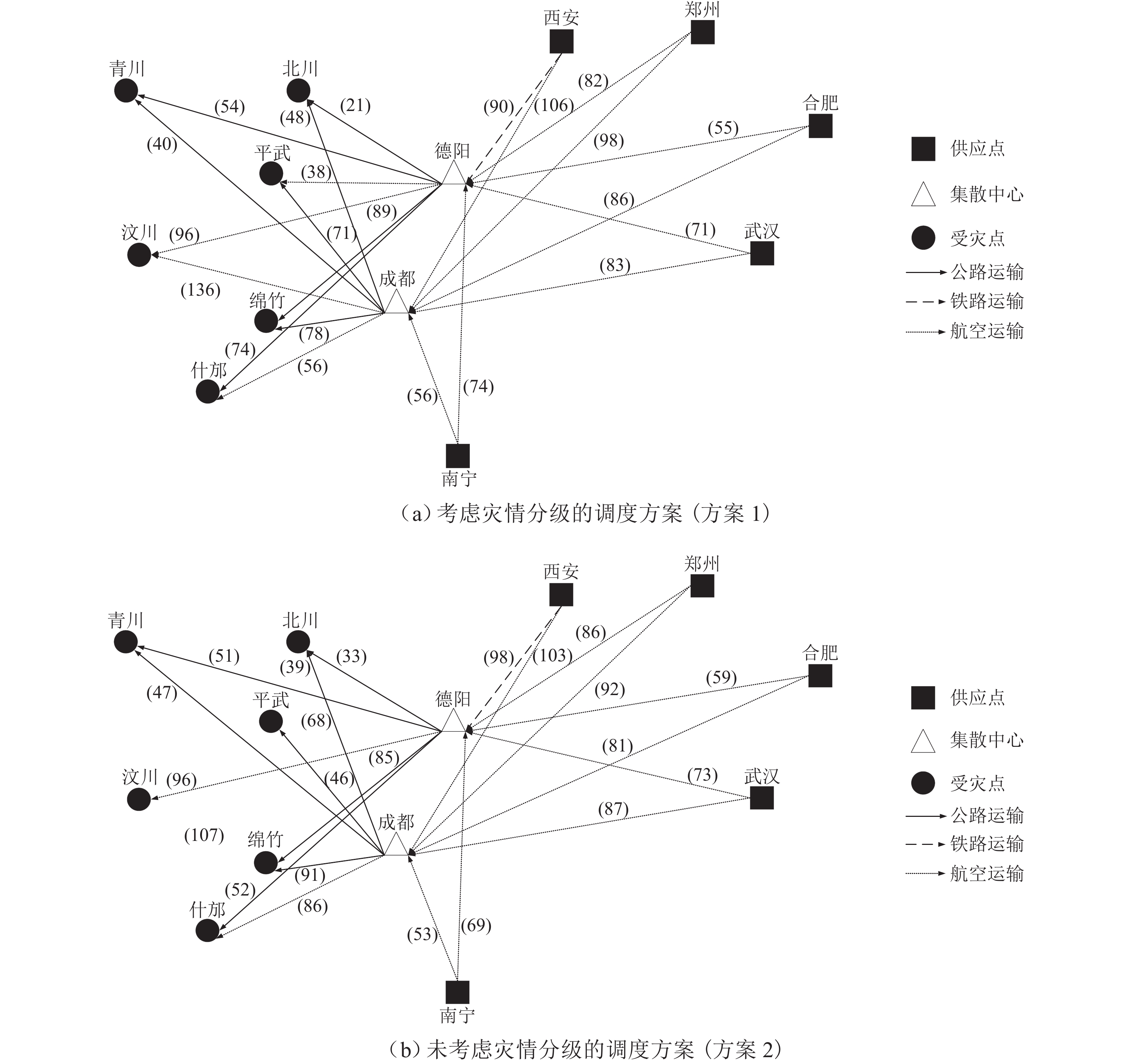
图 3 应急物资多式联运调度方案对比
Figure 3. Comparison of emergency supplies multimodal transportation dispatch schemes under two situations
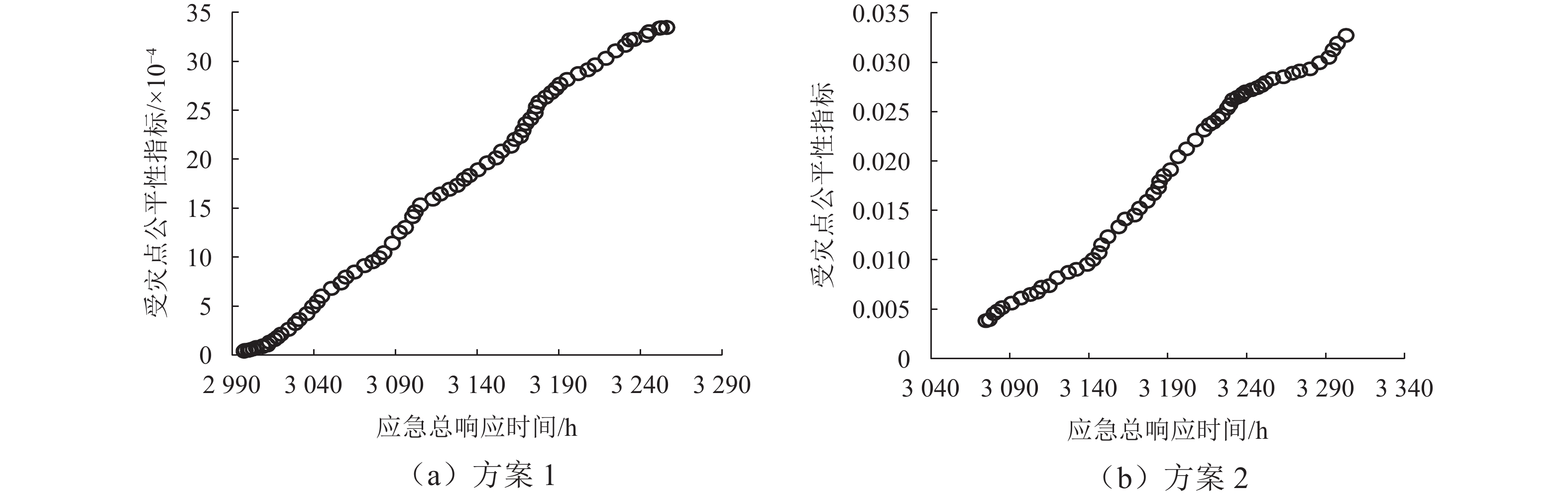
图 4 应急物资调度Pareto解集对比
Figure 4. Comparison of emergency supplies dispatch Pareto solution sets under two situations
表 1 语言变量与三角模糊数的转换
Table 1. Transformation between linguistic variables and triangular fuzzy numbers
语言变量评价 三角模糊数 很严重 (0.7,1.0,1.0) 严重 (0.5,0.7,0.9) 一般 (0.3,0.5,0.7) 轻 (0.1,0.3,0.5) 很轻 (0,0,0.3)  下载: 导出CSV
表 2 供应点到集散中心运输编码方案
Table 2. Transportation coding scheme from supply points to distribution centers
${i_1}$ ${i_2}$ ${i_3}$ ${i_4}$ ${i_5}$ ${l_1}$ ${A_1}$ ${A_2}$ ${A_3}$ ${A_4}$ ${A_5}$ ${l_2}$ ${A_6}$ ${A_7}$ ${A_8}$ ${A_9}$ ${A_{10}}$
下载: 导出CSV
表 3 集散中心到受灾点运输编码方案
Table 3. Transportation coding scheme from distribution centers to demand points
${j_1}$ ${j_2}$ ${j_3}$ ${j_4}$ ${j_5}$ ${j_6}$ ${l_1}$ ${A_{11}}$ ${A_{12}}$ ${A_{13}}$ ${A_{14}}$ ${A_{15}}$ ${A_{16}}$ ${l_2}$ ${A_{17}}$ ${A_{18}}$ ${A_{19}}$ ${A_{20}}$ ${A_{21}}$ ${A_{22}}$
下载: 导出CSV
表 4 受灾点评价指标及指标值
Table 4. Evaluation indicators and values of disaster-affected points
受灾点 受灾人口比例/% 受伤人口比例/% 死亡人口比例/% 老幼人口比例/% 道路损坏程度 建筑物损坏程度 需求量/
万件地震烈
度/度等级 数值 等级 数值 汶川县 21.94 18.47 28.02 26.82 很严重 0.95 很严重 0.95 320 Ⅺ 茂县 4.67 4.37 5.49 29.07 一般 0.50 一般 0.50 33 Ⅹ 北川县 9.89 5.18 27.51 28.72 严重 0.70 一般 0.50 114 Ⅺ 平武县 12.64 17.17 2.72 31.53 一般 0.50 一般 0.50 180 Ⅺ 安县 5.65 7.20 2.76 34.63 一般 0.50 一般 0.50 67 Ⅶ 什邡市 14.31 17.08 6.23 28.70 一般 0.50 严重 0.70 216 Ⅷ 绵竹市 17.96 16.86 11.96 26.85 严重 0.70 很严重 0.95 278 Ⅷ 都江堰市 2.80 2.34 5.40 35.77 轻 0.30 一般 0.50 51 Ⅶ 彭州市 2.52 3.08 1.67 32.15 一般 0.50 一般 0.50 27 Ⅺ 青川县 7.61 8.25 8.24 27.58 一般 0.50 严重 0.70 155 Ⅺ
下载: 导出CSV
表 5 风险等级划分
Table 5. Classification of disaster risk levels
受灾点 相对贴近度 排序 风险等级 汶川县 0.9197 1 Ⅰ 茂县 0.0400 10 Ⅳ 北川县 0.3092 6 Ⅱ 平武县 0.5189 4 Ⅱ 安县 0.1537 7 Ⅲ 什邡市 0.6349 3 Ⅱ 绵竹市 0.8255 2 Ⅱ 都江堰市 0.1156 8 Ⅳ 彭州市 0.0554 9 Ⅳ 青川县 0.4320 5 Ⅱ
下载: 导出CSV
表 6 供应点、受灾点与集散中心的最短距离和时间(公里,小时)
Table 6. Minimum distance and time between supply points, disaster-affected points and distribution centers (km, h)
物资供应点与受灾点 成都市 德阳市 货车 火车 货运飞机 直升机 货车 火车 货运飞机 直升机 距离 时间 距离 时间 距离 时间 距离 时间 距离 时间 距离 时间 距离 时间 距离 时间 郑州市 1203 12.03 1387 17.34 1005 1.68 1122 11.22 1115 13.94 954 1.59 西安市 742 7.42 849 10.61 612 1.02 661 6.61 592 7.40 556 0.93 合肥市 1510 15.10 1750 21.88 1257 2.10 1497 14.97 1530 19.13 1240 2.07 武汉市 1143 11.43 1249 15.61 980 1.63 1144 11.44 1423 17.79 947 1.58 南宁市 1186 11.86 1452 18.15 968 1.61 1230 12.30 1236 15.45 1037 1.73 汶川县 143 1.43 130 0.87 177 1.77 195 1.30 绵竹市 106 1.06 95 0.63 36 0.36 40 0.27 什邡市 83 0.83 51 0.34 25 0.25 30 0.20 青川县 299 2.99 190 1.27 220 2.20 156 1.04 北川县 153 1.53 112 0.75 72 0.72 55 0.37 平武县 262 2.62 170 1.13 181 1.81 205 1.37
下载: 导出CSV
表 7 运输工具参数
Table 7. Transportation vehicle parameters
运输工具 平均行驶速度/(km·h−1) 额定容积/m3 额定载重/t 货车 100 25 15 火车 80 90 60 货运飞机 600 200 60 直升机 150 50 5
下载: 导出CSV
表 8 调度方案对比
Table 8. Comparison between the two schemes
调度方案 调度时间/h 各受灾点应急物资最小满足率/% 汶川(Ⅰ级) 绵竹(Ⅱ级) 什邡(Ⅱ级) 平武(Ⅱ级) 青川(Ⅱ级) 北川(Ⅱ级) 考虑分级(方案1) 2997.35 72.50 60.07 60.19 60.56 60.65 60.53 未考虑分级(方案2) 3075.01 63.44 63.31 63.89 63.33 63.23 63.16
下载: 导出CSV
表 9 算法对比
Table 9. Comparison among four algorithms
算法 调度时间/h 各受灾点应急物资最小满足率/% 汶川(Ⅰ级) 绵竹(Ⅱ级) 什邡(Ⅱ级) 平武(Ⅱ级) 青川(Ⅱ级) 北川(Ⅱ级) 1 2997.35 72.50 60.07 60.19 60.56 60.65 60.53 2 3029.18 71.25 57.55 57.87 57.22 57.42 57.02 3 3041.73 71.56 58.63 58.80 58.33 58.71 58.77 4 3058.26 70.63 56.47 56.02 56.67 56.77 56.14
下载: 导出CSV
-
[1] 王伟, 宋月, 黄莉, 等. 粤港澳大湾区复合灾害系统脆弱性评估[J/OL]. 西南交通大学学报, 2024: 1-12. (2024-09-03). https://kns.cnki.net/KCMS/detail/detail.aspx?filename=XNJT20240902004&dbname=CJFD&dbcode=CJFQ.WANG Wei, SONG Yue, HUANG Li, et al. Vulnerability assessment of composite disaster systems in the Greater Bay Area[J/OL]. Journal of Southwest Jiaotong University, 2024: 1-12. (2024-09-03). https://kns.cnki.net/KCMS/detail/detail.aspx?filename=XNJT20240902004&dbname=CJFD&dbcode=CJFQ. [2] 贾宏宇, 肖楚照, 康炜, 等. 极端气候下交通基础设施脆弱性研究综述[J]. 西南交通大学学报, 2025, 60(2): 484-502.JIA Hongyu, XIAO Chuzhao, KANG Wei, et al. Review of research on vulnerability of transportation infrastructure to extreme climatic conditions[J]. Journal of Southwest Jiaotong University, 2025, 60(2): 484-502. [3] BODAGHI B, PALANEESWARAN E, ABBASI B. Bi-objective multi-resource scheduling problem for emergency relief operations[J]. Production Planning & Control, 2018, 29(14): 1191-1206. [4] 卢建锋, 韩霜, 赵佳虹. 考虑缺失风险的连续消耗型应急物资调度优化研究[J]. 公路交通科技, 2023, 40(2): 246-254.LU Jianfeng, HAN Shuang, ZHAO Jiahong. Study on scheduling optimization of continuous consumable emergency supplies considering missing risk[J]. Journal of Highway and Transportation Research and Development, 2023, 40(2): 246-254. [5] 陈旭浩, 吕莹, 孙会君, 等. 基于风险度量的多交通方式协同应急救援方案优化[J]. 交通运输工程与信息学报, 2023, 21(2): 79-94.CHEN Xuhao, LV Ying, SUN Huijun, et al. A multimodal transport collaborative-rescue optimization model for emergency responses based on risk evaluations[J]. Journal of Transportation Engineering and Information, 2023, 21(2): 79-94. [6] 杨枫, 种大双. 应急车辆动态路径选择的两阶段优化模型[J]. 交通运输系统工程与信息, 2022, 22(3): 84-92.YANG Feng, CHONG Dashuang. Emergency vehicle dynamic path selection based on two-stage objective optimization model[J]. Journal of Transportation Systems Engineering and Information Technology, 2022, 22(3): 84-92. [7] 刘松, 舒文, 彭勇, 等. 双重不确定下应急物资多式联运可靠路径优化[J]. 交通运输系统工程与信息, 2023, 23(1): 58-66.LIU Song, SHU Wen, PENG Yong, et al. Optimization of reliable routes for multimodal transport of emergency supplies under dual uncertainty[J]. Journal of Transportation Systems Engineering and Information Technology, 2023, 23(1): 58-66. [8] 何珊珊, 郭彦, 朱文海, 等. 疫情下考虑均衡松弛库存的双目标应急物流网络优化研究[J]. 铁道运输与经济, 2023, 45(1): 16-22, 29.HE Shanshan, GUO Yan, ZHU Wenhai, et al. Study on the bi-objective optimization of emergency logistics network with balanced slack inventory during pandemic period[J]. Railway Transport and Economy, 2023, 45(1): 16-22,29. [9] 张宗嘉, 袁狄平, 黄哲俊, 等. 城市洪涝灾害下的分级协同响应应急调度及路径规划[J]. 中国安全生产科学技术, 2023, 19(5): 202-208.ZHANG Zongjia, YUAN Diping, HUANG Zhejun, et al. Hierarchical collaborative response emergency dispatch and path planning under urban flooddisaster[J]. Journal of Safety Science and Technology, 2023, 19(5): 202-208. [10] 赵建有, 韩万里, 郑文捷, 等. 重大突发公共卫生事件下城市应急医疗物资配送[J]. 交通运输工程学报, 2020, 20(3): 168-177.ZHAO Jianyou, HAN Wanli, ZHENG Wenjie, et al. Distribution of emergency medical supplies in cities under major public health emergency[J]. Journal of Traffic and Transportation Engineering, 2020, 20(3): 168-177. [11] WANG W Q, YANG K, YANG L X, et al. Two-stage distributionally robust programming based on worst-case mean-CVaR criterion and application to disaster relief management[J]. Transportation Research Part E: Logistics and Transportation Review, 2021, 149: 102332. doi: 10.1016/j.tre.2021.102332 [12] 杜雪灵, 孟学雷, 杨贝, 等. 考虑公平性的面向多灾点需求应急资源调度[J]. 计算机应用, 2018, 38(7): 2089-2094.DU Xueling, MENG Xuelei, YANG Bei, et al. Emergency resource assignment for requirements of multiple disaster sites in view of fairness[J]. Journal of Computer Applications, 2018, 38(7): 2089-2094. [13] 王付宇, 谢昊轩. 突发洪涝灾害下考虑公平性的多灾点应急资源调度[J]. 安全与环境学报, 2023, 23(8): 2859-2865.WANG Fuyu, XIE Haoxuan. Multi-objective emergency resource assignment for sudden disasters in view of fairness[J]. Journal of Safety and Environment, 2023, 23(8): 2859-2865. [14] GUAN G F, LIN Z J, GONG Y, et al. Modeling and simulation of collaborative dispatching of disaster relief materials based on urgency[J]. Mathematical Problems in Engineering, 2020, 2020(1): 4274106. [15] 朱莉, 顾珺, 马铮, 等. 面向受灾差异的跨区域应急救援路径优化[J]. 控制与决策, 2017, 32(5): 879-884.ZHU Li, GU Jun, MA Zheng, et al. Routing optimization of cross-regional emergency rescue considering differentiated disaster impacts[J]. Control and Decision, 2017, 32(5): 879-884. [16] 李孟良, 王喜富, 孙全欣, 等. 基于鲁棒优化的应急物资多式联运调配策略研究[J]. 铁道学报, 2017, 39(7): 1-9.LI Mengliang, WANG Xifu, SUN Quanxin, et al. Research on allocation strategies of multimodal transportation for emergency resources based on robust optimization[J]. Journal of the China Railway Society, 2017, 39(7): 1-9. [17] LIU C, QIAN Y H. Optimal allocation of material dispatch in emergency events using multi-objective constraint for vehicular networks[J]. Wireless Networks, 2022, 28(8): 3715-3727. doi: 10.1007/s11276-022-03069-8 [18] 盛虎宜, 刘长石, 鲁若愚. 震后初期应急物资短缺情景下的定位-路径问题研究[J]. 运筹与管理, 2019, 28(6): 41-47.SHENG Huyi, LIU Changshi, LU Ruoyu. Location-routing problem with relief shortage in the early stage after earthquake[J]. Operations Research and Management Science, 2019, 28(6): 41-47. [19] MAGHFIROH M F N, HANAOKA S. Multi-modal relief distribution model for disaster response operations[J]. Progress in Disaster Science, 2020, 6: 100095. doi: 10.1016/j.pdisas.2020.100095 [20] 许钢焱, 龙玉莹, 王欣悦, 等. 考虑货车-无人机协同的灾后应急响应策略及调度优化[J]. 安全与环境学报, 2023, 23(5): 1587-1595.XU Gangyan, LONG Yuying, WANG Xinyue, et al. Truck-drone collaboration strategies and scheduling optimization for urban emergency responses[J]. Journal of Safety and Environment, 2023, 23(5): 1587-1595. [21] 薛星群, 王旭坪, 韩涛, 等. 考虑通行约束和运力限制的灾后应急物资联合调度优化研究[J]. 中国管理科学, 2020, 28(3): 21-30.XUE Xingqun, WANG Xuping, HAN Tao, et al. Study on joint dispatch optimization of emergency materials considering traffic constraints and capacity limits[J]. Chinese Journal of Management Science, 2020, 28(3): 21-30. [22] 刘雪萍, 朱海洋, 韩瑜睿, 等. 应急救援物资多式联运的成本最优化模型[J]. 交通运输研究, 2016, 2(1): 71-76.LIU Xueping, ZHU Haiyang, HAN Yurui, et al. Cost optimization model of emergency relief supplies based on multimodal transportation[J]. Transport Research, 2016, 2(1): 71-76. [23] SHI Y, YANG J H, HAN Q, et al. Optimal decision-making of post-disaster emergency material scheduling based on helicopter–truck–drone collaboration[J]. Omega, 2024, 127: 103104. doi: 10.1016/j.omega.2024.103104 [24] 赵洪雪, 姜森豪, 周炜, 等. 多种动力类型道路运输装备的区域优化配置方法[J]. 公路交通科技, 2023, 40(增刊2): 315-322.ZHAO Hongxue, JIANG Senhao, ZHOU Wei, et al. Regional optimized configuration method for road transportation equipment with multiple power types[J]. Journal of Highway and Transportation Research and Development, 2023, 40(Sup 2): 315-322. [25] 王巍, 陈虹, 马丽斯文, 等. 我国地震应急响应能力评价指标体系的构建[J]. 灾害学, 2020, 35(2): 167-170, 176.WANG Wei, CHEN Hong, MA Lisiwen, et al. Construction of an index system for evaluating earthquake emergency response capability of China[J]. Journal of Catastrophology, 2020, 35(2): 167-170,176. [26] 王付宇, 王欣蕊, 贺昕, 等. 考虑需求紧迫度和综合满意度的应急物资选址-调度问题[J]. 系统工程, 2024, 42(1): 37-50.WANG Fuyu, WANG Xinrui, HE Xin, et al. Emergency material location and scheduling problem considering demand urgency and comprehensive satisfaction[J]. Systems Engineering, 2024, 42(1): 37-50. [27] 杜映锦, 席传杰, 胡卸文, 等. 基于聚类和随机森林耦合模型的崩滑灾害易发性评估[J]. 西南交通大学学报, 2025, 60(2): 282-289.DU Yingjin, XI Chuanjie, HU Xiewen, et al. Susceptibility assessment of collapses and landslides based on cluster and random forest coupled model[J]. Journal of Southwest Jiaotong University, 2025, 60(2): 282-289. [28] 李尧. 不确定条件下跨区域综合交通运输网应急物资调度优化研究[D]. 成都: 西南交通大学, 2021.LI Yao. ■■■■■■■■. Chengdu: Southwest Jiaotong University, 2021. -

 下载:
下载:
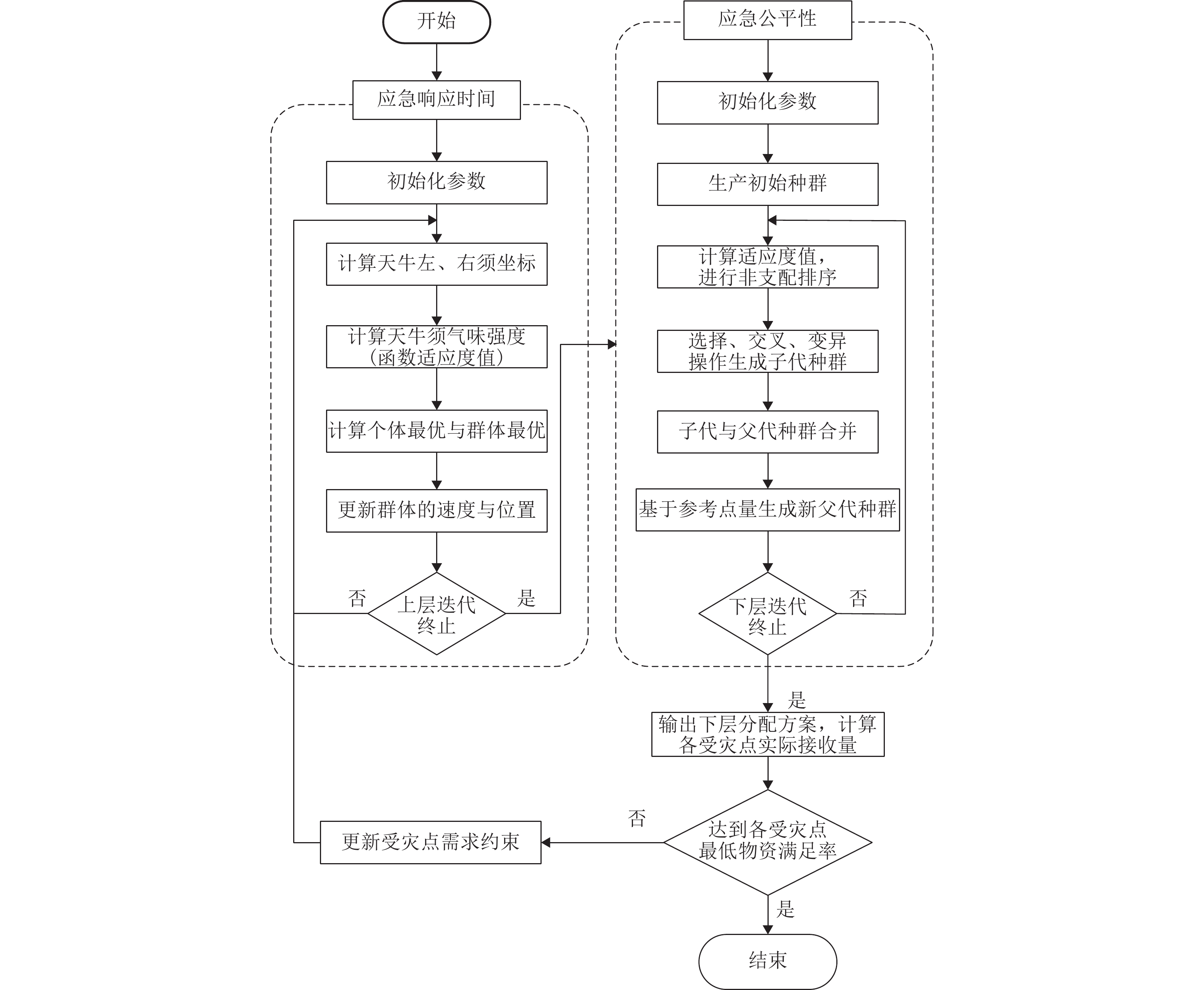

 点击查看大图
计量
- 文章访问数: 342
- HTML全文浏览量: 348
- PDF下载量: 95
- 被引次数: 0