



Analysis of Spatiotemporal Evolution Mechanism of Traffic Conflict Risk at Roundabouts
-
摘要:
为研究环形交叉口交通冲突的时空扩散和传播规律,本文结合多源时空数据,构建了基于时空Transformer网络的交通冲突传播风险预测模型. 该模型首先利用改进的碰撞时间(TTC)算法计算原始冲突数据. 接着,借助GIS软件将生成的冲突点映射到环形交叉口划分的3 × 36个网格单元中. 随后,通过核密度分析法量化每个时间步长内各区域的交通冲突风险,从而构建交通冲突风险序列数据. 在此基础上,引入Transformer算法通过学习历史冲突数据中的时空演变规律,以特定网格作为空间尺度,以每隔4.0 min为时间尺度,模拟环形交叉口内交通冲突的时空传播过程. 随后,本文将预测结果与其他序列预测模型的预测结果进行了性能对比;最后,基于交通冲突数据和冲突风险传播时空影响因素进行风险致因分析,应用沙普利加性解释(SHAP)分析各特征参数对冲突严重程度的重要度,得到影响冲突风险的关键指标. 研究表明:Transformer模型在交通冲突风险预测中的表现要优于长短期记忆网络(LSTM)与极限梯度提升模型(XGBoost),其预测准确率达到83.56%,F1-score为84.85%. 此外,车辆之间的速度差异是影响环形交叉口交通安全的关键因素. 交通冲突的发生与换道频率呈正相关,而与大车比例呈负相关.
Abstract:To study the spatiotemporal diffusion and propagation laws of traffic conflicts at roundabouts, multi-source spatiotemporal data were combined to construct a traffic conflict propagation risk prediction model based on a spatiotemporal Transformer network. The model first used an improved time-to-collision (TTC) algorithm to calculate the original conflict data. Next, with the help of GIS software, the generated conflict points were mapped onto the 3 × 36 grid cells into which the roundabout was divided. Subsequently, kernel density analysis was used to quantify traffic conflict risk in each region at each time step, thus generating time-series data on traffic conflict risk. On this basis, the Transformer algorithm was introduced to learn the spatiotemporal evolutionary patterns in historical conflict data, using a specific grid cell as the spatial scale and a 4.0 min interval as the temporal scale, to simulate the spatiotemporal propagation process of traffic conflicts in roundabouts. Subsequently, the prediction results were compared with those of other sequence prediction models. Finally, based on traffic conflict data and spatiotemporal factors affecting conflict risk propagation, a risk causation analysis was conducted. Shapley additive explanations (SHAP) were applied to analyze the importance of each feature parameter to conflict severity, and key indicators affecting conflict risk were identified. The results show that the Transformer model performs better than long short-term memory (LSTM) and extreme gradient boosting (XGBoost) models in predicting traffic conflict risks, with a prediction accuracy of 83.56% and an F1 score of 84.85%. In addition, the speed difference between vehicles is a key factor affecting traffic safety at roundabouts. The occurrence of traffic conflicts is positively correlated with lane-changing frequency and negatively correlated with the proportion of large vehicles.
-
Key words:
- traffic safety /
- traffic conflict technique /
- conflict prediction /
- roundabout /
- influencing factors
-
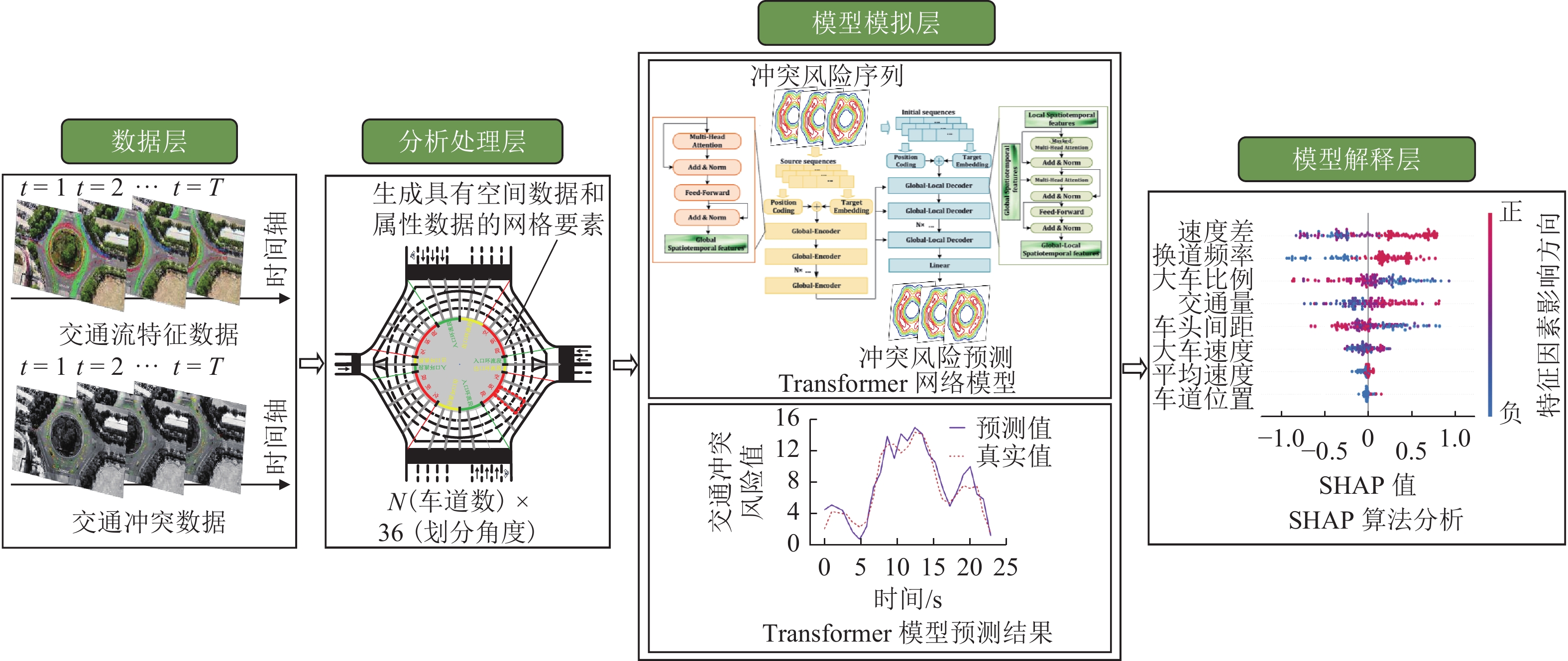
图 1 环形交叉口交通冲突风险时空演变分析研究框架
Figure 1. Research framework for spatiotemporal evolution analysis of traffic conflict risk at roundabouts
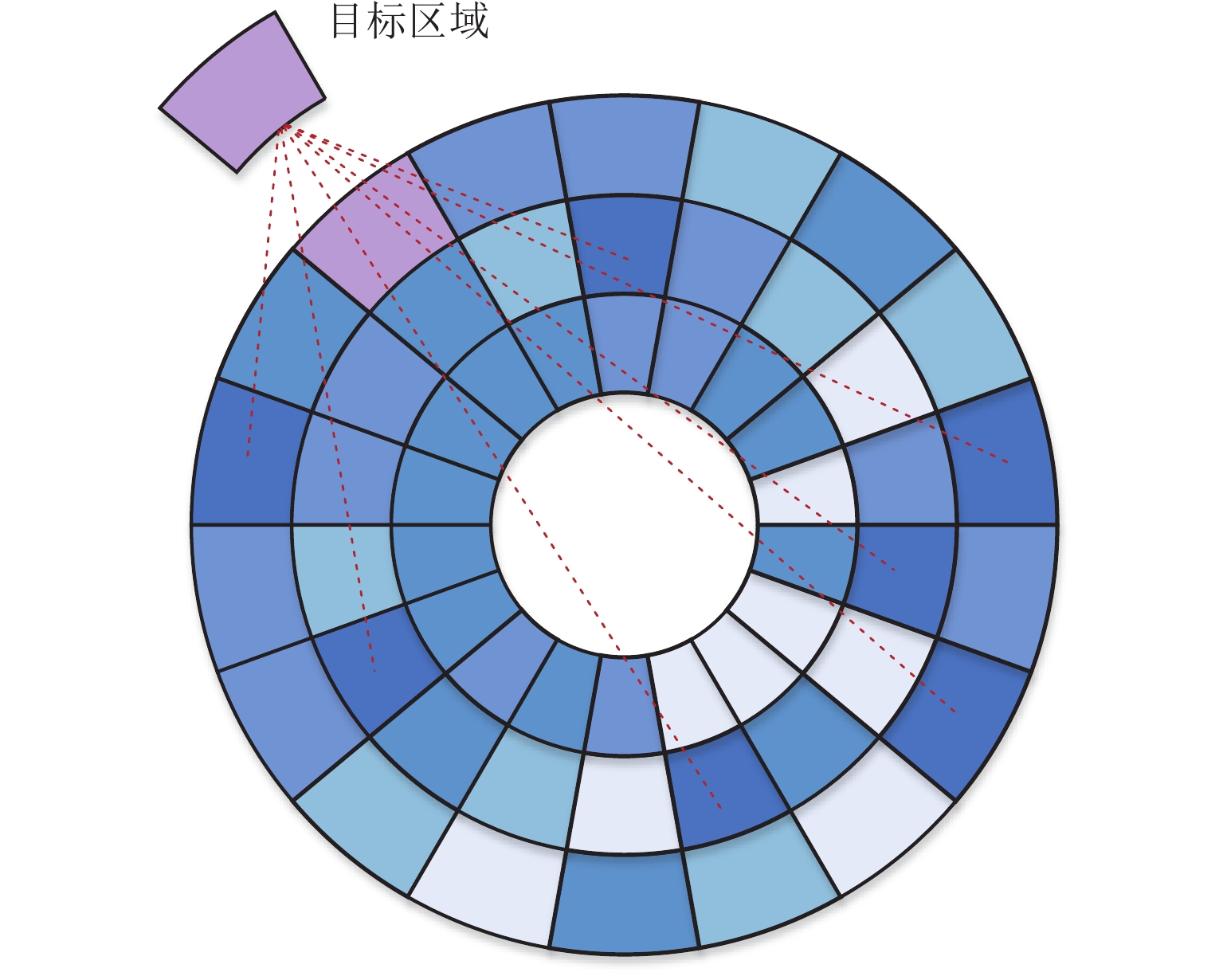
图 4 交通冲突风险区域相关性计算
Figure 4. Calculation of interregional traffic conflict risk correlations
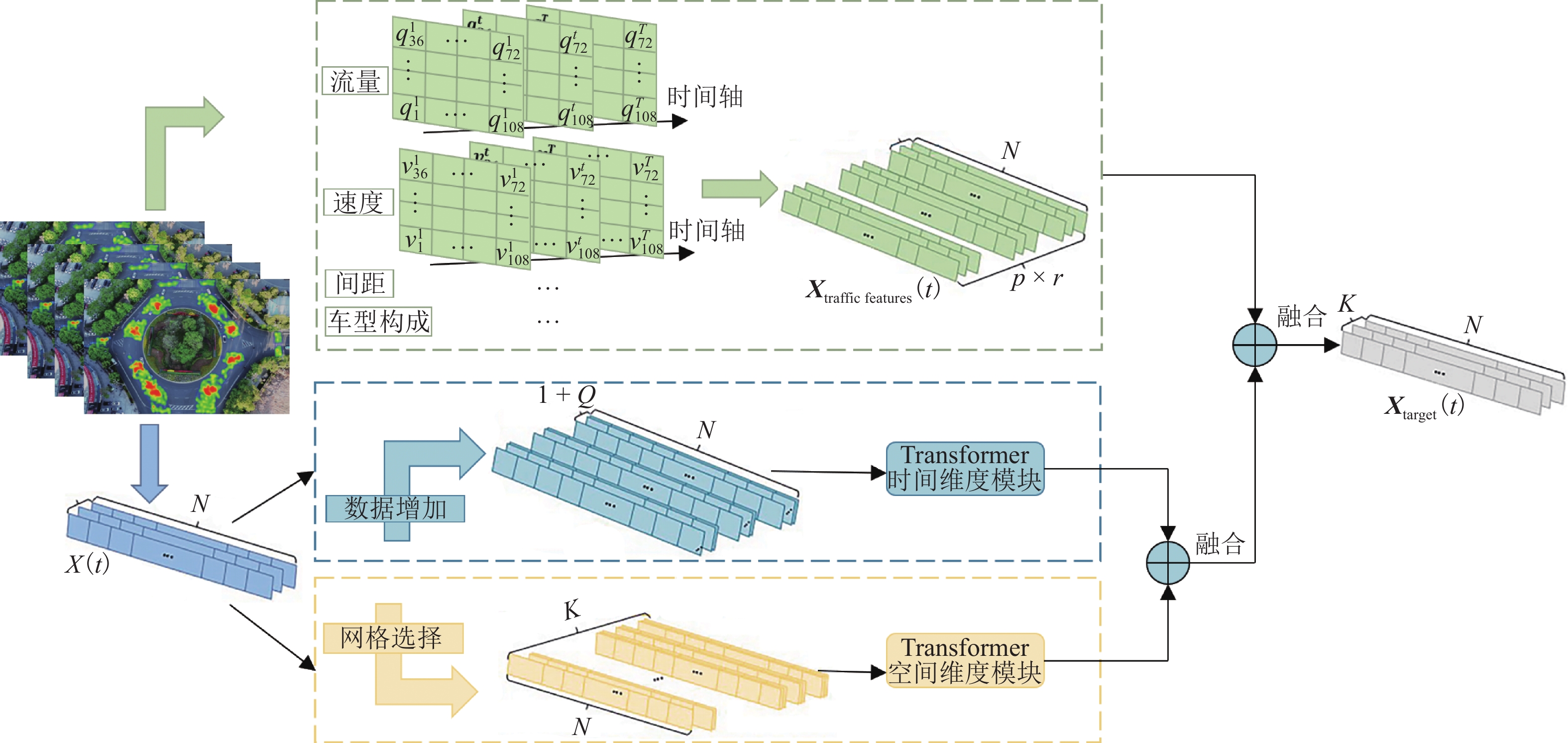
图 6 基于时空Transformer网络的环形交叉口交通风险传播模型结构示意图
Figure 6. Architecture of roundabout traffic risk propagation model based on spatiotemporal
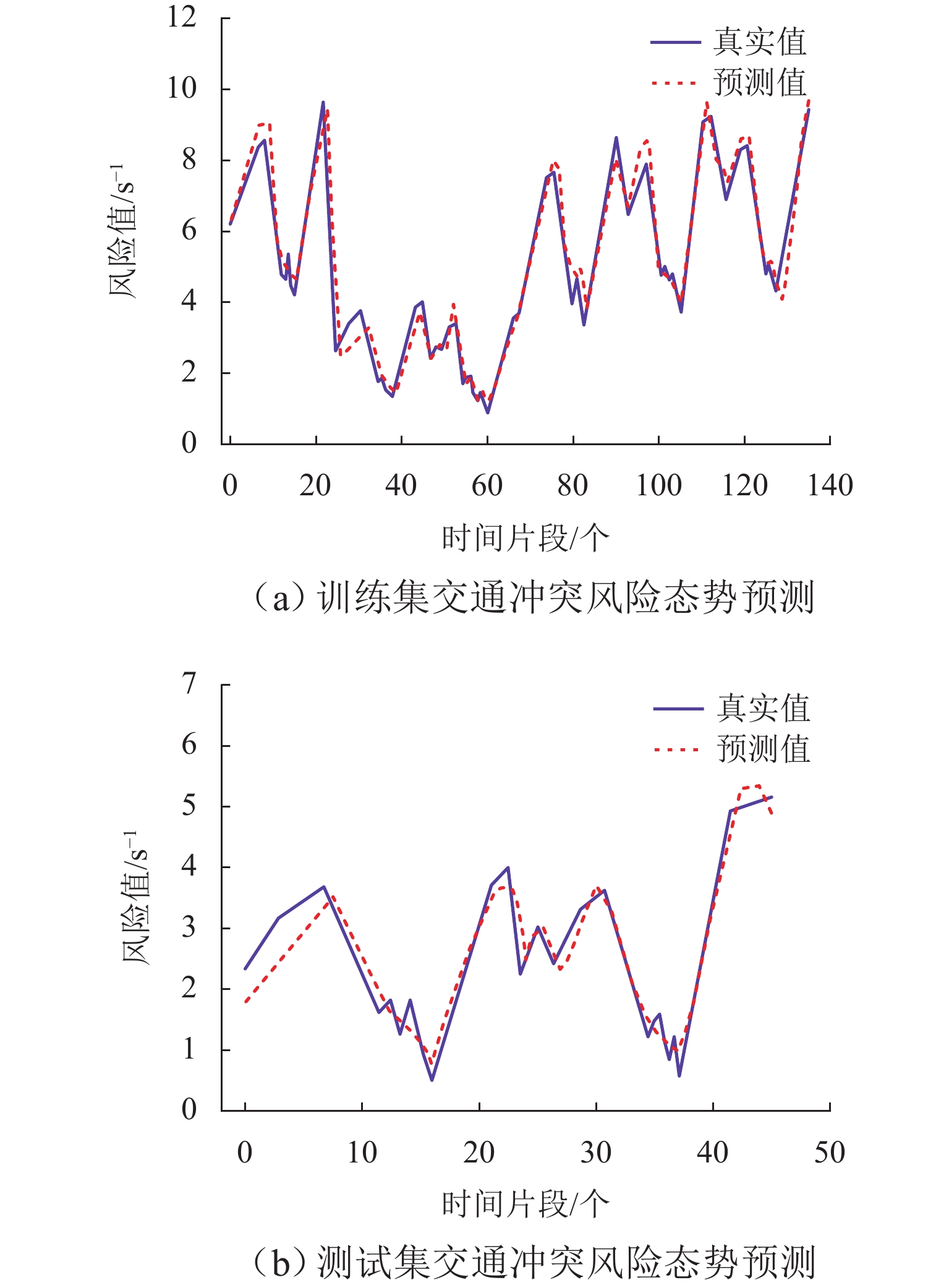
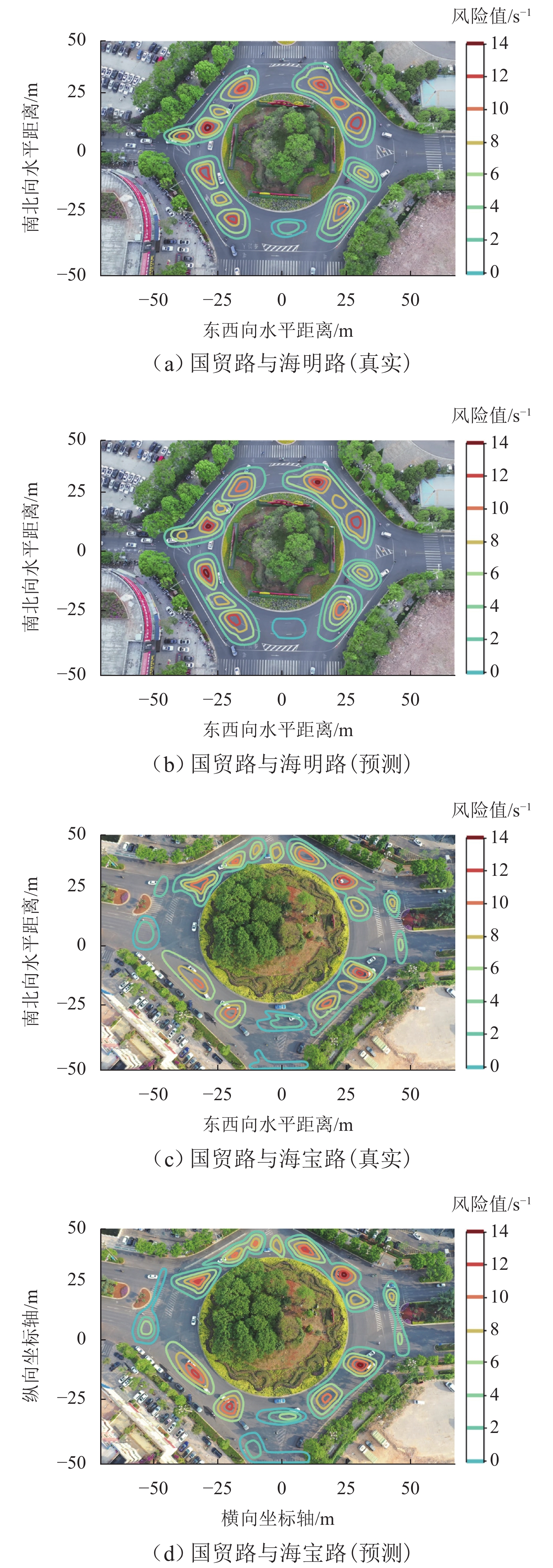
图 10 国贸路与海明路交叉口区域1预测情况
Figure 10. Prediction results for Area 1 at Guomao Road-Haiming Road intersection
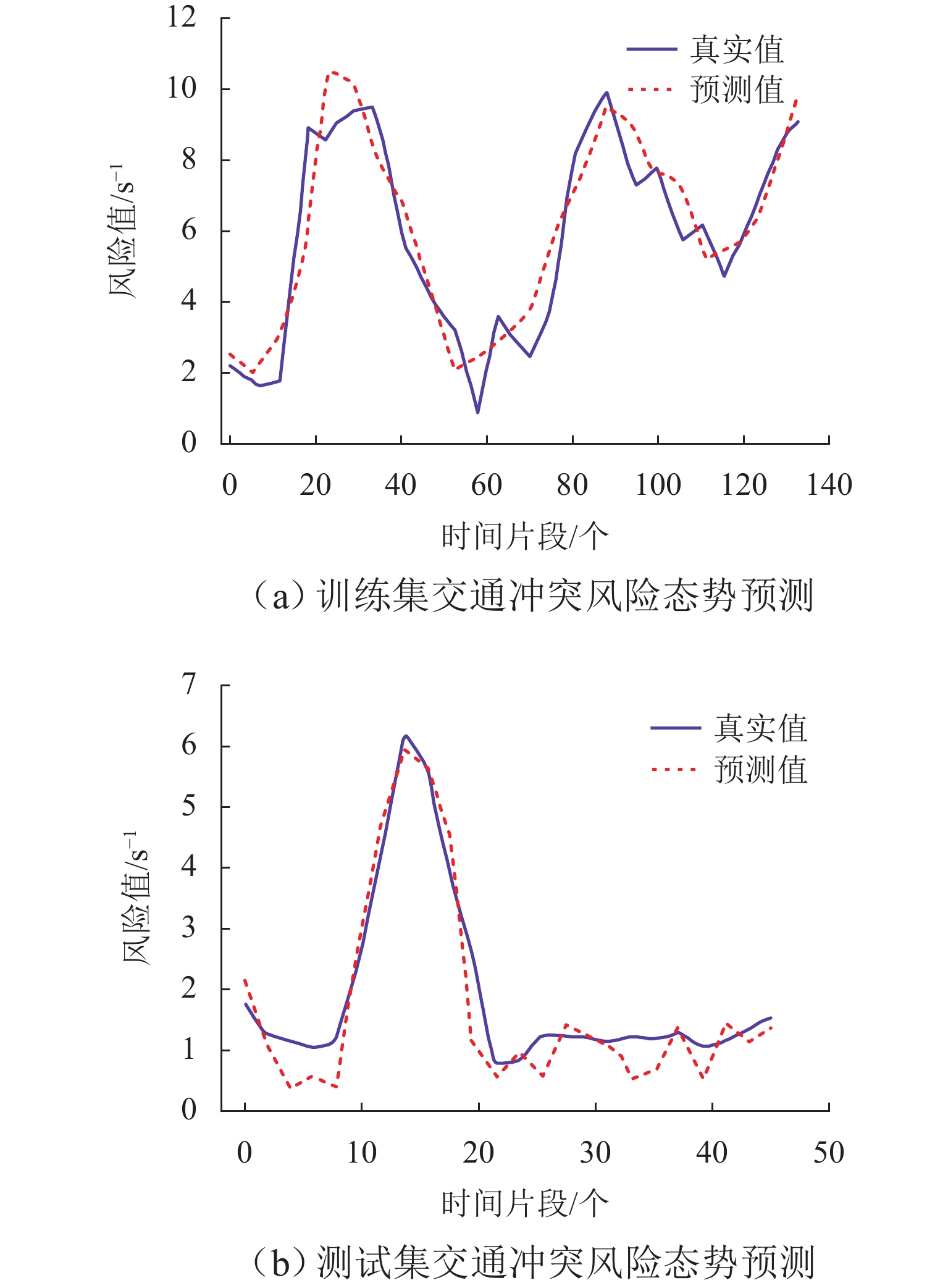
图 11 国贸路与海宝路交叉口区域1预测情况
Figure 11. Prediction results for Area 1 at Guomao Road-Haibao Road intersection
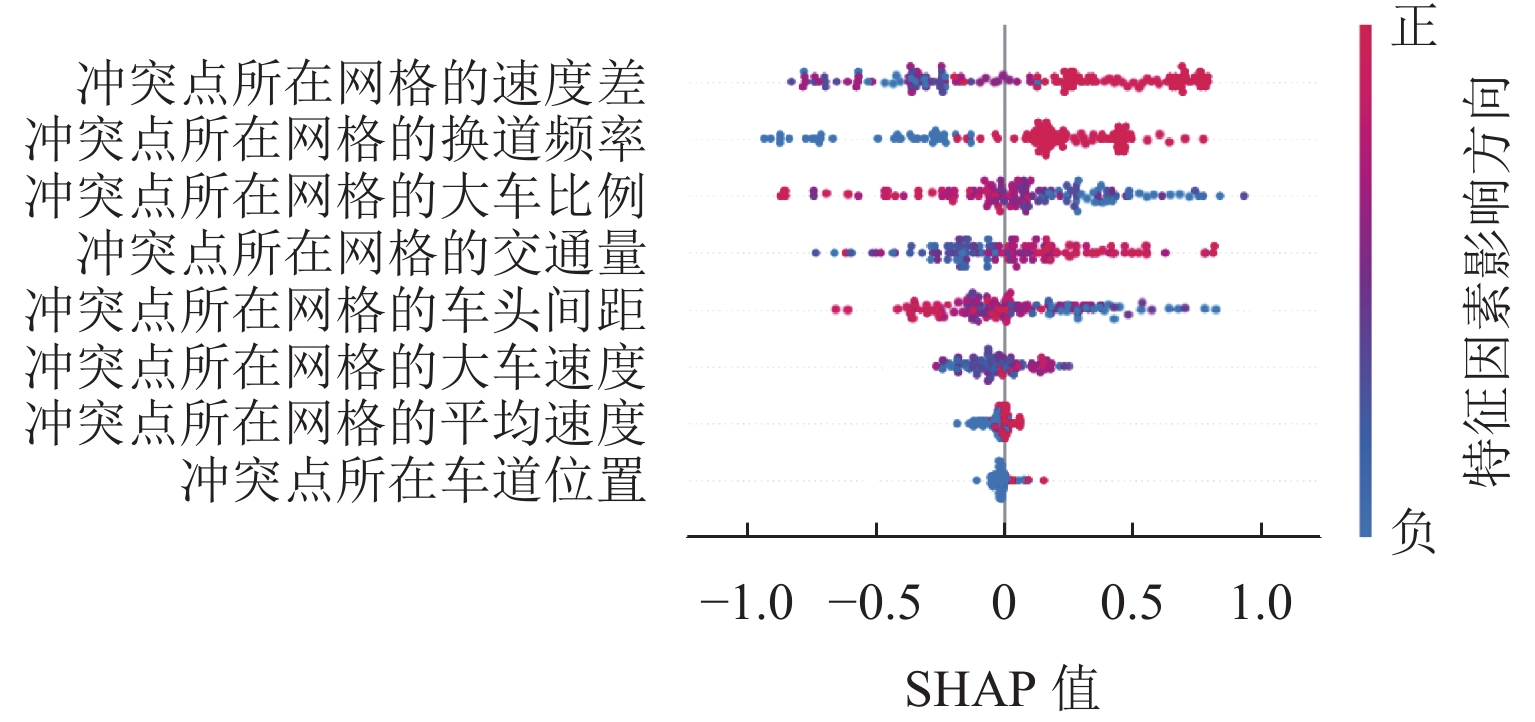
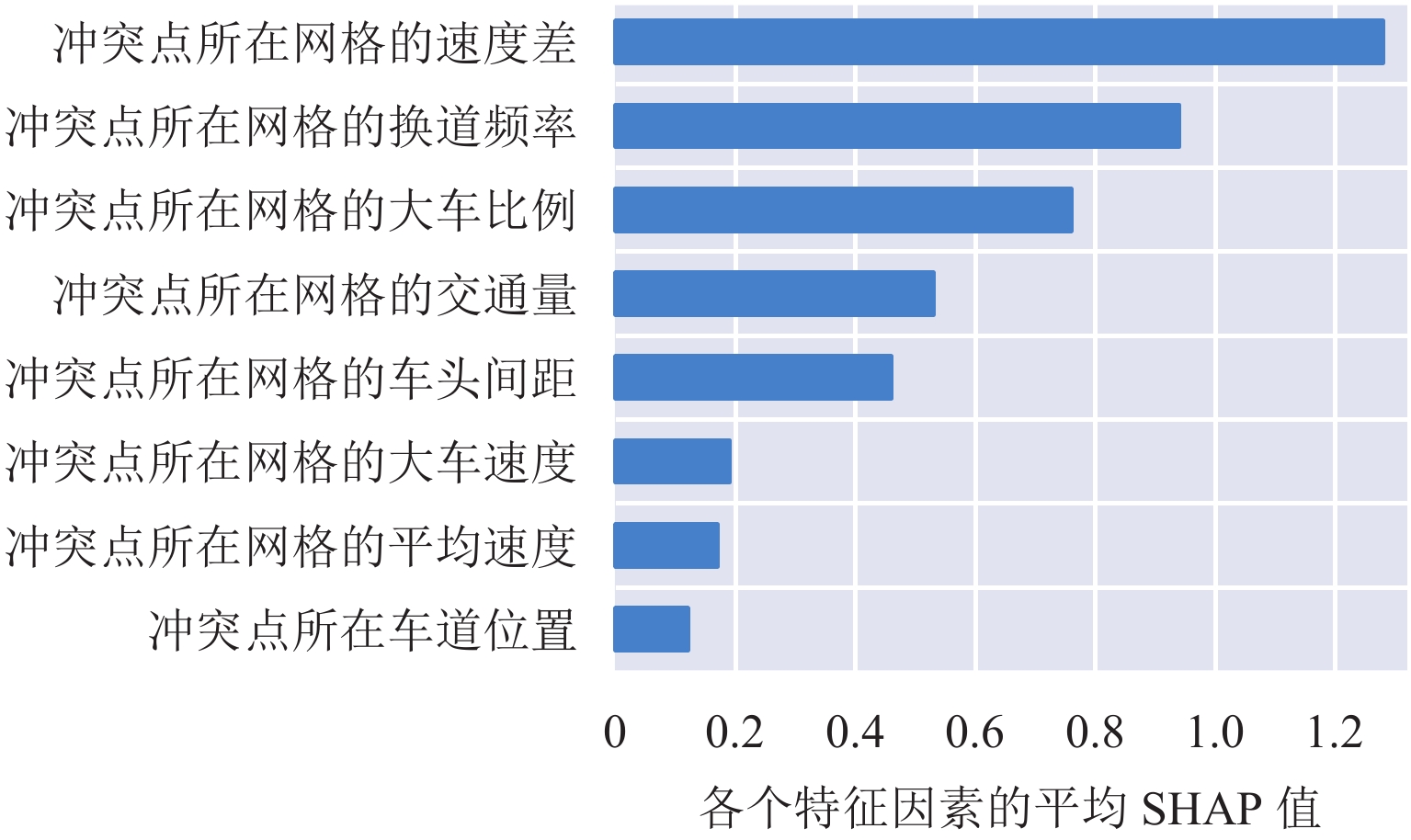
图 14 特征因素对交通冲突风险的影响强度与方向分析
Figure 14. Analysis of magnitude and direction of feature effects on traffic conflict risk
表 1 交通冲突风险预测模型特征变量
Table 1. Feature variables for traffic conflict risk prediction model
分类 指标 变量符号 说明 交通流指标 各网格单元交通量 $ N\left(i\right) $ 每个时间步长内通过第 i 个区域车辆数量 各网格单元平均速度 $ V\left(i\right) $ 每个时间步长内通过第 i 个区域车辆的平均速度 小型车交通量 $ N_{\mathrm{C}}(i) $ 每个时间步长内通过第 i 个区域小型车辆数量 小型车平均速度 $ V_{\mathrm{C}}(i) $ 每个时间步长内通过第 i 个区域小型车辆的平均速度 大型车交通量 $ N_{\mathrm{T}} (i)$ 每个时间步长内通过第 i 个区域大型车辆数量 大型车平均速度 $ V_{\mathrm{T}}(i) $ 每个时间步长内通过第 i 个区域大型车辆的平均速度 交通冲突时
空关联指标交通冲突风险空间关联矩阵 $ \boldsymbol{A}\left({t}\right) $ 每个时间步长内第 i 个区域与第 j 个区域交通冲突风险值的
皮尔逊相关系数矩阵交通冲突风险时间累计矩阵 $ \boldsymbol{X}\left({t}\right) $ 每个时间步长内发生在第 i 个区域所有交通冲突风险的累计值矩阵  下载: 导出CSV
表 2 模型参数
Table 2. Model parameters
模块 元素向
量维度源序列 初始序列 空间特征
学习模块64 $ {\boldsymbol{A}}\left({t}\right)\in {{R}}_{{{\mathrm{N}}}\times {{\mathrm{K}}}\times {{\mathrm{c}}}} $ $ {{\boldsymbol{A}}}^{\prime}\left({t}\right)\in {{R}}_{{{\mathrm{N}}}\times {1}\times {{\mathrm{c}}}} $ 时间特征
学习模块256 $ {{\boldsymbol{X}}}\left({t}\right)\in {{R}}_{{{\mathrm{N}}}\times {{\mathrm{c}}}\times \left({1 + }{Q}\right)} $ $ {{\boldsymbol{X}}}^{\prime}\left({t}\right)\in {{R}}_{{{\mathrm{N}}}\times {1}\times {{\mathrm{c}}}} $
下载: 导出CSV
表 3 预测结果比较
Table 3. Comparison of prediction results
% 模型 $e_{\mathrm{PRE}} $ $e_{\mathrm{REC}} $ $e_{\mathrm{F1}} $ $e_{\mathrm{ACC}} $ ARMA 68.37 70.23 71.35 69.34 XGBoost 73.87 75.36 75.22 75.57 LSTM 78.36 77.25 75.82 72.71 Transformer 82.77 89.33 84.85 83.56
下载: 导出CSV
-
[1] Park M, Lee D, Park J J. An investigation of the safety performance of round abouts in Korea based on a random parameters count model[J]. Journal of Advanced Transportation, 2018, 2018: 5628293. doi: 10.1155/2018/5628293 [2] 王玲, 李义丹, 王子坚, 等. 基于文本挖掘的连环追尾事故影响因素及严重程度[J]. 同济大学学报(自然科学版), 2025, 53(7): 1074-1083. doi: 10.11908/j.issn.0253-374x.24213Wang Ling, Li Yidan, Wang Zijian, et al. Analysis of influencing factors and severity of chain rear-end collision using text mining[J]. Journal of Tongji University (Natural Science), 2025, 53(7): 1074-1083. doi: 10.11908/j.issn.0253-374x.24213 [3] Daniels S, Brijs T, Nuyts E, et al. Externality of risk and crash severity at round abouts[J]. Accident Analysis & Prevention, 2010, 42(6): 1966-1973. doi: 10.1016/j.aap.2010.06.001 [4] Yoshioka K, Nakamura H, Shimokawa S, et al. Modeling of a novel risk index for evaluating the geometric designs of round abouts[J]. Accident Analysis & Prevention, 2020, 145: 105702. doi: 10.1016/j.aap.2020.105702 [5] 张惠玲, 张睿, 王瑞浩. 适老化信号交叉口行人服务水平评价研究[J/OL]. 西南交通大学学报, 1-17[2025-10-12]. [6] Layegh M, Mirbaha B, Rassafi A A. Modeling the pedestrian behavior at conflicts with vehicles in multi-lane round abouts (a cellular automata approach)[J]. Physica A: Statistical Mechanics and its Applications, 2020, 556: 124843. doi: 10.1016/j.physa.2020.124843 [7] 刘擎超, 徐天宇, 熊晓夏, 等. 城市环形交叉口智能汽车接管过程事故风险预测[J]. 中国安全科学学报, 2022, 32(12): 150-157. doi: 10.16265/j.cnki.issn1003-3033.2022.12.2650Liu Qingchao, Xu Tianyu, Xiong Xiaoxia, et al. Accident risk prediction of intelligent vehicle takeover process at urban round about[J]. China Safety Science Journal, 2022, 32(12): 150-157. doi: 10.16265/j.cnki.issn1003-3033.2022.12.2650 [8] 张栋. 基于交通冲突的环形交叉口电动自行车交通安全研究[D]. 西安: 长安大学, 2020. [9] 胡立伟, 龚麒, 赵雪亭, 等. 多车联动式掉头区域交通冲突风险识别研究[J]. 交通运输系统工程与信息, 2025, 25(5): 179-192. doi: 10.16097/j.cnki.1009-6744.2025.05.016Hu Liwei, Gong Qi, Zhao Xueting, et al. Traffic conflict risk identification in multi-vehicle linked U-turn areas[J]. Journal of Transportation Systems Engineering and Information Technology, 2025, 25(5): 179-192. doi: 10.16097/j.cnki.1009-6744.2025.05.016 [10] 汪勇杰, 徐玥莹, 苏倩, 等. 基于贝叶斯推理与XGBoost的城市交叉口车道风险综合评价模型[J]. 交通信息与安全, 2024, 42(4): 12-20. doi: 10.3963/j.jssn.1674-4861.2024.04.002Wang Yongjie, Xu Yueying, Su Qian, et al. A comprehensive evaluation model of lane-based risk for urban intersections based on Bayesian inference and XGBoost[J]. Journal of Transport Information and Safety, 2024, 42(4): 12-20. doi: 10.3963/j.jssn.1674-4861.2024.04.002 [11] Kamla J, Parry T, Dawson A. Analysing truck harsh braking incidents to study round about accident risk[J]. Accident Analysis & Prevention, 2019, 122: 365-377. doi: 10.1016/j.aap.2018.04.031 [12] 丁柏群, 宋子龙. 基于交通冲突的城市交叉口风险影响因素分析[J]. 森林工程, 2019, 35(5): 98-105. doi: 10.3969/j.issn.1006-8023.2019.05.016Ding Baiqun, Song Zilong. Analysis of influencing factors of urban intersections risks based on traffic conflict[J]. Forest Engineering, 2019, 35(5): 98-105. doi: 10.3969/j.issn.1006-8023.2019.05.016 [13] González-Collazo S M, Balado J, González E, et al. Analysis of Sun glare on round abouts with aerial laser scanning data[J]. The International Archives of the Photogrammetry, Remote Sensing and Spatial Information Sciences, 2022, XLIII-B2-2022: 1009-1016. [14] Yang L, Luo X K, Zuo Z J, et al. A novel approach for fine-grained traffic risk characterization and evaluation of urban road intersections[J]. Accident Analysis & Prevention, 2023, 181: 106934. doi: 10.1016/j.aap.2022.106934 [15] 杨洋, 邵哲平, 赵强, 等. 基于厦门港的海上交通事故地理空间分布及风险预测研究[J]. 地球信息科学学报, 2022, 24(9): 1676-1687.Yang Yang, Shao Zheping, Zhao Qiang, et al. Geographical spatial distribution and risk prediction of maritime traffic accidents in port of Xiamen[J]. Journal of Geo-Information Science, 2022, 24(9): 1676-1687. [16] 晏启祥, 贺文城, 阳翼繁, 等. 寒区隧道温度场多因素耦合分析与冻结半径预测研究[J/OL]. 西南交通大学学报, 1-12[2025-10-12]. [17] 赵雪亭, 胡立伟. 城市交通拥塞源参数反演性能综合对比[J]. 西南交通大学学报, 2025, 60(1): 243-252. doi: 10.3969/j.issn.0258-2724.20230008Zhao Xueting, Hu Liwei. Comprehensive comparison of inversion performance of urban traffic congestion source parameters[J]. Journal of Southwest Jiaotong University, 2025, 60(1): 243-252. doi: 10.3969/j.issn.0258-2724.20230008 [18] 王庞伟, 徐京辉, 何昕泽, 等. 基于多模态语义认知的城市自主式交通系统态势推演模型[J]. 西南交通大学学报, 2026, 61(5): 1749-1762. doi: 10.3969/j.issn.0258-2724.20250294Wang Pangwei, Xu Jinghui, He Xinze, et al. Urban autonomous traffic system situation evolution modeling based on multimodal semantic cognition[J]. Journal of Southwest Jiaotong University, 2026, 61(5): 1749-1762. doi: 10.3969/j.issn.0258-2724.20250294 [19] 李帅, 杨柳, 赵欣卉. 基于深度学习的城市区域短时交通拥堵预测算法[J]. 科学技术与工程, 2023, 23(25): 10866-10878. doi: 10.3969/j.issn.1671-1815.2023.25.028Li Shuai, Yang Liu, Zhao Xinhui. Prediction algorithm of short-term traffic congestion in urban area based on deep learning[J]. Science Technology and Engineering, 2023, 23(25): 10866-10878. doi: 10.3969/j.issn.1671-1815.2023.25.028 [20] 李振江, 万利, 周世睿, 等. 基于时空Transformer网络的隧道交通运行风险动态辨识方法[J]. 吉林大学学报(工学版), 2025, 55(4): 1336-1345. doi: 10.13229/j.cnki.jdxbgxb.20230689Li Zhenjiang, Wan Li, Zhou Shirui, et al. Dynamic estimation of operational risk of tunnel traffic flow based on spatial-temporal Transformer network[J]. Journal of Jilin University (Engineering and Technology Edition), 2025, 55(4): 1336-1345. doi: 10.13229/j.cnki.jdxbgxb.20230689 [21] Wang T, Ge Y E, Wang Y J, et al. A spatio-temporal deep learning approach to simulating conflict risk propagation on freeways with trajectory data[J]. Accident Analysis & Prevention, 2024, 195: 107377. doi: 10.1016/j.aap.2023.107377 [22] 陈喜群, 祝文琪, 吕朝锋. 融合轨迹时序与行为修正的车辆冲突风险预测[J]. 交通运输系统工程与信息, 2025, 25(4): 219-229. doi: 10.16097/j.cnki.1009-6744.2025.04.020Chen Xiqun, Zhu Wenqi, Lü Zhaofeng). Vehicle conflict risk prediction integrating trajectory time series and behavior correction[J]. Journal of Transportation Systems Engineering and Information Technology, 2025, 25(4): 219-229. doi: 10.16097/j.cnki.1009-6744.2025.04.020 [23] 胡立伟, 张瑞杰, 赵雪亭, 等. 道路环形交叉口机动车冲突风险区识别模型研究[J]. 交通运输系统工程与信息, 2024, 24(1): 168-178. doi: 10.16097/j.cnki.1009-6744.2024.01.017Hu Liwei, Zhang Ruijie, Zhao Xueting, et al. Round about motor vehicle conflict risk identification model[J]. Journal of Transportation Systems Engineering and Information Technology, 2024, 24(1): 168-178. doi: 10.16097/j.cnki.1009-6744.2024.01.017 [24] 朱顺应, 蒋若曦, 王红, 等. 机动车交通冲突技术研究综述[J]. 中国公路学报, 2020, 33(2): 15-33. doi: 10.3969/j.issn.1001-7372.2020.02.002Zhu Shunying, Jiang Ruoxi, Wang Hong, et al. Review of research on traffic conflict techniques[J]. China Journal of Highway and Transport, 2020, 33(2): 15-33. doi: 10.3969/j.issn.1001-7372.2020.02.002 [25] 孙林. 基于交通冲突技术的城市交叉口交通安全评价方法研究[D]. 西安: 长安大学, 2015. [26] 王涛. 城市道路交叉口交通冲突风险时空传播机理研究[D]. 西安: 长安大学, 2023. -

 下载:


 点击查看大图
计量
- 文章访问数: 4
- HTML全文浏览量: 4
- PDF下载量: 0
- 被引次数: 0