



Detection Method for Entire Vehicle Lane-Changing Process Based on Multi-Source Time-Series Data Fusion
-
摘要:
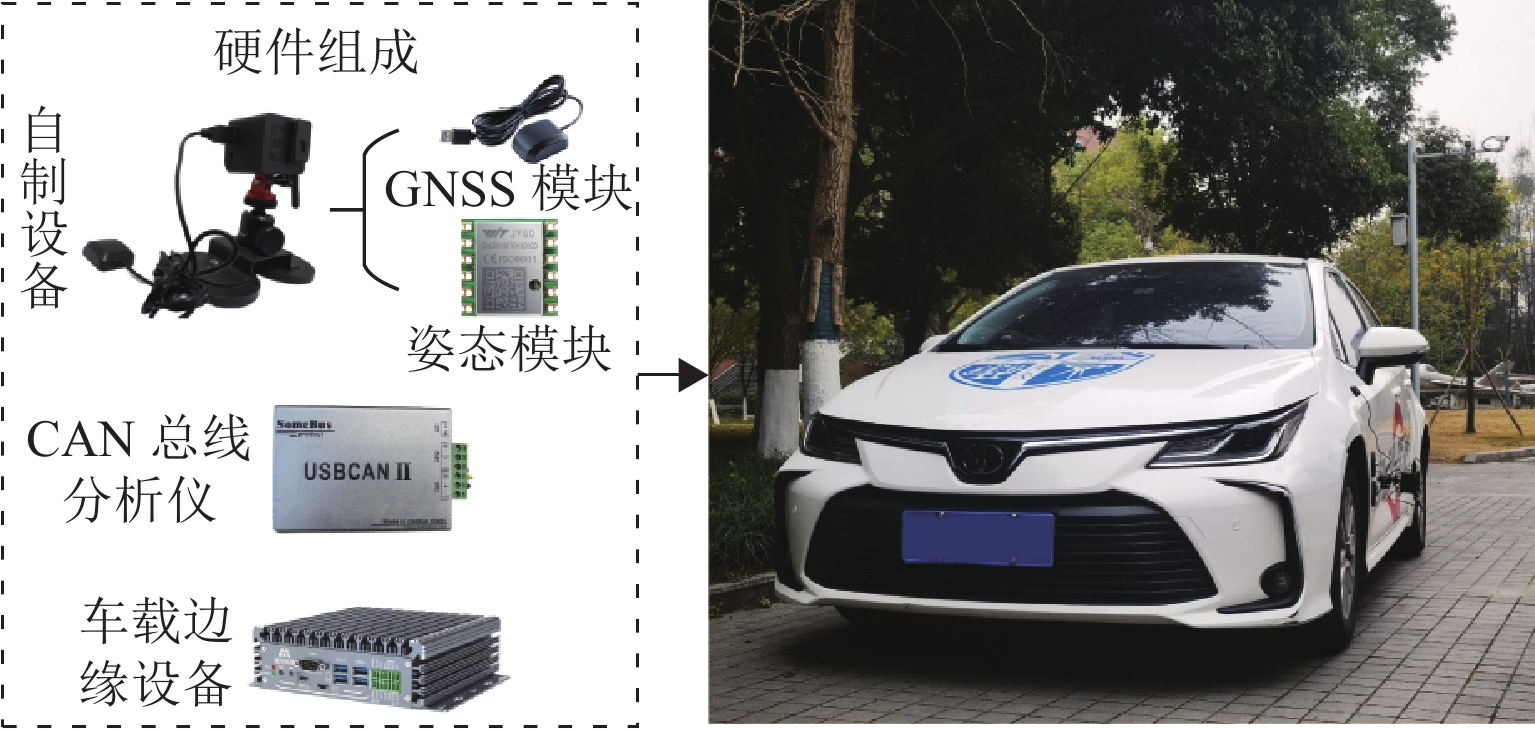
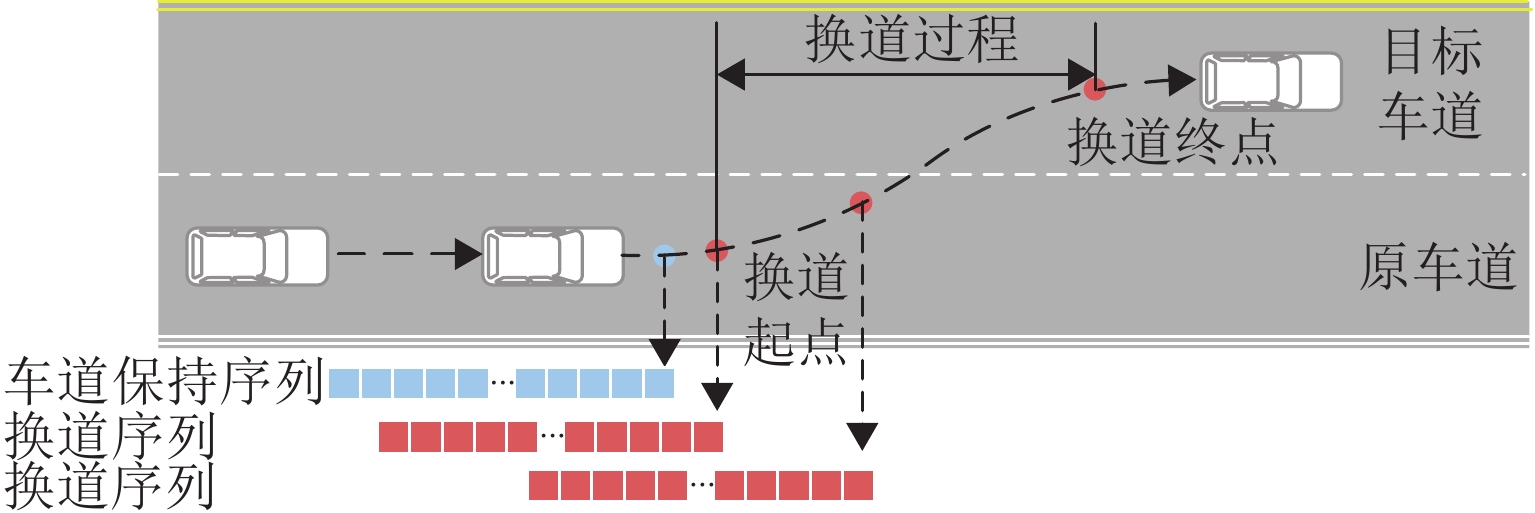
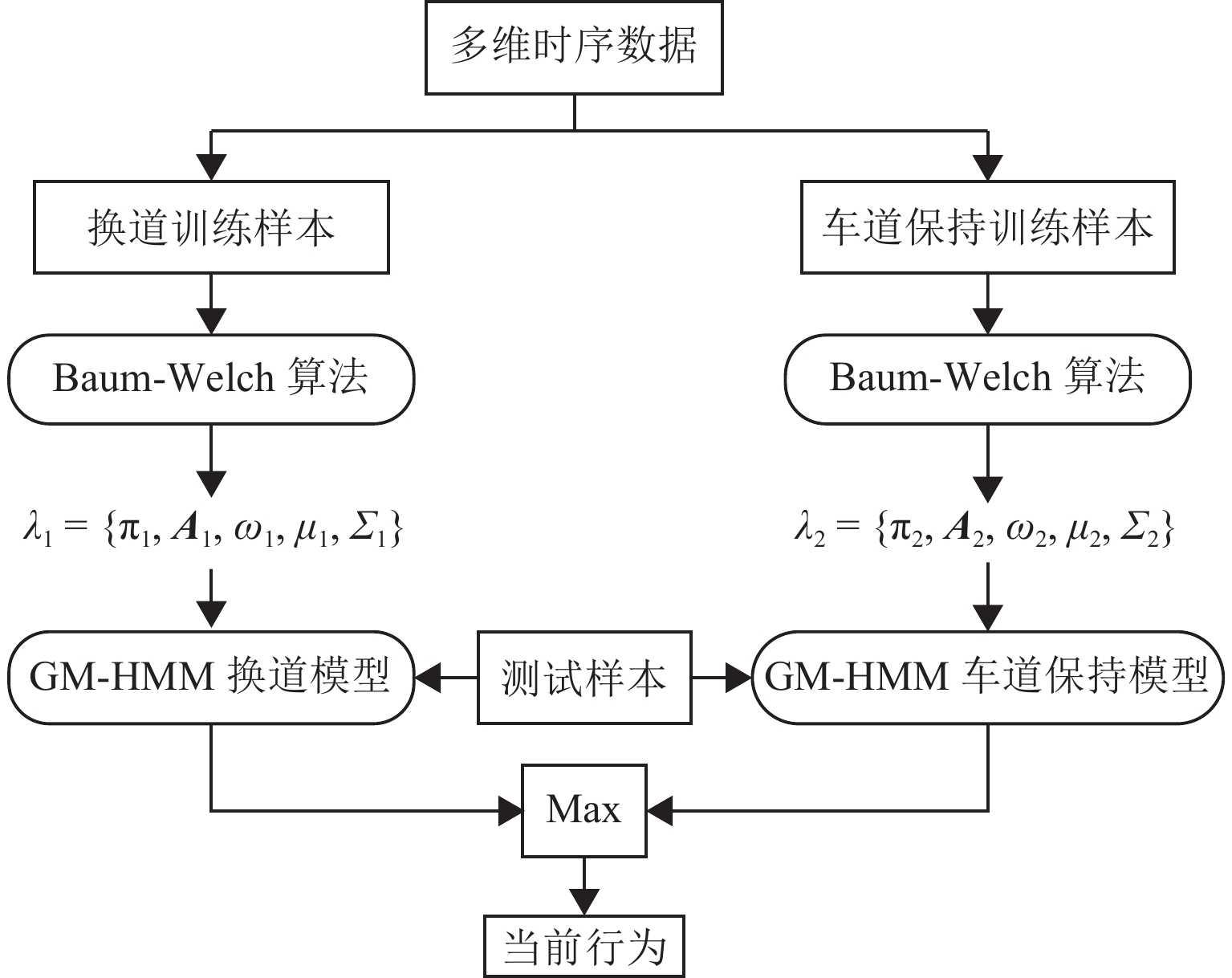
不当换道行为是引发交通事故的重要因素,准确检测车辆换道行为,对提高车辆行驶安全有着重要意义. 现有研究缺乏对换道全过程检测方面的研究,无法捕捉换道过程中动态变化过程,导致检测结果难以满足实际应用需求. 鉴于此,本研究提出融合GNSS(global navigation satellite system)、车辆姿态和CAN(controller area network)总线时序数据的车辆换道全过程检测方法,识别车辆是否换道、换道开始时刻、换道结束时刻;为提高检测的实时性,本文建立基于多维高斯混合隐马尔科夫模型(GM-HMM)的车辆换道行为检测框架;收集600个样本数据用于模型训练和对比,将横向加速度、角速度以及方向盘转角特征数据作为模型输入,并搭建一个实车测试平台进行数据采集和模型验证. 研究结果表明:本研究建立的模型在单一工况下展现了96.67%的高检测准确率;在复合工况下,相较于SVM(support vector machines)、LSTM(long short-term memory)等算法,在换道行为的检测实时性、稳定性、抗干扰能力等关键方面,均表现出显著的优越性.
Abstract:Improper lane-changing behavior is a significant contributing factor to traffic accidents. The accurate detection of lane-changing maneuvers is a crucial element in the enhancement of vehicle safety. Few studies have examined the entire lane-changing process, limiting the ability to capture dynamic variations throughout the maneuver and resulting in detection outcomes that fail to meet practical application demands. To address this limitation, an integrated lane-change detection method that combines Global Navigation Satellite System (GNSS), vehicle attitude, and controller area network (CAN) bus time-series data is proposed to determine whether a lane change occurs and identify its start and end times. To improve real-time detection performance, a lane-changing behavior detection framework based on a multidimensional Gaussian mixture hidden Markov model (GM-HMM) was developed. A total of 600 samples were collected for model training and comparison. Lateral acceleration, angular velocity, and steering wheel angle data were used as model inputs, and a real-vehicle testing platform was built for data collection and model validation. The results demonstrate that the proposed model achieves a high detection accuracy of 96.67% under a single operating condition. Moreover, under combined operating conditions, the proposed model outperforms other algorithms, including support vector machines (SVMs) and long short-term memory (LSTM) networks, in terms of real-time detection performance, stability, and resistance to interference, demonstrating its advantages in key aspects of lane-change detection.
-
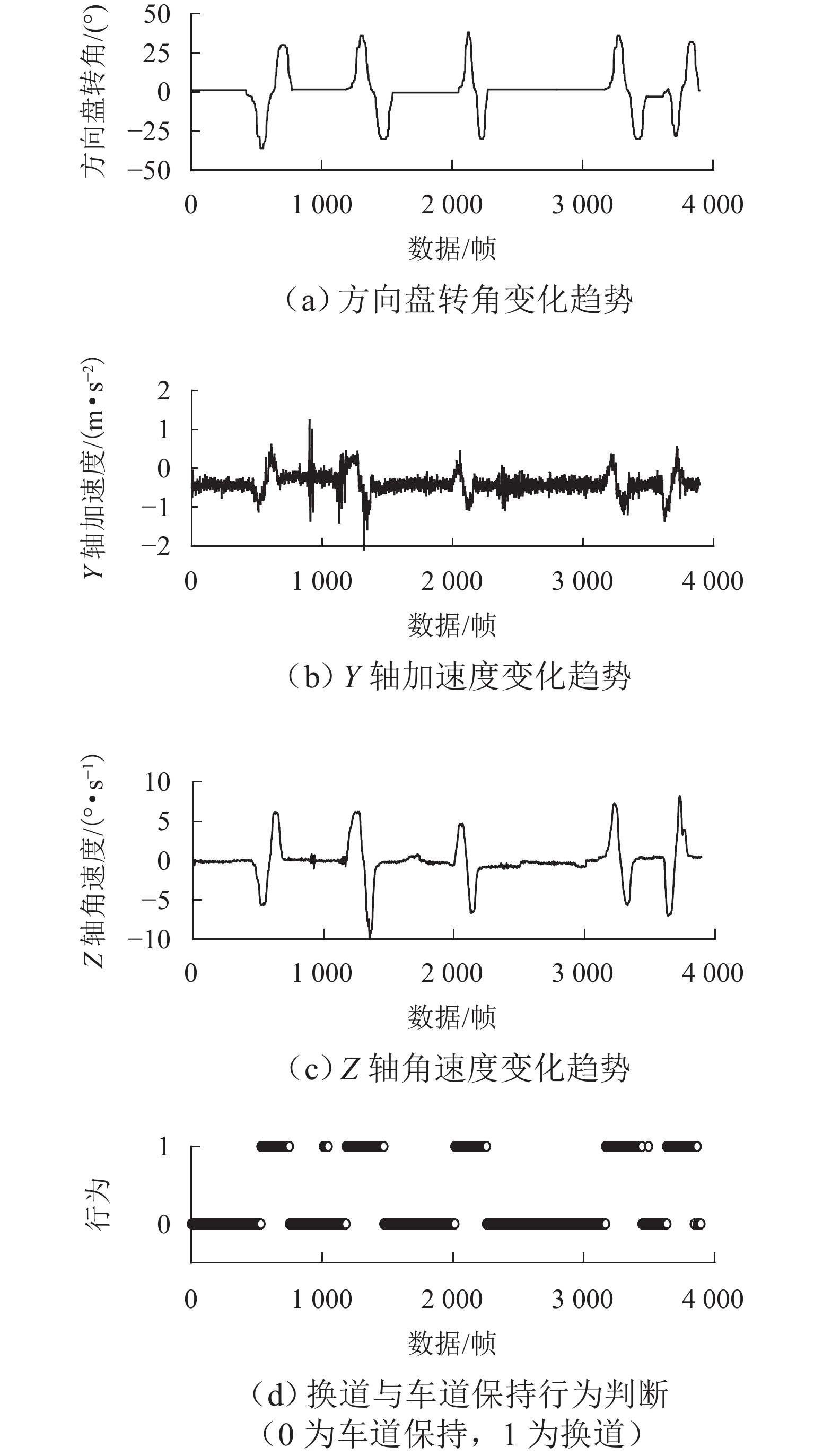
图 7 复合工况行为检测结果
Figure 7. Behavior detection results under combined operating conditions
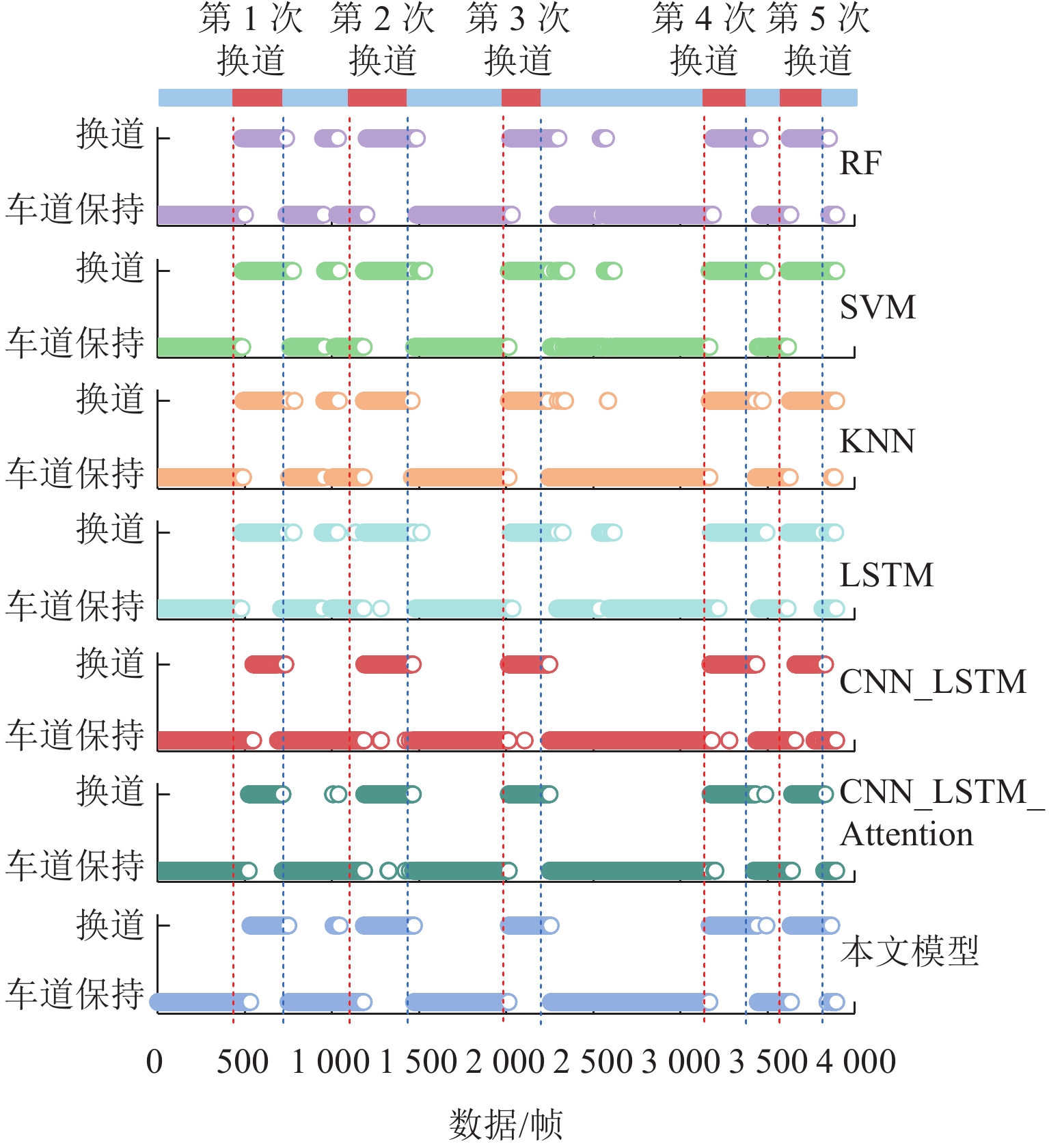
图 9 复合工况下不同模型检测结果对比图
Figure 9. Comparison of detection results among different models under combined operating conditions
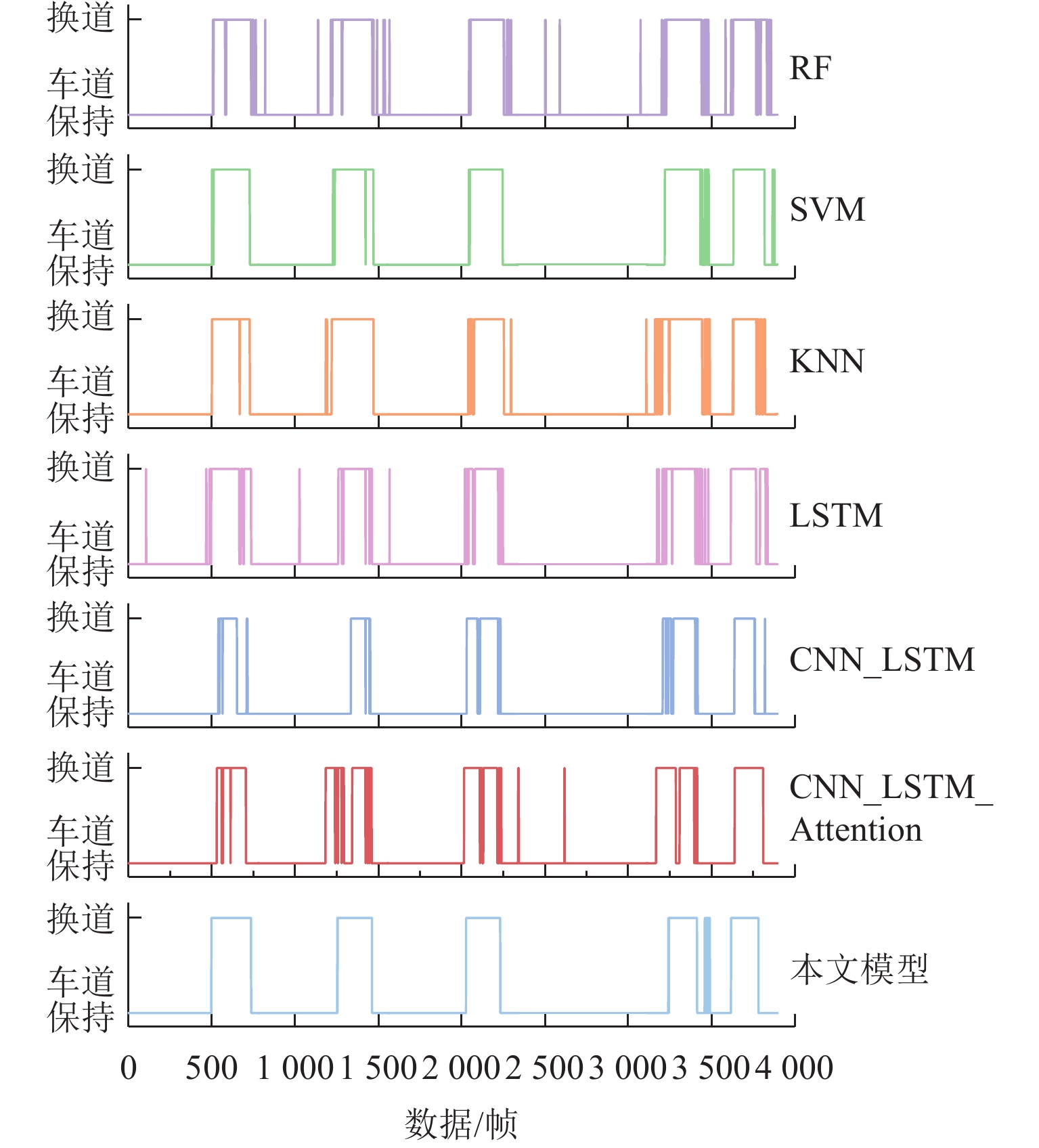
图 10 加噪声后的连续数据不同模型检测结果对比图
Figure 10. Comparison of detection results among different models using continuous data with added noise
表 1 车辆行驶数据类型
Table 1. Types of vehicle driving data
数据来源 字段 描述 姿态传
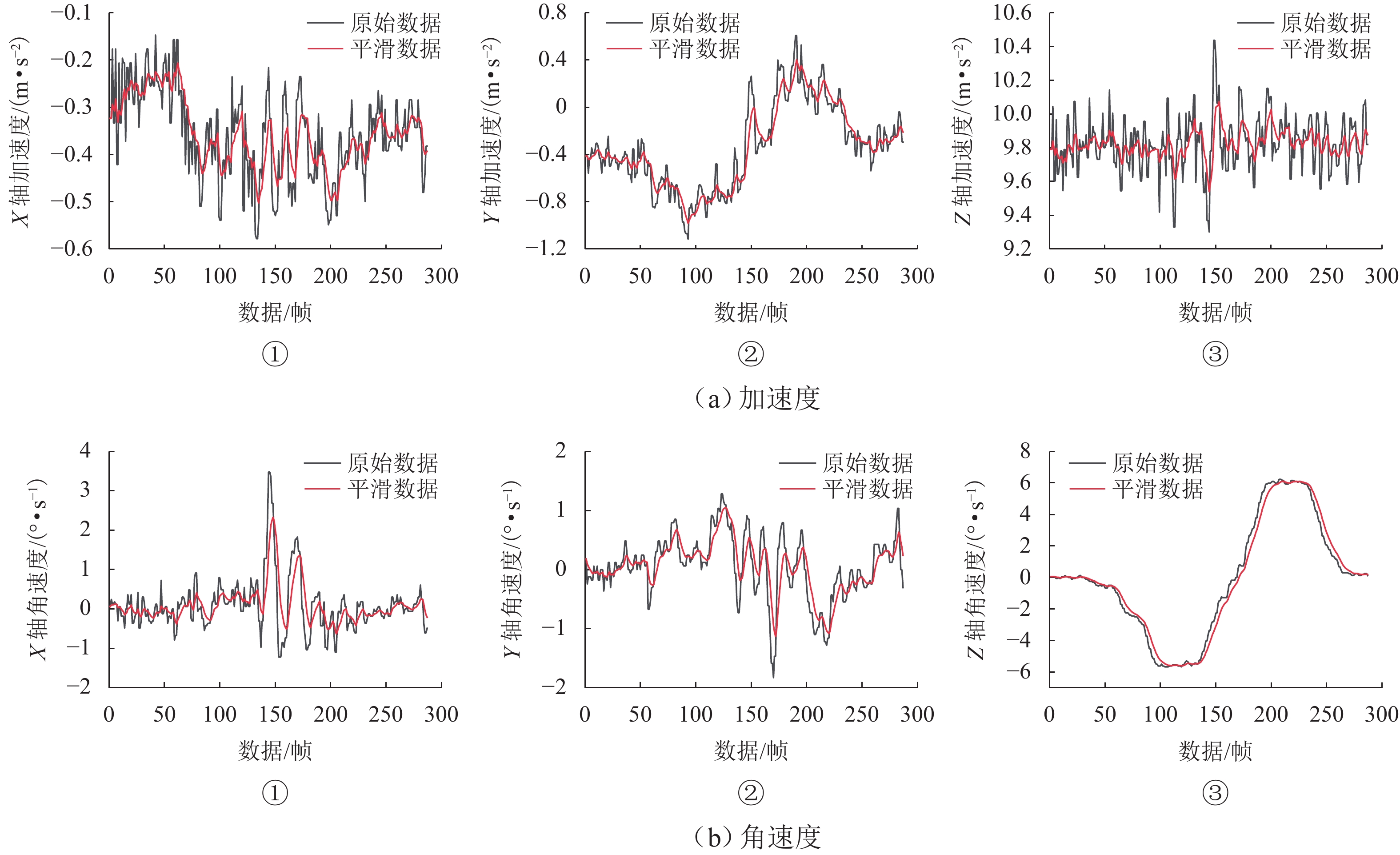
感器acc_x X 轴方向加速度/(m·s−2) acc_y Y 轴方向加速度/(m·s−2) acc_z Z 轴方向加速度/(m·s−2) gyro_x X 轴方向角速度/(°·s−1) gyro_y Y 轴方向角速度/(°·s−1) gyro_z Z 轴方向角速度/(°·s−1) gyro_yaw 行驶方向偏航角/(°) GNSS latitude 经度/(°) longitude 纬度/(°) CAN总线 throttle 加速踏板/% steering_wheel_angle 方向盘转角/(°) speed 速度/(km·h−1)  下载: 导出CSV
表 4 不同特征选取方式下的模型检测效果对比
Table 4. Comparison of model detection performance using different feature selection methods
特征选取方式 换道检测准确率/% 车道保持检测准确率/% 换道起点检测延迟/s 换道终点检测延迟/s 增加换道起点前后10帧数据 98.89 80.00 1.25 1.60 增加换道终点前后10帧数据 84.62 94.87 2.00 0.65 正常滑窗数据 98.89 94.44 1.75 1.05
下载: 导出CSV
表 5 单一工况下不同模型检测效果对比
Table 5. Comparison of detection performance among different models under single operating condition
% 每类训练样本数/条 模型 准确率 精准率 召回率 F1分数 10 SVM 91.11 87.00 96.67 91.58 RF 89.44 84.47 96.67 90.16 KNN 87.22 88.51 85.56 87.01 LSTM 73.89 74.71 72.22 73.44 CNN_LSTM 71.67 66.12 88.89 75.83 CNN_LSTM_Attention 76.67 70.69 91.11 79.61 本文模型 93.33 100.00 86.67 92.86 50 SVM 92.22 86.54 100.00 92.78 RF 91.67 89.47 94.44 91.89 KNN 92.22 87.25 98.89 92.71 LSTM 83.33 98.39 67.78 80.26 CNN_LSTM 87.78 84.00 93.33 88.42 CNN_LSTM_Attention 80.56 80.22 81.11 80.66 本文模型 94.44 90.00 100.00 94.74 100 SVM 92.78 87.38 100.00 92.26 RF 91.67 88.66 95.56 91.98 KNN 92.78 88.12 98.89 93.19 LSTM 80.56 100.00 61.11 75.86 CNN_LSTM 90.56 93.98 86.67 90.17 CNN_LSTM_Attention 89.44 96.10 82.22 88.62 本文模型 93.33 89.00 98.89 93.68 150 SVM 94.44 90.00 100.00 94.74 RF 94.44 91.67 97.78 94.62 KNN 96.67 95.65 97.78 96.70 LSTM 92.78 100.00 85.56 92.22 CNN_LSTM 91.67 100.00 83.33 90.91 CNN_LSTM_Attention 91.67 96.30 86.67 91.23 本文模型 96.67 94.68 98.89 96.74 200 SVM 94.44 90.00 100.00 94.74 RF 94.44 91.67 97.78 94.62 KNN 96.67 95.65 97.78 96.70 LSTM 95.56 98.81 92.23 95.40 CNN_LSTM 92.77 88.89 97.78 93.12 CNN_LSTM_Attention 91.11 87.00 96.67 91.58 本文模型 96.67 94.68 98.89 96.74 210 SVM 94.44 90.00 100.00 94.74 RF 94.44 91.67 97.78 94.62 KNN 96.67 95.65 97.78 96.70 LSTM 95.56 98.81 92.23 95.40 CNN_LSTM 91.11 93.02 88.89 90.91 CNN_LSTM_Attention 92.22 97.5 86.67 91.76 本文模型 96.67 94.68 98.89 96.74
下载: 导出CSV
表 6 复合工况下换道全过程状态变化检测对比表
Table 6. Comparison of state change detection throughout entire lane-changing process under combined operating conditions
换道
行为实际发
生帧
数/帧RF SVM KNN LSTM CNN_LSTM CNN_LSTM_
Attention本研究模型 检测时
刻/帧延迟时
间/s检测时
刻/帧延迟时
间/s检测时
刻/帧延迟时
间/s检测时
刻/帧延迟时
间/s检测时
刻/帧延迟时
间/s检测时
刻/帧延迟时
间/s检测时
刻/帧延迟时
间/s第 1 次
换道开始 485 498 0.65 486 0.05 490 0.25 486 0.05 535 2.50 523 2.00 520 1.75 结束 709 738 1.45 759 2.50 754 2.25 754 2.25 749 2.00 733 1.20 730 1.05 第 2 次
换道开始 1184 1198 0.70 1186 0.10 1186 0.10 1186 0.10 1188 0.20 1190 0.30 1191 0.35 结束 1433 1488 2.75 1471 1.90 1475 2.10 1475 2.10 1465 1.60 1471 1.90 1471 1.90 第 3 次
换道开始 2015 2033 0.90 2017 0.10 2017 0.10 2026 0.55 2025 0.50 2028 0.55 2019 0.25 结束 2246 2295 2.45 2256 0.50 2254 0.40 2296 2.50 2254 0.40 2260 0.70 2254 0.40 第 4 次
换道开始 3168 3187 0.95 3170 0.10 3170 0.10 3174 0.30 3174 0.30 3177 0.45 3178 0.50 结束 3397 3456 2.95 3495 4.90 3433 1.80 3450 2.65 3437 2.00 3439 2.10 3447 2.00 第 5 次
换道开始 3617 3632 0.75 3619 0.10 3629 0.60 3619 0.10 3660 2.15 3642 1.25 3630 0.65 结束 3819 3856 1.85 无 5.00 3876 2.85 3845 1.30 3832 0.65 3832 0.65 3837 0.90 平均延误 - - 1.54 - 1.53 - 1.06 - 1.19 - 1.23 - 1.11 - 0.98
下载: 导出CSV
-
[1] Li G F, Li S E, Cheng B, et al. Estimation of driving style in naturalistic highway traffic using maneuver transition probabilities[J]. Transportation Research Part C: Emerging Technologies, 2017, 74: 113-125. doi: 10.1016/j.trc.2016.11.011 [2] Habenicht S, Winner H, Bone S, et al. A maneuver-based lane change assistance system[C]//2011 IEEE Intelligent Vehicles Symposium (IV). Baden-Baden, Germany. IEEE, 2011: 375-380. [3] Tran D, Du J H, Sheng W H, et al. A human-vehicle collaborative driving framework for driver assistance[J]. IEEE Transactions on Intelligent Transportation Systems, 2019, 20(9): 3470-3485. doi: 10.1109/TITS.2018.2878027 [4] Xie D F, Fang Z Z, Jia B, et al. A data-driven lane-changing model based on deep learning[J]. Transportation Research Part C: Emerging Technologies, 2019, 106: 41-60. doi: 10.1016/j.trc.2019.07.002 [5] Singh H, Kathuria A. Analyzing driver behavior under naturalistic driving conditions: a review[J]. Accident Analysis & Prevention, 2021, 150: 105908. doi: 10.1016/j.aap.2020.105908 [6] Toledo T, Musicant O, Lotan T. In-vehicle data recorders for monitoring and feedback on drivers’ behavior[J]. Transportation Research Part C: Emerging Technologies, 2008, 16(3): 320-331. doi: 10.1016/j.trc.2008.01.001 [7] Bi H K, Bi H K, Mao T L, et al. A data-driven model for lane-changing in traffic simulation[C]//Proceedings of the ACM SIGGRAPH/Eurographics Symposium on Computer Animation. ACM, 2016: 149-158. [8] Shi H L, Wang T L, Zhong F S, et al. A data-driven car-following model based on the random forest[J]. World Journal of Engineering and Technology, 2021, 9(3): 503-515. doi: 10.4236/wjet.2021.93033 [9] Teimouri F, Ghatee M. A real-time warning system for rear-end collision based on random forest classifier[J]. Journal of Soft Computing in Civil Engineering, 2020, 4(1): 49-71. [10] Sun Q Y, Wang C, Fu R, et al. Lane change strategy analysis and recognition for intelligent driving systems based on random forest[J]. Expert Systems with Applications, 2021, 186: 115781. doi: 10.1016/j.eswa.2021.115781 [11] Hallac D, Sharang A, Stahlmann R, et al. Driver identification using automobile sensor data from a single turn[C]//2016 IEEE 19th International Conference on Intelligent Transportation Systems (ITSC). Piscataway: IEEE, 2016: 953-958. [12] 徐婷, 邓恺龙, 刘永涛, 等. 基于航测数据的不同风格换道轨迹规划[J]. 西南交通大学学报, 2024, 59(3): 720-728. doi: 10.3969/j.issn.0258-2724.20230392Xu Ting, Deng Kailong, Liu Yongtao, et al. Different styles of lane changing trajectory planning based on aerial survey data[J]. Journal of Southwest Jiaotong University, 2024, 59(3): 720-728. doi: 10.3969/j.issn.0258-2724.20230392 [13] Wu X R, Zhou J W, An J H, et al. Abnormal driving behavior detection for bus based on the Bayesian classifier[C]//2018 Tenth International Conference on Advanced Computational Intelligence (ICACI). Xiamen, China. IEEE, 2018: 266-272. [14] 苏丽娜, 李凡, 潘秀, 等. 基于雷达数据的车辆换道行为识别研究[J]. 北京交通大学学报, 2022, 46(4): 60-67. doi: 10.11860/j.issn.1673-0291.20210136Su Lina, Li Fan, Pan Xiu, et al. Detection of vehicle lane-changing behavior based on radar data[J]. Journal of Beijing Jiaotong University, 2022, 46(4): 60-67. doi: 10.11860/j.issn.1673-0291.20210136 [15] Zheng Y, Hansen J H L. Lane-change detection from steering signal using spectral segmentation and learning-based classification[J]. IEEE Transactions on Intelligent Vehicles, 2017, 2(1): 14-24. doi: 10.1109/TIV.2017.2708600 [16] Sharma O, Sahoo N C, Puhan N B. Highway discretionary lane changing behavior recognition using continuous and discrete hidden Markov model[C]//2021 IEEE International Intelligent Transportation Systems Conference (ITSC). Piscataway: IEEE, 2021: 1476-1481. [17] Jin H, Duan C G, Liu Y, et al. Gauss mixture hidden Markov model to characterise and model discretionary lane-change behaviours for autonomous vehicles[J]. IET Intelligent Transport Systems, 2020, 14(5): 401-411. doi: 10.1049/iet-its.2019.0446 [18] 徐婷, 温常磊, 张香, 等. 基于GMM-CHMM的城市道路换道行为识别[J]. 交通运输系统工程与信息, 2020, 20(1): 61-67. doi: 10.16097/j.cnki.1009-6744.2020.01.010Xu Ting, Wen Changlei, Zhang Xiang, et al. Lane changing behavior identification of urban road based on GMM-CHMM[J]. Journal of Transportation Systems Engineering and Information Technology, 2020, 20(1): 61-67. doi: 10.16097/j.cnki.1009-6744.2020.01.010 [19] Chen S Y, Yao H, Qiao F X, et al. Vehicles driving behavior recognition based on transfer learning[J]. Expert Systems with Applications, 2023, 213: 119254. doi: 10.1016/j.eswa.2022.119254 [20] 赵建东, 赵志敏, 屈云超, 等. 轨迹数据驱动的车辆换道意图识别研究[J]. 交通运输系统工程与信息, 2022, 22(4): 63-71. doi: 10.16097/j.cnki.1009-6744.2022.04.007Zhao Jiandong, Zhao Zhimin, Qu Yunchao, et al. Vehicle lane change intention recognition driven by trajectory data[J]. Journal of Transportation Systems Engineering and Information Technology, 2022, 22(4): 63-71. doi: 10.16097/j.cnki.1009-6744.2022.04.007 [21] 王婉琦, 程国柱, 徐亮. 基于无监督聚类分析的激进换道行为识别方法[J]. 交通运输系统工程与信息, 2024, 24(2): 166-178. doi: 10.16097/j.cnki.1009-6744.2024.02.017Wang Wanqi, Cheng Guozhu, Xu Liang. Identification of aggressive lane-changing behaviour based on unsupervised cluster analysis[J]. Journal of Transportation Systems Engineering and Information Technology, 2024, 24(2): 166-178. doi: 10.16097/j.cnki.1009-6744.2024.02.017 [22] Hu X H, Chen S Z, Zhao J H, et al. Risk identification and prediction model for continuous‐lane‐change vehicles considering driving style[J]. Expert Systems with Applications, 2025, 259: 125292. doi: 10.1016/j.eswa.2024.125292 [23] Liao X S, Zhao X P, Wang Z R, et al. Driver digital twin for online prediction of personalized lane-change behavior[J]. IEEE Internet of Things Journal, 2023, 10(15): 13235-13246. doi: 10.1109/JIOT.2023.3262484 [24] Knoop V L, De Bakker P F, Tiberius C C J M, et al. Lane determination with GPS precise point positioning[J]. IEEE Transactions on Intelligent Transportation Systems, 2017, 18(9): 2503-2513. doi: 10.1109/TITS.2016.2632751 [25] Tang L L, Yang X, Kan Z H, et al. Lane-level road information mining from vehicle GPS trajectories based on Naïve Bayesian classification[J]. ISPRS International Journal of Geo-Information, 2015, 4(4): 2660-2680. doi: 10.3390/ijgi4042660 [26] Yuan Y, Li Y B, Bao H P. An empirical study on the lane-change duration of naturalistic driving based on multiple linear regression model[C]//2020 IEEE International Conference on Artificial Intelligence and Information Systems (ICAIIS). Dalian, China. IEEE, 2020: 381-387. -

 下载:

 点击查看大图
计量
- 文章访问数: 5
- HTML全文浏览量: 4
- PDF下载量: 0
- 被引次数: 0