



Icing and Deicing Jump Analysis of Transmission Tower-Line System under Heavy Ice Load
-
摘要:
近年来出现带过渡段的新塔型用以适应陡峻山区地形. 为确保这些输电塔在重覆冰条件下的安全性,基于悬链线理论,对±800 kV特高压线路耐张段考虑线路转角和高差建立精细化有限元模型;研究在16种覆冰工况下主材、斜材及导线、地线的受力特性,并分析脱冰跳跃时导线和地线的张力及其位移响应特点,获得最大跳跃高度,并研究其电气安全性. 结果表明:30 mm重覆冰下,塔身主材、斜材应力比分别小于0.34和0.20,线的等效安全系数均大于2.25,结构安全裕度较大;带过渡段的塔型在覆冰条件下的薄弱位置主要集中在最长腿塔脚、过渡段的主材以及横担和地线支架的斜材;导线和地线的最大冰跳高度分别为7.9 m和5.2 m,满足最小空气绝缘间隙要求;线路脱冰跳跃竖向最大位移呈现阻尼余弦波函数特征,塔-线耦连体系中同跨导线和地线之间存在能量转移. 本文研究成果可为重冰区和大高差条件下高电压等级线路的建设提供参考.
Abstract:Objective With the increasing demand for electricity, the transmission lines inevitably need to traverse steep mountainous terrains with significant elevation differences. Traditional high-low leg transmission towers are limited by the angle constraints of their main and diagonal elements. To overcome these limitations, new tower designs with transition sections have emerged in recent years, solving the problem of positioning the towers in terrains with large elevation differences. These new tower types have been applied to the transmission lines of 220 kV and 500 kV voltage levels. However, research on the ±800 kV ultra-high-voltage (UHV) transmission lines under heavy ice load remains a research gap. Southwestern China is rich in hydropower resources, but the natural conditions of the region, steep terrain, and severe icing, present significant challenges, with many areas classified as moderate to heavy ice regions. With the implementation of the west-to-east power transmission strategy of China, this new type of tower design with transition sections has promising application prospects for transmission corridors in this region. However, the failures of transmission lines caused by tower collapses and line breakages under ice load frequently occur in mountainous areas. Therefore, the structural and electrical safety of the new tower type, especially when applied to UHV lines under icing and ice-shedding conditions, urgently needs investigation.
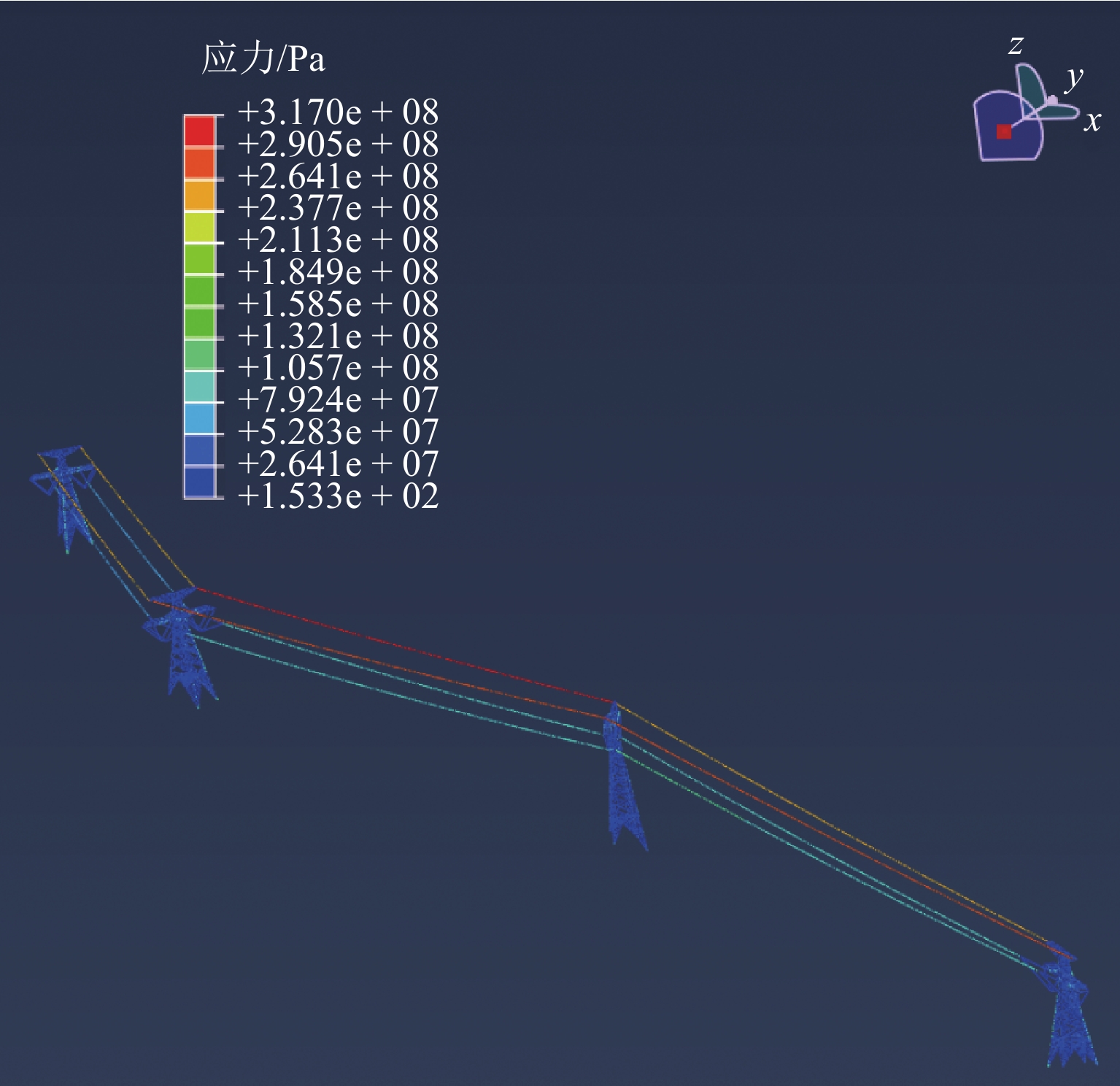
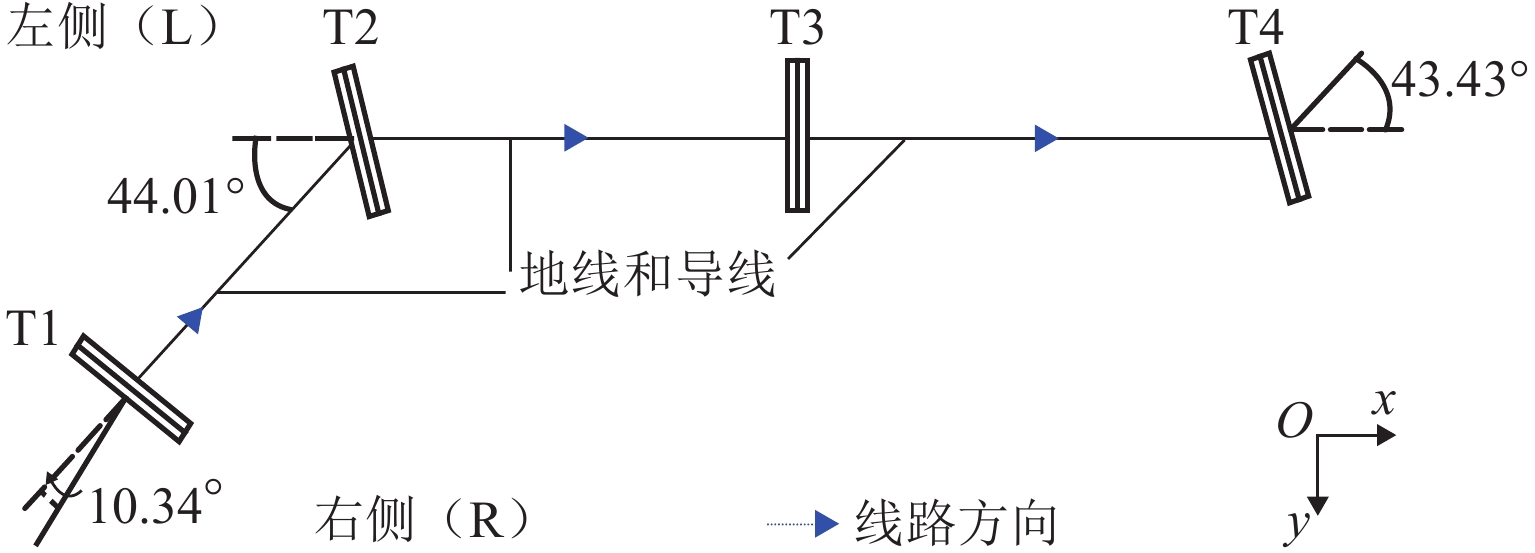
Methods A steep-span tension section of the ±800 kV UHV transmission line from Sichuan to Jiangsu was studied. The research employed a catenary model to simulate the shape of ground lines and conductor lines, and a finite element model of the transmission tower-line coupling system with transition sections was developed using ABAQUS software. The model accounts for line angles, as well as elevation differences; moreover, the structural dimensions and material property parameters were selected based on actual engineering data. The structural and electrical safety characteristics of the transmission tower-line coupling system under different icing and ice-shedding conditions were analyzed. Specifically, the stress distribution patterns of main and diagonal elements along the height of the tower during icing and ice-shedding were investigated, and the tension and safety factors of ground and conductor lines were evaluated; the displacement response and energy transfer mechanisms of ice-shedding were explored.
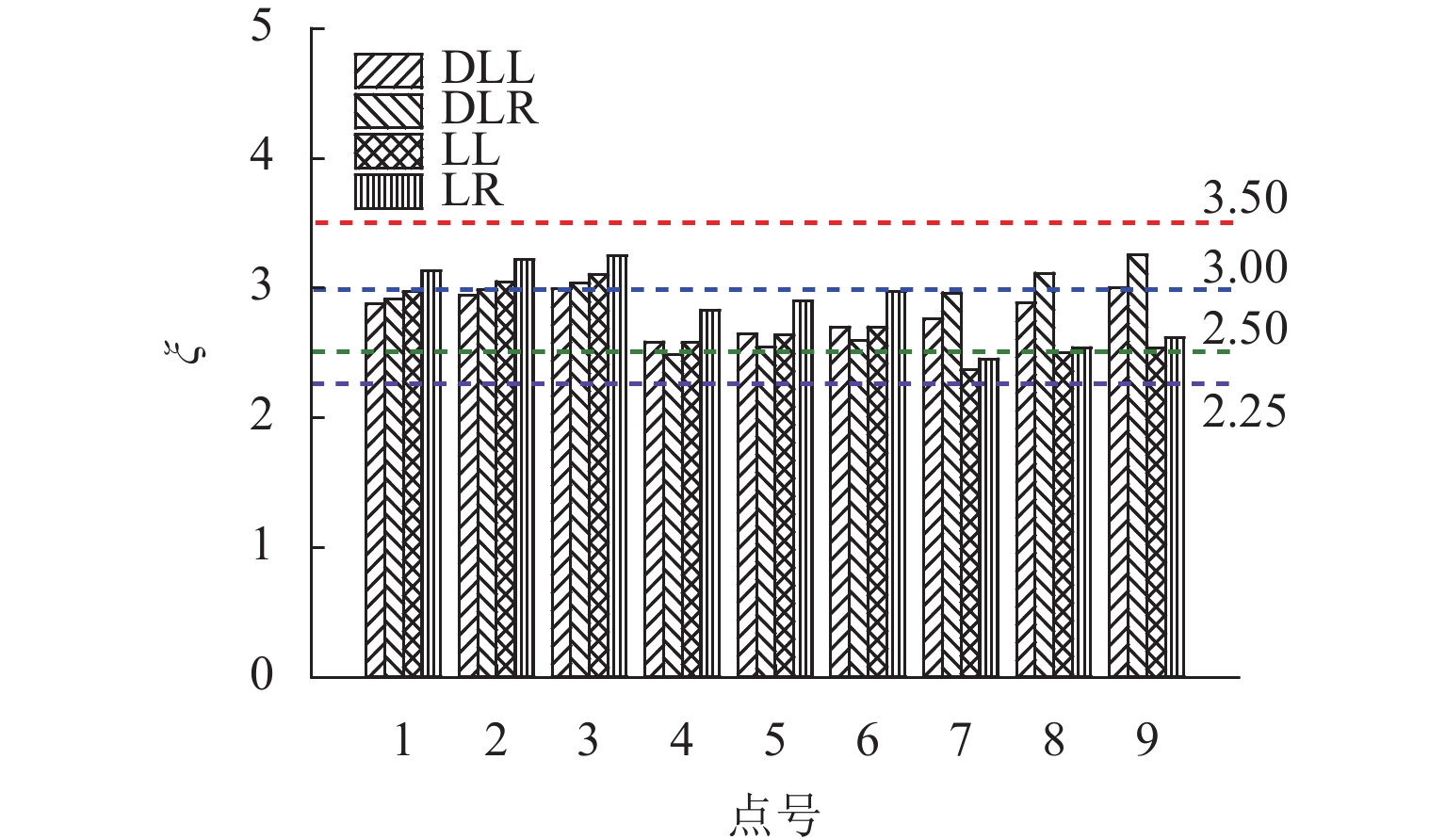
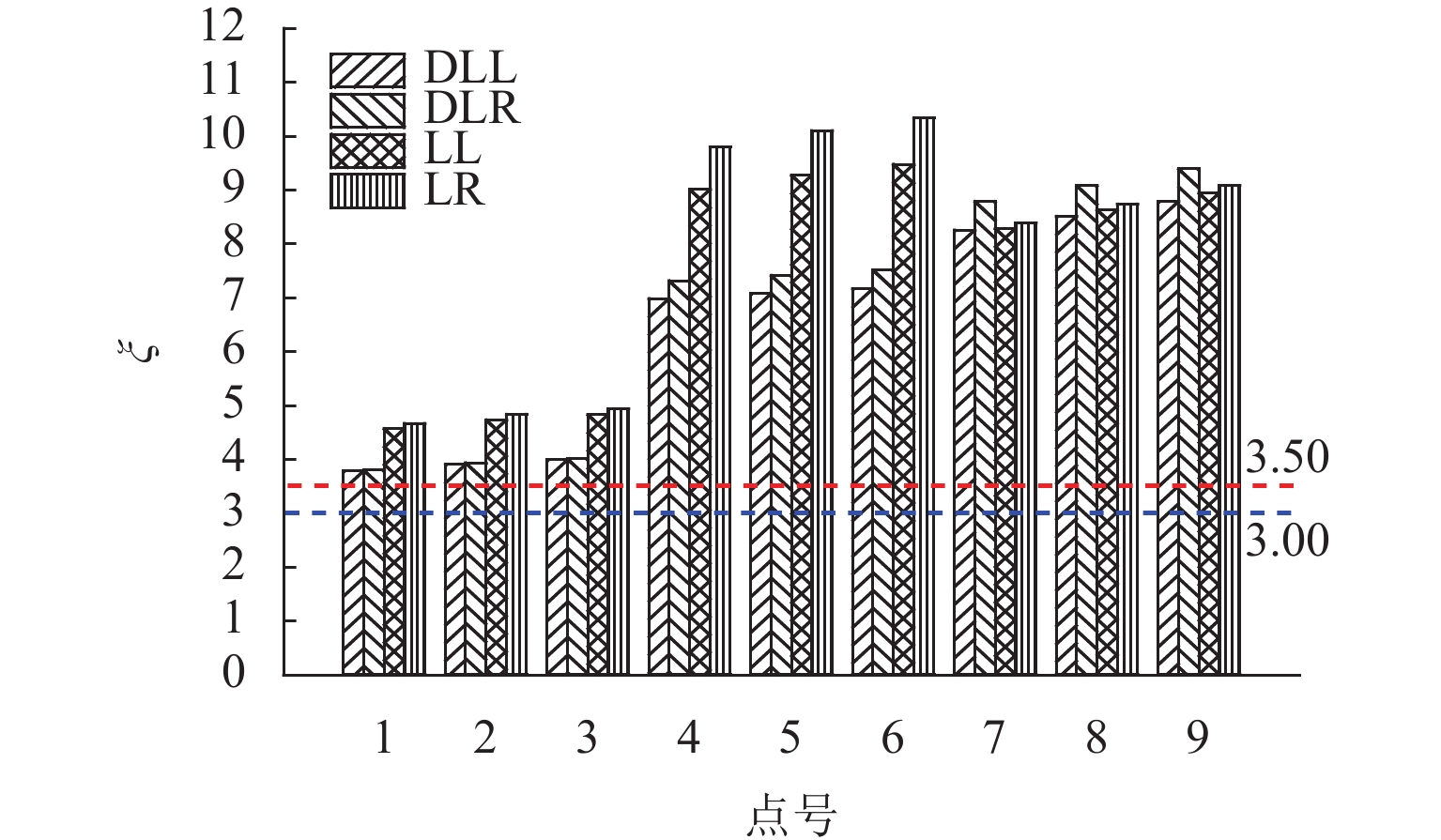
Results Results indicate that under the heavy icing condition of 30 mm, the stress ratios of the main and diagonal elements of the transmission tower are less than 0.4 and 0.3, respectively. The equivalent safety factors of the conductor and ground lines exceed 2.25, and the unbalanced tension complies with the code requirements, indicating a significant safety margin for the tower-line system. Compared to a uniform ice load condition, a non-uniform ice load condition significantly increases the stress on elements of the transmission tower, posing greater risks to the stability of the main and diagonal elements in transition section towers. However, the stresses remain within safe limits, and the main and diagonal elements remain stable. The weak positions of the transmission tower-line system with transition section include the main elements in the tower legs, the transition section and the cross-arms, and the diagonal elements of the ground line supports, which require special attention to the stability under heavy ice loads. The stress ratios along the height of the tower under non-uniform ice load conditions exhibit similar patterns to those under uniform ice load conditions, albeit with higher values. During ice-shedding under a 30 mm heavy ice load condition, the main and diagonal elements of the ±800 kV UHV transmission tower-line system with transition sections remain stable. The tensions of the ground and conductor lines all meet the minimum allowable safety factor, with only a few points slightly below the design safety factor value, maintaining adequate safety margins. The maximum vertical displacements of the ground and conductor lines of the ±800 kV UHV transmission tower-line system with transition sections during ice-shedding are 7.9 m and 5.2 m, respectively, which satisfy the requirements for air insulation clearances. However, for higher voltage levels or multi-phase transmission lines, electrical safety issues such as flashover induced by ice-shedding should be carefully considered. The ice-shedding process of ground and conductor lines exhibits typical damped cosine wave characteristics, with the maximum vertical displacement of a single line occurring in the first cycle, followed by gradual attenuation. Furthermore, when multiple lines unload ice simultaneously, the maximum jump height may not occur in the first cycle and may exceed the maximum displacement value of a single line, which requires significant attention. This indicates that energy transfer occurs between different lines during ice-shedding in the transmission tower-line coupling system. The jump height of a single line is influenced not only by its own response but also by energy transfer with other ground and conductor lines in the same span.
Conclusion In conclusion, the coupling effects between transmission towers and transmission lines, as well as the complex dynamic response mechanisms induced by ice-shedding of multiple ground and conductor lines, should be fully considered in the analysis of transmission lines under heavy ice loads. The weak position of the transmission tower-line system with transition section is the main elements in the tower legs, transition section and cross-arms, and the diagonal elements of the ground line supports. Although the structure maintains adequate safety margins, it is essential to prevent flashover hazards and element instability to ensure the long-term reliability and safety of transmission lines in heavy ice regions.
-
Key words:
- transmission tower-line system /
- mechanical property /
- deicing jump /
- electrical safety
-
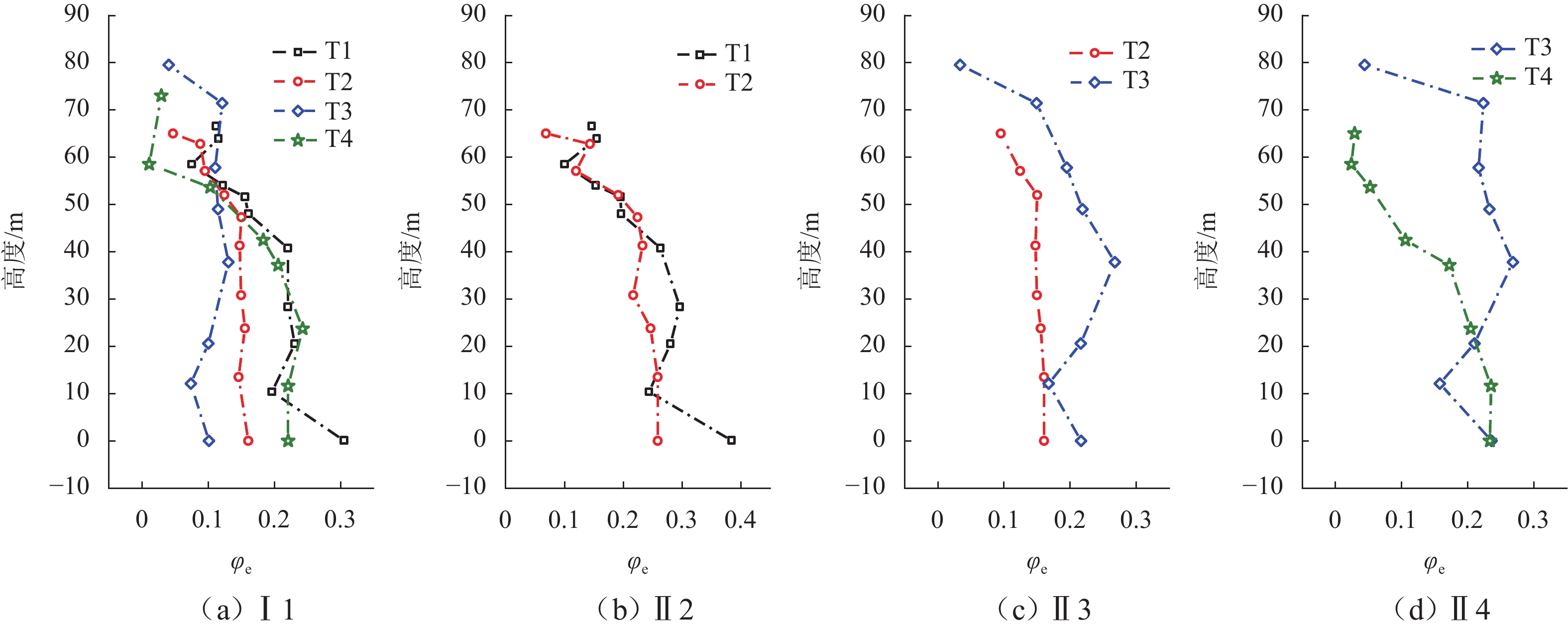
图 4 第Ⅰ、Ⅱ类覆冰各工况应力比
Figure 4. Stress ratio of ice load of types Ⅰ and Ⅱ under different conditions
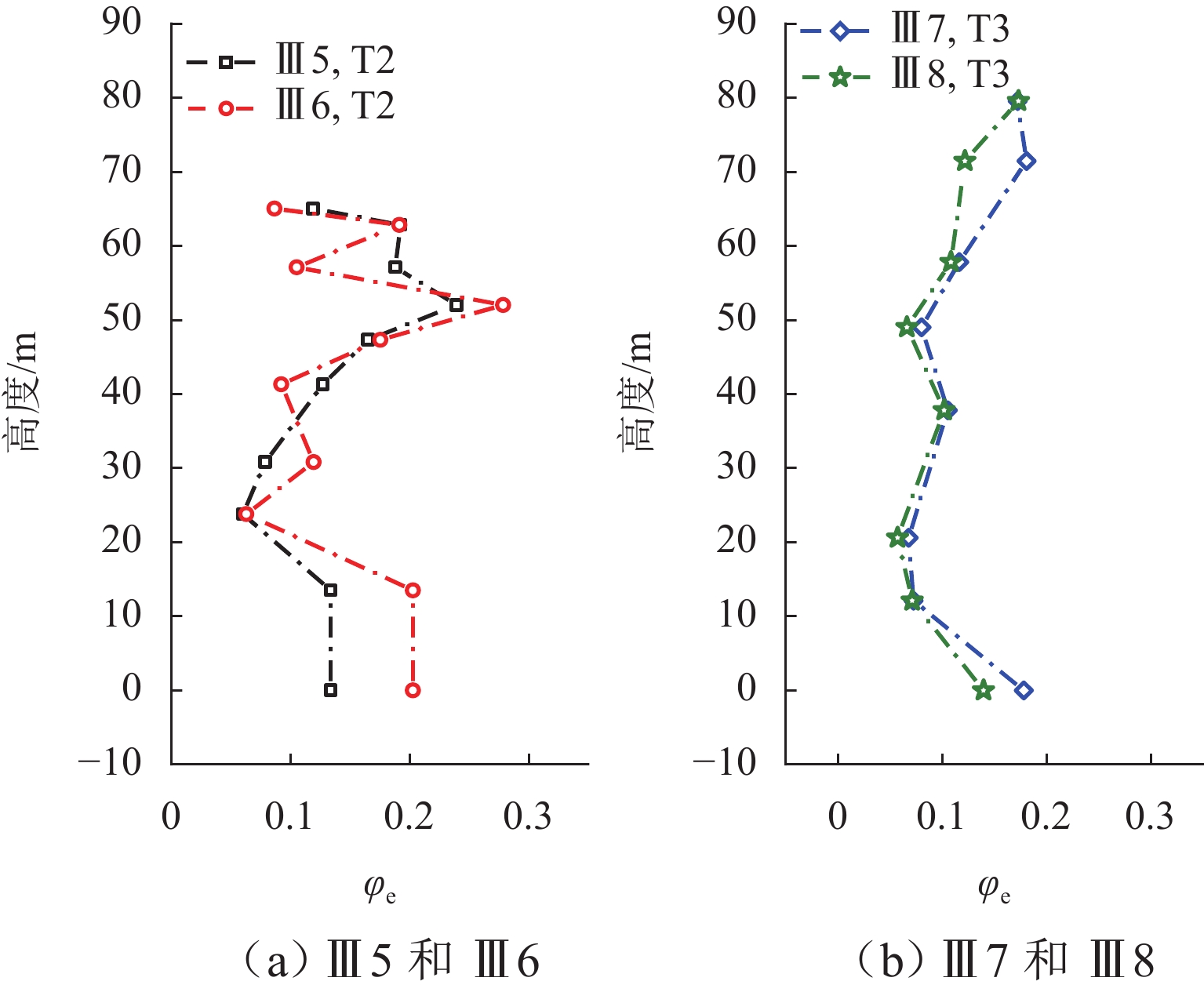
图 6 第Ⅲ类覆冰各工况应力比
Figure 6. Stress ratio of ice load of type Ⅲ under different conditions
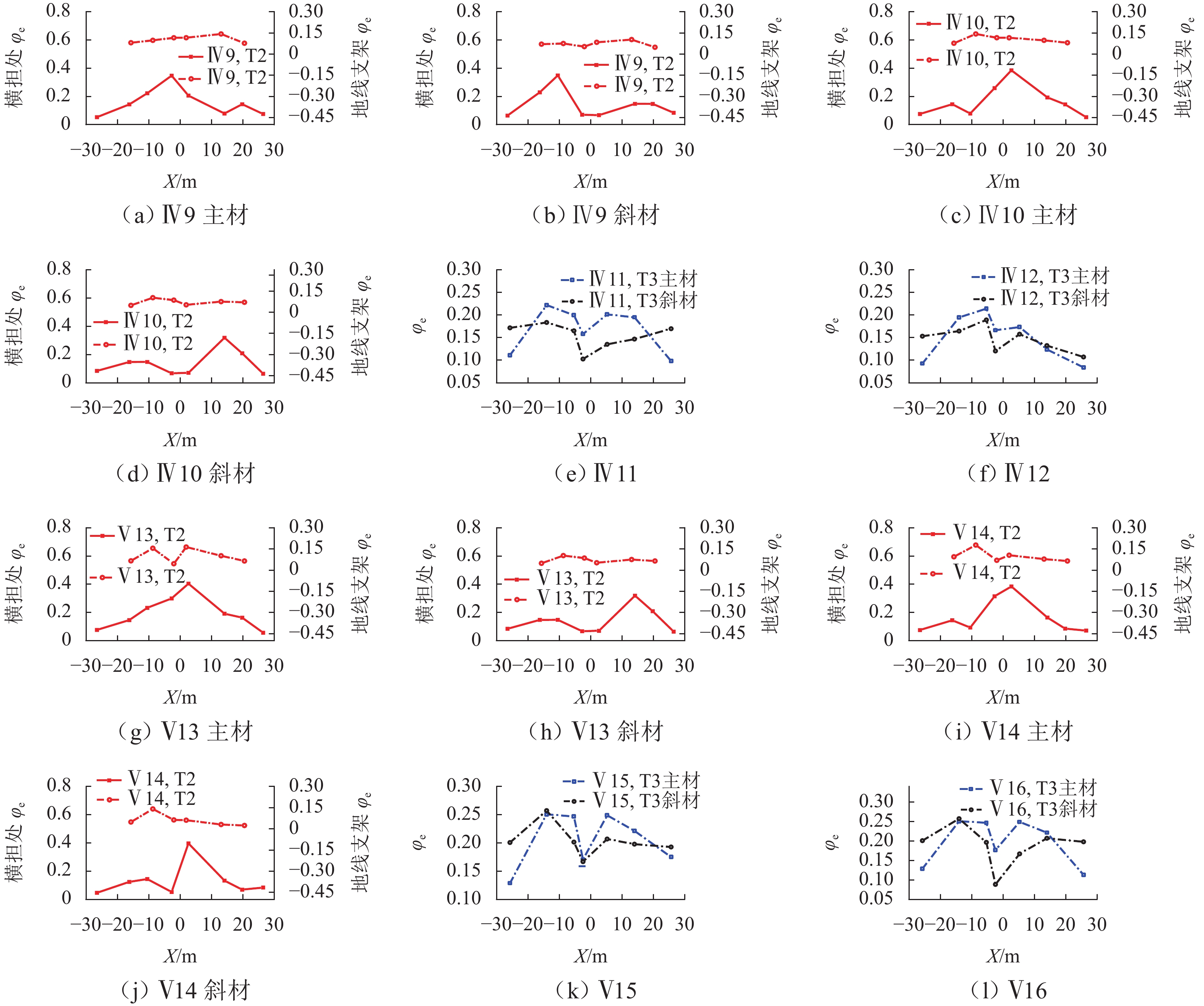
图 7 第Ⅳ~Ⅴ类覆冰各工况应力比
Figure 7. Stress ratio of ice load of type Ⅳ–Ⅴ under different conditions
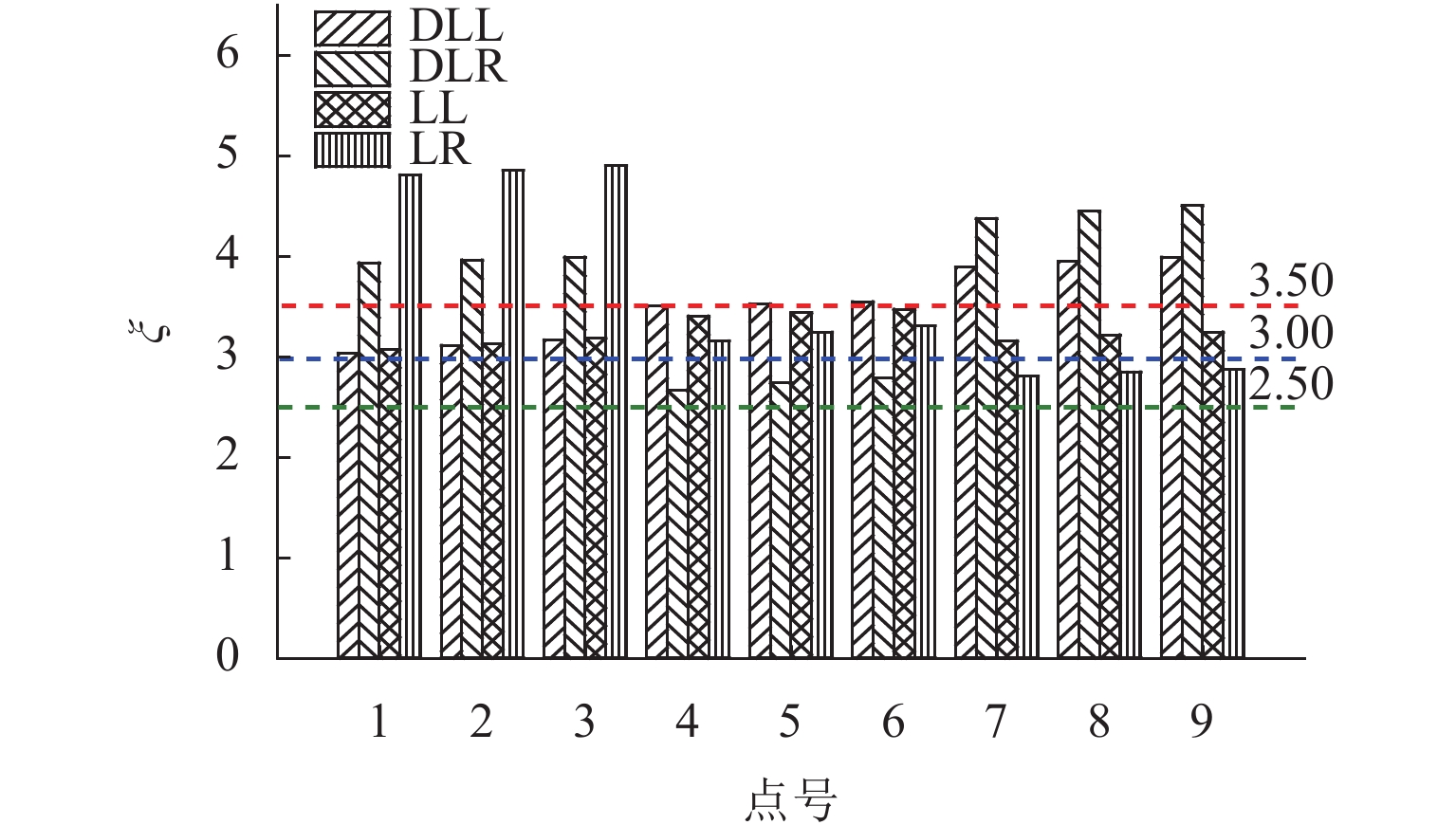
图 10 工况Ⅲ5导线、地线$\xi $
Figure 10. $\xi $ of conductor and ground line under condition Ⅲ5
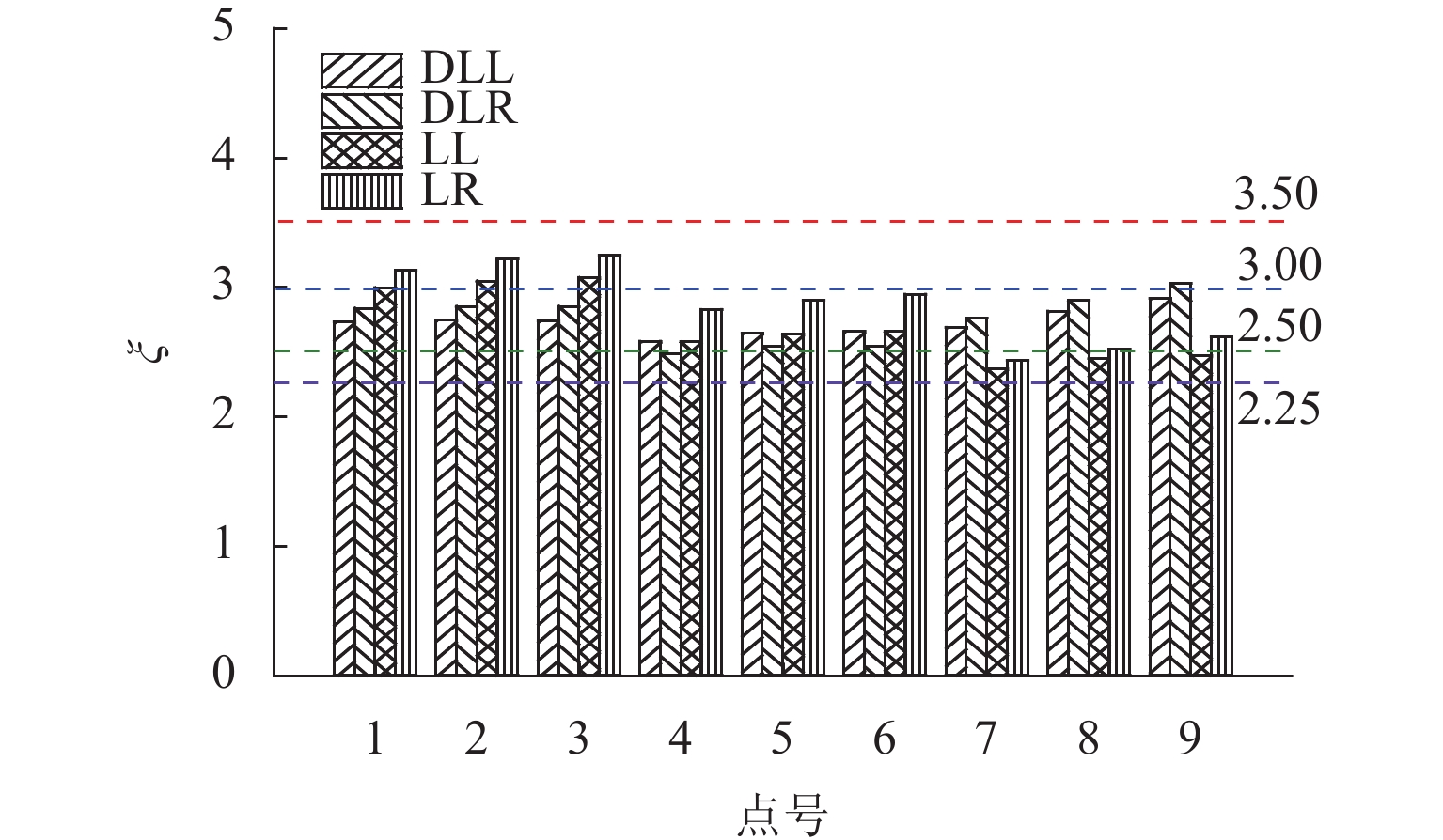
图 11 全跨脱冰跳跃时导线、地线的$\xi $
Figure 11. $\xi $ of conductor and ground line under full-span deicing jump
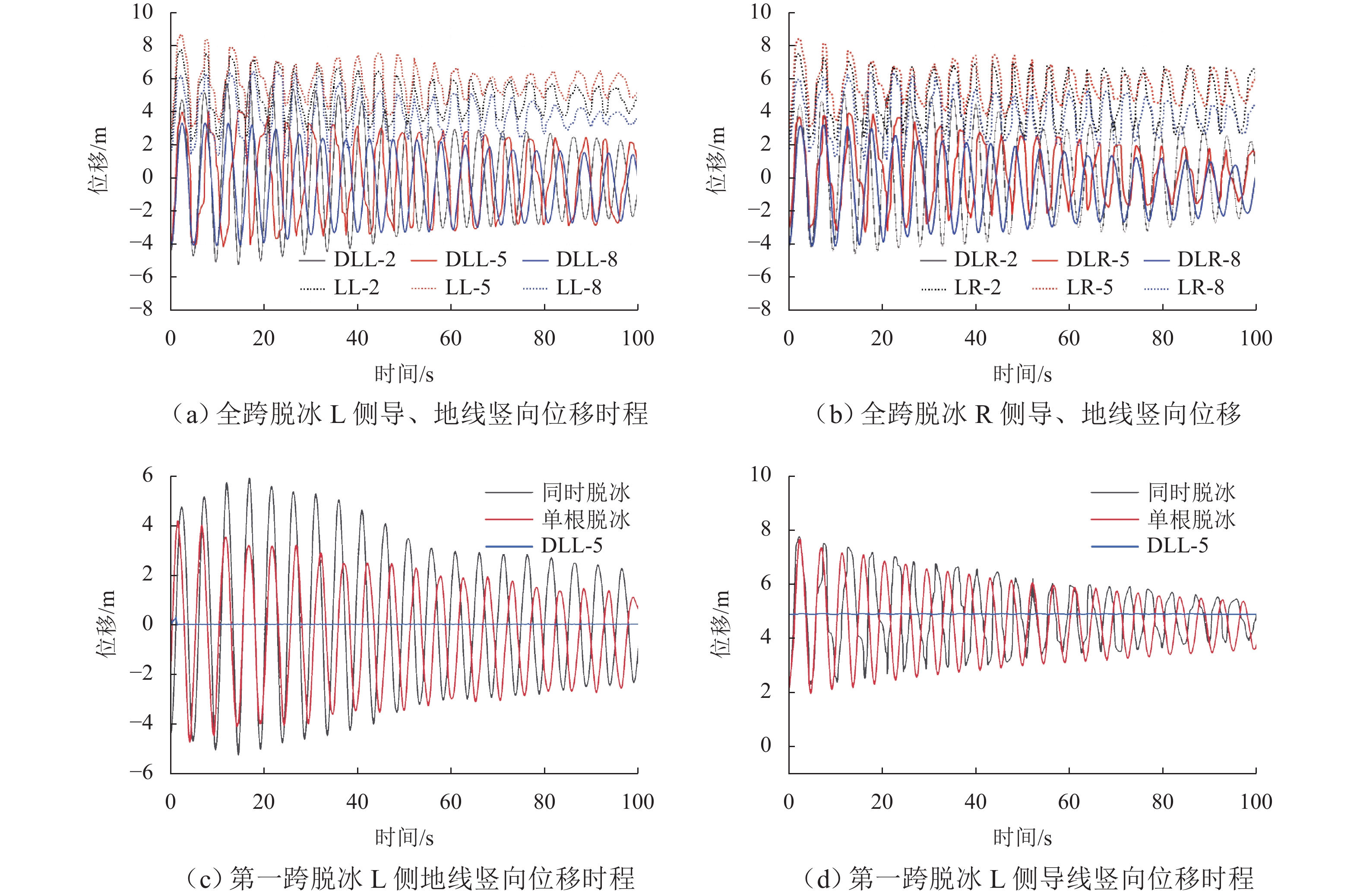
图 12 导、地线竖向最大位移时程
Figure 12. Maximum displacement time history of conductor and ground line
表 1 塔的几何参数
Table 1. Geometric parameters of towers
塔号 根开/m 总高/m 呼高/m 主材 斜材 腿 1/m 腿 2/m 腿 3/m 腿 4/m 过渡段高度/m 塔腿高差/m T1 12.1 73.0 56.0 Q345 Q235 6.5 11.5 19.5 22.5 6.0 16.0 T2 21.4 80.0 64.0 Q345 Q235 26.3 18.3 11.3 5.3 5.9 21.0 T3 18.8 92.5 83.0 Q345 Q235 24.2 18.2 10.2 5.2 4.9 19.0 T4 12.1 73.0 56.0 Q345 Q235 6.5 11.5 19.5 22.5 6.0 16.0  下载: 导出CSV
表 2 输电线材料参数
Table 2. Parameters of transmission line materials
输电线 型号 直径/
mm弹性模
量/GPa线密度/
(kg•km−1)热膨胀系
数/(1/℃)地线 JLB20A-
24020.0 147.2 1595.42 1.20×10⁻⁵ 导线 JLHA4/G2A-
900/7540.6 65.4 3071.30 1.80×10⁻⁵
下载: 导出CSV
表 3 T2和T3频率
Table 3. Frequency of T2 and T3
Hz 塔 1 阶 2 阶 3 阶 4 阶 5 阶 6 阶 7 阶 8 阶 9 阶 10 阶 T2 2.03 2.12 2.66 3.48 4.03 4.09 4.33 4.92 4.95 5.43 T3 1.22 1.29 1.59 2.46 3.03 3.30 3.34 3.84 3.87 4.27
下载: 导出CSV
表 4 覆冰工况
Table 4. Working condition of ice load
mm 类型 工况
序号跨 1 地线 跨 1 导线 跨 2 地线 跨 2 导线 跨 3 地线 跨 3 导线 L R L R L R L R L R L R Ⅰ 1 30 30 30 30 30 30 30 30 30 30 30 30 Ⅱ 2 30 30 30 30 0 0 0 0 0 0 0 0 3 0 0 0 0 30 30 30 30 0 0 0 0 4 0 0 0 0 0 0 0 0 30 30 30 30 Ⅲ 5 30 0 30 0 0 30 0 30 0 0 0 0 6 0 30 0 30 30 0 30 0 0 0 0 0 7 0 0 0 0 30 0 30 0 0 30 0 30 8 0 0 0 0 0 30 0 30 30 0 30 0 Ⅳ 9 30 30 0 0 0 0 30 30 0 0 0 0 10 0 0 30 30 30 30 0 0 0 0 0 0 11 0 0 0 0 30 30 0 0 0 0 30 30 12 0 0 0 0 0 0 30 30 30 30 0 0 Ⅴ 13 0 30 30 0 30 0 0 30 0 0 0 0 14 30 0 0 30 0 30 30 0 0 0 0 0 15 0 0 0 0 0 30 30 0 30 0 0 30 16 0 0 0 0 30 0 0 30 0 30 30 0
下载: 导出CSV
-
[1] DL/T 5154—2012 架空输电线路杆塔结构设计技术规定[S]. [2] 王成, 王涛, 黄兴, 等. 基于样本矩-最大熵法的长短腿输电塔整体可靠度分析[J]. 西南交通大学学报, 2025, 60(5): 1315-1324. doi: 10.3969/j.issn.0258-2724.20230105Wang Cheng, Wang Tao, Huang Xing, et al. Overall reliability analysis of transmission towers with asymmetrical legs based on sample moment and maximum entropy method[J]. Journal of Southwest Jiaotong University, 2025, 60(5): 1315-1324. doi: 10.3969/j.issn.0258-2724.20230105 [3] 许顺德. 输电塔高低腿逆向配置方法研究[J]. 南方能源建设, 2022, 9(增刊1): 125-131.Xu Shunde. Research on high-low leg reverse configuration method of transmission tower[J]. Southern Energy Construction, 2022, 9(S1): 125-131. [4] 侯晓燕, 崔强, 鲁先龙, 等. 输电线路高低腿杆塔基础配置策略及软件研发[J]. 地下空间与工程学报, 2014, 10(增刊2): 1917-1921.Hou Xiaoyan, Cui Qiang, Lu Xianlong, et al. Configuration strategy and software development of high-low leg tower foundation for transmission line[J]. Chinese Journal of Underground Space and Engineering, 2014, 10(S2): 1917-1921. [5] 黄勇, 赵维立, 邓洪洲, 等. 加过渡段输电塔塔腿稳定极限承载力分析[J]. 特种结构, 2019, 36(4): 58-64. doi: 10.19786/j.tzjg.2019.04.010Huang Yong, Zhao Weili, Deng Hongzhou, et al. Analysis on stable ultimate bearing capacity of tower leg of transmission tower with transition section[J]. Special Structures, 2019, 36(4): 58-64. doi: 10.19786/j.tzjg.2019.04.010 [6] 赵维立, 邓洪洲, 唐俊宇, 等. 塔腿加过渡段输电塔动力特性分析[J]. 特种结构, 2019, 36(2): 1-6. doi: 10.3969/j.issn.1001-3598.2019.02.001Zhao Weili, Deng Hongzhou, Tang Junyu, et al. Analysis on dynamic characteristics of transmission tower with transition section[J]. Special Structures, 2019, 36(2): 1-6. doi: 10.3969/j.issn.1001-3598.2019.02.001 [7] 朱诗羽, 高一然, 邓洪洲, 等. 加过渡段输电塔塔腿横隔面节点受力分析[J]. 山东电力技术, 2019, 46(7): 1-9. doi: 10.3969/j.issn.1007-9904.2019.07.001Zhu Shiyu, Gao Yiran, Deng Hongzhou, et al. Stress analysis on transverse plane joint of transmission towers with transition section[J]. Shandong Electric Power, 2019, 46(7): 1-9. doi: 10.3969/j.issn.1007-9904.2019.07.001 [8] 高一然, 黄勇, 邓洪洲, 等. 陡峻山区输电塔风振响应分析[J]. 钢结构, 2019, 34(4): 69-73. doi: 10.13206/j.gjg201904013Gao Yiran, Huang Yong, Deng Hongzhou, et al. Analysis of wind-induced response of transmission towers in steep mountainous areas[J]. Steel Construction, 2019, 34(4): 69-73. doi: 10.13206/j.gjg201904013 [9] 刘鸣, 陈宁, 徐亿, 等. 高低腿钢管角钢组合塔地震响应分析[C]//2020年工业建筑学术交流会论文集(下册), 2020: 298-301. [10] 吴景天, 邓洪洲, 李焱, 等. 塔腿加过渡段输电塔地震响应时程分析[J]. 山东电力技术, 2019, 46(3): 6-12, 28. doi: 10.3969/j.issn.1007-9904.2019.03.003Wu Jingtian, Deng Hongzhou, Li Yan, et al. Seismic time-history response analysis of special high-low-legs transmission tower with transition sections[J]. Shandong Electric Power, 2019, 46(3): 6-12, 28. doi: 10.3969/j.issn.1007-9904.2019.03.003 [11] 王邦杰, 王涛, 李茂华, 等. 500 kV耐张型悬索支撑输电体系动力整体可靠性分析[J]. 中国电机工程学报, 2025, 45(6): 2437-2447. doi: 10.13334/j.0258-8013.pcsee.232388Wang Bangjie, Wang Tao, Li Maohua, et al. Dynamic global reliability assessment of 500 kV tension suspension-braced transmission system[J]. Proceedings of the CSEE, 2025, 45(6): 2437-2447. doi: 10.13334/j.0258-8013.pcsee.232388 [12] Wang T, Dong Y, Wang L, et al. Global reliability assessment of coupled transmission tower-insulator-line systems considering soil-structure interaction subjected to multi-hazard of wind and ice[J]. Journal of Constructional Steel Research, 2024, 223: 109004. doi: 10.1016/j.jcsr.2024.109004 [13] 李正良, 王邦杰, 王涛. 耐张型悬索支撑输电结构风振非线性有限元分析[J]. 振动与冲击, 2024, 43(2): 71-78, 290.Li Zhengliang, Wang Bangjie, Wang Tao. Nonlinear finite element analysis on the wind-induced vibration of a tension suspension-braced transmission structure[J]. Journal of Vibration and Shock, 2024, 43(2): 71-78, 290. [14] 李正良, 王泽宇, 王涛, 等. 覆冰多分裂输电导线舞动的动态张力随机分析与可靠度评估[J]. 振动工程学报, 2025, 38(3): 529-538.Li Zhengliang, Wang Zeyu, Wang Tao, et al. Stochastic dynamic tension analysis and reliability evaluation of ice-covered multi-split transmission line galloping[J]. Journal of Vibration Engineering, 2025, 38(3): 529-538. [15] 王泽宇, 王涛, 李正良, 等. 紊流随机风场下多相多分裂覆冰输电导线舞动的相间闪络概率评估[J]. 高电压技术, 2024, 50(5): 2187-2197. doi: 10.13336/j.1003-6520.hve.20231204Wang Zeyu, Wang Tao, Li Zhengliang, et al. Interphase flashover probability evaluation of multi-phase multi-bundled ice-covered transmission conductors galloping in turbulent stochastic wind field[J]. High Voltage Engineering, 2024, 50(5): 2187-2197. doi: 10.13336/j.1003-6520.hve.20231204 [16] 赵明曦, 贺博, 冯文韬, 等. 塔–线耦联因素对于覆冰载荷下高压输电塔–线结构体力学性能影响及分析[J]. 中国电机工程学报, 2018, 38(24): 7141-7148, 7440.Zhao Mingxi, He Bo, Feng Wentao, et al. Influence of coupling factors on mechanical property of high voltage transmission tower-line structure under ice loading[J]. Proceedings of the CSEE, 2018, 38(24): 7141-7148, 7440. [17] 李再华, 白晓民, 周子冠, 等. 电网覆冰防治方法和研究进展[J]. 电网技术, 2008, 32(4): 7-13, 22.Li Zaihua, Bai Xiaomin, Zhou Ziguan, et al. Prevention and treatment methods of ice coating in power networks and its recent study[J]. Power System Technology, 2008, 32(4): 7-13, 22. [18] 韩军科, 杨靖波, 杨风利. 500 kV酒杯塔覆冰破坏形态分析[J]. 电力建设, 2009, 30(11): 21-23. doi: 10.3969/j.issn.1000-7229.2009.11.005Han Junke, Yang Jingbo, Yang Fengli. Analysis of failure mode on iced 500 kV transmission cup-type tower[J]. Electric Power Construction, 2009, 30(11): 21-23. doi: 10.3969/j.issn.1000-7229.2009.11.005 [19] Yan B, Chen K Q, Guo Y M, et al. Numerical simulation study on jump height of iced transmission lines after ice shedding[J]. IEEE Transactions on Power Delivery, 2013, 28(1): 216-225. doi: 10.1109/TPWRD.2012.2219324 [20] Wu C, Yan B, Zhang L, et al. A method to calculate jump height of iced transmission lines after ice-shedding[J]. Cold Regions Science and Technology, 2016, 125: 40-47. doi: 10.1016/j.coldregions.2016.02.001 [21] Wang J Y, Yan Z T, Zhong Y L, et al. Study on the maximum ice-shedding height of conductor based on energy method[J]. IEEE Access, 2023, 11: 121043-121051. doi: 10.1109/ACCESS.2023.3328335 [22] Wei Y Z, Su P. The numerical research on the jumping induced by the uniform and non-uniform ice-shedding of transmission lines[J]. Advanced Materials Research, 2014, 986/987: 611-614. [23] Wu K W, Yan B, Yang H X, et al. Dynamic response characteristics of isolated-span transmission lines after ice-shedding[J]. IEEE Transactions on Power Delivery, 2023, 38(5): 3519-3530. doi: 10.1109/TPWRD.2023.3277840 [24] Liu B, Ji K P, Zhan X P, et al. Experimental and numerical analysis of overhead transmission lines vibration due to atmospheric icing[C]//2017 Prognostics and System Health Management Conference (PHM-Harbin). Piscataway: IEEE, 2017: 1-4. [25] 王磊, 王涛, 李正良, 等. 土-结构相互作用下输电塔-线耦合系统整体可靠度分析[J]. 西南交通大学学报, 2025, 60(6): 1568-1580. doi: 10.3969/j.issn.0258-2724.20230399Wang Lei, Wang Tao, Li Zhengliang, et al. Global reliability analysis of transmission tower-line coupling system considering soil-structure interaction[J]. Journal of Southwest Jiaotong University, 2025, 60(6): 1568-1580. doi: 10.3969/j.issn.0258-2724.20230399 [26] 晏致涛, 李正良, 汪之松. 重冰区输电塔-线体系脱冰振动的数值模拟[J]. 工程力学, 2010, 27(1): 209-214, 227.Yan Zhitao, Li Zhengliang, Wang Zhisong. Simulation of ice-shedding of transmission tower-line system in heavy ice regions[J]. Engineering Mechanics, 2010, 27(1): 209-214, 227. [27] GB 50009—2012 建筑结构荷载规范[S]. [28] 傅鹏程, 邓洪洲, 吴静. 输电塔结构动力特性研究[J]. 特种结构, 2005, 22(1): 47-49.Fu Pengcheng, Deng Hongzhou, Wu Jing. Analytical studies in dynamic behavior of transmission towers[J]. Special Structures, 2005, 22(1): 47-49. [29] 姬昆鹏. 冲击载荷下覆冰架空输电线路动力响应研究[D]. 北京: 华北电力大学, 2016. [30] 吴海楠, 谢强, 李悦, 等. 输电塔斜材T型加固理论分析及试验研究[J/OL]. 西南交通大学学报, 2024-11-29, https://kns.cnki.net/KCMS/detail/detail.aspx?filename=XNJT2024112700A&dbname=CJFD&dbcode=CJFQ. [31] DL/T 5440—2020 重覆冰架空输电线路设计技术规程[S]. [32] 尹芳辉, 蒋兴良, Masoud Farzaneh. 导线表面电场强度对导线覆冰的影响[J]. 高电压技术, 2018, 44(3): 1023-1033. doi: 10.13336/j.1003-6520.hve.20180301047Yin Fanghui, Jiang Xingliang, Masoud Farzaneh. Influences of electric field of conductors surface on conductor icing[J]. High Voltage Engineering, 2018, 44(3): 1023-1033. doi: 10.13336/j.1003-6520.hve.20180301047 [33] 陈吉, 蒋兴良, 舒立春, 等. 绞线带电雾凇覆冰后的电晕起始特性[J]. 高电压技术, 2014, 40(6): 1738-1747. doi: 10.13336/j.1003-6520.hve.2014.06.019Chen Ji, Jiang Xingliang, Shu Lichun, et al. Corona onset characteristics of stranded conductor after energized rime icing[J]. High Voltage Engineering, 2014, 40(6): 1738-1747. doi: 10.13336/j.1003-6520.hve.2014.06.019 -

 下载:
下载:

 点击查看大图
计量
- 文章访问数: 109
- HTML全文浏览量: 190
- PDF下载量: 74
- 被引次数: 0