



Safety Performance and Vibration Reduction Effects of Prefabricated Slab Track in Metro Turnout Areas
-
摘要:
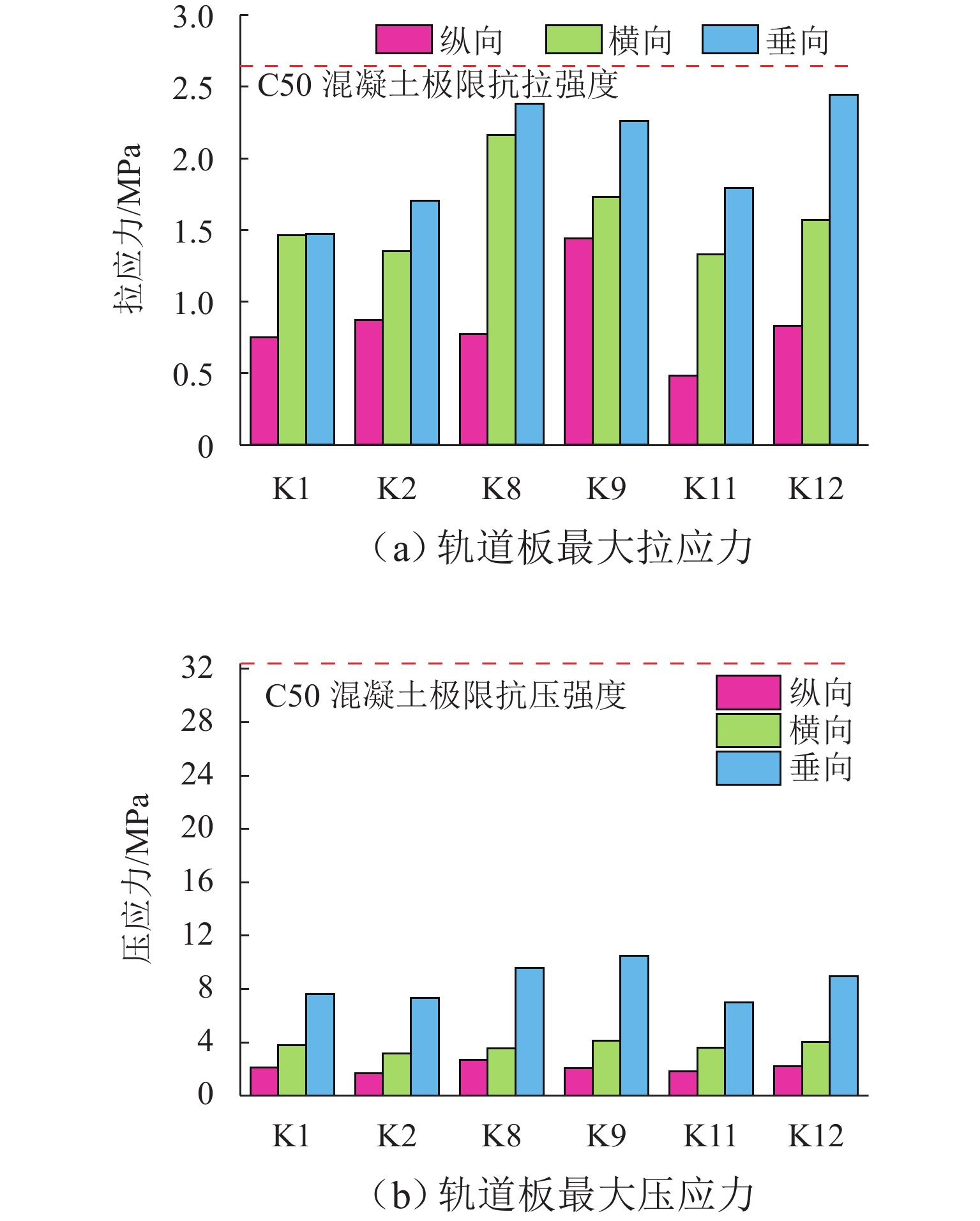
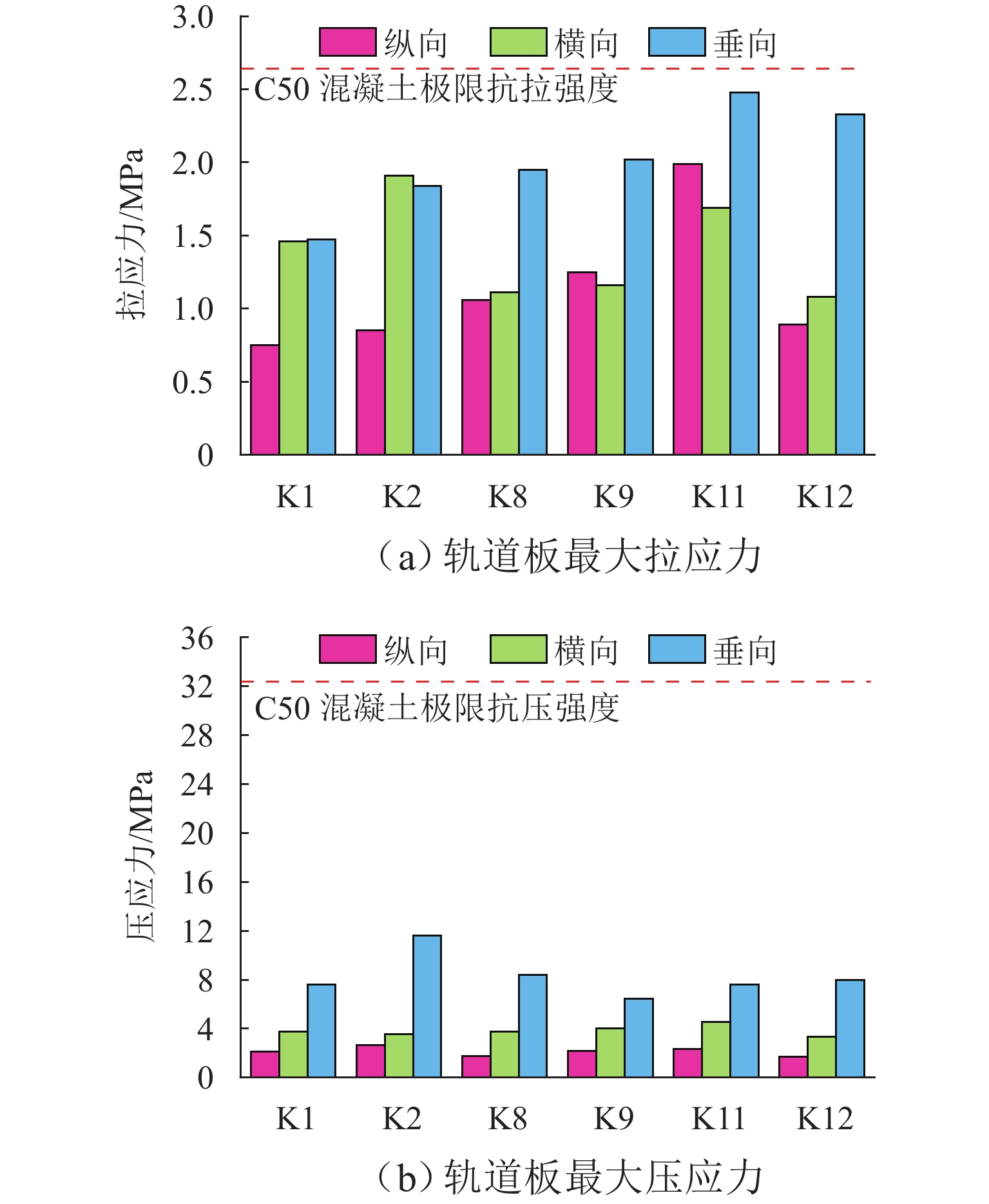
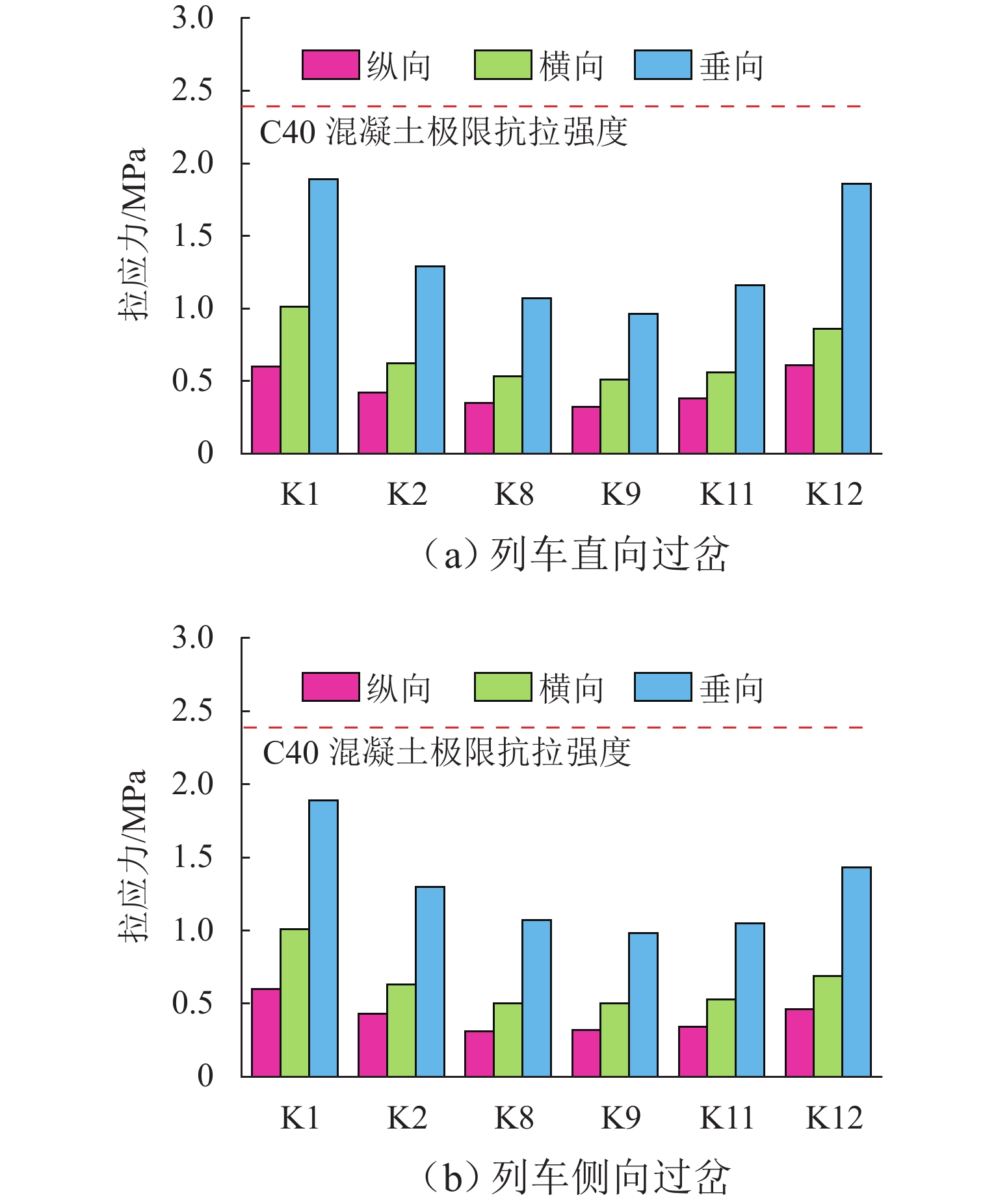
为研究装配式减振轨道应用于地铁道岔区的动力性能,基于考虑了约束效应的板-垫层间接触关系以及道岔区轮轨多点接触理论,以某典型装配式轨道为例,对其在列车荷载作用下的混凝土强度和极限弯矩承载力开展安全性能检算;建立了车-岔-隧耦合动力分析模型,在地铁道岔区采用不同板厚和刚度的装配式减振轨道条件下,利用自编联合仿真程序研究了列车过岔时系统动力学响应和减振效果情况. 研究结果表明:装配式减振轨道在地铁A型车的荷载条件下,轨道板、自密实混凝土层的最大拉应力分别为2.48、1.89 MPa;道岔区各轨道板纵向和横向钢筋的正截面极限弯矩承载力均大于横向荷载弯矩和纵向荷载弯矩;列车以55 km/h的速度通过道岔区,轨道板厚度从180 mm增加到300 mm时,各减振轨道的插入损失分别为8.1、9.3、10.0、10.7 dB,动力响应均满足安全性能要求;当板厚为260 mm,减振垫刚度从0.01 N/mm3增加到0.04 N/mm3时,各工况的插入损失分别为15.0、10.0、8.0、5.2 dB;刚度为0.01 N/mm3时,尖轨和心轨垂向位移分别为4.1 mm和5.2 mm. 综合安全性能、经济效益和减振效果,建议装配式减振轨道板厚为220~260 mm,减振垫刚度为0.019~0.030 N/mm3.
Abstract:To investigate the dynamic performance of prefabricated slab tracks (PSTs) applied in metro turnout areas, an analysis was conducted based on the interlayer contact relationship between the slab and the pad considering the constraint effect, as well as the multi-point contact theory in turnout areas. By taking a typical PST as an example, the safety performance in terms of concrete strength and ultimate bending moment capacity under train load was verified. A coupled vehicle–turnout–tunnel dynamic model was established, and a self-developed co-simulation program was used to study the system dynamic responses and vibration reduction effects during train passage through the metro turnout areas under different slab thicknesses and pad stiffnesses. The results show that under the load condition of metro type-A trains, the maximum tensile stresses in the track slab and self-compacting concrete layer are 2.48 MPa and 1.89 MPa, respectively. The cross-section bending moment capacities of longitudinal and transverse reinforcement in turnout areas are significantly greater than the lateral and longitudinal load moments. When the train speed is 55 km/h and the slab thickness increases from 180 mm to 300 mm, the insertion losses are 8.1, 9.3, 10.0 dB, and 10.7 dB, and the dynamic responses all meet the safety requirements. When the slab thickness is 260 mm and the pad stiffness increases from 0.01 N/mm3 to 0.04 N/mm3, the insertion losses are 15.0 dB, 10.0 dB, 8.0 dB, and 5.2 dB, respectively. At a stiffness of 0.01 N/mm3, the vertical displacements of the switch rail and nose rail are 4.1 mm and 5.2 mm, respectively. Considering the safety performance, economic benefits, and vibration reduction effects comprehensively, it is recommended that the slab thickness of the PST is between 220 mm to 260 mm, and the pad stiffness range from 0.019 to 0.030 N/mm3.
-
Key words:
- urban rail transit /
- turnout /
- structural dynamics /
- vibration and control /
- prefabricated slab track
-
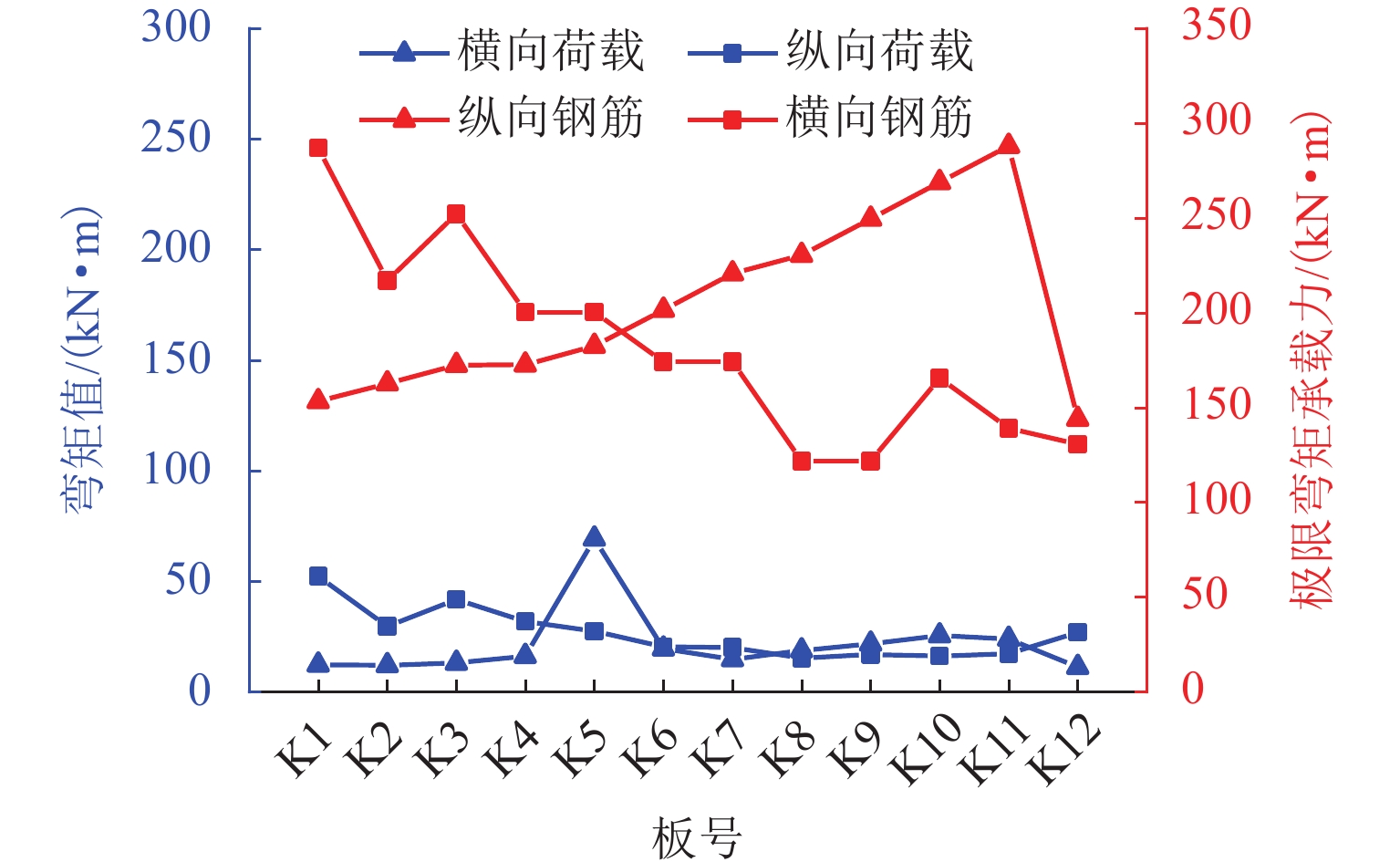
图 10 各轨道板极限弯矩承载力及荷载作用下弯矩值
Figure 10. Ultimate bending moment capacity and bending moment under load of each PST slab
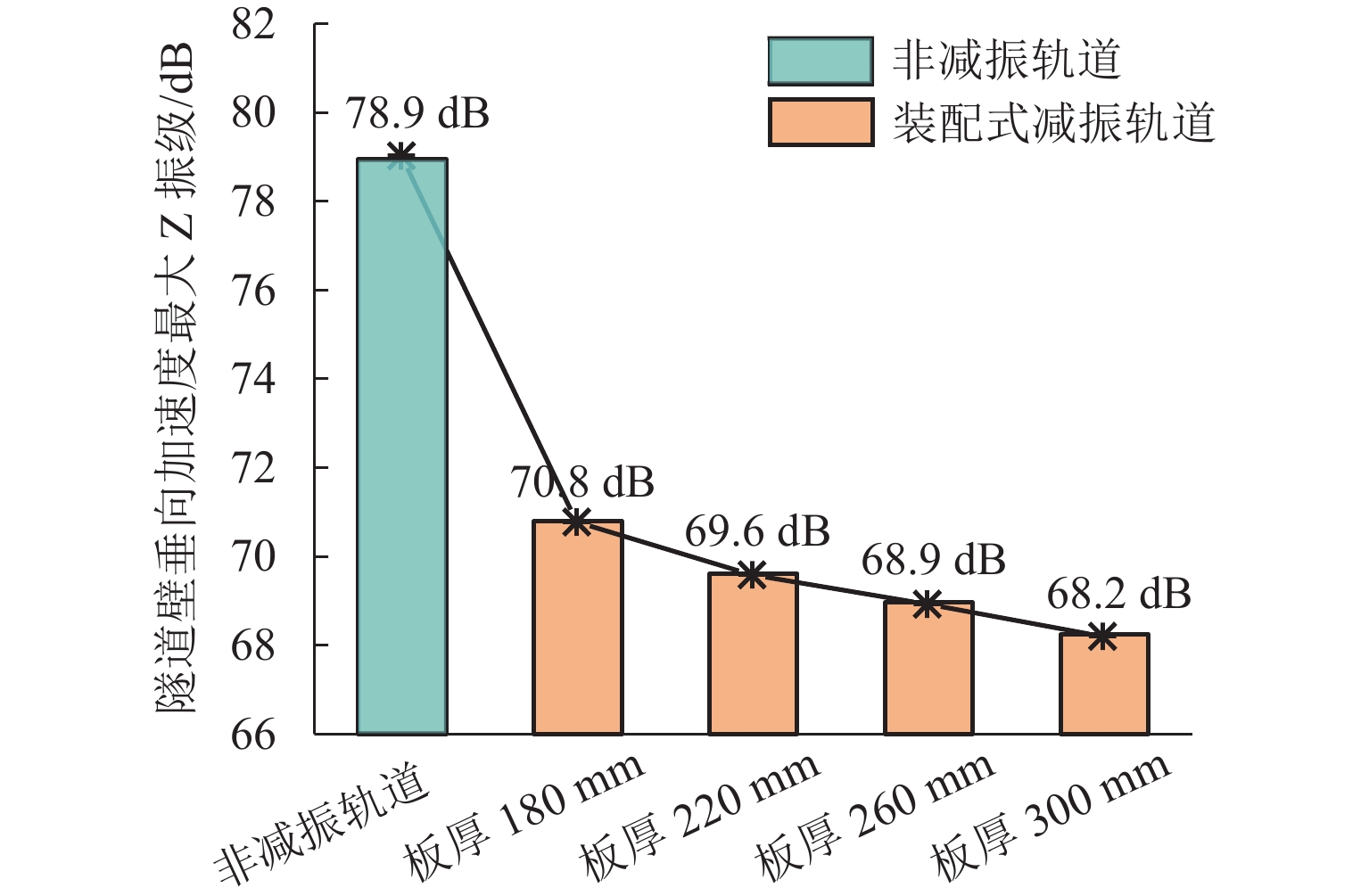
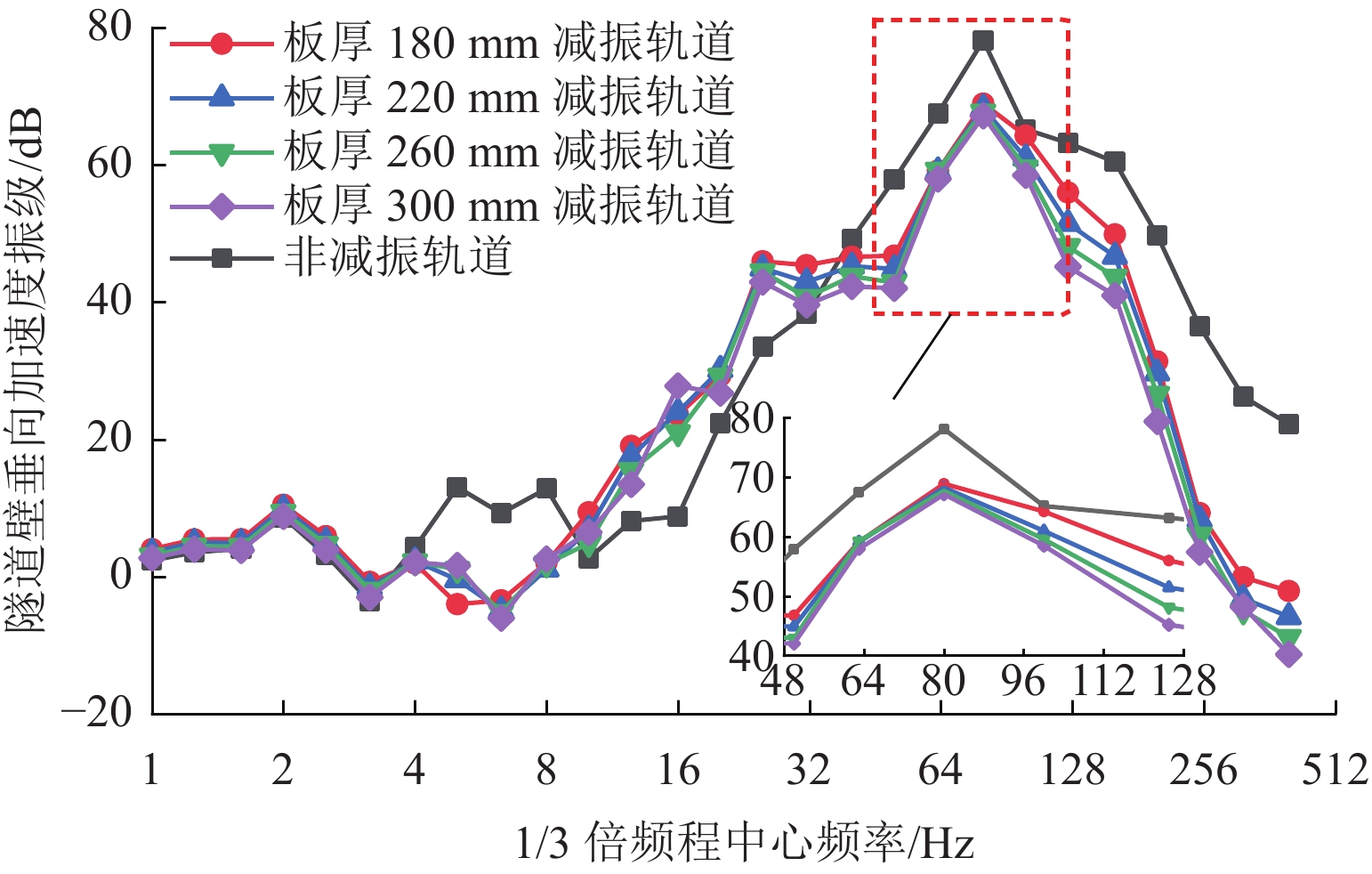
图 12 不同轨道板厚度条件下隧道壁最大Z振级
Figure 12. Maximum Z-direction vibration level of the tunnel wall with different track slab thicknesses
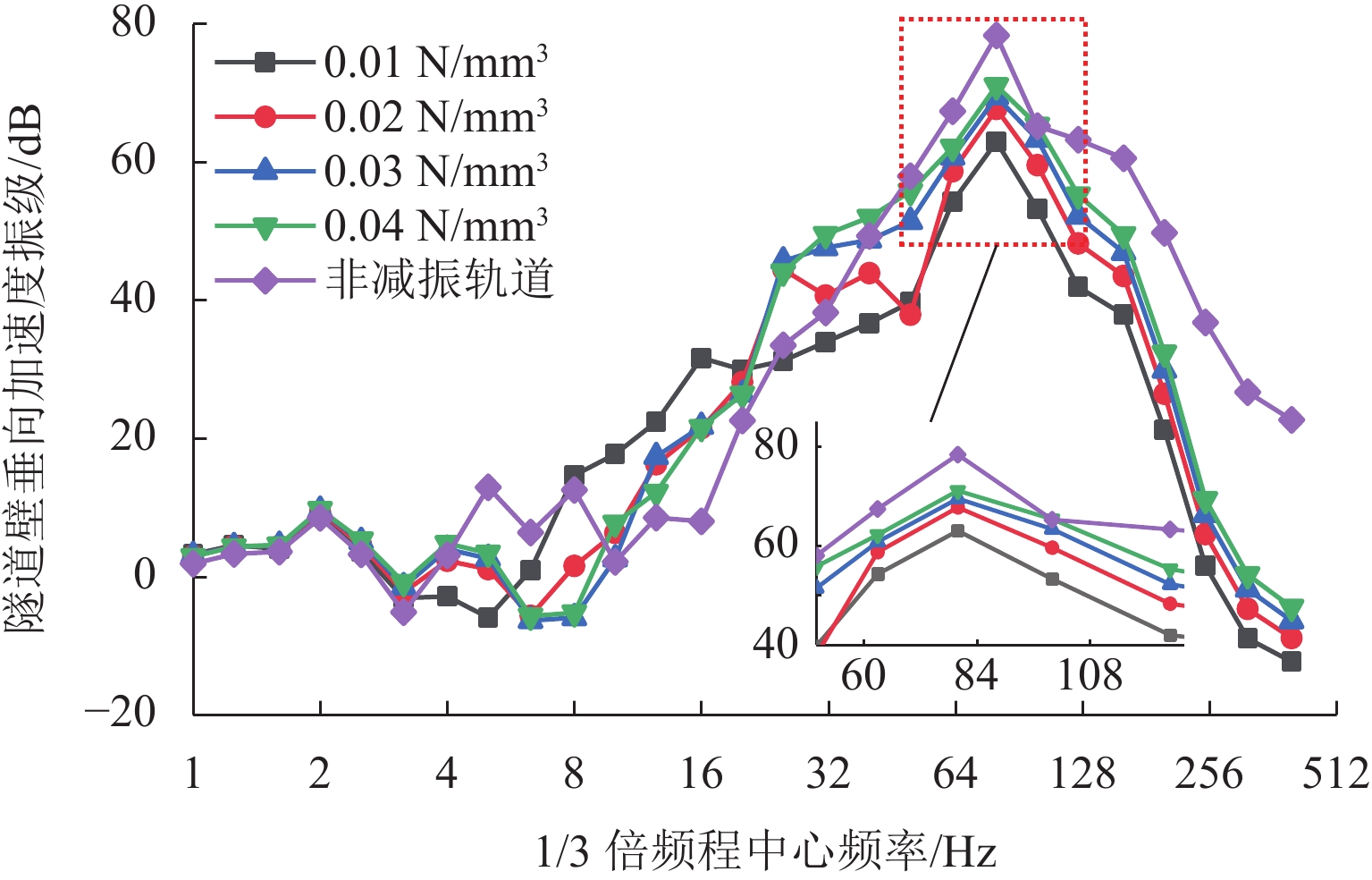
图 13 不同减振垫刚度下隧道壁垂向振动加速度分频振级
Figure 13. Vertical vibration acceleration levels of tunnel wall with different pad stiffnesses
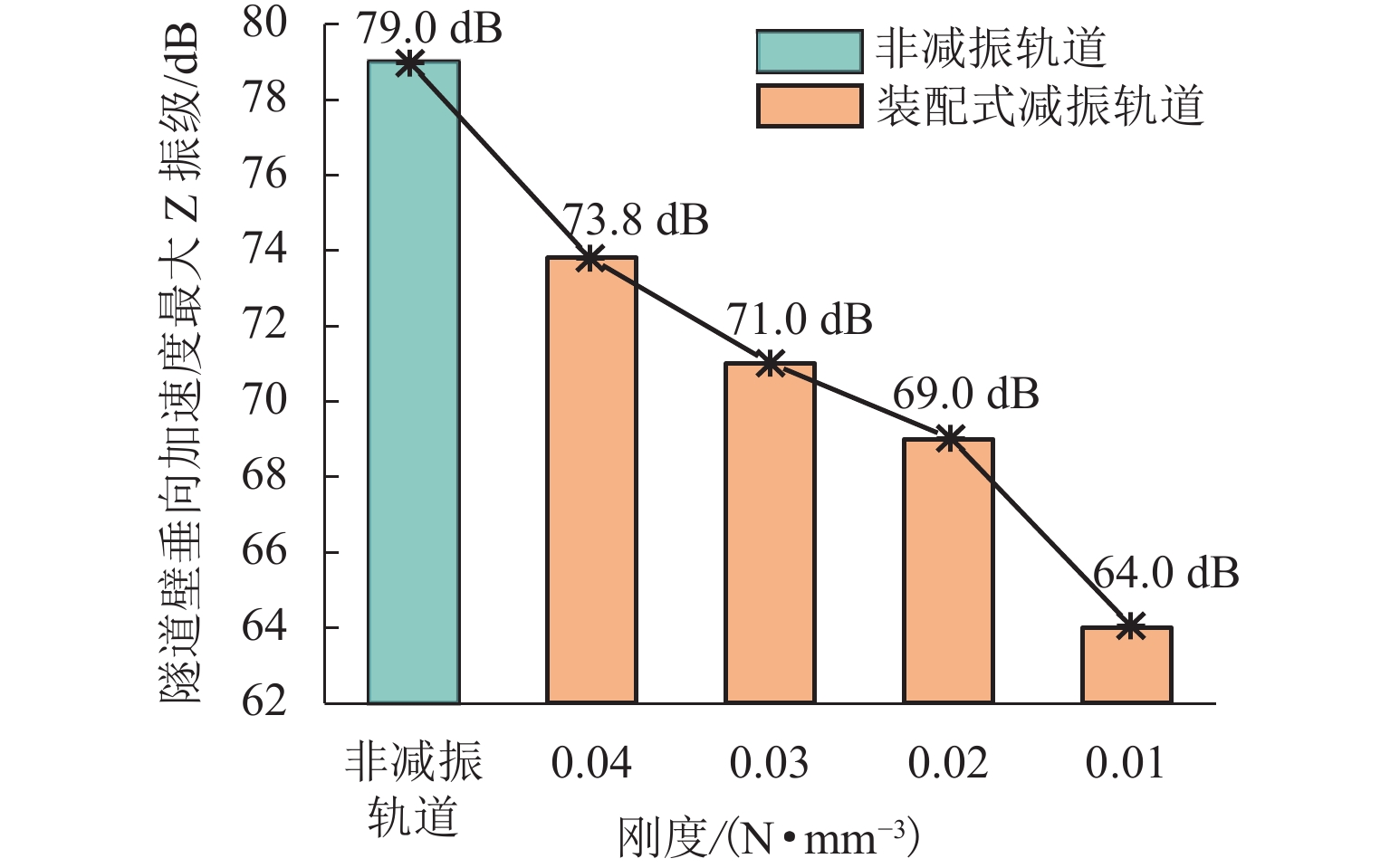
图 14 不同道床条件下隧道壁的最大Z振级
Figure 14. Maximum Z-direction vibration level of tunnel wall with different track bed conditions
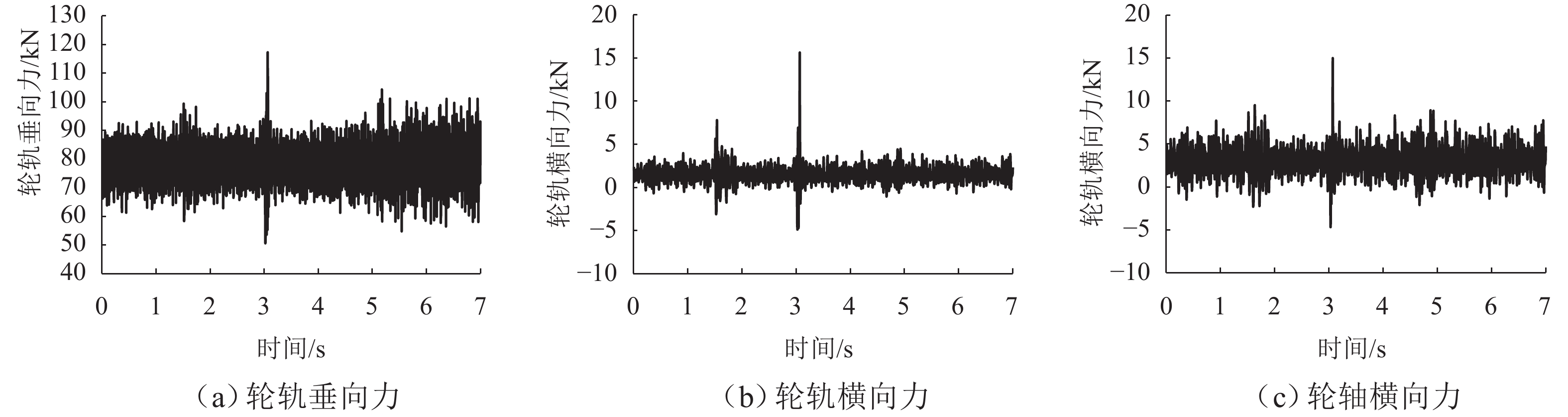
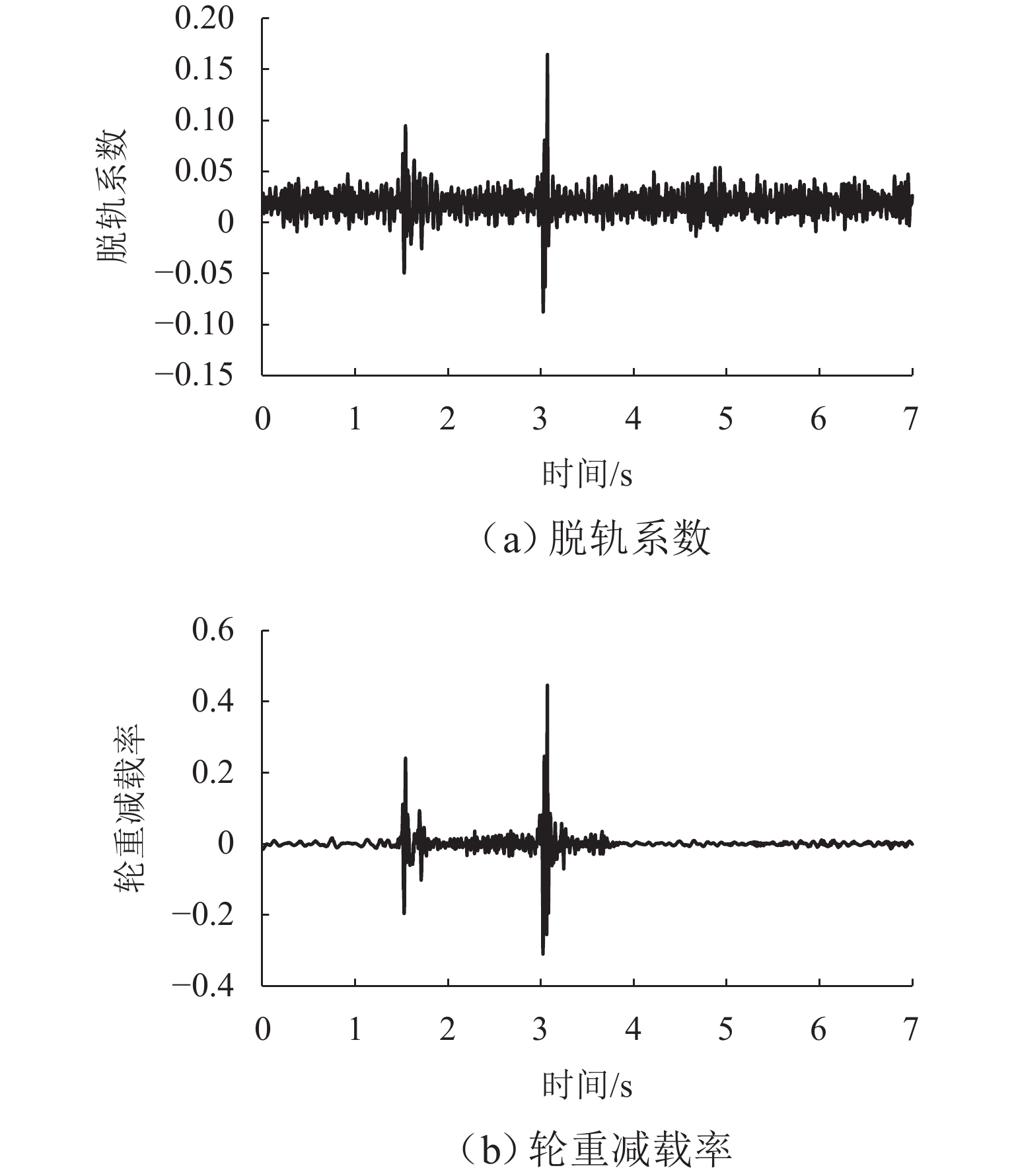
图 15 列车直向过岔时轮轨力时程图
Figure 15. Time history of wheel-rail forces when train passes through turnout
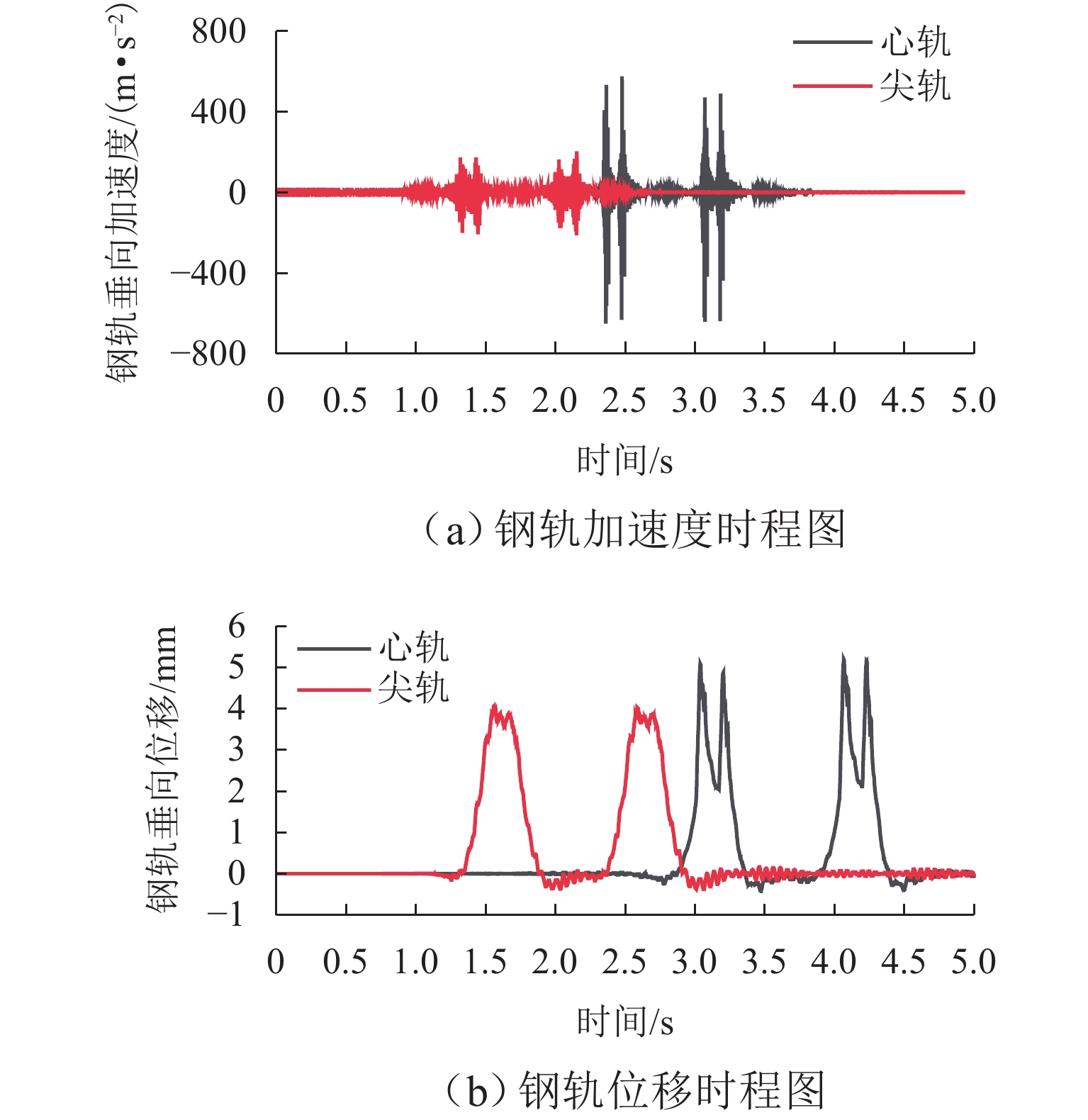
图 18 列车过岔时钢轨加速度及位移
Figure 18. Rail acceleration and displacement when the train passes through turnout
表 1 地铁A型车动力学参数
Table 1. Dynamic parameters of metro type-A vehicle
名称 数值 定距/m 15.7 轴距/m 2.5 车体质量/kg 54880 车体侧滚转动惯量/(kg•m2) 128000 车体点头转动惯量/(kg•m2) 1940000 车体摇头转动惯量/(kg•m2) 1670000 转向架质量/kg 2721 转向架侧滚转动惯量/(kg•m2) 2592 转向架点头转动惯量/(kg•m2) 1752 转向架摇头转动惯量/(kg•m2) 3200 轮对质量/kg 1900 轮对侧滚转动惯量/(kg•m2) 720 轮对摇头转动惯量/(kg•m2) 1783 一系悬挂垂向刚度/(kN·m−1) 2140 一系悬挂垂向阻尼/(kN·s·m−1) 49 二系悬挂垂向刚度/(kN·m−1) 2500 二系悬挂垂向阻尼/(kN·s·m−1) 196  下载: 导出CSV
表 2 轨道结构各部件力学参数
Table 2. Mechanical parameters of track components
部件 参数名称 数值 钢轨 弹性模量/Pa 2.06 × 10¹¹ 泊松比 0.33 密度/(kg·m−3) 7850 扣件 垂向刚度/(MN·m−1) 20 横向刚度/(MN·m−1) 30 垂/横向阻尼/(N·s·m−1) 5 × 10⁴ 轨道板 弹性模量/Pa 3.55 × 10¹⁰ 密度/(kg·m−3) 2500 减振垫 弹性模量/Pa 6.00 × 10⁵ 泊松比 0.20 密度/(kg·m−3) 400 自密实混凝土 弹性模量/Pa 3.25 × 10¹⁰ 密度/(kg·m−3) 2450
下载: 导出CSV
表 3 隧道结构参数
Table 3. Parameters of tunnel structure
部件 参数 数值 隧道壁 弹性模量/Pa 3.60 × 10¹⁰ 泊松比 0.20 密度/(kg·m−3) 2500 土体 弹性模量/Pa 2.00 × 10⁸ 泊松比 0.20 密度/(kg·m−3) 2350
下载: 导出CSV
表 4 振动源强数据结果对比
Table 4. Comparison of vibration source intensity data
来源 隧道壁最大加速度/(m·s−2) 轨道板最大加速度/(m·s−2) 隧道壁垂向振动加速度主频/Hz 隧道壁主频对应振级/dB 转辙器区 辙叉区 转辙器区 辙叉区 转辙器区 辙叉区 转辙器区 辙叉区 仿真 0.17 0.24 9.71 6.67 63 80 76 74 文献 0.10~0.20 0.20~0.30 3.70~22.20 6.20~7.40 63~80 63~80 70~78 70~76
下载: 导出CSV
表 5 车-岔耦合系统动力学响应
Table 5. Dynamic responses of vehicle–turnout coupling system
板厚/
mm轮轨垂向力/
kN横向力/kN 轮重减载率 车体加速度/(m·s−2) Sperling 加速度/(m·s−2) 位移量/mm 道床位移/mm 轮轨 轮轴 垂向 横向 垂向 横向 尖轨 心轨 尖轨 心轨 转辙区 辙叉区 180 118.08 6.53 8.86 0.47 0.10 0.08 0.78 0.92 265.87 380.11 2.32 3.53 1.84 1.75 220 106.78 7.29 10.04 0.34 0.10 0.08 0.78 0.92 269.06 485.88 2.30 3.45 1.81 1.75 260 105.07 7.75 10.98 0.36 0.10 0.08 0.78 0.92 265.29 489.05 2.29 3.41 1.77 1.74 300 102.85 7.97 11.81 0.39 0.10 0.08 0.78 0.92 264.02 324.79 2.29 3.38 1.76 1.73
下载: 导出CSV
-
[1] 杨宜谦, 刘鹏辉, 房斌, 等. 城市轨道交通地下线振动源机理和频率特性[J]. 振动与冲击, 2023, 42(4): 171-178.YANG Yiqian, LIU Penghui, FANG Bin, et al. Vibration source mechanism and frequency characteristics of underground lines of urban rail transits[J]. Journal of Vibration and Shock, 2023, 42(4): 171-178. [2] 冯青松, 王子玉, 刘全民, 等. 地铁车辆段不同区域振动特性对比分析[J]. 振动与冲击, 2020, 39(14): 179-185, 200.FENG Qingsong, WANG Ziyu, LIU Quanmin, et al. Comparative analysis of environmental vibration characteristics in different regions of a metro depot[J]. Journal of Vibration and Shock, 2020, 39(14): 179-185, 200. [3] ZHU S Y, WANG J W, CAI C B, et al. Development of a vibration attenuation track at low frequencies for urban rail transit[J]. Computer-Aided Civil and Infrastructure Engineering, 2017, 32(9): 713-726. doi: 10.1111/mice.12285 [4] KEDIA N K, KUMAR A, SINGH Y. Effect of rail irregularities and rail pad on track vibration and noise[J]. KSCE Journal of Civil Engineering, 2021, 25(4): 1341-1352. doi: 10.1007/s12205-021-1345-6 [5] VOGIATZIS K, MOUZAKIS H. Ground-borne noise and vibration transmitted from subway networks to multi-storey reinforced concrete buildings[J]. Transport, 2018, 33(2): 446-453. [6] 李小珍, 高慰, 雷康宁, 等. 高速列车对站房振动噪声影响的试验研究[J]. 西南交通大学学报, 2020, 55(5): 1067-1075. doi: 10.3969/j.issn.0258-2724.20190065LI Xiaozhen, GAO Wei, LEI Kangning, et al. Vibration and noise measurement of railway station hall induced by high-speed trains[J]. Journal of Southwest Jiaotong University, 2020, 55(5): 1067-1075. doi: 10.3969/j.issn.0258-2724.20190065 [7] 徐井芒, 郑兆光, 赖军, 等. 轨道参数对高速道岔轮轨接触行为的影响[J]. 西南交通大学学报, 2022, 57(5): 990-999. doi: 10.3969/j.issn.0258-2724.20210449XU Jingmang, ZHENG Zhaoguang, LAI Jun, et al. Influence of track parameters on wheel/rail contact behavior of high-speed turnout[J]. Journal of Southwest Jiaotong University, 2022, 57(5): 990-999. doi: 10.3969/j.issn.0258-2724.20210449 [8] QIAN Y, WANG P, XIE K Z, et al. Development and application of a calculation method for the equivalent conicity in high-speed turnout Zones[J]. Vehicle System Dynamics, 2022, 60(1): 96-113. doi: 10.1080/00423114.2020.1802046 [9] HAO C J, WANG P, XU J M, et al. Investigation of transient wheel-rail interaction and interface contact behaviour in movable-point crossing panel[J]. Vehicle System Dynamics, 2024, 62(5): 1103-1121. doi: 10.1080/00423114.2023.2217962 [10] 陈嵘, 王雪彤, 陈嘉胤, 等. 轮对安装偏角对高速列车过转辙器的动力特性影响[J]. 西南交通大学学报, 2021, 56(4): 872-882.CHEN Rong, WANG Xuetong, CHEN Jiayin, et al. Influence of wheelset installation deflection angle on dynamic characteristics of high-speed vehicles crossing switch[J]. Journal of Southwest Jiaotong University, 2021, 56(4): 872-882. [11] 王树国, 王璞, 葛晶, 等. 高速道岔尖轨磨耗特征及管理限值研究[J]. 中国铁道科学, 2022, 43(1): 9-16. doi: 10.3969/j.issn.1001-4632.2022.01.02WANG Shuguo, WANG Pu, GE Jing, et al. Study on wear characteristics and management limit of switch rail in high-speed turnout[J]. China Railway Science, 2022, 43(1): 9-16. doi: 10.3969/j.issn.1001-4632.2022.01.02 [12] GAO X, YI Q, LEI J X, et al. Experimental study on the characteristics of vibration energy propagation in the subway turnout area[J]. Construction and Building Materials, 2023, 409: 134210. doi: 10.1016/j.conbuildmat.2023.134210 [13] JIANG B L, MA M, LI M H, et al. Experimental study of the vibration characteristics of the floating slab track in metro turnout zones[J]. Proceedings of the Institution of Mechanical Engineers, Part F: Journal of Rail and Rapid Transit, 2019, 233(10): 1081-1096. doi: 10.1177/0954409719826824 [14] 曾志平, 曾强, 郭无极, 等. 9号道岔区铺设减振垫浮置板的行车安全性及舒适性研究[J]. 铁道科学与工程学报, 2024, 21(3): 1015-1024.ZENG Zhiping, ZENG Qiang, GUO Wuji, et al. Safety and comfort study of vibration-reduction pad floating slab applied to No. 9 turnout[J]. Journal of Railway Science and Engineering, 2024, 21(3): 1015-1024. [15] 张政, 娄会彬, 孙立, 等. 减振型装配式轨道设计方案理论与试验研究[J]. 西南交通大学学报, 2023, 58(3): 630-637. doi: 10.3969/j.issn.0258-2724.20210517ZHANG Zheng, LOU Huibin, SUN Li, et al. Theoretical and experimental study on design scheme of vibration damping prefabricated track[J]. Journal of Southwest Jiaotong University, 2023, 58(3): 630-637. doi: 10.3969/j.issn.0258-2724.20210517 [16] 高原, 廖涛, 王树国, 等. 高速道岔焊接接头区轮轨接触-冲击瞬态响应分析[J/OL]. 西南交通大学学报, 2025: 1-10. (2025-05-22). http://kns.cnki.net/kcms/detail/51.1277.U.20241231.1556.016.html. [17] 王平, 李抒效, 闫正, 等. 板间离缝对高速道岔转辙器区轨道动力响应的影响[J]. 中南大学学报(自然科学版), 2023, 54(12): 4946-4955. doi: 10.11817/j.issn.1672-7207.2023.12.030WANG Ping, LI Shuxiao, YAN Zheng, et al. Influence of debonding between layers on dynamic mechanical response of track structure in switch panel of high-speed turnout[J]. Journal of Central South University (Science and Technology), 2023, 54(12): 4946-4955. doi: 10.11817/j.issn.1672-7207.2023.12.030 [18] 马晓川, 徐井芒, 王平, 等. 铁路道岔转辙器部件轮轨两点接触计算方法研究[J]. 铁道学报, 2019, 41(7): 155-161. doi: 10.3969/j.issn.1001-8360.2019.07.020MA Xiaochuan, XU Jingmang, WANG Ping, et al. Study on wheel-rail two-point contact calculation in switch panel of railway turnout[J]. Journal of the China Railway Society, 2019, 41(7): 155-161. doi: 10.3969/j.issn.1001-8360.2019.07.020 [19] 施以旋, 戴焕云, 毛庆洲, 等. 基于车轨耦合的地铁车轮多边形形成机理[J]. 西南交通大学学报, 2024, 59(6): 1357-1367, 1388.SHI Yixuan, DAI Huanyun, MAO Qingzhou, et al. Formation mechanism of metro wheel polygonal based on vehicle-track coupling[J]. Journal of Southwest Jiaotong University, 2024, 59(6): 1357-1367, 1388. [20] 姜晓文, 郭世豪, 王文通. 地铁装配式预制板无砟轨道结构优化分析[J]. 铁道科学与工程学报, 2021, 18(12): 3164-3171.JIANG Xiaowen, GUO Shihao, WANG Wentong. Optimization analysis of prefabricated slab track structure for subway[J]. Journal of Railway Science and Engineering, 2021, 18(12): 3164-3171. [21] 韦凯, 王森, 马蒙, 等. 地铁轨道长波不平顺与轮轨短波粗糙度谱研究[J/OL]. 西南交通大学学报, 2025: 1-10. (2025-05-22). http://kns.cnki.net/kcms/detail/51.1277.U.20250506.1104.004.html. [22] 柯文华. 地铁9号道岔岔区振动源强特性测试与分析研究[D]. 成都: 西南交通大学, 2019. [23] 中国铁路总公司. 铁路轨道设计规范(极限状态法): Q/CR 9130—2018[S]. 北京: 中国铁道出版社, 2019. [24] 中华人民共和国生态环境部. 环境影响评价技术导则 城市轨道交通: HJ 453-2018[S]. 北京: 中国环境出版社, 2019. [25] 国际标准化组织. 人体暴露于全身振动的评估 第1部分: 一般要求: ISO 2631-1: 1985 EN[S].[出版地不详]: RO-ASRO, 1985. [26] 韦凯, 刘延滨, 王显, 等. 德标减振轨道插入损失率的理论修正方法及应用[J]. 西南交通大学学报, 2026, 61(1): 117-126.WEI Kai, LIU Yanbin, WANG Xian, et al. Theoretical correction method and application of german-standard insertion loss rate of vibration damping track[J]. Journal of Southwest Jiaotong University, 2026, 61(1): 117-126. -

 下载:
下载:

 点击查看大图
计量
- 文章访问数: 531
- HTML全文浏览量: 727
- PDF下载量: 29
- 被引次数: 0