



Comparative Analysis of Traffic Conflict Modelling and Classification Results for Slow-Moving Heterogeneous Groups in Bus Stop Areas
-
摘要:
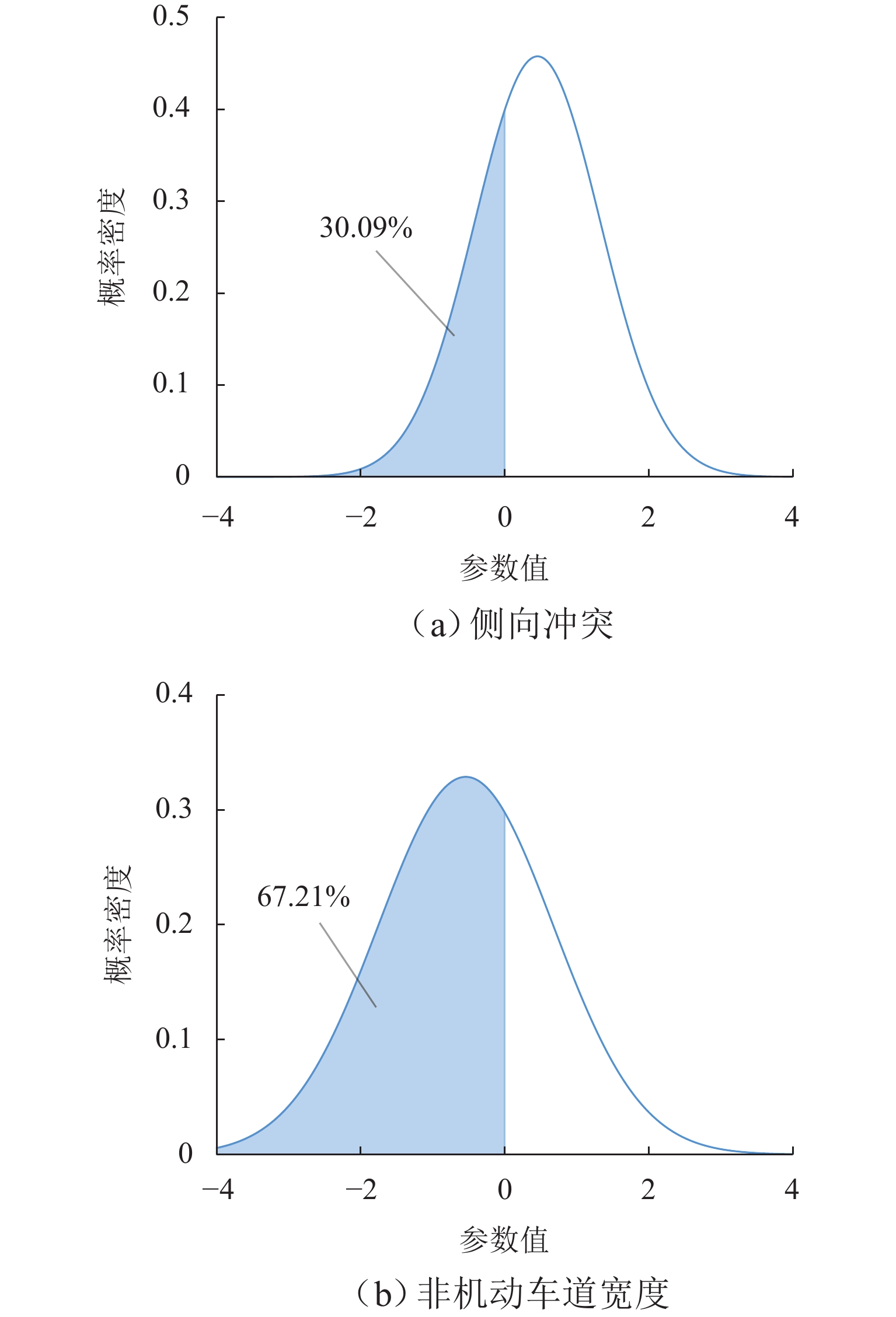
公交站承担着居民出行链中的衔接和接驳作用,其区域内慢行异质群体密度较高,增加了彼此间交通冲突的可能性. 既有研究多针对公交站区交通冲突问题,未深入研究公交站区慢行异质群体交通冲突致因机理和影响因素间的异质性. 以昆明市4类公交站为研究对象,采集2022年12月至2023年3月20个公交站数据,分析慢行异质群体运动特征,并基于DOCTOR (dutch objective conflict technique for operation and research)方法对冲突的严重程度进行判别,构建考虑均值和方差异质性的随机参数Logit模型,以更好地识别随机参数中的异质性,提高公交站区安全. 结果表明:在随机参数分布方面,行人的侧向冲突和非机动车道宽度分别服从
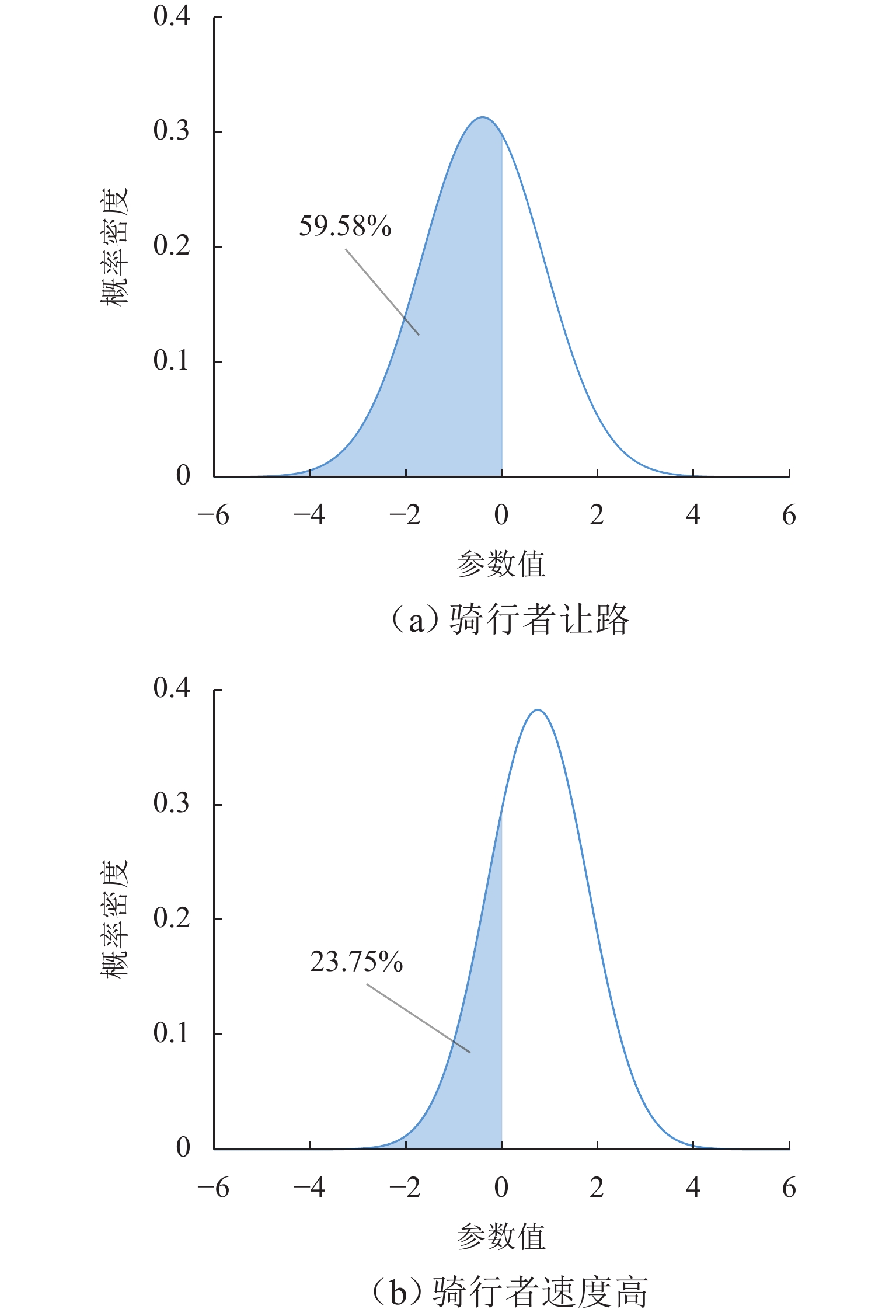
N (0.455,0.8722)、N (−0.541,1.2142),以及骑行者的让路和速度高分别服从N (−0.399,1.2742)、N (0.745,1.0432);在均值异质性方面,侧向冲突在行人速度高和非机动车道宽度在岛屿直线型公交站中存在均值异质性,骑行者让路在人行道上骑行和骑行者速度高在骑行者密度中时存在均值异质性;在方差异质性方面,非机动车道宽度的参数在老年人中以及骑行者速度高参数在女性骑行者中存在方差异质性. 进一步计算平均边际效应系数,量化了各影响因素对交通冲突严重程度的作用程度. 行人群体中,下车乘客发生严重交通冲突的概率最大;骑行者群体中,逆向骑行者发生严重交通冲突的概率最大.-
关键词:
- 交通工程 /
- 交通冲突 /
- 随机参数Logit模型 /
- 慢行异质群体 /
- 个体异质性
Abstract:The roles of connection and transfer in the travel chain of residents are played by bus stops. The high density of slow-moving heterogeneous groups in these areas increases the possibility of traffic conflicts among them. Existing studies mostly focus on the traffic conflict problem in bus stop areas, whereas the causal mechanism of traffic conflicts among slow-moving heterogeneous groups in bus stop areas and the heterogeneity among influencing factors are not deeply studied. Four types of bus stops in Kunming were taken as research objects. Data from 20 bus stops from December 2022 to March 2023 were collected, and the movement characteristics of slow-moving heterogeneous groups were analyzed. The severity of conflicts was discriminated based on the dutch objective conflict technique for operation and research (DOCTOR) method. A random parameter Logit model considering the heterogeneity of mean and variance was constructed to better identify the heterogeneity in random parameters and improve the safety of bus stop areas. The results indicate that in terms of random parameter distribution, the lateral conflict and non-motorized lane width for pedestrians follow
N (0.455, 0.8722) andN (−0.541, 1.2142), respectively; the yielding and high speed for cyclists followN (−0.399, 1.2742) andN (0.745, 1.0432), respectively. In terms of mean heterogeneity, mean heterogeneity exists in the lateral conflict when pedestrian speed is high and in the non-motorized lane width at island linear bus stops; mean heterogeneity also exists in cyclist yielding when riding on sidewalks and in high cyclist speed concerning cyclist density. In terms of variance heterogeneity, variance heterogeneity exists in the parameter of non-motorized lane width among the elderly and in the parameter of high cyclist speed among female cyclists. By calculating the average marginal effect coefficients, it is found that among the pedestrian group, alighting passengers have the highest probability of severe traffic conflicts, and among the cyclist group, counter-flow cyclists have the highest probability of severe traffic conflicts. -
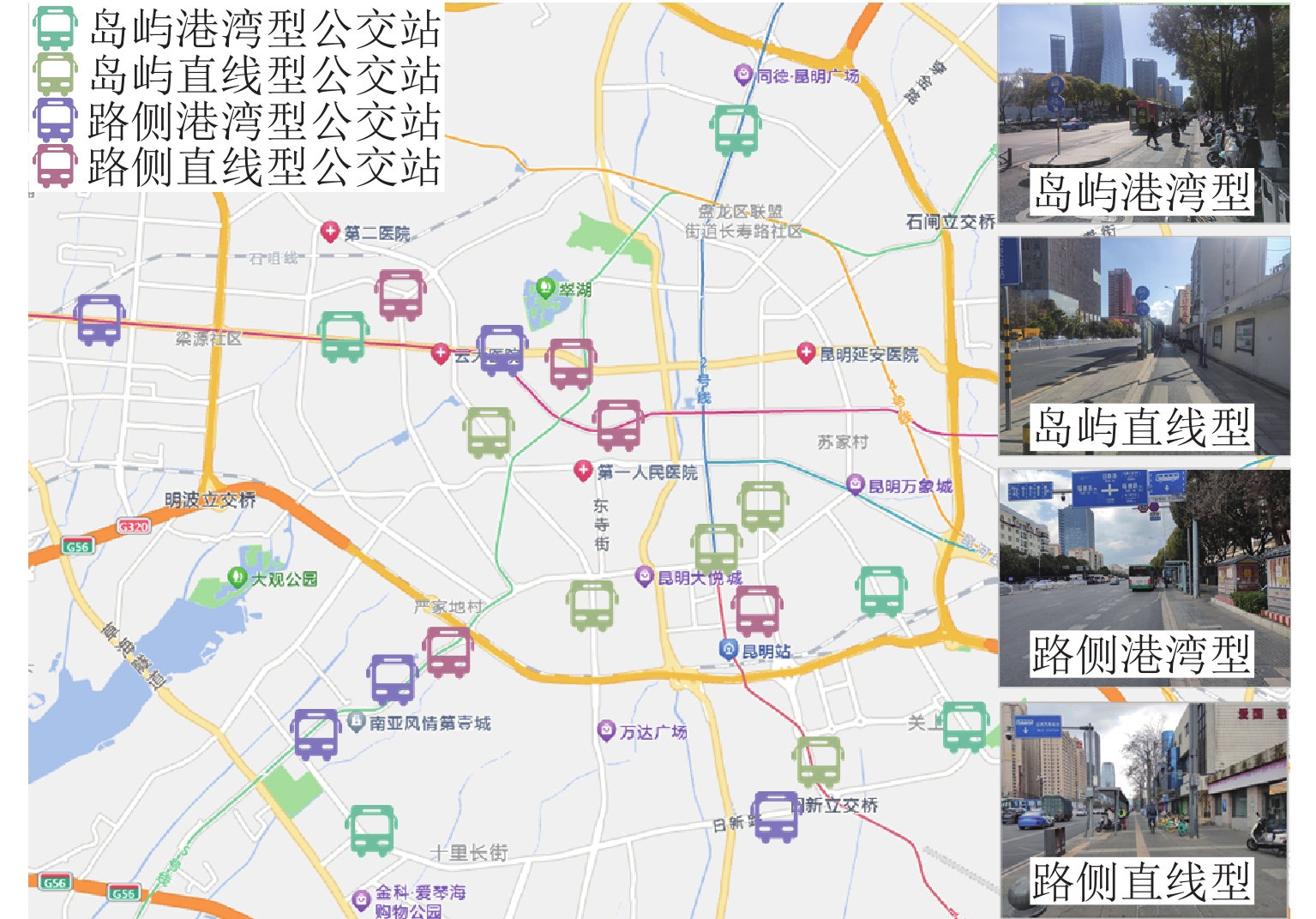
图 1 数据采集的公交站点位置分布及4种常见公交站
Figure 1. Distribution of bus stop locations for data collection and four common bus stops
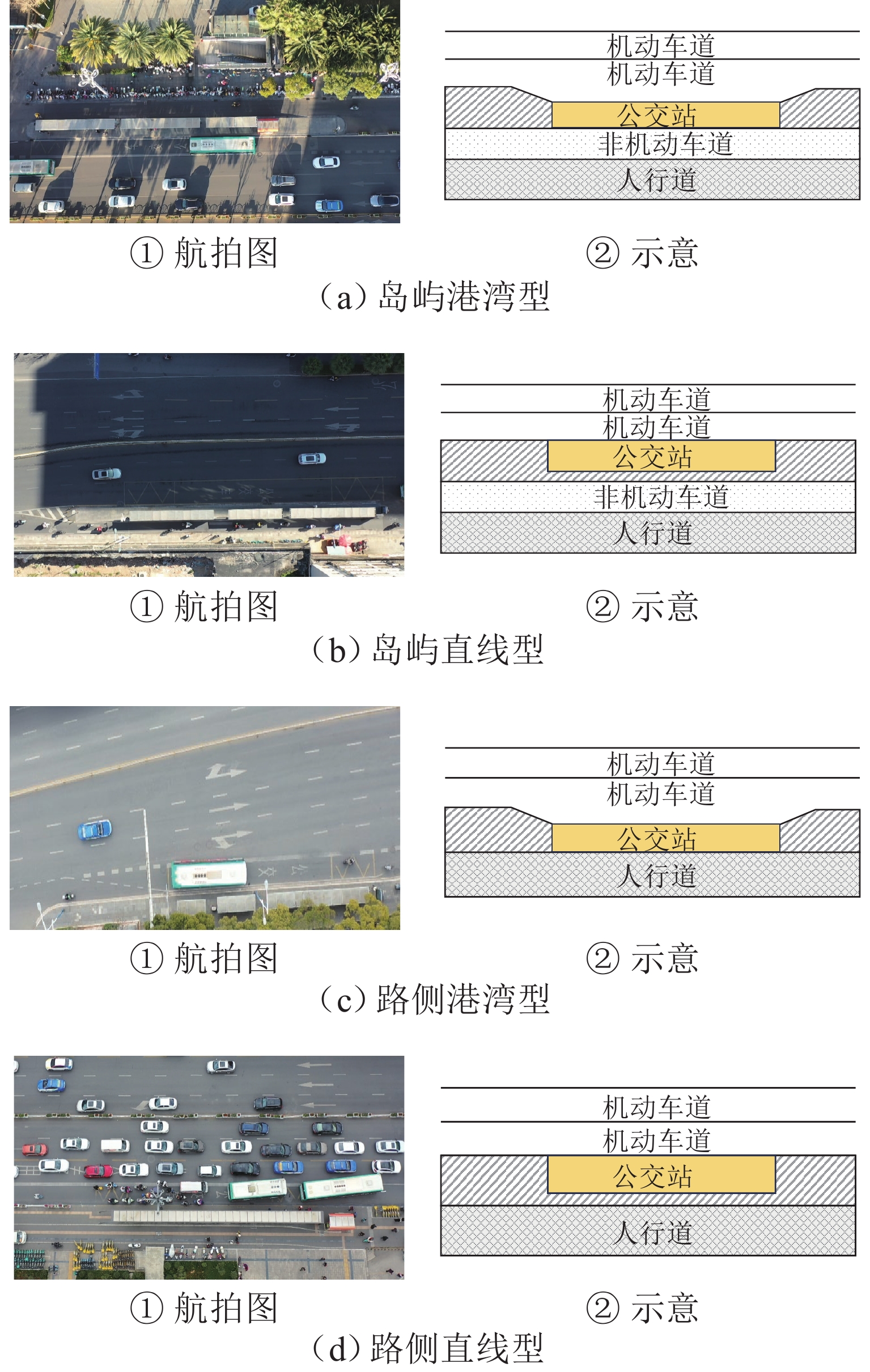
图 2 不同类型公交站设置方式航拍图和示意
Figure 2. Aerial photographs and schematic diagrams of different bus stop layout types
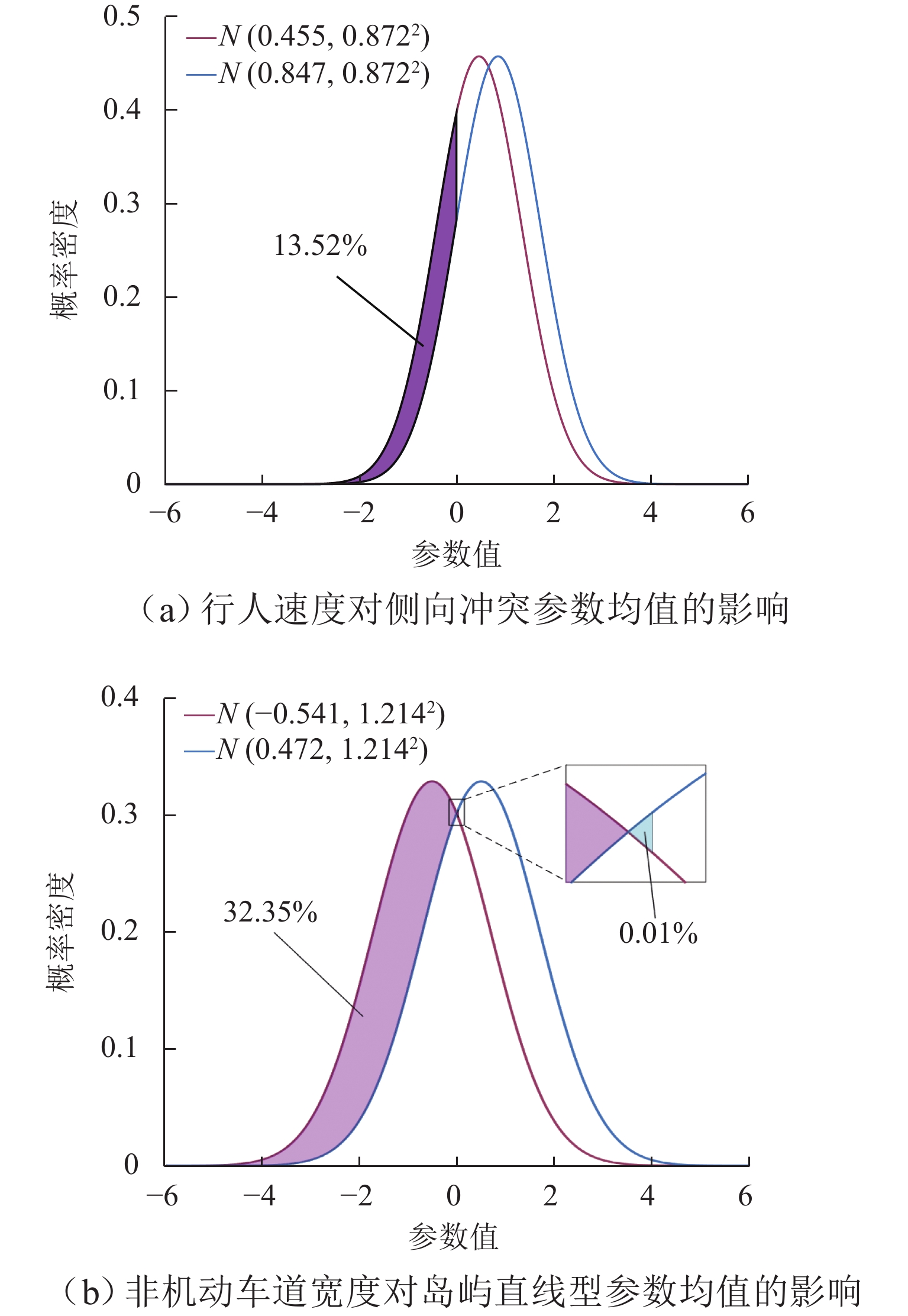
图 8 行人的随机参数均值异质性分布
Figure 8. Mean heterogeneity distribution of random parameters for pedestrians
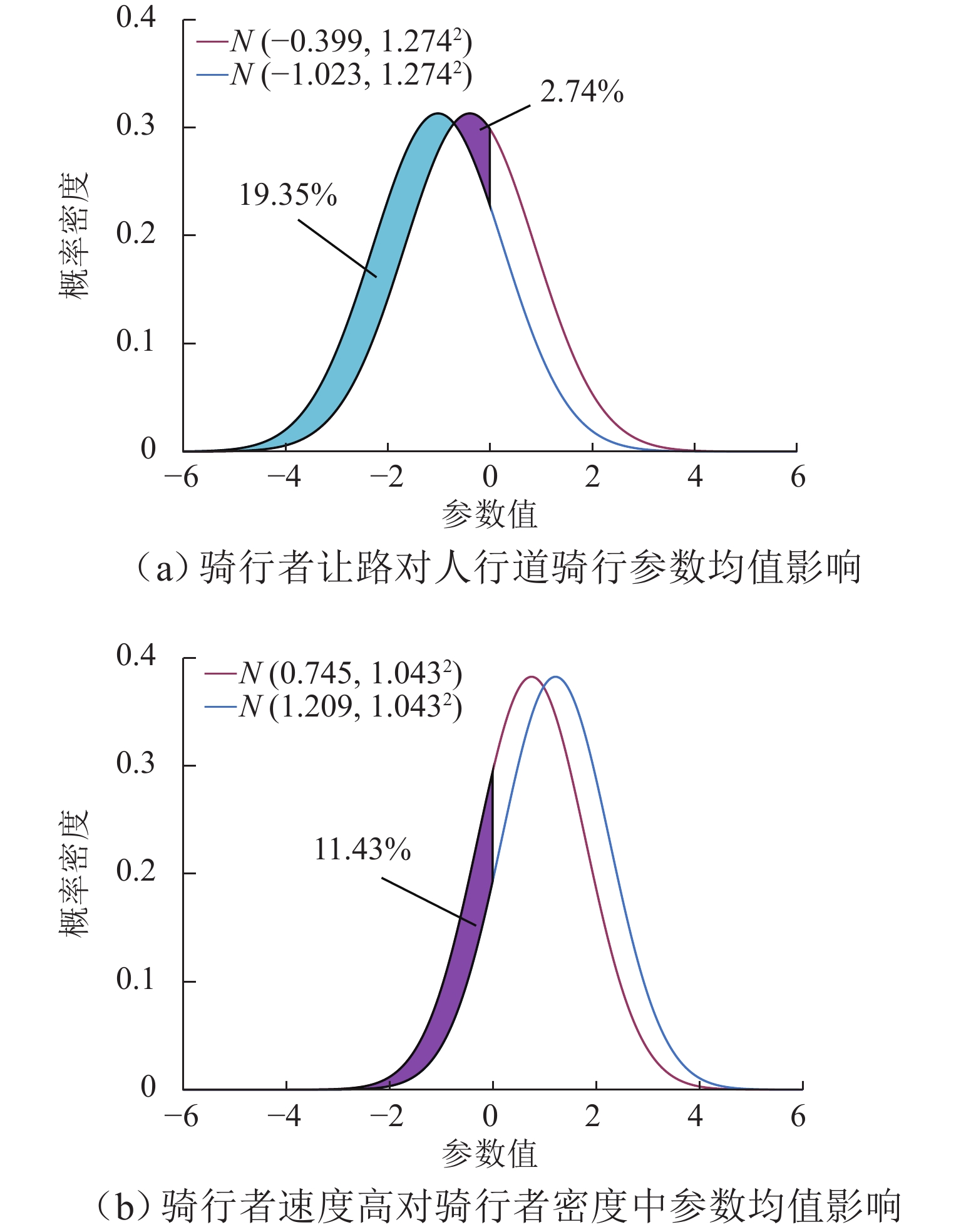
图 9 骑行者的随机参数均值异质性分布
Figure 9. Mean heterogeneity distribution of random parameters for cyclists
表 1 行人和骑行者的部分运动轨迹数据
Table 1. Partial motion trajectory data for pedestrians and cyclists
交通主体 帧数/帧 横向坐标/m 纵向坐标/m 速度/
(m•s−1)横向速度/
(m•s−1)纵向速度/
(m•s−1)加速度/
(m•s−2)转向角变
化值/(°)骑行者 1647 15.2310 1.8663 4.6559 4.6276 − 0.5127 1.3832 6.9860 1648 15.3860 1.8505 4.6359 4.6054 − 0.5310 1.7895 6.8581 1649 15.5383 1.8309 4.7406 4.7054 − 0.5770 0.4322 6.7203 1650 15.7000 1.8120 4.7182 4.6862 − 0.5488 2.3246 6.5836 1651 15.8510 1.7943 4.5335 4.5052 − 0.5053 3.3439 6.4582 1652 16.0006 1.7783 4.5111 4.4828 − 0.5046 1.6895 6.3417 1653 16.1502 1.7606 4.4737 4.4526 − 0.4339 1.2505 6.2216 1654 16.2978 1.7493 4.4395 4.4213 − 0.4009 0.8417 6.1264 1655 16.4452 1.7339 4.4266 4.4027 − 0.4600 2.1390 6.0186 1656 16.5916 1.7186 4.5537 4.5329 − 0.4344 1.9702 5.9138 行人 1363 8.5661 1.0030 0.7750 0.6972 0.3384 0.2868 6.6784 1364 8.6724 1.0667 0.6927 0.5784 0.3810 0.2073 7.0119 1365 8.7591 1.1302 0.7095 0.6114 0.3599 0.2685 7.3520 1366 8.8764 1.1867 0.7846 0.7006 0.3531 0.6057 7.6150 1367 8.9929 1.2480 0.8440 0.7808 0.3204 0.6794 7.9006 1368 9.1370 1.2936 0.9300 0.9045 0.2161 0.6412 8.0586  下载: 导出CSV
表 2 慢行异质群体运动特征量区间划分
Table 2. Division of motion characteristic quantity intervals of slow-moving heterogeneous groups
区间
划分行人速度/
(m·s−1)行人密度/
(h·m−2)骑行者速度/
(m·s−1)骑行者密度/
(h·m−2)低 (0,0.803] (0,1.145] (0,3.231] (0,0.185] 中 (0.803,1.138] (1.145,2.677] (3.231,5.095] (0.185,0.273] 高 (1.138,1.500] (2.677,5.000] (5.095,8.000] (0.273,0.500]
下载: 导出CSV
表 3 交通冲突严重程度等级判别及其解释说明
Table 3. Determination and explanation of traffic conflict severity rating
冲突严重程度 等级 解释说明 无交通冲突 0 行进方向或速度无变化,不发生交互行为或交通冲突 轻微交通冲突 1 采取措施以规避预见的交通冲突,发生交通冲突概率极低 一般交通冲突 2 行进方向需要转变或减小速度以规避交通冲突,发生交通冲突概率低 严重交通冲突 3 大幅度改变行进方向或停止行进以规避交通冲突,发生交通冲突概率适中 4 紧急采取措施以规避交通冲突,发生交通冲突概率高 5 未及时采取措施或紧急采取措施以规避交通冲突,并发生交通碰撞
下载: 导出CSV
表 4 慢行异质群体交通冲突影响因素汇总表
Table 4. Summary of factors influencing traffic conflict for slow-moving heterogeneous groups
次 慢行异质群体 影响因素 类别 轻微交通冲突频数 一般交通冲突频数 严重交通冲突频数 行人 行人类型 上车乘客 87 116 19 下车乘客 62 143 35 行人 1546 322 11 行人年龄 青年 1146 272 11 中年 197 59 9 老年 352 250 45 行人性别 男 942 298 42 女 753 283 23 行人是否结对 是 988 513 41 否 707 68 24 行人使用移动电子产品 是 1243 397 46 否 452 184 19 公交站类型 岛屿港湾型 501 207 17 岛屿直线型 436 241 19 路侧港湾型 282 57 14 路侧直线型 476 76 15 冲突方向 正向冲突 761 234 11 侧向冲突 269 176 38 同向冲突 665 171 16 时间段 早高峰 588 157 22 平峰 111 89 17 晚高峰 996 335 26 躲避(让路)主体 行人 715 276 21 骑行者 688 233 37 两者 292 72 7 骑行者 骑行者类型 正向骑行 671 377 47 逆向骑行 247 176 93 在人行道骑行 1144 526 52 骑行者年龄 青年 1764 894 165 中年 286 151 13 老年 12 34 14 骑行者 骑行者性别 男 1168 492 71 女 894 587 121 骑行者是否载人/物 是 586 468 78 否 1476 611 114 骑行者使用移动电子产品 是 887 679 129 否 1175 400 63 公交站类型 岛屿港湾型 879 277 38 岛屿直线型 769 328 49 路侧港湾型 249 255 43 路侧直线型 165 219 62 冲突方向 正向冲突 1059 379 64 侧向冲突 298 292 69 同向冲突 705 408 59 时间段 早高峰 876 432 48 平峰 461 211 59 晚高峰 725 436 85 躲避(让路)主体 行人 789 431 73 骑行者 839 567 97 两者 434 81 22
下载: 导出CSV
表 5 行人交通冲突严重程度模型参数标定结果
Table 5. Parameter calibration results of pedestrian traffic conflict severity model
冲突严重
程度影响因素 类别 随机参数 Logit
模型考虑均值异质性的
随机参数 Logit 模型考虑均值和方差异质性的
随机参数 Logit 模型系数 Z 值 系数 Z 值 系数 Z 值 一般交通冲突 常数项 −0.805 −2.203 −0.788 −2.065 −0.767 −1.944 行人类型 下车乘客 0.677 3.826 0.703 3.872 0.689 3.841 行人年龄 中年 0.766 5.575 0.781 5.602 0.755 5.572 老年 1.539 8.986 1.541 8.983 1.571 9.073 行人使用移动
电子产品否 −0.335 −1.412 −0.635 −2.507 −0.749 −2.897 行人速度 高 1.390 5.479 1.745 5.791 1.347 5.393 行人密度 高 −0.835 −3.258 −1.287 −4.574 −1.134 −4.225 公交站类型 岛屿直线型 0.115 0.840 0.148 1.045 0.128 0.922 路侧港湾型 −0.660 −4.628 −0.661 −4.595 −0.552 −3.989 路侧直线型 −0.721 −4.393 −0.724 −4.404 −0.675 −4.179 人行道宽度 连续变量 −0.432 −2.783 −0.427 −2.782 −0.376 −2.523 非机动车道
宽度连续变量 −0.315 −1.841 −0.343 −1.924 −0.366 −2.010 冲突方向 侧向冲突 0.432 3.213 0.477 3.353 0.455 3.312 侧向冲突的标准差 0.976 1.894 0.924 1.840 0.872 1.754 躲避(让路)
主体骑行者 −0.337 −2.971 −0.814 −4.578 −0.565 −3.769 两者 −0.899 −3.183 −1.176 −3.833 −1.034 −3.565 均值异质性 侧向冲突,
行人速度高Δ Δ 0.411 1.823 0.392 1.801 严重交通冲突 常数项 −1.327 −3.539 −1.264 −3.283 −1.207 −3.087 行人类型 下车乘客 0.806 4.150 0.811 4.109 0.809 4.17 行人年龄 老年 1.823 4.900 1.776 4.799 1.802 4.595 行人使用移动
电子产品否 −1.232 −3.384 −1.116 −3.258 −1.147 −3.233 行人速度 高 2.043 4.150 2.212 4.308 1.937 4.006 行人密度 高 −0.946 −3.843 −1.133 −3.762 −1.042 −3.627 公交站类型 岛屿直线型 0.434 2.798 0.438 2.781 0.435 2.782 时间段 晚高峰 0.457 2.637 Δ Δ Δ Δ 人行道宽度 连续变量 −0.673 −4.022 −0.973 −5.519 −0.692 −4.089 非机动车道
宽度连续变量 −0.537 −2.778 −0.609 −3.122 −0.541 −2.782 非机动车道宽度的
标准差1.404 4.145 1.313 4.102 1.214 3.661 冲突方向 侧向冲突 1.035 2.578 1.108 2.679 1.056 2.591 躲避(让路)主体 骑行者 −0.421 −2.083 −0.452 −2.071 −0.432 −2.071 两者 −1.035 −5.206 −1.076 −5.394 −1.032 −5.203 均值异质性 非机动车道宽度,
岛屿直线型Δ Δ 1.19 2.322 1.013 2.084 方差异质性 非机动车道宽度,
老年行人Δ Δ Δ Δ 1.767 2.785 模型评估 AIC 3367.421 3361.018 3353.904 BIC 3547.568 3544.762 3539.722 McFadden R2 0.506 0.511 0.519 注:Z值为通过比较估计值与标准误差的比率来判断模型中自变量系数是否显著的统计量,设置轻微交通冲突为参考类别,Δ表示在95%置信区间不显著,下表同.
下载: 导出CSV
表 6 骑行者交通冲突严重程度模型参数标定结果
Table 6. Parameter calibration results of cyclist traffic conflict severity model
冲突严重程度 影响因素 类别 随机参数 Logit
模型考虑均值异质性的
随机参数 Logit 模型考虑均值和方差异质性
的随机参数 Logit 模型系数 Z 值 系数 Z 值 系数 Z 值 一般交通冲突 常数项 −2.146 −4.889 −2.065 −4.465 −1.966 −4.160 骑行者类型 逆向骑行 0.632 2.596 0.711 2.817 0.658 2.649 人行道上骑行 0.325 2.280 0.273 2.141 0.268 2.158 骑行者性别 女 0.165 1.606 0.173 1.541 0.171 1.536 骑行者年龄 老年 0.553 2.393 0.581 2.427 0.576 2.438 骑行者速度 高 0.813 2.513 0.792 2.528 0.801 2.496 骑行者密度 中 0.327 1.203 0.411 1.387 0.386 1.374 公交站类型 路侧港湾型 0.553 2.750 0.573 2.764 0.576 2.727 路侧直线型 0.613 2.886 0.620 2.868 0.603 2.853 非机动车道宽度 连续变量 −0.463 −2.170 −0.507 −2.331 −0.481 −2.203 躲避(让路)主体 骑行者 −0.361 −1.684 −0.413 −1.858 −0.399 −1.870 骑行者标准差 1.438 3.302 1.364 3.157 1.274 2.863 两者 −1.136 −4.683 −1.016 −4.262 −1.011 −4.294 均值异质性 骑行者,人行道宽度 Δ Δ −0.921 −2.176 −0.624 −1.582 严重交通冲突 常数项 −3.186 −6.698 −3.247 −6.551 −3.338 −6.499 骑行者类型 逆向骑行 1.346 3.212 1.135 3.012 1.047 2.721 人行道上骑行 0.540 2.237 0.613 2.491 0.531 2.248 骑行者性别 女 0.531 1.919 0.735 2.473 0.632 2.248 骑行者年龄 老年 1.311 3.008 1.103 2.668 1.166 2.776 骑行者使用移动
电子产品否 −0.732 −3.256 Δ Δ Δ Δ 骑行者速度 高 0.672 2.431 0.835 2.887 0.745 2.658 骑行者速度高的标准差 1.125 2.517 1.287 2.461 1.043 2.167 骑行者密度 中 0.714 2.059 0.675 2.148 0.513 1.727 高 −0.325 −2.146 −0.599 −3.026 −0.742 −3.012 公交站类型 路侧港湾型 0.388 3.140 0.436 3.319 0.413 3.315 路侧直线型 0.476 3.049 0.616 3.654 0.586 3.658 非机动车道宽度 连续变量 −0.344 −2.028 −0.515 −2.804 −0.677 −3.365 躲避(让路)主体 骑行者 −0.717 −3.299 −0.635 −3.001 −0.604 −2.948 两者 −0.966 −4.525 −1.180 −4.465 −1.247 −4.540 均值异质性 骑行者速度高,骑行者
密度中Δ Δ 0.612 1.942 0.464 1.860 方差异质性 骑行者速度高,骑行者
性别为女Δ Δ Δ Δ 2.132 3.477 模型评估 AIC 4143.655 4136.627 4132.741 BIC 4268.347 4261.398 4257.126 McFadden R2 0.476 0.481 0.488
下载: 导出CSV
表 7 行人边际效应分析结果
Table 7. Analysis results of marginal effects of pedestrians
变量 类别 轻微 一般 严重 行人类型 下车乘客 −0.056 0.021 0.035 行人年龄 中年 −0.006 0.005 0.001 老年 −0.025 0.007 0.018 行人使用移动
电子产品否 0.003 −0.001 −0.002 行人速度 高 −0.020 0.009 0.011 行人密度 高 0.010 −0.004 −0.006 公交站类型 岛屿直线型 −0.013 0.014 −0.001 路侧港湾型 0.007 −0.011 0.004 路侧直线型 0.006 −0.011 0.005 人行道宽度 连续变量 0.023 −0.014 −0.009 非机动车道宽度 连续变量 0.012 −0.008 −0.004 冲突方向 侧向冲突 −0.015 0.009 0.006 躲避(让路)主体 骑行者 0.014 −0.008 −0.006 骑行者和行人 0.021 −0.016 −0.005
下载: 导出CSV
表 8 骑行者边际效应分析结果
Table 8. Analysis results of marginal effects of cyclists
变量 类别 轻微 一般 重度 骑行者类型 逆向 −0.049 0.017 0.032 人行道上
骑行−0.027 0.011 0.016 性别 女 −0.013 0.002 0.011 年龄 老年 −0.025 0.009 0.016 骑行者使用移动
电子产品否 0.003 −0.002 −0.001 骑行者速度 高 −0.017 0.01 0.007 骑行者密度 中 −0.014 0.006 0.008 高 0.003 0.002 −0.005 公交站类型 路侧港湾 −0.004 0.003 0.001 路侧直线 −0.006 0.004 0.002 非机动车道宽度 连续变量 0.011 −0.004 −0.007 谁让路 骑行者 −0.023 0.009 0.014 骑行者和行人 0.031 −0.014 −0.017
下载: 导出CSV
-
[1] QUISTBERG D A, KOEPSELL T D, JOHNSTON B D, et al. Bus stops and pedestrian-motor vehicle collisions in Lima, Peru: a matched case-control study[J]. Injury Prevention, 2015, 21(1): 15-22. doi: 10.1136/injuryprev-2014-041170 [2] ZHANG C, DU B, SHEN J, et al. Empirical investigation on conflicts between bus passengers and cyclists at different types of bus stops[C]//2022 IEEE 25th International Conference on Intelligent Transportation Systems (ITSC). Macau: IEEE, 2022: 1850-1855. [3] ASHRAF M T, DEY K, PYRIALAKOU D. Investigation of pedestrian and bicyclist safety in public transportation systems[J]. Journal of Transport & Health, 2022, 27: 101529.1-101529.17. [4] ULAK M B, KOCATEPE A, YAZICI A, et al. A stop safety index to address pedestrian safety around bus stops[J]. Safety Science, 2021, 133: 105017.1-105017.14. [5] SIDDIQUI C, ABDEL-ATY M, CHOI K. Macroscopic spatial analysis of pedestrian and bicycle crashes[J]. Accident Analysis & Prevention, 2012, 45: 382-391. [6] 李英帅, 马泽超, 王雯婧, 等. 考虑非机动车影响的直线式单泊位公交停靠站设置优化[J]. 交通信息与安全, 2021, 39(5): 137-143. doi: 10.3963/j.jssn.1674-4861.2021.05.017LI Yingshuai, MA Zechao, WANG Wenjing, et al. Optimization of single-berth curbside bus stops considering impacts of non-motorized vehicles[J]. Journal of Transport Information and Safety, 2021, 39(5): 137-143. doi: 10.3963/j.jssn.1674-4861.2021.05.017 [7] YE Z, WANG C, YU Y, et al. Modeling level-of-safety for bus stops in China[J]. Traffic Injury Prevention, 2016, 17(6): 656-661. doi: 10.1080/15389588.2015.1133905 [8] BEITEL D, STIPANCIC J, MANAUGH K, et al. Assessing safety of shared space using cyclist-pedestrian interactions and automated video conflict analysis[J]. Transportation Research Part D: Transport and Environment, 2018, 65: 710-724. doi: 10.1016/j.trd.2018.10.001 [9] 胡立伟, 侯智, 赵雪亭, 等. 基于交通事故文本挖掘的高速公路行车风险改进预测方法[J]. 西南交通大学学报, 2025, 60(6): 1487-1498.HU Liwei, HOU Zhi, ZHAO Xueting, et al. Improvement of Highway Traffic Risk Prediction Method Based on Traffic Accident Text Mining[J]. Journal of Southwest Jiaotong University, 2025, 60(6): 1487-1498. [10] LIANG X Y, MENG X H, ZHENG L. Investigating conflict behaviours and characteristics in shared space for pedestrians, conventional bicycles and e-bikes[J]. Accident Analysis & Prevention, 2021, 158: 106167.1-106167.10. [11] ZHENG L, SAYED T, GUO Y Y. Investigating factors that influence pedestrian and cyclist violations on shared use path: an observational study on the Brooklyn bridge promenade[J]. International Journal of Sustainable Transportation, 2020, 14(7): 503-512. doi: 10.1080/15568318.2019.1575495 [12] 夏亮, 江欣国, 范英飞. 基于均值-方差理论的多阶段公交走廊设计[J]. 西南交通大学学报, 2023, 58(6): 1294-1302. doi: 10.3969/j.issn.0258-2724.20210874XIA Liang, JIANG Xinguo, FAN Yingfei. Phased transit service design based on mean-variance theory[J]. Journal of Southwest Jiaotong University, 2023, 58(6): 1294-1302. doi: 10.3969/j.issn.0258-2724.20210874 [13] BEHNOOD A, MANNERING F. Determinants of bicyclist injury severities in bicycle-vehicle crashes: a random parameters approach with heterogeneity in means and variances[J]. Analytic Methods in Accident Research, 2017, 16: 35-47. doi: 10.1016/j.amar.2017.08.001 [14] 潘义勇, 缪炫烨, 吴静婷. 摩托车交通事故严重程度多尺度空间异质性分析[J]. 重庆交通大学学报(自然科学版), 2023, 42(10): 91-99. doi: 10.3969/j.issn.1674-0696.2023.10.12PAN Yiyong, MIAO Xuanye, WU Jingting. Multi-scale spatial heterogeneity analysis of motorcycle traffic accident severity[J]. Journal of Chongqing Jiaotong University (Natural Science), 2023, 42(10): 91-99. doi: 10.3969/j.issn.1674-0696.2023.10.12 [15] LI Y X, NI Y, SUN J, et al. Modeling the illegal lane-changing behavior of bicycles on road segments: considering lane-changing categories and bicycle heterogeneity[J]. Physica A: Statistical Mechanics and Its Applications, 2020, 541: 123302.1-123302.15. [16] ADANU E K, DZINYELA R, AGYEMANG W. A comprehensive study of child pedestrian crash outcomes in Ghana[J]. Accident Analysis & Prevention, 2023, 189: 107146.1-107146.9. [17] 陈昭明, 徐文远, 曲悠扬, 等. 基于混合Logit模型的高速公路交通事故严重程度分析[J]. 交通信息与安全, 2019, 37(3): 42-50. doi: 10.3963/j.issn.1674-4861.2019.03.006CHEN Zhaoming, XU Wenyuan, QU Youyang, et al. Severity of traffic crashes on freeways based on mixed Logit model[J]. Journal of Transport Information and Safety, 2019, 37(3): 42-50. doi: 10.3963/j.issn.1674-4861.2019.03.006 [18] 王菁, 董春娇, 李鹏辉, 等. 考虑建成环境的电动自行车事故严重程度致因分析[J]. 交通运输系统工程与信息, 2024, 24(1): 179-187. doi: 10.16097/j.cnki.1009-6744.2024.01.018WANG Jing, DONG Chunjiao, LI Penghui, et al. Causal analysis of E-bike traffic accident severity considering built environment[J]. Journal of Transportation Systems Engineering and Information Technology, 2024, 24(1): 179-187. doi: 10.16097/j.cnki.1009-6744.2024.01.018 [19] GAO D S, ZHANG X Q. Injury severity analysis of single-vehicle and two-vehicle crashes with electric scooters: a random parameters approach with heterogeneity in means and variances[J]. Accident Analysis & Prevention, 2024, 195: 107408.1-107408.14. [20] LI Z N, WANG C Y, LIAO H C, et al. Efficient and robust estimation of single-vehicle crash severity: a mixed logit model with heterogeneity in means and variances[J]. Accident Analysis & Prevention, 2024, 196: 107446.1-107446.13. [21] 叶建红, 陈小鸿. 行人交通流三参数基本关系式适用性研究[J]. 西南交通大学学报, 2016, 51(1): 138-144. doi: 10.3969/j.issn.0258-2724.2016.01.020YE Jianhong, CHEN Xiaohong. Applicability analysis of triparametric fundamental equations for pedestrian traffic flow[J]. Journal of Southwest Jiaotong University, 2016, 51(1): 138-144. doi: 10.3969/j.issn.0258-2724.2016.01.020 [22] FELICIANI C, NISHINARI K. Measurement of congestion and intrinsic risk in pedestrian crowds[J]. Transportation Research Part C: Emerging Technologies, 2018, 91: 124-155. doi: 10.1016/j.trc.2018.03.027 [23] VAN DER HORST A R A, DE GOEDE M, DE HAIR-BUIJSSEN S, et al. Traffic conflicts on bicycle paths: a systematic observation of behaviour from video[J]. Accident Analysis & Prevention, 2014, 62: 358-368. [24] ZHANG C, DU B, WANG Q, et al. Observational study on multi-type conflicts between passengers and cyclists at the bus stop–a case study in Nanjing[J]. Travel Behaviour and Society, 2022, 29: 176-185. doi: 10.1016/j.tbs.2022.06.010 [25] 世界卫生组织. 世卫组织确定新年龄分段: 44岁以下为青年人[EB/OL]. ( 2013-05-14) [2025-03-27]. https://news.cctv.com/2013/05/14/VIDE1368494762105539.shtml. [26] FOUNTAS G, ANASTASOPOULOS P C, ABDEL-ATY M. Analysis of accident injury-severities using a correlated random parameters ordered probit approach with time variant covariates[J]. Analytic Methods in Accident Research, 2018, 18: 57-68. doi: 10.1016/j.amar.2018.04.003 -

 下载:
下载:

 点击查看大图
计量
- 文章访问数: 303
- HTML全文浏览量: 144
- PDF下载量: 36
- 被引次数: 0