



Distribution and Migration Characteristics of Volatile Organic Compounds at Polluted Sites of Chemical Plants and Their Concentration Prediction Models
-
摘要:
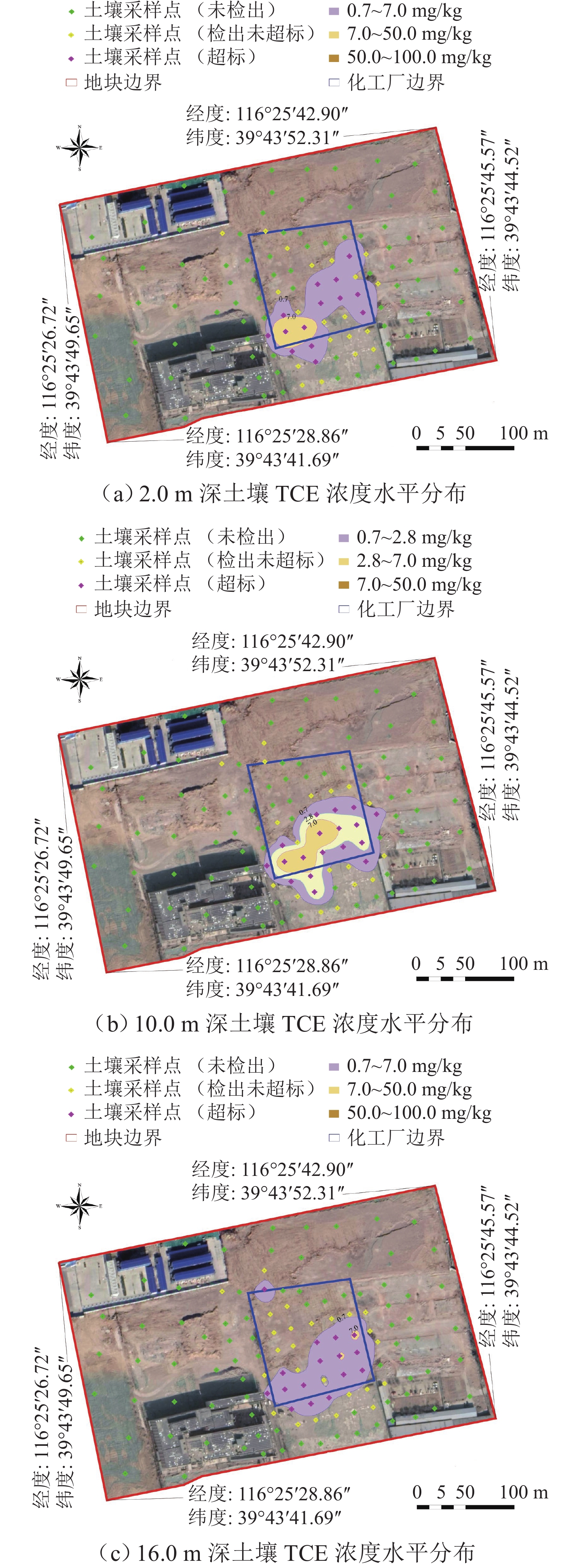
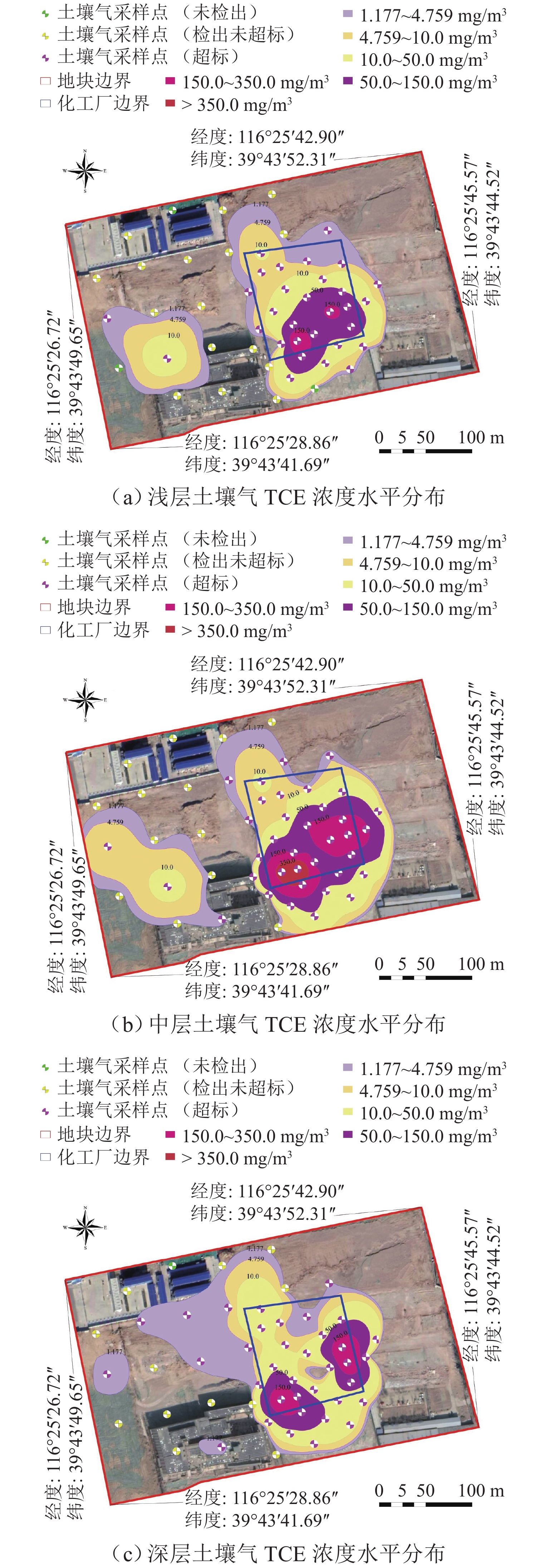
为阐明有机物污染场地挥发性有机物(VOCs)分布迁移特征,在某化工厂遗留场地布置120个土壤和48个土壤气采样孔,在重污染区14个钻孔内采集97对土壤/土壤气样品,通过试验室分析样品污染物含量,并借助Sufer软件分析污染物分布特性,结合地层岩性分析三氯乙烯(TCE)分布迁移特征,基于预测值和实测值对比对2种土壤气VOCs含量预测模型适用性进行分析. 结果表明:随孔深增加,重污染区土壤TCE浓度下降,超标率达50.4%,最大值位于黏质粉土层(
1610 mg/kg),超标2 300倍,土壤气TCE浓度则先增大后减小,并在砂土层出现最大值(643 mg/m3),超标546倍,超标率达97.9%,重污染区外污染物超标率分别为6.6%和54.9%,TCE浓度随土深增加先增大后减小;土壤TCE横向迁移弱于垂向,超标面积随土深增加先增大后减小,平均超标面积7.3 × 103 m2,土壤气TCE以重污染区为中心向四周迅速扩散,超标区布满整个化工厂区,并扩散至化工厂外,平均超标面积2.4 × 10⁴ m2;基于土壤TCE浓度,线性模型和DED (dual equilibrium desorption)模型均可预测土壤气TCE浓度,2种模型对填土和砂土预测误差在1个数量级内的数据点占比分别为78.6%和71.4%;回归分析则表明,DED模型对于填土(不可逆吸附进行程度f =0.1时)、粉质黏土(f =1.0时)、黏质粉土(f =0时)土壤气TCE浓度预测值与实际值更接近,而线性模型和DED模型对于砂土土壤气TCE浓度预测值较为接近;建议对类似场地进行污染评估及二次开发时,务必对土壤气污染物浓度进行监测或预测,进而避免低估场地污染程度和范围.Abstract:To clarify the distribution and migration characteristics of volatile organic compounds (VOCs) in organic pollution sites, 120 soil and 48 soil gas sampling holes were arranged at a site where a chemical plant was once located, and 97 pairs of soil/soil gas samples were collected from 14 holes in the heavily polluted area. The pollutant concentrations in the samples were determined through laboratory analysis. The distribution characteristics of the pollutants were analyzed using Sufer software, and the distribution and migration characteristics of trichloroethylene (TCE) were interpreted in combination with the stratigraphic lithology. The applicability of two models for predicting the content of soil gas VOCs was analyzed with predicted and measured values. The results show that as the hole depth increases, the TCE concentration in the soil in the heavily polluted area decreases with an exceedance rate of 50.4%. The maximum value is in the clayey silt layer (
1610 mg/kg), exceeding the standard by2300 times. The TCE concentration in soil gas first increases and then decreases, with the maximum value occurring in the sandy soil layer (643 mg/m3), exceeding the standard by 546 times with an exceedance rate of 97.9%. The TCE concentration in soil and soil gas outside the heavily polluted area first increases and then decreases with soil depth, and the exceedance rate is 6.6% and 54.9%, respectively. The horizontal migration of TCE is weaker than its vertical migration. The area that exceeds the standard first increases and then decreases with soil depth, and the average exceedance area is 7.3 × 10³ m2. TCE in soil gas spreads rapidly from the heavily polluted area to the surrounding areas. The exceedance area covers the entire chemical plant area and pollutes the area outside the chemical plant. The average exceedance area is 2.4 × 10⁴ m2. Based on the soil TCE concentration, both the linear model and the dual equilibrium desorption (DED) model can predict the soil gas TCE concentration. The proportion of data points with a prediction error of one order of magnitude or less for the two models is 78.6% and 71.4% for the fill and sandy soil, respectively. Regression analysis shows that the DED model predicts soil gas TCE concentrations more close to the actual values for fill (irreversible adsorption degreef = 0.1), silty clay (f = 1.0), and clayey silt (f = 0), while the linear model and DED model yield relatively close predictions of soil gas TCE concentrations for sandy soil. When a pollution assessment and secondary development of similar sites are conducted, the concentrations of soil gas pollutants should be monitored or predicted to avoid underestimating the degree and scope of site pollution. -
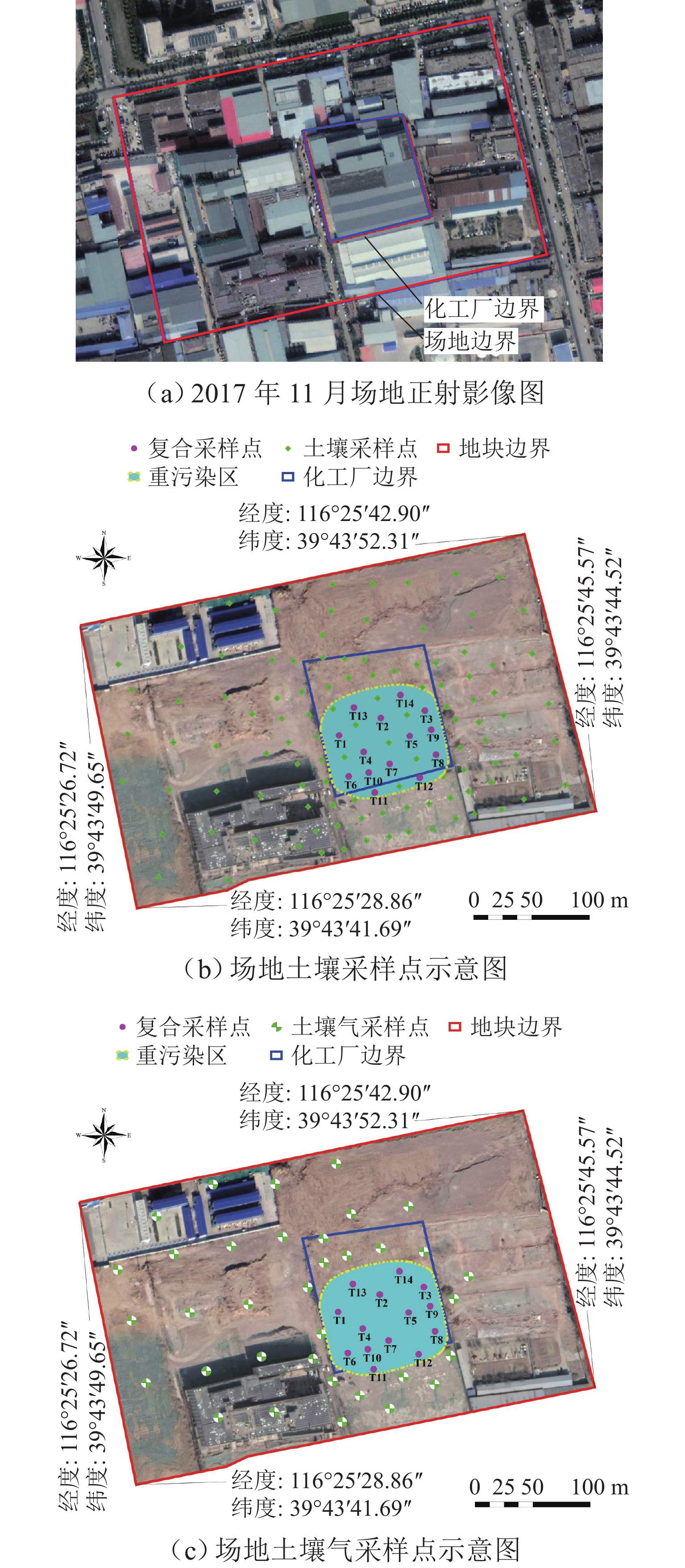
图 1 场地历史影像及采样点布置
Figure 1. Historical images of the site and layout of sampling points
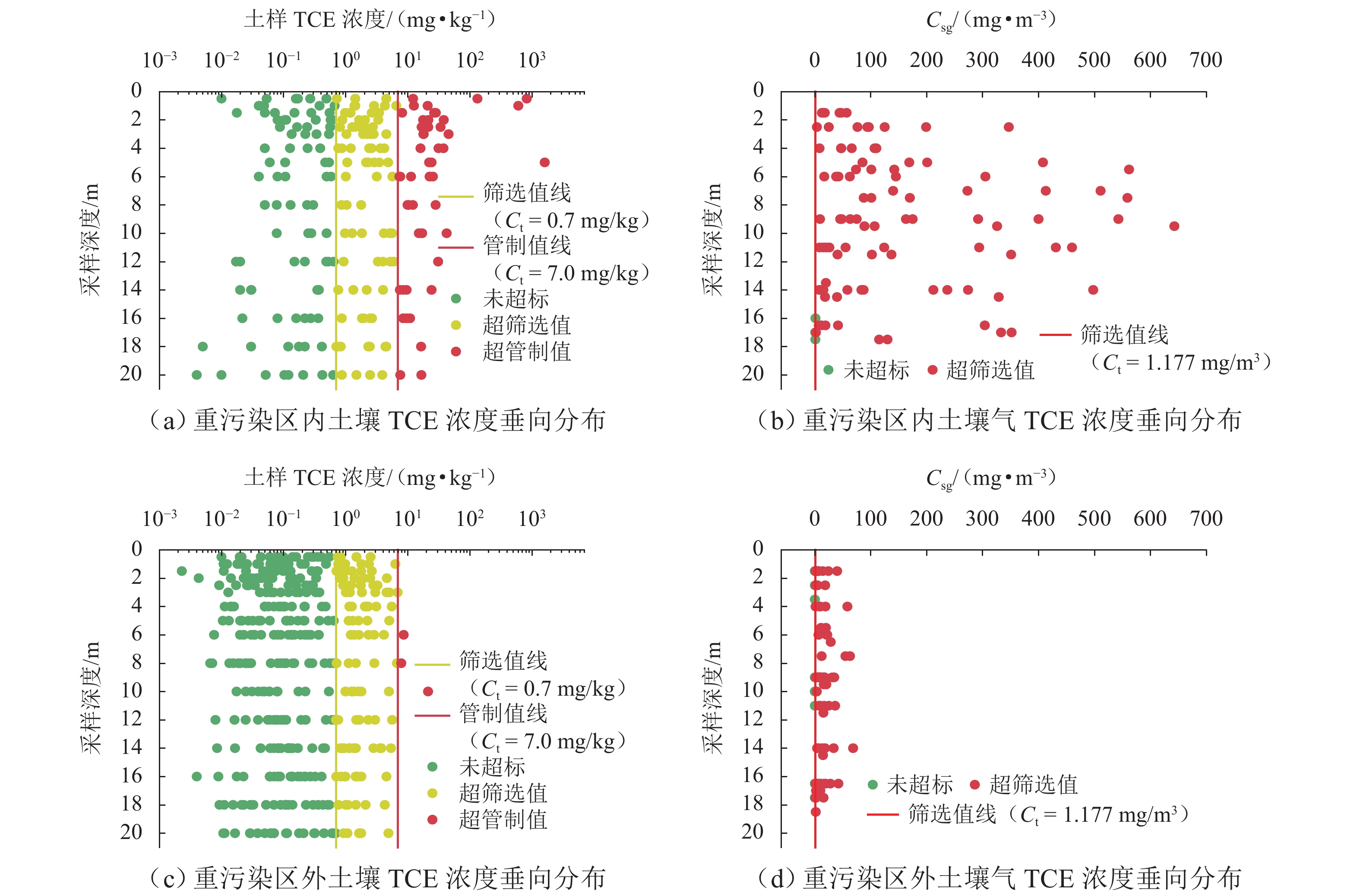
图 3 TCE浓度垂向分布及土层柱状图
Figure 3. Vertical distribution of TCE concentration and soil column diagram
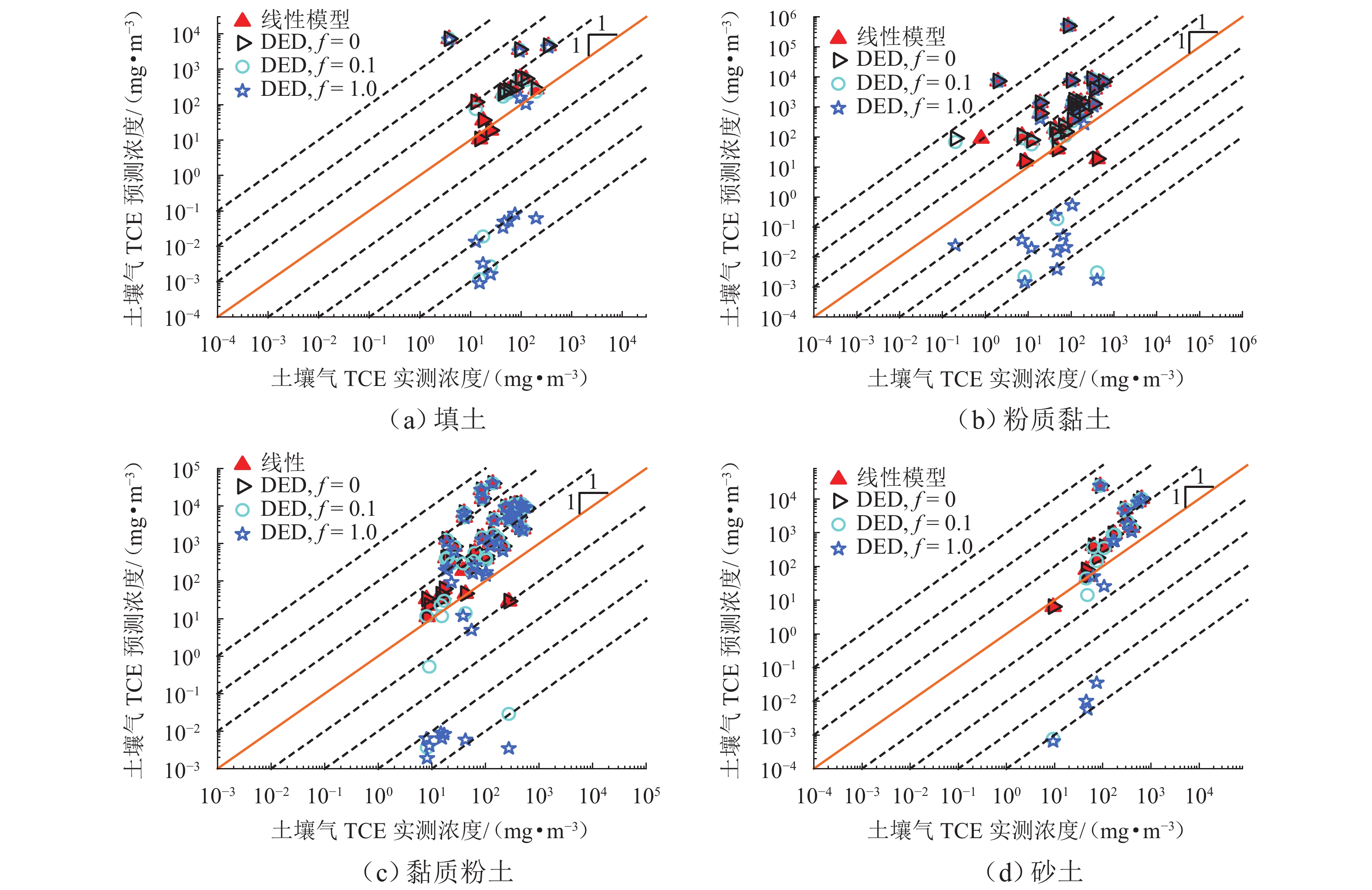
图 6 土壤气TCE浓度预测值与实测值比较
Figure 6. Comparison of predicted and measured soil gas TCE concentrations
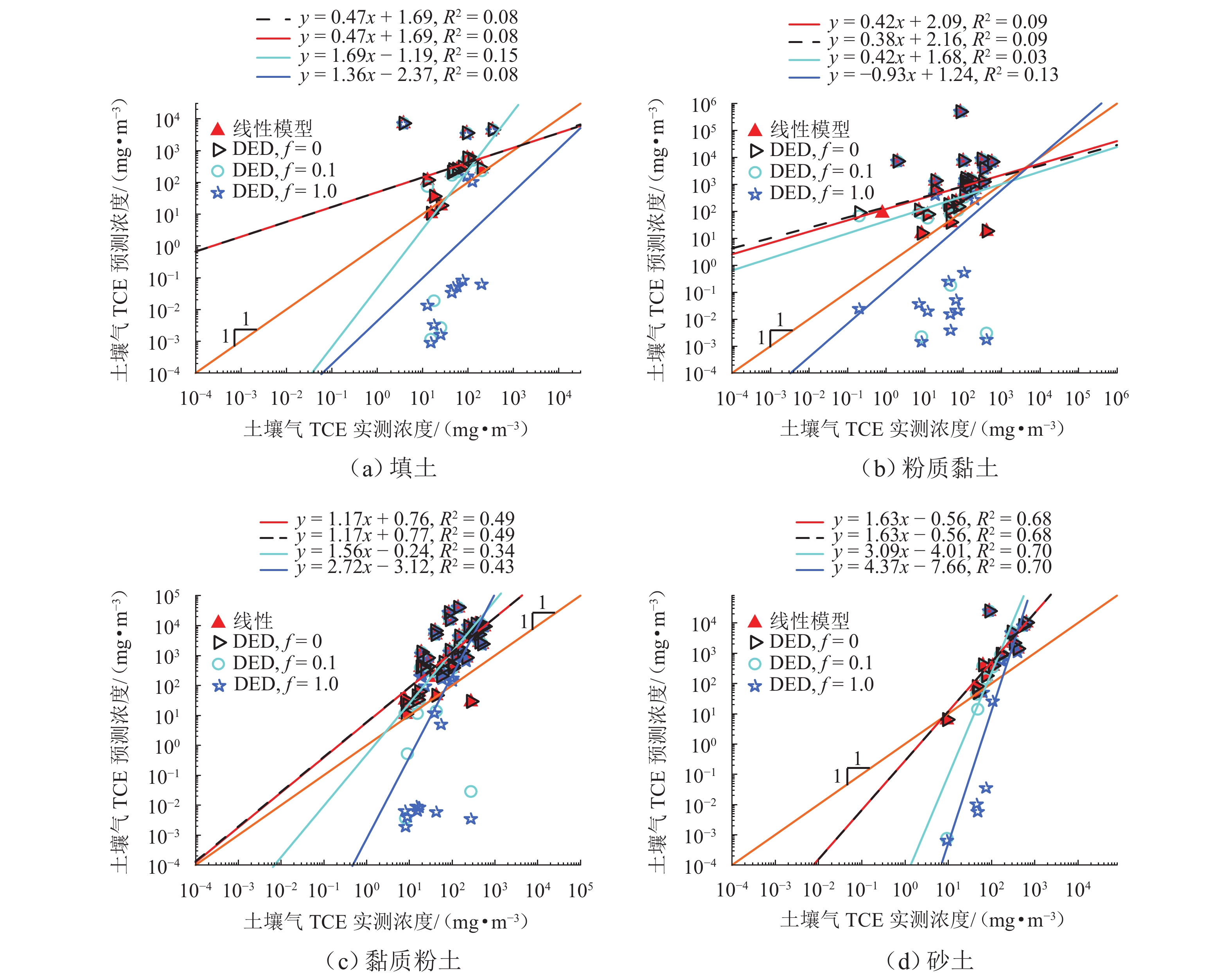
图 7 土壤气TCE浓度模型预测值回归分析
Figure 7. Regression analysis diagram of model predicted soil gas TCE concentration
表 1 样品TCE浓度检测结果统计表
Table 1. Statistical table of TCE concentration detection results of samples
类型 重污染区土壤/(mg·kg−1) 重污染区土壤气/(mg·m−3) 非重污染区土壤/(mg·kg−1) 非重污染区土壤气/(mg·m−3) 筛选值 0.700[36] 1.177[29] 0.700[36] 1.177[29] 最小值 0.004 0.800 0.002 0.049 最大值 1610.000 643.000 7.900 68.400 平均值 18.9000 147.400 0.200 8.100 检出率/% 95.5 100.000 26.700 72.300 超标率/% 56.7 97.0 6.5 55.3 最大超标倍数 2300.0 倍546.3倍 11.3倍 58.1倍  下载: 导出CSV
-
[1] 赵丹, 於方, 廖晓勇, 等. 发达国家(地区)污染场地修复现状及对中国的启示[J]. 中国科学院大学学报, 2023, 40(4): 441-452. doi: 10.7523/j.ucas.2022.014ZHAO Dan, YU Fang, LIAO Xiaoyong, et al. Status of remediation for contaminated sites in developed countries and regions and its enlightenment to China[J]. Journal of University of Chinese Academy of Sciences, 2023, 40(4): 441-452. doi: 10.7523/j.ucas.2022.014 [2] HOU D Y. Sustainable remediation in China: elimination, immobilization, or dilution[J]. Environmental Science & Technology, 2021, 55(23): 15572-15574. doi: 10.1021/acs.est.1c06044 [3] 葛峰, 张转霞, 扶恒, 等. 我国有机污染场地现状分析及展望[J]. 土壤, 2021, 53(6): 1132-1141. doi: 10.13758/j.cnki.tr.2021.06.005GE Feng, ZHANG Zhuanxia, FU Heng, et al. Distribution of organic contaminated sites in China: statu quo and prospect[J]. Soils, 2021, 53(6): 1132-1141. doi: 10.13758/j.cnki.tr.2021.06.005 [4] 骆永明, 滕应. 中国土壤污染与修复科技研究进展和展望[J]. 土壤学报, 2020, 57(5): 1137-1142.LOU Yongming, TENG Ying. Research progresses and prospects on soil pollution and remediation in china[J]. Acta Pedologica Sinica, 2020, 57(5): 1137-1142. [5] XIE S, SUUBERG E. The effects of temperature and relative humidity on trichloroethylene sorption capacities of building materials under conditions relevant to vapor intrusion[J]. Journal of Hazardous Materials, 2021, 401: 123807.1-123807.7. doi: 10.1016/j.jhazmat.2020.123807 [6] MILLER C J, RUNGE-MORRIS M, CASSIDY-BUSHROW A E, et al. A review of volatile organic compound contamination in post-industrial urban centers: reproductive health implications using a Detroit lens[J]. International Journal of Environmental Research and Public Health, 2020, 17(23): 8755.1-8755.21. doi: 10.3390/ijerph17238755 [7] MA J, MCHUGH T, BECKLEY L, et al. Vapor intrusion investigations and decision-making: a critical review[J]. Environmental Science & Technology, 2020, 54(12): 7050-7069. doi: 10.1021/acs.est.0c00225 [8] SHIRAZI E, HAWK G S, HOLTON C W, et al. Comparison of modeled and measured indoor air trichloroethene (TCE) concentrations at a vapor intrusion site: influence of wind, temperature, and building characteristics[J]. Environmental Science Processes & Impacts, 2020, 22(3): 802-811. doi: 10.1039/C9EM00567F [9] HOSANGADI V, SHAVER B, HARTMAN B, et al. High-frequency continuous monitoring to track vapor intrusion resulting from naturally occurring pressure dynamics[J]. Remediation Journal, 2017, 27(2): 9-25. doi: 10.1002/rem.21505 [10] KRAM M, HARTMAN B, FRESCURA C, et al. Vapor intrusion risk evaluation using automated continuous chemical and physical parameter monitoring[J]. Remediation Journal, 2020, 30(3): 65-74. doi: 10.1002/rem.21646 [11] WANG G F, MA S S, STRÖM J, et al. Investigating two-dimensional soil gas transport of trichloroethylene in vapor intrusion scenarios involving surface pavements using a pilot-scale tank[J]. Journal of Hazardous Materials, 2019, 371: 138-145. [12] ZHANG R H, JIANG L, ZHONG M S, et al. A source depletion model for vapor intrusion involving the influence of building characteristics[J]. Environmental Pollution, 2019, 246: 864-872. [13] WANG G F, XIAO Y T, ZUO J P, et al. Physically simulating the effect of lateral vapor source-building separation on soil vapor intrusion: Influences of surface pavements and soil heterogeneity[J]. Journal of Contaminant Hydrology, 2020, 235: 103712.1-103712.8. doi: 10.1016/j.jconhyd.2020.103712 [14] YAO Y J, MAO F, XIAO Y T, et al. Investigating the role of soil texture in petroleum vapor intrusion[J]. Journal of Environmental Quality, 2018, 47(5): 1179-1185. doi: 10.2134/jeq2018.04.0140 [15] PROVOOST J, BOSMAN A, REIJNDERS L, et al. Vapour intrusion from the vadose zone: seven algorithms compared[J]. Journal of Soils and Sediments, 2010, 10(3): 473-483. doi: 10.1007/s11368-009-0127-4 [16] 马杰. 土壤气监测在污染地块调查评估中的优势、局限及解决思路[J]. 环境工程学报, 2021, 15(8): 2531-2535.MA Jie. Soil gas monitoring for site investigation and risk assessment: Advantages, challenges and solutions[J]. Chinese Journal of Environmental Engineering, 2021, 15(8): 2531-2535. [17] ZHANG R H, JIANG L, ZHONG M S, et al. Applicability of soil concentration for VOC-contaminated site assessments explored using field data from the Beijing-Tianjin-Hebei urban agglomeration[J]. Environmental Science & Technology, 2019, 53(2): 789-797. doi: 10.1021/acs.est.8b03241 [18] 马杰. 我国挥发性有机污染地块调查评估中存在的问题及对策建议[J]. 环境工程学报, 2021, 15(1): 3-7.MA Jie. Problems and suggestion for investigation and risk assessment of sites impacted by volatile organic compounds in China[J]. Chinese Journal of Environmental Engineering, 2021, 15(1): 3-7. [19] 逯雨, 李义连, 杨森, 等. 基于J&E/AAM模型的污染场地VOCs风险防控[J]. 环境科学研究, 2018, 31(5): 868-877.LU Yu, LI Yilian, YANG Sen, et al. Risk control of VOCs contaminated sites based on J & E/AAM model[J]. Research of Environmental Sciences, 2018, 31(5): 868-877. [20] USEPA. OSWER technical guide for assessing and mitigating the vapor intrusion pathway from subsurface vapor sources to indoor air (OSWER Publication 9200.2-154)[R]. Washington D C: Environmental Protection Agency, 2015. [21] USEPA. Technical guide for addressing petroleum vapor intrusion at leaking underground storage tank sites (EPA 510-R-15001)[R]. Washington D C: Environmental Protection Agency, 2015 [22] USEPA. Risk assessment guidance for superfund Volume I- human health evaluation manual (part A)[R]. Washington D C: Environmental Protection Agency, 1989. [23] HWANG S T, FALCO J W. Estimation of multimedia exposures related to hazardous waste facilities[M]//Pollutants in a Multimedia Environment. Boston: Springer, 1986: 229-264. [24] PARK H S. A method for assessing soil vapor intrusion from petroleum release sites: multi-phase/multi-fraction partitioning[J]. Global Nest Journal, 1999, 1(3): 195-204. doi: 10.30955/gnj.000140 [25] KAN A T, FU G, HUNTER M, et al. Irreversible sorption of neutral hydrocarbons to sediments: experimental observations and model predictions[J]. Environmental Science & Technology, 1998, 32(7): 892-902. doi: 10.1021/es9705809 [26] CHEN W, KAN A T, FU G M, et al. Adsorption-desorption behaviors of hydrophobic organic compounds in sediments of Lake Charles, Louisiana, USA[J]. Environmental Toxicology and Chemistry, 1999, 18(8): 1610-1616. doi: 10.1002/etc.5620180802 [27] CHEN W, KAN A T, NEWELL C J, et al. More realistic soil cleanup standards with dual-equilibrium desorption[J]. Ground Water, 2002, 40(2): 153-164. doi: 10.1111/j.1745-6584.2002.tb02500.x [28] 北京市质量技术监督局. 污染场地挥发性有机物调查与风险评估技术导则: DB11/T 1278—2015[S]. 北京: 2016. 补充出版社 [29] HJ 1019—2019 地块土壤和地下水中挥发性有机物采样技术导则[S]. [30] HJ 605—2011 土壤和沉积物 挥发性有机物的测定吹扫捕集/气相色谱-质谱法[S]. [31] HJ 605—2011 土壤和沉积物挥发性有机物的测定吹扫捕集/气相色谱-质谱法[S]. [32] HJ 605—2011 环境空气挥发性有机物的测定吸附管采样热脱附/气相色谱质谱法[S]. [33] KARICKHOFF S W, BROWN D S, SCOTT T A. Sorption of hydrophobic pollutants on natural sediments[J]. Water Research, 1979, 13(3): 241-248. doi: 10.1016/0043-1354(79)90201-x [34] USEPA. Estimation programs interface suite for microsoft®windows, V 4.11 or insert version used[EB/OL]. New York: [2024-02-20]. https://www.epa.gov/tsca-screening-tools/epi-suitetm-estimation-program interface. [35] CHEN W, KAN A T, TOMSON M B. Irreversible adsorption of chlorinated benzenes to natural sediments: implications for sediment quality criteria[J]. Environmental Science & Technology, 2000, 34(3): 385-392. doi: 10.1021/es981141s [36] 张瑞环, 钟茂生, 姜林, 等. 基于DED模型的挥发性有机物健康风险评价[J]. 环境科学研究, 2018, 31(1): 170-178.ZHANG Ruihuan, ZHONG Maosheng, JIANG Lin, et al. Health risk assessment of volatile organic compounds based on DED model[J]. Research of Environmental Sciences, 2018, 31(1): 170-178. [37] GB 36600—2018 土壤环境质量 建设用地土壤污染风险管控标准[S]. [38] 钟茂生, 姜林, 张丽娜, 等. VOCs污染场地风险管理策略的筛选及评估[J]. 环境科学研究, 2015, 28(4): 596-604.ZHONG Maosheng, JIANG Lin, ZHANG Lina, et al. Screening and evaluation of risk management strategies for a site contaminated by VOCs[J]. Research of Environmental Sciences, 2015, 28(4): 596-604. [39] 郝辰宇, 钟茂生, 姜林, 等. 基于土壤气的场地VOCs污染刻画及风险评估[J]. 中国环境科学, 2023, 43(11): 5700-5708. doi: 10.3969/j.issn.1000-6923.2023.11.008HAO Chenyu, ZHONG Maosheng, JIANG Lin, et al. Characterization and vapor intrusion risk assessment of VOCs in contaminated sites based on soil gas[J]. China Environmental Science, 2023, 43(11): 5700-5708. doi: 10.3969/j.issn.1000-6923.2023.11.008 [40] 王倩. 东北某化工园区典型有机污染物在地下环境中多相迁移转化机制及模拟预测[D]. 长春: 吉林大学, 2022. -

 下载:
下载:

 点击查看大图
计量
- 文章访问数: 212
- HTML全文浏览量: 150
- PDF下载量: 77
- 被引次数: 0