
- ISSN 0258-2724
- CN 51-1277/U
- EI Compendex
- Scopus
- Indexed by Core Journals of China, Chinese S&T Journal Citation Reports
- Chinese S&T Journal Citation Reports
- Chinese Science Citation Database

| Citation: | LIU Xiaobo, DONG Ni, YAN Xuedong. Evolutionary Pathways, Key Challenges, and Future Prospects of Human-Centered Collaborative Autonomous Driving Systems[J]. Journal of Southwest Jiaotong University, 2026, 61(3): 656-672. doi: 10.3969/j.issn.0258-2724.20260022

|
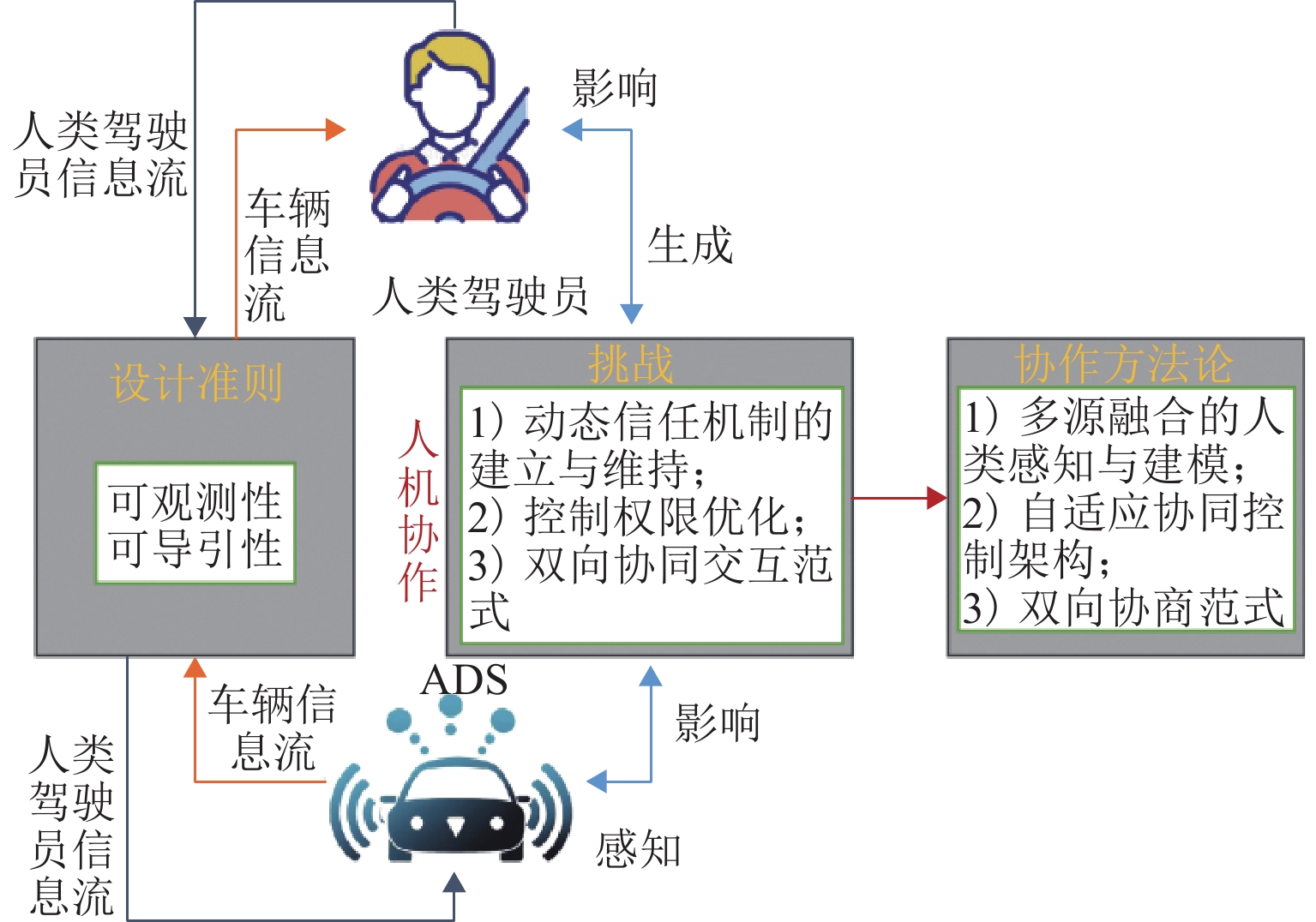
With the development of autonomous driving systems, the increasingly prominent bottleneck of “long-tail scenarios” demonstrates that the technology-driven “automation substitution” approach lacks a complete definition of human roles, human-machine relationships, and system ethics. First, the evolutionary pathways of autonomous driving systems from “tool-based assistance” to “automation-led” and ultimately to “collaborative control” were traced, and the fundamental transformation of the human-machine relationship from one-way control to two-way collaboration was elucidated. Secondly, to address key challenges that restrict the improvement of collaborative efficiency, such as the establishment and maintenance of dynamic trust mechanisms, the real-time optimal allocation of control permissions, and the construction of two-way collaborative interaction paradigms, their inherent logic, influencing factors, and existing bottlenecks at the levels of cognitive mechanisms, control theory, and interaction design were expounded on. Finally, developing human state perception and modeling technologies based on multi-source fusion, exploring adaptive collaborative control architectures based on real-time evaluation, and realizing the interaction paradigm shift from “one-way notification” to “two-way collaboration” were systematically proposed, which refined the future development pathways of autonomous driving systems. Through a review of existing theories, technical routes, and application cases, systematic theoretical support and practical references are provided for promoting the development of understandable, trustworthy, and widely acceptable “human-centered collaborative” autonomous driving systems.

| [1] |
FENG S, SUN H W, YAN X T, et al. Dense reinforcement learning for safety validation of autonomous vehicles[J]. Nature, 2023, 615(7953): 620-627. doi: 10.1038/s41586-023-05732-2
|
| [2] |
陶永, 闫学东, 王田苗, 等. 面向未来智能社会的智能交通系统发展策略[J]. 科技导报, 2016, 34(7): 48-53.
TAO Yong, YAN Xuedong, WANG Tianmiao, et al. Development strategy of intelligent transportation system for future intelligent society[J]. Science & Technology Review, 2016, 34(7): 48-53.
|
| [3] |
陈虹, 郭露露, 宫洵, 等. 智能时代的汽车控制[J]. 自动化学报, 2020, 46(7): 1313-1332. doi: 10.16383/j.aas.c190329
CHEN Hong, GUO Lulu, GONG Xun, et al. Automotive control in intelligent era[J]. Acta Automatica Sinica, 2020, 46(7): 1313-1332. doi: 10.16383/j.aas.c190329
|
| [4] |
BERGER C, RUMPE B. Autonomous driving-5 years after the urban challenge: the anticipatory vehicle as a cyber-physical system[EB/OL]. (2014-09-02)[2026-01-15]. https://arxiv.org/abs/1409.0413.
|
| [5] |
CHEN L, WANG H J, CAO D P, et al. Characterization of driver neuromuscular dynamics for human–automation collaboration design of automated vehicles[J]. IEEE/ASME Transactions on Mechatronics, 2018, 23(6): 2558-2567. doi: 10.1109/TMECH.2018.2812643
|
| [6] |
GUO H Y, SONG L H, LIU J, et al. Hazard-evaluation-oriented moving horizon parallel steering control for driver-automation collaboration during automated driving[J]. IEEE/CAA Journal of Automatica Sinica, 2018, 5(6): 1062-1073. doi: 10.1109/jas.2018.7511225
|
| [7] |
FITTS P M. Human engineering for an effective air-navigation and traffic-control system[M]. Newyork: Penguin Group, 1951.
|
| [8] |
BOLTON C, MACHOVÁ V, KOVACOVA M, et al. The power of human-machine collaboration: Artificial intelligence, business automation, and the smart economy[J]. Economics, Management, and Financial Markets, 2018, 13(4): 51-56. doi: 10.22381/emfm13420184
|
| [9] |
JHAVER S, BIRMAN I, GILBERT E, et al. Human-machine collaboration for content regulation: the case of reddit automoderator[J]. ACM Transactions on Computer-Human Interaction, 2019, 26(5): 1-35. doi: 10.1145/3338243
|
| [10] |
ENDSLEY M R. From here to autonomy: lessons learned from human–automation research[J]. Human Factors, 2017, 59(1): 5-27. doi: 10.1177/0018720816681350
|
| [11] |
HOC J M. From human–machine interaction to human–machine cooperation[J]. Ergonomics, 2000, 43(7): 833-843.
|
| [12] |
FORSTER Y, HERGETH S, NAUJOKS F, et al. User education in automated driving: owner’s manual and interactive tutorial support mental model formation and human-automation interaction[J]. Information, 2019, 10(4): 143-165. doi: 10.3390/info10040143
|
| [13] |
NAUJOKS F, PURUCKER C, NEUKUM A. Secondary task engagement and vehicle automation–comparing the effects of different automation levels in an on-road experiment[J]. Trans-portation Research Part F: Traffic Psychology and Behaviour, 2016, 38: 67-82. doi: 10.1016/j.trf.2016.01.011
|
| [14] |
On-Road Automated Driving (Road) Committee. Taxonomy and definitions for terms related to driving automation systems for on-road motor vehicles[M]. Warrendale: SAE International, 2021.
|
| [15] |
SHERIDAN T B, VERPLANK W L, BROOKS T. Human/computer control of undersea teleoperators[C]//Proceedings of the 14th Annual Conference on Manual Control. Washington D. C.: NASA, 1978: 1-15.
|
| [16] |
MCCALL J C, ACHLER O, TRIVEDI M M, et al. A collaborative approach for human-centered driver assistance systems[C]//Proceedings of The 7th International IEEE Conference on Intelligent Transportation Systems. Piscataway: IEEE, 2005: 663-667.
|
| [17] |
FLEMISCH F, KELSCH J, LOPER C, et al. Cooperative control and active interfaces for vehicle assistance and automation[R]. Munich: FISITA World Automotive Congress, 2008.
|
| [18] |
SOUALMI B, SENTOUH C, POPIEUL J C, et al. Automation-driver cooperative driving in presence of undetected obstacles[J]. Control Engineering Practice, 2014, 24: 106-119. doi: 10.1016/j.conengprac.2013.11.015
|
| [19] |
MARCANO M, DÍAZ S, PÉREZ J, et al. A review of shared control for automated vehicles: theory and applications[J]. IEEE Transactions on Human-Machine Systems, 2020, 50(6): 475-491. doi: 10.1109/THMS.2020.3017748
|
| [20] |
胡云峰, 曲婷, 刘俊, 等. 智能汽车人机协同控制的研究现状与展望[J]. 自动化学报, 2019, 45(7): 1261-1280. doi: 10.16383/j.aas.c180136
HU Yunfeng, QU Ting, LIU Jun, et al. Human-machine cooperative control of intelligent vehicle: recent developments and future perspectives[J]. Acta Automatica Sinica, 2019, 45(7): 1261-1280. doi: 10.16383/j.aas.c180136
|
| [21] |
XIE S S, CHEN S T, ZHENG J Y, et al. From human driving to automated driving: what do we know about drivers?[J]. IEEE Transactions on Intelligent Transportation Systems, 2022, 23(7): 6189-6205. doi: 10.1109/TITS.2021.3084149
|
| [22] |
GOODALL N J. Ethical decision making during automated vehicle crashes[J]. Transportation Research Record: Journal of the Transportation Research Board, 2014, 2424(1): 58-65. doi: 10.3141/2424-07
|
| [23] |
PARASURAMAN R, SHERIDAN T B, WICKENS C D. A model for types and levels of human interaction with automation[J]. IEEE Transactions on Systems, Man, and Cybernetics—Part A: Systems and Humans, 2000, 30(3): 286-297. doi: 10.1109/3468.844354
|
| [24] |
Christoffersen K, Woods D D. How to make automated systems team players[M]//Advances in Human Performance and Cognitive Engineering Research. Bingley: Emerald Group Publishing Limited, 2002: 1-12.
|
| [25] |
United Nations Trade and Development. Technology and innovation report 2025: inclusive artificial intelligence for development[M]. Manhattan: United Nations, 2025.
|
| [26] |
DUAN L, CHEN F. The future of advanced driving assistance system development in China[C]//Proceedings of 2011 IEEE International Conference on Vehicular Electronics and Safety. Piscataway: IEEE, 2011: 238-243.
|
| [27] |
ERIKSSON A, STANTON N A. Takeover time in highly automated vehicles: noncritical transitions to and from manual control[J]. Human Factors, 2017, 59(4): 689-705. doi: 10.1177/0018720816685832
|
| [28] |
MOLNAR L J, RYAN L H, PRADHAN A K, et al. Understanding trust and acceptance of automated vehicles: an exploratory simulator study of transfer of control between automated and manual driving[J]. Transportation Research Part F: Traffic Psychology and Behavior, 2018, 58: 319-328. doi: 10.1016/j.trf.2018.06.004
|
| [29] |
FAGNANT D J, KOCKELMAN K. Preparing a nation for autonomous vehicles: opportunities, barriers and policy recommendations[J]. Transportation Research Part A: Policy and Practice, 2015, 77: 167-181. doi: 10.1016/j.tra.2015.04.003
|
| [30] |
BIMBRAW K. Autonomous cars: Past, present and future a review of the developments in the last century, the present scenario and the expected future of autonomous vehicle technology[C]//2015 12th International Conference on Informatics in Control, Automation and Robotics (ICINCO). Piscataway: IEEE, 2015: 191-198.
|
| [31] |
JAUSSEIN M, LÉVÊQUE L, DENIEL J, et al. How do non-driving-related tasks affect engagement under highly automated driving situations? a literature review[J]. Frontiers in Future Transportation, 2021, 2: 687602. doi: 10.3389/ffutr.2021.687602
|
| [32] |
BONNEFON J F, SHARIFF A, RAHWAN I. The social dilemma of autonomous vehicles[J]. Science, 2016, 352(6293): 1573-1576. doi: 10.1126/science.aaf2654
|
| [33] |
HABOUCHA C J, ISHAQ R, SHIFTAN Y. User preferences regarding autonomous vehicles[J]. Transportation Research Part C: Emerging Technologies, 2017, 78: 37-49. doi: 10.1016/j.trc.2017.01.010
|
| [34] |
LI S, ZHANG Y, EDWARDS S, et al. Exploration into the needs and requirements of the remote driver when teleoperating the 5G-enabled level 4 automated vehicle in the real world: a case study of 5G connected and automated logistics[J]. Sensors, 2023, 23(2): 820. doi: 10.3390/s23020820
|
| [35] |
O’NEILL T, MCNEESE N, BARRON A, et al. Human–autonomy teaming: a review and analysis of the empirical literature[J]. Human Factors, 2022, 64(5): 904-938. doi: 10.1177/0018720820960865
|
| [36] |
BELLAMY R K E, ANDRIST S, BICKMORE T, et al. Human-agent collaboration: can an agent be a partner? [C]//Proceedings of the 2017 CHI Conference Extended Abstracts on Human Factors in Computing Systems. New York: ACM, 2017: 1289-1294.
|
| [37] |
FAVARÒ F M, NADER N, EURICH S O, et al. Examining accident reports involving autonomous vehicles in California[J]. PLoS One, 2017, 12(9): e0184952. doi: 10.1371/journal.pone.0184952
|
| [38] |
CHEN J Y C, LAKHMANI S G, STOWERS K, et al. Situation awareness-based agent transparency and human-autonomy teaming effectiveness[J]. Theoretical Issues in Ergonomics Science, 2018, 19(3): 259-282. doi: 10.1080/1463922X.2017.1315750
|
| [39] |
JAROSCH O, KUHNT M, PARADIES S, et al. It’s out of our hands now! effects of non-driving related tasks during highly automated driving on drivers’ fatigue[C]//Driving Assessment Conference Archive. Iowa City: University of Iowa Libraries Publishing, 2017: 319-325.
|
| [40] |
RADLMAYR J, GOLD C, LORENZ L, et al. How traffic situations and non-driving related tasks affect the take-over quality in highly automated driving[J]. Proceedings of the Human Factors and Ergonomics Society Annual Meeting, 2014, 58(1): 2063-2067. doi: 10.1177/1541931214581434
|
| [41] |
刘晓波, 鲁工圆, 郑芳芳, 等. 自动驾驶交通系统的协同管控技术[J]. 科学通报, 2020, 65(6): 434-441. doi: 10.1360/TB-2019-0526
LIU Xiaobo, LU Gongyuan, ZHENG Fangfang, et al. Coordinated management and control of autonomous traffic systems[J]. Chinese Science Bulletin, 2020, 65(6): 434-441. doi: 10.1360/TB-2019-0526
|
| [42] |
YAN Y C, JIA Y Y. A review on human comfort factors, measurements, and improvements in human–robot collaboration[J]. Sensors, 2022, 22(19): 7431. doi: 10.3390/s22197431
|
| [43] |
BRADSHAW J M, DIGNUM V, JONKER C, et al. Human-agent-robot teamwork[J]. IEEE Intelligent Systems, 2012, 27(2): 8-13. doi: 10.1109/MIS.2012.37
|
| [44] |
GOODRICH M A, COLTON M, BRINTON B, et al. Incorporating a robot into an autism therapy team[J]. IEEE Intelligent Systems, 2012, 27(2): 52-59. doi: 10.1109/MIS.2012.40
|
| [45] |
KLIEN G, WOODS D D, BRADSHAW J M, et al. Ten challenges for making automation a “team player” in joint human-agent activity[J]. IEEE Intelligent Systems, 2004, 19(6): 91-95. doi: 10.1109/MIS.2004.74
|
| [46] |
MOSIER K L, FISCHER U, BURIAN B K, et al. Autonomous, context-sensitive, task management systems and decision support tools I: human-autonomy teaming fundamentals and state of the art[M]. Washington D.C.: NASA, 2017.
|
| [47] |
JOE J C, O’HARA J M, MEDEMA H D, et al. Identifying requirements for effective human-automation teamwork[R]. Idaho Falls: Idaho National Lab, 2014.
|
| [48] |
AZEVEDO C R B, RAIZER K, SOUZA R. A vision for human-machine mutual understanding, trust establishment, and collaboration[C]//2017 IEEE Conference on Cognitive and Computational Aspects of Situation Management (CogSIMA). Piscataway: IEEE, 2017: 1-3.
|
| [49] |
SCHAEFER K E, STRAUB E R, CHEN J Y C, et al. Communicating intent to develop shared situation awareness and engender trust in human-agent teams[J]. Cognitive Systems Research, 2017, 46: 26-39. doi: 10.1016/j.cogsys.2017.02.002
|
| [50] |
PETERMEIJER S M, ABBINK D A, MULDER M, et al. The effect of haptic support systems on driver performance: a literature survey[J]. IEEE Transactions on Haptics, 2015, 8(4): 467-479. doi: 10.1109/TOH.2015.2437871
|
| [51] |
WANG W S, NA X X, CAO D P, et al. Decision-making in driver-automation shared control: a review and perspectives[J]. IEEE/CAA Journal of Automatica Sinica, 2020, 7(5): 1289-1307. doi: 10.1109/jas.2020.1003294
|
| [52] |
XING Y, LV C, CAO D P, et al. Toward human-vehicle collaboration: Review and perspectives on human-centered collaborative automated driving[J]. Transportation Research Part C: Emerging Technologies, 2021, 128: 103199. doi: 10.1016/j.trc.2021.103199
|
| [53] |
FRIDMAN L. Human-centered autonomous vehicle systems: principles of effective shared autonomy [EB/OL]. (2018-10-03)[2026-01-15]. https://arxiv.org/abs/1810.01835.
|
| [54] |
KUKKALA V K, TUNNELL J, PASRICHA S, et al. Advanced driver-assistance systems: a path toward autonomous vehicles[J]. IEEE Consumer Electronics Magazine, 2018, 7(5): 18-25. doi: 10.1109/MCE.2018.2828440
|
| [55] |
RUPP J D, KING A G. Autonomous Vehicles for Safer Driving [M]. Pennsylvania: SAE, 2010.
|
| [56] |
OMEIZA D, WEBB H, JIROTKA M, et al. Explanations in autonomous driving: a survey[J]. IEEE Transactions on Intelligent Transportation Systems, 2022, 23(8): 10142-10162. doi: 10.1109/TITS.2021.3122865
|
| [57] |
ADNAN N, MDNORDIN S, BIN BAHRUDDIN M A, et al. How trust can drive forward the user acceptance to the technology? in-vehicle technology for autonomous vehicle[J]. Transportation Research Part A: Policy and Practice, 2018, 118: 819-836. doi: 10.1016/j.tra.2018.10.019
|
| [58] |
高在峰, 李文敏, 梁佳文, 等. 自动驾驶车中的人机信任[J]. 心理科学进展, 2021, 29(12): 2172-2183. doi: 10.3724/SP.J.1042.2021.02172
GAO Zaifeng, LI Wenmin, LIANG Jiawen, et al. Trust in automated vehicles[J]. Advances in Psychological Science, 2021, 29(12): 2172-2183. doi: 10.3724/SP.J.1042.2021.02172
|
| [59] |
孙晓枫, 赵莹, 吕春梅. 自动驾驶汽车人机交互信任影响机制[J]. 东北大学学报(自然科学版), 2022, 43(9): 1305-1313. doi: 10.12068/j.issn.1005-3026.2022.09.013
SUN Xiaofeng, ZHAO Ying, LU Chunmei. Influencing mechanism of human-computer interaction trust in autonomous vehicles[J]. Journal of Northeastern University (Natural Science), 2022, 43(9): 1305-1313. doi: 10.12068/j.issn.1005-3026.2022.09.013
|
| [60] |
董文莉, 方卫宁. 自动化信任的研究综述与展望[J]. 自动化学报, 2021, 47(6): 1183-1200. doi: 10.16383/j.aas.c200432
DONG Wenli, FANG Weining. Trust in automation: research review and future perspectives[J]. Acta Automatica Sinica, 2021, 47(6): 1183-1200. doi: 10.16383/j.aas.c200432
|
| [61] |
LEWIS J D, WEIGERT A J. The social dynamics of trust: theoretical and empirical research, 1985-2012[J]. Social Forces, 2012, 91(1): 25-31. doi: 10.1093/sf/sos116
|
| [62] |
OLAVERRI-MONREAL C. Promoting trust in self-driving vehicles[J]. Nature Electronics, 2020, 3(6): 292-294. doi: 10.1038/s41928-020-0434-8
|
| [63] |
CHOI J K, JI Y G. Investigating the importance of trust on adopting an autonomous vehicle[J]. International Journal of Human–Computer Interaction, 2015, 31(10): 692-702. doi: 10.1080/10447318.2015.1070549
|
| [64] |
DIKMEN M, BURNS C. Trust in autonomous vehicles: The case of Tesla Autopilot and Summon[C]//2017 IEEE International Conference on Systems, Man, and Cybernetics (SMC). Piscataway: IEEE, 2017: 1093-1098.
|
| [65] |
LEE J D, SEE K A. Trust in automation: designing for appropriate reliance[J]. Human Factors, 2004, 46(1): 50-80. doi: 10.1518/hfes.46.1.50.30392
|
| [66] |
HASPIEL J, DU N, MEYERSON J, et al. Explanations and expectations: trust building in automated vehicles[C]//Companion of the 2018 ACM/IEEE International Conference on Human-Robot Interaction. New York: ACM, 2018: 119-120.
|
| [67] |
MIRNIG A G, WINTERSBERGER P, SUTTER C, et al. A framework for analyzing and calibrating trust in automated vehicles[C]//Proceedings of the 8th International Conference on Automotive User Interfaces and Interactive Vehicular Applications. Ann New York: ACM, 2016: 33-38.
|
| [68] |
LEE J D, MORAY N. Trust, self-confidence, and operators' adaptation to automation[J]. International Journal of Human-Computer Studies, 1994, 40(1): 153-184. doi: 10.1006/ijhc.1994.1007
|
| [69] |
BROWN B, LAURIER E. The trouble with autopilots: assisted and autonomous driving on the social road[C]//Proceedings of the 2017 CHI Conference on Human Factors in Computing Systems. New York: ACM, 2017: 416-429.
|
| [70] |
PARASURAMAN R, RILEY V. Humans and automation: use, misuse, disuse, abuse[J]. Human Factors, 1997, 39(2): 230-253. doi: 10.1518/001872097778543886
|
| [71] |
ZHANG Q, ROBERT L, DU N, et al. Trust in AVs: The impact of expectations and individual differences[C]//Conference on Autonomous Vehicles in Society. Mississippi: [s. n.], 2018: 35291503.
|
| [72] |
谭征宇, 张瑞佛, 刘芝孜, 等. 智能网联汽车人机交互信任研究现状与展望[J]. 机械工程学报, 2024, 60(10): 366-383. doi: 10.3901/JME.2024.10.366
TAN Zhengyu, ZHANG Ruifo, LIU Zhizi, et al. Human machine interaction trustin intelligentand connected vehicles: overview and perspectives[J]. Journal of Mechanical Engineering, 2024, 60(10): 366-383. doi: 10.3901/JME.2024.10.366
|
| [73] |
WU Chaozhong, WU Haoran, LYU Nengchao. Review of control switch and safety of human-computer driving intelligent vehicle[J]. Journal of Traffic and Transportation Engineering, 2018, 18(6): 131-141.
|
| [74] |
DE WAARD D, VAN DER HULST M, HOEDEMAEKER M, et al. Driver behavior in an emergency situation in the automated highway system[J]. Transportation Human Factors, 1999, 1(1): 67-82. doi: 10.1207/sthf0101_7
|
| [75] |
FLEMISCH F, SCHIEBEN A, KELSCH J, et al. Automation spectrum, inner/outer compatibility and other potentially useful human factors concepts for assistance and automation[C]//Human Factors for Assistance and Automation. Cologne: DLR, 2008: 1-15.
|
| [76] |
PAYRE W, CESTAC J, DELHOMME P. Fully automated driving: impact of trust and practice on manual control recovery[J]. Human Factors, 2016, 58(2): 229-241. doi: 10.1177/0018720815612319
|
| [77] |
HAYATI S, VENKATARAMAN S T. Design and implementation of a robot control system with traded and shared control capability[C]//Proceedings, 1989 International Conference on Robotics and Automation. Piscataway: IEEE, 2002: 1310-1315.
|
| [78] |
SIMPSON R C, LEVINE S P. Adaptive shared control of a smart wheelchair operated by voice control[C]//Proceedings of the 1997 IEEE/RSJ International Conference on Intelligent Robot and Systems. Piscataway: IEEE, 2002: 622-626.
|
| [79] |
STEELE M, GILLESPIE R B. Shared control between human and machine: using a haptic steering wheel to aid in land vehicle guidance[J]. Proceedings of the Human Factors and Ergonomics Society Annual Meeting, 2001, 45(23): 1671-1675. doi: 10.1177/154193120104502323
|
| [80] |
CORBALAN G, KESTER L, VAN MERRIËNBOER J J G. Selecting learning tasks: Effects of adaptation and shared control on learning efficiency and task involvement[J]. Contemporary Educational Psychology, 2008, 33(4): 733-756. doi: 10.1016/j.cedpsych.2008.02.003
|
| [81] |
杨俊儒, 褚端峰, 陆丽萍, 等. 智能汽车人机共享控制研究综述[J]. 机械工程学报, 2022, 58(18): 31-55.
YANG Junru, CHU Duanfeng, LU Liping, et al. Review on human-machine shared control of intelligent vehicles[J]. Journal of Mechanical Engineering, 2022, 58(18): 31-55.
|
| [82] |
MULDER M, ABBINK D A, VAN PAASSEN M M, et al. Design of a haptic gas pedal for active car-following support[J]. IEEE Transactions on Intelligent Transportation Systems, 2011, 12(1): 268-279. doi: 10.1109/TITS.2010.2091407
|
| [83] |
MULDER M, ABBINK D A, BOER E R. Sharing control with haptics: Seamless driver support from manual to automatic control[J]. Human Factors, 2012, 54(5): 786-798.
|
| [84] |
VAN PAASSEN M M R, BOINK R P, ABBINK D A, et al. Four design choices for haptic shared control[M]. Advances in Aviation Psychology, Volume 2. London: Routledge, 2017.
|
| [85] |
黄炜, 黄起鹏. 人机共驾控制架构与驾驶权决策研究综述[J]. 交通运输工程学报, 2025, 25(1): 48-65. doi: 10.19818/j.cnki.1671-1637.2025.01.004
HUANG Wei, HUANG Qipeng. Research review of control architecture and driving authority decision-making of driver-automation cooperative driving[J]. Journal of Traffic and Transportation Engineering, 2025, 25(1): 48-65. doi: 10.19818/j.cnki.1671-1637.2025.01.004
|
| [86] |
程洪, 黄瑞, 邱静, 等. 人机智能技术及系统研究进展综述[J]. 智能系统学报, 2020, 15(2): 386-398.
CHENG Hong, HUANG Rui, QIU Jing, et al. A survey of recent advances in human-robot intelligent systems[J]. CAAI Transactions on Intelligent Systems, 2020, 15(2): 386-398.
|
| [87] |
ABBINK D A, CARLSON T, MULDER M, et al. A topology of shared control systems: finding common ground in diversity[J]. IEEE Transactions on Human-Machine Systems, 2018, 48(5): 509-525. doi: 10.1109/THMS.2018.2791570
|
| [88] |
NA X X, COLE D J. Game-theoretic modeling of the steering interaction between a human driver and a vehicle collision avoidance controller[J]. IEEE Transactions on Human-Machine Systems, 2015, 45(1): 25-38. doi: 10.1109/THMS.2014.2363124
|
| [89] |
JI X W, YANG K M, NA X X, et al. Shared steering torque control for lane change assistance: a stochastic game-theoretic approach[J]. IEEE Transactions on Industrial Electronics, 2019, 66(4): 3093-3105. doi: 10.1109/TIE.2018.2844784
|
| [90] |
FLAD M, FRÖHLICH L, HOHMANN S. Cooperative shared control driver assistance systems based on motion primitives and differential games[J]. IEEE Transactions on Human-Machine Systems, 2017, 47(5): 711-722. doi: 10.1109/THMS.2017.2700435
|
| [91] |
WANG Z, ZHENG R C, KAIZUKA T, et al. Driver-automation shared control: modeling driver behavior by taking account of reliance on haptic guidance steering[C]//2018 IEEE Intelligent Vehicles Symposium (IV). Piscataway: IEEE, 2018: 144-149.
|
| [92] |
ERLIEN S M, FUJITA S, GERDES J C. Shared steering control using safe envelopes for obstacle avoidance and vehicle stability[J]. IEEE Transactions on Intelligent Transportation Systems, 2016, 17(2): 441-451. doi: 10.1109/TITS.2015.2453404
|
| [93] |
BENLOUCIF M A, SENTOUH C, FLORIS J, et al. Online adaptation of the Level of Haptic Authority in a lane keeping system considering the driver’s state[J]. Transportation Research Part F: Traffic Psychology and Behaviour, 2019, 61: 107-119. doi: 10.1016/j.trf.2017.08.013
|
| [94] |
GUO C S, SENTOUH C, POPIEUL J C, et al. Shared control framework applied for vehicle longitudinal control in highway merging scenarios[C]//2015 IEEE International Conference on Systems, Man, and Cybernetics. Piscataway: IEEE, 2016: 3098-3103.
|
| [95] |
ABBINK D A, MULDER M, VAN DER HELM F C T, et al. Measuring neuromuscular control dynamics during car following with continuous haptic feedback[J]. IEEE Transactions on Systems, Man, and Cybernetics, Part B (Cybernetics), 2011, 41(5): 1239-1249. doi: 10.1109/TSMCB.2011.2120606
|
| [96] |
LORENZ L, KERSCHBAUM P, SCHUMANN J. Designing take over scenarios for automated driving: How does augmented reality support the driver to get back into the loop?[J]. Proceedings of the Human Factors and Ergonomics Society Annual Meeting, 2014, 58(1): 1681-1685. doi: 10.1177/1541931214581351
|
| [97] |
NAUJOKS F, PURUCKER C, NEUKUM A, et al. Controllability of Partially Automated Driving functions–Does it matter whether drivers are allowed to take their hands off the steering wheel?[J]. Transportation Research Part F: Traffic Psychology and Behaviour, 2015, 35: 185-198. doi: 10.1016/j.trf.2015.10.022
|
| [98] |
LEES T, CHALMERS T, BURTON D, et al. Electroencephalography as a predictor of self-report fatigue/sleepiness during monotonous driving in train drivers[J]. Physiological Measurement, 2018, 39(10): 105012. doi: 10.1088/1361-6579/aae42e
|
| [99] |
宗长富, 代昌华, 张东. 智能汽车的人机共驾技术研究现状和发展趋势[J]. 中国公路学报, 2021, 34(6): 214-237. doi: 10.3969/j.issn.1001-7372.2021.06.021
ZONG Changfu, DAI Changhua, ZHANG Dong. Human-machine interaction technology of intelligent vehicles: current development trends and future directions[J]. China Journal of Highway and Transport, 2021, 34(6): 214-237. doi: 10.3969/j.issn.1001-7372.2021.06.021
|
| [100] |
LOUW T, KOUNTOURIOTIS G, CARSTEN O, et al. Driver inattention during vehicle automation: how does driver engagement affect resumption of control [C]//Proceedings of 4th International Conference on Driver Distraction and Inattention (DDI2015). Sydney: ARRB Group, 2015: 1-13.
|
| [101] |
BANKS V A, STANTON N A. Analysis of driver roles: modelling the changing role of the driver in automated driving systems using EAST[J]. Theoretical Issues in Ergonomics Science, 2019, 20(3): 284-300. doi: 10.1080/1463922X.2017.1305465
|
| [102] |
薛晴婉, 徐嘉伟, 闫学东, 等. 雾天驾驶人车辆操纵行为特性及其与追尾风险相关性分析[J]. 交通信息与安全, 2022, 40(1): 19-27. doi: 10.3963/j.jssn.1674-4861.2022.01.003
XUE Qingwan, XU Jiawei, YAN Xuedong, et al. A study on the correlation between vehicle control behaviors and rear-end collision risk under foggy conditions[J]. Journal of Transport Information and Safety, 2022, 40(1): 19-27. doi: 10.3963/j.jssn.1674-4861.2022.01.003
|
| [103] |
BRANDENBURGER N, NAUMANN A. On track: a series of research about the effects of increasing railway automation on the train driver[J]. IFAC-PapersOnLine, 2019, 52(19): 288-293. doi: 10.1016/j.ifacol.2019.12.115
|
| [104] |
武彪, 任洪泽, 郑联庆, 等. 基于自然驾驶行为的智能驾驶复杂场景构建方法[J]. 华南理工大学学报(自然科学版), 2025, 53(2): 38-47.
WU Biao, REN Hongzhe, ZHENG Lianqing, et al. Complex scenario construction method for navigation pilot based on natural driving behaviour[J]. Journal of South China University of Technology (Natural Science Edition), 2025, 53(2): 38-47.
|
| [105] |
ZEEB K, BUCHNER A, SCHRAUF M. Is take-over time all that matters? the impact of visual-cognitive load on driver take-over quality after conditionally automated driving[J]. Accident Analysis & Prevention, 2016, 92: 230-239. doi: 10.1016/j.aap.2016.04.002
|
| [106] |
BRAUNAGEL C, ROSENSTIEL W, KASNECI E. Ready for take-over? a new driver assistance system for an automated classification of driver take-over readiness[J]. IEEE Intelligent Transportation Systems Magazine, 2017, 9(4): 10-22. doi: 10.1109/MITS.2017.2743165
|
| [107] |
GOLD C, KÖRBER M, HOHENBERGER C, et al. Trust in automation—before and after the experience of take-over scenarios in a highly automated vehicle[J]. Procedia Manufacturing, 2015, 3: 3025-3032. doi: 10.1016/j.promfg.2015.07.847
|
| [108] |
BANKS V A, ERIKSSON A, O’DONOGHUE J, et al. Is partially automated driving a bad idea? observations from an on-road study[J]. Applied Ergonomics, 2018, 68: 138-145. doi: 10.1016/j.apergo.2017.11.010
|
| [109] |
TECHER F, OJEDA L, BARAT D, et al. Anger and highly automated driving in urban areas: The role of time pressure[J]. Transportation Research Part F: Traffic Psychology and Behaviour, 2019, 64: 353-360. doi: 10.1016/j.trf.2019.05.016
|
| [110] |
YOON S H, JI Y G. Non-driving-related tasks, workload, and takeover performance in highly automated driving contexts[J]. Transportation Research Part F: Traffic Psychology and Behaviour, 2019, 60: 620-631. doi: 10.1016/j.trf.2018.11.015
|
| [111] |
AYOUB J, ZHOU F, BAO S, et al. From manual driving to automated driving: a review of 10 years of AutoUI[C]//Proceedings of the 11th International Conference on Automotive User Interfaces and Interactive Vehicular Applications. Utrecht New York: ACM, 2019: 70-90.
|
| [112] |
CHEN J Y C, BARNES M J. Human–agent teaming for multirobot control: a review of human factors issues[J]. IEEE Transactions on Human-Machine Systems, 2014, 44(1): 13-29. doi: 10.1109/THMS.2013.2293535
|
| [113] |
CARSTEN O, MARTENS M H. How can humans understand their automated cars? HMI principles, problems and solutions[J]. Cognition, Technology & Work, 2019, 21(1): 3-20.
|
| [114] |
ALONSO V, DE LA PUENTE P. System transparency in shared autonomy: a mini review[J]. Frontiers in Neurorobotics, 2018, 12: 83. doi: 10.3389/fnbot.2018.00083
|
| [115] |
SCIUTTI A, MARA M, TAGLIASCO V, et al. Humanizing human-robot interaction: on the importance of mutual understanding[J]. IEEE Technology and Society Magazine, 2018, 37(1): 22-29. doi: 10.1109/MTS.2018.2795095
|
| [116] |
HELLSTRÖM T, BENSCH S. Understandable robots-what, why, and how[J]. Journal of Behavioral Robotics, 2018, 9(1): 110-123. doi: 10.1515/pjbr-2018-0009
|
| [117] |
王文军, 李清坤, 曾超, 等. 自动驾驶接管绩效的影响因素、模型与评价方法综述[J]. 中国公路学报, 2023, 36(9): 202-224. doi: 10.19721/j.cnki.1001-7372.2023.09.017
WANG Wenjun, LI Qingkun, ZENG Chao, et al. Review of take-over performance of automated driving: influencing factors, models, and evaluation methods[J]. China Journal of Highway and Transport, 2023, 36(9): 202-224. doi: 10.19721/j.cnki.1001-7372.2023.09.017
|
| [118] |
LAKHMANI S G, WRIGHT J L, SCHWARTZ M R, et al. Exploring the effect of communication patterns and transparency on performance in a human-robot team[J]. Proceedings of the Human Factors and Ergonomics Society Annual Meeting, 2019, 63(1): 160-164. doi: 10.1177/1071181319631054
|
| [119] |
ZHENG E L, JIN W N, HAMARNEH G, et al. From human-in-the-loop to human-in-power[J]. The American Journal of Bioethics, 2024, 24(9): 84-86. doi: 10.1080/15265161.2024.2377139
|
| [120] |
O’MALLEY M K, GUPTA A, GEN M, et al. Shared control in haptic systems for performance enhancement and training[J]. Journal of Dynamic Systems, Measurement, and Control, 2006, 128(1): 75-85. doi: 10.1115/1.2168160
|
| [121] |
CAPALLERA M, ANGELINI L, METEIER Q, et al. Human-vehicle interaction to support driver’s situation awareness in automated vehicles: a systematic review[J]. IEEE Transactions on Intelligent Vehicles, 2023, 8(3): 2551-2567. doi: 10.1109/TIV.2022.3200826
|
| [122] |
YUN H N, YANG J H. Multimodal warning design for take-over request in conditionally automated driving[J]. European Transport Research Review, 2020, 12(1): 34. doi: 10.1186/s12544-020-00427-5
|
| [123] |
DE CLERCQ K, DIETRICH A, NÚÑEZ VELASCO J P, et al. External human-machine interfaces on automated vehicles: effects on pedestrian crossing decisions[J]. Human Factors, 2019, 61(8): 1353-1370. doi: 10.1177/0018720819836343
|
| [124] |
KUN A L, BOLL S, SCHMIDT A. Shifting gears: user interfaces in the age of autonomous driving[J]. IEEE Pervasive Computing, 2016, 15(1): 32-38. doi: 10.1109/MPRV.2016.14
|
| [125] |
ATAKISHIYEV S, SALAMEH M, YAO H S, et al. Explainable artificial intelligence for autonomous driving: a comprehensive overview and field guide for future research directions[J]. IEEE Access, 2024, 12: 101603-101625. doi: 10.1109/ACCESS.2024.3431437
|
| [126] |
RASTGOO M N, NAKISA B, MAIRE F, et al. Automatic driver stress level classification using multimodal deep learning[J]. Expert Systems with Applications, 2019, 138: 112793. doi: 10.1016/j.eswa.2019.07.010
|
| [127] |
ZHANG L, GAO X B. Transfer adaptation learning: a decade survey[J]. IEEE Transactions on Neural Networks and Learning Systems, 2024, 35(1): 23-44. doi: 10.1109/TNNLS.2022.3183326
|
| [128] |
HOFF K A, BASHIR M. Trust in automation: integrating empirical evidence on factors that influence trust[J]. Human Factors, 2015, 57(3): 407-434. doi: 10.1177/0018720814547570
|
| [129] |
QI X W, LUO Y D, WU G Y, et al. Deep reinforcement learning enabled self-learning control for energy efficient driving[J]. Transportation Research Part C: Emerging Technologies, 2019, 99: 67-81. doi: 10.1016/j.trc.2018.12.018
|
| [130] |
MELCHER V, RAUH S, DIEDERICHS F, et al. Take-over requests for automated driving[J]. Procedia Manufacturing, 2015, 3: 2867-2873. doi: 10.1016/j.promfg.2015.07.788
|
| [131] |
PETERMEIJER S, BAZILINSKYY P, BENGLER K, et al. Take-over again: investigating multimodal and directional TORs to get the driver back into the loop[J]. Applied Ergonomics, 2017, 62: 204-215. doi: 10.1016/j.apergo.2017.02.023
|
| [132] |
BENGLER K, RETTENMAIER M, FRITZ N, et al. From HMI to HMIs: towards an HMI framework for automated driving[J]. Information, 2020, 11(2): 61-78. doi: 10.3390/info11020061
|
| [133] |
CHEN J Y, PROCCI K, BOYCE M W, et al. Situation awareness-based agent transparency: ARL-TR-6905 [R/OL]. 2014-01-03. https://www.researchgate.net/publication/264963346_Situation_Awareness-Based_Agent_Transparency.
|
| [134] |
CHROMIK M, BUTZ A. Human-XAI interaction: a review and design principles for explanation user interfaces[C]//Human-Computer Interaction–INTERACT 2021. Cham: Springer, 2021: 619-640.
|
| [135] |
EHSAN U, LIAO Q V, MULLER M, et al. Expanding explainability: towards social transparency in AI systems[C]//Proceedings of the 2021 CHI Conference on Human Factors in Computing Systems. New York: ACM, 2021: 1-19.
|
| [136] |
KUMAR A, RANA K, GUPTA R, et al. Human-centered AI for autonomous vehicles: a review of interaction strategies and technologies[C]//2024 3rd Edition of IEEE Delhi Section Flagship Conference (DELCON). Piscataway: IEEE, 2025: 1-6.
|
Figures(1) / Tables(1)


 DownLoad: