- ISSN 0258-2724
- CN 51-1277/U
- EI Compendex
- Scopus
- Indexed by Core Journals of China, Chinese S&T Journal Citation Reports
- Chinese S&T Journal Citation Reports
- Chinese Science Citation Database

| Citation: | ZHANG Menglei, ZHANG Liwei, SHEN Lu, MENG Xuedong, MA Binrui, LÜ Shangyang. Zero-Power Control of Hybrid Magnetic Levitation System Based on Particle Swarm Optimization[J]. Journal of Southwest Jiaotong University, 2026, 61(4): 1117-1129. doi: 10.3969/j.issn.0258-2724.20260105

|
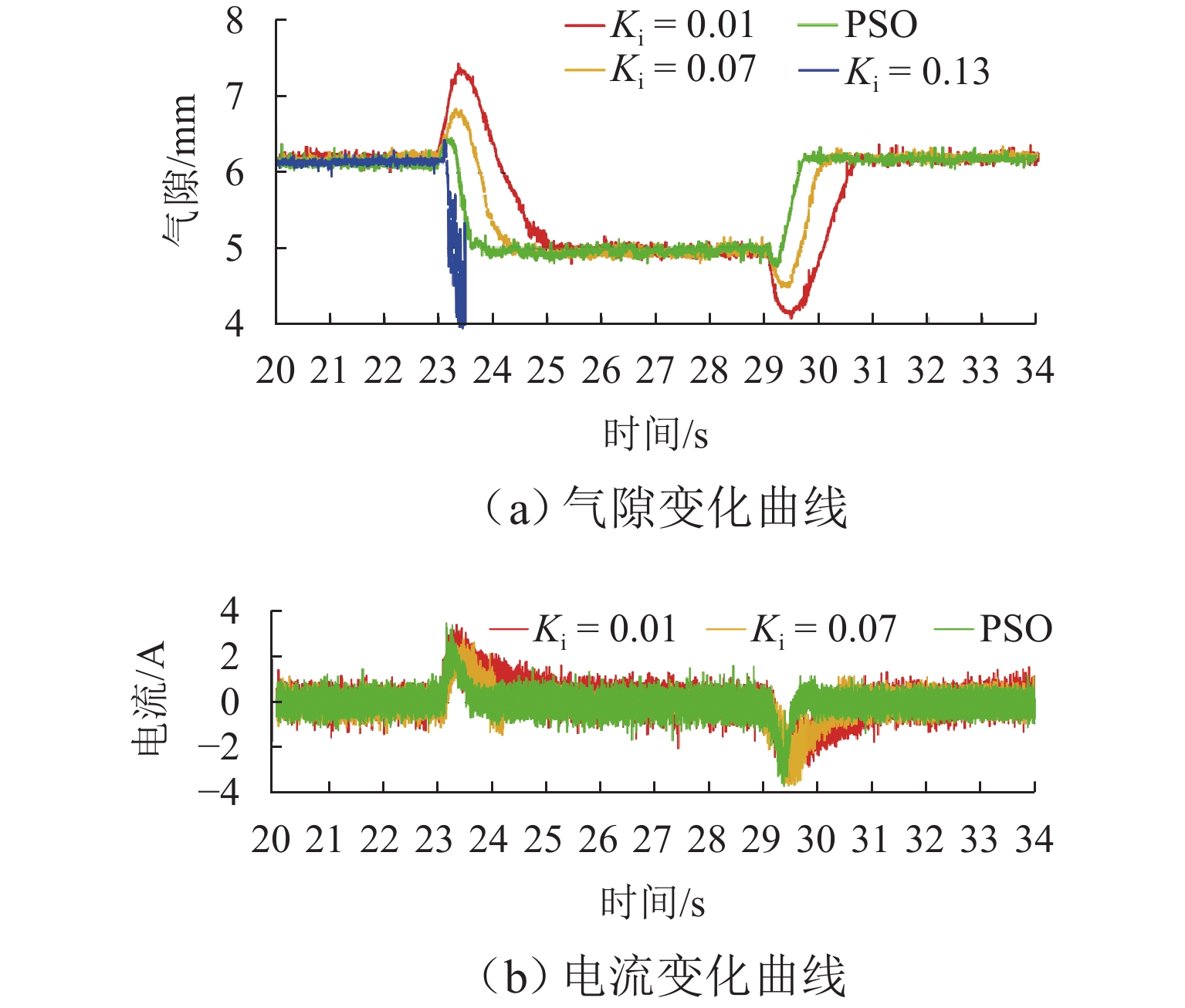
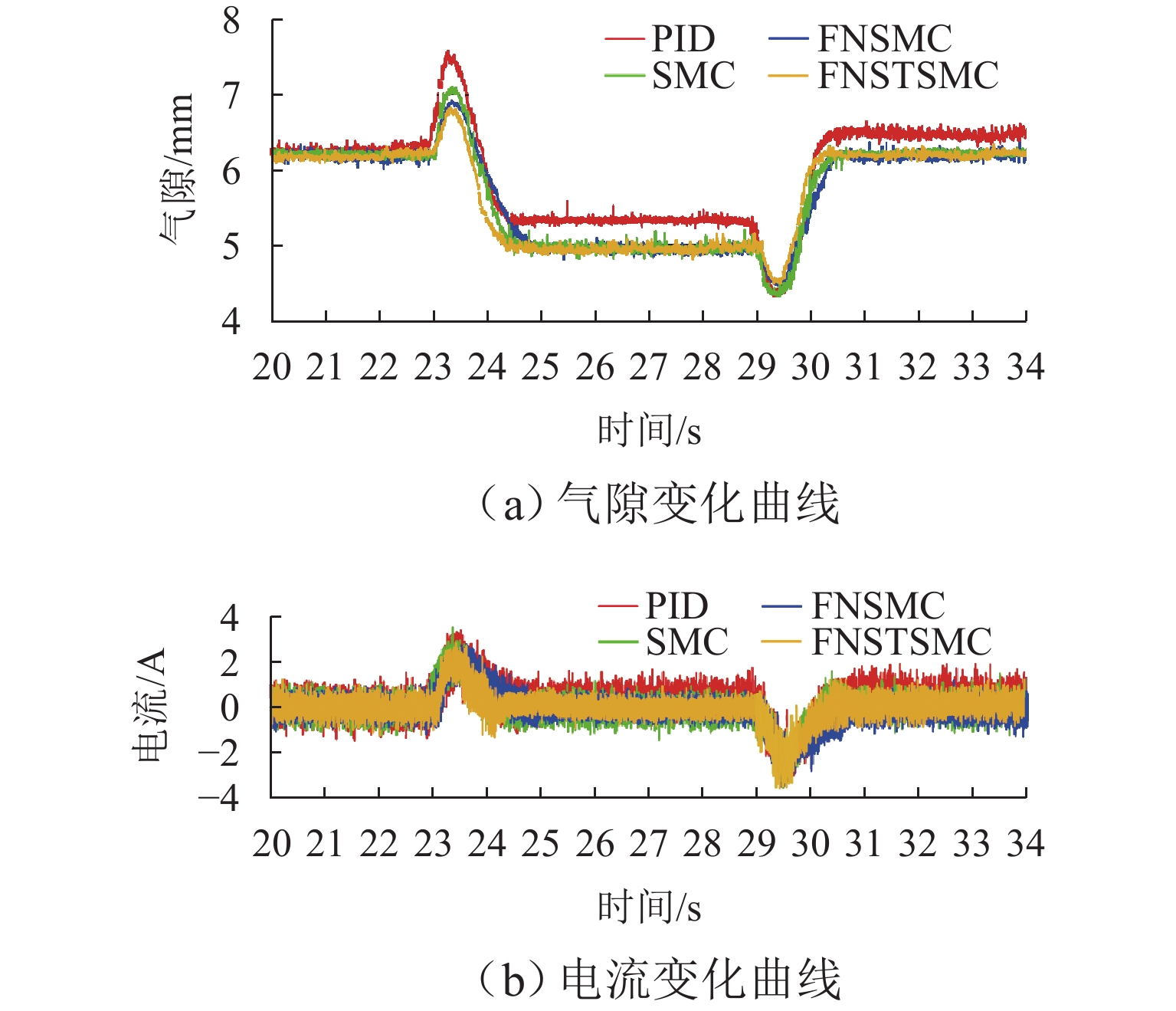
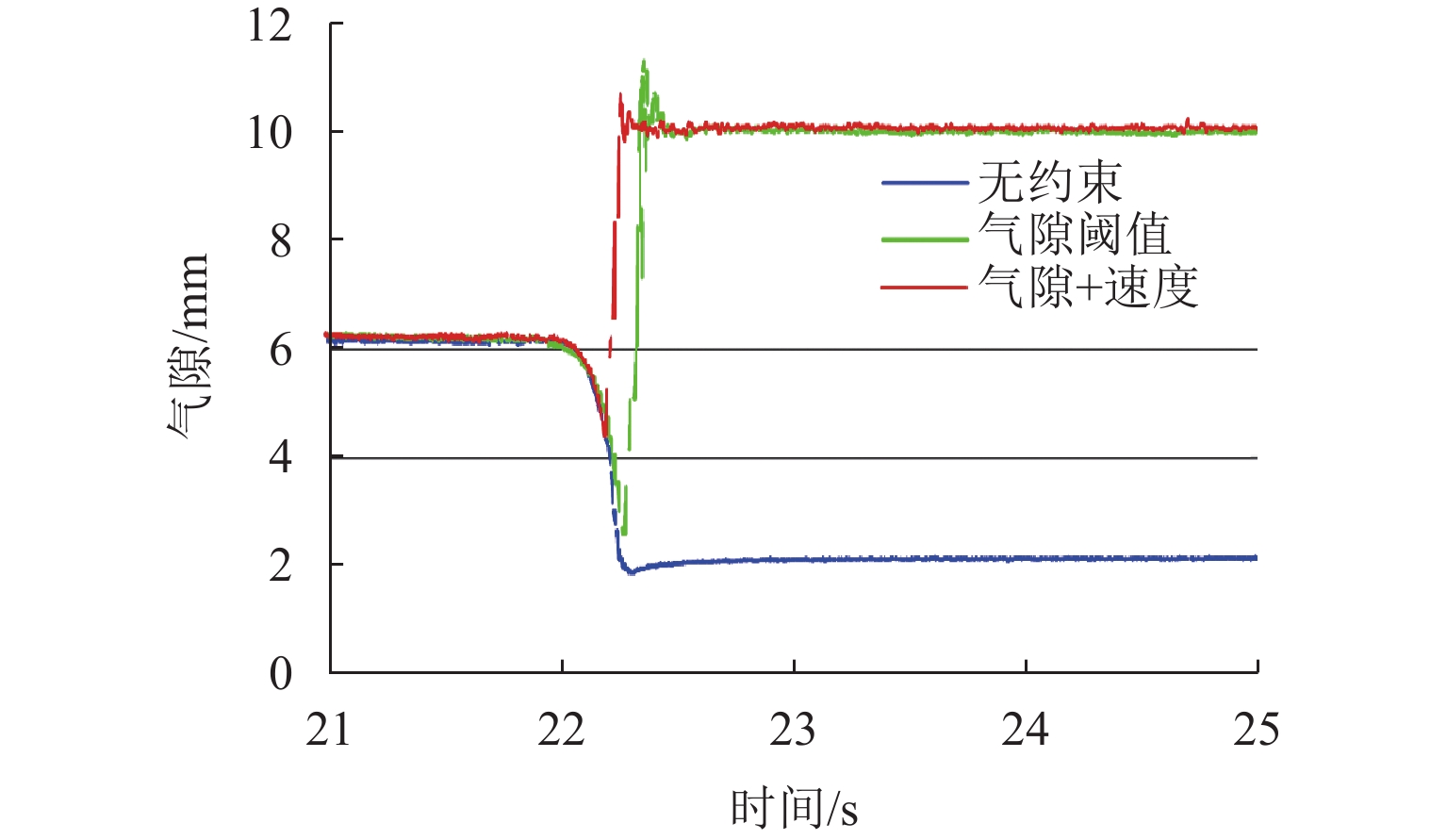
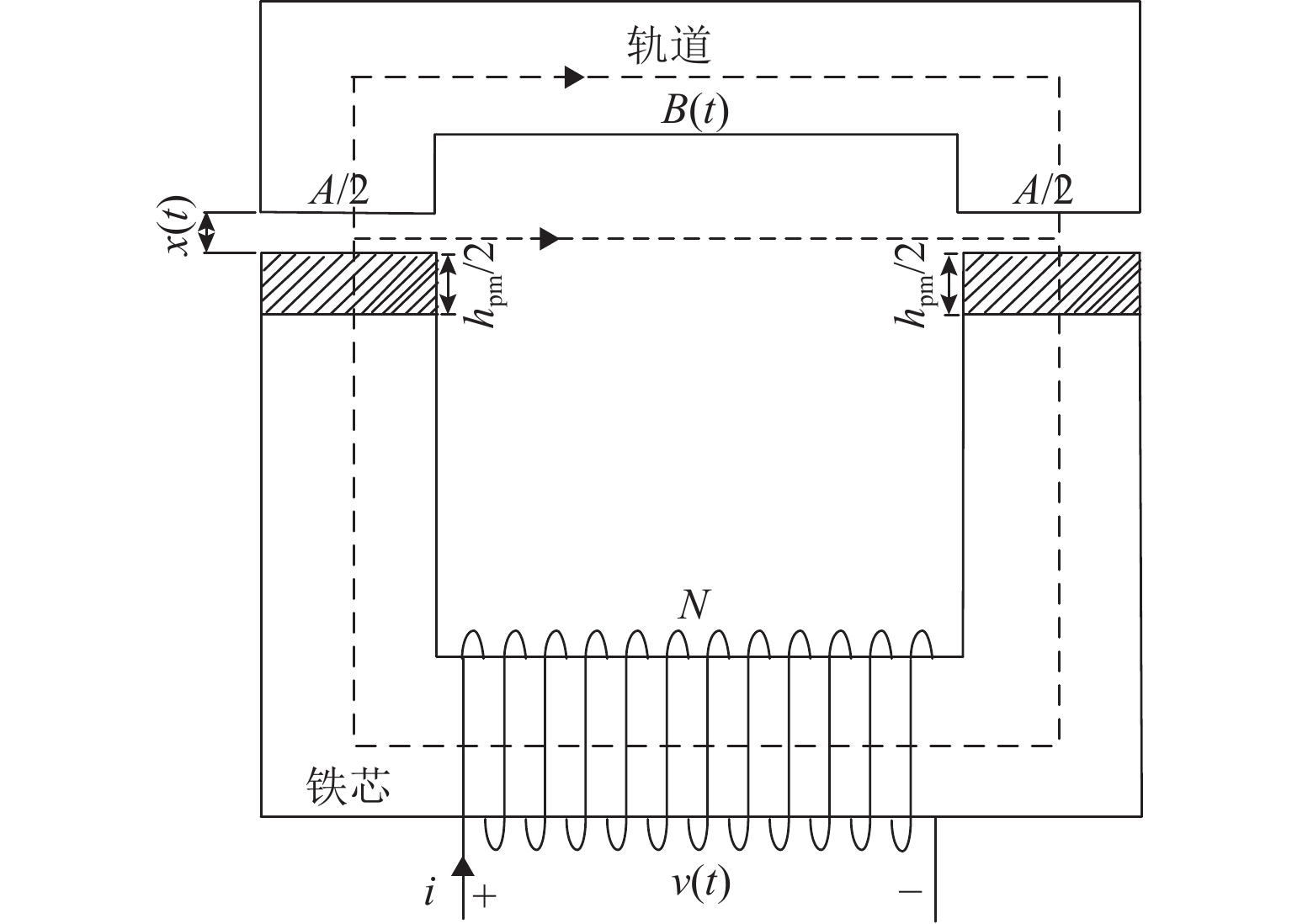
To effectively suppress the airgap overshoot and collision issues during the zero-power control process of the hybrid permanent magnet electromagnetic levitation system, an adaptive super-twisting sliding mode zero-power controller based on current integral feedback was proposed, and the particle swarm optimization (PSO) algorithm was utilized for online tuning of the current integral coefficient. First, the mathematical model of the hybrid levitation system was established, and a zero-power controller was designed based on the current integral feedback strategy. On this basis, a fast non-singular terminal (FNST) sliding mode surface was constructed to accelerate convergence, and an adaptive dual-mode switching strategy was introduced into the super-twisting sliding mode control to form the zero-power controller, realizing rapid airgap adjustment and tracking under disturbances. To address the problems caused by the fixed integral coefficient in the controller, its impact on the dynamic performance of the system was analyzed. The PSO algorithm was utilized for online optimization of the integral coefficient, enabling it to adjust in real time according to the system state, effectively suppressing airgap overshoot, improving convergence speed, and thereby enhancing the overall control performance. Furthermore, to reduce the risk of track collision during the zero-power control process, airgap velocity information was introduced based on the traditional airgap threshold strategy to construct a “velocity + size” dual criterion, enhancing the collision prediction capability in the vertical direction. Simulation and experimental results indicate that the proposed strategy significantly reduces airgap overshoot and accelerates the convergence process. The overshoot is less than 0.30 mm, and the convergence time is shortened to 0.67 s; compared with the traditional threshold method, the proposed dual criterion advances the decision time by approximately 0.10 s, reduces the airgap overshoot by 1.70 mm, and can more effectively predict and prevent the occurrence of collisions.

| [1] |
邓自刚, 刘宗鑫, 李海涛, 等. 磁悬浮列车发展现状与展望[J]. 西南交通大学学报, 2022, 57(3): 455-474, 530.
Deng Zigang, Liu Zongxin, Li Haitao, et al. Development status and prospect of maglev train[J]. Journal of Southwest Jiaotong University, 2022, 57(3): 455-474, 530.
|
| [2] |
《西南交通大学学报》编辑部. “磁悬浮技术应用” 专刊概述[J]. 西南交通大学学报, 2025, 60(4): 封2.
|
| [3] |
熊嘉阳, 沈志云, 池茂儒, 等. 高速磁悬浮列车技术综述[J]. 交通运输工程学报, 2025, 25(2): 1-23. doi: 10.19818/j.cnki.1671-1637.2025.02.001
Xiong Jiayang, Shen Zhiyun, Chi Maoru, et al. Review on high-speed maglev train technology[J]. Journal of Traffic and Transportation Engineering, 2025, 25(2): 1-23. doi: 10.19818/j.cnki.1671-1637.2025.02.001
|
| [4] |
Wang A X, Xu X G, Wang S Q, et al. Terminal sliding mode control for microgravity electromagnetic active vibration isolation system[C]//IECON 2023—49th Annual Conference of the IEEE Industrial Electronics Society. Piscataway: IEEE, 2023: 1-6.
|
| [5] |
Friedl B, Pechhacker A, Csencsics E, et al. Design and control of a table-top vibration isolation system with zero-power gravity compensation[C]//2024 IEEE International Conference on Advanced Intelligent Mechatronics (AIM). Piscataway: IEEE, 2024: 835-840.
|
| [6] |
黎松奇, 罗成, 张昆仑. 基于漏磁补偿的混合电磁铁磁力修正研究[J]. 西南交通大学学报, 2022, 57(3): 604-609. doi: 10.3969/j.issn.0258-2724.20210843
Li Songqi, Luo Cheng, Zhang Kunlun. Correction of magnetic force of hybrid electromagnet based on magnetic flux leakage compensation[J]. Journal of Southwest Jiaotong University, 2022, 57(3): 604-609. doi: 10.3969/j.issn.0258-2724.20210843
|
| [7] |
Zhao C, Sun F, Jin J J, et al. Analysis of quasi-zero power characteristic for a permanent magnetic levitation system with a variable flux path control mechanism[J]. IEEE/ASME Transactions on Mechatronics, 2021, 26(1): 437-447. doi: 10.1109/tmech.2020.3026086
|
| [8] |
Zhao C, Oka K, Sun F, et al. Design of zero-power control strategy with resisting tilt of hybrid magnetic levitation system[J]. IEEE Transactions on Industrial Electronics, 2022, 69(11): 11394-11402. doi: 10.1109/TIE.2021.3121670
|
| [9] |
孙凤, 裴文哲, 金俊杰, 等. 可变磁路式永磁悬浮平台的起浮控制方法[J]. 西南交通大学学报, 2022, 57(3): 531-539.
Sun Feng, Pei Wenzhe, Jin Junjie, et al. Floating control method for permanent magnetic levitation platform with variable flux path[J]. Journal of Southwest Jiaotong University, 2022, 57(3): 531-539.
|
| [10] |
Tang X W, Hashimoto S, Kawaguchi T, et al. Zero-power control strategy and dynamics enhancement for hybrid maglev conveyor cart[J]. Electronics, 2024, 13(15): 2921. doi: 10.3390/electronics13152921
|
| [11] |
Yalçın B C, Erkan K. 3-DoF zero power micro vibration isolation via linear matrix inequalities based on H∞ and H2 control approaches[J]. Mechanical Systems and Signal Processing, 2021, 153: 107506. doi: 10.1016/j.ymssp.2020.107506
|
| [12] |
Hu L F, Fan K G, Wei L B, et al. Design of nonlinear active disturbance rejection controller based on the adaptive particle swarm optimization algorithm for the maglev train traction control system[J]. Journal of Sensors, 2023, 2023: 6627429. doi: 10.1155/2023/6627429
|
| [13] |
王玉蓉, 屈薇薇, 李桂琳, 等. 一种基于多目标粒子群算法的太赫兹超材料吸收器快速优化方法[J]. 物理学报, 2025, 74(5): 203-212.
Wang Yurong, Qu Weiwei, Li Guilin, et al. An optimization method for terahertz metamaterial absorber based on multi-objective particle swarm optimization[J]. Acta Physica Sinica, 2025, 74(5): 203-212.
|
| [14] |
杨杰, 陈昱圻, 王盼盼. 基于改进粒子群算法的列车速度跟踪自抗扰控制器设计[J]. 铁道学报, 2021, 43(7): 40-46.
Yang Jie, Chen Yuqi, Wang Panpan. Design of active disturbance rejection controller for train speed tracking based on improved particle swarm optimization[J]. Journal of the China Railway Society, 2021, 43(7): 40-46.
|
| [15] |
Tzeng Y K, Wang T C. Optimal design of the electromagnetic levitation with permanent and electro magnets[J]. IEEE Transactions on Magnetics, 1994, 30(6): 4731-4733. doi: 10.1109/20.334204
|
| [16] |
陈慧星, 郝阿明, 程虎. 基于Kalman的电-永磁混合磁悬浮系统过流检测[J]. 兵工自动化, 2007, 26(8): 61-62. doi: 10.3969/j.issn.1006-1576.2007.08.031
Chen Huixing, Hao Aming, Cheng Hu. Current detection for electricity-permanent magnetism mixed suspending system based on Kalman[J]. Ordnance Industry Automation, 2007, 26(8): 61-62. doi: 10.3969/j.issn.1006-1576.2007.08.031
|
| [17] |
张晓友, 尚利冬, 赵川, 等. 混合磁悬浮平台的零功率特性分析[J]. 机械工程与自动化, 2023, 52(6): 40-42, 45.
Zhang Xiaoyou, Shang Lidong, Zhao Chuan, et al. Zero power characteristic analysis of hybrid magnetic levitation platform[J]. Mechanical Engineering & Automation, 2023, 52(6): 40-42, 45.
|
| [18] |
Zhang T B, Jiang S H, Shen D, et al. Adaptive finite-time fuzzy control for hybrid levitation system of maglev trains with active anti-lock constraints[J]. Journal of the Franklin Institute, 2023, 360(4): 2635-2659. doi: 10.1016/j.jfranklin.2023.01.006
|
| [19] |
Sun F, Pei W Z, Zhao C, et al. Permanent maglev platform using a variable flux path mechanism: stable levitation and motion control[J]. IEEE Transactions on Magnetics, 2022, 58(7): 8300410.
|
| [20] |
Zhang T B, Jiang S H, Shen D. Collaborative control of a levitation module for maglev trains with physical contact prevention and user-defined convergence time[J]. International Journal of Systems Science, 2024, 55(2): 355-369. doi: 10.1080/00207721.2023.2272218
|
| [21] |
Long Z Q, Wang Z Q, Zhai M D, et al. High-speed maglev train’s levitation and guidance control: the key technologies[M]. Singapore: Springer, 2024: 225-250.
|
| [22] |
赵川, 孙凤, 金俊杰, 等. 混合磁悬浮系统零功率抗偏载控制方法研究[J]. 机械工程学报, 2024, 60(8): 360-369. doi: 10.3901/JME.2024.08.360
Zhao Chuan, Sun Feng, Jin Junjie, et al. Research on zero power and resisting eccentric load control method of hybrid magnetic levitation system[J]. Journal of Mechanical Engineering, 2024, 60(8): 360-369. doi: 10.3901/JME.2024.08.360
|
| [23] |
Sun Y G, Xu J Q, Wu H, et al. Deep learning based semi-supervised control for vertical security of maglev vehicle with guaranteed bounded airgap[J]. IEEE Transactions on Intelligent Transportation Systems, 2021, 22(7): 4431-4442. doi: 10.1109/TITS.2020.3045319
|
| [24] |
Sun Y G, Xu J Q, Qiang H Y, et al. Adaptive sliding mode control of maglev system based on RBF neural network minimum parameter learning method[J]. Measurement, 2019, 141: 217-226. doi: 10.1016/j.measurement.2019.03.006
|
| [25] |
Bhat S P, Bernstein D S. Finite-time stability of continuous autonomous systems[J]. SIAM Journal on Control and Optimization, 2000, 38(3): 751-766. doi: 10.1137/S0363012997321358
|
| [26] |
Feng Y, Yu X H, Han F L. On nonsingular terminal sliding-mode control of nonlinear systems[J]. Automatica, 2013, 49(6): 1715-1722. doi: 10.1016/j.automatica.2013.01.051
|
Figures(12) / Tables(4)


 DownLoad: