- ISSN 0258-2724
- CN 51-1277/U
- EI Compendex
- Scopus
- Indexed by Core Journals of China, Chinese S&T Journal Citation Reports
- Chinese S&T Journal Citation Reports
- Chinese Science Citation Database


| Citation: | HUANG Haotian, ZHANG Xiaojing, XIE Jingchao, MA Anke. Characterization of Dynamic Heat Transfer Characteristics of Building Envelopes Based on Energy Attenuation Coefficient[J]. Journal of Southwest Jiaotong University. doi: 10.3969/j.issn.0258-2724.20250509

|
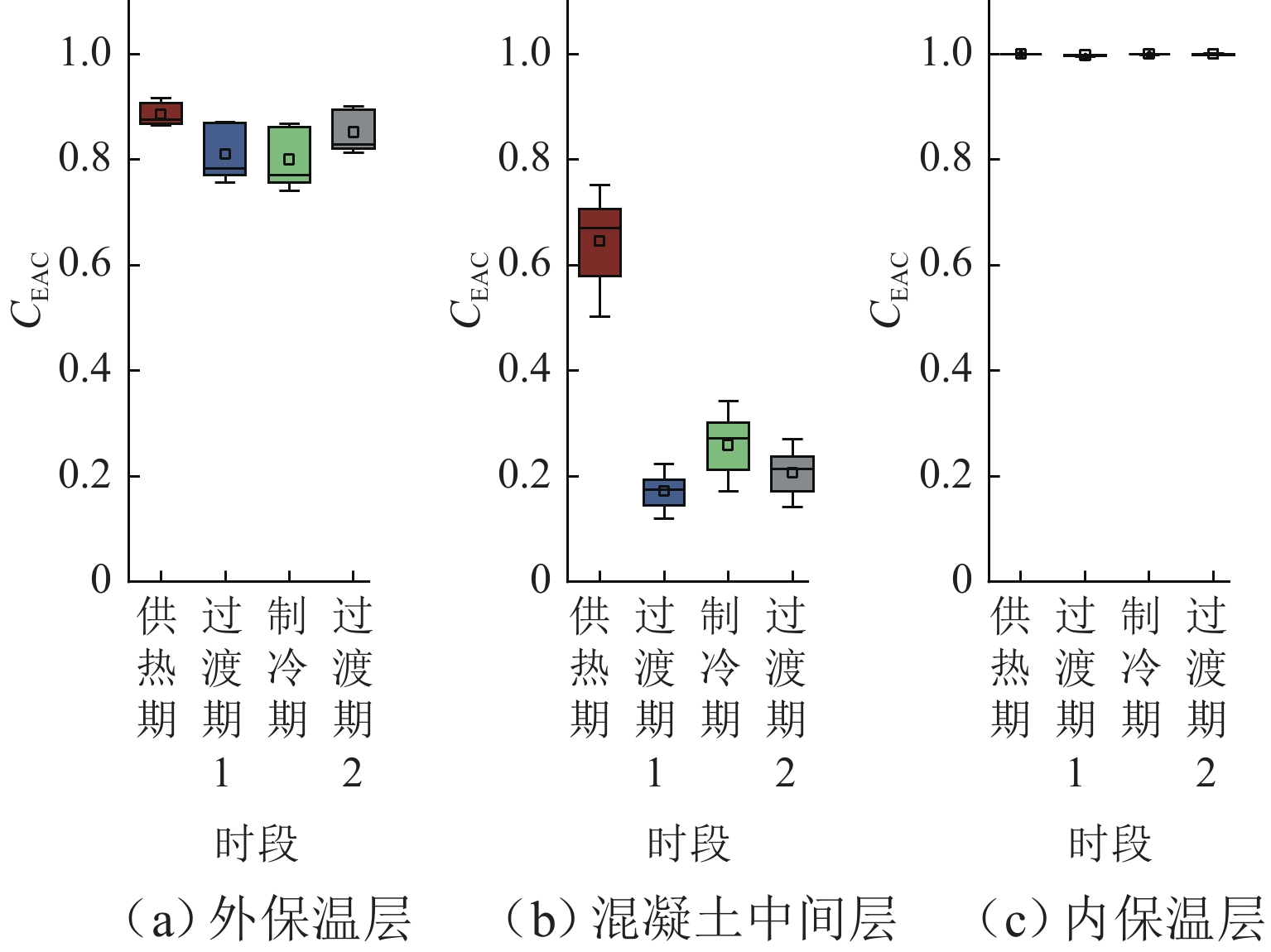
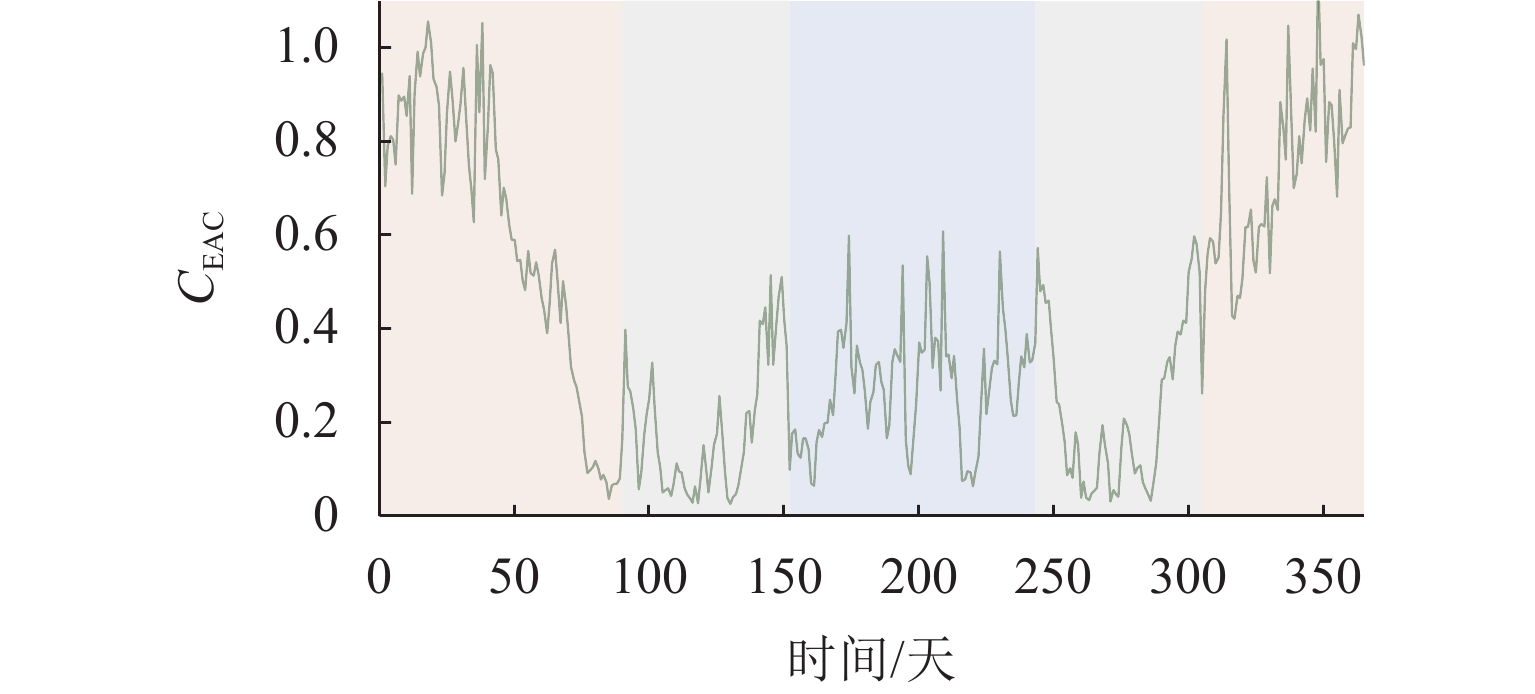
An energy attenuation coefficient (EAC) is introduced to quantify the dynamic response of building envelopes to outdoor thermal disturbances. It is defined as the ratio of the time integral of the absolute heat flux at the internal surface to that at the external surface over a given period. A higher value indicates weaker attenuation, whereas a lower value indicates stronger mitigation of outdoor thermal disturbances. Yanqi, Xinjiang, characterised by large air-temperature fluctuations and strong solar radiation, is used as a case study. Heat transfer in 25 typical envelope assemblies was simulated using a combined frequency- and time-domain method, and layer-specific EAC values were evaluated at daily, monthly, seasonal, and annual scales. The results show that the annual mean EAC values for the external insulation layer, concrete layer, and internal insulation layer are 0.85, 0.40, and 0.99, respectively, indicating that the concrete layer is the primary contributor to energy attenuation. During the heating season, the EAC of the concrete layer increases significantly to 0.78 compared with other typical periods, indicating that the building envelope is less effective at attenuating outdoor thermal disturbances. The external insulation layer mainly provides steady-state thermal resistance. At the annual scale, moderately increasing the thermal conductivity and heat capacity of the insulation layer improves the overall attenuation of outdoor thermal disturbances throughout the year.

| [1] |
Yang J M, Wu H J, Liang Y Y, et al. Modeling the thermally adaptive performance of building exterior walls with linear temperature-dependent thermal conductivity[J]. Applied Thermal Engineering, 2024, 251: 123552. doi: 10.1016/j.applthermaleng.2024.123552
|
| [2] |
崔元龙, 朱柯锋. 新型太阳能光伏/光热集成微通道热管组件一体化系统的性能研究[J/OL]. 西南交通大学学报, 2026-01-08. https://link.cnki.net/urlid/51.1277.u.20260108.1133.010.
|
| [3] |
李福海, 杨博, 霍佳腾, 等. 相变材料对陶粒泡沫混凝土热工性能的影响[J/OL]. 西南交通大学学报, 2025-12-09. https://link.cnki.net/urlid/51.1277.U.20251208.1820.002.
|
| [4] |
Soret G M, Vacca P, Tignard J, et al. Thermal inertia as an integrative parameter for building performance[J]. Journal of Building Engineering, 2021, 33: 101623. doi: 10.1016/j.jobe.2020.101623
|
| [5] |
Fokaides P A, Kylili A, Kyriakides I. Boundary conditions accuracy effect on the numerical simulations of the thermal performance of building elements[J]. Energies, 2018, 11(6): 1520. doi: 10.3390/en11061520
|
| [6] |
Gagliano A, Patania F, Nocera F, et al. Assessment of the dynamic thermal performance of massive buildings[J]. Energy and Buildings, 2014, 72: 361-370. doi: 10.1016/j.enbuild.2013.12.060
|
| [7] |
Zhao Q, Fan X N, Wang Q, et al. Research on energy-saving design of rural building wall in qinba mountains based on uniform radiation field[J]. Mathematical Problems in Engineering, 2020, 2020: 9786895. doi: 10.1155/2020/9786895
|
| [8] |
Sun C, Shu S M, Ding G Z, et al. Investigation of time lags and decrement factors for different building outside temperatures[J]. Energy and Buildings, 2013, 61: 1-7. doi: 10.1016/j.enbuild.2013.02.003
|
| [9] |
Ulgen K. Experimental and theoretical investigation of effects of wall’s thermophysical properties on time lag and decrement factor[J]. Energy and Buildings, 2002, 34(3): 273-278. doi: 10.1016/S0378-7788(01)00087-1
|
| [10] |
Daouas N. A study on optimum insulation thickness in walls and energy savings in Tunisian buildings based on analytical calculation of cooling and heating transmission loads[J]. Applied Energy, 2011, 88(1): 156-164. doi: 10.1016/j.apenergy.2010.07.030
|
| [11] |
Hu H W, Zhang Y B, et al. Analysis of the applicability of a phase-change energy storage wall for public buildings in hot summer and cold winter climate zones[J]. Heat Transfer Engineering, 2025, 46(19/20): 1774-1787. doi: 10.1080/01457632.2024.2400867
|
| [12] |
Hou L Q, Liu Y, Zhu Y Y, et al. Thermal performance of cavity masonry wall structures in the solar rich areas of Western China[J]. Journal of Building Engineering, 2024, 86: 108797. doi: 10.1016/j.jobe.2024.108797
|
| [13] |
Ricciu R, Ragnedda F, Galatioto A, et al. Thermal properties of building walls: Indirect estimation using the inverse method with a harmonic approach[J]. Energy and Buildings, 2019, 187: 257-268. doi: 10.1016/j.enbuild.2019.01.035
|
| [14] |
刘加平, 谢静超. 广义建筑围护结构热工设计原理与方法[J]. 建筑科学, 2022, 38(8): 1-8. doi: 10.13614/j.cnki.11-1962/tu.2022.08.01
Liu Jiaping, Xie Jingchao. Generalized principle and method of thermal design for building envelopes[J]. Building Science, 2022, 38(8): 1-8. doi: 10.13614/j.cnki.11-1962/tu.2022.08.01
|
| [15] |
Quagraine K A, Ramde E W, Fiagbe Y A K, et al. Evaluation of time lag and decrement factor of walls in a hot humid tropical climate[J]. Thermal Science and Engineering Progress, 2020, 20: 100758. doi: 10.1016/j.tsep.2020.100758
|
| [16] |
Toure P M, Dieye Y, Gueye P M, et al. Experimental determination of time lag and decrement factor[J]. Case Studies in Construction Materials, 2019, 11: e00298. doi: 10.1016/j.cscm.2019.e00298
|
| [17] |
Toure P M, Dieye Y, Gueye P M, et al. Influence of envelope thickness and solar absorptivity of a test cell on time lag and decrement factor[J]. Journal of Building Physics, 2020, 43(4): 338-350. doi: 10.1177/1744259119863446
|
| [18] |
Mazzeo D, Oliveti G, Arcuri N. Influence of internal and external boundary conditions on the decrement factor and time lag heat flux of building walls in steady periodic regime[J]. Applied Energy, 2016, 164: 509-531. doi: 10.1016/j.apenergy.2015.11.076
|
| [19] |
Stazi F, Ulpiani G, Pergolini M, et al. The role of areal heat capacity and decrement factor in case of hyper insulated buildings: an experimental study[J]. Energy and Buildings, 2018, 176: 310-324. doi: 10.1016/j.enbuild.2018.07.034
|
| [20] |
Bai L, Wang Y Q, Bai Y F, et al. Influence of phase change materials on the thermal performance of heavy-weight walls with different thermal inertia[J]. Journal of Building Engineering, 2025, 99: 111573. doi: 10.1016/j.jobe.2024.111573
|
| [21] |
Li R N, Zhang J L. Transfer function models for instantaneous internal cooling loads to describe time lag effect of conversion process[J]. Building and Environment, 2022, 217: 109054. doi: 10.1016/j.buildenv.2022.109054
|
| [22] |
Mazzeo D, Oliveti G, De Simone M, et al. Dynamic thermal characteristics of opaque building components. a proposal for the extension of EN ISO 13786[J]. Energy Procedia, 2015, 78: 3240-3245. doi: 10.1016/j.egypro.2015.11.787
|
| [23] |
Michalak P. Experimental and theoretical study on the internal convective and radiative heat transfer coefficients for a vertical wall in a residential building[J]. Energies, 2021, 14(18): 5953. doi: 10.3390/en14185953
|
| [24] |
DICKINSON R E. Land surface processes and climate: surface albedos and energy balance[J]. Advances in Geophysics, 1983: 305-335.
|
| [25] |
杨岗, 邓琴, 徐五一, 等. 基于频谱重构的经验傅里叶分解算法及轴承故障诊断应用[J/OL]. 西南交通大学学报, 2026-01-08. https://link.cnki.net/urlid/51.1277.U.20250618.1502.002.
|
| [26] |
SCHMIDT D. Models for coupled heat and mass transfer processes in buildings: applications to achieve low exergy room conditioning[M]. Institutionen för byggnader och installationer, 2001.
|
| [27] |
朱新荣, 冯伟建, 梁嘉, 等. 一种墙体蓄热量的评价方法研究[J]. 太阳能学报, 2024, 45(1): 67-72. doi: 10.19912/j.0254-0096.tynxb.2022-0131
Zhu Xinrong, Feng Weijian, Liang Jia, et al. Evaluation method study on heat storage capacity of building envelopes[J]. Acta Energiae Solaris Sinica, 2024, 45(1): 67-72. doi: 10.19912/j.0254-0096.tynxb.2022-0131
|
| [28] |
Xie J L, Xu X H, Li A B, et al. Experimental validation of frequency-domain finite-difference model of active pipe-embedded building envelope in time domain by using Fourier series analysis[J]. Energy and Buildings, 2015, 99: 177-188. doi: 10.1016/j.enbuild.2015.04.043
|
| [29] |
Tabares-velasco P C, Christensen C, Bianchi M. Verification and validation of EnergyPlus phase change material model for opaque wall assemblies[J]. Building and Environment, 2012, 54: 186-196. doi: 10.1016/j.buildenv.2012.02.019
|
Figures(8) / Tables(2)


 DownLoad: