- ISSN 0258-2724
- CN 51-1277/U
- EI Compendex
- Scopus
- Indexed by Core Journals of China, Chinese S&T Journal Citation Reports
- Chinese S&T Journal Citation Reports
- Chinese Science Citation Database

| Citation: | XIE Hongtai, WANG Hong. Influence of Longitudinal Layout Density of Aerodynamic Braking Devices on Braking Effect of High-Speed Trains[J]. Journal of Southwest Jiaotong University, 2026, 61(1): 253-264. doi: 10.3969/j.issn.0258-2724.20240219

|
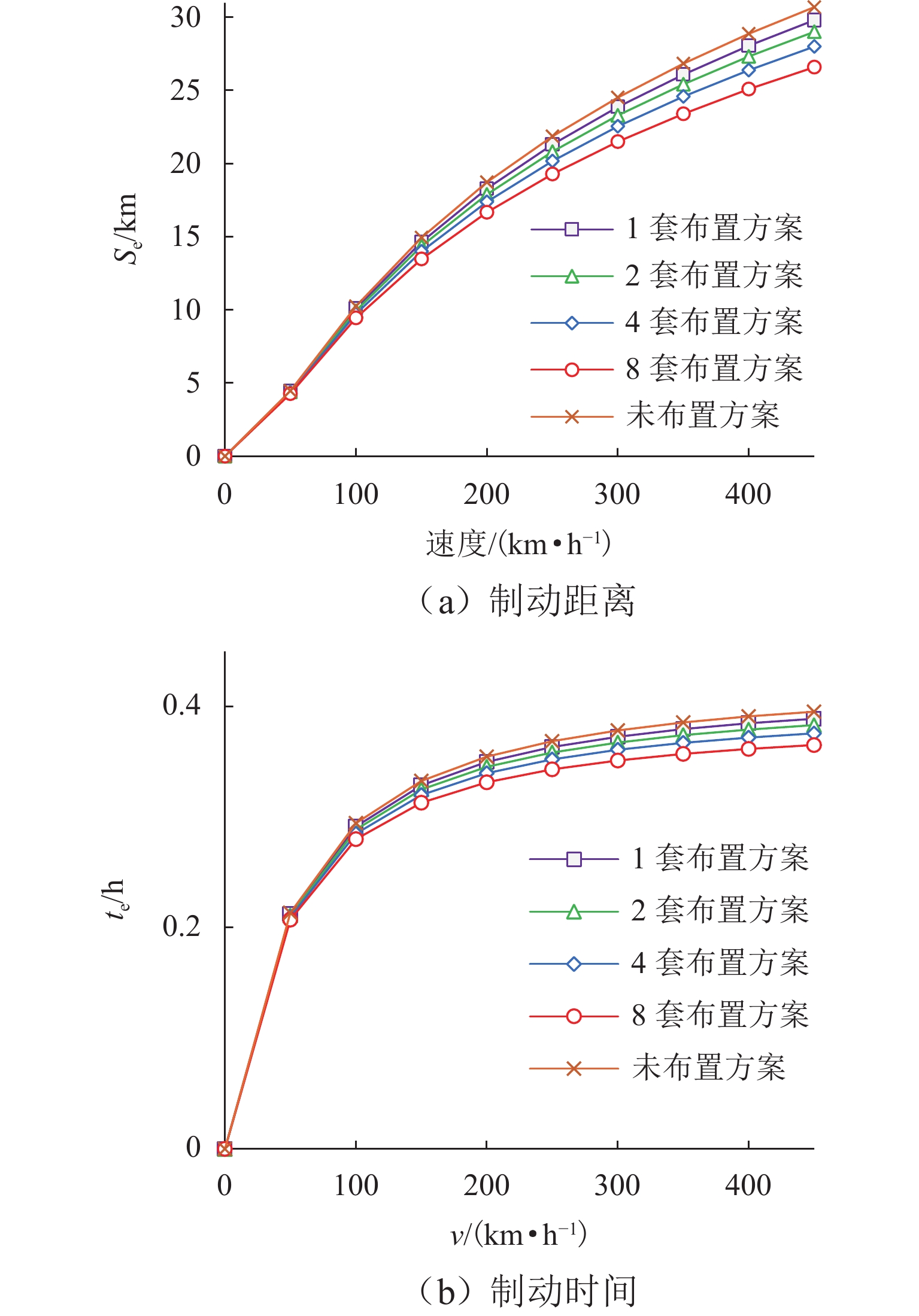
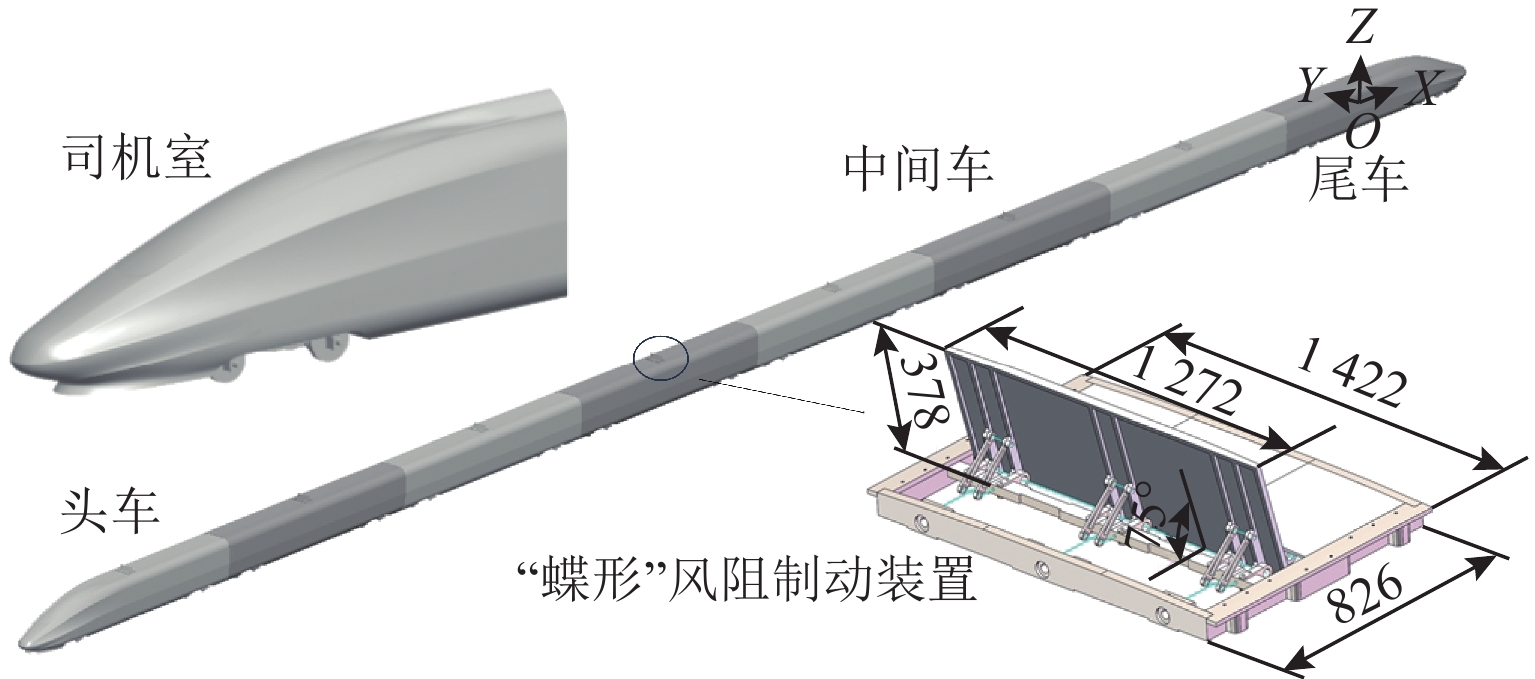
To further investigate the synergistic layout of aerodynamic braking devices on high-speed trains operating at 400 km/h and above and to clarify the overall braking benefit and efficiency of aerodynamic braking systems suitable for China’s current standard trainsets, the shape of the CR400AF platform and the configuration of its basic braking system were taken as a reference. Different numbers of “butterfly-type” aerodynamic braking devices were installed, and the aerodynamic characteristics of high-speed trains equipped with such devices under different operating conditions were simulated and calculated. A direct integration method applicable to aerodynamic braking problems was proposed. The braking performance of trains relying solely on aerodynamic braking devices at a given initial speed was compared with coasting to stop, and the braking effect was analyzed. Train braking equations were established, and the segmented accumulation method was used to calculate the braking distance and time when aerodynamic braking was combined with service braking and emergency braking. The results show that the installation of aerodynamic braking devices significantly increases the overall aerodynamic resistance of trains, and higher layout density leads to stronger aerodynamic interference between front and rear braking plates. The composite braking method combining aerodynamic braking effectively compensates for insufficient adhesive braking force at high speed, while addressing the low braking efficiency of aerodynamic braking at low speed. The combined braking distance is proportional to the square of the speed, and the braking time is proportional to the speed. With combined aerodynamic braking, the emergency braking distance from an initial speed of 350 km/h can be reduced to

| [1] |
YOSHIMURA M, SAITO S, HOSAKA S, et al. Characteristics of the aerodynamic brake of the vehicle on the yamanashi maglev test line[J]. Quarterly Report of RTRI, 2000, 41(2): 74-78. doi: 10.2219/rtriqr.41.74
|
| [2] |
BAKER C J. The simulation of unsteady aerodynamic cross wind forces on trains[J]. Journal of Wind Engineering and Industrial Aerodynamics, 2010, 98(2): 88-99. doi: 10.1016/j.jweia.2009.09.006
|
| [3] |
CARRARINI A. Reliability based analysis of the crosswind stability of railway vehicles[J]. Journal of Wind Engineering and Industrial Aerodynamics, 2007, 95(7): 493-509. doi: 10.1016/j.jweia.2006.10.001
|
| [4] |
KAZUMASA O, MASAFUMI Y. Development of aerodynamic brake of maglev vehicle for emergency use[J]. RIRI, 1989, 3(11): 22-30.
|
| [5] |
TAKAMI H, MAEKAWA H. Characteristics of a wind-actuated aerodynamic braking device for high-speed trains[J]. Journal of Physics: Conference Series, 2017, 822: 012061.1-012061.7.
|
| [6] |
TAKAMI H. Development of aerodynamic brake device for high-speed railway[J]. Quarterly Report of RTRI, 2020, 61(4): 267-272.
|
| [7] |
田春, 吴萌岭, 朱洋永, 等. 空气动力制动风翼在车上布置数值仿真研究[J]. 中国铁道科学, 2012, 33(3): 98-101. doi: 10.3969/j.issn.1001-4632.2012.03.16
TIAN Chun, WU Mengling, ZHU Yangyong, et al. Numerical simulation research on the arrangement of the aerodynamic braking plates in the train[J]. China Railway Science, 2012, 33(3): 98-101. doi: 10.3969/j.issn.1001-4632.2012.03.16
|
| [8] |
田春, 吴萌岭, 费巍巍, 等. 空气动力制动制动风翼纵向位置制动力规律[J]. 同济大学学报(自然科学版), 2011, 39(5): 705-709.
TIAN Chun, WU Mengling, FEI Weiwei, et al. Rule of aerodynamics braking force in longitudinal different position of high-speed train[J]. Journal of Tongji University (Natural Science), 2011, 39(5): 705-709.
|
| [9] |
孙文静, 田春, 周劲松, 等. 高速列车空气动力制动会车动力学性能[J]. 同济大学学报(自然科学版), 2014, 42(9): 1401-1407.
SUN Wenjing, TIAN Chun, ZHOU Jinsong, et al. Dynamics performance of high-speed train with aerodynamic brake under crossing[J]. Journal of Tongji University (Natural Science), 2014, 42(9): 1401-1407.
|
| [10] |
高立强, 奚鹰, 邓阁, 等. 空气动力制动风翼板气动干扰效应研究[J]. 机械设计, 2015, 32(9): 19-24.
GAO Liqiang, XI Ying, DENG Ge, et al. Research on the aerodynamic interference effects of the brake panel[J]. Journal of Machine Design, 2015, 32(9): 19-24.
|
| [11] |
高立强, 胡雄, 孙德建, 等. 空气动力制动前排风翼板制动力影响规律[J]. 铁道学报, 2018, 40(1): 31-37.
GAO Liqiang, HU Xiong, SUN Dejian, et al. Influence rule of aerodynamics braking force from the front brake panel[J]. Journal of the China Railway Society, 2018, 40(1): 31-37.
|
| [12] |
高广军, 张普阳, 商雯斐, 等. 流线型部位风阻制动板对高速列车气动特性的影响分析[J]. 中南大学学报(自然科学版), 2023, 54(9): 3708-3718.
GAO Guangjun, ZHANG Puyang, SHANG Wenfei, et al. Analysis of influence of aerodynamic braking plates installed on streamlined parts on aerodynamic characteristics of high-speed train[J]. Journal of Central South University (Science and Technology), 2023, 54(9): 3708-3718.
|
| [13] |
李锋. 高速列车流线型区域制动板增阻机理及参数优化研究[D]. 长沙: 中南大学, 2022.
|
| [14] |
谢红太, 王红. 速度400 km/h高速列车风阻制动装置布置的数值研究[J]. 铁道学报, 2023, 45(10): 42-51.
XIE Hongtai, WANG Hong. Numerical study on arrangement of aerodynamic braking device for 400 km/h high-speed train[J]. Journal of the China Railway Society, 2023, 45(10): 42-51.
|
| [15] |
谢红太, 王红. 400 km/h高速列车 “蝶形” 风阻制动装置设计与仿真[J]. 北京交通大学学报, 2022, 46(6): 152-160.
XIE Hongtai, WANG Hong. Design and simulation of “butterfly” aerodynamic braking device for 400 km/h high-speed train[J]. Journal of Beijing Jiaotong University, 2022, 46(6): 152-160.
|
| [16] |
谢红太, 王红, 柴伟. 新型高速列车风阻制动装置设计实现与仿真分析[J]. 工程设计学报, 2023, 30(2): 244-253.
XIE Hongtai, WANG Hong, CHAI Wei. Design and numerical simulation of new aerodynamic braking de-vice for High-speed train[J] Chinese Journal of Engineering Design, 2023, 30(2): 244-253.
|
| [17] |
BAKER C J. A review of train aerodynamics part 2—applications[J]. The Aeronautical Journal, 2014, 118(1202): 345-382. doi: 10.1017/S0001924000009179
|
| [18] |
HAJIPOUR A, RASHIDI M M, LI T, et al. A review of recent studies on simulations for flow around high-speed trains[J]. Journal of Applied and Computational Mechanics, 2018, 5(2): 311-333.
|
| [19] |
RAGHUNATHAN R S, KIM H D, SETOGUCHI T. Aerodynamics of high-speed railway train[J]. Progress in Aerospace Sciences, 2002, 38(6/7): 469-514.
|
| [20] |
TIAN H Q. Review of research on high-speed railway aerodynamics in China[J]. Transportation Safety and Environment, 2019, 1(1): 1-21. doi: 10.1093/tse/tdz014
|
| [21] |
刘继宗, 张祖涛, 王浩, 等. 城轨交通制动能量利用技术研究现状与展望[J]. 西南交通大学学报, 2024, 59(6): 1322-1345.
LIU Jizong, ZHANG Zutao, WANG Hao, et al. Braking energy utilization in urban rail transit: status and prospects[J]. Journal of Southwest Jiaotong University, 2024, 59(6): 1322-1345.
|
| [22] |
李田, 秦登, 安超, 等. 计算网格对列车空气动力学不确定性的影响[J]. 西南交通大学学报, 2019, 54(4): 816-822.
LI Tian, QIN Deng, AN Chao, et al. Effect of computational grid on uncertainty in train aerodynamics[J]. Journal of Southwest Jiaotong University, 2019, 54(4): 816-822.
|
| [23] |
国家铁路局. 铁路应用空气动力学第4部分: 列车空气动力学性能数值仿真规范: TB/T 3503.4—2018[S]. 北京: 中国铁道出版社, 2018.
|
| [24] |
ZUO J Y, WU M L, TIAN C, et al. Aerodynamic braking device for high-speed trains: design, simulation and experiment[J]. Proceedings of the Institution of Mechanical Engineers, Part F: Journal of Rail and Rapid Transit, 2014, 228(3): 260-270. doi: 10.1177/0954409712471620
|
| [25] |
张中央. 列车牵引计算[M]. 2版. 北京: 中国铁道出版社, 2019.
|
| [26] |
马飞, 尹崇宏, 刘中华, 等. 安装风阻制动装置的高速列车制动距离研究[J]. 铁道车辆, 2021, 59(1): 16-19.
MA Fei, YIN Chonghong, LIU Zhonghua, et al. Research on braking distance of high-speed train mounted with wind-resistance brake device[J]. Rolling Stock, 2021, 59(1): 16-19.
|
| [27] |
朱文良, 吴萌岭. 动车组制动计算方法研究[J]. 同济大学学报(自然科学版), 2017, 45(1): 119-123, 134.
ZHU Wenliang, WU Mengling. Braking calculation of electric multiple units (EMUs)[J]. Journal of Tongji University (Natural Science), 2017, 45(1): 119-123,134.
|
| [28] |
中国铁路总公司. 铁路技术管理规程-高速铁路部分[M]. 北京: 中国铁道出版社, 2014.
|
| [29] |
刘志明, 王文静, 等. 高速铁路动车组[M]. 北京: 中国铁道出版社, 2021.
|
Figures(14) / Tables(6)


 DownLoad: