- ISSN 0258-2724
- CN 51-1277/U
- EI Compendex
- Scopus
- Indexed by Core Journals of China, Chinese S&T Journal Citation Reports
- Chinese S&T Journal Citation Reports
- Chinese Science Citation Database

| Citation: | ZHOU Weiteng, LI Zhuoyi, RAN Jiangliang, HAN Baoming, SONG Lixin, FAN Guorong. Train Rescheduling Model Based on Combination Strategy for Urban Rail Transit Operation Interruption[J]. Journal of Southwest Jiaotong University. doi: 10.3969/j.issn.0258-2724.20240174

|
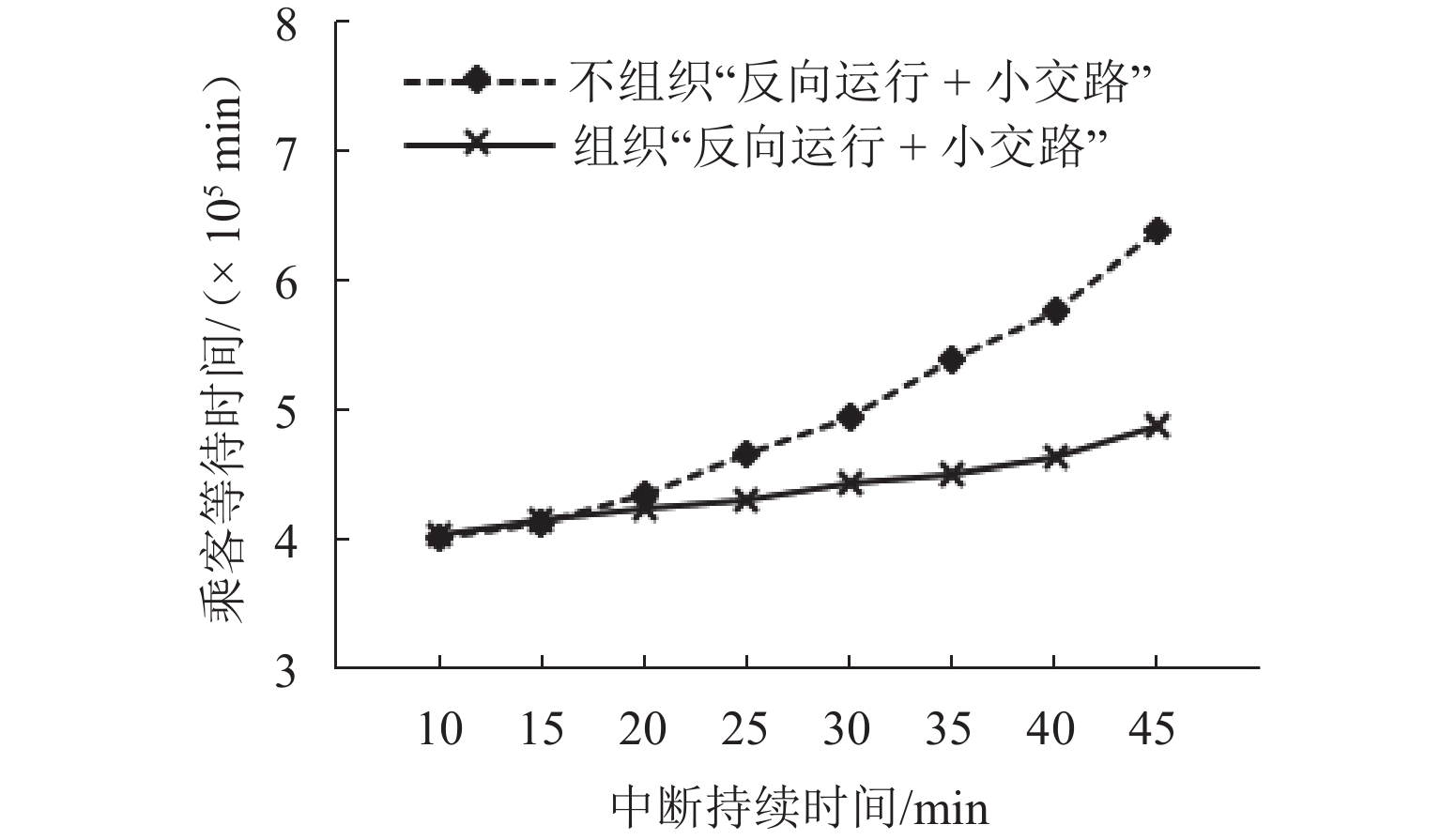
Operation interruption is a safety factor that cannot be ignored in the actual operation of urban rail transit. To address train operation adjustment under unidirectional operation interruption in urban rail transit, a combined adjustment strategy of “reverse operation + short turning” was proposed. From the perspective of passenger time value, taking the minimum waiting time of passengers at the station as the optimization objective, a two-stage model of urban rail transit train operation adjustment under unidirectional operation interruption was established for the interruption stage and the recovery stage. Considering the complexity of the model and the requirements of the adjustment problem for solution efficiency, an adaptive large-scale neighborhood search algorithm based on different service patterns was specifically designed for the proposed model, so as to achieve effective solutions for large-scale instances. The case study shows that, under unidirectional operation interruption, the “reverse operation + short turning” strategy reduces passenger waiting time by 5.19% compared with the reverse operation strategy. Compared with closing the interrupted direction line, it can reduce the waiting time of passengers on the whole line by 19.80%, and the transportation services in both directions are more balanced. In addition, when the interruption duration is more than 15 minutes, adopting the strategy of “reverse operation + short turning” to organize train operation adjustment can achieve better results than closing the interrupted direction line.

| [1] |
Wang X H, Jin J G, Sun L J. Real-time dispatching of operating buses during unplanned disruptions to urban rail transit system[J]. Transportation Research Part C: Emerging Technologies, 2022, 139: 103696. doi: 10.1016/j.trc.2022.103696
|
| [2] |
Ghaemi N, Cats O, Goverde R M P. A microscopic model for optimal train short-turnings during complete blockages[J]. Transportation Research Part B: Methodological, 2017, 105: 423-437. doi: 10.1016/j.trb.2017.10.002
|
| [3] |
Canca D, Barrena E, Zarzo A, et al. Optimal train reallocation strategies under service disruptions[J]. Procedia-Social and Behavioral Sciences, 2012, 54: 402-413. doi: 10.1016/j.sbspro.2012.09.759
|
| [4] |
Canca D, Barrena E, Laporte G, et al. A short-turning policy for the management of demand disruptions in rapid transit systems[J]. Annals of Operations Research, 2016, 246(1): 145-166. doi: 10.1007/s10479-014-1663-x
|
| [5] |
王丹丹. 城市轨道交通运营中断下面向乘客的列车运行调整研究[D]. 北京: 北京交通大学, 2020.
|
| [6] |
周玮腾, 钱蕾, 韩宝明, 等. 运营区间双向中断下城市轨道交通列车运行调整[J]. 东南大学学报(自然科学版), 2022, 52(4): 770-779.
Zhou Weiteng, Qian Lei, Han Baoming, et al. Train rescheduling of urban rail transit under bi-directional interruption in operation section[J]. Journal of Southeast University (Natural Science Edition), 2022, 52(4): 770-779.
|
| [7] |
Yin H D, Han B M, Li D W, et al. Modeling and simulating passenger behavior for a station closure in a rail transit network[J]. PLoS One, 2016, 11(12): e0167126. doi: 10.1371/journal.pone.0167126
|
| [8] |
刘峰博, 周庭梁, 王小敏. 城市轨道交通故障下客流分布计算及评估方法[J]. 西南交通大学学报, 2021, 56(5): 921-927, 966.
Liu Fengbo, Zhou Tingliang, Wang Xiaomin. Calculation and evaluation method of passenger flow distribution under urban rail transit failure[J]. Journal of Southwest Jiaotong University, 2021, 56(5): 921-927, 966.
|
| [9] |
Xu X M, Li K P, Yang L X. Rescheduling subway trains by a discrete event model considering service balance performance[J]. Applied Mathematical Modelling, 2016, 40(2): 1446-1466. doi: 10.1016/j.apm.2015.06.031
|
| [10] |
刘浩江. 单线双向运行在地铁行车组织中的应用[J]. 都市快轨交通, 2008, 21(3): 17-19, 23. doi: 10.3969/j.issn.1672-6073.2008.03.005
Liu Haojiang. Application of bidirectional operation on single track in subway train operation organization[J]. Urban Rapid Rail Transit, 2008, 21(3): 17-19, 23. doi: 10.3969/j.issn.1672-6073.2008.03.005
|
| [11] |
Xu Y, Jia B, Ghiasi A, et al. Train routing and timetabling problem for heterogeneous train traffic with switchable scheduling rules[J]. Transportation Research Part C: Emerging Technologies, 2017, 84: 196-218. doi: 10.1016/j.trc.2017.08.010
|
| [12] |
Huang Y R, Mannino C, Yang L X, et al. Coupling time-indexed and big-M formulations for real-time train scheduling during metro service disruptions[J]. Transportation Research Part B: Methodological, 2020, 133: 38-61. doi: 10.1016/j.trb.2019.12.005
|
| [13] |
Veelenturf L P, Kidd M P, Cacchiani V, et al. A railway timetable rescheduling approach for handling large-scale disruptions[J]. Transportation Science, 2015, 50(3): 841-862. doi: 10.2139/ssrn.2472934
|
| [14] |
户佐安, 夏一鸣, 蔡佳, 等. 延误条件下综合多种策略的城轨列车运行调整优化[J]. 吉林大学学报(工学版), 2021, 51(5): 1664-1672.
Hu Zuoan, Xia Yiming, Cai Jia, et al. Optimization of urban rail transit operation adjustment based on multiple strategies under delay[J]. Journal of Jilin University (Engineering and Technology Edition), 2021, 51(5): 1664-1672.
|
| [15] |
Huang Y R, Mannino C, Yang L X, et al. Coupling time-indexed and big-M formulations for real-time train scheduling during metro service disruptions[J]. Transportation Research Part B: Methodological, 2020, 133: 38-61. doi: 10.1016/j.trb.2019.12.005
|
| [16] |
Ghaemi N, Cats O, Goverde R M P. Railway disruption management challenges and possible solution directions[J]. Public Transport, 2017, 9(1): 343-364. doi: 10.1007/s12469-017-0157-z
|
| [17] |
孙晴, 张生瑞, 陈恒瑞. 城市轨道交通区间中断下列车运行调整[C]//2019世界交通运输大会论文集(上). 北京: 中国科学技术协会, 2019: 1642-1652.
|
| [18] |
Li S K, Zhou X S, Yang L X, et al. Automatic train regulation of complex metro networks with transfer coordination constraints: a distributed optimal control framework[J]. Transportation Research Part B: Methodological, 2018, 117: 228-253. doi: 10.1016/j.trb.2018.09.001
|
| [19] |
Peng S R, Yang X, Wang H W, et al. Dispatching high-speed rail trains via utilizing the reverse direction track: adaptive rescheduling strategies and application[J]. Sustainability, 2019, 11(8): 2351. doi: 10.3390/su11082351
|
| [20] |
Ropke S, Pisinger D. An adaptive large neighborhood search heuristic for the pickup and delivery problem with time windows[J]. Transportation Science, 2006, 40(4): 455-472. doi: 10.1287/trsc.1050.0135
|
| [21] |
徐长安, 李晟东, 李斯涵, 等. 高铁夕发朝至列车开行与天窗设置协同优化[J]. 西南交通大学学报, 2021, 56(4): 744-754.
Xu Chang’an, Li Shengdong, Li Sihan, et al. Collaborative optimization for overnight train operation and maintenance window setting of high-speed railways[J]. Journal of Southwest Jiaotong University, 2021, 56(4): 744-754.
|
Figures(9) / Tables(4)


 DownLoad: