- ISSN 0258-2724
- CN 51-1277/U
- EI Compendex
- Scopus
- Indexed by Core Journals of China, Chinese S&T Journal Citation Reports
- Chinese S&T Journal Citation Reports
- Chinese Science Citation Database

| Citation: | DING Tiecheng, ZHI Jinyi, ZOU Rui, WANG Zhenyu, HE Sijun, JING Chunhui. Impact of Initial Levels of Trust in Automation on Urban Rail Transit Driving Tasks[J]. Journal of Southwest Jiaotong University, 2025, 60(6): 1519-1526. doi: 10.3969/j.issn.0258-2724.20230654

|
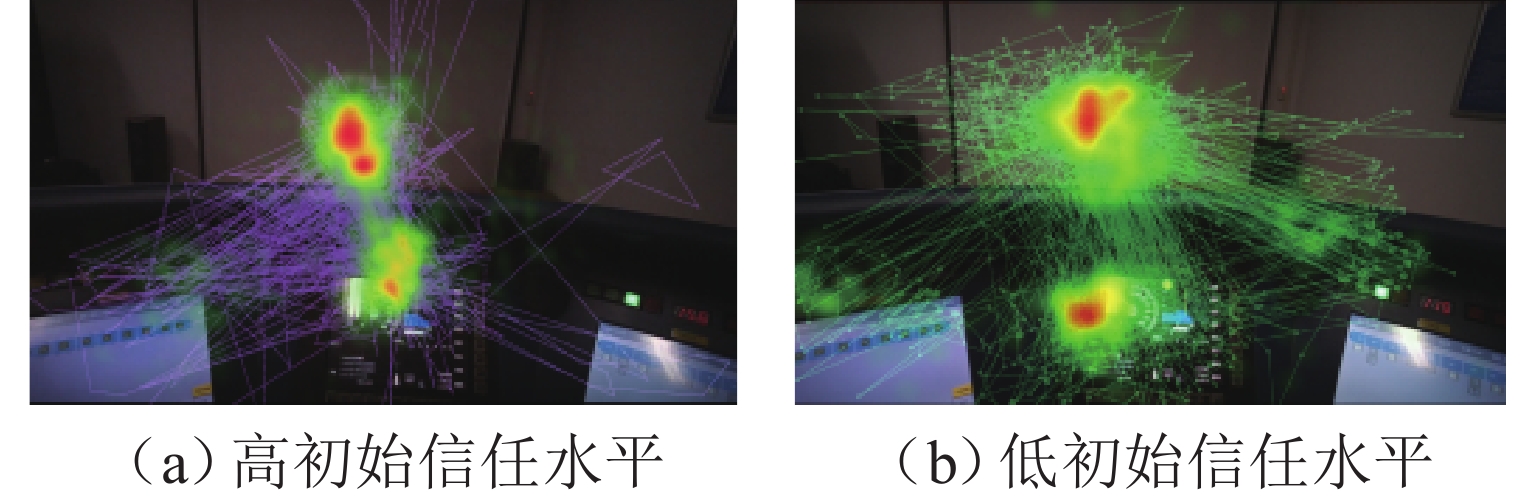
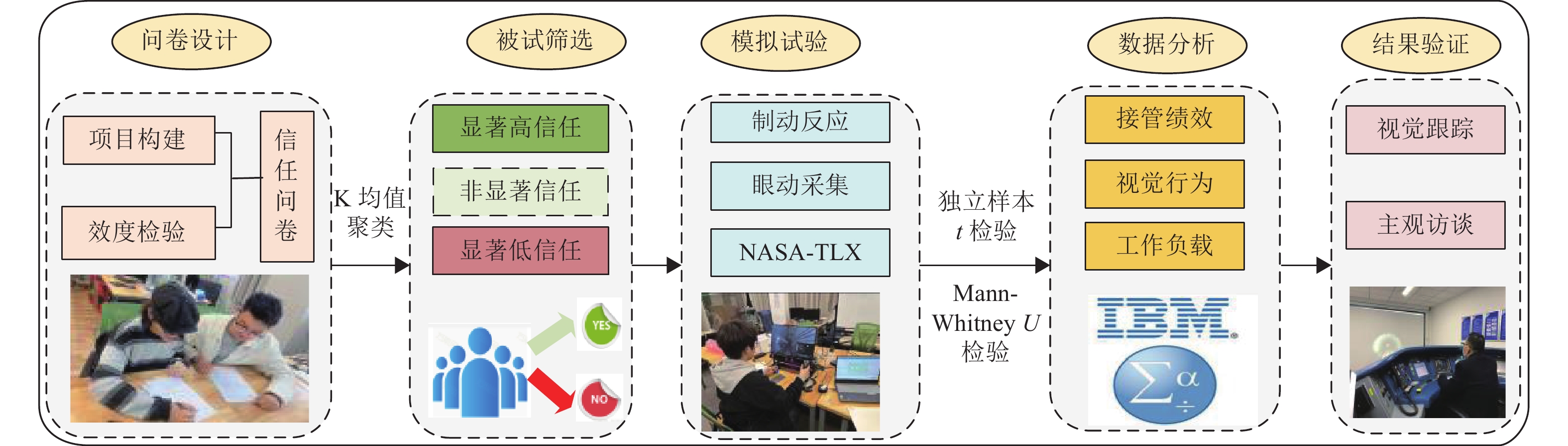
In order to ascertain the impact of the initial levels of trust in automation on takeover performance, workload, and visual behavior in urban rail transit driving tasks, a questionnaire assessing initial trust in automation was designed and validated. The questionnaire was used to screen participants with significantly different initial levels of trust for driving simulation tests. Takeover performance was evaluated by recording the response time of both routine and emergency braking. Workload was assessed by the National Aeronautics and Space Administration Task Load Index (NASA-TLX) questionnaire. Additionally, data on visual behavior differences were analyzed by capturing saccade counts, total fixation counts, fixation durations, and mean fixation durations in two distinct areas separately: the rail surface and the driving interface. The results indicate that participants with different initial levels of trust show no significant difference in takeover performance. A 21.39% reduction in overall workload, a 34.24% reduction in physical demand, and a 31.96% reduction in frustration are observed among participants with high initial levels of trust compared with those with low levels of trust. The initial level of trust significantly influences visual behavior. Low-trust participants tend to exhibit active visual search behaviors, who demonstrate 28.14% more fixation counts on the rail surface, 41.78% more saccade counts to the road surface, and 42.91% more saccade counts to the driving interface. Meanwhile, high-trust participants tend to display fixed visual gaze behaviors, with a 40.74% longer mean fixation duration on the rail surface. The findings of this study offer theoretical guidance and practical implications for enhancing driving safety interventions in urban rail transit.

| [1] |
付世亮. 城市轨道交通车辆系统安全完整性等级分析[J]. 城市轨道交通研究, 2019, 22(10): 70-74.
FU Shiliang. Safety integrity level analysis of urban guided transport vehicle system[J]. Urban Mass Transit, 2019, 22(10): 70-74.
|
| [2] |
徐田坤. 城市轨道交通网络运营安全风险评估理论与方法研究[D]. 北京: 北京交通大学, 2012.
|
| [3] |
向泽锐, 支锦亦, 李然, 等. 我国城市轨道列车工业设计研究综述[J]. 西南交通大学学报, 2021, 56(6): 1319-1328.
XIANG Zerui, ZHI Jinyi, LI Ran, et al. Review on industrial design of urban rail vehicles in China[J]. Journal of Southwest Jiaotong University, 2021, 56(6): 1319-1328.
|
| [4] |
SINGH P, DULEBENETS M A, PASHA J, et al. Deployment of autonomous trains in rail transportation: current trends and existing challenges[J]. IEEE Access, 2021, 9: 91427-91461. doi: 10.1109/ACCESS.2021.3091550
|
| [5] |
WANG A B, GUO B Y, DU H, et al. Impact of automation at different cognitive stages on high-speed train driving performance[J]. IEEE Transactions on Intelligent Transportation Systems, 2022, 23(12): 24599-24608. doi: 10.1109/TITS.2022.3211709
|
| [6] |
LEES T, CHALMERS T, BURTON D, et al. Electroencephalography as a predictor of self-report fatigue/sleepiness during monotonous driving in train drivers[J]. Physiological Measurement, 2018, 39(10): 105012.1-105012.13.
|
| [7] |
CHIOU E K, LEE J D. Trusting automation: designing for responsivity and resilience[J]. Human Factors, 2023, 65(1): 137-165. doi: 10.1177/00187208211009995
|
| [8] |
LEE J D, SEE K A. Trust in automation: designing for appropriate reliance[J]. Human Factors, 2004, 46(1): 50-80. doi: 10.1518/hfes.46.1.50.30392
|
| [9] |
ZHANG T R, TAO D, QU X D, et al. The roles of initial trust and perceived risk in public’s acceptance of automated vehicles[J]. Transportation Research Part C: Emerging Technologies, 2019, 98: 207-220. doi: 10.1016/j.trc.2018.11.018
|
| [10] |
KARPINSKY N D, CHANCEY E T, PALMER D B, et al. Automation trust and attention allocation in multitasking workspace[J]. Applied Ergonomics, 2018, 70: 194-201. doi: 10.1016/j.apergo.2018.03.008
|
| [11] |
PAN H Y, XU K, QIN Y, et al. How does drivers’ trust in vehicle automation affect non-driving-related task engagement, vigilance, and initiative takeover performance after experiencing system failure[J]. Transportation Research Part F: Traffic Psychology and Behaviour, 2023, 98: 73-90. doi: 10.1016/j.trf.2023.09.001
|
| [12] |
王新野, 李苑, 常明, 等. 自动化信任和依赖对航空安全的危害及其改进[J]. 心理科学进展, 2017, 25(9): 1614-1622. doi: 10.3724/SP.J.1042.2017.01614
WANG Xinye, LI Yuan, CHANG Ming, et al. The detriments and improvement of automation trust and dependence to aviation safety[J]. Advances in Psychological Science, 2017, 25(9): 1614-1622. doi: 10.3724/SP.J.1042.2017.01614
|
| [13] |
SKRAANING G, JAMIESON G A. Human performance benefits of the automation transparency design principle[J]. Human Factors, 2021, 63(3): 379-401. doi: 10.1177/0018720819887252
|
| [14] |
SEBOK A, WICKENS C D. Implementing lumberjacks and black swans into model-based tools to support human–automation interaction[J]. Human Factors, 2017, 59(2): 189-203. doi: 10.1177/0018720816665201
|
| [15] |
KÖRBER M, BASELER E, BENGLER K. Introduction matters: manipulating trust in automation and reliance in automated driving[J]. Applied Ergonomics, 2018, 66: 18-31. doi: 10.1016/j.apergo.2017.07.006
|
| [16] |
DU Y, ZHI J Y, HE S J. Impact of experience on visual behavior and driving performance of high-speed train drivers[J]. Scientific Reports, 2022, 12: 5956.1-5956.10.
|
| [17] |
MANCHON J B, BUENO M, NAVARRO J. How the initial level of trust in automated driving impacts drivers’ behaviour and early trust construction[J]. Transportation Research Part F: Traffic Psychology and Behaviour, 2022, 86: 281-295. doi: 10.1016/j.trf.2022.02.006
|
| [18] |
KOHN S C, DE VISSER E J, WIESE E, et al. Measurement of trust in automation: a narrative review and reference guide[J]. Frontiers in Psychology, 2021, 12: 604977.1-604977.23.
|
| [19] |
BRANDENBURGER N, NAUMANN A. On track: a series of research about the effects of increasing railway automation on the train driver[J]. IFAC-PapersOnLine, 2019, 52(19): 288-293. doi: 10.1016/j.ifacol.2019.12.115
|
| [20] |
O’CASS A, CARLSON J. An e-retailing assessment of perceived website-service innovativeness: implications for website quality evaluations, trust, loyalty and word of mouth[J]. Australasian Marketing Journal (AMJ), 2012, 20(1): 28-36. doi: 10.1016/j.ausmj.2011.10.012
|
| [21] |
POWELL J P, FRASZCZYK A, CHEONG C N, et al. Potential benefits and obstacles of implementing driverless train operation on the Tyne and wear metro: a simulation exercise[J]. Urban Rail Transit, 2016, 2(3): 114-127.
|
| [22] |
RYAN B, WILSON J R, SHARPLES S, et al. Developing a rail ergonomics questionnaire (REQUEST)[J]. Applied Ergonomics, 2009, 40(2): 216-229. doi: 10.1016/j.apergo.2008.04.006
|
| [23] |
BRANDENBURGER N, NAUMANN A, JIPP M. Task-induced fatigue when implementing high grades of railway automation[J]. Cognition, Technology & Work, 2021, 23(2): 273-283.
|
| [24] |
COTRIM T, CARVALHAIS J, NETO C, et al. Determinants of sleepiness at work among railway control workers[J]. Applied Ergonomics, 2017, 58: 293-300. doi: 10.1016/j.apergo.2016.07.006
|
| [25] |
NIU J W, GENG H, ZHANG Y J, et al. Relationship between automation trust and operator performance for the novice and expert in spacecraft rendezvous and docking (RVD)[J]. Applied Ergonomics, 2018, 71: 1-8. doi: 10.1016/j.apergo.2018.03.014
|
| [26] |
OLSSON N. A validation study comparing performance in a low-fidelity train-driving simulator with actual train driving performance[J]. Transportation Research Part F: Traffic Psychology and Behaviour, 2023, 97: 109-122. doi: 10.1016/j.trf.2023.07.007
|
| [27] |
NAWEED A, CHAPMAN J, VANDELANOTTE C, et al. ‘Just right’ job design: a conceptual framework for sustainable work in rail driving using the goldilocks work paradigm[J]. Applied Ergonomics, 2022, 105: 103806.1-103806.18.
|
| [28] |
BERGGREN N, EIMER M. Visual working memory load disrupts template-guided attentional selection during visual search[J]. Journal of Cognitive Neuroscience, 2018, 30(12): 1902-1915. doi: 10.1162/jocn_a_01324
|
| [29] |
HERGETH S, LORENZ L, VILIMEK R, et al. Keep your scanners peeled[J]. Human Factors, 2016, 58(3): 509-519. doi: 10.1177/0018720815625744
|
| [30] |
NATSOULAS T. The tunnel effect, Gibson’s perception theory, and reflective seeing[J]. Psychological Research, 1992, 54(3): 160-174. doi: 10.1007/BF00922095
|
| [31] |
STAPEL J, GENTNER A, HAPPEE R. On-road trust and perceived risk in Level 2 automation[J]. Transportation Research Part F: Traffic Psychology and Behaviour, 2022, 89: 355-370. doi: 10.1016/j.trf.2022.07.008
|
| [32] |
HARTWICH F, WITZLACK C, BEGGIATO M, et al. The first impression counts – A combined driving simulator and test track study on the development of trust and acceptance of highly automated driving[J]. Transportation Research Part F: Traffic Psychology and Behaviour, 2019, 65: 522-535. doi: 10.1016/j.trf.2018.05.012
|
| [33] |
WANG Z T, LI M K, ZHANG Q D, et al. High-speed train drivers’ operation performance: key factors, models, and management implications[J]. International Journal of Industrial Ergonomics, 2023, 97: 103482.1-103482.10.
|
| [34] |
MA S, ZHANG W, YANG Z, et al. Promote or inhibit: an inverted U-shaped effect of workload on driver takeover performance[J]. Traffic Injury Prevention, 2020, 21(7): 482-487. doi: 10.1080/15389588.2020.1804060
|
Figures(6) / Tables(3)



 DownLoad: