- ISSN 0258-2724
- CN 51-1277/U
- EI Compendex
- Scopus
- Indexed by Core Journals of China, Chinese S&T Journal Citation Reports
- Chinese S&T Journal Citation Reports
- Chinese Science Citation Database

| Citation: | WANG Lili, LIU Xinyu. Cross-Flight Flow Pre-conflict Resolution Based on Autonomous Diversion[J]. Journal of Southwest Jiaotong University, 2025, 60(6): 1476-1486. doi: 10.3969/j.issn.0258-2724.20230430

|
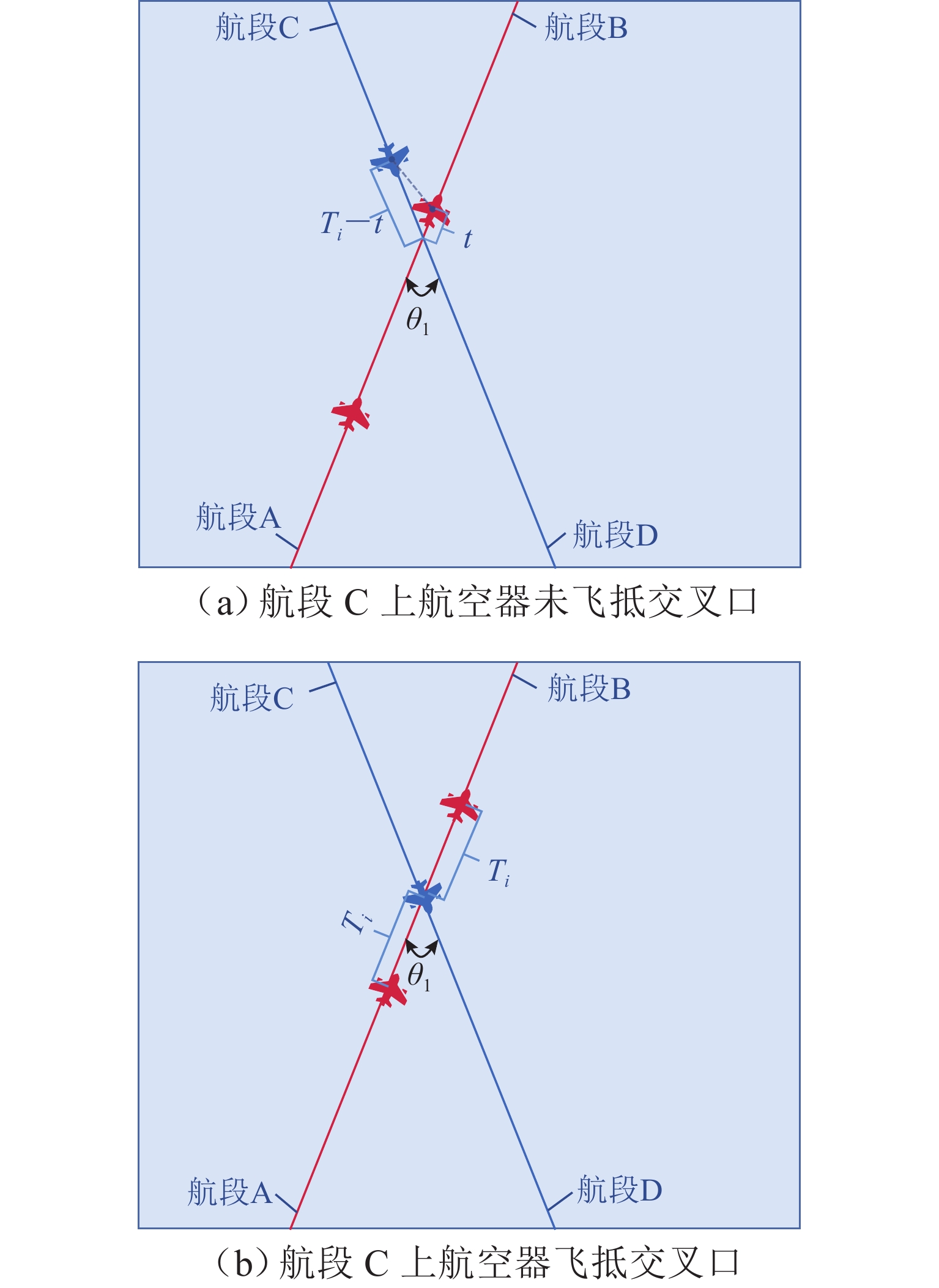
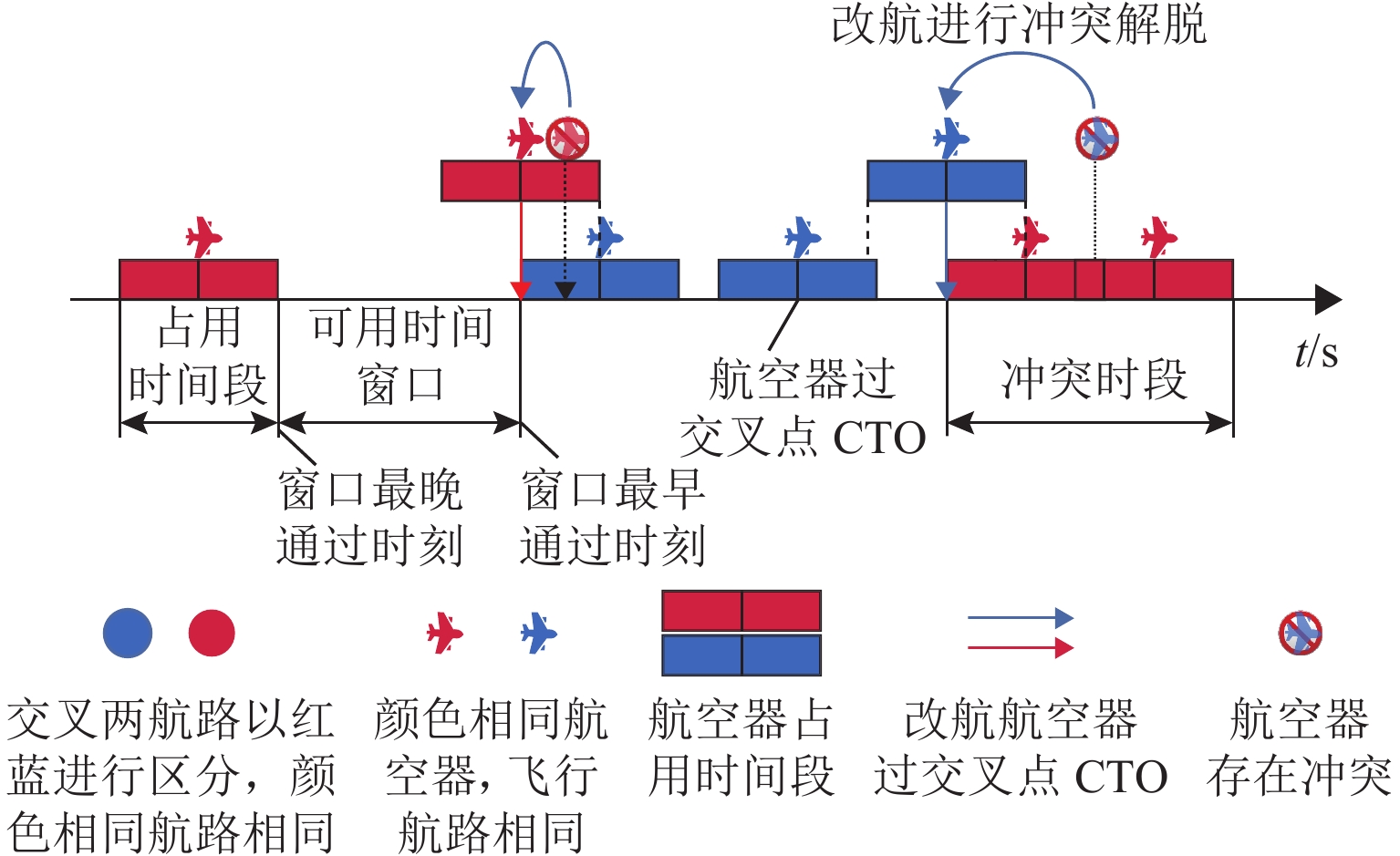
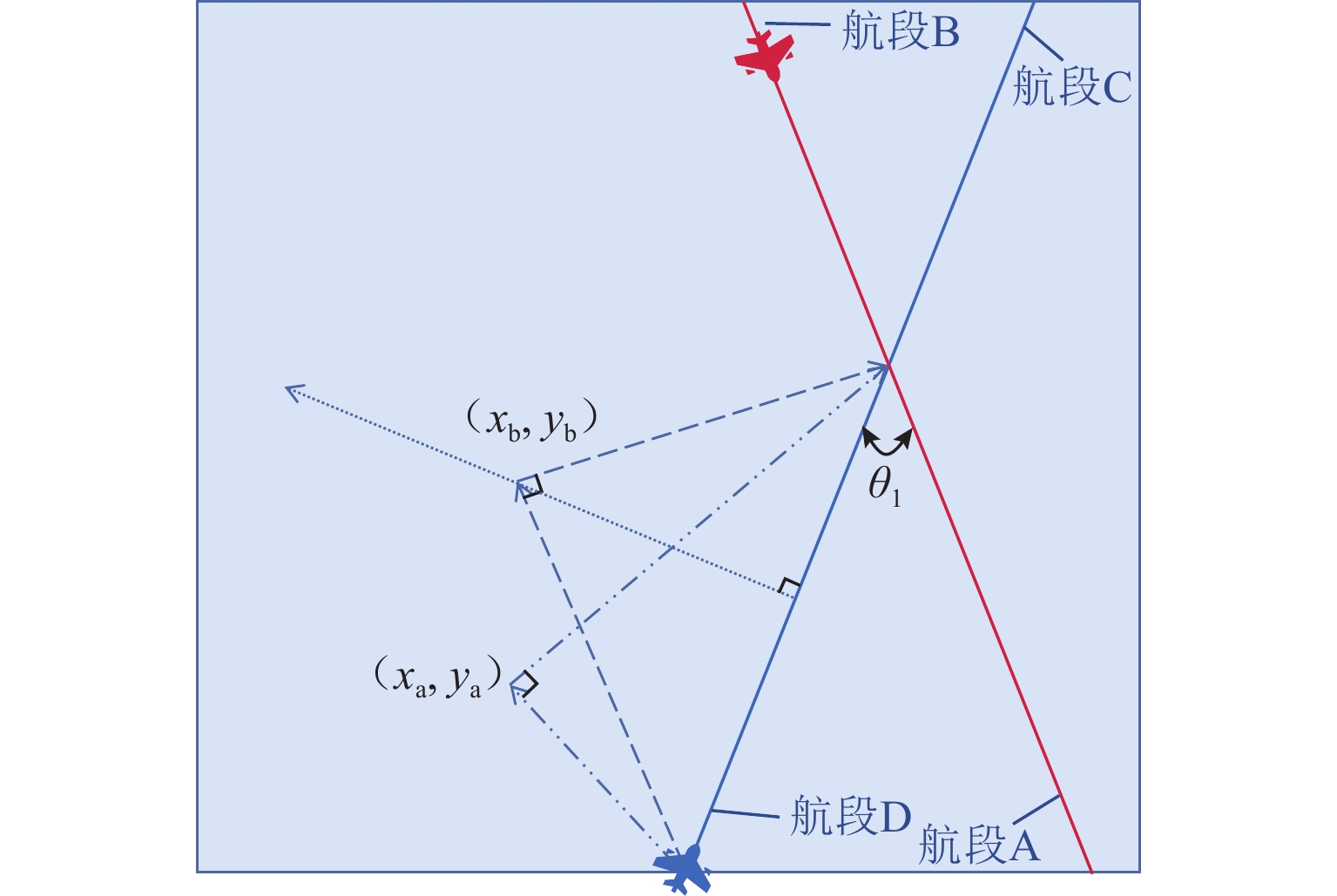
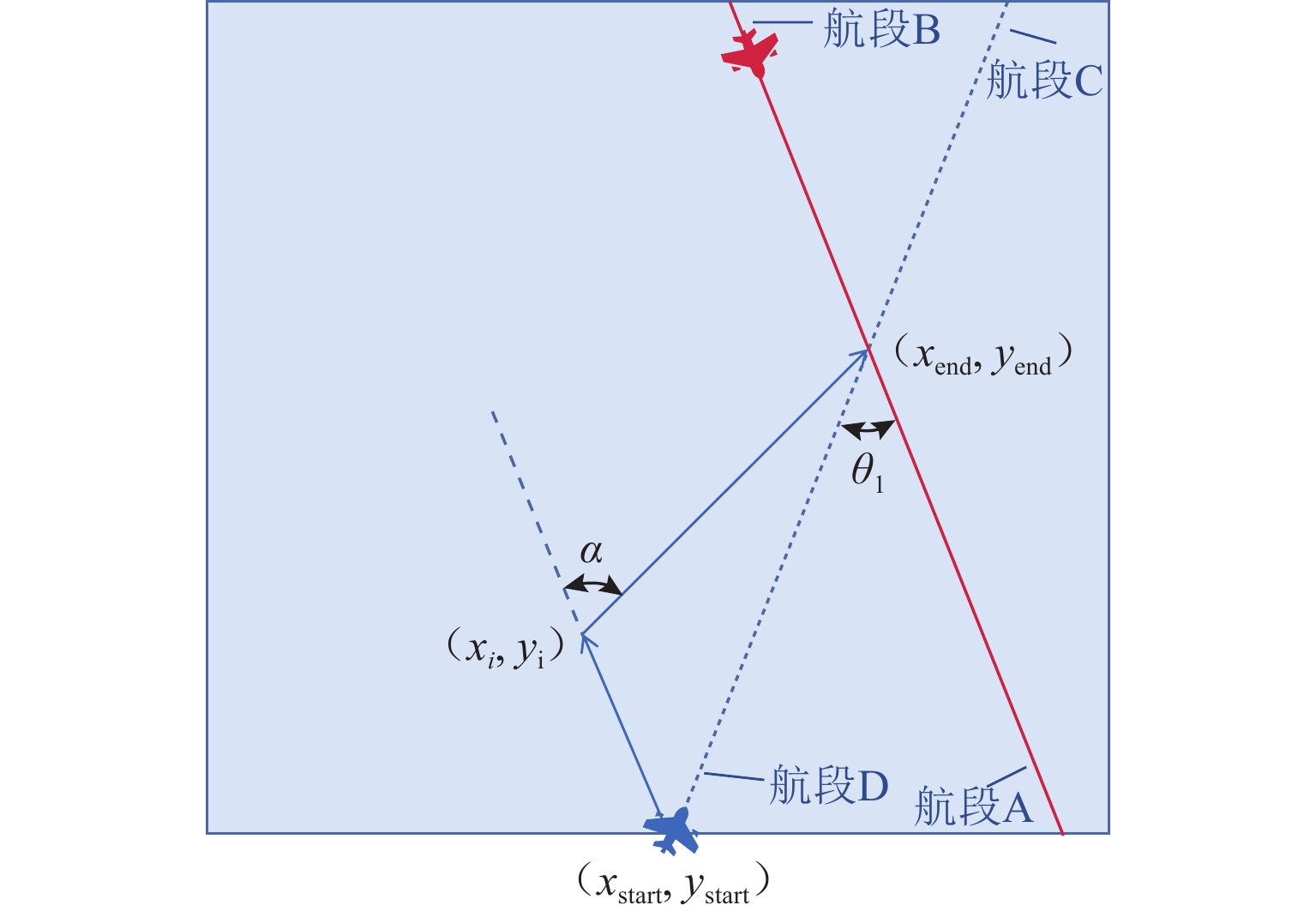
Control deployment at airway intersections has always been a core issue affecting the efficiency of air traffic control (ATC). Previous research has primarily focused on a small number of aircraft flights. As a result, a pre-conflict resolution method of large-scale cross-flight flow based on autonomous diversion in the trajectory-based operations (TBO) environment was proposed. Firstly, based on the horizontal safety interval between aircraft, the minimum longitudinal time interval that should be maintained when an aircraft crosses the intersection was converted; secondly, the concept of occupancy time window was proposed, and a conflict detection mechanism based on the occupancy time window was established. By integrating the principle of the shortest passage time for flight flows, a multi-objective decision-making model was established to achieve precise identification of conflicting aircraft and determine their priority for diversion. Finally, to address the issue of insufficient timeliness of traditional heuristic algorithms in flight flow movement, the feasible solution space was reduced by limiting the turning angles, and a search model for the diversion points was established to minimize the diversion time, thereby improving the solution speed and search accuracy. An example of a typical high-altitude sector in northeastern China was used to verify the effectiveness of the proposed method for actual cross-route operation. The simulation results indicate that the domino effect parameter (DEP) of the proposed conflict resolution method is 18.2% lower than that of the speed regulation resolution method. The total time consumption for speed regulation resolution is 7.6 times that of the proposed method. Therefore, the proposed method has a lesser impact on spatial stability and a higher resolution efficiency.

| [1] |
王莉莉, 胡亚坤. 空中航路交叉点的复杂度分析[J]. 计算机仿真, 2019, 36(8): 51-56, 246. doi: 10.3969/j.issn.1006-9348.2019.08.011
WANG Lili, HU Yakun. Research on improving runways capacity for BCIA[J]. Computer Simulation, 2019, 36(8): 51-56, 246. doi: 10.3969/j.issn.1006-9348.2019.08.011
|
| [2] |
RUIZ S, PIERA M A, POZO I D. A medium term conflict detection and resolution system for terminal maneuvering area based on spatial data structures and 4D trajectories[J]. Transportation Research Part C: Emerging Technologies, 2013, 26: 396-417.
|
| [3] |
OMER J. A space-discretized mixed-integer linear model for air-conflict resolution with speed and heading maneuvers[J]. Computers & Operations Research, 2015, 58: 75-86.
|
| [4] |
CECEN R K, CETEK C. A two-step approach for airborne delay minimization using pretactical conflict resolution in free-route airspace[J]. Journal of Advanced Transportation, 2019, 2019(1): 4805613.
|
| [5] |
王莉莉, 刘子昂. 针对平行航路的改航路径规划研究[J]. 重庆交通大学学报(自然科学版), 2020, 39(8): 45-5, 58. doi: 10.3969/j.issn.1674-0696.2020.08.07
WANG Lili, LIU Ziang. Reroute planning for parallel route[J]. Journal of Chongqing Jiaotong University (Natural Science), 2020, 39(8): 45-5, 58. doi: 10.3969/j.issn.1674-0696.2020.08.07
|
| [6] |
王莉莉, 杨惠东. 飞行冲突条件下基于几何算法的改航策略研究[J]. 飞行力学, 2012, 30(5): 466-469.
WANG Lili, YANG Huidong. Rerouting strategy research based on geometry algorithm in flight conflict[J]. Flight Dynamics, 2012, 30(5): 466-469.
|
| [7] |
吴君, 张京娟. 采用遗传算法的多机自由飞行冲突解脱策略[J]. 智能系统学报, 2013, 8(1): 16-20.
WU Jun, ZHANG Jingjuan. Conflict resolution of multiple airplanes in free flightbased on the genetic algorithm[J]. CAAI Transactions on Intelligent Systems, 2013, 8(1): 16-20.
|
| [8] |
向征, 张文奇, 张文军. 雷暴天气下基于多航空器冲突避让的路径规划[J]. 中国安全科学学报, 2019, 29(8): 151-156.
XIANG Zheng, ZHANG Wengi, ZHANG Wenjun. Route planning based on multi-aircraft conflict avoidance under thunderstorm weather[J]. China Safety Science Journal, 2019, 29(8): 151-156.
|
| [9] |
王红勇, 郭宇鹏. 终端区离场航空器自主路径规划研究[J]. 北京航空航天大学学报, 2025, 51(2): 446-456.
WANG Hongyong, GUO Yupeng. Research on autonomous path planning of departing aircraft in terminal area[J]. Journal of Beijing University of Aeronautics and Astronautics, 2025, 51(2): 446-456.
|
| [10] |
陈雨童, 胡明华, 杨磊, 等. 受限航路空域自主航迹规划与冲突管理技术[J]. 航空学报, 2020, 41(9): 253-270.
CHEN Yutong, HU Minghua, YANG Lei, et al. Autonomous trajectory planning and conflict management technology in restricted airspace[J]. Acta Aeronautica et Astronautica Sinica, 2020, 41(9): 253-270.
|
| [11] |
王岩韬, 刘锟. 危险天气下4D改航回归航迹规划方法[J]. 中国安全科学学报, 2023, 33(2): 110-117.
WANG Yantao, LIU Kun. Four-dimension diversion and regression path planning method in hazardous weather conditions[J]. China Safety Science Journal, 2023, 33(2): 110-117.
|
| [12] |
国际民航组织. 空中交通管理[M]. 16版. Montréal: [s.n.], 2016.
|
| [13] |
ICAO. Global air traffic management operational concept: AN/458—9854[S]. Montréal: [s.n.], 2005.
|
| [14] |
王莉莉, 周娟, 任杰. 交叉口汇聚航班的航线选择方法[J]. 南京航空航天大学学报, 2015, 47(1): 83-87.
WANG Lili, ZHOU Juan, REN Jie. Route selection method of converging flight at intersection[J]. Journal of Nanjing University of Aeronautics & Astronautics, 2015, 47(1): 83-87.
|
| [15] |
MILLER O M. Notes on cylindrical world map projections[J]. Geographical Review, 1942, 32(3): 424-430. doi: 10.2307/210384
|
| [16] |
李雄, 徐肖豪, 朱承元, 等. 基于几何算法的空中交通改航路径规划[J]. 系统工程, 2008(8): 37-40. doi: 10.3969/j.issn.1001-4098.2008.08.007
LI Xiong, XU Xiaohao, ZHU Chengyuan, et al. Air traffic reroute planning based on geometry algorithm[J]. Systems Engineering, 2008(8): 37-40. doi: 10.3969/j.issn.1001-4098.2008.08.007
|
| [17] |
BOS A. Model accuracy report for the base of aircraft Data (BADA): Revision 2.5[R]. Brétigny: EEC, 2012.
|
| [18] |
BILIMORIA K, SHETH K, LEE H, et al. Performance evaluation of airborne separation assurance for free flight[C]//18th Applied Aerodynamics Conference. Reston: AIAA, 2000: 4269.
|
Figures(11) / Tables(2)



 DownLoad: