



Modeling and Experimental Validation of “Vehicle-Guideway-Human” Dynamic System for High-Speed Maglev
-
摘要:
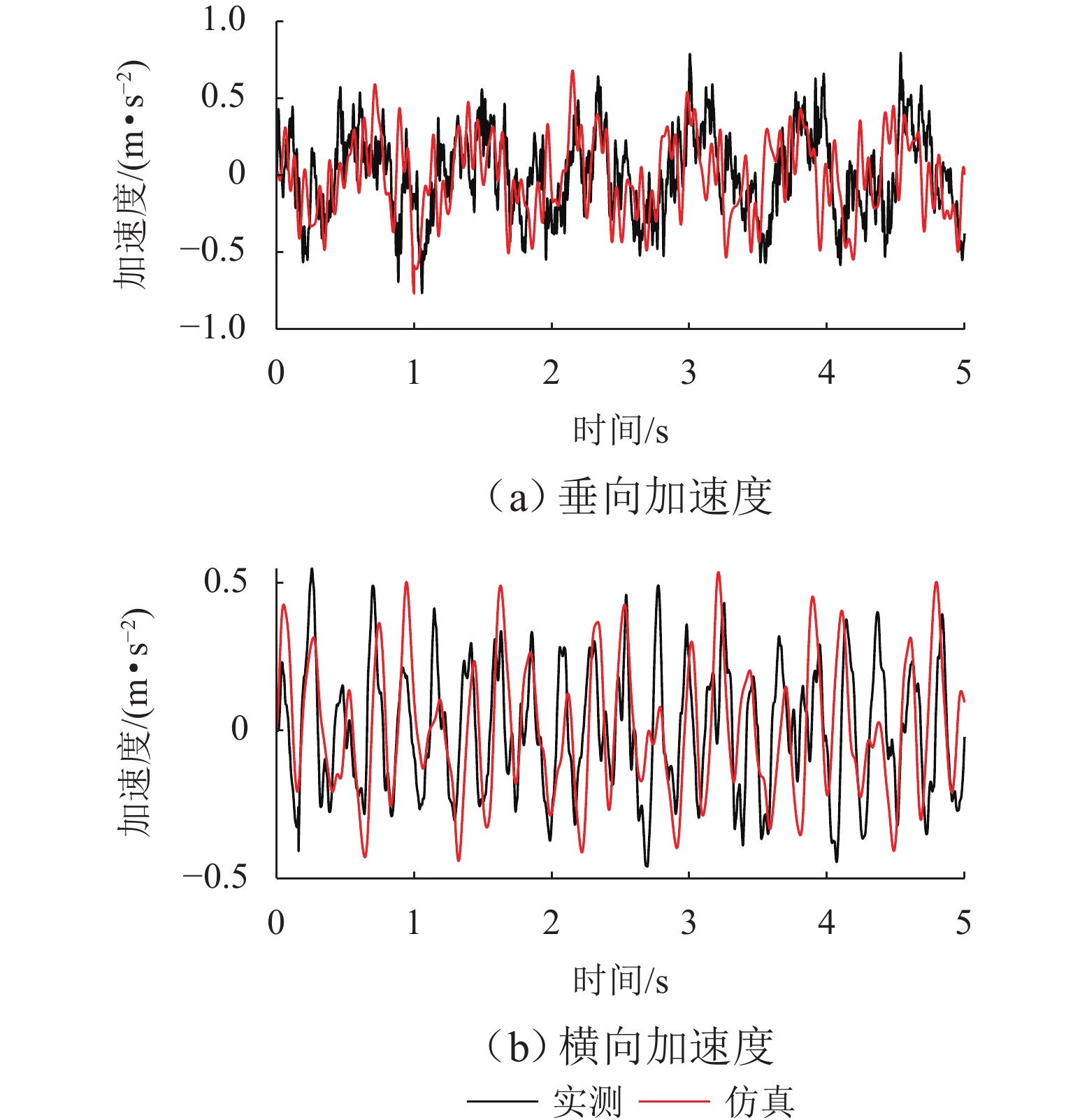
为研究600 km/h级高速磁浮列车轨道不平顺对乘坐舒适性的影响,针对常规动力学模型缺乏对人体精细化生物结构的描述,难以揭示车体运动与人体器官共振之间复杂相互作用的局限,本文提出一种集成“车辆-轨道-人体”全链路的耦合动力学仿真方法. 首先,基于多体动力学与有限元理论,建立包含空间柔性轨道梁、悬浮/导向主动控制算法及多体车辆动力学的系统仿真框架;其次,引入45自由度三维坐姿人体生物力学模型,构建全系统耦合动力学模型,以解决振动传递路径中人体感知端的失真问题;然后,结合系统模态分析,揭示车体运动与人体内脏器官及骨骼系统共振的耦合机理;最后,利用上海高速磁浮示范线实测数据对模型进行验证. 试验结果表明:依据标准(GB/T 5599—2019)计算的列车运行平稳性指标显示,实测垂向与横向的平稳性指标分别为2.33(优秀)和2.61(良好),仿真计算值分别为2.28和2.56,相对误差仅为2.15%和1.92%;针对人体直接感知的座椅面振动,实测座椅面的垂向与横向加速度峰值分别为0.915 m/s2和1.115 m/s2,仿真结果的对应误差均控制在5.00%以内(分别为0.76%和2.91%);在频域层面,模型不仅准确复现约1.5 Hz的车体刚体模态,更精准捕捉约4.0~6.0 Hz频段由人体生物力学特性主导的耦合共振峰,验证了该模型在精细化舒适性预测中的有效性.
Abstract:To study the influence of guideway irregularity on ride comfort of 600 km/h high-speed maglev trains and to address the limitations of conventional dynamic models, which lack detailed descriptions of human biological structures and thus fail to reveal the complex interactions between vehicle body motion and resonance of human internal organs, an integrated full-chain “vehicle-guideway-human” coupled dynamic simulation method was proposed. First, a system simulation framework was established based on multibody dynamics and finite element theory, incorporating spatial flexible guideway beams, active levitation/guidance control algorithms, and multibody vehicle dynamics. Second, a 45 degrees of freedom (DOF) three-dimensional seated human biomechanical model was introduced to construct a full-system coupled dynamic model, thereby addressing the distortion at the human perception end in the vibration transmission path. Then, system modal analysis was employed to reveal the coupling mechanism between vehicle body motion and the resonance of human internal organs and skeletal system. Finally, the model was validated using measured data from the Shanghai high-speed maglev demonstration line. The results indicate that according to the standard (GB/T 5599—2019), the measured vertical and lateral ride quality indices are 2.33 (excellent) and 2.61 (good), respectively, while the simulated values are 2.28 and 2.56, with relative errors of only 2.15% and 1.92%, respectively. Furthermore, for the seat surface vibration directly perceived by the human body, the measured peak vertical and lateral accelerations are 0.915 m/s2 and 1.115 m/s2, respectively, with corresponding simulation errors controlled within 5.00% (0.76% and 2.91%, respectively). In the frequency domain, the model not only accurately reproduces the car body’s rigid body mode at approximately 1.5 Hz but also precisely captures the coupled resonance peaks in the 4.0–6.0 Hz band dominated by human biomechanical characteristics, thereby verifying the effectiveness of the model in refined ride comfort prediction.
-
Key words:
- maglev train /
- vehicle-guideway-human coupling /
- dynamic modeling /
- human biomechanics /
- ride comfort
-
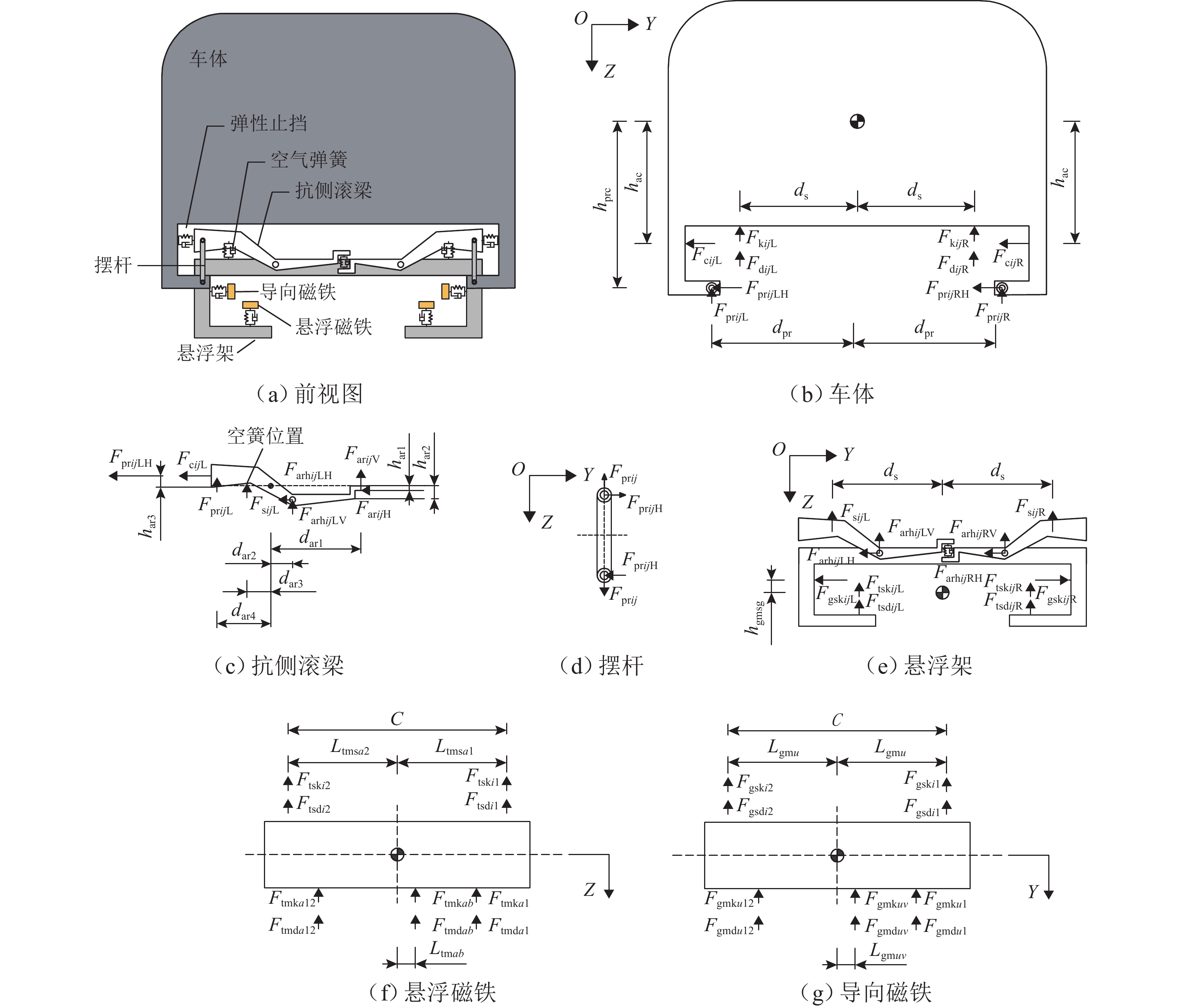
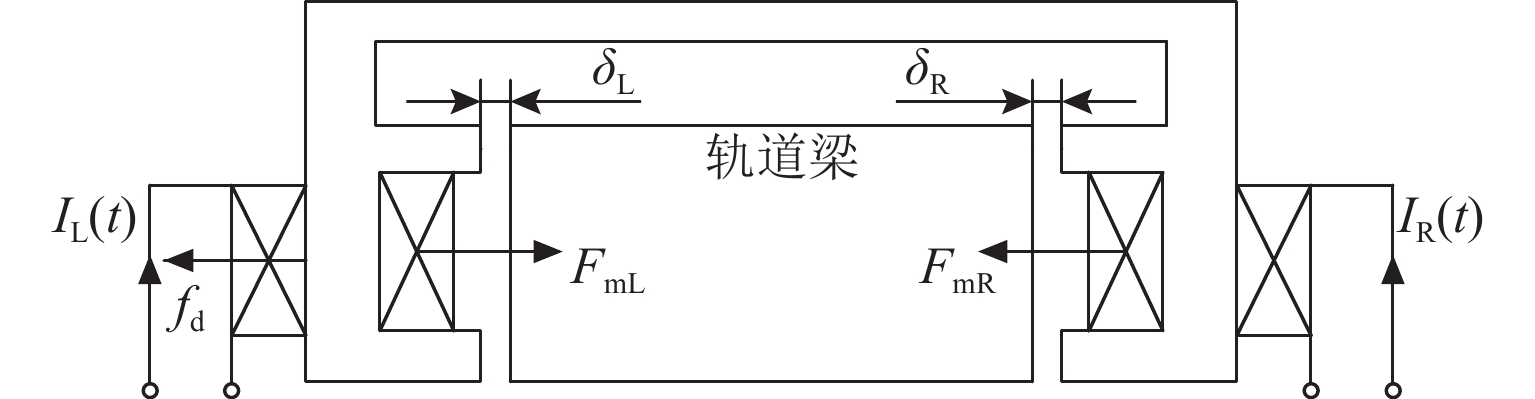
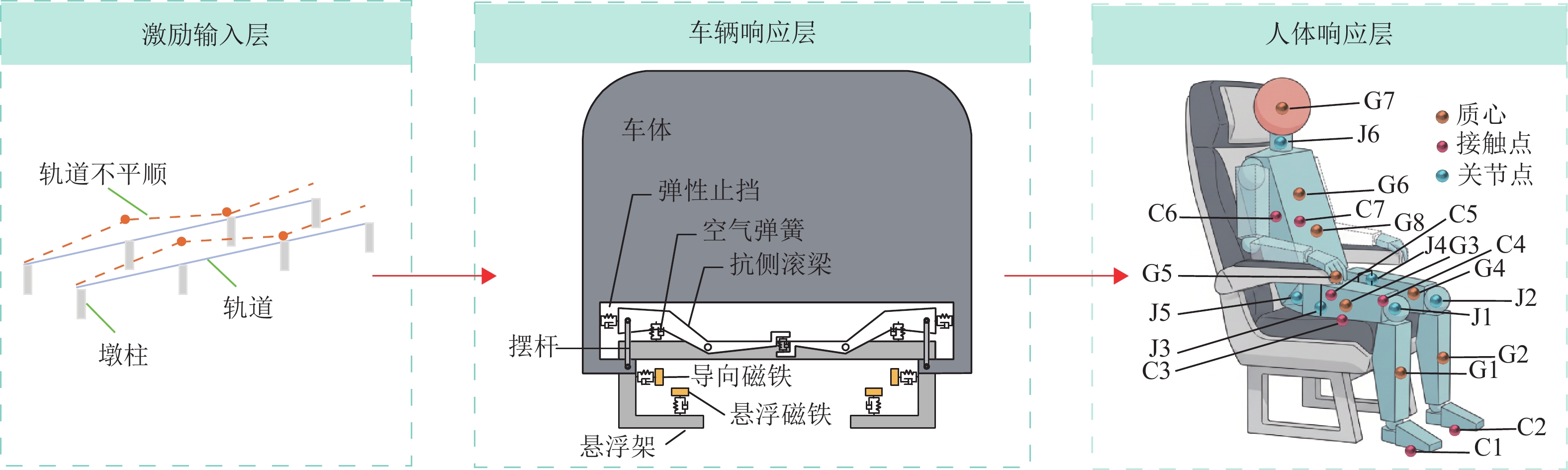
图 2 车辆模型及各部件受力分析
Figure 2. Vehicle model and force analysis diagrams of each component
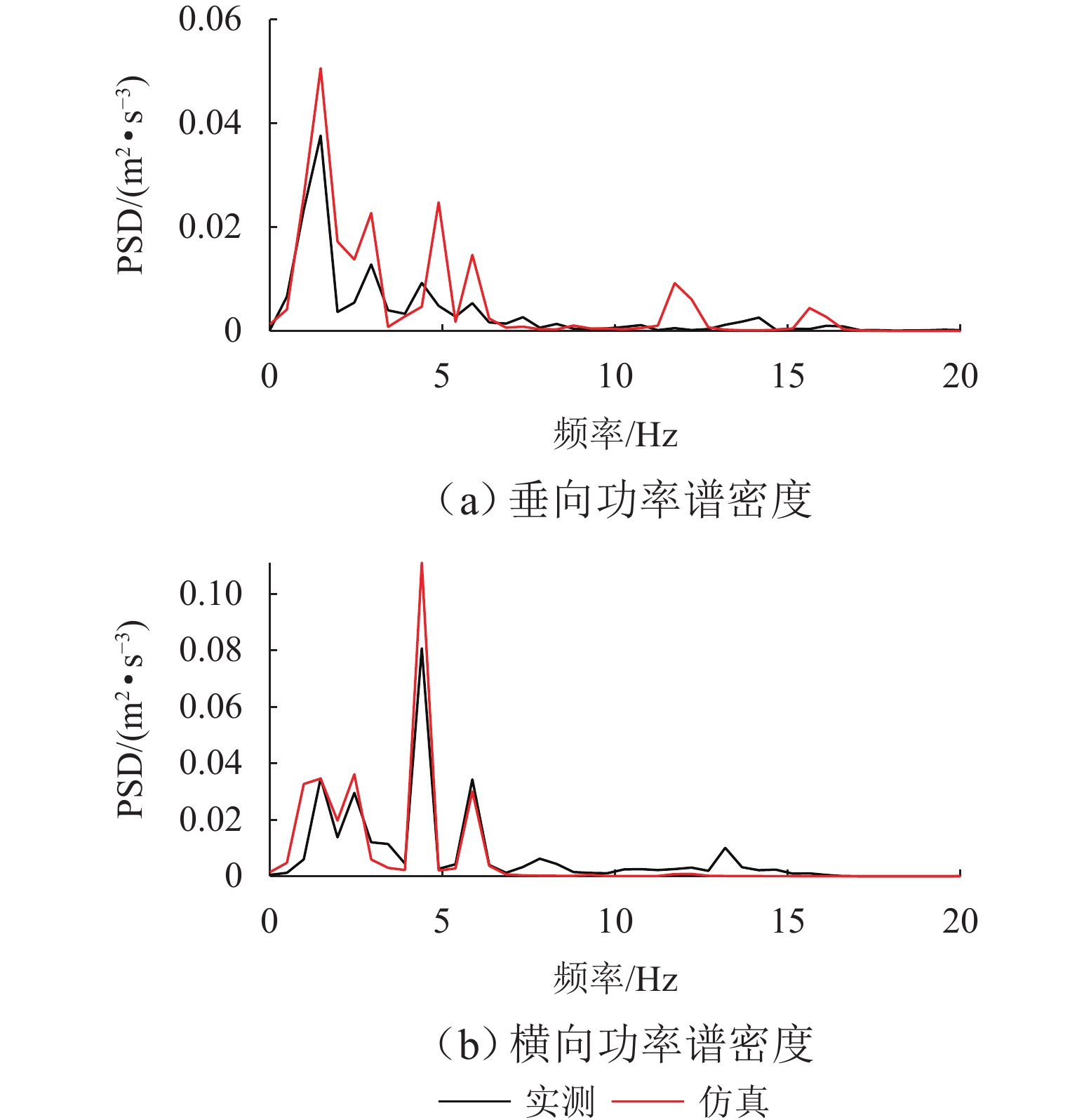
图 9 座椅面振动频域对比结果
Figure 9. Frequency-domain comparison results of seat surface vibration
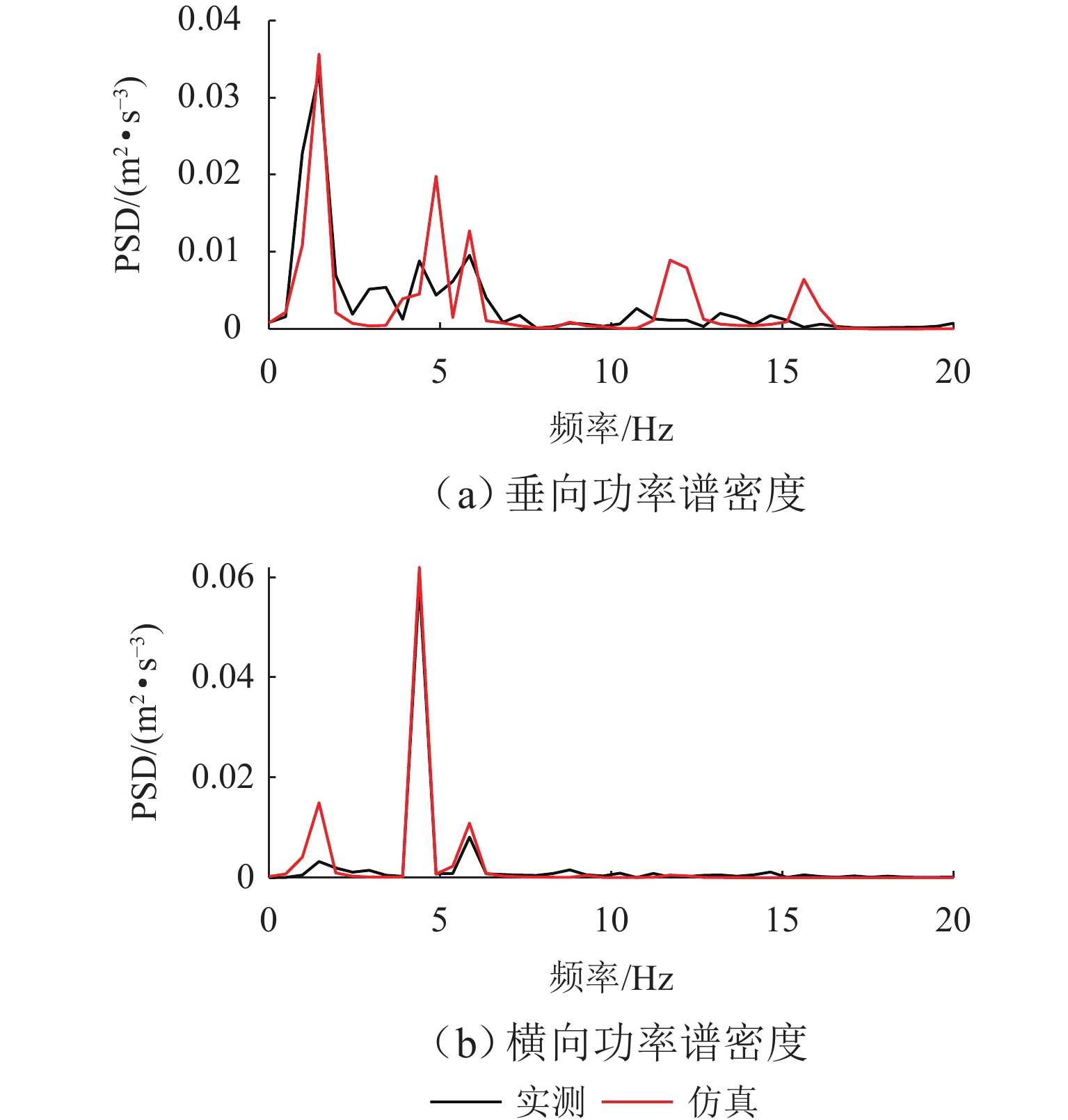
图 10 车厢地板振动频域对比结果
Figure 10. Frequency-domain comparison results of carriage floor vibration
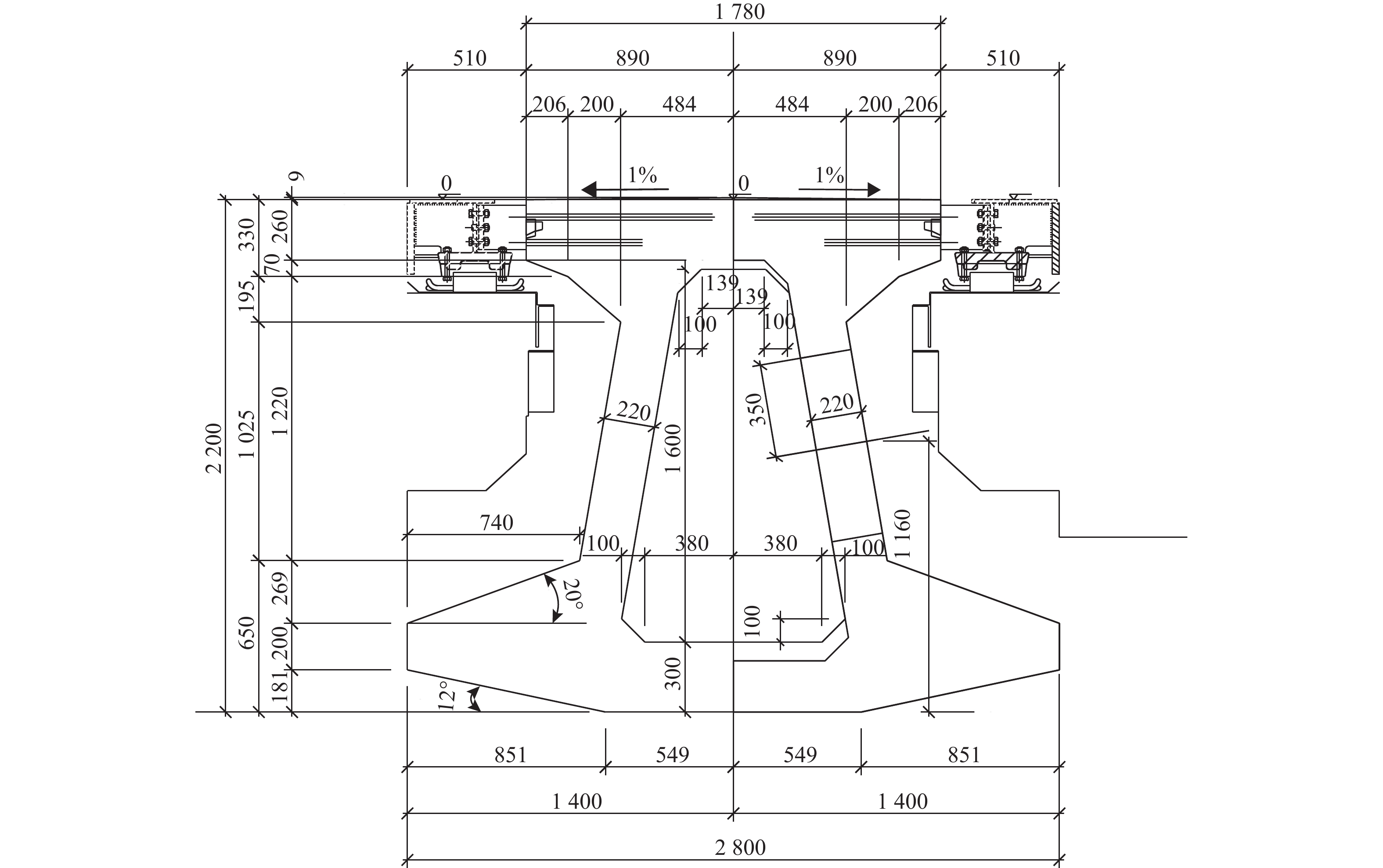
表 2 轨道梁相关参数
Table 2. Guideway beam parameters
参数 密度 ρ /(kg·m−3) 泊松比 μ 弹性模量 E/MPa 数值 2790 0.167 3.6×10¹⁰  下载: 导出CSV
表 1 人体动力学模型节点定义
Table 1. Human dynamic model node definitions
类别 编号 描述 质心 G1/G2 左/右小腿 G3/G4 左/右大腿 G5 骨盆 G6 躯干 G7 头部 G8 内脏器官 关节点 J1/J2 左/右膝关节,连接小腿与大腿 J3/J4 左/右髋关节,连接大腿与骨盆 J5 腰椎关节,连接骨盆与躯干 J6 颈椎关节,连接躯干与头部 接触点 C1/C2 左/右脚与地板的接触点 C3/C4 左/右大腿与座椅座垫的接触界面 C5 臀部与座椅座垫的主要接触界面 C6 背部与座椅靠背的接触界面 C7 内脏与躯干的等效连接点
下载: 导出CSV
表 3 坐姿人体动力学模型前3阶模态分析结果
Table 3. Analysis results of first three modes of seated human dynamic model
模态阶数/阶 模态频率/Hz 主要振型描述 1 1.19 全身横向与侧倾耦合的摇摆运动,伴随内脏的横向振动 2 3.21 全身纵向运动,伴随显著的上半身俯仰及偏航转动,内脏以纵向振动为主 3 4.61 全身垂向运动,耦合了上半身与骨盆的纵向、俯仰运动,内脏同样以纵向振动为主
下载: 导出CSV
表 4 关键数据处理流程及验证结论汇总
Table 4. Summary of key data processing flows and validation conclusions
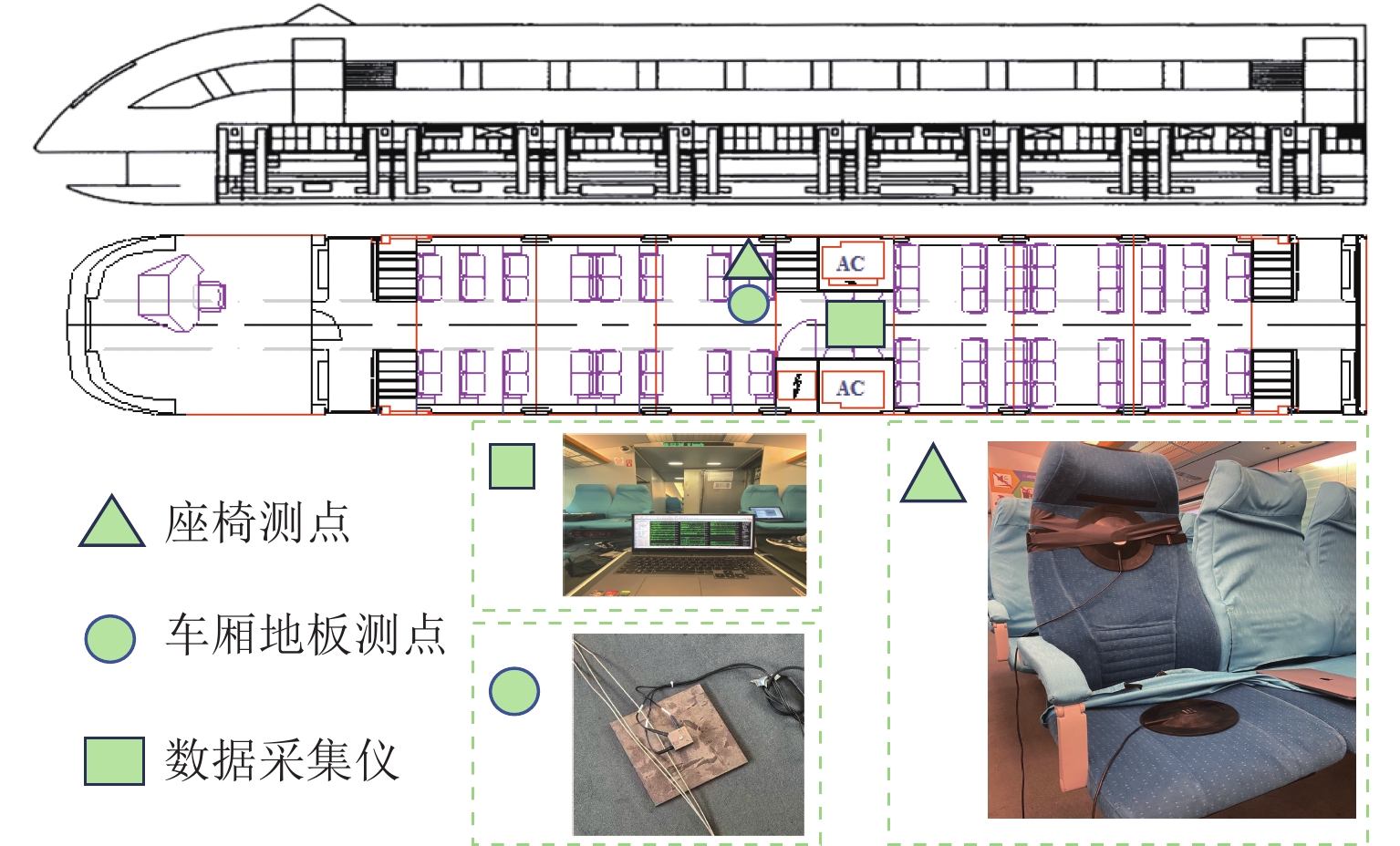
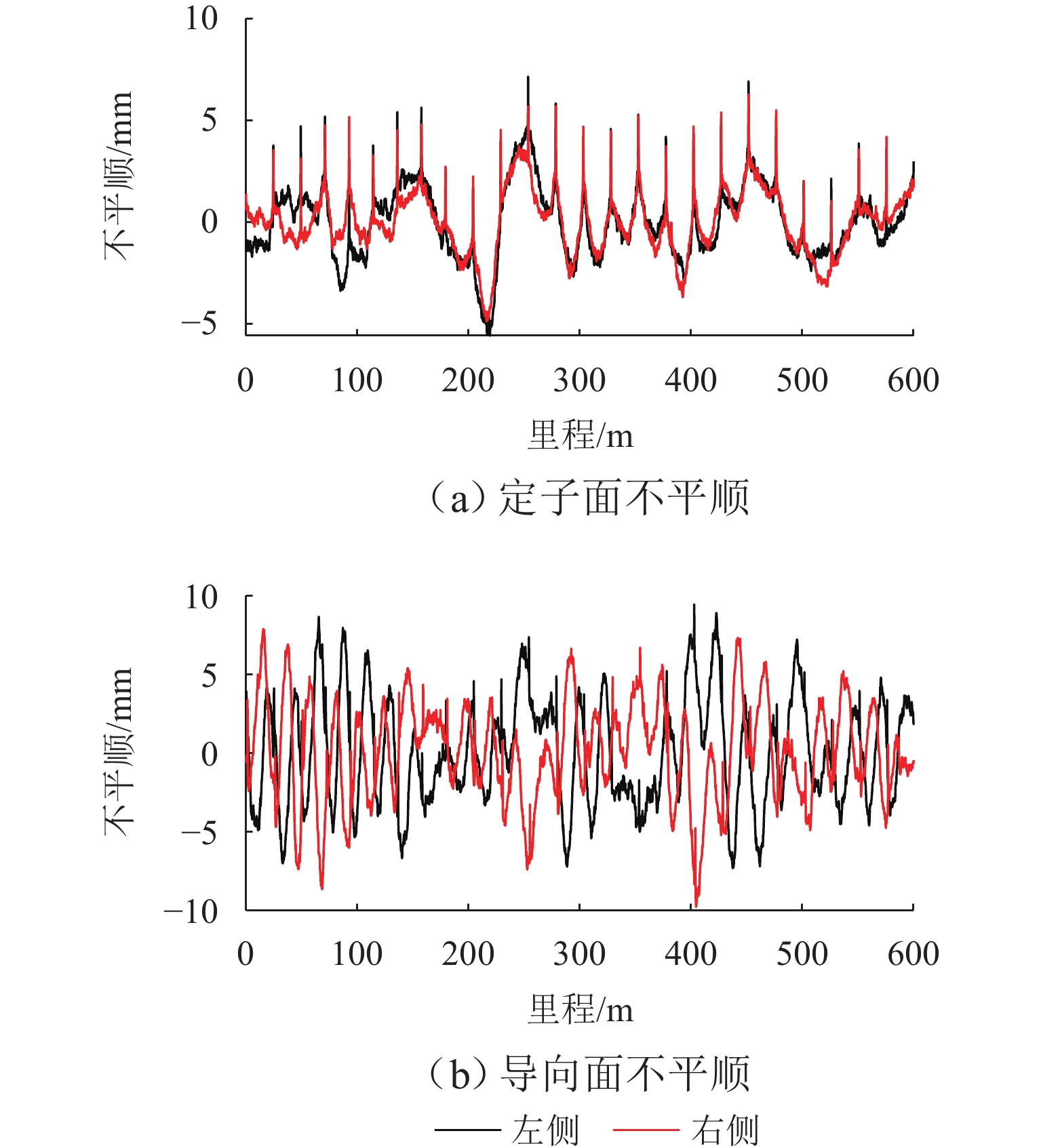
数据类型 处理流程 车厢地板振动 1) 激励输入:实测轨道不平顺 2) 动力计算:通过悬浮/导向控制算法计算动态电磁力,驱动多体车辆模型与柔性轨道梁模型进行双向耦合迭代;采用 Newmark-β 积分法求解得到车厢地板(即人体基座)的加速度响应 座椅面
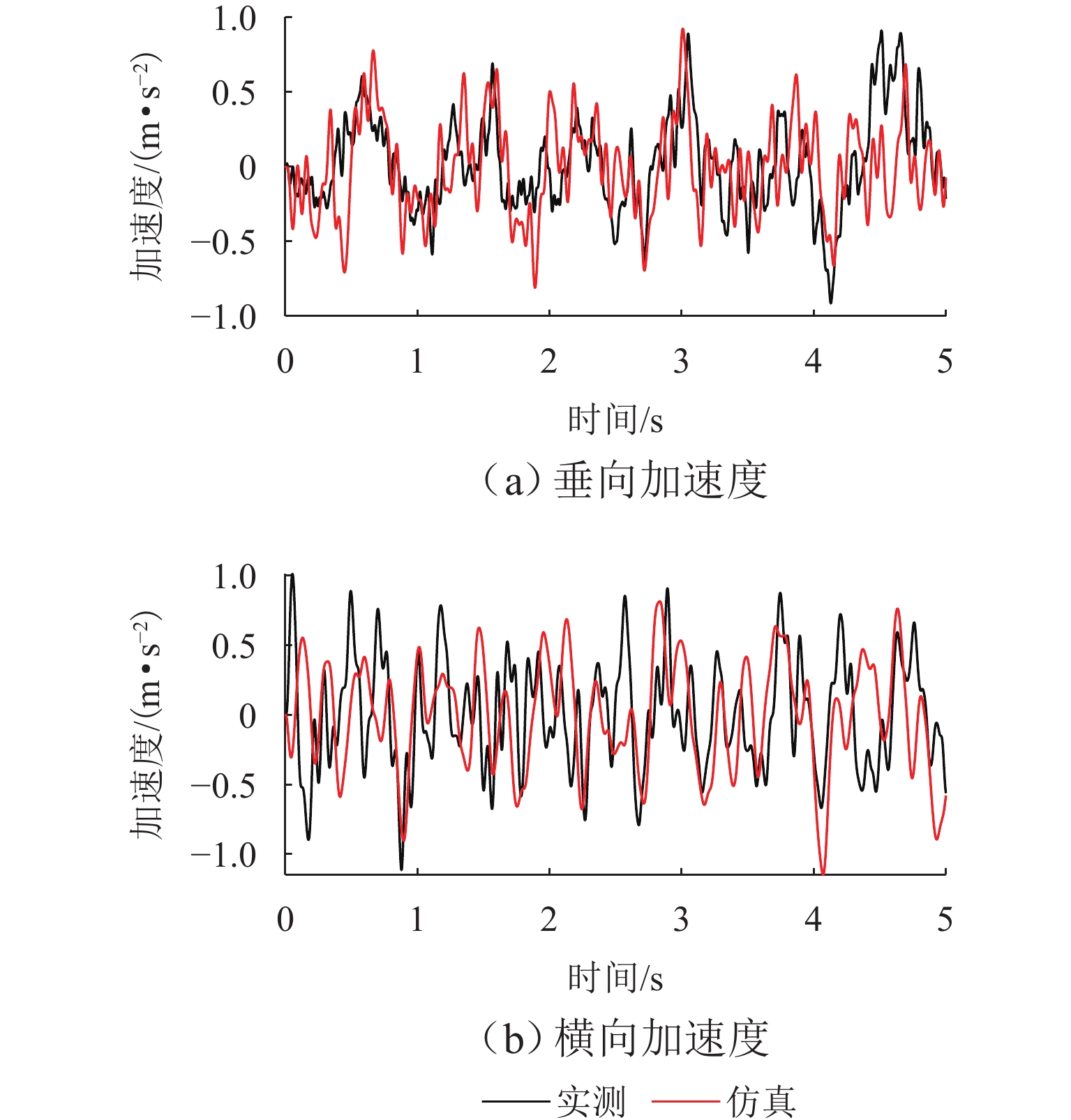
振动1) 激励输入:计算得到的车厢地板振动 2) 动力计算:基于 45 自由度人体模型,通过接触力算法实时解算人体各节段与座椅间的动态相互作用;采用 Newmark-β 积分法求解得到座椅面的加速度响应 列车运行平稳性
指标1) 信号加权:依据规范(GB/T 5599—2019),引入人体对不同频率振动敏感度的加权函数,对原始加速度信号进行滤波处理 2) 指标计算:基于加权后的振动能量,按规范公式计算列车运行平稳性指标
下载: 导出CSV
表 5 仿真与实测时域统计特征及列车运行平稳性指标对比
Table 5. Comparison of time-domain statistical characteristics and train ride quality indices between simulation and measurement
评价类别 评价指标 实测值 仿真值 相对误差/% 座椅面垂向振动 最大值/(m·s−2) 0.915 0.922 0.76 方差/(m2·s−4) 0.096 0.098 1.70 标准差/(m·s−2) 0.310 0.313 0.85 座椅面横向振动 最大值/(m·s−2) 1.115 1.147 2.91 方差/(m2·s−4) 0.150 0.153 2.04 标准差/(m·s−2) 0.387 0.391 1.01 车厢地板垂向振动 最大值/(m·s−2) 0.796 0.768 3.50 方差/(m2·s−4) 0.075 0.065 12.88 标准差/(m·s−2) 0.273 0.255 6.66 车厢地板横向振动 最大值/(m·s−2) 0.549 0.537 2.29 方差/(m2·s−4) 0.046 0.051 10.58 标准差/(m·s−2) 0.214 0.225 5.16 列车运行平稳性 垂向平稳性指标 2.331 2.281 2.15 横向平稳性指标 2.611 2.562 1.92
下载: 导出CSV
-
[1] Xiao X B, Xu H W, Yang Y, et al. Analysis of the influence of track irregularity on high-speed train ride comfort[J]. Vehicle System Dynamics, 2024, 62(7): 1658-1685. doi: 10.1080/00423114.2023.2250888 [2] 韩艳, 卜秀孟, 王力东, 等. 高速磁浮列车-轨道梁耦合系统轨道不平顺敏感波长研究[J]. 振动与冲击, 2024, 43(5): 1-11, 19.Han Yan, Bu Xiumeng, Wang Lidong, et al. High-speed maglev train-track beam coupled system track irregularity sensitive wavelengths[J]. Journal of Vibration and Shock, 2024, 43(5): 1-11,19. [3] 赵春发, 冯洋, 翟婉明. 面向列车稳定舒适运行的磁浮交通车线动力学参数匹配设计[J]. 前瞻科技, 2023, 2(4): 49-60. doi: 10.3981/j.issn.2097-0781.2023.04.005Zhao Chunfa, Feng Yang, Zhai Wanming. Matching design of train and line dynamics parameters of maglev transportation oriented toward stable and comfortable train running[J]. Science and Technology Foresight, 2023, 2(4): 49-60. doi: 10.3981/j.issn.2097-0781.2023.04.005 [4] 杨飞, 孙宪夫, 谭社会, 等. 动静态轨道不平顺评价差异及动态弦测法特性[J]. 西南交通大学学报, 2022, 57(6): 1239-1249.Yang Fei, Sun Xianfu, Tan Shehui, et al. Evaluation difference of dynamic and static track irregularity and characteristics of dynamic chord measurement method[J]. Journal of Southwest Jiaotong University, 2022, 57(6): 1239-1249. [5] Liu M B, Ye F, Zeng G F. Research of the track irregularity spectrum of Shanghai high-speed transrapid demonstration line[J]. Vehicle System Dynamics, 2024, 62(8): 2054-2078. doi: 10.1080/00423114.2023.2273868 [6] 罗奕, 袁宇航, 邓斌, 等. 基于自参考自适应噪声消除的永磁轨道不平顺测量方法[J]. 西南交通大学学报, 2025, 60(4): 904-911.Luo Yi, Yuan Yuhang, Deng Bin, et al. Measurement method for permanent magnet guideway irregularity based on self-adaptive noise cancellation[J]. Journal of Southwest Jiaotong University, 2025, 60(4): 904-911. [7] Zhou D F, Yu P C, Wang L C, et al. An adaptive vibration control method to suppress the vibration of the maglev train caused by track irregularities[J]. Journal of Sound and Vibration, 2017, 408: 331-350. doi: 10.1016/j.jsv.2017.07.037 [8] Mao J F, Li D H, Yu Z W, et al. A novel refined dynamic model of high-speed maglev train-bridge coupled system for random vibration and running safety assessment[J]. Journal of Central South University, 2024, 31(7): 2532-2544. doi: 10.1007/s11771-024-5671-y [9] 时瑾, 魏庆朝. 线路不平顺对高速磁浮铁路动力响应特性的影响[J]. 工程力学, 2006, 23(1): 154-159, 86.Shi Jin, Wei Qingchao. The effect of guideway irregularity on the dynamic characteristics of high-speed maglev railway[J]. Engineering Mechanics, 2006, 23(1): 154-159, 86. [10] 姜培斌, 凌亮, 丁鑫, 等. 考虑车体刚柔耦合振动的高速铁路轨道不平顺敏感波长研究[J]. 振动与冲击, 2021, 40(15): 79-89.Jiang Peibin, Ling Liang, Ding Xin, et al. Track irregularity sensitive wavelengths of high-speed railway considering flexible vibration of vehicle body[J]. Journal of Vibration and Shock, 2021, 40(15): 79-89. [11] 张斌. 轮轨匹配与轨道不平顺对地铁车辆横向晃动影响研究[D]. 成都: 西南交通大学, 2022. [12] ISO 5982—2019 International Organization for Standardization. Mechanical vibration and shock - Range of idealized values to characterize human biodynamic response under whole-body vibration[S]. [13] Gao J M, Wang X T. Comparative analysis of ride comfort evaluation indices of high-speed vehicles based on a vehicle-seat-human body coupled dynamics model[J]. Proceedings of the Institution of Mechanical Engineers, Part K: Journal of Multi-body Dynamics, 2024, 238(4): 507-523. doi: 10.1177/14644193241291468 [14] Guruguntla V, LAL M, Pradeep Ghantasala G S, et al. Ride comfort and segmental vibration transmissibility analysis of an automobile passenger model under whole body vibration[J]. Scientific Reports, 2023, 13: 11619. doi: 10.1038/s41598-023-38592-x [15] Xu H W, Jin X S, WEI Q, et al. Study on the ride comfort of a high-speed sleeper train[J]. Vehicle System Dynamics, 2025, 63(12): 2296-2325. doi: 10.1080/00423114.2024.2410916 [16] 陈晨旭, 邱毅, 刘迟, 等. 仰卧人体在三轴单向全身振动激励下的振动传递特性[J]. 声学学报, 2024, 49(2): 202-208. doi: 10.12395/0371-0025.2023190Chen Chenxu, Qiu Yi, LIU Chi, et al. Transmissibility of supine human body exposed to tri-axial unidirectional whole-body vibration[J]. Acta Acustica, 2024, 49(2): 202-208. doi: 10.12395/0371-0025.2023190 [17] 陈鹏. 基于“车–椅–人”耦合模型高速列车振动舒适性研究[D]. 成都: 西南交通大学, 2023. [18] 张志飞, 胡正权, 徐中明, 等. 面向振动响应特性的坐姿人体动力学模型[J]. 振动与冲击, 2016, 35(4): 104-109. doi: 10.13465/j.cnki.jvs.2016.04.017Zhang Zhifei, Hu Zhengquan, Xu Zhongming, et al. A dynamic model of a seated human body based on dynamic response[J]. Journal of Vibration and Shock, 2016, 35(4): 104-109. doi: 10.13465/j.cnki.jvs.2016.04.017 [19] 匡昊. 多轴振动下坐姿人体动力学特性及舒适性预测方法研究[D]. 杭州: 浙江大学, 2024. [20] 曾国锋, 韩紫平, 刘鸣博, 等. 电磁悬浮型高速磁浮车-岔垂向动力响应[J]. 同济大学学报(自然科学版), 2023, 51(3): 303-313.Zeng Guofeng, Han Ziping, Liu Mingbo, et al. Vertical dynamic response of electromagnetic suspension high-speed maglev vehicle-turnout[J]. Journal of Tongji University (Natural Science), 2023, 51(3): 303-313. [21] 曾国锋, 叶丰. 常导高速磁浮轨道结构[M]. 上海: 上海科学技术出版社, 2024. [22] 赵春发. 磁悬浮车辆系统动力学研究[D]. 成都: 西南交通大学, 2002. [23] 叶丰, 彭龙, 曾国锋, 等. 常导高速磁浮轨道结构研发回顾与展望[J]. 交通与运输, 2024, 40(5): 76-80.Ye Feng, Peng Long, Zeng Guofeng, et al. Review and prospect of R & D of high-speed EMS guideway structures[J]. Traffic & Transportation, 2024, 40(5): 76-80. [24] Sun Y G, Xu J Q, Chen C, et al. Reinforcement learning-based optimal tracking control for levitation system of maglev vehicle with input time delay[J]. IEEE Transactions on Instrumentation and Measurement, 2022, 71: 7500813. doi: 10.1109/tim.2022.3142059 [25] 赵春霞. EMS型高速磁浮列车导向动力学研究[D]. 长沙: 国防科学技术大学, 2014. [26] 李云钢, 常文森, 龙志强. EMS磁浮列车的轨道共振和悬浮控制系统设计[J]. 国防科技大学学报, 1999, 21(2): 93-96.Li Yungang, Chang Wensen, Long Zhiqiang. Guideway resonance vibration and levitation control system design of an EMS maglev vehicle[J]. Journal of National University of Defense Technology, 1999, 21(2): 93-96. [27] 邹东升, 佘龙华. 磁浮系统车轨解耦控制研究[J]. 控制工程, 2008, 15(增刊2): 55-57.Zou Dongsheng, She Longhua. On the decoupling control of the maglev system[J]. Control Engineering of China, 2008, 15(S2): 55-57. [28] 刘恒坤, 常文森. 磁悬浮列车的双环控制[J]. 控制工程, 2007, 14(2): 198-200. doi: 10.3969/j.issn.1671-7848.2007.02.025Liu Hengkun, Chang Wensen. Double-loop control of maglev train[J]. Control Engineering of China, 2007, 14(2): 198-200. doi: 10.3969/j.issn.1671-7848.2007.02.025 [29] Wu J, Qiu Y, Zhou H. Biodynamic response of seated human body to vertical and added lateral and roll vibrations[J]. Ergonomics, 2022, 65(4): 546-560. doi: 10.1080/00140139.2021.1967461 [30] Sun C, Liu C, Zheng X, et al. An analytical model of seated human body exposed to combined fore-aft, lateral, and vertical vibration verified with experimental modal analysis[J]. Mechanical Systems and Signal Processing, 2023, 200: 110527. doi: 10.1016/j.ymssp.2023.110527 [31] Kitazaki S, Griffin M J. A modal analysis of whole-body vertical vibration, using a finite element model of the human body[J]. Journal of Sound and Vibration, 1997, 200(1): 83-103. doi: 10.1006/jsvi.1996.0674 [32] GB/T 5599—2019 机车车辆动力学性能评定及试验鉴定规范[S]. -

 下载:
下载:

 点击查看大图
计量
- 文章访问数: 250
- HTML全文浏览量: 175
- PDF下载量: 80
- 被引次数: 0